UNCHEHARA’S PHOOL METAL CRAFT: HERITAGE, DECLINE, AND THE URGENT NEED FOR PRESERVATION
DOI:
https://doi.org/10.29121/shodhkosh.v7.i4s.2026.7368Keywords:
Phool Metal Craft, Unchehara, Tamrakar Community, Copper-Tin Alloy, Traditional Metallurgy, Craft HeritageAbstract [English]
The Unchehara Phool metal craft of Satna district Madhya Pradesh represents a traditional bronze-working art which originates from the metallurgical practices of the Tamrakar community. The craft which started in the Unchehara area used Phool a special copper-tin alloy to create bells and ritual objects and utensils for domestic use. The items which originated during the Gupta period functioned as essential domestic items and sacred objects and elements of communal identity.
The research studies the historical development and current state of the craft by documenting its operational methods and equipment and its cultural significance. The craft maintains its existence through approximately fifteen practitioners who produce work for local fairs and temple events but its heritage remains extensive. The study uses oral histories and fieldwork and archival sources to analyze the social and economic and cultural elements that contributed to its decline.
The study presents a historical and modern narrative which enhances the documentation of India's metallurgical heritage while it shows the need for protection initiatives to preserve endangered traditional knowledge.
References
Bhatia-Kalluri, A. (2021). E-Commerce for Rural Micro-Entrepreneurs: Mapping Restrictions, Ecologies of Use and Trends for Development. arXiv.
Das, S. (2024). The Lost-Wax Technique of Dokra Art: An Empirical Study on Bikna Village of Bankura, West Bengal. International Education and Research Journal, 10(8). https://doi.org/10.21276/IERJ24537157334322 DOI: https://doi.org/10.21276/IERJ24537157334322
Dutta, R., and Chanu, S. (2025). Bell Metal Craft of Assam: An Economic Sustainability Approach. Journal of Traditional Art Studies, 9(1), 33–44.
Ghosh, A., and Bhattacharya, T. (2023). Assessment of the Issues and Opportunities of the Traditional Brass and Bell Metal Crafts of Birbhum District, West Bengal. ShodhKosh: Journal of Visual and Performing Arts, 5(1), 980–991. https://doi.org/10.29121/shodhkosh.v4.i2CDSDAD.2023.572 DOI: https://doi.org/10.29121/shodhkosh.v4.i2CDSDAD.2023.572
Jain, J. (2016). Handmade in India: Artisan Livelihoods and Craft Revival Strategies. National Institute of Design Press.
Mehta, S. (2021). Digital Empowerment of Rural Artisans: A Study on Online Craft Marketing Platforms in India. International Journal of Rural Management, 17(1), 45–58.
Pandey, A. (2016). Bidri Ware: A Unique Metal Craft of India. International Journal of Research - Granthaalayah, 4(3), 170–175. https://doi.org/10.29121/granthaalayah.v4.i3.2016.2799 DOI: https://doi.org/10.29121/granthaalayah.v4.i3.2016.2799
Pattnaik, S. (2018). Revival of Kansari Craft in Odisha through Design Intervention. Indian Crafts Journal, 12(2), 88–94.
Roy, T. (2012). India in the World Economy: From Antiquity to the Present. Cambridge University Press. https://doi.org/10.1017/CBO9780511920516 DOI: https://doi.org/10.1017/CBO9780511920516
Sahu, B. (2020). Traditional Knowledge on Dhokra Craft of Mayurbhanj. International Journal of Conservation Science, 15, 219–230.
Saxena, A., and Pandey, S. (2023). Design for Sustainability using a Craft-Based Human-Centric Approach. Journal of Design Research, 21(1), 21–37. https://doi.org/10.29121/shodhkosh.v5.i1.2024.774 DOI: https://doi.org/10.29121/shodhkosh.v5.i1.2024.774
Sharma, A. (2020). Sustainability of Dhokra Artisans in Chhattisgarh: A Case Study of Bastar Region. Art and Heritage Quarterly, 14(3), 47–54.
Waghmare, N. A. (2018). Scientific and Technical Study of Bidriware. International Journal of Management, Technology and Engineering, 8(7), 773–782.
Walia, M., Datt, S., and Brar, T. (2024). Comparative Analysis of Design Thinking Process and Traditional Craft Practices of Rajasthan. ShodhKosh: Journal of Visual and Performing Arts, 5(1), 1262–1275. https://doi.org/10.29121/shodhkosh.v5.i1.2024.989 DOI: https://doi.org/10.29121/shodhkosh.v5.i1.2024.989
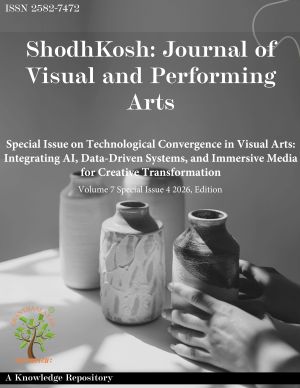

Published
How to Cite
Issue
Section
License
Copyright (c) 2026 Manjari Kanungo, Dr. Kakoli Biswas

This work is licensed under a Creative Commons Attribution 4.0 International License.
With the licence CC-BY, authors retain the copyright, allowing anyone to download, reuse, re-print, modify, distribute, and/or copy their contribution. The work must be properly attributed to its author.
It is not necessary to ask for further permission from the author or journal board.
This journal provides immediate open access to its content on the principle that making research freely available to the public supports a greater global exchange of knowledge.