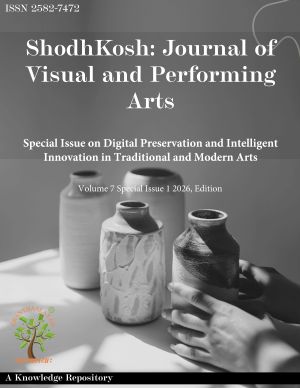
DIGITAL PRESERVATION AND INTELLIGENT INNOVATION IN TRADITIONAL AND MODERN ARTS
DOI:
https://doi.org/10.29121/shodhkosh.v7.i1s.2026.7169Abstract [English]
This special issue of ShodhKosh: Journal of Performing and Visual Arts explores how digital preservation and intelligent innovation are transforming traditional and modern arts. It highlights AI-driven archiving, restoration, and revival of cultural heritage alongside generative design, computational aesthetics, and human–AI co-creation in contemporary practice. The issue also examines AI-enhanced arts education through adaptive learning, predictive analytics, and inclusive pedagogy. Additionally, it addresses intelligent museum systems, blockchain provenance, and data-driven cultural management. By engaging ethical and philosophical debates on authorship and creativity, the collection emphasizes responsible integration of technology to sustain heritage while fostering innovation in the digital age.
Issue Editor:
Dr. Amit Verma
Associate Professor and Assistant Registrar in Journalism & Mass Communication, Centre for Distance and Online Education (CDOE), Manipal University Jaipur, Rajasthan, India
Email: amit.verma@jaipur.manipal.edu / amitve4@gmail.com
Dr. Archana Kale
Associate Professor, Computer Engineering, MES Wadia College of Engineering, Pune, India
Email: archana.kale@mescoepune.org
Dr. Krati Agarwal
Noida International University, Noida, India
Email: drkratiagarwal0820@gmail.com
Abhijit Chandratreya
Associate Dean (PhD Programs), Indira University, Pune, India
Email: abhijit.indira@gmail.com
Dr. Archana Rani
Head and Associate Professor, Department of Fine Arts, R G College, Meerut, India
Email: rgpgcollegemrt@gmail.com / drarchana.art@gmail.com
Dr. Samir N. Ajani
School of Computer Science and Engineering, Ramdeobaba University (RBU), Nagpur, India
Email: samir.ajani@gmail.com

Published
How to Cite
Issue
Section
License
Copyright (c) 2026 Dr. Amit Verma, Archana Kale, Dr. Krati Agarwal, Abhijit Chandratreya, Dr. Archana Rani, Dr. Samir N. Ajani

This work is licensed under a Creative Commons Attribution 4.0 International License.
With the licence CC-BY, authors retain the copyright, allowing anyone to download, reuse, re-print, modify, distribute, and/or copy their contribution. The work must be properly attributed to its author.
It is not necessary to ask for further permission from the author or journal board.
This journal provides immediate open access to its content on the principle that making research freely available to the public supports a greater global exchange of knowledge.