Original Article
A COMPREHENSIVE REVIEW ON GENETIC ALGORITHM-BASED OPTIMIZATION OF STEEL TRUSS STRUCTURES FOR WEIGHT REDUCTION AND STRUCTURAL EFFICIENCY
|
Santosh
Haridas Sutar 1* 1 MTech Scholar, Vikrant
University Gwalior, Madhya
Pradesh,
India 2 Assistant Professor, Department of Civil
Engineering, Vikrant University, Gwalior, Madhya Pradesh, India |
|
|
|
ABSTRACT |
||
|
The steel truss structure is a typical engineering structure since it is extremely robust relative to its weight and its structure. Nevertheless, there is still a considerable challenge in trying to optimize these structures to ensure minimum weight, safety and performance. Conventional optimization methods may be ineffective in dealing with nonlinear and multiple constraints design spaces. The artificial algorithms based on the concept of natural selection and evolution that have become a powerful tool to resolve such optimization problems are called Genetic Algorithms (GAs). This review paper will discuss in detail the GA-based optimization solution to steel truss structures. It talks about techniques, encoding, constraint management, mixed methods and newer techniques. Challenges, comparative studies, future research directions are also pointed out in the paper. Keywords: Genetic Algorithm, Steel Truss
Optimization, Structural Efficiency, Weight Minimization, Metaheuristic
Techniques, Evolutionary Computation |
||
INTRODUCTION
The steel trusses
structures form an essential part of the current civil and structural
engineering systems and have an important role in the construction of bridges,
transmission towers, industrial sheds, space frames and long span roof
structures. Their most remarkable usage is mostly due to their high
strength-to-weight ratio, structural stability, manufacturing simplicity and
economic cost-effectiveness Kaveh
and Mahdavi (2019). Trusses also reduce the number of bending
moments in members by transferring the loads efficiently in the axial force of
the members thus allowing less material to be used without the sacrifice of
structural integrity.
The basic aim of
designing the steel truss is to ensure optimum structural performance of
minimum material consumption which in turn leads to cost minimization, better
sustainability and resource efficiency Alkhraisat et
al. (2023). Reducing structural weight in the present
era of sustainable engineering practices is not only a cost-reducing factor in
the construction process but also a less harmful factor in terms of the
environment since less material is used and less carbon is produced during the
process of steel manufacturing.
Conventionally,
the design of trusses has been conducted on a trial-and-error basis or
classical optimization processes like gradient-based methods Ho-Huu et al. (2018). These traditional techniques are usually
time consuming and inefficient as they rely on the experience and intuition of
the designer. Moreover, gradient-based optimization models require that the
objective function is a continuous and differentiable function and these limits
their applicability to complex structural problems with discrete variables,
nonlinear relationships and multi-constrained problems. Therefore, these
methods will tend to be local optima and not obtain a global optimum solution Pham (2019).
To address these
disadvantages, innovative advanced computational optimization techniques have
been suggested, and Genetic Algorithms (GAs) have been the topic of much
concern. Genetic Algorithms: Genetic Algorithms are stochastic search and
optimization algorithms, which are founded on natural selection and genetics Grzywiński and Selejdak (2019). They are particularly useful to complex
engineering problems, since they are able to solve problems with large search
space, nonlinear objective and discrete design variables without need to know
the gradient information.
Objectives of the Study
The current review
article seeks to accomplish the following goals:
1)
To
critically examine the application of Genetic Algorithms (GA) in optimization
of steel truss structures to achieve the least structural weight and higher
efficiency.
2)
To test
various optimization methods, including optimization of size, shape and
topology of steel trusses, using the GA based technology.
3)
To
investigate various encoding techniques and constraint-handling schemes that
can be used in Genetic Algorithms to solve complex structural optimization
problems.
4)
To test
the hybrid optimization algorithms that are the combinations of Genetic
Algorithms with other optimization algorithms such as Finite Element Analysis
(FEA), Particle Swarm Optimization (PSO) and Simulated Annealing (SA) to
increase the accuracy of solutions and the convergence rates.
Fundamentals of Steel Truss Optimization
One of the most
critical aspects of structural engineering is also steel truss optimization
since it aims to create an effective balance between performance, safety and
economics. It is done by systematically finding the optimal design
configuration by changing variables like the size of the member, geometry and
connectivity to meet a predetermined set of constraints Mehta et
al. (2025). To improve structural behaviour, minimize
material usage, and meet design standards, optimization techniques are used.
|
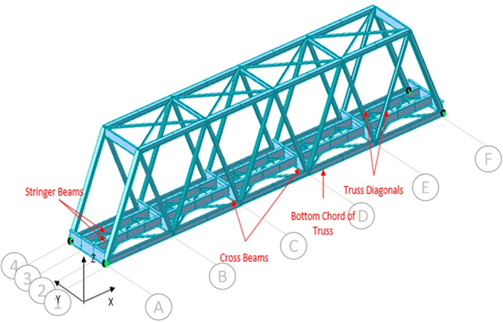
Figure 1
|
|
Figure 1 Components of a Steel Truss Structure (Including Chords, Diagonals, and
Beams) |
Objectives of Optimization
Optimization of
steel trusses aims mostly at enhancing the structural performance at the lowest
possible cost in terms of resource use. The following are the summarization of
these objectives:
·
Minimization
of Structural Weight: One of
the most important goals is to reduce the total weight of the structure. It
will result in cost-saving in the material, transportation, and construction as
well as help in sustainability through reduced consumption of resources.
·
Maximization
of Stiffness and Strength:
Optimized designs have the goal of increasing the load bearing and stiffness of
the structure. Greater stiffness will guarantee decreased deflections and
enhanced strength that guarantees safety in several loading conditions.
·
Reduction
of Material Cost: Economic
benefits are directly proportional to efficient use of materials Li et al. (2021). Optimization aims at utilizing minimum
material without affecting structural performance or safety.
·
Compliance
with Design Constraints: The
design should meet all the engineering requirements such as stress boundaries,
displacement limits and buckling limits to ensure safe and dependable
performance under recommended loading conditions.
Design Variables
The parameters
that can be changed in the course of optimization to attain the desired
objectives are the design variables. These variables can be commonly classified
in the following way in steel truss optimization:
·
Cross-Sectional
Areas of members (Size Optimization): Truss member sizes have a great impact on the weight and strength of
the structure. Modifications of cross-sectional areas assist in attaining a
good balance between strength and material consumption.
·
Node
Positions (Shape Optimization): The geometry and load distribution in the truss is sensitive to the
spatial arrangement of the nodes Akbari
and Henteh (2019). Adjusting node positions can result in
better structural performance and minimization of stress concentrations.
·
Topology
(Connectivity of Members): Topology
optimization finds the optimal way to arrange the members and can be achieved
by deciding which elements to include or exclude. This leads to innovative
structural forms with enhanced efficiency.
Constraints
Constraints will
stipulate the limits within which the optimization process should be carried
out. These are necessary to be sure that the final design is safe, functional
and can meet the engineering standards.
·
Stress
Limits: Stress in the
individual member should not surpass the stress values to be accepted by the
material to avoid failure.
·
Displacement
Limits: Structural
deflections should not be allowed to be of such magnitude that serviceability
or comfort of the user is compromised.
·
Stability
Constraints (Buckling):
Compressive forces on members should be inspected to prevent buckling to make
the entire structure stable.
·
Code-Based
Requirements: The design
should be based on the standard and code of design like Bureau of Indian
Standards (IS codes) and American Institute of Steel Construction (AISC) which
give the guidelines of safe and reliable design of the structure.
|
Table 1 |
|
Table 1 Key References on Genetic
Algorithm-Based Structural Optimization |
|||
|
Author(s) & Year |
Study Focus |
Key Findings |
Relevance to Section |
|
Mirnateghi and Mosallam (2021) |
Multi-criteria optimization of energy-efficient
cementitious sandwich panel systems using Genetic Algorithms |
Proved that GA can be used to optimize the
structural and energy performance concurrently, producing a better
sustainability and cost efficiency. |
Supports multi-objective optimization and GA
applicability in structural systems (Sections 4 & 6) |
|
Chen et al. (2020) |
Optimization of steel–concrete hybrid wind
turbine towers using improved GA |
Enhanced GA increased the rate of convergence and
offered the best design solutions with excellent structural performance and
less use of materials. |
Relevant to hybrid GA approaches and real-world
structural optimization (Section 7) |
|
Toğan and Daloğlu
(2015) |
Application of Genetic Algorithms in optimization
of 3D truss structures |
GA effectiveness in optimization of complex 3D
truss systems with less weight and enhanced efficiency has been demonstrated. |
Directly supports GA-based truss optimization
concepts (Section 4) |
|
Guimarães et al. (2022) |
Optimization of concrete-filled steel columns
using GA with environmental and cost considerations |
Outlined the potential of GA to balance cost,
structural performance, and environmental impact by use of multi-objective
optimization. |
Supports sustainability and cost optimization
using GA (Sections 2 & 6) |
|
Grzywiński (2020) |
Size and shape optimization of truss structures
using Jaya algorithm (comparative approach) |
Demonstrated that metaheuristic techniques are
useful in optimising truss structures, and that they perform competitively
with GA-based techniques. |
Provides comparative perspective on
metaheuristics, supporting GA relevance (Section 7) |
Genetic Algorithm: Overview
GAs are a group of evolutionary optimization algorithms that are
commonly applied to solve complex engineering optimization problems. The GAs are based on the concepts of natural selection and Darwinian
evolution and model the process of survival of the fittest to find the best or
the best possible solutions in the large search space Yücel et
al. (2024). They have been especially useful in
structural optimization, because of their strength and flexibility, in tasks
where the space of solutions is nonlinear, discontinuous, and constrained, like
the design of steel trusses.
Basic Concept
The basic idea
behind Genetic Algorithms is to imitate natural evolution. This method involves
a pool of potential solutions, referred to as individuals or chromosomes that
evolves with each generation. The possible solutions to the optimization
problem are each represented as a chromosome, in an appropriate format like
binary strings, real numbers or integers.
Three major
genetic operators control the process of evolution:
·
Selection: This operator chooses the fittest of the
existing population according to the values of their fitness. Fitter
individuals are more likely to be selected to reproduce, whereby better
solutions are replicated to another generation.
·
Crossover
(Recombination): Crossover
involves the combination of genetic information of two parent chromosomes to
give out one or more offspring. The process helps to facilitate the process of
the desired traits exchange and improves the search space exploration.
·
Mutation: Mutation brings randomness in the
chromosomes in order to maintain genetic diversity in the population. It can
avoid premature convergence and enables the algorithm to search new areas of
the solution space.
By successive
trial and error in the use of these operators, there is a gradual evolution of
the population to optimal or near-optimal solutions.
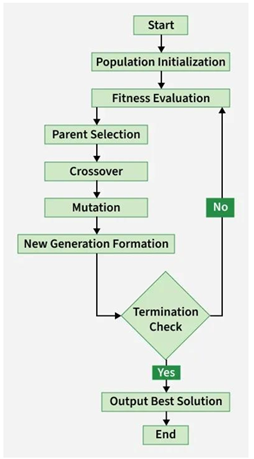
GA Workflow
The working
procedure of a Genetic Algorithm follows a systematic and iterative process:
·
Initialization
of Population: Randomly
generated set of candidate solutions are produced within the search space. This
set of population is the starting point of the optimization process.
·
Fitness
Evaluation: Each candidate
solution is measured by a fitness function which is a measure of how well the
solution meets the optimization objectives and constraints. When it comes to
optimization of steel truss, the overall goal is usually to minimize the weight
of the structure with all the design requirements, including stress,
displacement, and stability limits, being met. The fitness is given by the
expression:
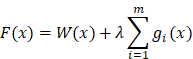
represents the
weight of the structure,  represents the functions of constraint
violation, k is the quantity of constraints, and
represents the functions of constraint
violation, k is the quantity of constraints, and  is the coefficient of penalty. This
formulation punishes solutions that are infeasible and thus the Genetic
Algorithm is directed to work towards solutions that are feasible and optimal
designs.
is the coefficient of penalty. This
formulation punishes solutions that are infeasible and thus the Genetic
Algorithm is directed to work towards solutions that are feasible and optimal
designs.
·
Selection
of Parents: Roulette wheel
selection, tournament selection or rank selection are some of the methods that
can be used to select individuals to reproduce depending on the fitness value.
·
Crossover
and Mutation: The parents of
selected parents are exposed to crossover and mutation to create new offspring
which introduce variation and enhances the quality of solutions.
·
Generation
of New Population: The
children displace part or entire members of the existing population, creating a
new generation.
·
Criterion
Based Termination: It
continues until an algorithmic objective is achieved, such as the greatest
number of generations, the sought fitness or convergence.
|
Figure 2
|
|
Figure 2 Flowchart of
Genetic Algorithm Process |
Advantages of Genetic Algorithms
Genetic Algorithms
have a number of strengths that render them very applicable to structural
optimization problems Carbas and
Artar (2022):
·
Global
Search Capability: GAs
investigations vary across the search space, which decreases the likelihood of
local optima.
·
No
Gradient Information Requirement: Compared to the traditional optimization methods, GAs do not require
derivative information, and as a result, can be extended to non-differentiable
and complex problems.
·
Appropriateness
in Discrete and Nonlinear Problems: GAs can be applied in solving problems of discrete variables,
nonlinear relationships, and numerous constraints, common in truss
optimization.
·
Flexibility
in Constraint Handling:
Penalty functions, repair methods, or special operators may be used to
incorporate constraints and enable GAs to effectively solve constrained
optimization problems.
Application of Genetic Algorithms in Steel Truss Optimization
GAs have also
found wide applications in optimization of steel truss structures because of
their ability to solve complex, multi-variable and nonlinear design problems.
In structural engineering, optimization using GA is mainly divided into size,
shape, and topology optimization Serpik
et al. (2017).
Size Optimization
The most popular
application of Genetic Algorithms in steel truss design is size optimization,
which is frequently applied. It is aimed at defining the optimum
cross-sectional areas of truss members and does not compromise structural
performance and safety.
In this method,
the design variables are the cross-sectional areas of a member, and may be
discrete (the standard steel sections) or continuous variables. This is usually
aimed at reducing the total structural weight but must meet certain constraints
like the stress, displacements, and buckling requirements.
Genetic Algorithms
have found application especially in size optimization because it can:
·
Handle
both discrete and continuous design variables efficiently
·
Explore
a large design space without requiring gradient information
·
Achieve
significant reductions in structural weight compared to conventional methods
Many experiments
have shown that size optimization using GA can result in a significant
reduction in material usage, without degrading structural performance or
sometimes improving it.
|
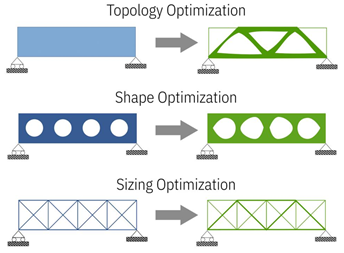
Figure 3
|
|
Figure 3 Types of
Structural Optimization: Size, Shape, and Topology Optimization |
Shape Optimization
Shape optimization
consists of altering the spatial layout of the truss by changing the
coordinates of its nodes. The aim is to enhance the structural reaction to the
imposed loads by attaining a more effective geometry.
Genetic Algorithms
in this form of optimization explore various geometric layouts and determine
the most effective layout between nodes. The structure can be modified by
changing the position of the nodes in order to redistribute the internal forces
and result into an improved performance Es-Haghi et al. (2020).
The main
advantages of shape optimization using GA are:
·
Enhanced
load distribution across members
·
Reduction
in stress concentrations
·
Improved
structural stiffness and stability
The optimization
of shape is especially applicable in long-span structures where geometry is
critical in the performance.
Topology Optimization
Topology
optimization is concerned with how to connect the truss members to ensure the
final structure is the best possible, i.e. which truss members need to exist
and which ones need to be eliminated Saravanan
et al. (2022). It is a more intricate type of optimization
since it presupposes some changes in the structural layout.
In topology
optimization based on GA, binary variables are frequently employed, to indicate
the presence or absence of members Sun et al. (2022). The algorithm mutates various structural
arrangements to determine the most efficient structure.
Topology
optimization has the following advantages:
·
Elimination
of redundant or inefficient members
·
Reduction
in overall structural weight
·
Generation
of innovative and non-intuitive structural designs
This approach
enables engineers to develop highly efficient truss systems that may not be
easily achievable through traditional design methods Sistla
and Rama (2021).
Encoding Techniques in GA
Encoding is a core
concept to Genetic Algorithms (GAs) because it describes how design variables
are encoded into chromosomes, which directly affects the performance, precision
and convergence of the optimization Mroginski et
al. (2016). The encoding scheme is a determiner of the
efficiency of exploration of the search space and the ability to apply genetic
operators, including selection, crossover, and mutation. Binary encoding that
encodes variables as a series of binary numbers (0s and 1s) is one of the
oldest and most popular methods. It is especially well adapted to discrete
optimization problems, like choosing standard member sizes or deciding whether
or not to include truss elements in topology optimization Farahmand-Tabar
and Ashtari (2020). Its simplicity and ease of implementation
due to its simplicity, and its ability to be compatible with classical GA
operations although typically requires longer length chromosomes and may not be
as precise with continuous variables.
In order to
circumvent these shortcomings, it is common practice in the modern world to use
real-valued (floating-point) encoding Brütting et al.
(2019). The design variables in this approach are
defined directly in real numbers and this can more easily and efficiently
represent continuous variables such as the cross-sectional areas and the nodal
coordinates. Encoding in real values can also simplify computational complexity
and increase speed of convergence due to the absence of binary-to-decimal
conversion, and the ability to perform search operations in the solution space
more smoothly Dolwana (2019).
In real world
structural optimization problems, especially in the design of steel trusses,
discrete and continuous variables may coexist. In this case, mixed encoding is
a dynamic and efficient solution; binary and real-valued representations on the
same chromosome. An example is that topology (existence of members) is
encodable using binary encoding and geometric and size variables can be
encodable using real values. The hybrid representation is optimizable in size,
form and topology, which leads to more realistic and efficient design
solutions.
Constraint Handling Techniques
Constraint
management in optimization of steel truss structures with the application of
GAs is one of the most important issues of ensuring that the solutions found
are both optimal and feasible and safe Jayaram
(2022). The nature of the structural optimization
problems is such that it is marked by a number of constraints such as stress
limits, displacement constraints and stability conditions.
Penalty Function Method
One of the most
popular methods of dealing with constraints in Genetic Algorithms is the
penalty function method. The penalty term is incorporated into the objective
function in this approach each time a solution violates a constraint(s). This
is a good way of converting a constrained optimization problem to an
unconstrained one since it discourages infeasible solutions Nouri
and Ashtari (2015).
The new fitness
function can be mathematically written as:
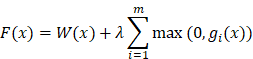
where  is the objective function (e.g., structural
weight), represents the constraint violation
functions,
is the objective function (e.g., structural
weight), represents the constraint violation
functions,  is the number of constraints, and
  is the penalty coefficient. The term
  ensures that only violated constraints
contribute to the penalty.
ensures that only violated constraints
contribute to the penalty.
Advantages:
·
Simple
and easy to implement
·
Compatible
with standard GA operators
·
Effective
for a wide range of structural problems
Limitations:
·
Requires
careful tuning of penalty parameters
·
Excessive
penalties may restrict exploration, while low penalties may allow infeasible
solutions
Repair Methods
Repair techniques
strive to transform infeasible solutions into feasible ones through adjusting
their design variables Saleem
(2018). This method is more proactive in enforcing
feasibility, rather than penalizing constraint violations, through the active
adjustment of the solution.
For example:
·
If a
member exceeds stress limits, its cross-sectional area may be increased
·
If
displacement constraints are violated, nodal positions or member sizes may be
modified
Repair algorithms
are typically applied after genetic operations such as crossover and mutation
to ensure that all individuals in the population satisfy the constraints.
Advantages:
·
Ensures
feasibility of solutions
·
Improves
convergence toward valid designs
·
Reduces
dependency on penalty parameters
Limitations:
·
May
increase computational complexity
·
Requires
problem-specific repair strategies
Multi-Objective Optimization
In most real world structural optimization tasks, several
conflicting goals need to be addressed at the same time, e.g. a minimization of
weight and maximization of strength and a minimization of cost. Multi-objective
optimization offers a natural methodology to deal with such problems and
constraints Saraskanroud and Babaei (2023).
In GA-based
multi-objective optimization, the concept of Pareto optimality is used. A set
of non-dominated solutions (Pareto front) is produced instead of a single best
solution, in which no single solution is best on all objectives Oluwafemi
(2018).
For example:
·
One
solution may have minimum weight but higher displacement
·
Another
may have slightly higher weight but better structural performance
This approach
allows designers to choose the most suitable solution based on practical
requirements Kaveh
and Zakian (2018).
Advantages:
·
Balances
conflicting objectives effectively
·
Provides
multiple optimal design alternatives
·
Eliminates
the need for predefined weighting factors
Limitations:
·
Increased
computational effort
·
Complexity
in decision-making from Pareto solutions
Conclusion
Genetic Algorithms
have also turned out to be very effective in optimization of steel trusses in
an attempt to get the lowest weight but at the same time structural efficiency
and performance. They are more appropriate than traditional optimization techniques
as they are able to solve complex, nonlinear, and multi-objective problems. The
combination of the GAs with other methods like FEA and hybrid methods like PSO
and SA increases the accuracy and convergence of the solution even more.
Nonetheless, there are still difficulties like the large computational cost,
parameter optimization, and earlier convergence. With ongoing advancements and
the integration of emerging technologies like artificial intelligence and
real-time monitoring systems, GA-based optimization is expected to play an
increasingly important role in developing efficient and sustainable structural
designs.
ACKNOWLEDGMENTS
None.
REFERENCES
Akbari, M., and Henteh, M. (2019). Comparison of Genetic Algorithm (GA) and Particle Swarm Optimization Algorithm (PSO) for Discrete and Continuous Size Optimization of 2D Truss Structures. Journal of Soft Computing in Civil Engineering, 3(2), 76–97.
Alkhraisat, H., Dalbah, L. M., Al-Betar, M. A., Awadallah, M. A., Assaleh, K., and Deriche, M. (2023). Size optimization of Truss Structures Using Improved Grey Wolf Optimizer. IEEE Access, 11, 13383–13397. https://doi.org/10.1109/ACCESS.2023.3243164
Brütting, J., Desruelle, J., Senatore, G., and Fivet, C. (2019). Design of Truss Structures Through Reuse. Structures, 18, 128–137. https://doi.org/10.1016/j.istruc.2018.11.006
Carbas, S., and Artar, M. (2022). Comparative Seismic Design Optimization of Spatial Steel Dome Structures Through Three Recent Metaheuristic Algorithms. Frontiers of Structural and Civil Engineering, 16(1), 57–74. https://doi.org/10.1007/s11709-021-0784-y
Chen, J., Li, J., and He, X. (2020). Design Optimization of Steel–Concrete Hybrid Wind Turbine Tower Based on Improved Genetic Algorithm. The Structural Design of Tall and Special Buildings, 29(10), e1741. https://doi.org/10.1002/tal.1741
Dolwana, Z. (2019). Optimum Design of Steel Structures Using Evolutionary Algorithms (Doctoral Dissertation).
Es-Haghi, M. S., Shishegaran, A., and Rabczuk, T. (2020). Evaluation of a Novel Asymmetric Genetic Algorithm to Optimize the Structural Design of 3D Regular and Irregular Steel Frames. Frontiers of Structural and Civil Engineering, 14(5), 1110–1130. https://doi.org/10.1007/s11709-020-0643-2
Farahmand-Tabar, S., and Ashtari, P. (2020). Simultaneous Size and Topology Optimization of 3D Outrigger-Braced Tall Buildings With Inclined Belt Truss Using Genetic Algorithm. The Structural Design of Tall and Special Buildings, 29(13), e1776. https://doi.org/10.1002/tal.1776
Grzywiński, M. (2020). Size and Shape Design Optimization of Truss Structures Using the Jaya Algorithm. Computer Assisted Methods in Engineering and Science, 27(2–3), 177–184.
Grzywiński, M., and Selejdak, J. (2019). Weight Minimization of Spatial Trusses with Genetic Algorithm. In Proceedings of the Conference Quality Production Improvement (CQPI) (Vol. 1, No. 1, 238–243). Quality and Production Managers Association. https://doi.org/10.2478/cqpi-2019-0032
Guimarães, S. A., Klein, D., Calenzani, A. F. G., and Alves, É. C. (2022). Optimum Design of Steel Columns Filled with Concrete Via Genetic Algorithm: Environmental Impact and Cost Analysis. REM—International Engineering Journal, 75(2), 117–128. https://doi.org/10.1590/0370-44672021750034
Ho-Huu, V., Duong-Gia, D., Vo-Duy, T., Le-Duc, T., and Nguyen-Thoi, T. (2018). An Efficient Combination of Multi-Objective Evolutionary Optimization and Reliability Analysis for Reliability-Based Design Optimization of Truss Structures. Expert Systems with Applications, 102, 262–272. https://doi.org/10.1016/j.eswa.2018.02.040
Jayaram, M. A. (2022). Optimal Design of Steel Planar Trusses Using ant Lion Algorithm. Journal of Mines, Metals and Fuels, 70. https://doi.org/10.18311/jmmf/2022/32021
Kaveh, A., and Mahdavi, V. R. (2019). Multi-Objective Colliding Bodies Optimization Algorithm for Design of Trusses. Journal of Computational Design and Engineering, 6(1), 49–59. https://doi.org/10.1016/j.jcde.2018.04.001
Kaveh, A., and Zakian, P. (2018). Improved GWO Algorithm for Optimal Design of Truss Structures. Engineering with Computers, 34(4), 685–707. https://doi.org/10.1007/s00366-017-0567-1
Li, W., Yao, Q., Cao, S., Qiu, J., and Wei, H. (2021). Truss Optimization Using Genetic Algorithm and FEA. In Journal of Physics: Conference Series (Vol. 1965, No. 1, p. 012134). IOP Publishing. https://doi.org/10.1088/1742-6596/1965/1/012134
Mehta, P., Tejani, G. G., and Mousavirad, S. J. (2025). Structural Optimization of Different Truss Designs Using Two Archive Multi-Objective Crystal Structure Optimization Algorithm. Scientific Reports, 15(1), 14575. https://doi.org/10.1038/s41598-025-97133-w
Mirnateghi, E., and Mosallam, A. S. (2021). Multi-Criteria Optimization of Energy-Efficient Cementitious Sandwich Panels Building Systems Using Genetic Algorithm. Energies, 14(18), 6001. https://doi.org/10.3390/en14186001
Mroginski, J. L., Beneyto, P. A., Gutierrez, G. J., and Di Rado, A. (2016). A Selective Genetic Algorithm for Multiobjective Optimization of Cross Sections in 3D Trussed Structures Based on a Spatial Sensitivity Analysis. Multidiscipline Modeling in Materials and Structures, 12(2), 423–435. https://doi.org/10.1108/MMMS-08-2015-0048
Nouri, F., and Ashtari, P. (2015). Weight and Topology Optimization of Outrigger-Braced Tall Steel Structures Subjected to Wind Loading Using GA. Wind and Structures, 20(4), 489–508. https://doi.org/10.12989/was.2015.20.4.489
Oluwafemi, J. (2018). Structural Analysis of a Genetic Algorithm Optimized Steel Truss Structure According
to BS 5950.
Pham,
B. T. (2019).
Optimum Cost Design of Frames Using Genetic Algorithms. Steel and
Composite Structures, 30(3), 293–304.
Saleem,
M. U. (2018).
Design Optimization of Pre-Engineered
Steel Truss Buildings. International Journal of Civil Engineering and Technology, 9(10), 304–316.
Saraskanroud, H. T., and Babaei, M. (2023). Connection Topology Optimization of Steel Moment Frames Using Genetic Algorithm. International Journal of Optimization in Civil Engineering, 13(4), 533–561.
Saravanan, M., Harihanandh, M., Gopi, R., Sathishkumar, V., and Srimathi, N. (2022). Algorithm for Optimum Design of Space Trusses. Materials Today: Proceedings, 52, 1671–1675. https://doi.org/10.1016/j.matpr.2021.11.313
Serpik, I. N., Alekseytsev, A. V., and Balabin, P. Y. (2017). Mixed Approaches to Handle Limitations and Execute Mutation in the Genetic Algorithm for Truss Size, Shape, and Topology Optimization. Periodica Polytechnica Civil Engineering, 61(3), 471–482. https://doi.org/10.3311/PPci.8125
Sistla, S., and Rama, J. K. (2021). Evaluating the Performance of Nature-Inspired Algorithms Using 52-Bar Steel Truss Subjected to Dynamic Load. Materials Today: Proceedings, 38, 2464–2470. https://doi.org/10.1016/j.matpr.2020.07.390
Sun, Y., Li, H., Shabaz, M., and Sharma, A. (2022). Research on Building Truss Design Based on Particle Swarm Intelligence Optimization Algorithm. International Journal of System Assurance Engineering and Management, 13(Suppl 1), 38–48. https://doi.org/10.1007/s13198-021-01192-x
Toğan, V., and Daloğlu, A. T. (2015). Genetic Algorithms for Optimization of 3D Truss Structures. In Metaheuristics and Optimization in Civil Engineering (115–134). Springer. https://doi.org/10.1007/978-3-319-26245-1_6
Yücel, M., Nigdeli, S. M., and Bekdaş, G. (2024). Optimization of Truss Structures by Using a Hybrid Population-Based Metaheuristic Algorithm. Arabian Journal for Science and Engineering, 49(4), 5011–5026. https://doi.org/10.1007/s13369-023-08319-1
 This work is licensed under a: Creative Commons Attribution 4.0 International License
© Granthaalayah 2014-2026. All Rights Reserved.