Original Article
A COMPREHENSIVE REVIEW OF WIDE-AREA MONITORING AND CONTROL OF POWER SYSTEMS USING PHASOR MEASUREMENT UNITS (PMUS)
|
Sreedhara
Babu Korukonda 1 1 MTech Scholar, Vikrant
University Gwalior MP, India 2 Assistant Professor, Department of
Electrical Engineering Vikrant University Gwalior, India |
|
|
|
ABSTRACT |
||
|
The modern power systems are becoming increasingly complex due to the large-scale interconnections, the integration of renewable energy sources, and the dynamic changes in loads, which require the sophisticated monitoring and control systems. Phasor Measurement Units (PMUs) have led to the creation of Wide-Area Monitoring, Protection, and Control (WAMPAC) systems, capable of transforming the grid, boosting its reliability, stability, and operational efficiency. PMUs are also used to offer time-synchronized measurements (synchro phasors) that can offer real-time insight into the dynamics of a system, which was not possible with traditional SCADA systems. This paper provides an extensive overview of the PMU technology and its application in Wide-Area Monitoring Systems (WAMS), their structure, essential elements, and communication structure. It also discusses key applications like real-time monitoring, state estimation, oscillation detection, fault location, voltage stability assessment, and wide-area control. The study also addresses some of the critical challenges, such as high implementation costs, data management complexities, cybersecurity threats, and communication latency, as well as interoperability issues. Further recent developments, including the combination of PMUs with smart grids, artificial intelligence, cloud computing, and Wide-Area Control Systems (WACS) are discussed, as well as future research directions, including optimization of costs, improved security, and autonomous operation of grids. In general, PMU-based WAMS is found as a foundational technology in terms of designing intelligent, resilient, and sustainable power system. Keywords: Phasor Measurement Units (PMUs),
Wide-Area Monitoring Systems (WAMS), Wide-Area Monitoring, Protection, and
Control (WAMPAC), Synchro-Phasor Technology. |
||
INTRODUCTION
The contemporary
electric power system is rapidly changing with growing electricity demand,
adoption of renewable energy sources Pazderin et al.
(2023), and the development of the interconnected
grid networks. The developments have greatly made the operations of the power
systems more dynamic and complex and the real time monitoring and controlling
more difficult and critical. Reliability, stability, and security of the system
under these dynamic conditions have become an urgent issue to utilities and
grid operators.
Supervisory
Control and Data Acquisition (SCADA) are traditional monitoring systems that
have been used to offer operational visibility Mohanta
et al. (2016). Nevertheless, these systems are constrained
by low sampling rates and lack of accurate time synchronization which limit its
capability to record high-speed transient events and dynamic disturbances. With
more complex power systems, the constraints of SCADA bring up the necessity of
sophisticated monitoring systems that can deliver real-time and precise
information about a system Ashok et
al. (2020).
A game changer to
these issues has been the development of Phasor Measurement Units (PMU) which
offer fast, time synchronized measurements called synchro phasors. PMUs are
designed to be integrated into Wide-Area Monitoring Systems (WAMS), which can
provide visibility across the system, enhance situational awareness, and
decision-making abilities Krommydas et
al. (2025). With the purpose of aiding the
establishment of intelligent and resilient power systems, this paper provides
an in-depth survey of PMU-based wide-area monitoring and control, including its
basic principles, architecture, use, challenges, and recent developments.
Objectives of the Study
·
To analyze the role of Phasor Measurement Units (PMUs) in
enhancing wide-area monitoring and control of modern power systems.
·
To
examine the architecture, applications, and challenges associated with
PMU-based Wide-Area Monitoring Systems (WAMS).
·
To
evaluate recent advancements and future directions in PMU technology for
developing intelligent, secure, and resilient smart grids.
FUNDAMENTALS OF PHASOR MEASUREMENT UNITS (PMUS)
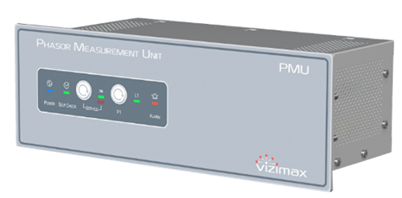
Phasor Measurement
Units (PMUs) are sophisticated measurement devices in the present power systems
that are designed to measure electrical quantities including voltage and
current in the form of phasors Penshanwar et
al. (2015). A phasor is a quantity that is a
combination of both the amplitude and phase of a sinusoidal waveform, which is
essential in the analysis of the dynamics of power systems. In contrast to
traditional measurement apparatus, PMUs can measure electrical quantities
synchronized by time, known as synchro phasors, and can monitor electrical
quantities at geographically separated sites.
|
Figure 1 |
|
Figure 1 Phasor Measurement
Unit (PMU) Nageswara Rao et
al. (2019) |
This coordination
is performed by signals received via the Global Positioning System (GPS) that
ensures that all PMUs in a network have a common time reference. As a result,
system operators can have a cohesive and real-time overview of the grid
conditions, which contributes greatly to situational awareness and makes it
easier to make decisions.
The other
significant feature of PMUs is that they have large sampling rate, which is
usually between 30 to 120 samples per second Lu et al. (2015). This is significantly greater than the
traditional Supervisory Control and Data Acquisition (SCADA) systems which
typically have intervals of 2-4 seconds. The increased frequency of sampling
enables PMUs to record any transient events, oscillations, and disturbances
that would otherwise be unnoticed in traditional systems.
The components
that make a typical PMU are:
·
GPS
Receiver to synchronize the time.
·
Digitization
of signals with Analog-to-Digital Converter (ADC)
·
Phasor
Estimation Unit: To calculate the magnitude and phase angle.
·
Communication
Module to send information to control centers Khan et al. (2018).
In order to draw
the benefits of PMUs compared to traditional systems, a comparative analysis
with the SCADA systems is stated in Table 1. The comparison serves to clearly show that
PMUs offer better performance (in regard to sampling rate, synchronization,
accuracy and real-time monitoring capabilities).
|
Table 1 |
|
Table 1 Comparison between SCADA and PMU Systems Mohamed et al.
(2025) |
||
|
Parameter |
SCADA System |
PMU System |
|
Sampling Rate |
2–4 seconds |
30–120 samples/second |
|
Time Synchronization |
Not synchronized |
GPS synchronized |
|
Data Accuracy |
Moderate |
High |
|
Dynamic Monitoring |
Limited |
Real-time |
|
Application Scope |
Local monitoring |
Wide-area monitoring |
|
Response Time |
Slow |
Fast |
As it can be seen
based on Table 1, PMUs are much more efficient than SCADA
systems as they provide synchronized and high-frequency data, which can be used
to provide real-time monitoring and wide-area analysis. Although SCADA could
still be used in simple operation control, PMUs are absolutely necessary in the
current smart grids where response speed and visibility of the system are
important.
WIDE-AREA MONITORING AND CONTROL (WAMS) ARCHITECTURE
Wide-Area
Monitoring and Control Systems (WAMS) is an important development in the
contemporary operation of the power system and combine Phasor Measurement Units
(PMUs) in geographically distributed locations Aljazaeri and
Toman (2022). These systems offer real time system wide
visibility of grid conditions, which can allow operators to monitor, analyze and control the power system more efficiently. WAMS
has the advantage over traditional localized systems of monitoring that it is
able to help coordinate the decision-making process on a regional or national
scale, thus increasing grid stability and reliability.
|
Figure 2
|
|
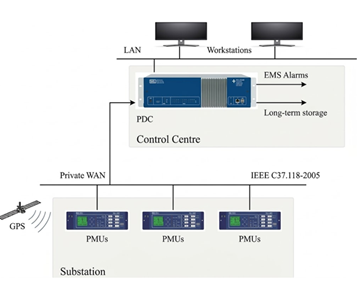
Figure 2 The General
Architecture of WAMS Shankar et al.
(2020) |
WAMS architecture
is developed to support huge amounts of synchronized data produced by PMUs and
secure the efficient transmission, processing, and use of this data. It is
comprised of a number of interrelated elements that collaborate to provide
proper and prompt information to control operations.
The major elements
of WAMS are:
·
Phasor
Measurement Units (PMUs): PMUs
are equipment placed at substations, charged with the responsibility of
measuring synchronized voltage and current phasors in real time 0Menezes et al. (2024).
·
Phasor
Data Concentrators (PDCs):
PDCs are devices that receive data about several PMUs, time-stamp align data,
and provide data aggregation.
·
Communication
Networks: The use of
high-speed and reliable communication infrastructure (e.g., optical fiber or wireless networks) between PMUs, PDCs and control centers transmits data Sharma
and Dhole (2016).
·
Control
Centers: These are central hubs where data gathered is processed to conduct
monitoring, visualization and make decisions.
Besides these main
elements, the data storage systems are frequently added to preserve historical
data to be analyzed further, re-create events, and
conduct research.
Table 2 provides a detailed description of the
components and their respective functions as illustrated in Table 2 with an emphasis on the role of each
component in the WAMS framework.
|
Table 2 |
|
Table 2 Components of WAMS and Their Functions Biswal et al.
(2023) |
|
|
Component |
Function Description |
|
PMU |
Measures synchronized
voltage and current phasors |
|
Phasor Data
Concentrator (PDC) |
Aggregates and aligns
data from multiple PMUs |
|
Communication Network |
Transfers data between
PMUs and control centers |
|
Control Center |
Performs analysis,
monitoring, and decision-making |
|
Data Storage System |
Stores historical data
for analysis |
All the components
are vital towards the efficient operation of WAMS as depicted in Table 2. PMUs are the main data providers and PDCs
guarantee the integrity and synchronization of data. The communication network
acts as the backbone of the system that facilitates the smooth transfer of data
and control centers use this data to ensure system
stability and act in response to disturbances in real time.
APPLICATIONS OF PMUS IN POWER SYSTEMS
Phasor Measurement
Units (PMUs) have revolutionized the monitoring, protection and control of
modern power systems by offering time-synchronized data at high speeds Alhelou (2019). Their real-time system dynamics capture
capabilities make them very useful in a plethora of applications intended to
enhance grid reliability, efficiency and stability. As the complexity of
interdependent power networks grows, and renewable energy sources are
integrated, PMUs become important in supporting sophisticated operational
plans.
Real time
monitoring of grid conditions is one of the main uses of PMUs, as synchronized
measurements can enable operators to monitor voltage, current, frequency and
phase angle throughout the network in real time. This enhances situational
awareness and enables quick identification of abnormal operating conditions.
Enhanced state
estimation is another key application where PMU data enhances the accuracy and
reliability of system models Palizban
(2015). Compared to the traditional estimation
methods, which use unsynchronized and sparse information to estimate the state
of a system, PMU-based state estimation offers accurate and real-time system
states, which results in improved operational decisions.
Oscillation
detection and stability analysis are also popular applications of PMUs. In
disturbances or changes in loads, low-frequency oscillations are typical in
power systems. These oscillations can be identified by PMUs in time when the
operators can take corrective measures before they can develop into significant
stability problems.
Moreover, PMUs
enable fault localization and identification because they offer precise and
time synchronized measurements. This allows quicker fault location, minimizes
system downtime, and enhances reliability of services.
The other
important use is in voltage stability where PMUs constantly monitor voltage
profiles over the network. This can assist in the avoidance of voltage collapse
and stability of the system particularly when the system is running under heavy
loads Arefin
et al. (2022).
Lastly, PMUs
facilitate wide-area protection and control which facilitate automated and
adaptive control mechanisms. Such systems are able to react fast to disruptions
and, therefore, enhance grid resiliency and reduce the likelihood of cascading
failures.
In order to
reinforce the discussion of the PMU applications, Table 3 provides a literature-based comparison of
the key studies, pointing out the key contributions of the current research in
this area.
|
Table 3 |
|
Table 3 Review on PMU Applications in Power
Systems |
||
|
Author(s) & Year |
Focus Area |
Key Contribution |
|
Maheswari et al. (2020) |
WAMS & PMU
fundamentals |
Discussed the role of
PMUs in wide-area stability, protection, and system security |
|
Ravi et al. (2022) |
Micro-PMUs |
Reviewed recent
advancements and trends in micro-PMUs for distribution systems |
|
Raju et al. (2021) |
Cost-effective PMUs |
Developed a low-cost
PMU model for practical WAMS applications |
|
Monti et al. (2016) |
PMU & WAMS
overview |
Provided comprehensive
insights into PMU technology and wide-area monitoring systems |
|
Hojabri et al. (2019) |
Distribution system
applications |
Analyzed PMU
applications in distribution networks including monitoring and control |
|
Phadke and Bi (2018) |
Protection and control |
Highlighted PMU
applications in protection schemes and real-time control of power systems |
As it can be seen
in Table 3, the past has presented extensive research
on different facets of PMU applications, such as monitoring, control,
protection, and optimization of costs. According to the literature, PMUs are
not merely needed in applications at the transmission level but also being
implemented in distribution systems in other forms like micro-PMUs. Moreover,
the PMU technology is more accessible and scalable due to developments in
cost-effective designs and smart control strategies.
CHALLENGES AND LIMITATIONS
Although Phasor
Measurement Unit (PMU)-based systems have been found to have profound benefits
in improving power system monitoring and control, their large-scale adoption
has been linked with various technical, economic and operational problems.
These limitations must be addressed to guarantee the successful implementation
and maintenance of Wide-Area Monitoring Systems (WAMS).
|
Figure 3
|
|
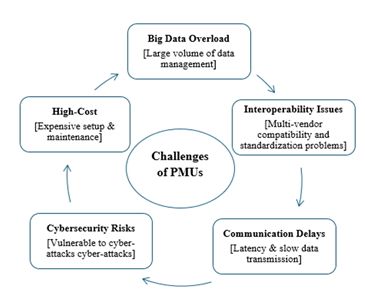
Figure 3 Challenges of PMUs
Dixit et al.
(2022) |
A major challenge
is the cost of installation and maintenance which is high. PMUs located over a
large geographical region demand hefty investments in hardware such as sensors,
GPS synchronization units, communication infrastructure, and Phasor Data Concentrators
(PDCs). Moreover, there is the cost of continuous maintenance, calibration, and
upgrades of the system, which further adds to the total cost, making it a major
setback, especially to the developing world.
The other problem
that is of high concern is the huge amount of data produced by PMUs. PMUs
generate large volumes of real time data due to their high sampling rates
(30-120 samples/second). This data management, storage and processing need
complex data management systems, high-performance computing resources, and
scalable storage systems to manage, store and process efficiently Abdulkareem
et al. (2020). In the absence of appropriate data handling
mechanisms, the system can experience bottlenecks, which impact on performance
and reliability.
The risk of
cybersecurity is also a significant issue in PMU-based systems. Since WAMS
relies on communication networks for transmitting sensitive real-time data, it
becomes vulnerable to cyber-attacks such as data manipulation, spoofing,
denial-of-service (DoS), and unauthorized access. Any failure of data integrity
or availability may result in inaccurate decision-making and may even cause
instability in the power system. Thus, there is a need to have strong
cybersecurity structures and encryptions.
Moreover,
communication delays and latency can have a tremendous effect on the
performance of PMU-based applications, particularly those that need real-time
control Samson
et al. (2025). Even with high-speed data offered in PMUs,
network congestion, limited bandwidth, or infrastructure constraints may cause
delays in delivering data to support timely decision-making and decrease system
effectiveness.
Lastly, there are
still problems of interoperability and standardization. PMUs and associated
products are commonly produced by various manufacturers and the absence of
standardization may cause compatibility problems. Despite the development of
standards like IEEE C37.118, differences in implementation can still pose
challenges to the tasks of uniting devices into a single system.
RECENT ADVANCES AND FUTURE SCOPE
Thes last few
years have seen a tremendous progress in the design and implementation of
Phasor Measurement Unit (PMU)-based systems due to increased requirement in
intelligent, resilient and efficient power grids. These developments are
directly connected with the development of smart grid technologies and growing
use of renewable energy sources.
The combination of
PMUs and smart grids and renewable energy systems is one of the most prominent
developments Aminifar et al.
(2015). Solar and wind are some of the variable
sources of energy that are being increasingly integrated into modern power
systems that bring fluctuations and uncertainties into the grid. PMUs make
these dynamic conditions visible in real-time, which helps the operators of the
systems to maintain the stability of the grid and to guarantee the efficient
use of energy.
The other
significant development is the use of Artificial Intelligence (AI) and Machine
Learning (ML) to analyze PMU data. Predictive
analytics, such as fault prediction, anomaly detection, load forecasting, and
stability assessment, are applied using these technologies. Through AI and ML,
power systems will be able to become proactive, not reactive, and hence minimize
the chances of failures and enhance performance Schofield
et al. (2018).
The implementation
of cloud computing and big data technologies have also augmented the
capabilities of PMU-based systems. As PMUs produce much data, cloud services
can offer scalable storage and real-time data processing and analysis with high
computational power. This enables effective data management, remote
accessibility and better decision-making.
Also, the
development of Wide-Area Control Systems (WACS) has been made to a great extent
Sneha et
al. (2025). The systems use real-time PMU data to apply
automated and adaptive control measures on large power networks. WACS has the
ability to react promptly to disruptions, synchronize control, and preclude
cascading failures, thus, improving the system reliability and resilience.
In the future
research and development of PMU-based systems, there are various areas that
will be concentrated on. The issue of cost reduction is still a priority in
order to facilitate its broader implementation especially in developing nations
Kumar
and Karthikeyan (2016). It is necessary to improve the
cybersecurity systems to ensure the safety of critical infrastructure against
the new cyber threats. Moreover, the emergence of autonomous and
self-reparative grid systems driven by sophisticated analytics and smart control
systems is a promising trend to the future of power systems.
CONCLUSION
This review offers
an overview of the concept of Wide-Area Monitoring and Control systems which
are facilitated by Phasor Measurement Units (PMUs) and explains why they are
essential in improving the observability, reliability and stability of the
present-day power systems. This analysis has shown that PMUs, with their
high-speed and time-synchronized measurements, enhance real-time monitoring,
state estimation, fault detection and stability assessment to a large degree
and enable more efficient and informed decision-making. The coordinated control
actions and grid resilience against disturbances and cascading failures are
achieved by the integration of PMUs into Wide-Area Monitoring Systems (WAMS).
Nevertheless, the limitations of the implementation cost, extensive data
management needs, cybersecurity risks, delays in communications, and
interoperability should be properly overcome to make large-scale
implementation. Additionally, new developments such as artificial intelligence,
cloud computing, and Wide-Area Control Systems (WACS) have shown a clear shift
towards intelligent, automated, and self-healing power grids. In general,
PMU-based WAMS will be at the center of creating
secure, sustainable, and resilient smart power systems, and future studies will
aim to increase efficiency, security, and scalability.
ACKNOWLEDGMENTS
None.
REFERENCES
Abdulkareem, A., Ogbe, D., and Somefun, T. (2020). Review of Different Methods for Optimal Placement of Phasor Measurement Unit on the Power System Network. Advances in Science, Technology and Engineering Systems Journal, 5(6), 1071–1081. https://doi.org/10.25046/aj0506130
Alhelou, H. H. (2019). An Overview of Wide Area Measurement System and its Application in Modern Power Systems. In Handbook of Research on Smart Power System Operation and Control ( 289–307). IGI Global. https://doi.org/10.4018/978-1-5225-8030-0.ch012
Aljazaeri, A., and Toman, P. (2022). A Review of the Use of Phasor Measurement Units in Power System State Estimation. In 2022 22nd International Scientific Conference on Electric Power Engineering (EPE) ( 1–6). IEEE. https://doi.org/10.1109/EPE54603.2022.9814130
Aminifar, F., Fotuhi-Firuzabad, M., Safdarian, A., Davoudi, A., and Shahidehpour, M. (2015). Synchrophasor Measurement Technology in Power Systems: Panorama and State-of-the-Art. IEEE Access, 2, 1607–1628. https://doi.org/10.1109/ACCESS.2015.2389659
Arefin, A. A., Baba, M., Singh, N. S. S., Nor, N. B. M., Sheikh, M. A., Kannan, R., … Mathur, N. (2022). Review of the Techniques of Data Analytics and Islanding Detection of Distribution Systems Using Phasor Measurement Unit Data. Electronics, 11(18), 2967. https://doi.org/10.3390/electronics11182967
Ashok, V., Yadav, A., and Abdelaziz, A. Y. (2020). A Comprehensive Review on Wide-Area Protection, Control and Monitoring Systems. In Wide area Power Systems Stability, Protection, and Security ( 1–43). Springer. https://doi.org/10.1007/978-3-030-54275-7_1
Biswal, C., Sahu, B. K., Mishra, M., and Rout, P. K. (2023). Real-Time Grid Monitoring and Protection: A Comprehensive Survey on the Advantages of Phasor Measurement Units. Energies, 16, 4054. https://doi.org/10.3390/en16104054
Dixit, A., Chowdhury, A., and Saini, P. (2022). A Review on Optimal Placement of Phasor Measurement Unit (PMU). In System Assurances ( 513–530). Elsevier. https://doi.org/10.1016/B978-0-323-90240-3.00028-X
Hojabri, M., Dersch, U., Papaemmanouil, A., and Bosshart, P. (2019). A Comprehensive Survey on Phasor Measurement Unit Applications in Distribution Systems. Energies, 12(23), 4552. https://doi.org/10.3390/en12234552
Khan, M. Q., Ahmed, M. M., Haidar, A. M., Julai, N., and Hasan, M. K. (2018). Synchrophasors Based Wide Area Protection and Phasor Estimation: A Review. In 2018 IEEE 7th International Conference on Power and Energy (PECon) ( 215–220). IEEE. https://doi.org/10.1109/PECON.2018.8684046
Krommydas, K. F., Karavas, C. S. G., Plakas, K. A., Chassioti, E., Moraitis, I., Hurtado, A. A. P., … Brnobic, D. (2025). Enhancing the Operation of the Hellenic Transmission System Through Wide-Area Monitoring and Control: Design, Implementation, and Evaluation of a Phasor Measurement Unit-Based System with Advanced Algorithms. IEEE Power and Energy Magazine, 23(1), 99–112. https://doi.org/10.1109/MPE.2024.3435171
Kumar, L. A., and Karthikeyan, S. (2016). Modeling of Phasor Measurement Unit for Wide Area Monitoring and Control of Smart Grids with Distributed Energy Resources. In 2016 IEEE Conference on Technologies for Sustainability (SusTech) ( 188–194). IEEE. https://doi.org/10.1109/SusTech.2016.7897165
Lu, C., Shi, B., Wu, X., and Sun, H. (2015). Advancing China’s Smart Grid: Phasor Measurement Units in a Wide-Area Management System. IEEE Power and Energy Magazine, 13(5), 60–71. https://doi.org/10.1109/MPE.2015.2432372
Maheswari, M., Suthanthira Vanitha, N., and Loganathan, N. (2020). Wide-Area Measurement Systems and Phasor Measurement Units. In Wide Area Power Systems Stability, Protection, and Security ( 105–126). Springer. https://doi.org/10.1007/978-3-030-54275-7_4
Menezes, T. S., Barra, P. H. A., Dizioli, F. A. S., Lacerda, V. A., Fernandes, R. A. S., and Coury, D. V. (2024). A Survey on the Application of Phasor Measurement Units to the Protection of Transmission and Smart Distribution Systems. Electric Power Components and Systems, 52(8), 1379–1396. https://doi.org/10.1080/15325008.2023.2240320
Mohamed, S. A., Mageed, H. M. A., Arafa, O. M., Merzban, M. H., Eteiba, M. B., and Saleh, A. A. (2025). Review of Phasor Estimation Algorithms and Applications of Phasor Measurement Units. IEEE Instrumentation and Measurement Magazine. https://doi.org/10.1109/MIM.2026.11395444
Mohanta, D. K., Murthy, C., and Sinha Roy, D. (2016). A Brief Review of Phasor Measurement Units as Sensors for Smart Grid. Electric Power Components and Systems, 44(4), 411–425. https://doi.org/10.1080/15325008.2015.1117538
Monti, A., Muscas, C., and Ponci, F. (2016). Phasor Measurement Units and Wide Area Monitoring Systems. Academic Press. https://doi.org/10.1016/B978-0-12-804569-5.00008-2
Nageswara Rao, A., Vijaya Priya, P., Kowsalya, M., and Gnanadass, R. (2019). Wide Area Monitoring for Energy System: A Review. International Journal of Ambient Energy, 40(5), 537–553. https://doi.org/10.1080/01430750.2017.1399458
Palizban, A. (2015). Wide-Area Monitoring and Control Utilizing PMU Measurements for a System Protection Scheme (Doctoral Dissertation, University of British Columbia).
Pazderin, A., Zicmane, I., Senyuk, M., Gubin, P., Polyakov, I., Mukhlynin, N., … Kamalov, F. (2023). Directions of Application of Phasor Measurement Units for Control and Monitoring of Modern Power Systems: A State-of-the-Art Review. Energies, 16(17), 6203. https://doi.org/10.3390/en16176203
Penshanwar, M. K., Gavande, M., and Satarkar, M. R. (2015). Phasor Measurement Unit Technology and its Applications: A Review. In 2015 International Conference on Energy Systems and Applications ( 318–323). IEEE. https://doi.org/10.1109/ICESA.2015.7503363
Phadke, A. G., and Bi, T. (2018). Phasor Measurement Units, WAMS, and their Applications in Protection and Control of Power Systems. Journal of Modern Power Systems and Clean Energy, 6(4), 619–629. https://doi.org/10.1007/s40565-018-0423-3
Raju, V. V. R., Shree, K. P., and Kumar, S. J. (2021). Development of Cost-Effective Phasor Measurement Unit for Wide Area Monitoring System Applications. International Journal of Electrical and Computer Engineering, 11(6), 4731–4739. https://doi.org/10.11591/ijece.v11i6.pp4731-4739
Ravi, A., Saranathan, M., Achuthan, P. H. K., Lavanya, M. C., and Rajini, V. (2022). A Comprehensive Review on the Current Trends in Micro-Phasor Measurement Units. In IOP Conference Series: Materials Science and Engineering (Vol. 1258, No. 1, p. 012045). IOP Publishing. https://doi.org/10.1088/1757-899X/1258/1/012045
Samson, S. Y., Rahman, M. S., Zhang, G., Meraj, S. T., and Trinh, H. (2025). Comprehensive Review of PMU Applications in Smart Grid: Enhancing Grid Reliability and Efficiency. Chinese Journal of Electrical Engineering.
Schofield, D., Gonzalez-Longatt, F., and Bogdanov, D. (2018). Design and Implementation of a Low-Cost Phasor Measurement Unit: A Comprehensive Review. https://doi.org/10.1109/BalkanLight.2018.8546936
Shankar, S., Yadav, K. B., Priyadarshi, A., and Rathore, V. (2020). Study of Phasor Measurement Unit and its Applications. In Recent Advances in Power Systems: Select proceedings of EPREC 2020 ( 247–257). Springer. https://doi.org/10.1007/978-981-15-7994-3_22
Sharma, R. B., and Dhole, G. M. (2016). Wide Area Measurement Technology in Power Systems. Procedia Technology, 25, 718–725. https://doi.org/10.1016/j.protcy.2016.08.165
Sneha, B., Babu, R., and Mahapatra, S. (2025). Empowering Grid Intelligence: A Comprehensive Review on Optimal Placement and Diverse Applications of Synchronized Phasor Measurement Units in Modern Power Systems. International Journal of System Assurance Engineering and Management, 16(2), 622–650. https://doi.org/10.1007/s13198-024-02637-9
 This work is licensed under a: Creative Commons Attribution 4.0 International License
© Granthaalayah 2014-2026. All Rights Reserved.