Original Article
Effect of Poynting-Robertson force on the resonant motion of Geocentric Satellite
|
Md Sabir
Ahamad 1 1 Department of Mathematics, SNSRKS College, Saharsa-852202, Bihar,
India |
|
|
|
ABSTRACT |
||
|
This paper is
to discuss the effects of Poynting-Robertson force on the resonant motion of
geocentric satellite. In presence of Poynting-Robertson force the resonances Keywords: Resonance, Poynting-Robertson Force, Geocentric Satellite, Amplitude and Time Period |
||
INTRODUCTION
Over the last few decades, several authors widely studied three-body problem and restricted three-body
problem under diverse perturbation conditions. The perturbation owing to
mechanism of dissipation in solar system is several dimensional. Understanding
of factors affecting the motion of the bodies of the solar system is necessary
for the analysis of solar dynamics. Resonance established in solar system plays
a vital role in the solar dynamics. Throughout the integration of equations of
motion; a set of cases wherein the periods of revolution are in the ratio of
two integers demonstrated by the appearance of small divisors is defined as
resonance. Hughes
(1980) reported resonance’s impact on the orbit of
Earrth’s satellite because of lunisolar gravity and respective direct solar
radiation pressure, whose appearance relies only on the orbital of satellite
inclination. Under gas rich condition, the nature of resonance trapping was
explored by Weidenschilling and Davis (1985). Further, which was continued by Patterson
(1987) for the existence of resonances of any order
and exhibiting formation of planetary embryous at
two-body external resonances by accretion of infinitesimals caught in these
orbits. Bhatnagar
and Mehera (1986) verified the motion of a satellite using
gravitational forces of several bodies including Moon, Earth and the radiating
Sun. Ferraz-Mello (1992) studied “averaging
of the elliptic asteroidal problem with a Stokes drag” and with the assistance
of Beaugé and
Ferraz-Mello (1993) he studied “resonance trapping and Stokes
drag dissipation in the primordial solar nebula. The often decrease of
semi-major axis due to dissipation and consequent collision between one primary
and minor bodies has been studied by Celletti
et al. (2011). Quarles
et al. (2012) has studied the resonances for co-planar
CR3BP for the mass ratio between 0.10 and 0.15 and used the method of maximum Lyaponav exponent to locate the resonant points. They
showed that in presence of single resonance, the orbital stability is ensured
for high value of resonance.
Sushil
et al. (2013) worked on
resonance in a geocentric satellite due to Earth’s equatorial ellipticity and
analysed the effects on amplitude and time period of oscillation on  (angle measured
from the minor axis of the Earth’s equatorial ellipse to the projection of the
moon on the plane of equator) and on the other orbital elements of the
satellite. Rosemary (2013) has given detail
description of the perturbation theory to determine the presence of resonance
based on approximations to a harmonic oscillation. Kour et al. (2018) worked on resonance in the motion of
geocentric satellite due to PR-drag and further in (2019) they have discussed
the “Resonance” in the motion of geocentric satellite due to PR-drag and
equatorial ellipticity of the Earth. Hassan
et al. (2022) studied effects of Stokes drag on the
resonant motion of a geocentric satellite and found that time period and
amplitude vary with the variation of Stokes Drag parameter. Presently we
proposed to extend the work of Hassan
et al. (2022) by considering the Combined Effect of Stokes
Drag and Earth’s equatorial ellipticity on the resonant motion of moon, where
the minor axis of the Earth’s equatorial section is called ellipticity
parameter of the Earth. Here the Stokes-Drag defined by Ferraz-Mello (1992) is under consideration.
(angle measured
from the minor axis of the Earth’s equatorial ellipse to the projection of the
moon on the plane of equator) and on the other orbital elements of the
satellite. Rosemary (2013) has given detail
description of the perturbation theory to determine the presence of resonance
based on approximations to a harmonic oscillation. Kour et al. (2018) worked on resonance in the motion of
geocentric satellite due to PR-drag and further in (2019) they have discussed
the “Resonance” in the motion of geocentric satellite due to PR-drag and
equatorial ellipticity of the Earth. Hassan
et al. (2022) studied effects of Stokes drag on the
resonant motion of a geocentric satellite and found that time period and
amplitude vary with the variation of Stokes Drag parameter. Presently we
proposed to extend the work of Hassan
et al. (2022) by considering the Combined Effect of Stokes
Drag and Earth’s equatorial ellipticity on the resonant motion of moon, where
the minor axis of the Earth’s equatorial section is called ellipticity
parameter of the Earth. Here the Stokes-Drag defined by Ferraz-Mello (1992) is under consideration.
We divide this
paper in five sections. In section 2, the equations of motion of the geocentric
satellite in polar form have been established in presence of Poynting-Robertson
force in rotating frame relative to the Earth. In Section 3, we have solved first
the unperturbed equation of motion and hence the integrable form of the
perturbed equation of motion and its solution is established. In section 4,
Amplitudes and time periods have been found out by using the generalised
formula of Hassan
et al. (2022). The manuscript has been concluded in
section 5 and ended with the references.
The Equations of Motion
|
|
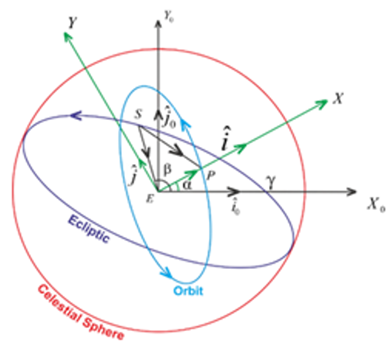
Let us considering the inertial frame  whose origin at
the Earth
whose origin at
the Earth and a rotating frame
  relative to the
inertial one , where
relative to the
inertial one , where  passes through the vernal
equinox
passes through the vernal
equinox  .Let
.Let  and
and  be the unit vectors along the axes of inertial frame
and rotating frame with common unit vector
be the unit vectors along the axes of inertial frame
and rotating frame with common unit vector along the
vertical axis EZ (not seen in the figure). Let
along the
vertical axis EZ (not seen in the figure). Let  be the position
vector of the satellite P,
be the position
vector of the satellite P,  be the position of the Sun S relative to
the Earth E and
be the position of the Sun S relative to
the Earth E and  . If
. If  and
and  be the masses of the Sun, Earth and the Geocentric Satellite
respectively then their mutual gravitational forces are given by
be the masses of the Sun, Earth and the Geocentric Satellite
respectively then their mutual gravitational forces are given by
 (1)
(1)
 The
Poynting-Robertson force applied on the satellite P is given by
The
Poynting-Robertson force applied on the satellite P is given by
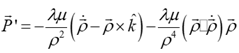 (2)
(2)
where  is the dissipative
constant, we can decompose the above force into two components, first one is
the drag component due to the impact of photons of the solar radiation with the
satellite and second component represents the Doppler shift of solar radiation
that’s hit the satellite. Let
is the dissipative
constant, we can decompose the above force into two components, first one is
the drag component due to the impact of photons of the solar radiation with the
satellite and second component represents the Doppler shift of solar radiation
that’s hit the satellite. Let  be angular
velocity of the rotating frame relative to the inertial frame and the unit
vector
be angular
velocity of the rotating frame relative to the inertial frame and the unit
vector  along the direction of
geocentric satellite then the equation of motion of satellite in rotating frame
can be written as
along the direction of
geocentric satellite then the equation of motion of satellite in rotating frame
can be written as
 (3)
(3)
Let α be the
angle of direction of the satellite with the direction of vernal equinox, then  , where
  is the angular
velocity of the satellite. Thus, the equation (3) reduced to
is the angular
velocity of the satellite. Thus, the equation (3) reduced to
 (4)
(4)
In the triangle EPS

If  be the unit
vector along
be the unit
vector along  and
and be the angle of the direction
of the sun with the direction of vernal equinox
be the angle of the direction
of the sun with the direction of vernal equinox  then
then  and
and  implies that

 (5)
(5)
Scalar product of  with (4) and
(5) and that of
with (4) and
(5) and that of  with
with  and
and  comparing the results one can find the
equations of motions of the satellite in polar form as
comparing the results one can find the
equations of motions of the satellite in polar form as

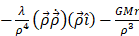 (6)
(6)

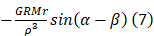 (7)
(7)
These equations are not integrable, so we replace r and by their steady state value  and
and  by perturbation technique which can be introduced in
  and
and  as
as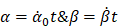

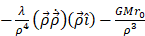 (8)
(8)

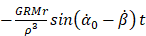 (9)
(9)
At steady state




For central orbit of satellite  constant=h (say) and
 in (8) we get



 (10)
(10)
Resonance in the Motion of the Satellite
The complete solution of the
unperturbed equation of motion 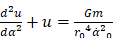 is given by
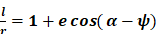 , where
 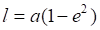 and
and  are constants.
Thus
are constants.
Thus 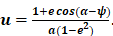
Let us consider  where n be the frequency of the satellite.
Since eccentricity , so
, so  .
.
Hence by using  and
and  in equation (10), then we get the perturbed
equation of the motion of the satellite is
in equation (10), then we get the perturbed
equation of the motion of the satellite is




 (11)
(11)
Where









The solution of equation (11) is given by





 (12)
(12)
Where is constant of integration. On
vanishing the denominator of any term of equation (12) we get some points at
which motion becomes indeterminate and hence resonance occurs at these points.
Thus, the resonances occur at the points
is constant of integration. On
vanishing the denominator of any term of equation (12) we get some points at
which motion becomes indeterminate and hence resonance occurs at these points.
Thus, the resonances occur at the points 
 and
and  . All the resonances
  and
and  occur due to
Poynting-Robertson force.
occur due to
Poynting-Robertson force.
Amplitude
and Time Period
By using Brown
and Shook (1933) and Hassan
et al. (2022) the
generalization formula of the
amplitude  and the time period
  at the resonant point
  where
where  for
for
the equation is of the form 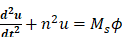 and
and  are
are
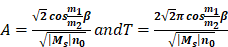 (13)
(13)
It’s to be noted that any value
of  may or may not
represent the corresponding value of
may or may not
represent the corresponding value of  and using the result of
  the
amplitude and time period at different resonant points are cited in the table.
the
amplitude and time period at different resonant points are cited in the table.
|
Resonant Point |
Amplitude |
Time Period |
s |
|
|
|
|
|
|
|
|
|
|
|
|
|
|
|
|
|
|
|
|
|
|
|
|
|
|
|
|
|
|
|
|
|
|
|
|
|
|
|
|
|
|
|
|
|
|
|
|
|
|
|
|
|
|
|
Where



















Conclusion
In section 1, of
this manuscript, the previous works have been cited. In section 2, the polar
equations of motion of the geocentric satellite have been established in
presence of Poynting-Robertson force in rotating frame relative to the Earth.
To reduce the chances of non-integrability of the equations of motion, we used
perturbation technique by taking the steady state values of the position vector
and angular velocity of satellite. In section 3, we have solved first the
unperturbed equation of motion. The solution of perturbed equation (11) of
motion in equation (12). By making denominator of any term from 5th
to 26th to zero  becomes infinity and hence the motion of the satellite becomes
indeterminate. Thus
becomes infinity and hence the motion of the satellite becomes
indeterminate. Thus  and are eleven
resonances of the problem all of them are occurred due to Poynting-Robertson force. In section
4, we have found the amplitudes and time periods at all the resonant points
which are occurred due to Poynting-Robertson
force.
and are eleven
resonances of the problem all of them are occurred due to Poynting-Robertson force. In section
4, we have found the amplitudes and time periods at all the resonant points
which are occurred due to Poynting-Robertson
force.
ACKNOWLEDGMENTS
None.
REFERENCES
Beaugé, C., and Ferraz-Mello, S. (1993). Resonance Trapping in the Primordial Solar Nebula: The Case of a Stokes Drag Dissipation. Icarus, 103(2), 301–318. https://doi.org/10.1006/icar.1993.1072
Bhatnagar, K. B., and Mehera, M. (1986). The Motion of a Geosynchronous Satellite—I. Indian Journal of Pure and Applied Mathematics, 17(12), 1438–1452.
Brouwer, D. (1963). Analytical Study of Resonance Caused by Solar Radiation Pressure. In Dynamics of Satellites Symposium (pp. 28–30). Springer. https://doi.org/10.1007/978-3-642-48130-7_4
Brown, E. W., and Shook, C. A. (1933). Planetary Theory. Cambridge University Press.
Celletti, A., Stefanelli, L., Lega, E., and Froeschle, C. (2011). Some Results on The Global Dynamics of the Regularized Restricted Three-Body Problem with Dissipation. Celestial Mechanics and Dynamical Astronomy, 109(3), 265–284. https://doi.org/10.1007/s10569-010-9326-y
Hassan, M. R., Ahamad, M. S., and Sharma, B. K. (2022). The Effects of Stokes Drag on the Resonant Motion of a Geocentric Satellite. Few-Body Systems, 63(76). https://doi.org/10.1007/s00601-022-01772-y
Hughes, S. (1980). Earth Satellite Orbits with Resonant Lunisolar Perturbations. I. Resonances Dependent only on Inclination. Proceedings of the Royal Society of London. Series A, 372(1751), 243–264. https://doi.org/10.1098/rspa.1980.0111
Kour,
C., Sharma, B. K., and Pandey, L. P. (2018). Resonance in the
Motion of Geocentric Satellite Due to Poynting-Robertson Drag. An International Journal, 13,
173–189.
Kour,
C., Sharma, B. K., and Yadav, S. (2019). Resonance in the
Motion of a Geocentric Satellite Due to Poynting-Robertson Drag and Equatorial Ellipticity
of the Earth. An International Journal, 14, 416–436.
Murray, C. D., and Dermott, S. F. (2010). Solar System Dynamics. Cambridge University Press.
Patterson, C. W. (1987). Resonance Capture and the Evolution of the Planets. Icarus, 70(2), 319–333. https://doi.org/10.1016/0019-1035(87)90138-2
Poynting, J. H. (1903). Radiation in the Solar System, Its Effect on Temperature and Its Pressure on Small Bodies. Philosophical Transactions of the Royal Society of London. Series A, 202, 525–552. https://doi.org/10.1098/rsta.1904.0012
Quarles, B., Musielak, Z. E., and Cuntz, M. (2012). Study of Resonances for the Restricted Three-Body Problem. Astronomische Nachrichten, 333(1), 1–10. https://doi.org/10.1002/asna.201111704
Robertson, H. P. (1937). Dynamical Effects of Radiation in the Solar System. Monthly Notices of the Royal Astronomical Society, 97(6), 423–437. https://doi.org/10.1093/mnras/97.6.423
Weidenschilling, S. J., and Davis, D. R. (1985). Orbital Resonances in The Solar Nebula: Implications for Planetary Accretion. Icarus, 62(1), 16–29. https://doi.org/10.1016/0019-1035(85)90169-1
Yadav, S., and Aggarwal, R. (2013). Resonance in a Geocentric Satellite Due to Earth’s Equatorial Ellipticity. Astrophysics and Space Science, 347(2), 249–259. https://doi.org/10.1007/s10509-013-1515-1
 This work is licensed under a: Creative Commons Attribution 4.0 International License
© Granthaalayah 2014-2026. All Rights Reserved.