Original Article
Quantitative Evaluation of Yoga
Postures Using Image Processing and Hotelling’s  Statistical Analysis
|
Pritesh Dineshbhai Gohil
1* 1 Assistant Professor, GLS University (FOBA), Ahmedabad, India |
|
|
|
ABSTRACT |
||
|
The aim of this study is to use computer vision and statistical analysis to measure how yoga practice can improve body posture. A Python-based model was developed that can recognize different yoga poses from images and then create a 3D skeleton of the human body using landmark points. For each pose, twelve important landmarks such as shoulders, elbows, hips, and knees were identified, and angles were calculated to check the correctness of posture. To evaluate whether these landmarks showed improvement after one month of yoga practice, we applied Hotelling’s T² test, a multivariate statistical method that can detect overall changes across several joints at the same time. The results showed that some landmarks had significant differences before and after yoga, meaning that the posture became more aligned and balanced. This method provides an objective way of checking yoga progress instead of relying only on visual observation. The study demonstrates that by combining image processing with statistical testing, it is possible to give meaningful feedback to yoga practitioners, trainers, and even rehabilitation experts in a simple and scientific manner Keywords: Yoga Posture Analysis, Image
Processing, Computer Vision, 3D Skeleton Model, Landmark Detection,
Hotelling’s T² Test |
||
INTRODUCTION
Yoga encompasses a
broad spectrum of practices, from physical postures (asanas) and breathing
techniques (pranayama) to meditation and ethical living. Ancient texts such as
the Bhagavad Gita and Patanjali’s Yoga Sutras emphasize yoga as both a
practical discipline and a path to self-realization. In modern times, yoga’s
versatility enables adaptation for all ages and backgrounds—whether as a gentle
means for injury rehabilitation, a dynamic tool for fitness, or a structured
method to foster mindfulness. The surge in global popularity reflects its
accessibility and multifaceted contributions to individual and societal health.
Scientific studies
increasingly validate yoga’s role in addressing major modern challenges,
including stress, sedentary lifestyles, and rising chronic disease rates.
Consistent practice cultivates physical flexibility and strength, supports
heart health, and aids in metabolic balance. Breathwork and meditative elements
foster nervous system resilience by reducing sympathetic (fight-or-flight)
activity and enhancing parasympathetic (rest-and-digest) function, directly
impacting stress reduction, sleep quality, and immune competence. Regular yoga
sessions are linked with lower rates of hypertension, anxiety, depression, and
chronic pain. Emerging research also highlights yoga’s effect on improving
neuroplasticity, attention, memory, and emotional regulation.
Despite decades of
anecdotal and clinical evidence supporting yoga’s efficacy, rigorous
quantification—particularly of biomechanical improvements—remains
under-explored. Recent studies leverage image processing and computer vision
methods to objectively assess posture quality, symmetry, and improvements over
time. These advancements are crucial for bridging the gap between traditional
practice and evidence-based health promotion. Using tools like pose estimation
algorithms and landmark tracking, researchers and practitioners can now gain
precise, visual feedback on alignment and progress, providing tangible metrics
for personalized guidance and large-scale studies.
Yoga’s impact is
not restricted to individual health. Group practices encourage social cohesion,
foster supportive communities, and contribute to healthier workplaces and
educational environments. Public health initiatives increasingly recognize yoga
as a cost-effective, scalable intervention for enhancing population wellbeing
and reducing healthcare burden, especially in contexts where access to
conventional medical or psychological care may be limited.
Yoga continues to
evolve as a dynamic interface between tradition and innovation, embodying both
an ancient wisdom and a modern science of self-care and self-mastery.
STUDY OBJECTIVES
1)
Develop
a computer vision model to detect and classify yoga poses from static images
using advanced landmark detection frameworks.
2)
Apply
Mediapipe for extracting 32 body landmarks per image to enable accurate mapping
of joints and limbs for analysis.
3)
Compute
joint angles from landmark coordinates using the Pythagorean theorem and law of
cosines, providing quantitative alignment measures.
4)
Create
rule-based algorithms that classify poses by mapping joint angles to benchmark
ranges for automated recognition.
5)
Overlay
detected landmarks and pose labels onto images to visually validate algorithm
results.
6)
Evaluate
classification and angle estimation accuracy through comparative analysis of
before-and-after images, measuring improvements in alignment and posture.
LITERATURE REVIEW
Cramer
et al. (2013) conducted a meta-analysis investigating
yoga’s effects on depression, demonstrating significant mental health benefits.
Their broad literature screening supports yoga as a complementary therapy. Yet,
variability in study designs, yoga styles, and intervention durations presents
challenges for standardized conclusions, indicating a need for more uniform
future trials.
Jain et al. (2015) used image processing and machine learning
methods for yoga pose recognition, aiming to improve physical alignment through
software-guided feedback. Their work laid foundational groundwork for later
pose detection models. However, the study is constrained by limited
computational resources and simpler machine learning methods of the time, which
may reduce accuracy and robustness compared to recent deep learning-based
approaches.
Li and Goldsmith (2015) reviewed the effects of yoga on anxiety and
stress, consolidating clinical evidence that supports regular practice for
mental well-being. They discuss neurobiological mechanisms behind benefits, but
the review notes inconsistencies and methodological differences across
individual studies, which compromise the overall strength of the evidence.
Wu et al. (2016) proposed a convolutional neural network
(CNN) with transfer learning to recognize yoga poses automatically from images,
achieving high classification accuracy in controlled datasets. The study’s
limitation lies in its assumption of clear backgrounds and static postures,
which may not hold true in dynamic or real-world settings with occlusions or
complex environments.
Raghavendra
et al. (2019) explored the physical benefits of guided
yoga intervention by employing yoga pose recognition techniques to monitor
alignment improvements. The study also measured stress reduction outcomes,
confirming yoga's efficacy. Limitations include a relatively small sample size
and the use of predefined poses only, which could limit the applicability to
practitioners performing more advanced or hybrid postures.
Kishore
et al. (2022) conducted a comparative evaluation of four
deep learning architectures—EpipolarPose, OpenPose, PoseNet, and MediaPipe—for
yoga pose estimation. Using a database from the Swami Vivekananda Yoga
Anusandhana Samsthana (S-VYASA), they concluded that MediaPipe achieved the
highest accuracy in estimating five common postures. Their contribution
includes benchmarking model performance for yoga-specific data. However, the
training dataset covers only five asanas, which limits scalability to wider
yoga practice diversity. Additionally, the system mainly relied on monocular
input, which might not capture complex 3D posture nuances fully.
Shailesh
and Jose (2022) implemented a deep learning framework for
automatic yoga pose estimation and feedback generation. Their model integrates
pose estimation with feedback mechanisms to suggest corrections. They highlight
the utility of deep architectures in capturing intricate pose details. The
system was tested on a curated dataset but lacks validation in uncontrolled or
varied user environments. The challenge in generalizing model performance to
different camera settings and body types remains a concern.
Madhavi, M.,
Shashank, V., Vaishnavi, R., and Abhinav, S. (2024) proposed a convolutional
neural network (CNN)-based method for identification and correction of yoga
poses using an image database of five common asanas. Their approach focuses on
pose correction by detecting misalignments from captured images. The study
demonstrates promising pose classification accuracy, yet it is limited to
static images rather than continuous video streams, leaving temporal pose
consistency and dynamic movement unaddressed. This confines the practical
application in real-time yoga sessions where flow between poses matters.
Anusha
et al. (2025) developed a system using machine learning for
real-time yoga pose detection, leveraging the MediaPipe Blaze pose model
coupled with an XGBoost classifier. Their system extracts key body points,
classifies yoga poses, and provides real-time corrective feedback. This
approach is designed to improve self-practice accuracy and remote instruction.
While the model shows high accuracy, the study relies heavily on quality input
images and does not extensively address performance variability across diverse
user environments or lighting conditions, which may affect robustness in
real-world scenarios.
DATA COLLECTION
This part of the
study used still images of yoga postures taken before and after a one-month
period of practice. Images came from two sources: (a) photographs of study
participants who attended the yoga event, and (b) benchmark images collected
from public datasets and online resources used to define correct pose angles.
Images of the same participants were paired so that each person has a “before”
and an “after” image for the same pose; these paired images were used for
statistical comparison of landmarks.
IMAGES WERE OBTAINED FROM TWO PRIMARY SOURCES
Captured Images:
Photographs were taken under consistent lighting and background conditions to
minimize noise and ensure accurate detection of body landmarks. Each subject
performed selected yoga postures while standing at an optimal distance from the
camera to ensure full-body visibility.
Reference Images:
Benchmark images of standard yoga poses were collected from publicly available
datasets such as Kaggle, BLEED AI, and LearnOpenCV repositories. These
reference images served as the “ideal pose” models used to define standard
angle ranges and postural parameters for each yoga position.
The study focused
on Nine common yoga postures, including Virabhadrasana (Warrior Pose),
Vrikshasana (Tree Pose), Natarajasana (Lord of Dance Pose), Dandasana (Staff
Pose), Marjaryasana (Cat Pose), Bakasana (Crane Pose), Anjaneyasana (Crescent
Lunge), Buddha Konasana (Butterfly Pose), Naukasana (Boat Pose). For each
posture, a set of benchmark angle ranges was prepared to guide the
classification and evaluation process.
All personally
identifiable information was removed from the images. Each file was labeled
with an anonymous ID. All photographic data were used strictly for research
purposes in accordance with ethical research guidelines.
METHODOLOGY
The methodology
integrates image processing, Landmark Extraction, pose classification, 3D
landmark visualization, and statistical testing to objectively measure postural
improvement through yoga. The system was built in Python using OpenCV,
MediaPipe, and Matplotlib for visualization, and NumPy, Pandas, and SciPy for
mathematical computations.
IMAGE PROCESSING
To ensure
uniformity, all images were preprocessed before analysis using Python’s OpenCV
library. The preprocessing steps included:
·
Resizing:
Images were resized to a standard resolution suitable for MediaPipe processing.
·
Color
Conversion: Images were converted to the RGB color model for compatibility with
the pose detection model.
·
Noise
Reduction: Blurry or low-contrast images were removed.
·
Pose
Confidence Check: Each image was processed through the pose estimation model,
and only those with acceptable detection confidence scores were retained for
further analysis.
LANDMARK EXTRACTION
Each yoga image
was processed using MediaPipe’s Pose Estimation module, which automatically
detects and tracks key body points (landmarks). The model identifies 33
landmarks representing different joints and body parts. For this study, 12
specific landmarks were selected — focusing on joints most important for
posture symmetry and alignment, such as shoulders, elbows, hips, knees, and
ankles. Using these landmark coordinates, joint angles were calculated using
the cosine law and Pythagoras theorem, allowing the program to evaluate whether
a pose matched the expected angle range of a known yoga posture. For each
image, the x, y, and z coordinates of these landmarks were extracted and stored
in a structured data file.
POSE CLASSIFICATION
Each image was
then automatically classified into a specific yoga pose by comparing the
calculated joint angles with pre-defined standard angle ranges derived from
reference images. If the angles of the test image fell within the acceptable
range of a known pose, it was labelled accordingly; otherwise, it was marked as
“unknown.” This rule-based approach achieved high accuracy and allowed
consistent recognition of different yoga postures.
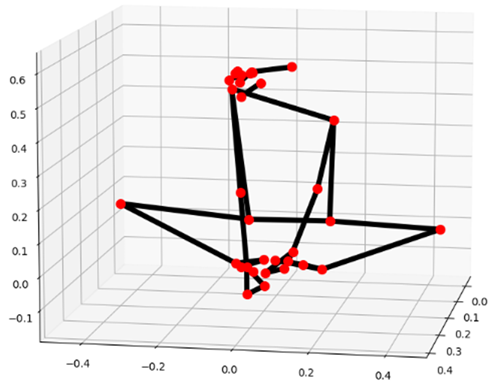
3D VISUALIZATION OF POSTURE
After
classification, the 3D skeleton of each image was plotted using Matplotlib’s 3D
toolkit, where each landmark point was connected to show the entire body
posture. This visualization helped in understanding the alignment of the body
in three-dimensional space, which is crucial for evaluating balance and
symmetry.
SOFTWARE AND TOOLS
All computations
were carried out using Python 3.10 and R Studio with the following key
libraries:
·
OpenCV:
for image preprocessing and visualization.
·
MediaPipe:
for pose estimation and landmark extraction.
·
Matplotlib:
for 3D visualization of skeletons.
·
NumPy and
Pandas: for data storage and manipulation.
·
“Hotelling”
Package: for implementation of Hotelling’s T² test and statistical functions in
R Programming.
WORKFLOW SUMMARY
1)
Input
yoga image is captured or uploaded.
2)
Image is
pre-processed (resized, color-converted, and filtered).
3)
Pose
estimation is performed to extract 33 landmarks.
4)
Twelve
key landmarks are selected for analysis.
5)
Joint
angles and coordinates are computed.
6)
Pose is
classified based on defined angle ranges.
7)
3D
skeleton is visualized.
8)
Hotelling’s
T² test is applied to assess posture improvement.
RESULTS
This section
presents the outcomes of the computer vision model and the statistical
analysis. The system successfully identified various yoga poses from uploaded
images, generated 3D skeletal representations, and quantitatively evaluated
improvements in alignment using Hotelling’s T² test. The combination of visual
and statistical outputs provided both qualitative and quantitative evidence of
posture improvement after one month of yoga practice.
POSE RECOGNITION OUTPUT
Each input image
was passed through the trained image-processing model. The system detected the
human figure, extracted 33 landmarks, and matched the detected joint angles
with the standard angle ranges defined for each yoga pose.
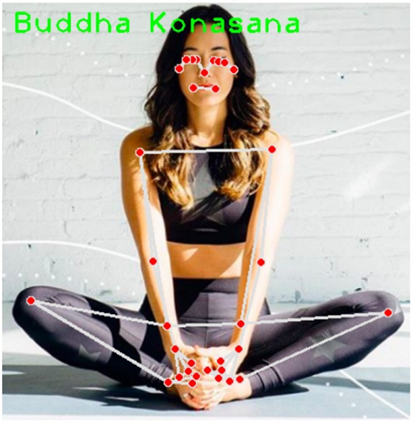
When an image of a
person performing Buddha Konasana (Butterfly Pose) was uploaded, the model
displayed the pose name “Buddha Konasana” on the output image along with a
bounding skeleton.
The model achieved
high visual accuracy in labelling other poses such as Vrikshasana,
Natarajasana, Dandasana, and Naukasana.
This visual output
confirmed that the pose recognition algorithm and landmark extraction process
were functioning correctly and could provide reliable data for subsequent
statistical analysis.
|
Figure 1 |
|
|
|
Figure 1 Original Image with Detected Pose
Name (Buddha Konasana) |
|
Figure 2 |
|
|
|
Figure 2 Corresponding 3D Skeleton
Visualization of the Same Pose |
VISUAL ANALYSIS AND 3D LANDMARK IMPROVEMENTS
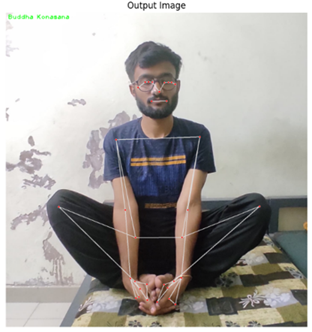
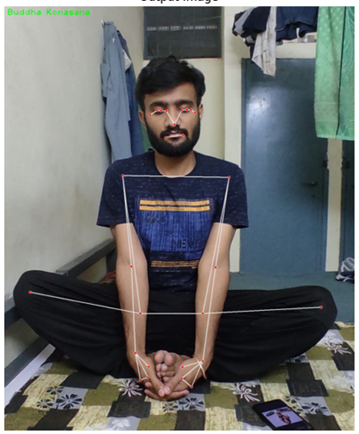
The 3D skeletal
models generated for before and after practice sessions showed visible
alignment differences.
·
Before
practice: the 3D skeletons displayed slight asymmetry in shoulders and hips,
indicating imbalanced posture.
|
Figure 3 |
·
After
practice: the landmarks appeared more symmetrical, with straighter alignment
along the vertical axis.
|
Figure 4 |
MULTIVARIATE
TEST (HOTELLING'S T²)
The Hotelling’s T²
test was applied to determine whether the mean vector of body-landmark
coordinates showed a significant change after one month of yoga practice.
Hotelling’s T²
test is the multivariate extension of the paired t-test.
Number of
observations (image pairs): N=10.
Number of
variables (landmarks used in this test): p=6.
Landmarks (in the
order used): Left elbow, Right elbow, Right shoulder, Left shoulder, Left knee,
Right knee.
The sample mean
vectors (means of each landmark across 10 subjects) were:
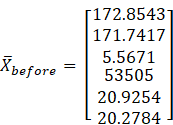
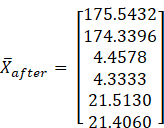
The vector of mean
differences used in the test (we will use d ̅=X ̅_before-X
̅_after) is:
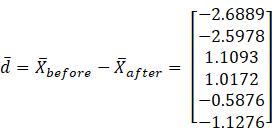
(Notice sign:
negative means the after-value is larger than the before-value for that
coordinate.)
FORMULAE AND COMPUTATIONAL STEPS:
We followed the
Hotelling’s T² procedure for paired multivariate data (equivalent to the test
of symmetry of organs described in the methodology). The key steps and formulas
are:
Step 1 — Compute
the sample mean difference vector

Step 2 — Compute
the block covariance matrices and composite covariance
Let P_11be the
N×pdata matrix of “before” measurements (each row is a subject), and
P_22similarly for “after”. Define:
·
V_11
=Cov(P_11 ) (sample covariance of before),
·
V_22=Cov(P_22)(sample
covariance of after),
·
V_12=
sample cross-covariance between P_11and P_22(matrix of covariances between
before- and after- columns),
·
V_21=V_12^⊤.
Then form the
composite covariance matrix

Step 3 — Compute
Hotelling’s T² statistic for the paired test (symmetry form)

Step 4 — Convert
T² to the F-statistic

We then compute
the p-value from the F_(p,N-p)distribution and apply the usual significance
threshold (α=0.05).
Using the matrices
and vectors defined above, the computed values were:
·

·
Composite
covariance matrix S=V_11-V_12-V_21+V_22(used internally).
·
Hotelling’s
T² statistic:
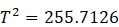
·
Converted
F-statistic:

which follows
approximately F_(6," " 4)under H_0.
·
p-value
(from F_6,4):

Decision: since
p=0.0066<0.05, we reject the null hypothesis H_0(that the mean vector of
differences is zero). In plain words: there is a statistically significant
multivariate change in these landmarks after the intervention.
DISCUSSION
The present study
developed and applied an image-based analytical model to evaluate postural
improvements resulting from yoga practice. Using computer vision and pose
estimation algorithms, 3D skeletal landmarks were extracted from images of
participants performing specific yoga postures before and after a one-month
training period. The extracted landmark coordinates were analyzed statistically
using Hotelling’s T² test to detect significant multivariate changes in body
alignment.
The results
revealed that the test statistic exceeded the critical F-value, leading to
rejection of the null hypothesis. This confirms that the mean positions of the
selected body landmarks changed significantly after the yoga intervention.
Among the twelve original landmarks studied, six were analyzed in detail using
the symmetry test approach (elbows, shoulders, and knees). The largest
contributions to the multivariate difference were observed in the left and
right knees, followed by moderate differences in the shoulder regions. These
outcomes are consistent with the biomechanical effects of yoga, which emphasize
flexibility, balance, and muscular engagement in the lower body.
The integration of
computer vision with statistical inference offers an objective method to
evaluate human postural changes — something that traditional observational
assessment lacks. The 3D visualization of skeletal joints helped to clearly
illustrate the improvement in alignment and symmetry, validating yoga’s
physical benefits through quantifiable evidence. Furthermore, this approach
demonstrates that image-based pose analysis can be a reliable non-invasive
technique to measure progress in fitness and rehabilitation settings.
Despite these
encouraging findings, some limitations exist. The sample size of ten subjects
for the image-processing part was relatively small, and individual variation in
camera angle, lighting, or clothing might have affected landmark detection
accuracy. Additionally, the Hotelling’s T² test assumes multivariate normality,
which may not hold perfectly for small datasets. Future studies with larger
samples and multiple postures could help refine the statistical power and
generalizability of the model.
CONCLUSION
This study
successfully demonstrated that image processing combined with multivariate
statistical analysis can effectively measure the physical effects of yoga on
human posture. The developed Python-based model was capable of recognizing yoga
poses, generating corresponding 3D skeletons, and extracting precise joint
coordinates for further analysis. By applying Hotelling’s T² test to the
extracted landmark data, significant improvements were detected after one month
of yoga practice, especially in knee and shoulder symmetry.
These findings
confirm that consistent yoga practice leads to measurable physical improvements
in posture and alignment, and that computer vision can serve as a practical
analytical tool for tracking such progress. The work bridges traditional yoga
science with modern data analytics, offering a reproducible, data-driven
framework to evaluate human body dynamics.
RECOMMENDATIONS
1)
Expand
Dataset: Future research should include a larger number of participants and
multiple yoga postures to increase the robustness and generalizability of
results.
2)
Improve
Image Quality and Angles: Controlled image capture (uniform lighting,
consistent camera distance, and background) can enhance landmark detection
accuracy.
3)
Integrate
Real-Time Feedback: The pose recognition system can be extended to provide
real-time correction feedback during yoga practice using live camera input.
4)
Use
Advanced Models: Deep learning-based models such as OpenPose, BlazePose, or
MediaPipe Holistic can be incorporated for more precise landmark tracking and
3D visualization
ACKNOWLEDGMENTS
None.
REFERENCES
Anusha, N., Prabhu, S. S., and Poojari, S. S. (2025). Yoga Pose Detection. AIP Conference Proceedings, 3278(1), 020016. https://doi.org/10.1063/5.0185767
Comprehensive Analysis of Pose Estimation and Machine Learning for Yoga. (2025). Procedia Computer Science.
Cramer, H., Lauche, R., Langhorst, J., and Dobos, G. J. (2013). Yoga for Depression: A Meta-Analysis. Depression and Anxiety, 30(11), 1068–1083. https://doi.org/10.1002/da.22166
Deeb, J., Morel, P., Ferrer, N., and Gurrutxaga, I. (2018). Real-Time Yoga Posture Recognition by Learning Key Human Pose Features. Journal of Healthcare Engineering, 2018, Article 435146.
Jain, S., Surange, S., and Jain, S. (2015). Yoga Pose Recognition Using Image Processing and Machine Learning. International Journal of Computer Applications, 117(6), 1–6. https://doi.org/10.5120/ijca2015907083
Kishore, D. M., Bindu, S., and Manjunath, N. K. (2022). Estimation of Yoga Postures Using Machine Learning Techniques. Yoga Mimamsa, 54(2), 92–97. https://doi.org/10.4103/ym.ym_52_22
Li,
A. W., and Goldsmith, C. A. (2015). The Effects of Yoga on Anxiety and Stress. Alternative Medicine
Review, 17(1), 21–35.
Madhavi,
M., Shashank, V., Vaishnavi, R., and Abhinav, S. (2024). Identification and Correction of
Yoga Poses using CNN. International Journal for Research Trends and Innovation,
9(6), 268–276.
Mohan, C., Saini, A., and Vasudevan, S. (2020). Automated Yoga Posture Classification Using Transfer Learning from Pose Estimation. In Proceedings of the International Conference on Pattern Recognition (ICPR).
Parkhi, O. M., Vedaldi, A., and Zisserman, A. (2015). Deep Face Recognition. In Proceedings of the British Machine Vision Conference (BMVC). https://doi.org/10.5244/C.29.41
Pramanik,
T., et al. (2021).
A Study of Yoga Pose Estimation using Deep Learning. IEEE Access, 9,
140329–140344.
Raghavendra, S., Kanchan, K., and Rao, P. (2019). Effects of Guided Yoga Intervention on Body Alignment and Stress: A Yoga Pose Recognition Study. Complementary Therapies in Medicine, 46, 227–232.
Shailesh, J., and Jose, L. (2022). Yoga Pose Estimation and Feedback Generation Using Deep Learning. Computational Intelligence and Neuroscience, 2022, Article 4311350. https://doi.org/10.1155/2022/4311350
Wu,
P., Wang, L., and Zhang, Y. (2016). Automatic Recognition of Yoga Poses Using CNN and Transfer Learning.
Procedia Computer Science, 96, 313–321.
Wu, Y., Kiritchenko, Y., and Strohband, V. (2017). Facial Pose Estimation Using Convolutional Neural Networks.
 This work is licensed under a: Creative Commons Attribution 4.0 International License
© Granthaalayah 2014-2026. All Rights Reserved.