Original Article
Lexicographical Study of the Axomia Sadri Language: A Learners’ Dictionary of The Axomia Sadri Language
|
Dr. Iftikar Ali Ahmed 1* 1 Research Scholar, Department
of English, The Assam Royal Global University, Guwahati 781035, India |
|
|
|
ABSTRACT |
||
|
Studying lexicography is essential because it makes it possible to produce precise, userfocused dictionaries that improve communication and language competency. In addition to facilitating translation and digital language technologies, it provides a basis for language preservation, standardisation, and educational advancement. The Axomia Sadri language, an Indo-Aryan language that is an essential lingua franca for the "tea tribes" (Adivasi population) in Assam, is the subject matter of the study. The study details the Axomia Sadri language, which is in danger of becoming extinct due to its strong impact from Assamese and other prominent languages. The research comprises a grammatical sketch that covers the syntax, morphology, and phonology of the language. The core output of the work is "A Learner's Dictionary of Axomia Sadri," a monolingual dictionary with English glosses containing 400 words. The study emphasises the importance of this kind of documentation for revitalisation and preservation of minority language. Keywords: Lexicography, Axomia Sadri Language, Learners’ Dictionary, Language Preservation, Language Revitalisation, Minority Languages |
||
INTRODUCTION
The Sadri language
used to be a populated language of the Chota Nagpur plateau. It is an
Indo-Aryan language belonging to the Indo-Iranian language family. The origin
of the language is in the Chota Nagpur Plateau. It was the language of the Sadans, an Aryan group amongst the non-aryan
groups of the Chota Nagpur Plateau Navarangi (1965:5). It was also the lingua franca among the
Adivasis living in and around the Chota Nagpur Plateau that spreads over
present day Bihar, Jharkhand, Chattisgarh and parts
of West Bengal and Orissa.
Lexicography is
the art and craft of making dictionary. The dictionaries are the repository of
words. It helps one in comprehending a language, learning the correct spellings
of the words of the language as well as using them in the suitable contexts. The
impact of globalization has expanded the scope of inter-community
communication, thereby exposing one to languages other than one‟s
own native tongue. A Dictionary is an integral part of language learning
process. Different types of dictionaries are prepared for serving different
purposes at different times. Dictionaries are probably the only resource which
can give us the best and most comprehensive information about the words or
terminologies of a language or a certain field.
This study
primarily attempts to compile “A Learner’s Dictionary of Axomia
Sadri” and also to provide a basic grammatical and social sketch of the Axomia Sadri Language and its community. “A Learner’s
Dictionary of Axomia Sadri” is a monolingual
dictionary which also includes English glosses. Each entry in the dictionary
consists of Head Word, Phonetic Form, English Gloss, Word Class, Example of Axomia Sadri and English gloss of the Axomia
Sadri example. The dictionary consists of 400 words including nouns, verbs,
adjectives, adverbs and other lexical parts of speech.
Significance of the Study
Language is a
distinguishing attribute of individuals. The language of a community serves as
the cornerstone of its unique attributes, encompassing culture, history,
ceremonies, rituals, and more. Individuals within a community have an identity
crisis when their language faces the threat of extinction. A Dictionary can
provide a way towards preservation of a language. The researchers' endeavour to
investigate the basic grammatical features and social life of the Axomia Sadri language and its community and attempts to
compile ‘A Learner’s dictionary of the Axomia Sadri
Language’ so that it could help the community in preserving and restoring their
language in the present time as well as in the future.
Review of Related Literature
During the days of
the British Rule, after the discovery of tea plants in Assam, the British
officers brought a group of people from the Chota Nagpur plateau area to Assam
as labourers in their tea-gardens. They were the native speakers of Sadri
language. After settling in Assam, the Sadri people found it difficult to
interact with the local peoples of Assam. So, they have to adopt a pidgin which
was a combination of Assamese and Sadri. The reason for adopting the pidgin
were the difficulties they faced in communication. As a result, the pidgin was
gradually adopted as the mother tongue among the tea-tribe community and it
became creolized and got the status of a language. The language was used as the
lingua franca between the tea-garden labourers and the natives of Assam. The
result of this adoption led to the convergence of the Sadri language into
Assamese. But it did not converged totally into
Assamese and retained some of its phonological, morphological and syntactical
features and used to be called a variety of Sadri language, i.e. Axomia Sadri.
The native
speakers of Sadri are found in all parts of Assam. They mostly inhabit in the
districts of Tinsukia, Dibrugarh, Sivasagar, Jorhat, Golaghat, Nagaon, Sonitpur and
Lakhimpur of Assam. Some of them are also found in parts of Sadia, Kamrup, Goalpara and Kokrajhar districts of Assam. Toppno (1999), states that there are about 845 tea
gardens in Assam where Axomia Sadri is spoken and is
the mother tongue of the speakers.
The tradition of
making dictionary is very old. The traditional lexicography of earlier times
was arguably a distinct endeavour from the lexicography based on field work
nowadays. Traditional lexicography was based on a massive corpus or earlier
dictionaries. It started first in China in the 1st and 2nd century during the
reign of Han dynasty. ‘Shuowen Jiezi’ was the first
remarkable work on lexicography compiled by Xu Shen which became the foundation
for all other subsequent work on lexicography. It was a compilation of the
information about the origins, meanings and pronunciations of the Chinese
words.
In India, the
tradition of making dictionaries began over two thousand years ago. Sanskrit
dictionaries and Thesaurus are the evidence of long tradition of native
lexicography practices in Indian languages. There are three terms nighantu, kosha and nirukta which
are particularly relevant in Indian lexicographic tradition. Nighantu means
lexicon and nirukta means explanation. Nighantu gives
the explanations of obscure, rare and difficult words found in the Vedic texts
for easier understanding of the Vedic texts. Kosha is literally the storehouse
which was written in verse in the early time. It contains entries for nouns and
in declinable forms but not verbs. The best work among such Koshas is the “Amorkosha” by Amarasinha, a Buddhist scholar.
In medieval
Europe, lexicography originated (rather re-invented itself) in the form of
compilations of the interlinear vernacular glosses in Medieval Latin. The word
“Dictionary” was used as ‘Dictionarous’ meaning “of
words‟ in the 13th century by an Englishman John
Garland and the
word ‘Dictionarium’ was used in the 14th century. The
first English titled Dictionary was ‘Latin-English Dictionary’ by Sir Thomas Elyot (1538). The first monolingual
dictionary of English was ‘A Table Alphabetical’ by Robert
Cawdrey (1604), consisting of
3000 entries.
Samuel Johnson compiled an English dictionary more than hundred years later in
1755 named ‘The Dictionary of English Language’, consisting of over 42000
entries. It was the most comprehensive reference text until the first
publication of the great ‘Oxford English Dictionary’ in 1884. There were some
other dictionaries in English, published during the 18th and 19th century,
namely, James Buchanan’s ‘Linguae Britannicae’ (1757), Thomas Sheridan’s “A General Dictionary
of the English Language‟ (1780). Dash (2015)
The word
“Lexicography” is derived from the Greek word lexicos
means lexeme and graphe means writing. The word
lexicography was used in English in 1680. It is an art and craft of making
dictionary. It describes the linguistic as well as technical aspects of making
a dictionary. A dictionary always depicts the socio-cultural aspects of a community
as well as its language. Many scholars have given so many different definitions
on lexicography. A few of those are discussed as follows:
According to the
Concise Oxford Dictionary for Current English (1998), a dictionary is “A book
that deals with the individual words of a language (or certain specified class
of them) so as to set forth their orthography, pronunciation, signification and
use, their synonyms, derivation and history, or at least some of these facts;
for convenience of reference the words are arranged in some stated order, now
in most languages, alphabetical, and in larger dictionaries the information
given in illustrated by quotations from literature”.
According to
Cornelis Christiaan Berg, “A dictionary is a systematically arranged list of
socialized linguistic forms compiled from the speech-habits of a given
speech-community and commented on by the author in such a way that the
qualified reader understands the meaning […] of each separate form, and is
informed of the relevant facts concerning the function of that form in its
community” Filipec (1971).
According to
Richard Chenevix Trench, “A dictionary is an inventory of the words of a
language (with explanation of meaning and other information)”. (ed. Allan
(2013))
Rationale and Aims of the Study
An examination of
the literature review indicates that the importance of dictionary is immense.
It plays a vital role in comprehending a language properly as well as helps in
disciplines like literature, culture, education, etc. With time, lexicography is
being developing and expanding its scope. In future, hope we will get much
developed and modern dictionaries. Nowadays, various softwares
are created to compile advanced dictionaries easily. The researcher intends to
study the grammatical sketch and the social life of the Axomia
Sadri
Language and its
community to provide an introduction of the community to the world and provide
the community with a compiled dictionary of their mother tongue. A particular
focus of this research article is compile a Learners’
Dictionary. The research paper aims to achieve the following:
·
To
explore the Axomia Sadri language and its community
to study its grammatical features and to provide a gist of the social life of
the community.
·
To
compile “A Learners’ Dictionary of the Axomia Sadri
Language”.
Methodology
This study employs
the descriptive survey approach, collecting information from both primary and
secondary sources. The core data for the study came from the fieldwork that was
conducted in the Charaideo, Sivasagar
and Dibrugarh districts of Assam, India, specifically in the 3 Tea Estates,
namely, Khoomtaie Tea Estate, under Assam Tea Company
Limited
(Sivasagar), Hingrijan Tea Estate,
under Andrew Yule & Company Limited (Charaideo)
and Moran Tea Estate, under Mcleod Russel Group
(Dibrugarh). Fieldwork has been carried out based on events that have occurred
across all of the available platforms of language usage, including political
gatherings, educational institutions, social community functions, public areas,
and so on. Secondary data have been gathered from the literary and linguistic
works on the Axomia Sadri as well as on the Sadri
language and the theme genre that are pertinent to the research issue. These
works have been read in order to gather information. The dictionary was
compiled with the help of Lexique Pro,
Toolbox/Shoebox and PhoTrans Edit softwares.
Lexique Pro is an interactive lexicon viewer, with
hyperlinks between entries, category views, dictionary reversal, search, and
export tools. It can be configured to display your Toolbox/Shoebox database in
a user-friendly format so that you can distribute it to others. It’s simple interface allows the user to build a dictionary
from scratch rather effortlessly, compared with the cumbersome Toolbox setup.
APA 7th edition citation stylesheet has been used throughout the research work.
IPA has been used for the transcription purpose.
Grammatical Sketch of the Axomia Sadri Language
There are 23
consonant phonemes found in the Axomia Sadri language
that contrasts each other in minimal pair sets. Among them are non-aspirated
plosive, aspirated plosive, nasal, tap, fricative and lateral. The consonant
chart of Axomia Sadri Language is as follows:
|
Figure 1
|
|
Figure 1 Table showing
Consonants of the Axomia Sadri Language |
There are 8
monophthongs and 8 diphthongs found in the Axomia
Sadri language. The vowel chart of Axomia Sadri
Language is as follows:
|
Figure 2
|
|
Figure 2 Table showing
Vowels of the Axomia Sadri Language |
·
Monophthongs:
There are eight monophthongs in the Axomia Sadri
language.
These are /i/, /e/, /a/, /ɑ/, /ɔ/, /o/, /u/ and /ə/.
/ i / - gari ‘car’
/ e / - gʰɔre ‘gʰɔr-e’
‘house-LOC’
/ a / - bagan ‘tea-garden’
/ ɑ / - tɑmɑm ‘ultimate’ /
ɔ / - kɔrɔm ‘Korom Puja’
/ o / - oidige ‘that side’ (proximal)
/ u / - u ‘he’
/ ə / - galəbɔn ‘garland’
·
Diphthongs:
There are eight diphthongs found in the Axomia Sadri
language. These
are /ei/, /ui/, /oi/, /ɔi/, /ai/, /iu/, /ou/, /eu/, /au/, /ia/, /ua/, /ea/.
/ ei / - zakei ‘emphatic marker’ /
ai / - zamai ‘Son-in-Law’
/ ui / - mui ‘me’ / ou / - outa ‘that’ (distant)
/ oi / - tʰoila
‘sack’ / ia
/ - matia ‘brown’
/ ɔi / - bɔhnɔi ‘Co-parents-in-Law’ / ua / - bedʰua ‘widow’ (male)
There are two
syllable structures in Axomia Sadri language. They
are monosyllabic and disyllabic. The possible syllable structures are as
follows:
·
V
structure
·
CV
structure
·
VC
structure
·
CVC
structure
·
VCV
structure
·
VCVC
structure
·
CVCV
structure
·
CVCVC
structure
The Axomia Sadri language is an Indo-Aryan language. Like most other Indo-Aryan languages, Axomia Sadri also follows the SOV word order. The verb is in the sentence final position and the object follows the subject. Axomia Sadri language is both agglutinating and inflectional in nature.
For instance,
S O V ram bagh-ta-ke marde-l-ek
Ram.NOM tiger-CLS-ACC kill.give-PST-AGR
‘Ram killed the
tiger’
The Axomia Sadri language have three tenses; present, past and
future. As it is an inflectional language, tense are
marked by inflectional suffixes. For example,
·
Present Tense:
|
|
mui bhat |
|
kha-il-a |
|
|
I.NOM food ‘I eat food’ |
|
eat-PRS-AGR |
|
|
usɔb bhat |
|
kha-il-a |
|
|
They.NOM food ‘They eat food’ |
|
eat-PRS-AGR |
|
§ |
Past Tense: |
|
|
|
|
mui bhat |
|
kha-l-i |
|
|
I.NOM food ‘I ate food’ |
|
eat-PST-AGR |
|
|
usɔb bhat |
|
kha-l-ek |
|
|
They.NOM food ‘They ate food’ |
|
eat-PST-AGR |
|
§ |
Future Tense: |
|
|
|
|
mui bhat |
|
kha-m |
|
|
I.NOM food |
|
eat-FUT |
‘I will eat food’
usɔb bhat kha-b-en
They.NOM food eat-FUT-AGR
‘They will eat
food’
The Axomia Sadri language is predominantly an inflectional
language with certain amount of agglutinating feature. Inflectional is a
morphological feature in which words are formed with the help of inflectional
and derivational suffixes. The agglutinating feature is also found in the
language where linear sequences of free morphemes are used to form a single
word.
For instance,
|
Verb + suffix
|
kha-l-ek eat-PST-AGR |
|
‘ate’ |
|
Adjective + suffix |
notun-se new-ADV |
|
‘newly’ |
|
Verb + Verb + Suffix |
mar-de-l-ek |
|
‘killed’ |
On the basis of
the analysis, the grammatical sketch provides us a picture that the phonemic
inventory of the Axomia Sadri language consists of 23
consonants; 8 vowels, which are both rounded and unrounded along with 8
diphthongs. The syllable structure of the Axomia
Sadri language is disyllabic. It follows the SOV word order. The tense system
in Axomia Sadri as it has all the three tenses;
present, past and future. Being an inflectional-agglutinating language, words
are formed by adding affixes to the root or stem.
Social Life of the Axomia Sadri Community
The Tea-garden
labourers (Adivasi), with its distinct customs and practices, rituals and
social beliefs, is a community with a rich socio-cultural heritage. It has a
patriarchal system.
The property of
the ancestors is inherited by the male child. Now a days, females are also
given equal rights as the male, but still, the male is always preferred than
the female. Early age marriage or Child marriage is prevalent in the community.
In Assam, we can
find 3 different varieties of Axomia Sadri. It is due
to the impact of the dominating language or mostly spoken language of the
areas. The variety found in Dibrugarh, Tinsukia and some parts of Sivasagar district is called as Axomia
Sadri. The variety found in Jorhat, Golaghat and most
of the parts of Sivasagar districts are called as
Oriya Sadri. The variety found in the districts of Nagaon, Sonitpur,
Lakhimpur, Kamrup, Goalpara and Kokrajhar are called
as Puruliya Sadri. The names of these varieties were
given by a native speaker and he stated that the variation are
divided in terms of lexical borrowing. In Oriya Sadri, many lexical borrowings
from the Oriya language are found. Likewise, in Assam Sadri and Puruliya Sadri, lexical borrowings from Assamese and
Bengali respectively are found. The language though is used as the lingua
franca across the state of Assam, it has variations. For instance, the Axomia Sadri, i.e. the variety spoken in Dibrugarh,
Tinsukia and some parts of Sivasagar districts, is
different from the Puruliya Sadri, i.e. the variety
spoken in the districts of Nagaon, Sonitpur,
Lakhimpur, Kamrup, Goalpara and Kokrajhar.
The Adivasi
community in Assam has its own traditional cultures and rituals. They primarily
celebrate two types of Puja viz. Korom Puja and Tusu Puja. They also celebrate Rongali
Bihu, Kongali Bihu, Bhugali
Bihu, Durga Puja and Diwali(Kali Puja) as they are now
assimilated with the indigenous Assamese community of Assam. A brief account of
the primary festivals of the community are as follows:
1)
Korom
Puja: Korom is the worship
of Korom-Devota, the god of power, youth, and youthfulness. The Korom festival
is an agricultural festival. The festival is held on the 11th day of a full
moon (Purnima) of the Assamese month of Bhado, which
falls between August and September. Groups of young villagers go to the jungle
and collect wood, fruits, and flowers. These are required during the puja
(worship) of the KoromDevota. The Karam tree,
scientifically named Nauclea Parvifolia
is the center of the proceedings of the festival. The
preparations for the Karam festival begin around ten or twelve days before the
festival. During this period, people sing and dance together in groups.
|
Figure 3
|
|
Figure 3 Korom Puja
Celebrations |
2)
Tusu Puja: Tusu Puja is one of the important festivals
of the Tea Tribes of Assam. It is celebrated in the Assamese month of Magh,
which falls between January and February. They worship Goddess Tusu during this festival. The festival is also celebrated
beautifully by the dwellers of the tea gardens of Assam like other folk
festivals. During Tusu Puja, sculptures make statues
of Goddess Tusu and people beautifully decorate it
with mud and flower. Young boys and girls carry the statue from house to house
singing and dancing. The young girls of the community dress in their
traditional attire and tie handkerchief on their hands and dance with the
rhythm of the music and instruments. Goddess Tusu is
popular among the tea tribes who symbolize kindness, virtue, love and
sacrifice.
|
Figure 4
|
|
Figure 4 Tusu Puja Celebrations |
The Adivasi
(Tea-Tribe) community donot have any different type
of dress for their day to day life. The females wear
Mekhela Sador, Saree, Salwar and now a days they wear western clothes too. The
males wear half trousers clubbed with Vests most of the time as they work in
the tea-gardens. The youth wears normal dress in their day to
day life like Jeans, Trousers, Shirts, T-Shirts, etc. They have their
own traditional dress for festivals like Korom Puja, Tusu
Puja, etc. The female wear white Saree with Red
borders (which they call in their language as “boga
sari lal pari”), ornaments and ties a red handkerchief
in both of their wrists. The male wear white Kurta clubbed with white dhoti and
ties a Gamusa in their head. They wear their
traditional attire at the time of performing the Jhumor
Dance which is their traditional dance.
|
Figure 5
|
|
Figure 5 Jhumor Dance Performance in the Traditional Attire |
The Adivasi people
are mostly uneducated. In present day, the rate of literacy is increasing but
most of the children fail to attain higher studies. The cause behind it is
means of livelihood. They work in the tea-garden as daily wage labourers and
that is the only source of their livelihood. Once the elder of the house
retires from its job, the son or the daughter has to work in place of his/her
father or mother to earn livelihood. This is the main reason why children have
to leave their studies in the midway. Most of the students are either
matriculate or below. There are a few post-graduate and graduate students in
their community. The primary occupation of the people is to work as tea-garden
labourers. Some of them are also indulged in agriculture, carpentry, business,
etc. A few of them have government jobs or private company jobs.
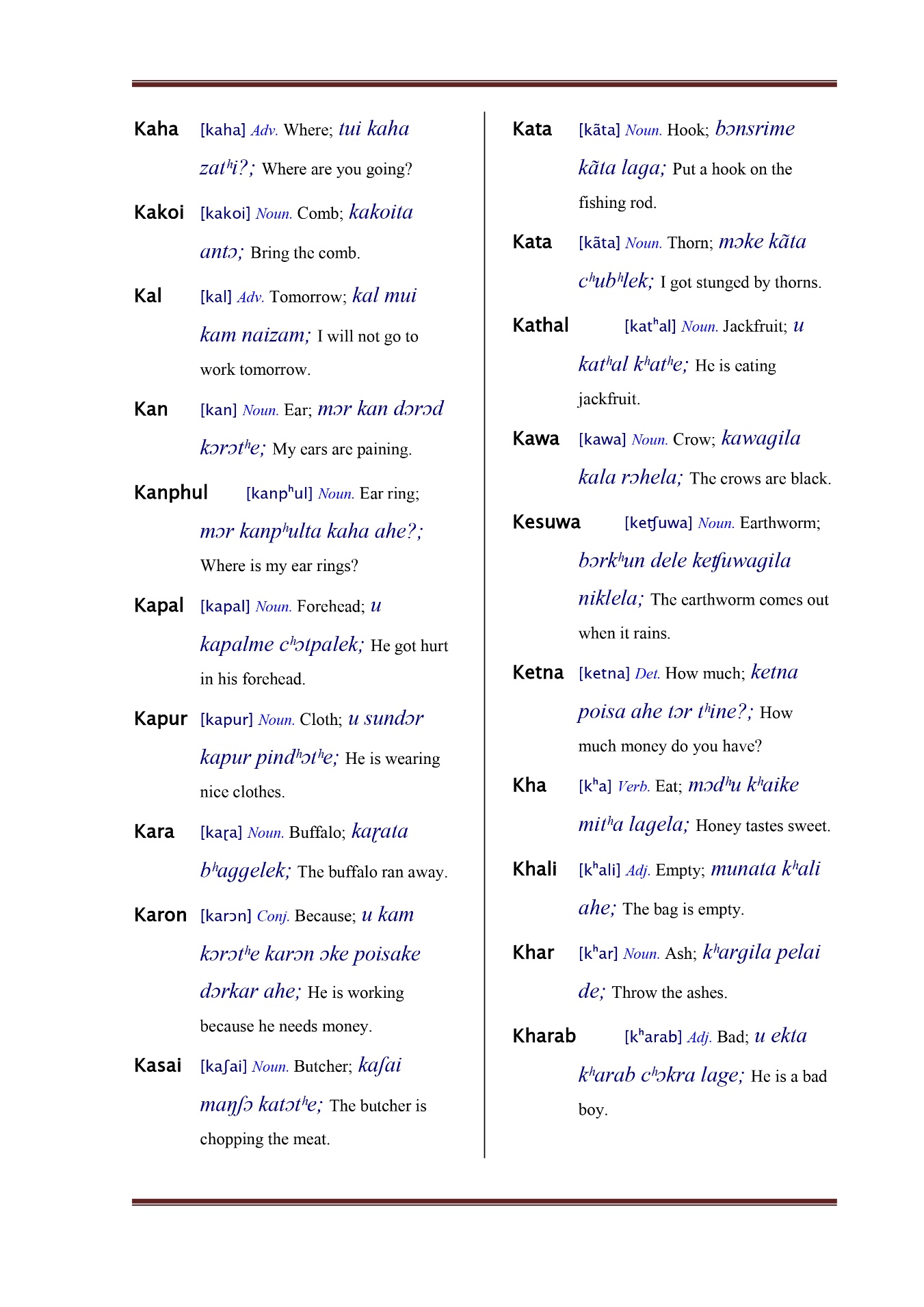
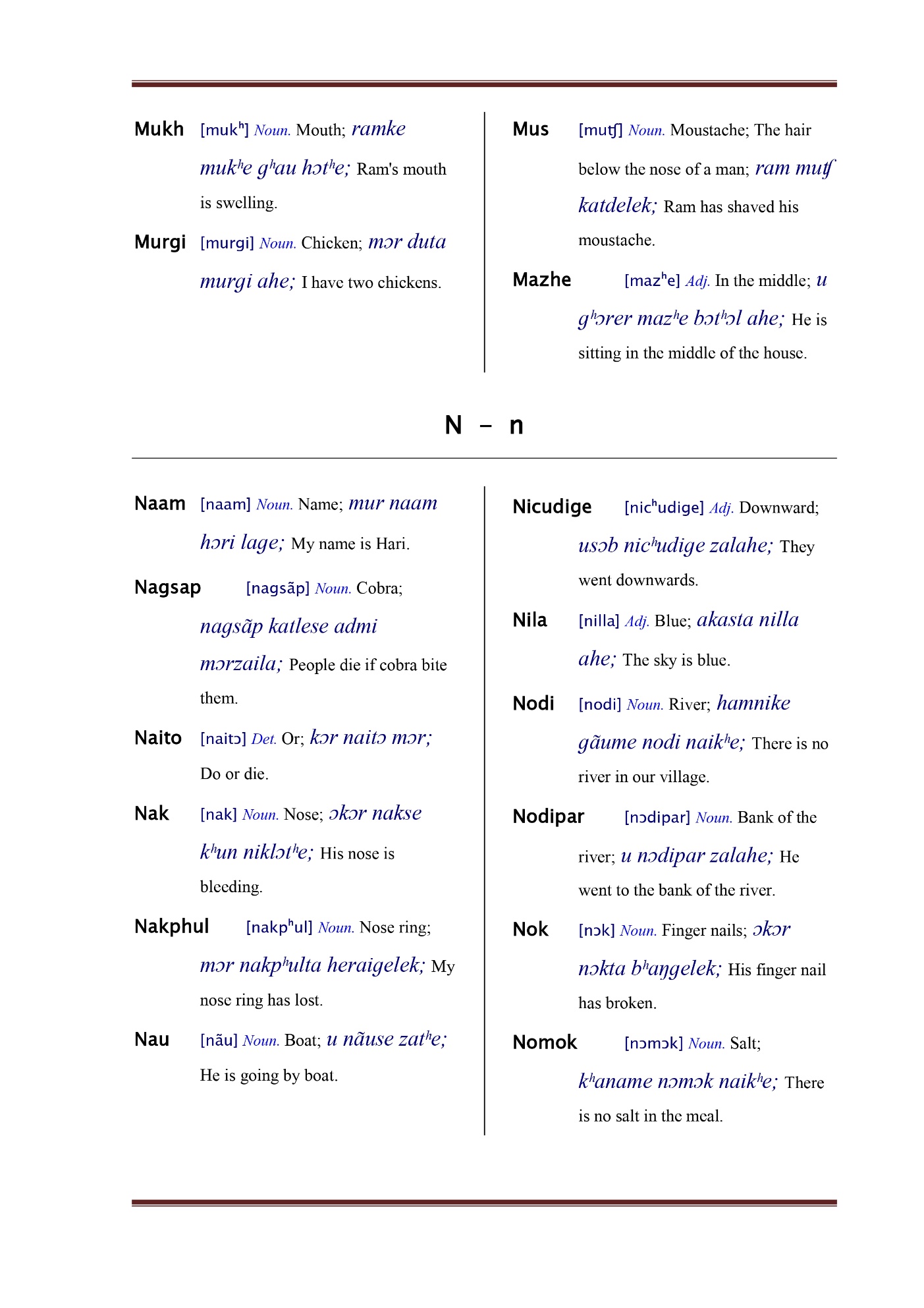
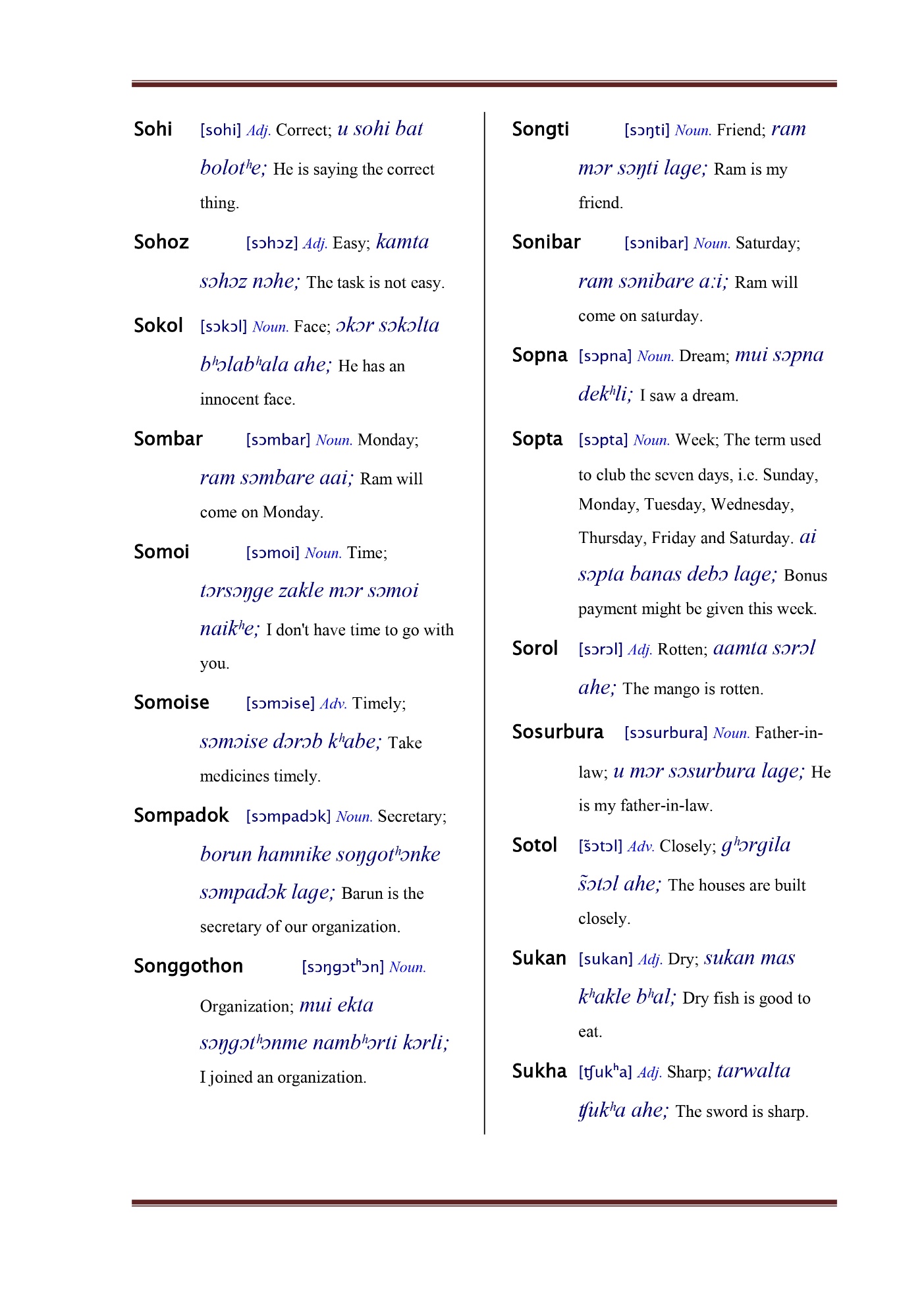
A Learners’ Dictionary of the Axomia Sadri Language
This research
primarily focuses to compile “A Learner’s Dictionary of Axomia
Sadri Language”. “A Learner’s Dictionary of Axomia
Sadri” is a monolingual dictionary which also includes English glosses. Each
entry in the dictionary consists of Head Word, Phonetic Form, English Gloss,
Word Class, Example of Axomia Sadri and English gloss
of the Axomia Sadri example. The dictionary consists
of 400 words including nouns, verbs, adjectives, adverbs and other lexical
parts of speech. The dictionary is also colour coded based on different
entries.
The dictionary
starts from the next page onwards…
|
|
|
|

|
|
|
|
|
|
|
|
|
|
|
|
|
|
|
|
|
|
|
|
|
|
|
|
|
|
|
|
|
|
|
|
|
|
|
|
|
|

|
|
Conclusion
A dictionary
captures the varied and manifold aspects of a language, and is thereby
reflective of the concepts, assumptions and the world-view of its speakers.
Language, being a representation, invariably carries the abstract and
ideational dispositions of the concerned linguistic community. Since the
dictionary is the repository of a language’s lexical properties and their
semantic possibilities, it has immense importance in documenting and developing
a language.
The Adivasi
(Tea-tribe) people of Assam are basically multilingual. In addition to their
own language, they speak Assamese, Hindi and Bengali language depending on
their different geographical and social context. According to the UNESCO report
the Axomia Sadri language is a vulnerable language.
Most of the Adivasi people adopted the Assamese language as their mother tongue
due to prolonged language contact situation. Assamese language is widely spoken
everywhere. Particularly, the urban elites of the Adivasi community have so far
exhibited an attitude of negligence and disinterestedness to learn and speak
the Axomia Sadri language. Societal factors behind
this are: a perceived feeling of inferiority to speak a ‘powerless’ language of
a marginalized community, its limited scope in enhancing one’s employability,
lack of exposure to environment where the language is ‘alive’, etc. But there
are some areas where people are still retaining their language. They have a
strong positive attitude towards the language. They use the language at home,
work place, informally at schools and colleges, and within their community. The
peoples of remote tea- gardens are the ones who are retaining the use of the Axomia Sadri language. Tea-gardens like, Hojua Tea Estate, Moranhat;
Doba Tea Estate, Sepon; Naharani Tea Estate, Sepon; Jamirah Tea Estate, Dibrugarh; Moheema
Tea Estate, Golaghat; are examples of those tea- gardens which are
retaining the Axomia Sadri
Language in every
possible domain. Although these people will maintain the language in future but
some extensive researches should be done on this language for revitalization.
It should be try to introduce the language in the
primary level schools.
A dictionary helps in the revitalizing process of a language. It helps the speakers to know the accurate pronunciation, spelling and explanation of the words. It would help the present and future speakers of the Axomia Sadri language by providing them a grasp of the different linguistic aspects of the language, thus offering the scope to revitalize the language.
ACKNOWLEDGMENTS
None.
REFERENCES
Allan, K. (Ed.). (2013). The Oxford Handbook of the History of Linguistics. Oxford University Press. https://doi.org/10.1093/oxfordhb/9780199585847.001.0001
Béjoint, H. (2000). Modern Lexicography: An Introduction. Oxford University Press. https://doi.org/10.1093/oso/9780198299516.001.0001
Coward,
D., and Grimes, C. E. (1995). Making Dictionaries: A Guide to Lexicography and the Multi-Dictionary
Formatter (Version 1.0). The COCOON Platform, University
of Paris.
Dash,
N. S. (2007). The
Art of Lexicography. In Encyclopedia
of Life Support Systems (225–276). EoLSS Publishers.
Filipec, J. (1971). Manual of Lexicography. Academia, Publishing House of the Czechoslovak Academy of Sciences.
Görlach, M. (2010). The Oxford History of English Lexicography. Vol. 1: General-Purpose Dictionaries; Vol. 2: Specialized Dictionaries (Ed. A. P. Cowie). Anglia - Zeitschrift für Englische Philologie, 127(2). https://doi.org/10.1515/angl.2009.033
Ilson, R. F. (1985). Dictionaries, Lexicography and Language Learning.
Loránd-Levente, P. (2009). Review of The Oxford History of English Lexicography (Vols. 1–2, Ed. A. P. Cowie). Lexikos, 19. https://doi.org/10.5788/19-0-453
List of Abbreviations

 This work is licensed under a: Creative Commons Attribution 4.0 International License
© Granthaalayah 2014-2026. All Rights Reserved.