CYBERSECURITY RISKS AND MITIGATION
STRATEGIES IN THE INDIAN BANKING SECTOR
Namrata Verma 1
 ,
Dr. Sanyam 2
,
Dr. Sanyam 2
1 Associate
Professor Psychology, Rajkiya Mahavidyalay
Modinagar, Ghaziabad, India
2 Assistant
Professor Cpommerce Rajkiya Mahila Mahavidyalaya
Nagla Kashi, Dhaulana, Hapur
|
|
|
ABSTRACT |
|
|
The
rapid-fire digitalization of fiscal services has significantly impacted the
global fiscal assiduity, particularly the banking assiduity, with significant
changes observed in the fiscal systems of arising husbandry similar as India.
Digital banking, mobile payment systems, and online fiscal services have
bettered the fiscal assiduity’s effectiveness and fiscal addition. still, the
increased use of digital structure has also redounded in exposure to a wide
range of cyber security pitfalls. Cyber security pitfalls similar as
phishing, ransomware, malware, bigwig attacks, and data breaches pose
significant pitfalls to the fiscal assiduity and its guests. The fiscal
assiduity of India has come a seductive target for cybercriminals because of
the increased digitalization of fiscal systems and the high volume of fiscal
deals reused on a diurnal base. This study aims to identify the primary cyber
security pitfalls faced by the fiscal assiduity of India and assess the
effectiveness of the cyber security mitigation strategies espoused by fiscal
institutions. The qualitative system has been used to conduct the study, and
secondary data has been used, which has been attained from the literature
review of colourful publications, reports, and
papers. The results attained indicate that cyber pitfalls in the fiscal
assiduity are rising with the increase in technology, cyberattack
methodologies, and the lack of cyber security mindfulness among the general
public. The results also indicate the part of technology, similar as artificial
intelligence, blockchain technology, and biometric technology, in perfecting
the cyber security of the fiscal assiduity. Eventually, the results attained
in the study are presented with suggestions and recommendations for the
development of an effective cyber security strategy, which can be used to
alleviate cyber security pitfalls and ensure the development of robust cyber
security systems to insure the trustability and responsibility of the digital
fiscal ecosystem of India. |
|||
|
Received 07 December 2024 Accepted 08 January 2025 Published 31 March 2025 Corresponding Author Namrata Verma, Namrata9476@gmail.com DOI 10.29121/granthaalayah.v13.i3.2025.6870 Funding: This research received no specific grant from any funding agency in
the public, commercial, or not-for-profit sectors. Copyright: © 2025 The Author(s). This work is licensed under a Creative Commons
Attribution 4.0 International License. With the license CC-BY, authors retain the copyright, allowing anyone
to download, reuse, re-print, modify, distribute, and/or copy their
contribution. The work must be properly attributed to its author.
|
|||
|
Keywords: Banking, Data Breach, Fiscal Ecosystem,
OTP and MFA |
|||
1. INTRODUCTION
The managing an account division plays a essential portion in supporting
productive development and monetary steadiness. In later times, innovative
development has essentially changed over the operations of keeping money
educate. The development of computerized managing an account administration,
counting web keeping money, versatile keeping money, and genuine- time
instalment frameworks, has upgraded accessibility, comfort, and adequacy for
visitors. India has persevered rapid-fire development in computerized financial
administrations over the once decade. Government venture pointed at advancing
advanced instalments and financial expansion have quickened the relinquishment
of electronic keeping money stages. The including infiltration of smartphones,
tall- speed web network, and monetary innovation comes about has assist
contributed to the development of computerized managing an account
administration. In spite of the multitudinous benefits of advanced
transformation, the developing dependence on advanced innovations has made
unused vulnerabilities in keeping money frameworks. financial educate store and
prepare huge volumes of touchy data, counting client individualities, financial
records, and deal information. In like manner, the keeping money division has
come a essential target for cybercriminals looking for
monetary pick up or key disengagement.
Cybersecurity pitfalls have come decreasingly
advanced and fragile to descry. Cyberattacks comparative as phishing cheats,
malware diseases, ransomware assaults, and information breaches can conceive
critical monetary misfortunes and harm the character of monetary teach. too,
cyber episodes may disturb keeping money operations and weaken open certainty
in computerized monetary administrations. The including complexity of cyber
pitfalls highlights the require for vigorous cybersecurity textures inside the
managing an account segment. Viable cybersecurity techniques bear a combination
of mechanical comes about, nonsupervisory oversight, danger operation hones,
and cybersecurity mindfulness among specialists and visitors.
This think about points to
look at the cybersecurity pitfalls confronted by the Indian managing an account
division and gauge relief procedures that can improve cyber flexibility. By
assaying being investigation and assiduity reports, the paper gives
perceptivity into the advancing cybersecurity topography and distinguishes
certain comes about for reinforcing keeping money security.
2. Problem
Statement
The fast extension of computerized keeping money
administrations in India has altogether expanded the introduction of money
related educate to cyber dangers. Whereas banks have received different
mechanical arrangements to move forward operational proficiency, numerous teach
still confront challenges in actualizing comprehensive cybersecurity
frameworks.
Cyberattacks focusing on keeping money frameworks
have gotten to be more visit and advanced, posturing genuine dangers to money
related soundness, client security, and regulation notoriety.
Despite executive trials and innovative marches,
multitudinous banks do to battle with cybersecurity vulnerabilities.
Subsequently, there is a require to methodicallly
look at the cybersecurity dangers influencing the Indian managing an account
division and assess compelling relief strategies.
3. Literature
Review
3.1. Cybersecurity in Monetary Systems
Cybersecurity alludes to the assurance of computer
frameworks, systems, and advanced data from cyber dangers and unauthorized get
to. Agreeing to Anderson
et al. (2019), cybercrime has gotten
to be one of the most noteworthy dangers confronting advanced budgetary
frameworks. The expanding reliance on computerized framework has extended the
assault surface for cybercriminals.
Financial educate are especially helpless to
cyberattacks since they oversee important budgetary resources and touchy
information.
3.2. Computerized Managing an account and Cyber Risk
The computerized change of money related
administrations has presented various mechanical advancements in the keeping
money segment. Arner et
al. (2017) contend that fintech
advancements have altogether progressed popular consideration and functional
proficiency. In addition, these advances have also posed a number of
cybersecurity challenges.
The integration of protean keeping plutocrat
operations, pall computing stages, and third- party plutocrat related
administrations has expanded the complexity of keeping plutocrat fabrics and
extended implicit section focuses for cyberattacks.
3.3. Common Cyber risks in Banking
Research thinks about recognize a few major cyber
dangers influencing the keeping money segment. Phishing assaults are among the
most common troubles, as cybercriminals use deceiving communication strategies
to get secret data from guests Hadnagy
(2018).
Malware assaults and ransomware occurrences are
moreover predominant dangers that can compromise managing an account framework
and disturb money related operations. Agreeing to Romanosky
(2016), ransomware assaults
have expanded essentially in later a long time, especially in businesses taking
care of delicate budgetary information.
Table-1
|
Table 1 Major cybersecurity Threats in
Banking Sector in India |
||
|
Cyber Threatt |
Description of Cyber Threat |
Impact on Banking System |
|
Phishing |
Fraudulent E-Mail or messages are used to steal
login credentials |
Unauthorised account access |
|
Malware |
Malicious software is installed that infiltrates
the banking system |
System is compromised and data theft |
|
Ransomware |
Data is encrypted and ransom demand |
Operational disruption |
|
Data Vulnerability |
weakness in system, software or human processes |
unauthorised access to sensitive information of
individual or corporate |
|
Insider Threat |
Authorised access is misused by employees |
Data leaks and financial frauds |
|
Sim Swapping |
Mobile number is fraudulently transferred to
attackers |
OTP interception and account is takeover by
attackers |
4. Research
Methodology
4.1. Research Design
The study is based on qualitative research design
so as to analyse the cybersecurity risk and mitigation strategies in the
banking sector of India. The qualitative approach allows an in-depth
examination of cybersecurity challenges and solutions on the bases of existing
literature and industry data.
4.2. Data Collection
The secondary data was used in the study which
collected from-
·
Academic Journals accompanying cybersecurity,
FinTech and Digital Banking System
·
Government reports on banking
·
Industrial publication
4.3. Objectives of Study
·
To Identify and analyse major types of cyber
risks faced by banks
·
To suggest suitable strategies and best
practices for strengthening cyber risk management
5. Risk of
Cyber Security in Indian Banking System
5.1. Phishing and Social Engineering
It is an attempt to pilfer sensitive information
of customer by pretending to be trustworthy. The customer might get an E-Mail
that looks like it is from the bank or customer may get a text message saying
his delivery needs confirmation. it looks like normal but behind it is a
fraudster. Without social engineering phishing is not possible to be succeed
its helps to understand how individuals respond under pressure. Psychology is
more often used by attackers than technology.
Phishing isn't just one method instead takes many
forms-
·
E-Mails containing fake links
·
Text messages containing links to harmful
websites
·
Phone calls in which the caller claims to be an
official
·
Social media chats asking for personal
information
Preventions strategies from phishing attacks
·
Anti-phishing plug-ins can be used that warn
before clicking a harmful link
·
E-Mail gateways can be used so as to filter
suspicious content
·
Training Programs can be organised that simulate
phishing attacks to prepare employees
5.2. Malware and Banking Trojans
Malware is malicious software that is designed to
disrupt, damage or steal sensitive information from user's device. Banking
trojans is also a malware that is specially designed to target online banking
platforms and capture login credentials, debit card/credit card information One
Time Passwords (OTP) and Multi Factor Authentication (MFA) codes, session data
and device fingerprints etc. Banking trojans target those users and
organisations that regularly access financial services online. The common banking
trojans are- Zeus(Zbot), TrickBot, Emotet, Dridex and Mobile banking trojans.
Preventions Strategies from Malware and banking
trojans-
An individual can prevent himself from malware and
banking trojans by avoiding phishing, keeping software update, using security
tools, by enabling MFA code and regularly monitoring accounts.
5.3. Ransomware Attacks
With over 10% of all the data breeches, ransomware
attacks are currently third most popular type of malware. It is type of malware
which is used as a tool to pilfer sensitive information and essentially hold it
hostage. the data is only released after cyberattackers
get ransom payment. Once the ransomware enters into the computer it infects it
covertly. The software then attacks files and accesses and modifies the
credentials. Consequently, the person who control the malware holds hostage the
computer infrastructure.
Preventions Strategies from Ransomware Attacks
Ransomware attacks can be prevented by-
·
Keeping devices updated
·
Always install software from trusted and
verified sources
·
Installation of antivirus protection in devices
·
Always have Back-Up of data
·
Provide training employees
5.4. Data Vulnerability
Data vulnerability is a weakness in system,
software or human processes like unpatched software, use of weak passwords or
phishing. Data vulnerability allows unauthorised access to sensitive
information of individual or corporate.
Preventions Strategies from Data Vulnerability
preventions can be used-
·
keep updated software regularly
·
Use of strong passwords and MFA
·
Provide training to employees
·
Limit access user and permissions
5.5. Internal Threats
Every organisation has people who have authorised
access to its system and network these people might be present employees,
former staff, consultants, board members or business partners. An insider
threat occurs when someone having authorised access uses it to compromise the
organisation's cybersecurity intentionally or unintentionally. Insider threats
are intentional, unintentional, collusive threats, third party threats and
malicious threats.
Preventions Strategies from Insider threats-
·
Access control and least privilege
·
Implementation of regular monitoring and
auditing of user activities
·
Deployment of data loss prevention (DLP) tools
6. Data
Analysis and Results
The incidents of cybercrime in India have
increased significantly in the past decade which is due the rapid expansion of
digital banking platforms, Mobile payment system and online financial services.
As the digital transactions are increasing the cyber criminals are getting more
opportunities to take the advantage of loopholes of financial systems. As per
the NCRB data 2023-25, India experienced a 31% jump in cybercrimes with over
86000 cases reported.
Table 2
|
Table 2 Cybercrime and Financial Fraud
Cases in India |
|||
|
Year |
Reported Cybercrime Case |
Financial Fraud Cases |
Estimated financial Loss (in ₹ Crore) |
|
2019 |
44546 |
12317 |
1246 |
|
2020 |
50035 |
14678 |
1903 |
|
2021 |
52974 |
16112 |
2150 |
|
2022 |
65893 |
18902 |
2750 |
|
2023 |
71468 |
21349 |
3450 |
|
2024 |
80000+ |
25000+ |
4000+ |
|
Estimated are Based on the Cybersecurity
Industry Reports. Source:
NCRB, Cybersecurity Reports by RBI and Cybersecurity Industry Analysis |
|||
Figure 1
|
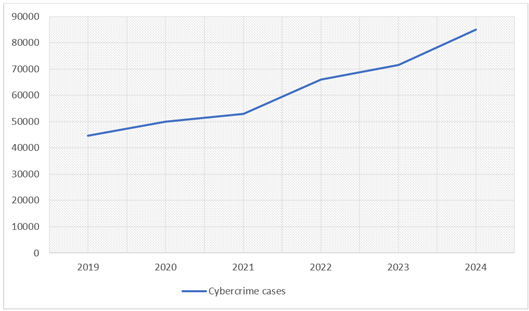
Figure 1 Cybercrime Cases |
From the above table and figure it is clear that
reported cybercrimes and financial fraud have grown steadily each year.
Cybercrime attacks have increased by nearly 80% from 2019 to 2024. This increase reflects the rapid adoption of
digital technology and increased use of online platforms, mobile banking and
digital payments. Financial fraud cases have also risen sharply, from 12317 in
2019 to more than 25000 in 2024. This increase suggests that cybercriminals are
increasingly targeting financial transactions and services and exploiting
vulnerabilities in banking and payment system. The financial losses from
cybercrime have also increased significantly, from ₹1246 crore in 2019 to
an estimated ₹4000 crore in 2024. This increase shows that cybercrimes
are not only increasing in volume but their impact and consequences are also
becoming more severe.
7. Conclusion
In conclusion it is clear that cyber threats to
India's digital economy are rapidly increasing. This situation underscores the
need for robust cybersecurity measures, stricter regulatory laws, and increased
awareness among users and organizations. The rise in financial fraud cases, in
particular, indicates that cybercriminals are increasingly focusing on
financial systems, requiring the banking and financial sector to strengthen its
security. The findings of the study indicates that cybersecuirty
has become a critical part of modern banking operations. As cyber threats
evolve, financial institutions must adopt proactive and adaptive security
strategies. One of the most effective methods of preventing from cyber risk is
to implement a multi-layered security architecture that integrates multiple
defence mechanisms. These may include firewalls, encryption protocols,
intrusion detection system and authentication techniques.
In
addition, cybersecurity strategies must also address human factors. Employee
training and customer awareness programs are crucial to mitigating
vulnerabilities associated with phishing attacks and social engineering.
CONFLICT OF INTERESTS
None.
ACKNOWLEDGMENTS
None.
REFERENCES
Anderson, R., Barton, C.,
Böhme, R., Clayton, R., van Eeten, M. J. G., Levi, M., Moore, T., and Savage,
S. (2019). Measuring the
Cost of Cybercrime. Journal of Cybersecurity, 5(1),
1–19.
Arner, D. W., Barberis, J. N., and Buckley, R. P. (2017).
FinTech and the Transformation of Financial Services. Journal of Banking Regulation, 19(3), 1–17.
Hadnagy, C. (2018). Social Engineering: The
Science of Human Hacking. Wiley. https://doi.org/10.1002/9781119433729
Kshetri, N. (2020). Cybersecurity
in the Financial Services Industry. Computer, 53(2),
16–24.
Reserve Bank of India. (2021). Cyber Security Framework for Banks. RBI Publications.
Romanosky, S. (2016). Examining the Costs
and Causes of Cyber Incidents. Journal of Cybersecurity, 2(2), 121–135.
https://doi.org/10.1093/cybsec/tyw001
World Economic
Forum. (2020). Global Risk Report. World Economic Forum.
 This work is licensed under a: Creative Commons Attribution 4.0 International License
© Granthaalayah 2014-2025. All Rights Reserved.