WORKPLACE STRESS AMONG EMPLOYEES: CAUSES, CONSEQUENCES, AND EFFECTIVE MANAGEMENT STRATEGIES
Krishna Chandra Pandey 1 , Dr. Shahnawaz Mushtaq 2
1 Research
Scholar (Psychology), Glocal School of Art and Social
Science, Glocal University, Saharanpur, Uttar Pradesh,
India
2 Associate Professor and Research Supervisor, Glocal School of Art and Social Science, Glocal University, Saharanpur, Uttar Pradesh, India
|
|
|
ABSTRACT |
|
|
Stress at
workplace has turned out to be a major problem that has impacted employee well being and performance at work place. The paper
discusses the key causes, effects, and ways of managing stress in the
workplace among the workers. The quantitative research methodology was
employed through a structured questionnaire that was administered to 100
employees involved in the private and the public sector. The results show
that work overload, job insecurity and extended working hours are the major
causes of stress at work. The research also states that stress in the work
place would have a number of adverse effects that include; reduced
productivity, health issues and dissatisfaction with the job. Some of the
coping mechanisms embraced by employees to deal with stress are time
management, bodily workouts as well as meditation. The research points out
the importance of good organizational policies and good working conditions to
curb stress and enhance the well-being and productivity of the employees. |
|||
|
Received 14 April
2024 Accepted 23 May 2024 Published 31 July 2024 Corresponding Author Krishna
Chandra Pandey, Krishna.123@outlook.com DOI 10.29121/granthaalayah.v12.i7.2024.6824 Funding: This research
received no specific grant from any funding agency in the public, commercial,
or not-for-profit sectors. Copyright: © 2024 The
Author(s). This work is licensed under a Creative Commons
Attribution 4.0 International License. With the
license CC-BY, authors retain the copyright, allowing anyone to download,
reuse, re-print, modify, distribute, and/or copy their contribution. The work
must be properly attributed to its author.
|
|||
|
Keywords: Workplace
Stress, Employee Productivity, Job Satisfaction, Stress Management, Work
Environment |
|||
1. INTRODUCTION
Workers in the contemporary work set up are being subjected to different forms of stress and pressures that may result into work stress. The stress has become an everyday occurrence among most employees due to the rapid technological development, competitive work setting, deadline, and job demands. Work place stress is a situation when work demands are higher than an employee can effectively cope with, which has an impact on the physical and psychological well being of an employee. Although some amount of stress may cause employees to work better, too much and long stress may have severe effects to both employees and the organization.
The issue of stress at the workplace has become a significant issue to organizations around the globe since workplace stress directly affects the performance and productivity of employees, the level of job satisfaction, and the overall performance of an organization. Stress that is of high magnitude to employees would result in challenges like exhaustion, anxiety, health issues and lack of concentration. These problems can contribute to lowered productivity, rise in absenteeism, employee turnover, and low performance at work. Hence, it is important to learn what leads to workplace stress in order to allow organizations to have a healthy and productive workforce.
Work place stress is an issue among workers due to several factors. The usual reasons are overworking, extended work hours, job insecurity, poor working conditions, role clashes and a weak managerial support. Most of the time, employees are unable to manage their work and personal lives hence augmenting stress. Unless properly managed, these stressors may impact negatively on the mental health, physical health as well as the professional development of the employees.
Stress in the workplace is not only limited to the lives of single employees, but also may affect the entire operations of a given organization. A high amount of stress can lead to a drop in productivity, low morale, job dissatisfaction, and low organizational commitment. Additionally, long-term stress may cause severe health conditions, including hypertension, depression, and burnout, which also add to the healthcare expenses and efficiency of the employees.
Organizations and employees are forced to respond to these challenges by embracing good stress management practices. Time management, physical workouts, relaxation, counseling, and providing of a conducive working environment are some of the practices that can reduce stresses and enhance the well being of the employees. Another significant role can be taken by the organizations through the application of measures that foster work-life balance and employee support services, as well as healthy workplace culture.
In this regard, the current study will focus on the causes of workplace stress, the effects, and ways in which stress can be effectively managed among employees. Knowing the causes of stress and finding feasible methods of coping with it, organizations can provide the creation of the healthier working environment and the improvement of the productivity and satisfaction rates of the employees.
2. LITERATURE REVIEW
Patro and Kumar (2019) is concerned with the exposition of the stress management strategies to the private enterprises and their impact on the efficiency of the employees. The findings show that the efficiency of employees is significantly affected by the stress program interventions and training and development. This necessitates the need of the private enterprises to invest the required resources in the development of strategies and interventions to help to minimize stresses at the workplace. When possible, the opportunities will be indefinite in terms of efficiency of employees and the sustainability of the organisation in general.
Nekoranec and Kmosena (2015) devoted its attention to the issues of stress in the workplace. The authors will establish the prevalent causes of work-related stress, their impact on the performance, physical and mental health of the employees. The authors underline the stress factors that arise due to the work environment, work relationships, organizational culture and work environment, role conflict, career growth, and work-life balance. Some stress coping strategies are mentioned in the second section of the article that included gaining social support, exploiting the programs aimed at coping with stress, stress reduction in the workplace through the improvement of working conditions and work organization.
Pfejfer-Buczek (2023) identify how stress has affected the working environment and give the causes of its occurrence. The central topic of the article is the psychological health of employees in the COVID-19 pandemic. The primary research question of this work was the following: What effect does stress have on working environment safety, and what preconditions its appearance? The qualitative methods were necessary in order to get answers to the above questions. To conduct the research, the tool of the examination of the national and international literature, internet sources on the analysed topic, and analysis of the research performed by both domestic and international reports were involved. The topic in the central section of the article concerned the mental health of employees under the COVID-19 pandemic. The pandemic has brought about many changes and challenges that can result in the rising levels of stress at the workplace. The authors of this paper showed how working environment stress directly impact employees and the organizations. They also raised awareness of the so called psychosocial stress factors and the poor state of the Polish employees which requires the attention of the employer in designing efficient stress management and prevention programs. Stress causes are one of the key pre-requisites to the creation of an effective stress management approach. Knowledge about determinants of stress in employees helps employers to reduce stress and establish conducive programs at the place of work. Precise perception and study of the trigger points would facilitate the establishment and designing of effective stress management programs which are specific to the needs of the organization taken as a whole.
3. METHODOLOGY
3.1. Research Design
In the current research, the research design to be adopted is descriptive and analytical to investigate the issues of causes, effects, and coping mechanisms of workplace stress among employees. This design assists in realizing the experience of the employees and the correlation of the workplace stress and job outcomes.
3.2. Research Approach
This study follows a quantitative research approach. They are gathered using structured questionnaires to assess the perceptions of the employees in terms of stress at work, its causes, effects and coping mechanisms.
3.3. Data Collection Methods
The study uses both primary and secondary data.
· Primary Data: The primary data would be collected as a structured questionnaire and sent to employees of various organizations. The questions contained in the questionnaire are based on the workload, work environment, work pressure, health impacts, and stress coping behavior.
· Secondary Data: These data have been gathered through books, research journals, articles, reports and online academic databases to support the theoretical background of stress at work place.
3.4. Sampling Method and Sample Size
The respondents are selected by simple random sampling. The sample size of the study covers 100 or so employees in various fields like the private and public organization in order to receive a wide range of feedback.
3.5. Data Analysis Techniques
Descriptive statistics like frequency, percentage, mean and standard deviation are used in the analysis of the collected data. The findings are presented in tables and charts. This discussion assists in determining the key sources of stress, implications as well as the effective process of stress management.
3.6. Study Area and Respondents
The research is based on the employees of different organizations. The respondents are not restricted to any job position, age, or experience level to cover the stress in the work place quite exhaustively.
3.7. Ethical Considerations
Involvement in the study is voluntary. The anonymity and confidentiality of the respondents are taken care of, and the obtained data is utilized with the sole purpose of scholarly research.
4. DATA ANALYSIS
Table 1
|
Table 1 Gender Distribution of Respondents |
||
|
Gender |
Frequency (f) |
Percentage (%) |
|
Male |
55 |
55 |
|
Female |
45 |
45 |
|
Total |
100 |
100 |
Figure 1
|
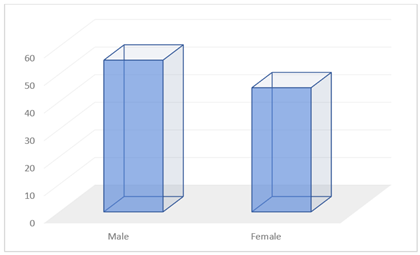
Figure 1 Gender Distribution |
The table indicates gender distribution of the respondents taken in the study. Among the total number of employees (n=100) 55 of them (55 percent) are male and 45 of them (45 percent) are female. This implies that the male respondents are slightly more than the female respondents in the sample. Nonetheless, the difference is not that big, which implies that both sexes are fairly represented in the research. The equal involvement of the male and female employees assists in gaining a more detailed picture of the stress in the workplace among the various gender groups.
Table 2
|
Table 2 Age Group of Respondents |
||
|
Age Group |
Frequency (f) |
Percentage (%) |
|
20–30 years |
40 |
40 |
|
31–40 years |
35 |
35 |
|
41–50 years |
15 |
15 |
|
Above 50 years |
10 |
10 |
|
Total |
100 |
100 |
Figure 2
|
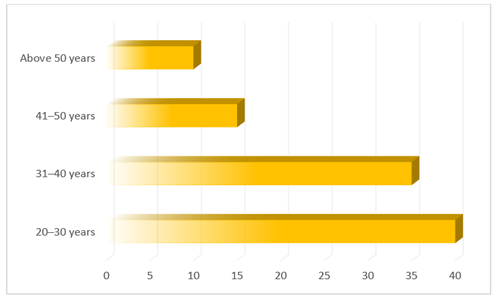
Figure 2 Age Group of Respondents |
The table provides the age of the respondents taking part in the study. The respondents of the age group 203140 years constitute 40 (40) and 35 (35) respectively out of the total 100 employees. Moreso, 15 respondents (15%) are in the age category of 41-50 years, and 10 respondents are above 50 years of age (10%). It means that the majority of respondents are young with their careers in their initial or middle years. The availability of respondents of varying ages will assist in the realization of stressfulness at work at the various phases of career life.
Table 3
|
Table 3 Sector of Employment |
||
|
Sector |
Frequency (f) |
Percentage (%) |
|
Private Sector |
60 |
60 |
|
Public Sector |
40 |
40 |
|
Total |
100 |
100 |
Figure 3
|
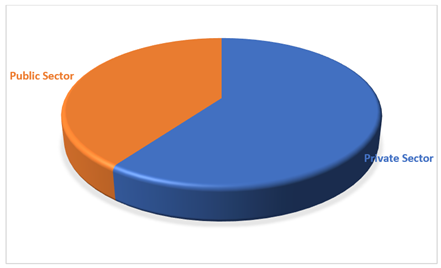
Figure 3 Sector of Employment |
The table shows the breakdown on the respondents according to their employment industry. Among the 100 employees, 60 employees (60 percent) of the entire employees are working in the private sector, and 40 employees (40 percent) are working in the public sector. This implies that most of the participants in the study are of the private sector. This inclusion of both the staff members in the private and the public sector also contributes to the fact that we get a wider view of the stress at the work place since the circumstances, workload, and the organizational set ups may be different in the two sectors.
Table 4
|
Table 4 Major Causes of Workplace Stress |
||
|
Causes of Stress |
Frequency (f) |
Percentage (%) |
|
Excessive Workload |
35 |
35 |
|
Job Insecurity |
20 |
20 |
|
Long Working Hours |
18 |
18 |
|
Poor Work Environment |
15 |
15 |
|
Lack of Management Support |
12 |
12 |
|
Total |
100 |
100 |
Figure 4
|
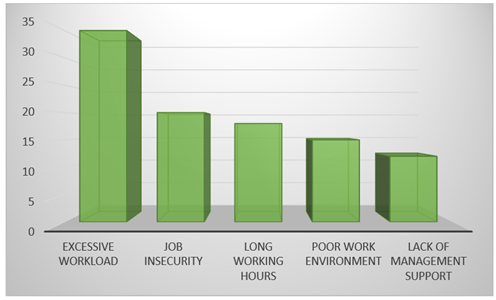
Figure 4 Major Causes of Workplace Stress |
The table will outline the significant sources of stress among the employees. Among the group of 100 respondents, excess workload was identified by 35 employees (35% of the total) as the highest level of stressor and thus it was the most important factor. Twenty respondents (20%), and 18 respondents (18%), ascertain job insecurity and stress due to long working hours, respectively. Further, 15 respondents (15%) said that one of the causes of stress is a poor work environment and 12 respondents (12) said that the lack of management support contributed to stress. Such results indicate that workload pressure and job related uncertainties are the major causes of stress in the workplace among workers.
Table 5
|
Table 5 Consequences of Workplace Stress |
||
|
Effects of Stress |
Frequency (f) |
Percentage (%) |
|
Decreased Productivity |
30 |
30 |
|
Health Problems |
25 |
25 |
|
Job Dissatisfaction |
20 |
20 |
|
Absenteeism |
15 |
15 |
|
Poor Work Performance |
10 |
10 |
|
Total |
100 |
100 |
The table indicates the effects of workplace stress to the employees. The 30 employees who were part of the 100 respondents (30 percent) indicated reduced productivity to be the significant impact of stress at work. The respondents who have health problems are 25 (25%), and the respondents who gave stress at work resulting in job dissatisfaction are 20 (20%). Also, 15 respondents (15%) said they would absentee and 10 respondents (10%) said they would perform poorly at work due to stress at work. These findings are an indication that workplace stress can have immense effects on the productivity, health, and job satisfaction of employees that can eventually translate to the overall performance of the organizations.
Table 6
|
Table 6 Stress Management Strategies Used by Employees |
||
|
Stress Management Strategy |
Frequency (f) |
Percentage (%) |
|
Time Management |
28 |
28 |
|
Physical Exercise |
22 |
22 |
|
Taking Breaks |
18 |
18 |
|
Counseling/Support |
17 |
17 |
|
Meditation/Yoga |
15 |
15 |
|
Total |
100 |
100 |
The table gives the stress management techniques that are employed by employees to deal with stress at work. Among the 100 respondents, 28 employees (28 percent) apply time management techniques as the most important way of coping with stress. Physical exercise among the respondents is practiced by 22 respondents (22%), and 18 respondents (18%), take short breaks during work in order to reduce stress. Moreover, 17 respondents (17%) get counseling or support of colleagues or professionals, and 15 respondents (15%) meditate or practice yoga to deal with stress. These results indicate that the employees employ numerous coping mechanisms to deal with the stress at work, and time management, and physical activity are the most widely adopted tactics.
Table 7
|
Table 7 Level of Workplace Stress Among Employees |
||
|
Stress Level |
Frequency (f) |
Percentage (%) |
|
High Stress |
38 |
38 |
|
Moderate Stress |
42 |
42 |
|
Low Stress |
20 |
20 |
|
Total |
100 |
100 |
Figure 5
|
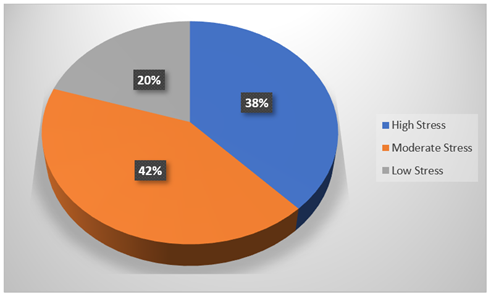
Figure 5 Level of Workplace Stress Among Employees |
The table shows how employees have experienced stress at the workplace. Among the total 100 respondents, 42 employees (42%) said they were exposed to moderately high levels of stress, this being the highest number of respondents. The number of respondents who reported high levels of stress is 38 (38%), which shows that there is a great number of employees who experience high levels of stress in the workplace. In the meantime, 20 respondents (20% of the respondents) have low stress levels. These results imply that stress in the workplace is a widespread problem among the employees with most of them showing moderate and high levels of stress meaning the need to have appropriate stress management techniques in the organizations.
5. CONCLUSION
The current research involved the study of stress at workplace amongst workers, its key causes, effects and the coping mechanisms adopted to deal with stress. The results have shown that stress at work is a familiar problem among workers in various industries and regardless of their age. The review has shown that work overload, job insecurity, and excessive working hours are the main causes of stress in the workplace. These factors put strain on the employees and they impact negatively on the overall well being of employees.
The paper has also mentioned that stress at the workplace is associated with a number of negative effects such as reduced productivity, health issues, job dissatisfaction, absenteeism, and poor performance of work. This is not only the impact it has on the employees but also on the organizational efficiency and general productivity.
Moreover, the findings indicate that different stress management strategies are embraced by employees in order to manage stress at workplace. Time management, physical activity, breaks, counseling, and meditation or yoga are some of the techniques that are normally utilized to lower the stress levels and retain the work life balance. These strategies notwithstanding, the authors are able to find that a significant percentage of employees continue to report moderate to high stress levels, which suggest that more support is needed on the part of organizations.
Finally, the paper highlights the need to adopt effective stress management practices and favorable workplace policies. Organizations are advised to work on the issues of excessive workloads, working conditions, and offer the correct support systems to the employees. Solving these problems will allow organizations to improve the well-being of employees, boost productivity, and provide a healthier and more favorable working environment.
CONFLICT OF INTERESTS
None.
ACKNOWLEDGMENTS
None.
REFERENCES
Al-Suraihi, W. A., Samikon, S. A., Al-Suraihi, A. H. A., and Ibrahim, I. (2021). Employee Turnover: Causes, Importance and Retention Strategies. European Journal of Business and Management Research, 6(3), 1–10. https://doi.org/10.24018/ejbmr.2021.6.3.893
Azizi, M. R., Atlasi, R., Ziapour, A., Abbas, J., and Naemi, R. (2021). Innovative Human Resource Management Strategies During the COVID-19 Pandemic: A Systematic Narrative Review Approach. Heliyon, 7(6). https://doi.org/10.1016/j.heliyon.2021.e07233
Bhui, K., Dinos, S., Galant-Miecznikowska, M., De Jongh, B., and Stansfeld, S. (2016). Perceptions of Work Stress Causes and Effective Interventions in Employees Working in Public, Private and Non-Governmental Organisations: A Qualitative Study. BJPsych Bulletin, 40(6), 318–325. https://doi.org/10.1192/pb.bp.115.050823
Ebeh, R., and Ezirim, N. U. (2025). A Critical Review of Workplace Stress: Causes, Theoretical Models and Strategic Management Approaches.
Caritas Journal of Psychology and Behaviourial
Sciences, 3(1).
Ekienabor, E. E. (2016). Impact of Job Stress on Employees’ Productivity and Commitment. International Journal for Research
in Business, Management and Accounting, 2(6),
124–133.
Kurki, R. (2018). Stress Management Among Nurses:
Literature Review of Causes
and Coping Strategies.
Nekoranec, J., and Kmosena, M. (2015). Stress in the Workplace: Sources, Effects and Coping Strategies. Review of the Air Force Academy,
1, 163.
Panigrahi, D. A. K. (2016). Managing Stress at Workplace. Journal of
Management Research and Analysis,
3(4), 154–160.
Patro, C. S., and Kumar, K. S. (2019). Effect of Workplace Stress Management Strategies on Employees’ Efficiency. International Journal of Scientific Development and Research, 4(5), 412–418.
Pfejfer-Buczek, A. (2023). Stress in the Working Environment and Its Causes. European Research Studies Journal. https://doi.org/10.35808/ersj/3196
Prasad, K. D. V., Vaidya, R. W., and Mangipudi, M. R. (2020). Effect of Occupational Stress and Remote Working on Psychological Well-Being of Employees: An Empirical Analysis During COVID-19 Pandemic Concerning Information Technology Industry in Hyderabad. Indian Journal of Commerce and Management Studies, 11(2), 1–13. https://doi.org/10.18843/ijcms/v11i2/01
Prasad, K. D. V., Vaidya, R., and Anil Kumar, V. (2015). A Study on Causes of Stress Among the Employees and Its Effect on the Employee Performance at the Workplace in an International Agricultural Research Institute, Hyderabad, Telangana, India. International Journal of Management Research and Business Strategy, 4(4), 68–82.
Prasad, K. D. V., Vaidya, R., and
Kumar, V. A. (2016). A Comparative Analysis:
Causes of Stress Among the Employees
and Its Effect on the
Performance at the Workplace in Agricultural Research
and Information Technology Sectors.
AIMA Journal of Management Research, 10, 1–23.
Sethi, T., Vermani, R., and Verma, M. (2015). Stress Management: Its Cause and Effect. CLEAR International Journal of Research in Commerce and Management, 6(2).
Yu, J., Park, J., and Hyun, S. S. (2021). Impacts of the COVID-19 Pandemic on Employees’ Work Stress, Well-Being, Mental Health, Organizational Citizenship Behavior, and Employee-Customer Identification. Journal of Hospitality Marketing and Management, 30(5), 529–548. https://doi.org/10.1080/19368623.2021.1867283
 This work is licensed under a: Creative Commons Attribution 4.0 International License
© Granthaalayah 2014-2024. All Rights Reserved.