
Original Article
AN INVENTORY MODEL FOR ADVANCED MATHEMATICAL MODELING ACROSS MULTIPLE INTERCONNECTED MARKETS
|
Archit Jain 1* 1 Scholar, Institute, Digamber Jain College, Baraut, Uttar Pradesh, India 2 Professor & Supervisor, Institute, Digamber Jain College, Baraut,
Uttar Pradesh, India |
|
|
|
ABSTRACT |
||
|
This study presents a comprehensive framework for advanced mathematical modeling across multiple interconnected markets, highlighting the importance of capturing interdependencies among demand, supply, pricing, and strategic interactions. Unlike traditional single-market analyses, multi-market modeling recognizes that economic and financial systems operate as complex, interlinked structures where changes in one market influence outcomes in others. The paper reviews key theoretical foundations, including multi-market equilibrium theory, partial and general equilibrium models, two-sided and multi-sided market structures, agent-based modeling, and optimal control approaches. These models enable the analysis of competitive behavior, cross-market spillovers, trade flows, inventory coordination, and policy interventions within integrated market environments. Special emphasis is placed on dynamic and nonlinear modeling techniques that account for uncertainty, behavioral heterogeneity, and network effects. Mathematical formulations such as Walrasian equilibrium conditions, cross-elasticity demand systems, inter-regional trade equations, platform-based network utility functions, and optimal control structures are systematically discussed. The paper also explores the growing role of computational methods, including simulation, machine learning integration, and data-driven optimization, in enhancing the scalability and predictive accuracy of multi-market models. Despite the strong theoretical development, the paper identifies a major research gap in empirical validation and real-world calibration of these models. To address this limitation, future research directions emphasize large-scale data integration, dynamic adaptive modeling, interdisciplinary collaboration, and the inclusion of external shocks such as regulatory changes and geopolitical risks. The proposed modeling frameworks offer valuable decision-support tools for policymakers, firms, and researchers operating in volatile and interconnected market systems. Keywords: Multimarket, Modeling, Equilibrium,
Optimization, Networks, Competition, Dynamics |
||
INTRODUCTION
Multiple markets
refer to the interconnected systems where goods, services, or financial assets
are exchanged across different sectors or regions simultaneously. Each market
influences and depends on others through demand, supply, and pricing dynamics Davidson
et al. (2009). Multiple markets are situations wherein
more than one market coexists within the same economic or spatial context,
often overlapping in terms of traded goods, agents, and practices Iyappan
et al. (2024), Sinha et
al. (2015). This multiplicity challenges the notion of
a singular market concept and is shaped by various theories from disciplines
such as economics, accounting, and marketing Sinha et
al. (2015). Analysts and market participants may
perceive markets differently, which has significant implications for
regulatory, strategic, and empirical analysis Tokarev
et al. (2019), Aittahar
et al. (2023).
In contemporary
market studies, the concept of multiple markets encompasses the existence of
diverse market assemblages and configurations shaped by users, firms, and
regulators Binti et
al. (2025). These overlapping markets may perform
distinct practices, utilize different theories, and exhibit unique norms,
boundaries, and representations for exchange. (Market multiplicity thus
requires researchers to account for multiple perspectives, reflecting the
empirical reality of complex market environments Okoha
And Grace (2025).
THEORIES ON MATHEMATICAL MODELING FOR MULTIPLE MARKETS
Mathematical
modeling provides a robust framework for understanding and analyzing the
complex interactions that occur in multiple interrelated markets. Unlike
single-market models, which focus on supply and demand dynamics for a single
good or service, multiple market models capture the nuanced dependencies and
feedback mechanisms among various goods, sectors, or geographical regions Saydullayeva (2025), Chen and He (2024). These interdependencies arise because
changes in one market often ripple across others, influencing prices, demand,
supply, and ultimately, welfare outcomes in ways that are not always intuitive Wang (2024). The capacity to represent multiple markets
mathematically thus equips economists, policymakers, and business leaders with
essential insights required for strategic planning, policy design, and
operational efficiency Kovalenko
and Zlotov (2022).
Mathematical
modeling for multiple markets represents a robust theoretical approach aimed at
understanding the complexities and interactions that arise when distinct
markets operate simultaneously within a dynamic environment Bergault
(2021). Traditionally, markets are analyzed
individually under the assumption that their behaviors are somewhat
independent, but in reality, multiple markets interact, adapt, and evolve
through shared agents, overlapping demand and supply conditions, and rapid
changes driven by external factors such as policy and technology Burgstaller
(2020).
CONCEPTUAL FOUNDATIONS
The starting point
of mathematical modeling in multiple markets is the recognition that complex
systems require a framework capable of addressing multiplicity, heterogeneity,
and uncertainty Zhu et al. (2019). Theories such as agent-based modeling and
econometric models have been employed to dissect market behaviors, enabling
researchers to analyze cross-market effects, predict consumer choices, and
simulate the repercussions of various policies—a crucial feature for capturing
emergent phenomena that arise from interconnected markets. A notable example is
the modeling of two-sided markets, where two different user groups interact
over a common platform Golovanova
and Lebedchenko (2018). Here, mathematical models can capture
same-side and cross-side effects, including network externalities and
behavioral asymmetries. These frameworks reveal how the equilibrium conditions
of one market influence the dynamics of another, often mediated by external
agents or engineered platforms Madykh
et al. (2017).
INTERDISCIPLINARY APPLICATIONS
The application of
mathematical models across multiple markets spans disciplines such as
economics, marketing, computer science, and engineering. In consumer behavior
analysis within dynamic markets, models—such as econometric regression,
agent-based simulations, and machine learning algorithms—shed light on the
determinants of demand, price sensitivity, and decision-making processes Drezner
et al. (2016). This multi-method approach is vital for
understanding and forecasting market trends, particularly when real-world data
exhibits volatility, diverse agents, and feedback loops. In the recent studies
emphasize the integration of data analytics with mathematical modeling
techniques to address complex market phenomena Park and Kim (2014). For instance, machine learning approaches
have become critical in analyzing large-scale market data and predicting future
states, providing nuanced insights critical for business decision-making Gintis
and Mandel (2012).
THEORETICAL IMPLICATIONS
At the theoretical
level, mathematical modeling for multiple markets provides a lens through which
inter-market dependencies, competitive forces, and strategic interactions are
examined. By abstracting real-world conditions into formal models, researchers
can test hypotheses regarding equilibrium, stability, and optimal policy
outcomes. The use of affinity curves and rate parameters, as cited in two-sided
market research, illustrates how mathematical abstractions serve as proxies for
complex social and economic dynamics Beresnev
and Suslov (2010). Additionally, the iterative process of
model building spanning conceptualization, formalization, simulation, and
empirical validation—serves as a bridge between theoretical constructs and
actionable knowledge. The capacity to revise and refine models as new data
emerges reflects the adaptability and sophistication of mathematical modeling
in capturing evolving market realities Herrán
et al. (2010).
Hence,
mathematical modeling for multiple markets is a cornerstone of modern
theoretical research, enabling scholars to scrutinize the mechanisms by which
various markets co-exist and influence one another Mukherjee
and Sahoo (2010). This modeling approach is integral for
decision-making, strategic planning, and policy development within volatile and
interlinked market systems. Its theoretical richness stems from the careful
abstraction, simulation, and analytical rigor applied to dissecting
multilayered market phenomena.
MATHEMATICAL MODELING FOR MULTIPLE MARKETS
Multi-Market Equilibrium Theory
One foundational
theory in economics and finance regarding multiple markets is the concept of
multi-market equilibrium, extensively grounded in Walrasian general equilibrium
theory Nagasawa
et al. (2009). According to this framework, markets for
multiple goods or commodities simultaneously clear when supply equals demand in
every market. This equilibrium is represented by a price vector  , where m is the number of markets,
satisfying the system:
, where m is the number of markets,
satisfying the system:
 (4.1)
(4.1)
Here:
Z(p) is the vector of excess demand functions for
all markets, X(p) denotes aggregate demand as a function of prices,  denotes aggregate supply as a function of prices.
Walras' Law
dictates that the value of excess demand weighted by prices is zero for all
feasible prices:
 (4.2)
(4.2)
This ensures that
if all but one market is in equilibrium, the remaining market must also clear.
The existence of an equilibrium price vector
 is
guaranteed under certain continuity, monotonicity, and budget constraint
assumptions Rabbani
et al. (2008).
is
guaranteed under certain continuity, monotonicity, and budget constraint
assumptions Rabbani
et al. (2008).
Dynamic adjustment
processes describe convergence to equilibrium prices, for example, by iterative
price updates proportional to excess demand:
|
|
 (4.3)
(4.3)
Where,  is an
adjustment parameter and t is the iteration index.
is an
adjustment parameter and t is the iteration index.
Mathematical Models for Multi-Market Partial and General Equilibrium
|
|
Beyond static general equilibrium, partial equilibrium models analyze multiple closely related markets where the rest are held constant or exogenous. These models organize supply-demand data and economic parameters to focus on specific sectors or regions. Multi-market partial equilibrium models extend single-market models by solving simultaneous nonlinear demand and supply equations:
 (4.4)
(4.4)
Where:
 and
and  represent demand and supply in market i,
respectively, Prices
represent demand and supply in market i,
respectively, Prices  affect
demands and supplies across markets via cross elasticity.
affect
demands and supplies across markets via cross elasticity.
Applications
include agricultural policy impact assessments across multiple commodities and
regions, trade policy analyses in multi-regional contexts, and inventory
distribution networks involving several product lines. These models typically
require fixed-point algorithms or nonlinear solvers due to complexity Kjellberg
and Helgesson (2006).
General
equilibrium models simultaneously balance all markets, incorporating
households, firms, and governmental sectors across regions. The models are
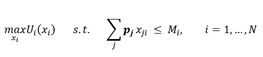
framed as large systems of nonlinear equations deriving from optimization
conditions under restrictions:
 (4.5)
(4.5)
Where, U_i is
utility for agent i, M_i is income, and x_ji quantity of good j consumed by i.
Price vectors p clear markets when aggregate demand and supply match in each
market.
Multi-Market Advertising and Competition Models
Murali et al., (2004) and successors developed
mathematical models capturing competition in multiple markets with multiple
firms by expressing net sales or revenues as functions of controllable
variables like price and promotional effort Krishnan
and Gupta (1967).
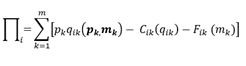
A generic
multi-market profit function Π_i for firm i can be written as:
 (4.6)
(4.6)
Where:
m = number of
markets, q_ik = quantity sold by firm i in market k, function of market price
p_k and marketing effort m_k,〖 C〗_ik, F_ik are cost functions dependent on quantity
and marketing.
Equilibrium
conditions solve for optimal price and marketing allocations across markets,
maximizing total profit subject to demand and competition constraints Roningen
(1997)
Multi-Region and Multi-Market Partial Equilibrium Modeling
Roningen
et al. (1991) and expanded by Hertel (1997), multi-region
partial equilibrium models analyze linked markets across geographic regions,
capturing interdependencies in prices, trade flows, and policy impacts.
Formally, for
markets  in
regions
in
regions  :
:
 (4.7)
(4.7)
Where, T_ir
denotes trade variables or tariffs, cross-region and inter-market effects
influence demand-supply balance. These models incorporate transportation costs,
tariffs, quotas, and trade policies Merton
(1994).
The system solves
for price vectors {p_ir} that clear all regional markets simultaneously, often
via computational general equilibrium (CGE) frameworks or specialized trade
policy simulation models (SWOPSIM).
Two-Sided and Multi-Sided Market Models
Two-sided (or
multi-sided) markets involve multiple user groups interacting via platform
intermediaries—such as buyers and sellers on e-commerce platforms—where
cross-side network externalities are critical Roningen
et al. (1991). They
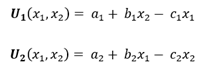
propose mathematical models where utilities depend on the size and behavior of
the opposing side:
 (4.8)
(4.8)
Here,  ,
, represent participation levels on each side,
and bi coefficients measure cross-side effects. The equilibrium occurs at
represent participation levels on each side,
and bi coefficients measure cross-side effects. The equilibrium occurs at  solving the coupled system reflecting consumer and supplier behaviors.
These models
analyze platform pricing, adoption dynamics, and stability of equilibrium under
network externalities and strategic firm behavior.
Optimal Control Models in Multi-Market Contexts
Dynamic
multi-market control theories model optimal allocation of resources over time
across multiple markets, leveraging control theory.
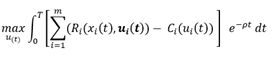
Develop
continuous-time optimal control models Krishnan
and Gupta (1967):
 (4.9)
(4.9)
Subject to dynamic
constraints:
 (4.10)
Where  is the
state (e.g., inventory or market share) in market
is the
state (e.g., inventory or market share) in market  control variable (e.g., advertising spend),
R_i revenue,
control variable (e.g., advertising spend),
R_i revenue,  cost, and
  discount
rate. Solutions involve
Pontryagin’s Maximum Principle or Hamilton-Jacobi-Bellman equations, allowing
temporal optimization across markets simultaneously.
discount
rate. Solutions involve
Pontryagin’s Maximum Principle or Hamilton-Jacobi-Bellman equations, allowing
temporal optimization across markets simultaneously.
1)
Agent-based
Model Formulation
The agent-based
mathematical model draws from earlier frameworks in two-sided markets Arrow
and Debreu (1954) and multi-market competition theory
(Burgstaller, J., 2020). Let the set of markets be  with
agents indexed by i. Each agent i maximizes utility across all interacting
markets:
with
agents indexed by i. Each agent i maximizes utility across all interacting
markets:
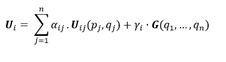 (4.11)
Where, α_ij
represents preference weights and  captures
inter-market synergy effects Aasgård
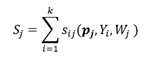
(2018). Demand and supply are represented as:
captures
inter-market synergy effects Aasgård
(2018). Demand and supply are represented as:
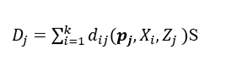 (4.12)
Market equilibrium
for each〖 M〗_j:
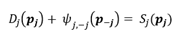 (4.13)
Where,  captures the cross-market demand spillover Saadatmand
et al. (2018).
captures the cross-market demand spillover Saadatmand
et al. (2018).
CONCLUSION AND SUGGESTIONS
This paper has
provided a comprehensive exploration of mathematical modeling for multiple
markets, synthesizing theoretical frameworks, model structures, and empirical
challenges across diverse industries. The reviewed studies collectively
contribute valuable insights into competitive market strategies, resource
allocation, inventory management, and decision-making optimization using a
variety of mathematical approaches. These range from bi-level programming in
competitive scenarios to agent-based models capturing multi-market interactions
and from spatial equilibrium models to hybrid machine learning frameworks.
Despite this rich methodological diversity, a persistent limitation across the
literature is the underrepresentation of empirical validation. Many models
remain theoretical constructs or are tested within constrained experimental
conditions, limiting their pragmatic applicability to dynamic, complex
real-world markets subject to volatility, regulatory shifts, and technological
disruptions.
The paper
underscored the importance of integrating economic and behavioral heterogeneity
in modeling approaches to capture real market nuances better. It highlighted
the necessity for models to transcend static assumptions by accommodating
external shocks, evolving regulatory environments, and cross-market spillovers.
Additionally, the advancement of computational methods, including stochastic
programming and AI-driven learning algorithms, was recognized as imperative for
improving model accuracy and scalability in high-dimensional market systems.
However, the practical implementation of these innovations demands extensive
empirical work, including large-scale data collection, industry-specific case
studies, and longitudinal analyses that reflect market evolution over time.
Suggestions for
future research emphasize a multi-pronged approach. First, empirical data
integration should be prioritized to test and calibrate models rigorously
against real-world market behaviors, thus enhancing predictive validity.
Second, the development of dynamic models capable of adapting to market
fluctuations and policy changes would improve robustness and usability for
practitioners and policymakers. Third, interdisciplinary collaboration bridging
economics, operations research, computer science, and behavioral sciences could
foster more holistic models that account for market complexity comprehensively.
Finally, attention to the responsiveness of models under external economic
disruptions, such as geopolitical risks or abrupt regulatory reforms, is
critical for ensuring resilience in diverse industrial applications.
ACKNOWLEDGMENTS
None.
REFERENCES
Aasgård,
E. K. (2018).
Coordinated Hydropower Bidding in the Day-Ahead and Balancing Market. In The
International Workshop on Hydro Scheduling in Competitive Markets (16–25).
Springer International Publishing.
Aittahar,
S., de Villena, M. M., Derval, G., Castronovo, M., Boukas, I., Gemine, Q., and
Ernst, D. (2023).
Optimal Control of Renewable Energy Communities with Controllable Assets.
Frontiers in Energy Research, 11, 879041.
Arrow,
K. J., and Debreu, G. (1954). Existence of an Equilibrium for a competitive Economy. Econometrica,
22(3), 265–290.
Beresnev, V. L., and Suslov, V. I. (2010). A Mathematical Model of Market Competition. Journal of Applied and Industrial Mathematics, 4(2), 147–157.
Bergault,
P. (2021).
Mathematical Modeling for Market Making and Related Problems of Financial
Liquidity: A Song of Assets and Traders (Doctoral Dissertation, Université
Paris 1–Panthéon-Sorbonne).
Binti
Mat Dawi, N., Kumar Singh, A., and Namazi, H. (2025). Application of Mathematical
Modeling in Finance: A Review. Fractals, 2530011.
Burgstaller, J. (2020). Competition in Local Banking Markets and the Influence of Rival
Proximity. Journal of Applied Finance & Banking, 10(2), 193–221.
Chen,
N., and He, W. (2024). Explore the Specific Applications of Mathematical Models in Finance.
Journal of Modern Business and Economics, 1(1).
Davidson,
M. R., Dogadushkina, Y. V., Kreines, E. M., Novikova, N. M., Seleznev, A. V.,
Udal’tsov, Y. A., and Shiryaeva, L. V. (2009). Mathematical Model of Power System
Management in Conditions of a Competitive Wholesale Electric Power (capacity)
Market in Russia. Journal of Computer and Systems Sciences International,
48(2), 243–253.
Drezner, T., Drezner, Z., and Kalczynski, P. J. (2016). The Multiple Markets Competitive Location Problem. Kybernetes, 45(6), 854–865.
Gintis,
H., and Mandel, A. (2012). The Dynamics of Walrasian General Equilibrium: Theory and
Application. Complexity Economics.
Golovanova, M., and Lebedchenko, V. (2018). Using Economic and Mathematical Models for
Determining the Market Capacity.
Сучасний
Стан
Наукових
Досліджень
та
технологій в
промисловості,
1(3), 71–81.
Herrán, A., de la Cruz, J. M., and De Andrés, B. (2010). A Mathematical Model for Planning Transportation of Multiple Petroleum Products in a Multi-Pipeline system. Computers & Chemical Engineering, 34(3), 401–413.
Iyappan,
K., Kumar, S., Kumar, P., Parkash, R., Dwivedi, V. K., and Mishra, M. K. (2024). Mathematical Models for Predicting
Consumer Behavior in Dynamic Market Environments. Journal of Computational
Analysis & Applications, 33*(8).
Kjellberg, H., and Helgesson, C. F. (2006). Multiple Versions of Markets: Multiplicity
and Performativity in Market Practice. Industrial Marketing Management, 35(7),
839–851.
Kovalenko, A., and Zlotov, A. (2022). Mathematical Modeling of a Multi-Product
Dispersed Market: Numerical Methods for Solving Problems. Norwegian Journal of
Development of the International Science, 77(3), 3–13.
Krishnan,
K. S., and Gupta, S. K. (1967). Mathematical Model for a Duopolistic Market. Management Science,
13(7), 568–583.
Madykh, A. A., Okhten, O. O., and Dasiv, A. F. (2017). Analysis of the world experience of Economic and Mathematical Modeling of Smart Enterprises. Economy of Industry, 4(80), 19–46.
Merton,
R. C. (1994).
Influence of Mathematical Models in Finance on Practice: Past, Present and
Future. Philosophical Transactions of the Royal Society of London. Series A:
Physical and Engineering Sciences, 347(1684), 451–463.
Mukherjee, K., and Sahoo, G. (2010). Development of Mathematical Model for Market-Oriented Cloud Computing. International Journal of Computer Applications, 9(11), 19–24.
Nagasawa, H., Kotani, M., and Morizawa, K. (2009). Optimal Cooperative Harvesting Patterns of Agricultural Fresh Products in Case of Multiple Farmers and Multiple Markets Under Periodical Flowering. Journal of the Operations Research Society of Japan, 52(4), 417–432.
Okoha, O. F., And Grace, I. (2025). Mathematical modeling and Machine Learning for economic forecasting: A Hybrid Approach to Predicting Market Trends. Acta Electronica Malaysia, 1(1), 7–15.
Park,
S. I., and Kim, J. S. (2014). A Mathematical Model for a Capacity Reservation Contract. Applied
Mathematical Modelling, 38*(5–6), 1866–1880.
Rabbani, M., Tavakkoli-Moghaddam, R., and Parsa, H. (2008). A New Mathematical Model for a Distribution Network Problem in a Multi-Product Supply Chain System: A Real-Case Study. International Journal of Manufacturing Technology and Management, 16(1–3), 1–11.
Roningen,
V. H., Hertel, T. W., and Ivanic, M. (1991). The Static World Policy Simulation Model
(SWOPSIM).
Roningen,
V. O. (1997).
Multi-Market, Multi-Region Partial Equilibrium Modeling. In Applied Methods for
Trade Policy Analysis: A Handbook (231–257).
Saadatmand, M., Dabab, M., and Weber, C. (2018). Dynamics of Competition and
Strategy: A Literature Review of Strategic Management Models and Frameworks. In
2018 Portland International Conference on Management of Engineering and
Technology (PICMET) (1–14). IEEE.
Saydullayeva, R. (2025). Optimizing Economic Insights: The Impact of Economic Mathematical
Methods on Financial Analysis and Profitability in Complex Markets. Conference
of Advance Science & Emerging Technologies, 1(2), 1–10.
Sinha,
K., Colombo, E. F., Shougarian, N. R., and de Weck, O. L. (2015). A Simplified Mathematical Model for
Two-Sided Markets with an Intervening Engineered Platform. 41st Design
Automation Conference.
Tokarev,
K. E., Rogachev, A. F., Pleschenko, T. V., Rudenko, A. Yu., and Kuzmin, V. A.
(2019). Economic
and Mathematical Modelling of Regional Market of Grain crops. IOP Conference
Series: Earth and Environmental Science, 341, 012212.
Wang,
Y. (2024).
Application and Challenges of Mathematical Modeling in Financial Market Risk
Assessment. In Recent Advancements in Computational Finance and Business
Analytics (CFBA 2024) (42, 86–95). Learning and Analytics in Intelligent
Systems.
Zhu, F., Li, X., Valavi, E., and Iansiti, M. (2019). Network interconnectivity and Entry into Platform Markets. Harvard Business School Technology & Operations Management Unit Working Paper, 19(062), 19–06.
 This work is licensed under a: Creative Commons Attribution 4.0 International License
© Granthaalayah 2014-2026. All Rights Reserved.


