Original Article
Privatizing India’s Airports: A SWOT-Based Policy Review of Delhi International Airport
|
Mohan Phuyal 1 1 Department
of Economics, Soka University, Tokyo, Japan |
|
|
|
ABSTRACT |
||
|
This study presents a SWOT (Strengths, Weaknesses, Opportunities, and Threats) analysis of Indira Gandhi International Airport (IGIA), also known as Delhi International Airport (DIA), located in New Delhi, India. It is a prominent example of privatized airport management in India. This research analyzed the period from 2015 to 2024 following privatization. Through this case study, this paper contributes to the broader discourse on airport privatization in India, offering policy implications for future privatization initiatives under the Public-Private Partnership (PPP) model. The study highlights opportunities for investment, innovation, and global competitiveness while acknowledging threats such as regulatory uncertainties, monopolistic tendencies, and socio-political opposition. Keywords: Airport
Privatization, Public-Private Partnership, Policy Framework, Economic
Regulation, Swot Analysis |
||
INTRODUCTION
India commenced
its first commercial, civil air transportation in 1932, and for decades,
airports and airline-related businesses functioned under the aviation policies
of the Ministry of Civil Aviation (MoCA). In modern India, the development and
modernization of airports and airways play a vital role in connecting the
geographies and contributing to the economy Ferrulli
(2016). Following the economic liberalization of
1991, India began deregulating the airport and aviation sectors, allowing
private entities to enter through Public-Private Partnership (PPP) policies.
This policy has led to the emergence of low-cost carriers and a significant
transformation of the airport and airline industries Jayathilakan et al. (2024), Krishnaswamy (2006). Since then, air passenger traffic has
increased rapidly, driving demand for improved airport infrastructure. To date,
over 15 international airports in India are managed and operated by private
entities. In addition, MoCA aims to complete the privatization process at more
than 13 airports by 2026, to improve operational efficiency, attract private
investment, and elevate service standards to meet global benchmarks Majumder
(2025).
In this way, the
number of privately operated airports, along with those awaiting privatization,
continues to grow under subsequent policy frameworks. However, there is a lack
of research and observations on the strengths, weaknesses, opportunities, and threats
(SWOT) in the privatized Indian airports. In this context, this research uses
the SWOT framework as a critical tool for evaluating the impact of private
participation in India’s airport industry. Despite significant developments in
academic research, the Indira Gandhi International Airport, commonly known as
Delhi International Airport, serves as the case study. This study aims to
address this gap by analyzing the internal and
external factors and providing actionable recommendations for future airport
privatization initiatives in India.
METHODOLOGY
This study employs
qualitative research methods. It focuses on modernizing Delhi International
Airport. Secondary data from 2015 onwards were obtained from the DIAL Yearly
Report, government policy documents, and academic literature.
EMERGING DYNAMICS OF AIRPORT PRIVATIZATION IN INDIA
Following the
success of airport privatization in the United Kingdom in 1986, many countries
have since adopted a similar approach Budd and Ison (2021). India initiated airport privatization
following the merger of the International Airport Authority of India (IAAI) and
the National Airport Authority of India (NAAI) into the Airports Authority of
India (AAI) in 1995 ICAO (2013). Since then, several policies and rules have
been introduced to guide airport development. In 1997, the government
introduced the National Airport Policy to facilitate the operation,
development, and further modernization of airport infrastructure. For example,
Cochin International Airport initiated the process in 1993 and commenced
operations in 1999. CIAL was the first airport in India to be built through
private participation under the PPP model Rajan et
al. (2008). Following the successful implementation of
PPP at Cochin International Airport in 1999, the GOI approved the restructuring
and modernization of Delhi and Mumbai airports through brownfield investment
using the PPP model Ohri (2012). Furthermore, to promote airport
privatization, the GoI introduced the Greenfield
(GFA) policy in 2008, which provides a regulatory framework for the
construction and commissioning of new airports. To date, more than 16 airports
have adopted the GFA policy through a PPP Joint Venture (JV) model. To regulate
tariffs for aeronautical services, the Airport Economic Regulatory Authority
was established in 2009. Similarly, the Foreign Direct Investment (FDI)
policies in the aviation sector, along with initiatives such as the Ude Desh ka
Aam Nagarik (UDAN) scheme launched in 2015, have further enhanced regional
connectivity and accessibility through FDI policies Ministry
of Civil Aviation (2021). To increase private-sector investment,
India has predominantly used concession models, which involve private entities
in the construction, development, and operation of brownfield and Greenfield
airports Aayog
(2021). These models, like Build, Operate, and
Transfer (BOT), DBFO, etc., are instrumental in addressing budgetary
constraints and enhancing service efficiency in the airports Carney and Mew (2003). As a result, the Adani
Group secured concession agreements for six airports —Ahmedabad, Lucknow, Mangaluru, Guwahati, Jaipur, and Trivandrum—under PPP
agreements Ministry
of Civil Aviation (2021), AAI (2022).
|
Table 1 |
|
Table 1 Scenario of
Privately Operated International Airports |
||||
|
No |
Airport
Location |
Owner |
Operator |
Year
of Privatization |
|
1 |
Ahmedabad |
AAI |
AIAL,
Ahmedabad International Airport Limited |
2020 |
|
2 |
Delhi |
AAI |
DIAL,
Delhi International Airport Limited |
2006 |
|
3 |
Guwahati |
AAI |
AGIAL,
Guwahati International Airport Limited |
2021 |
|
4 |
Jaipur |
AAI |
AAHL,
Jaipur International Airport Limited |
2019 |
|
5 |
Lucknow |
Adani |
ALIA,
Lucknow International Airport Limited |
2019 |
|
6 |
Mangalore |
AAI |
MIAL,
Mangaluru International Airport Limited |
2019 |
|
7 |
Mumbai |
AAI |
MIAL,
Mumbai International Airport Limited |
2006 |
|
8 |
Nagpur |
AAI |
GMRand Mihan International Airport Limited |
2021 |
|
9 |
Trivandrum |
AAI |
TRV,
Kerala International Airport Limited |
2021 |
|
10 |
Goa
(Manohar) |
AAI |
GMR
Goa International Airport Limited |
2004 |
|
11 |
Bangalore |
BIAL |
BIAL,
Bengaluru International Airport Limited |
2004 |
|
12 |
Cochin |
CAIL |
CIAL,
Cochin International Airport |
1999 |
|
13 |
Hyderabad |
GHIAL |
GHIAL,
GMR Hyderabad International Airport, Limited |
2004 |
|
14 |
Kannur |
KIAL |
KIAL,
Kannur International Airport Limited |
2018 |
|
Source: Airports Authority of India |
||||
Analyzing the data from 1990 to 2018 indicates
consistent double-digit annual growth in air passenger and cargo traffic, with
yearly double-digit growth rates in passenger numbers and freight volumes Sutare and
Rathod (2022). The rise of low-cost carriers, such as
Indigo, SpiceJet, and GoAir, has democratized air travel in India. Indian
airlines have expanded their international routes, connecting major cities to
destinations across Asia, North America, the Middle East, and Europe.
Researchers claim that the PPP airports in India have contributed more than 40%
of revenues Damodaran
et al. (2022). Additionally, the aviation sector has
contributed approximately 5% to India’s GDP and supported over 4 million jobs IBEF (2023). In line with this, global projections rank
AAI as the third-largest civil aviation market Thummala
and Hiremath (2022) In this way, the airport privatization in India has primarily focused
on addressing passenger growth and boosting economic development Dörnberg (2008). To meet the projected demand of over 22
billion air passengers by 2040, the AAI has outlined plans to construct 100
additional airports and heliports by 2024 Iyer and Thomas (2021). Investors are expected to invest an
estimated US$5.99-6.41 billion in FY 2018-2023 IBEF (2022).
Despite these
advancements, comprehensive research on airport privatization in India remains
limited, particularly in assessing its regulatory frameworks, challenges, and
outcomes. A Strengths, Weaknesses, Opportunities, and Threats (SWOT) analysis
is crucial for evaluating the effectiveness of privatization strategies and
informing future policy decisions Chang
and Huang (2006). This approach enables policymakers and
stakeholders to make informed decisions that align with strategic goals,
including potential risks and leveraging strengths in airport privatization.
SWOT ANALYSIS OF DELHI INTERNATIONAL AIRPORT
Case
Study at Delhi International Airport
SWOT analysis is a
strategic planning tool widely used to generate actionable insights for
organizational decision-making and the development of corporate strategy Valentin
(2001), Hill and Westbrook (1997). It systematically evaluates internal
factors (strengths and weaknesses) and external factors (opportunities and
threats) that influence an organization’s performance and strategic direction Gürel
and Tat (2017). By identifying and analyzing
these factors, SWOT analysis provides a comprehensive understanding of both
positive and negative trends impacting a business Namugenyi
et al. (2019). Delhi International Airport (DIA) is South
Asia’s busiest airport and a central global hub connecting Europe, the Middle
East, and Asia. Since its establishment, the airport has hosted domestic and
international passenger and cargo services from over 40 airlines. It also
serves as a hub for several carriers, including Air India, Air India Regional,
Blue Dart Aviation, GoAir, IndiGo, JetLite, and
SpiceJet Bansal
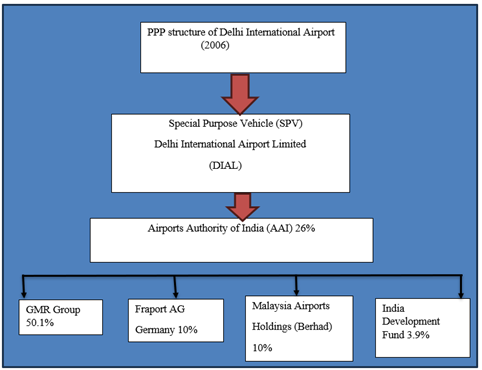
and Sen (2022). In 2006, a GMR-led consortium won the
concession to operate, manage, and develop IGIA through a competitive bidding
process, signing a 30-year Operations, Management, and Development Agreement
(OMDA) with the AAI, which was extendable by another 30 years Jain et al. (2007), DIAL (2022). The first phase is marked by the
construction of a new integrated terminal T3 by 2010 to handle 34 million
passengers per annum. This would be followed by three more passenger terminals
in subsequent phases by 2026. For this purpose, a special purpose vehicle (SPV)
called Delhi International Airport Limited (DIAL) was established to carry out
operations, management, and modernization Ministry
of Civil Aviation (2006). In the first phase of the concession
agreement, the equity structure consisted of GMR Infrastructure (54%), AAI
(26%), Fraport (10%), and Eraman Malaysia (10%) Bhat (2019). This is one of the first brownfield
projects in the Indian airport sector. The operation and management of the
airport involve an agreement between the AAI, representing the public sector,
and several private partners, with both parties expecting to benefit from the
complementary partnership Albalate et al.
(2014).
Figure 1 PPP Structure of Delhi International Airport
Limited
In 2010, DIAL
completed the first phase of expansion and modernization, increasing its
capacity to 66 million passengers, primarily through the construction of
Terminals T1D and T3 Kuhad (2010). Further, the National Capital Region of
Delhi forecasts that more than 16 million passengers will depart from Delhi
Airport. Additionally, the Commonwealth Games, scheduled to be held in Delhi in
2010, also put pressure on modernizing the IGIA Majumdar
(2011). In 2011, Malaysia Airports Holdings
withdrew 10% equity from the partnerships. After that, GMR increases its equity
holding (64%), Fraport AG Frankfurt Airport Services Worldwide (Fraport) 10%
and AAI 26%.
|
Figure 1
|
|
Figure 1 PPP Structure of Delhi International
Airport Limited Source: Delhi Customs (2017) Compiled by
the Author |
The Economic Performance of DIA 2015-2024
The economic
performance of DIA under the GMR-led consortium has exhibited significant
fluctuations over the period from 2015 to 2024.
|
Table 2 |
|
Table 2 Trends in
Passenger Numbers, Customs Activity and Aircraft Movements 2015-2024 |
||||||
|
Fiscal
Year |
Pax
Traffic (Millions) |
Growth% |
Aircraft
Traffic Movements (Thousand) |
Growth% |
Annual
Cargo (Thousand MT) |
Growth
% |
|
2015-2016 |
48.42 |
- |
365.696 |
- |
787.17 |
- |
|
2016-2017 |
55.70 |
+15 |
417.319 |
+14.11 |
857.43 |
+8.93 |
|
2017-2018 |
65.69 |
+17.93 |
459.243 |
+10.046 |
963.03 |
+12.32 |
|
2018-2019 |
69.23 |
+5.38 |
476.720 |
+3.80 |
1042.95 |
+8.30 |
|
2019-2020 |
67.30 |
-2.78 |
464.058 |
-2.656 |
955.86 |
-8.35 |
|
2020-2021 |
22.58 |
-66.448 |
224.045 |
-51.72 |
737.43 |
-22.87 |
|
2021-2022 |
39.34 |
+74 |
320 |
+42.82 |
924.3 |
+25.34 |
|
2022-2023 |
65.3 |
+65 |
430.4 |
+34.5 |
895.9 |
-3.07 |
|
2023-2024 |
73.7 |
+12.8 |
442.5 |
+2.81 |
1003 |
+11.9 |
|
Source: annual-report-fy-20-21.pdf |
||||||
Delhi
International Airport has regularly experienced steady growth in passenger
traffic over the years. From 2015-16 to 2018-19, passenger numbers increased
significantly, from 48.42 million to 69.23 million. However, the COVID-19
pandemic (2019-21) caused a sharp decline, with passenger numbers falling to
22.58 million in 2020-2021 due to travel restrictions and safety concerns. In
response to the pandemic, DIA became the first airport in India to establish an
on-site COVID-19 testing facility for international passengers arriving from
abroad. Despite the temporary setback caused by the pandemic, air travel demand
has shown strong signs of recovery, driven by sustained economic growth, a
rising middle class, and increasing tourism. DIAL’s ability to attract a steady
and diverse stream of passengers is one of its core strengths.
Rising passenger
numbers, driven by economic growth and increased mobility, have created stable,
long-term revenue streams. Furthermore, airports benefit not only from
aeronautical income but also from robust non-aeronautical revenues. Premium travelers and transit passengers further enhance
per-passenger yields, making the airport financially resilient even during
fluctuating airline business cycles. From 2015 to 2019, aircraft movements
increased from 365 to 477 thousand, representing a 23% rise. This indicates
steady growth in air traffic. In 2020, Covid-19 resulted in a minus growth of
224 to 320 thousand. Due to government restrictions and fears of the virus,
aircraft movements were limited. The continued rise in passenger traffic has
created stable, long-term revenue streams. Airports like DIA benefit not only
from aeronautical revenues but also from robust non-aeronautical income
sources, such as retail, food and beverage, and premium services. The presence
of premium and transit passengers contributes to higher per-passenger yields,
enhancing the airport’s financial resilience, even amid fluctuating airline
business cycles. Aircraft movements at DIA also exhibited steady growth,
increasing from 365,000 in 2015–16 to 477,000 in 2018–19—an increase of approximately
23%. However, due to the impact of the COVID-19 pandemic in 2020–21, aircraft
movements declined to between 224,000 and 320,000. Government-imposed travel
restrictions and public health concerns were the primary factors behind this
temporary downturn.
|
Figure 2
|
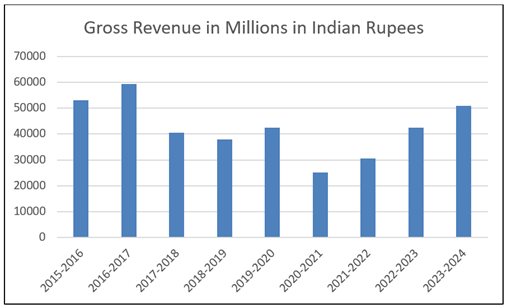
Figure 2 Financial Performance Gross Revenue (2015-2024)Source: Annual-Report-Fy-20-21. Pdf Annual Report Fy 2023 - 24 |
The bar chart
illustrates the gross revenue in millions of Indian Rupees for the period
2015–2016 to 2023–2024, highlighting significant fluctuations over the years.
Revenue peaked in 2016–2017, exceeding ₹60,000 million, reflecting strong
operational performance, possibly driven by increasing passenger traffic and
effective commercial use of airport infrastructure. However, a noticeable
decline followed, with revenue falling steadily from 2017 to 2021, reaching a
low of approximately ₹25,000 million. This drop is mainly due to the
COVID-19 pandemic, which severely disrupted air travel. Beginning in 2021–2022,
the chart shows a gradual recovery, with gross revenue rebounding to over
₹50,000 million by 2023–2024, indicating a resurgence in aviation activity
and the resilience of airport operations. This upward trend also suggests the
effectiveness of DIA's strategic initiatives to restore service levels and
revenue streams in the post-pandemic period.
|
Figure 3
|
|
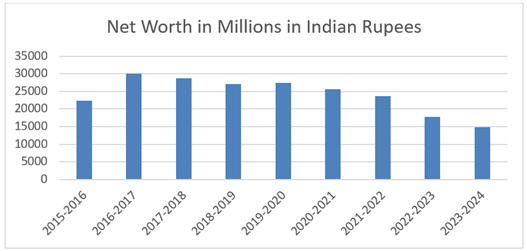
Figure 3 Net Worth
Performance 2015-2024 Source: Annual-Report-Fy-20-21. Pdf
Annual Report FY 2023 - 24 |
The net worth
performance of the DIA from FY 2015–16 to FY 2023–24 reveals a significant
shift over the years, highlighting the organization's financial evolution
following privatization. Initially, the net worth rose sharply from around
₹22,000 million in 2015–16 to nearly ₹30,000 million by 2016–17,
indicating a period of financial strengthening, possibly driven by increased
private investment, operational efficiency, and revenue growth. From FY 2017–18
to FY 2020–21, the net worth remained relatively stable, suggesting a phase of
financial maturity and consistent performance. However, a noticeable decline
began in FY 2021–22, with the net worth decreasing steadily, falling below
₹20,000 million by FY 2022–23 and reaching around ₹15,000 million
in FY 2023–24. This downturn may reflect the lingering effects of the COVID-19
pandemic on air traffic, rising operational costs, increased debt servicing, or
a decline in profitability. The trend raises concerns about the airport's
long-term financial sustainability and signals a need for strategic
interventions to restore economic stability.
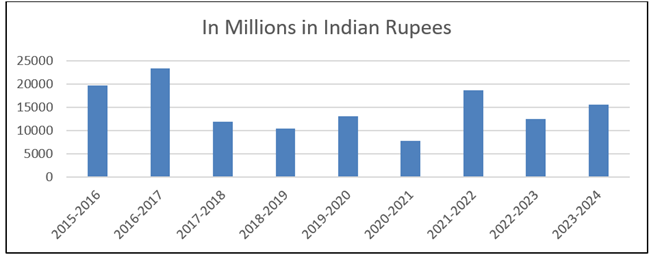
Figure 4 EBITDA 2015-2024
|
Figure 4
|
|
Figure 4 EBITDA, or Earnings Before Interest,
Taxes, Depreciation, and Amortization, is a Valuable Measure for
Understanding DIAL's Profitability. Source: Annual-Report-Fy-20-21. Pdf
Annual Report FY 2023 - 24 |
The EBITDA trend
from 2015–2016 to 2023–2024 reflects the financial resilience and operational
efficiency of Delhi International Airport. While the pre-pandemic years saw
robust EBITDA margins, the onset of COVID-19 in 2020–2021 led to a significant
contraction due to steep declines in passenger traffic. However, the
post-pandemic period, notably 2021–2022, witnessed a sharp recovery,
highlighting the adaptability of private operators in managing costs and
restoring service levels. Although EBITDA remained volatile in the subsequent
years, the upward movement in 2023–2024 indicates a return to stable
operations, underlining the benefits of privatization in maintaining financial
health even during systemic shocks. Based on information about the airport and literature
on SWOT analysis, the following SWOT analysis was developed.
|
Table 3 |
|
Table 3 SWOT Analysis of
Delhi International Airport (Post Privatization) |
||
|
Factors |
Negative |
|
|
Internal |
Strengths · Attractive
and practical private investment · Improvement
of public services and saving costs · Risk sharing within the public and private
sectors · Formation
of a regulatory framework for PPP airports |
Weaknesses ·
AAI
had a limited role in airport operations ·
Changing
work culture ·
Fixed
return to AAI ·
Multiple
Regulatory Agencies and Issues of Governance Accountability ·
Unanticipated
and frequent changes to the Project Plan |
|
External |
Opportunities ·
Massive
demand for Airport development and necessary for private investment ·
Opening new opportunities for private business |
Threats ·
Delays
in decision-making ·
Encroached
Land Issue and Village within the Airport ·
Unrealistic
Deadlines |
|
Source:
Compiled by the author |
||
Delhi
International Airport Limited enjoys a substantial competitive edge, owing to
IGIA's leading status as the largest airport in India by passenger volume.
Strengths
The construction
of Terminal 3 and subsequent upgrades to aeronautical and non-aeronautical
services transformed the Delhi International Airport into one of the largest
and most modern hubs in India. After the completion of the terminals, the
airport offers nonstop services to 144 destinations worldwide. The economic
performance of Delhi International Airport from 2015 to 2024 reflects its
resilience and adaptability. Over the decade, Delhi International Airport
Limited has delivered strong returns on investment. Revenue increased from
Indian rupees 3,200 crore in 2015 to an estimated 6,000, supported by both
traffic recovery and higher commercial revenues. EBITDA margins improved in the
recovery years, and the airport maintained a positive cash flow to support
capital-intensive projects. The implementation of the PPP model in DIA became
an effective attraction for private investors. It has consistently ranked among
the world's best airports, showcasing the success of privatization in achieving
international standards. DIAL derives a significant competitive advantage given
the IGIA's dominant position as the largest Indian airport by passenger
traffic.
Weaknesses
After winning the
consortium, GMR faced several problems due to the involvement of multiple
regulatory agencies, including MoCA, AAI, and the Airports Economic Regulatory
Authority of India. Apart from this, DIAL had to approach more than 50 central
government ministries and departments to secure permission and a license, which
together led to delays and an increase in total project costs. Most local
governments lack PPP specialists, as they transfer their responsibilities to
private companies and are reluctant to take on any risks. They failed to fulfill their duty to supervise the construction and
operation of the DIAL modernization project. Similarly, land Issues became an
unanticipated problem. The AAI's land-handling regulations were unclear.
Opportunities
The outstanding
features of Delhi International Airport regarding the opportunities arising
from the external environment are numerous, but they are challenging to
identify. This is seen as an increase in international and domestic passenger
traffic, Technological innovations, and government policies. DIA’s strategic
location between Southeast Asia, the Middle East, and Europe positions it
ideally to become a premier international transit hub. Attracting more
international carriers forming alliances can significantly increase high-yield
transit passenger traffic.
Threats Faced by the Project
On multiple
occasions, AAI's labor unions had aggressively
opposed GMR and attempted to halt the project's progress. Additionally, the GMR
faced significant human resources challenges during the implementation of the
Delhi PPP project. The lack of a highly skilled workforce at the airport was a
considerable challenge.
Conclusions
This study
examined the privatization of Delhi International Airport through a SWOT
analysis, offering insights into the trajectory of airport privatization in
India under the Public-Private Partnership (PPP) model. The findings
demonstrate that privatization has generated significant strengths in
attracting private investment, improving infrastructure and service quality,
and sharing risks between public and private actors. Privatized airports have
significantly improved infrastructure, service quality, and operational
efficiency. However, challenges such as regulatory complexities, financial
sustainability, and equitable regional development persist. Despite the
weaknesses and the threats, the Delhi International Airport has established a
model regulatory framework that guides other airport PPP projects in India.
REFERENCES
AAI. (2022). Annual Report 2021–22: Spurring Infrastructure Development Transforming Civil
Aviation. Airports Authority
of India.
Aayog, N. (2021). National Monetisation Pipeline:
Volume I – Monetisation Guidebook. NITI Aayog.
Albalate,
D., Bel, G., and Fageda, X. (2014). Beyond Pure Public and Pure Private Management
Models: Partial Privatization in the European Airport Industry. International
Public Management Journal, 17(3), 308–327. https://doi.org/10.1080/10967494.2014.935234
Bansal, S., and Sen, J. (2022). Network Assessment of Tier-II Indian Cities’ Airports
in Terms of Type, Accessibility,
and Connectivity. In World Conference on Transport Research (WCTR 2019) (1–20). Transportation Research Procedia.
Bhat, S. (2019). Public Private
Partnership in India: A Sectoral
Analysis. National Law School of India University.
Budd,
L., and Ison, S. (2021). Public Utility or Private Asset? The Evolution of
UK Airport Ownership. Case Studies on Transport Policy, 9(1), 212–218. https://doi.org/10.1016/j.cstp.2020.12.004
Chang,
H. H., and Huang, W. C. (2006). Application of a Quantification SWOT Analytical
Method. Mathematical and Computer Modelling, 43, 158–169. https://doi.org/10.1016/j.mcm.2005.08.016
Damodaran,
A., Shree, D., Singh, P. P., Sagar, M., and Dhingra, T. (2022). Factors
Affecting Non-Aeronautical Revenue in Indian Airports: A Focus Group Study of
Indian PPP Airports. International Journal of Business Excellence, 28(2),
157–170. https://doi.org/10.1504/IJBEX.2022.126912
DIAL. (2022). Annual Report FY
2021–22. Delhi International Airport Limited.
Dörnberg,
A. v. (2008). Airport Privatization and Takeover—Creating Value for All
Stakeholders? In R. Conrady and M. Buck (Eds.), Trends and Issues in Global
Tourism 2008 (47–60). Springer. https://doi.org/10.1007/978-3-540-77798-4_4
Ferrulli,
P. (2016). Green Airport Design Evaluation (GrADE): Methods and
Tools Improving Infrastructure Planning. Transportation Research Procedia, 14,
3781–3790. https://doi.org/10.1016/j.trpro.2016.05.463
Gürel, E., and
Tat, M. (2017). SWOT Analysis: A Theoretical Review. The Journal of
International Social Research, 10(51), 994–1006. https://doi.org/10.17719/jisr.2017.1832
Hill,
T., and Westbrook, R. (1997). SWOT Analysis: It’s Time for a Product Recall.
Long Range Planning, 30(1), 46–52. https://doi.org/10.1016/S0024-6301(96)00095-7
IBEF.
(2022, May 24). Indian Aviation Industry.
IBEF. (2023, February). Rise of the
Indian Aviation Market.
ICAO. (2013). Case Studies on Commercialization, Privatization
and Economic Oversight of Airports and Air Navigation Services Providers:
India. Air Transport Bureau, Economic Analysis and Policy Section.
Iyer,
K. C., and Thomas, N. (2021). An Econometric Analysis of Domestic Air Traffic
Demand in Regional Airports: Evidence from India. Journal of Air Transport
Management, 93, Article 102046. https://doi.org/10.1016/j.jairtraman.2021.102046
Jain, R., Raghuram, G., and Gangwar,
R. (2007). Airport Privatization in India: Lessons from
the Bidding Process in Delhi and Mumbai (Working Paper). Indian Institute of
Management Ahmedabad.
Jayathilakan, A., Ngo, T., Tsui, W. H., Redmayne, N. B., Balli, F., and
Fu, X. (2024). Examining the Determinants of Indian Airlines’ Revenues.
Journal of the Air Transport Research Society, 3, 1–11. https://doi.org/10.1016/j.jatrs.2024.100038
Krishnaswamy, S. (2006). Airport Privatisation Case: Public Law and Public Sector
Reform. Economic and Political
Weekly, 41(40), 4239–4241.
Kuhad, P. (2010, August). Bidding Process for the
Delhi and Mumbai Airports (Case Study). Secretariat for Infrastructure, Planning Commission.
Majumdar, B.
(2011). Commonwealth Games 2010: The Index of a “New” India? Social Research,
78(1), 231–254. https://doi.org/10.1353/sor.2011.0032
Majumder, A. (2025, February 25). Government Puts Airport
Privatisation Plan in Flight Mode Again.
Ministry of Civil Aviation. (2006). State Support
Agreement in Relation to the Modernisation and Restructuring
of the Delhi Airport. Government of India.
Ministry of Civil Aviation. (2021a). Annual Report 2020–21. Government
of India.
Ministry of Civil Aviation. (2021b). UDAN: Ude Desh Ka Aam Nagrik. Government of India.
Namugenyi,
C., Nimmagadda, S. L., and Reiners, T. (2019). Design of a SWOT
Analysis Model and its Evaluation in Diverse Digital Business Ecosystem
Contexts. Procedia Computer Science, 159, 1145–1154. https://doi.org/10.1016/j.procs.2019.09.283
Ohri,
M. (2012). Airport Privatization in India. Networks and Spatial
Economics, 12, 279–297. https://doi.org/10.1007/s11067-009-9117-8
Rajan,
T. A., Sharad, S., and Sinha, S. (2008). PPP in Greenfield
Airport Development: A Case Study of Cochin International Airport Limited. In
A. Akintoye (Ed.), Policy, Finance and Management for Public-Private
Partnerships. Wiley. https://doi.org/10.1002/9781444301427.ch6
Sutare, N., and Rathod, V. (2022). A Study on Impact of
COVID-19 Pandemic on Air Cargo Industry
of India. Journal of the Maharaja Sayajirao University of Baroda Science and Technology,
56(8), 219–226.
Thummala,
V., and Hiremath, R. B. (2022). Green Aviation in India: Airline Implementation
for Achieving Sustainability. Cleaner and Responsible Consumption, 7, Article
100082. https://doi.org/10.1016/j.clrc.2022.100082
Valentin,
E. K. (2001). SWOT Analysis from a Resource-Based View. Journal of
Marketing Theory and Practice, 9(2), 54–69. https://doi.org/10.1080/10696679.2001.11501891
 This work is licensed under a: Creative Commons Attribution 4.0 International License
© Granthaalayah 2014-2026. All Rights Reserved.