Original
Article
AN ANALYTICAL STUDY OF INDIAN SOCIETY REFLECTED IN THE PAINTINGS OF M.F. HUSAIN
|
Dr. Vinod
Singh 1* 1 Assistant Professor and
Head, Drawing and Painting, Dr. P.D.B.H. Government (P.G.) College, Kotdwar, Pauri Garhwal, Uttarakhand, India |
|
|
|
ABSTRACT |
||
|
This research paper examines and emphasizes on the creations of Maqbool Fida Husain (popularly known as M.F. Husain) on Indian society. M.F. Husain is one of the veteran Indian artist painted diverse themes which includes Mother Teresa, Mahatma Gandhi, Ramayana, Mahabharata, Horse series and lives of rural and urban India. The study depicts that through his artworks M.F. Husain honestly captured the colors and spirit of Indian festivals and decorative elements of the Indian’s soul. The researcher also finds during the study that M.F. Husain is one of India’s greatest artists, whose life and works are as celebrated as they are controversial. It was found that M.F. Husain was showered with Padma Shri and Padma Vibhushan awards during his lifetime. Keywords: Indian Art, Modern Indian Artists,
Indian Society, Controversial Paintings |
||
INTRODUCTION
In the galaxy of
modern masters in art and painting, one name that is synonymous with twentieth
century Indian art the depiction and development of modern Indian art was one
of the main regards of iconic Indian artist is M.F. Husain. The rich mosaic of
colours and canvas, the world was simultaneously real, mythical and symbolic in
the paintings of M.F. Husain. His language translated India’s mixed culture
into a rich variety of colours.
M.F. Husain’s life
was mesmerizing as born in Pandharpur, Maharashtra, on September 17, 1913.
After spending initial days of his career painting cinema posters in Mumbai he
further went on to design children’s nursery furniture. In 1947, he became a
member of the Progressive Artist’s Group. To connect with the people of India
M.F. Husain began to paint the Ramayana and the Mahabharata. His grandfather
Mr. Abdul Husain played an important role in his life. As symbols like lamps
and umbrellas in his works are representative of his grandfather. In his life
the lack of a maternal figure often haunted him and his work. After portraying
Mother Teresa, who represented kindness and universal motherhood in his life.
Some arts and works of M.F. Husain shown in the following Table 1.
Table 1
|
Table 1 Showing Arts and Works of M.F. Husain |
|
|
YEAR |
ARTS
AND WORKS |
|
1940 |
The toys he designed from when he worked at the
Fantasy Furniture Shop also made occasional appearances in paintings such as
Mridang and an untitled work with ‘Tiger and Woman’. |
|
1950 |
M.F.Husain comes in contact with a large number of
artistic influences Indian miniatures, Chinese calligraphy and Western
artists. |
|
1954 |
Husain’s landmark painting Passage of Time marked
the use of horses on his canvas, influenced by his meeting with Chinese
nonagenarian artist Chi Pai-Shih. |
|
1967 |
His film, “Through the Eyes of a Painter” won the
Golden Bear at the Berlin International Film Festival in 1967. In the same
year M.F. Husain started work on his Kerala series, by his keen artistic
interest in the highly rigid and orthodox Namboothiri Brahmin caste of
Kerala. |
|
1968 |
The Ramayana series, which was painted by M.F.
Husain was taken around the country and shown to those who otherwise would
have been unable to visit faraway art galleries and museums. |
|
Source: Researcher compiled from various websites and
Wikipedia. |
|
M.F. Husain was
blessed with Padma Shri and Padma Vibhushan awards during his lifetime. In June
9, 2011 the legendry artist died in London. He had been in self-isolation after
receiving death threats from Hindu nationalists. Over the course of his career
journey M.F. Husain constantly sought to portray not just India’s culture but
also, farmers, musicians, dancers, thinkers and philosophers. Throughout his
career the paintings depicted India and her people believing that the country
was a ‘museum without walls’.
|
Figure 1 |
|
Figure 1 Source:
M.F. Husain, Bharat Mata, 2006. Image courtesy of Ohio State University |
|
|
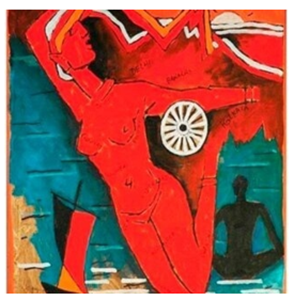
M.F. Husain’s
debated painting “Bharat Mata” is a most not without criticism 2005-2006
acrylic painting depicting Mother India as a nude figure, surrounded by symbols
of the nation. The arts and works aimed to portray the struggles of the nation
using dark reds, blues, and yellows, but caused significant storm of criticism
due to the depiction of a national figure as nude, leading to attributions of
wrong doing and living abroad for the artist. Bharat Mata or Mother India is a
symbolic embodiment of a woman as country of India. Many times
Bharat Mata is depicted as an Indian Goddess, most likely Goddess Durga holding
the national flag and clad in white or orange saree. Bharat Mata came into
being and metaphorically expressed the freedom struggle during the late
nineteenth century. It has been controversial that this image of Bharat Mata is
unfair towards Hinduism and does not meet the requirement to the
multi-religious and multi-cultural population of India.
Disputed about its
title and depiction of Bharat Mata, she is shown nude and coloured in a
chromatic tone of matte red. The painting uses radiant colors
and shades of red, blue and yellow earth tone contrasting with black and white.
The posture and facial expressions of the woman figured is very uneasy, muted
and forced. It feels like she has been tied by her hands and legs to something
which is not defined. However, pointing towards the bordering countries though,
one can see black lines on wrists and ankle.
From her head
surface mountains like strokes denoted the himalayas
and a white sun shining alongside. On her right fore-arm is white colored wheel signified the invention of a wheel by the
stone-age man. It may embodied the Ashoka-chakra on
the national flag and the spiritual teachings of Gautama Buddha, but the wheel
in the painting has fourteen spokes and that in the Ashoka- chakra has twenty four.
Metropolises and
states of India like Mumbai, Srinagar, Kerala, Chennai, Bangalore, Kochin,
Delhi, Kolkata, Gujarat, Banaras and Goa are portrayed on the body of the
woman.
·
Definition
and Style: The artwork
features a central, unclothed woman representing the motherland, depicted in an
uncomfortable, subdued, and occasionally obscured manner. It utilizes bold,
suggestive painting style and a palette of dark reds, blues, and unheroic
ochre.
·
Symbolism: The artwork incorporates colorful
symbols, including a wheel (representing the Ashok Chakra, however with
fourteen spokes rather of Twenty-four), chart-such like features, and
mountainous, rugged strokes.
·
Contestation: The artwork entered violent counter reaction
from one religious group, leading to legal challenges and demurrers. Despite
this, the Supreme Court of India ultimately rejected desires against it,
admitting it as a “work of art”.
·
Context: Painting created by M.F. Husain often
referred to as the “Picasso of India”, created this work as part of his broader
and frequently controversial engagement with Indian culture and tradition.
While the painting was highly debated, it was intended to represent the nations
turbulent state rather than depict a traditional, philanthropic deity.
LITERATURE REVIEW
Shanker
(2018) MF Husain’s Modern India, the study
addresses the central questions surrounding M.F. Husain’s practice, focusing on
how he offered a vision of what ultra-modern Indian art could be. Establishing
his practice in 1947-48, M.F. Husain inevitably had to grapple with questions
of identity, as the conception of India as a nation had only just been
formulated. Drawing inspiration from an abundance of sources ranging from
medieval Indian bronze sculptures to modern Indian influences- M.F. Husain
developed a modern Indian visual vocabulary. The study explores how he
developed this and examines the resources available to him as an ultra-modern
artist. The researcher also examines the artists position as a Muslim and how,
later in his life, certain themes and visual vocabularies became inaccessible
to him as India’s socio political landscape changed.
By exploring socio-political agents and actors, this social anthropology of art
examines a turning point in Indian history and how Husain engaged with and
illustrated these changes, eventually becoming one of most notorious artists.
Golchhaand Haridas (2023),
GLOBAL INSPIRATION, LOCAL IMPACT: PROGRESSIVE ART MOVEMENT ACROSS STATES. This
study demonstrates that cross disciplinary collaboration is a defining feature
of contemporary creative practice and a necessity for specialists who will
shape the future of innovative movement. By blurring the boundaries between
multiple fields, integrative art practices are being employed by both artists
and institutions to address socio-political and other significant concerns. The
exhibition and conservation of art still have become increasingly complex as a
result of the expanding diversity of cultural contexts. This
specialized tools required to present new art that employs digital
technologies are generally lacking among exhibitors. Whether museums and
galleries are fully developing the capacity to present multidisciplinary,
workshop-based, ultra-modern Indian art remains a question that must be
assessed in relation to cross-cultural collaboration, multiplicity, and its
negotiation between durability and rupture with tradition. Therefore, defining
shared and divergent creative conditions could encourage their structured, targeted, and productive
development.
RESEARCH METHODOLOGY
The present
research paper adopts a qualitative and analytical methodology to study the
artistic works done by M.F. Husain, focusing on his visual language, thematic
concerns, stylistic evolution and cultural significance within modern Indian
art. The study follows a descriptive and interpretative research design, aiming
to analyze M.F. Husain’s artworks in their
historical, social and cultural contexts and its impact on Indian society. The
study is based on secondary data which includes books, journals, thesis, and
research papers, selected paintings, sketches, murals and series created by
M.F. Husain. The present study relies largely on available visual reproductions
and secondary literature. A purposive sampling method is used to significant
artworks from different phases of M.F. Husain career.
OBJECTIVE OF THE STUDY
·
To study
the paintings of M.F. Husain and its controversial impact on Indian society.
·
To study
the Arts and works done by M.F. Husain throughout his career journey.
IMPACT OF M.F. HUSAIN PAINTINGS ON INDIAN SOCIETY
M.F. Husain is one
of the most influential Indian modern artists, had a
intense impact on Indian society through his arts, public presence and cultural
mediation. His arts and works extended beyond creative, engaging deeply with
Indian history, mythology, politics and everyday life. As a result of that
shaping public exchange of ideas on art, identity, and freedom of expression.
·
Liberalization
of Art: M.F. Husain played a
vital role in making modern art reachable to common people. Different
traditional superior art practices, his bold forms, simplified figures, and
vibrant colors resonated with ordinary people.
Husain’s background as a cinema hoarding painter helped him bridge the gap
between “high art” and popular visual culture, bringing modern art into public
awareness.
·
Rejuvenation
of Indian culture: M. F.
Hussain reevaluated Indian mythology, history, and folk traditions through an
avant-gardist lens. By portraying Hindu deities’ epics and national symbols in
atypical ways, he challenged rigid and conventional interpretations of culture.
This uplifted society to view tradition as dynamic and evolving rather than
fixed.
·
Contribution
to Indian variation: M.F.
Husain as a founding member of the ‘Progressive Artists Group’ helped shape a
new visual language for post-independence India. The art and work of Husain’s
reflected the ambitions, apprehension and transformations of a newly
independent nation, persuading generations of artists and reassessing Indian
modern art.
·
Art
as Social and Political analysis: Maqbool Fida Husain used his art skills to comment on social realities
such as metropolitan expansion, assault, gender, revolution. His paintings have
themes like national leader, partition of India, Mother Teresa, which
highlighted collective trauma, compassion and identity. These works of M.F.
Husain encouraged viewers to engage critically with India’s social and
political history.
·
Controversy
and Freedom of Expression:
One of M.F. Husain’s most significant societal impacts lie in the debates
kindled by his debatable works. Allegations of hurting religious emotions led
to protests, legal cases and eventually his self-imposed isolation.
·
Representation
of Women and the oppressed:
M.F. Husain frequently shows women as powerful, meaningful and central figures
rather than passive subjects. His renderings questioned traditional gender
roles and emphasized female agency influencing wider conversations around
representation and identity in Indian art and society.
·
Global
Identification of Indian Art:
Through Indian and International exhibitions and collaborations, the veteran
artist brought global attention to Indian modern art. M.F. Husain’s success
helped position Indian artists on the world stage, promoting national pride and
fostering cultural exchange.
·
Motivation
for future generations: M.F.
Husain’s fearless experimentation, fruitful output and lifelong engagement with
art inspired numberless artists, writers and thinkers. His life illustrated
that art could be both deeply Indian and worldwide modern, personal yet
political.
CONCLUSION
Summing up it is
found that M.F. Husain impact on Indian society extends far beyond his
paintings. The artists transformed visual culture, challenged social norms,
aggravated critical debate, and reshaped the relationship between art and
society. Whether esteemed or blamed, his inheritance remains central to
understanding modern India’s cultural and democratic fabric. The study depicts
that in 2008, India’s Supreme Court suppressed cases against the Bharat Mata
painting, appreciating it as art. Despite this, the controversy continued, with
galleries still facing legal challenges over his works even after his death.
REFERENCES
Asia Society. (n.d.). M. F. Husain: Art and the Nation.
deSouza, P. R. (2022). The Case of M. F. Husain in Democratic India. In Public Space Democracy: Performative, Visual and Normative Dimensions of Politics in a Global Age. Routledge. https://doi.org/10.4324/9781003193753-11
Dhavan,
R. (2007). Harassing Husain: Uses and Abuses
of the Law of Hate Speech. Social Scientist, 35(1/2),
16–60.
Golchha, R. L., and Haridas, R. (2021). Global Inspiration, Local Impact: Progressive Art Movement Across States.
Herwitz, D. (2006). Maqbool Fida Husain: The Artist as India's National Hero. Third Text, 20(1), 41–55. https://doi.org/10.1080/09528820500472811
Husain,
M. F. (1987). M.
F. Husain.
Husain, M. F. (2004). M. F. Husain. Lalit Kala Akademi.
Malviya, S. (2024). Censorship and Obscenity: An Analysis (SSRN No. 4756620). https://doi.org/10.2139/ssrn.4756620
Pal,
I. (2011). M. F. Husain: A Life in Art. Roli Books.
Saddiqa,
A., and Ijaz, N. (2025). Art as Diplomacy: M. F. Husain's Contributions to
Peace Dialogue Through Visual Design. Journal for Current Sign,
3(4), 1–15.
Shanker,
T. S. (2018). M.
F. Husain's Modern India.
Sodhi, H. (2020). Master Minds: Creativity in Picasso's and Husain's paintings, part 5: Similarities, Differences and Contribution (Vol. 5). Harpal Sodhi.
The Times of India. (2023, September 17). Celebrating M. F. Husain, the Legacy of India's Modernist Master. The Times of India.
Wikipedia Contributors. (n.d.). M. F. Husain. Wikipedia.
Wyma, K. L. (2000). Bodies at Play in the Field of the Nation: M. F. Husain and the Trace of Modernity (Doctoral Dissertation, University of British Columbia).
 This work is licensed under a: Creative Commons Attribution 4.0 International License
© Granthaalayah 2014-2026. All Rights Reserved.