Original Article
From Epic to Image: The Ramayana and Mahabharata in Indian Painting and Visual Art
|
Dr. Sonali
Jain 1* 1 Associate Professor, Rahini
College of Art and Design, Mhow, India |
|
|
|
ABSTRACT |
||
|
The document examines the profound connection between Hindu mythology and Indian art, highlighting how mythology has consistently inspired creativity over the ages. It portrays mythology as a mirror of human aspirations, trepidations, principles, and ethical direction, initially conveyed through oral storytelling and subsequently codified in sacred texts. Hindu mythology is depicted as an extensive and communal tradition rather than the vision of an individual prophet, classified into six primary categories: Shrutis, Smritis, Epics, Puranas, Agamas, and Darshanas. Within this framework, the Ramayana and Mahabharata emerge as the most significant epics, greatly influencing Indian spiritual thought, culture, and artistic endeavors. The Ramayana, written by Maharishi Valmiki, recounts the saga of Lord Rama as a model ruler and a paragon of virtue. In addition to the central story, it features multiple sub-narratives that enhance its philosophical and moral richness. The Mahabharata, compiled by Vedavyasa, is a far more extensive epic focused on the clash between the Pandavas and Kauravas, with Lord Krishna serving as its philosophical essence. It encompasses intricate narratives that explore themes of ethics, responsibilities, devotion, and the human condition, making it one of the most intricate literary masterpieces globally. The document emphasizes the extensive representation of scenes from both epics in Indian art forms, including temple sculptures, murals, miniature paintings, and manuscripts found in regions like Ellora, Mahabalipuram, Hampi, Rajasthan, Kerala, and Mysore. These artistic depictions played a crucial role in making the epics accessible to both educated and uneducated audiences. It further addresses the significance of miniature painting traditions—such as those from the Rajasthani, Mughal, and Pahari schools—in depicting epic stories. The patronage from royal figures, notably Rana Jagat Singh and Mughal emperor Akbar, was instrumental in maintaining and disseminating these visual art forms. Additionally, the study investigates how contemporary Indian artists—including Raja Ravi Varma, Nandalal Bose, M.F. Husain, Jamini Roy, Ganesh Pyne, among others—have reinterpreted the epics through modern styles, personal symbolism, and current perspectives, ensuring the narratives remain pertinent in evolving cultural contexts. Ultimately, the document highlights the role of cultural festivals, workshops, and national events like Gita Jayanti, Ramayana Melas, and Mahabharata workshops in fostering ongoing interest in epic traditions. In conclusion, it asserts that the Ramayana and Mahabharata have greatly impacted not only Indian painting but also literature, music, dance, theatre, cinema, and popular culture, continuously influencing Indian identity and artistic expression. Keywords: Mahabharata, Vedavyasa, Pandavas, Kauravas, Lord Krishna |
||
INTRODUCTION
One of the most
significant ways to comprehend human societies' inner consciousness and
cultural development is through art. Art reveals emotional, intellectual, and
spiritual development, whereas archaeological objects such as tools, weaponry,
and skeletal remains demonstrate physical existence. People have used simple
lines and shapes to express emotions such as fear, love, grief, and triumph
from the beginning of human history. These representations eventually evolved
into more symbolic and structured visual representations.
Humans developed
skills in fields like writing, architecture, pottery, and agriculture as
civilization advanced. Belief systems emerged in concert with these material
developments, first concentrating on elements of nature such as the sun, moon,
rain, rivers, and earth. Religion and mythology emerged as a result of the
personification and veneration of these natural forces over time. In order to
visualize these beliefs, art became crucial, transforming abstract ideas into
tangible representations of gods and goddesses.
This study
emphasizes how closely religion and art are related. Because religious beliefs
encouraged artistic endeavors, art became a
significant medium for spiritual expression and communication. This link in
ancient Indian society is exemplified by the sacred paintings of the Indus
Valley and the poems of the Rig Veda, which reinterpreted natural elements as
legendary figures. Over time, mythology developed into an organized narrative
framework for effectively conveying moral principles, social conventions, and
intellectual concepts.
The preservation
of artistic heritage and aesthetic ideals depended heavily on texts like as the
Vedas, Ramayana, Mahabharata, Puranas, and Shilpashastra.
These works produced theories about proportion, beauty, symbolism, and the
discipline of art in addition to having an impact on religious rituals. This
information was shared with the public orally and in writing, and it had an
impact on India's artistic identity.
This study also
examines the purposes and functions of art, which include the production of
beauty, the improvement of the environment, the representation of reality, the
preservation of concepts and people, the expression of faith, creativity, and
emotions, the sharing of experiences, the reflection of social and cultural
realities, the resistance to injustice, the portrayal of daily life, and the
artist's personal fulfillment. Art is seen as a
mirror of society, able to record history, raise consciousness, and influence
human cognition. Artists have used art to communicate both internal and outward
truths, as demonstrated by examples from both Indian and Western artistic
traditions. Art has continuously changed in reaction to social and cultural
changes while retaining its essential function, from the frescoes and temple
carvings of Ajanta to the creations of Raja Ravi Verma and modern artists.
THE ROLE OF EPICS IN VISUAL ART
The Ramayana and
the Mahabharata are the main sources of inspiration that connect abstract
philosophical ideas with visual depiction, and mythology serves as a
fundamental narrative framework for Indian art. These epics are described as
"friendly compositions" that convey deep spiritual and moral lessons
through simple narratives, making them understandable to both academics and the
uneducated. The Ramayana and Mahabharata are extensive accounts of human
creativity, behavior, and societal norms rather than merely
religious writings. These stories have multiple purposes in Indian painting:
·
Narrative
Transmission: Stories that
were once passed down orally over thousands of years are given a concrete form
through visual art.
·
Moral
and Social Guidance: By
depicting ideal behaviors, such as the "ideal
son" and "ideal king" in Rama, the "ideal wife" in
Sita, and the "ideal brothers" in Lakshmana and Bharata, paintings of
these epics serve as a visual "code of conduct" for society.
·
Universal
Accessibility: The
"common man" can understand the deepest truths of the Srutis (Vedas) and Smritis without extensive study thanks
to the epics' straightforward language and well-known subject matter.
Indian Paintings of the Ramayana
Numerous
generations of artists have been influenced by the Ramayana, which is
considered the Aadi Kavya (first literary writing).
·
Thematic
Focus: The "perfection
and idealism" of Rama-Rajya, a period of harmony, happiness, and
tolerance, is often portrayed by artists.
·
Iconographic
depictions: Important
incidents that are frequently depicted include Rama's exile, Ravana's
kidnapping of Sita, and Hanumana's devoted service,
including his flight to the Himalayas to return a whole mountain of medicinal
herbs.
·
Symbolism
of Good vs. Evil: The epic's
recurring theme is the "destruction of evil by good," but it also
permits nuanced depictions, such the scholar-demon Ravana.
Indian Paintings of the Mahabharata
With 100,000
verses, the Mahabharata provides painters with a vast storehouse of intricate
imagery and psychological nuance.
·
Central
Narratives: Lord Krishna, an
incarnation of Vishnu, is frequently the focal point of paintings that depict
the great conflict between the Pandavas and Kauravas.
·
The
Bhagavad-Gita: The
conversation between Krishna and Arjuna at Kurukshetra, which represents the
idea of Nishkama Karma—action without desire for its fruits—is a key topic in
visual art.
·
Diverse
Episodes: In addition to the
main conflict, artists use a variety of subplots, such the sea's turbulence,
Shakuntala's tale, or Yudhishthira's humanity tests.
Tradition's Persistence
In Indian visual
art, the Ramayana and Mahabharata stories continue to be the most popular
subjects. Because they have been continuously "painted or carved on the
walls of temples and forts through the ages," the "thread of divinity
and creativity" that unites ancient customs with contemporary artistic
expression will continue to exist.
Indian artists
started reinterpreting mythology via their own viewpoint and current issues
with the shift from traditional to modern painting. Mythology evolved from
being a literal story to a metaphor for communicating national identity,
psychological issues, and social realities. Through realistic approaches,
artists such as Raja Ravi Varma popularized legendary themes, making holy
beings more approachable to the general public.
Mythology is no
longer exclusively associated with religious devotion in the modern world. Myth
is a conceptual tool that artists use to question tradition, reinterpret
identity, and connect the past and present. This change demonstrates the
adaptability and ongoing relevance of legendary ideas in Indian art.
Transformation to Contemporary Traditionalism
Important
individuals who bridged the gap between ancient scripture and contemporary
visual language preserved and reworked traditional themes as Indian art
progressed into the modern period.
·
Raja
Ravi Varma: Through oil
paintings and inexpensive printed reproductions, he is credited with
"immortalizing" the gods and goddesses from the epics so that the
common populace could access them.
·
Regional
Miniature Traditions: The
Rajasthani, Mughal, and Pahari schools of miniature painting used epic
narratives to portray the social and geographical contexts of their times,
acting as visual archives of history.
Through the
translation of these "Epics" into "Images," both modern and
traditional artists have created a "thread of divinity and
creativity" that unites generations and creates a harmonious relationship
between the two.
CONTEMPORARY INDIAN ARTISTS AND MYTHOLOGICAL PAINTINGS
The stories of the
Ramayana and the Mahabharata have been revived by contemporary Indian artists,
who have gone beyond simple illustration to employ these epics as a prism for
contemporary social, political, and psychological criticism. Modern art frequently
humanizes these characters or uses their history to discuss topics like gender,
conflict, and identity, whereas traditional art concentrated on the figures'
holiness.
The Ramayana and
Mahabharata are now viewed in modern Indian art as dynamic "cultural
metaphors" rather than merely religious texts. To reimagine these ancient
stories, artists use a range of techniques, from abstract and cubism to
hyper-realistic and folk-fusion.
A thorough section
on modern Indian painters' mythical paintings, with a particular emphasis on
the two great epics, may be seen below.
1) M.F.
Husain: The Epic Narrative and Cubism
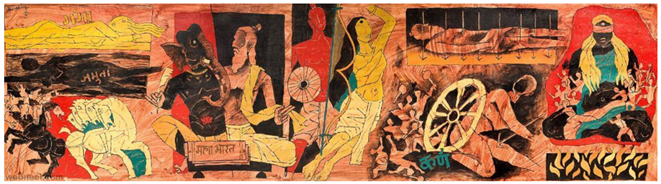
One of the most
well-known modernists to discuss the epics was Maqbool Fida Husain (M.F.
Husain). His Mahabharata series, which was displayed at the 1971 São Paulo
Biennial, depicted the chaos and moral complexity of the Kurukshetra conflict
using a vivid, cubist-inspired language.
·
Focus: Husain's paintings convey the movement and
vitality of the conflict rather than static emblems. In order to symbolize the
unavoidable momentum of Dharma and Karma, Buddha frequently employed horses as
key symbols of strength and speed.
·
Crucial
Realization: Husain
humanized the gods by emphasizing not only their heavenly qualities but also
the psychological weight of their decisions.
|
Figure 1
|
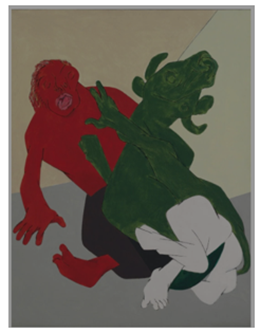
2) Tyeb
Mehta: Universal Suffering and Mythology
Mythology was a
common way for Tyeb Mehta to convey the "angst of the modern human
condition." Despite being well-known for his portrayals of Mahishasura
Mardini, he frequently takes a fragmented approach to epic topics.
·
Method: He uses the "diagonal line" to
divide the canvas, which is a visual symbol for the inner turmoil that
characters like Arjuna and Karna experience.
·
Thematic
Depth: Mehta saw the
Mahabharata's conflicts as a reflection of the violence that followed partition
and the divisions in contemporary Indian society.
|
Figure 2
|
3) Atul Dodiya: Comparing the Everyday and the Epic
Atul Dodiya is
renowned for fusing Western art history and popular culture with Indian
mythology. His paintings sometimes include shutter paintings, which, when
raised, expose a contemporary, frequently grim urban reality while the outer
layer may depict a scene from the Ramayana.
·
Interpretation: Dodiya makes observations about modern
Mumbai life through the trials of Sita or the ideals of Rama. He raises the
question of whether the moral compass offered by these epics still directs
contemporary India by situating these characters in contemporary contexts.
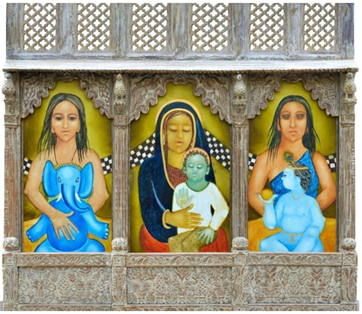
4) Anjolie
Menon: The Viewpoint of Women
Anjolie Menon
offers a contemporary, frequently reflective perspective on the epics' female
heroes, especially Sita and Draupadi.
·
Focus: She frequently emphasizes the vulnerability
and tenacity of women in her artwork. In addition to being a subservient
character, her "Sita" represents unwavering resistance to social
injustice.
·
Style: She gives these figures a status that unites
the heavenly and the human by employing a brilliant, transparent technique
evocative of Byzantine icons.
|
Figure 3
|
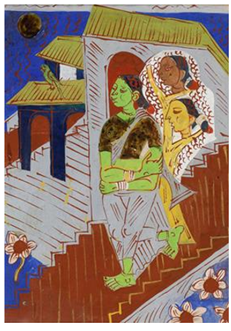
5) K.G.
Subramanyan: Tradition's Play
According to K.G.
Subramanyan, mythology is a "living language." He frequently depicted
episodes from the epics with wit and irony using folk techniques and the
terracotta mural style.
·
Method: He thought mythology ought to be lighthearted (Leela). In order to maintain the narrative
rooted in the "soil" of the common people, he frequently incorporates
regional traditional motifs (such as those from Kalighat or Pattachitra)
into his Ramayana paintings.
|
Figure 4
|
6) Modern
Folk-Fusion (Avinash Karn and The Vayeda Brothers)
The epics are also
being updated for the twenty-first century by contemporary folk artists.
·
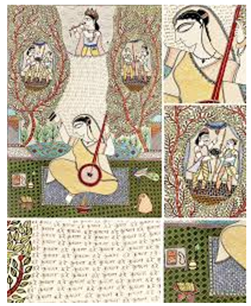
Madhubani/Mithila
Art: Artists such as Avinash
Karn incorporate themes of women's empowerment or environmental protection into
scenes such as the Swayamvara (marriage) of Rama and
Sita using traditional Bihar traditions.
|
Figure 5
|
·
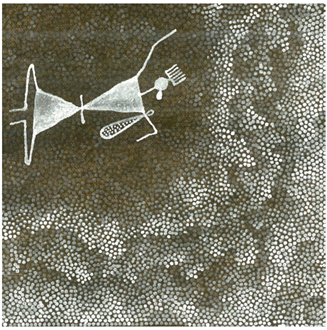
Warli
Art: The Vayeda Brothers
have demonstrated that tribal aesthetics may successfully support the weight of
big epic narratives by experimenting with narrating Mahabharata episodes using
Warli's rhythmic, geometric patterns.
|
Figure 6
|
Poosapati
Parameshwar Raju's Ramayana-based calligraphic series, which uses abstract and Devanagari-inspired
brushstrokes to tell epic stories. His artwork demonstrates how cultural legacy
may be preserved while traditional scripts, symbols, and iconography are
transformed into a contemporary visual language.
|
Table 1
|
||||||||||||||||||||||||
|
|
CONCLUSION
In conclusion, the
study shows how closely mythology and art are related. Together, they establish
a link between tradition and modern living, preserving cultural legacy while
fostering creative reinterpretation. Art can enhance human understanding and preserve
cultural continuity across time thanks to this mutually beneficial
relationship.
Mythology is a
dynamic tradition that constantly stimulates artistic expression. Indian
aesthetic identity has been greatly influenced by the intimate relationship
between myth and art, which enables art to serve as a link between spiritual
belief, cultural legacy, and artistic expression.
The study supports
the notion that mythology and art are complementary disciplines. Whereas art
delivers form and prominence, mythology offers content and significance. When
combined, they uphold customs, spread morals, and enable creative
reinterpretations of inherited information.
Indian
mythological painting is dynamic and ever-evolving. Indian artists have made
sure that mythology remains an essential and expressive component of visual
arts by fusing creativity and tradition. The study highlights the
centuries-long influence of mythical themes on Indian painting. Mythology has
provided artists with a rich visual vocabulary that preserves cultural history
while encouraging creative expression, from traditional miniature techniques to
modern reinterpretations.
By changing the
emphasis from ritualistic devotion to critical inquiry, modern Indian artists
have successfully guaranteed that the Ramayana and Mahabharata stay relevant.
By reinterpreting these epics, they establish a link between India's ancient
past and its contemporary identity, utilizing the "Epic" to clarify
the "Image" of the current world.
REFERENCES
Birdwood,
G. C. M. (1997).
The Arts of India. Nanda Book Service.
Chawala, R. (1995). Surface and Depth: Indian Artists’ Artworks. Penguin Books India.
Jain, K. (2007). Gods in the Bazaar: The Economies of Indian Calendar Art. Duke University Press. https://doi.org/10.2307/j.ctv1131bjr
Kapur,
G. (2000). When was Modernism: Essays on Contemporary Cultural
Practice in India. Tulika Books.
Littleton, C. S. (2002). Mythology: The Illustrated
Anthology of World Myth and
Storytelling. Duncan Baird Publishers.
Mago,
P. N. (2009). Contemporary Art in India: A
Perspective. National Book Trust.
Pattanaik, D. (2006). Myth = Mithya: A Handbook of Hindu Mythology.
Penguin Books India.
Pattanaik, D. (2009). 7 Secrets of Hindu Calendar Art. Westland.
Pattanaik, D. (2010). Jaya: An Illustrated
Retelling of the Mahabharata.
Penguin Books India.
Pattanaik, D. (2011). 7 Secrets of Vishnu. Westland.
Pattanaik, D. (2012). The Book of Ram. Penguin Books India.
Pattanaik, D. (2013). Sita: An Illustrated Retelling of the Ramayana. Penguin Books India.
 This work is licensed under a: Creative Commons Attribution 4.0 International License
© Granthaalayah 2014-2026. All Rights Reserved.