Original Article
Neural Style Transfer as Digital Representation through Painting using Deep Learning
|
Mahesh
Vishvakarma 1* 1 Freelance Web Developer, Self-Employed |
|
|
|
ABSTRACT |
||
|
The intersection of art and technology, particularly
the development of deep learning and artificial intelligence, has opened new
avenues for creative expression. Neural Style Transfer (NST) is a new
approach that uses deep neural networks to add creative style to digital
images. This technique overlays visual elements—such as texture, color
patterns, and brushstrokes—from one image onto the content of another,
producing interesting and imaginative results. This study explores the fundamental concepts,
methodology, and artistic significance of neural style transfer. This
technique is primarily based on convolutional neural networks (CNNs), which are capable of extracting high-level content features and
low-level style features from images. Through an optimization process that
separates and then reassembles these features, NST creates images that retain
the structural content of the original image while adopting the artistic
style of the reference artwork. This research highlights the interdisciplinary
impact of neural style transfer, demonstrating its relevance not only in
digital art and graphic design, but also in fields such as animation,
multimedia, and visual communication. Furthermore, NST serves as a bridge
between traditional artistic methods and modern computational techniques,
allowing artists, designers, and technologists to collaborate and explore new
creative possibilities. The results show that neural style transfer is an
important step toward integrating deep learning. Keywords: Neural Style Transfer (NST), Painting, Convolutional
Neural Networks (CNNs) |
||
INTRODUCTION
Neural style transfer (NST)
is a technique in the fields of deep learning and computer vision that focuses
on creating a new image by combining the content of one image with the style of
another. The primary objective of NST is to preserve the structural information
of the content image by applying aesthetic features such as texture, color, and visual patterns from the style image.
With the rapid advancement
of artificial intelligence and convolutional neural networks (CNNs), neural
style transfer has emerged as a major application of deep learning in digital
arts, image processing, and the creative industries. The concept was first
popularized by Gatys et al., who demonstrated that
deep neural networks trained for object recognition can also be used to
separate and reassemble the content and style of images.
In neural style transfer, a
pre-trained convolutional neural network, such as VGG-16 or VGG-19, is used to
extract feature representations from both the content and style images. Content
representations capture high-level semantic structure, while style representations
are constructed using statistical measures such as Gram matrices, which encode
texture and visual correlation. By optimizing the target image using a weighted
combination of content loss and style loss, a visually appealing output is generated
that reflects both content and artistic style.
Neural style transfer has
widespread applications in areas such as digital painting, film production,
gaming, augmented reality, and multimedia content creation. It not only
automates artistic processes but also helps non-artists create visually rich
images using simple inputs, bridging the gap between technology and creativity.
Experimental Configuration and
Visual Presentation
|
Figure 1
|
|
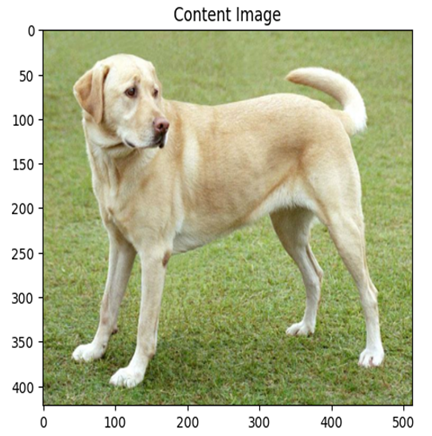
Figure 1 Shows the Original
Content Image Used in the Experiment, While |
|
Figure 2
|
|
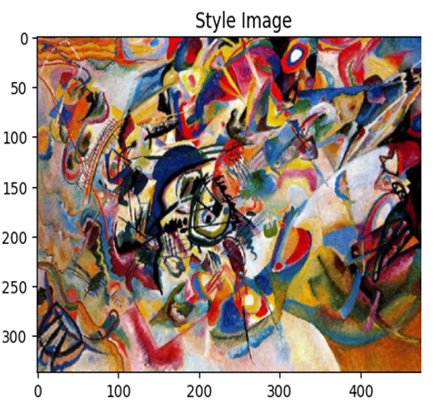
Figure 2 Shows the Reference Style Image. |
|
Figure 3
|
|
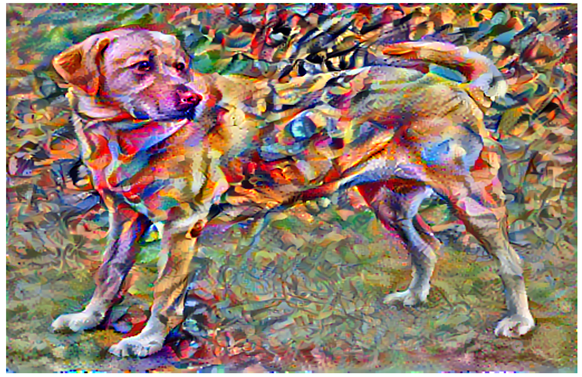
Figure 3 Shows the Final
Stylized Output Generated After Applying Neural Style Transfer. |
These images clearly show
how the structural elements of the source image have been preserved, while the
artistic color of the style image has been successfully transferred.
Methodology
The proposed methodology
implements neural style transfer using a deep learning framework. The system is
based on previously developed convolutional neural networks, specifically the
VGG-19 model, which serves as a feature extractor. The methodology includes
image selection, preprocessing, RGB normalization, style calculation, loss
calculation, and optimization using gradient descent.
Image Selection and
Preprocessing
In this research, the user
manually selects both the content and style of the image through an image
upload interface. The system supports common digital image formats such as JPEG
and PNG, which makes this approach flexible and user-oriented rather than
dependent on a fixed dataset.
After the image is
uploaded, it is converted to a standard RGB format to ensure compatibility with
the neural network's input dimensions and resized to a fixed resolution.
Resizing also helps reduce computational complexity while preserving the
necessary visual information.
RGB Calculation and
Normalization:
A digital image is
represented using the RGB color model, where each
pixel has three channels: red (R), green (G), and blue (B). The intensity value
of each channel typically ranges from 0 to 255.
For a pixel at position (x,
y), the RGB representation is:

To make the data suitable
for neural network processing, the RGB values are normalized as follows:

After normalization, pixel
values fall into the [0, 1] range, improving numerical stability and
convergence speed.
Style Representation
using Gram Matrix:
The content of an image is
represented by the feature activations of the inner layers of the neural
network. However, the style of an image is captured using the correlation
between different feature maps.
the Gram matrix is
calculated as:
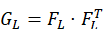
where F_L is the matrix of
vectorized feature maps at layer L. This operation captures texture patterns
and artistic features.
Working of Neural
Style Transfer
NST creates an image that
matches the content representation of the content image and the style
representation of the style image. The created image is initially random or
copied from the content image, and is repeatedly
updated until it minimizes the total loss.
|
Figure 4
|
|
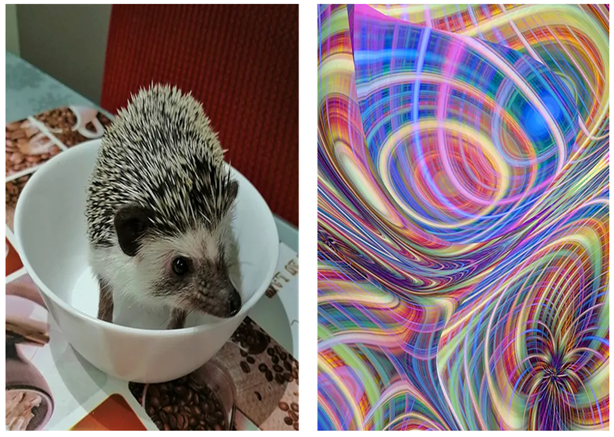
Figure 4 |
Content Loss
Content loss ensures that
the structure and meaning of the content image are preserved in the resulting
image. It is calculated as the mean square error between the feature maps of
the resulting image and the content image.
Style Loss
Style loss is an essential
component of neural style transfer, ensuring that the resulting image recreates
the statistical texture patterns of the styled image. Unlike content loss,
which preserves specific structure, style loss captures visual appearance
features such as brush strokes, color distribution,
and repetitive textures.
The concept of style loss
was introduced by Gatys et al., who showed that the
style of an image can be effectively represented by the correlation between
feature maps extracted from a deep convolutional neural network.
Mathematical
Representation
Let F_l∈R^(N_l×M_l )be the feature map of the layer l, where:
 =
number of feature channels
=
number of feature channels·
 = spatial size of each feature map
The Gram matrix for layer lis defined as:

The Gram matrix captures the interactions between
different feature channels, which encode texture and style information.
Style Loss Function
The style loss for a layer
is calculated as the mean square difference between the Gram matrix of the
generated image and the style image:
Where:
·
 = Gram
matrix of generated image
= Gram
matrix of generated image
·
 = Gram matrix of style image
The total style loss is
obtained by aggregating losses across multiple layers:

Here  represents the weight assigned to each layer.
Total Loss Function
The total loss is defined
as:

Where α controls
content importance and β controls style importance.
Gradient Descent
In neural style transfer,
the objective is not to train the neural network itself, but to transfer the
pixel values of the resulting image in a way that minimises the total loss.
This adaptation problem is solved using a gradient-based adaptation technique.
The total loss is defined
as:
Where:
·  preserves
semantic structure
preserves
semantic structure
·  preserves
artistic texture
preserves
artistic texture
·  are
weighting factors controlling the trade-off
are
weighting factors controlling the trade-off
Formulation of
Gradient Descent:
Let x denote the generated
image. The goal of optimization is to find:

This is done by repeatedly
updating the image generated using gradient descent:
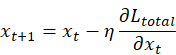
Where:
·  = learning
rate
= learning
rate
·
 = gradient
of loss w.r.t. pixels
= gradient
of loss w.r.t. pixels
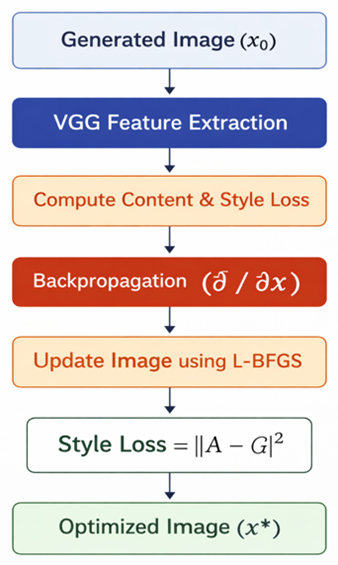
Workflow
|
Figure 5
|
|
Figure 5 Workflow |
Comparative Color
Transmission Analysis
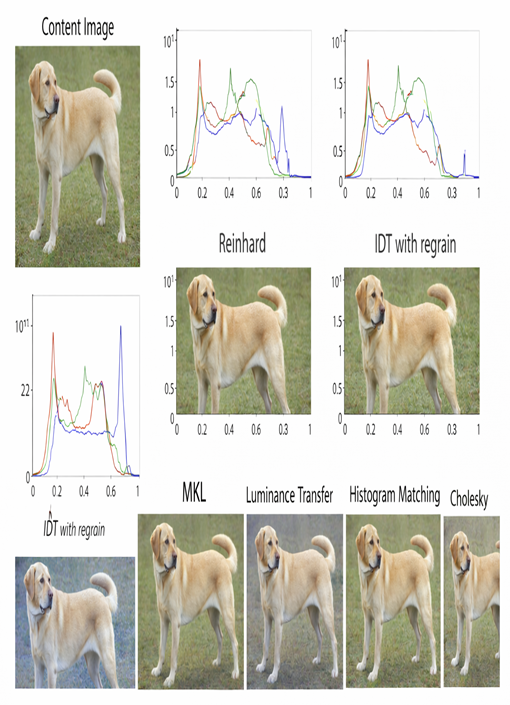
Figure 6 shows a comparative analysis of different color transmission techniques, including Reinhardt,
Iterative Distribution Transfer (IDT), MKL, Luminance Transfer, Histogram
Matching, Kolsky Decompression, and PCA. The figure shows both the visual
output and their corresponding color histograms for
each method applied to the same source image.
Histogram Distribution This
highlights that Histogram Matching and IDT achieve a closer alignment with the
original content image in terms of color intensity
and coefficient. These methods preserve the global color
structure more effectively than other techniques, such as Reinhardt and PCA,
which exhibit noticeable deviations in channel distribution.
Additionally, luminance
transfer rate produces intensity transitions but lacks a strong color coefficient, while MKL and IDT with re-graining
provide a balanced perceptual quality. Overall, histogram matching and IDT
perform better in maintaining perceptual similarities and color
consistency with the content image, making them more accurate for true color transmission.
|
Figure
6
|
|
Figure 6 Visual and histogram-based comparison of
different color transmission methods (Renard, IDT,
MKL, luminosity transform, histogram matching, Cholesky, PCA). |
Quantitative Evaluation
Table 1
|
Table 1 Shows the
KL-Divergence Values for Different Colour Transfer Techniques Across RGB
Channels. |
|||
|
Method |
Red |
Green |
Blue |
|
Reinhard |
1.41 |
1.08 |
1.65 |
|
IDT (10 iter.) |
0.10 |
0.08 |
0.19 |
|
Luminance Transfer |
0.82 |
0.31 |
0.92 |
|
Histogram Matching |
0.15 |
0.26 |
0.04 |
|
PCA |
43.63 |
Inf |
1.66 |
Lower
KL values indicate better similarity between colour distributions.
Results and
Discussion
Experimental results
demonstrate that neural style transfer successfully incorporates artistic
features from style images while maintaining the structural integrity of the
content image. Pending results confirm that NST is capable of creating visually
appealing digital paintings.
Analysis of the results
also shows that histogram-based color transfer
techniques outperform linear transformations in terms of perceptual similarity.
Conclusion
This research shows that
neural style transfer is not just a visual filter, but a mathematically based
optimization framework that enables a deep neural network to digitally paint.
This approach effectively combines artistic creativity with computational
intelligence.
Neural style transfer
serves as a powerful tool for digital artists, designers, and multimedia
professionals, opening up new possibilities for creative expression while
preserving the essence of human imagination.
ACKNOWLEDGMENTS
None.
REFERENCES
Efros,
A. A., and Freeman, W. T. (2001). Image Quilting for Texture Synthesis and
Transfer. In Proceedings of the 28th Annual Conference on Computer Graphics and
Interactive Techniques (SIGGRAPH ’01) (341–346). ACM. https://doi.org/10.1145/383259.383296
Garber,
D. D. (1981). Computational Models for Texture Analysis and Texture Synthesis
(Doctoral dissertation). University of Southern California, Image Processing
Institute. https://doi.org/10.21236/ADA102470
Gatys,
L. A., Ecker, A. S., and Bethge, M. (2015). A Neural Algorithm of Artistic
Style. arXiv. https://arxiv.org/abs/1508.06576
Johnson, J., Alahi, A., and Fei-Fei, L. (2016). Perceptual Losses for
Real-Time Style Transfer and Super-Resolution. In Computer Vision—ECCV 2016
(694–711). Springer. https://doi.org/10.1007/978-3-319-46475-6_43
Khaligh-Razavi, S.-M., and Kriegeskorte, N. (2014). Deep Supervised,
but Not Unsupervised, Models May Explain IT Cortical Representation. PLOS
Computational Biology, 10(11), e1003915. https://doi.org/10.1371/journal.pcbi.1003915
Kriegeskorte, N., Mur, M., Ruff, D. A., Kiani, R., Bodurka, J., Esteky,
H., Tanaka, K., and Bandettini, P. A. (2008). Matching Categorical Object
Representations in Inferior Temporal Cortex of Man and Monkey. Neuron, 60(6),
1126–1141. https://doi.org/10.1016/j.neuron.2008.10.043
Kwatra,
V., Schödl, A., Essa, I., Turk, G., and Bobick, A. (2003). Graphcut Textures:
Image and Video Synthesis Using Graph Cuts. ACM Transactions on Graphics,
22(3), 277–286. https://doi.org/10.1145/882262.882264
Kyprianidis,
J. E., Collomosse, J., Wang, T., and Isenberg, T. (2013). State of the “Art”: A
Taxonomy of Artistic Stylization Techniques for Images and Video. IEEE
Transactions on Visualization and Computer Graphics, 19(5), 866–885. https://doi.org/10.1109/TVCG.2012.160
Lee,
H., Seo, S., Ryoo, S., and Yoon, K. (2010). Directional Texture Transfer. In
Proceedings of the 8th International Symposium on Non-Photorealistic Animation
and Rendering (NPAR ’10) (43–48). ACM. https://doi.org/10.1145/1809939.1809945
Liu, S.
(2022). An Overview of Color Transfer and Style Transfer for Images and Videos.
arXiv. https://arxiv.org/abs/2204.13339
Long,
J., Shelhamer, E., and Darrell, T. (2015). Fully Convolutional Networks for
Semantic Segmentation. In Proceedings of the IEEE Conference on Computer Vision
and Pattern Recognition (CVPR) (3431–3440). https://doi.org/10.1109/CVPR.2015.7298965
Pitié,
F., Kokaram, A. C., and Dahyot, R. (2007). Automated Colour Grading Using
Colour Distribution Transfer. Computer Vision and Image Understanding, 107,
123–137. https://doi.org/10.1016/j.cviu.2006.11.011
Ruderman,
D. L., Cronin, T. W., and Chiao, C.-C. (1998). Statistics of Cone Responses to
Natural Images: Implications for Visual Coding. Journal of the Optical Society
of America A, 15(8), 2036–2045. https://doi.org/10.1364/JOSAA.15.002036
Wang, X., and Yu, J. (2020). Learning to Cartoonize Using White-Box
Cartoon Representations. In Proceedings of the IEEE/CVF Conference on Computer
Vision and Pattern Recognition (CVPR) (8090–8099). https://doi.org/10.1109/CVPR42600.2020.00811
Wei,
L.-Y., and Levoy, M. (2000). Fast Texture Synthesis Using Tree-Structured
Vector Quantization. In Proceedings of SIGGRAPH 2000 (479–488). https://doi.org/10.1145/344779.345009
Xu, M.,
and Ding, Y. (2022). Color Transfer Algorithm Between Images Based on a
Two-Stage Convolutional Neural Network. Sensors, 22, 1–21. https://doi.org/10.3390/s22207779
Zhu, C., Byrd, R. H., Lu, P., and Nocedal, J. (1997). Algorithm 778: L-BFGS-B: Fortran Subroutines for Large-Scale Bound-Constrained Optimization. ACM Transactions on Mathematical Software, 23(4), 550–560. https://doi.org/10.1145/279232.279236
 This work is licensed under a: Creative Commons Attribution 4.0 International License
© Granthaalayah 2014-2026. All Rights Reserved.