INFLUENCE OF MONETARY AND FISCAL POLICIES ON ECONOMIC STABILITY IN A MACROECONOMIC FRAMEWORK
Done Thirupathi 1, Dr. Jyoti Kanamadi 2
1 Research
Scholar, (Economics) Sunrise University, Alwar, Rajasthan, India
2 Research
Supervisor, School of Humanities and Social Studies, Sunrise University, Alwar,
Rajasthan, India
|
|
|
ABSTRACT |
|
|
In this
context economic stability in macroeconomic terms has emerged as a major
imperative in economic policy-making, especially in the face of economic
uncertainties and financial integration. In this research, an attempt has
been taken to focus on the influence of monetary and fiscal policy on
economic stability in a macroeconomic context. Based on a descriptive and
analytical method of analysis using secondary data sources in a macroeconomic
context, this research aims to identify and assess key indicators of economic
volatility, fiscal balance, and debt in order to arrive at a conclusive
result regarding the effectiveness of economic policy measures. From the
results, it has been determined that economic stability is closely related to
disciplined monetary policy, especially in restraining inflation volatility,
while fiscal policy sustainability assumes great significance in limiting
fluctuations in terms of economic output. Furthermore, this research reveals
that imbalances in terms of debt levels, coupled with policy inconsistencies,
tend to further destabilize the economy. |
|||
|
Received 07 July
2024 Accepted 08 August 2024 Published 30 September 2024 DOI 10.29121/granthaalayah.v12.i9.2024.6666 Funding: This research
received no specific grant from any funding agency in the public, commercial,
or not-for-profit sectors. Copyright: © 2024 The
Author(s). This work is licensed under a Creative Commons
Attribution 4.0 International License. With the
license CC-BY, authors retain the copyright, allowing anyone to download,
reuse, re-print, modify, distribute, and/or copy their contribution. The work
must be properly attributed to its author.
|
|||
|
Keywords: Macroeconomic Stability, Monetary Policy,
Fiscal Policy, Economic Volatility, Policy Coordination |
|||
1. INTRODUCTION
Macroeconomic stability is an important goal of economic policies, as it acts as the base upon which economic growth, financial security, and overall welfare can be achieved. In other words, stable economic conditions help reduce economic risks while creating optimal allocation of resources in an economy. Over time, factors like globalization, financial integration, and economic shocks have made it critical to have adequate economic policies that can help achieve economic stability in changing economic environments. In this backdrop, Monetary and Fiscal Policies have become the chief means through which the public sector can intervene to achieve economic outcomes.
The role of monetary policy in the regulation of liquidity conditions, in controlling inflation, in maintaining price stability, etc., occupies center stage. However, the effectiveness of monetary policy also depends upon certain factors like institutional credibility, financial market structure, as well as the general macro-economic setting. On certain occasions or periods of economic distress, the limits of monetary policy are observed or experienced, especially in cases of supply shocks or financial instability.
Fiscal Policy, on the contrary, directly influences aggregate demand, public expenditure, and income distribution through government expenditure and taxation decisions. While an expansive fiscal policy stimulates economic growth, large fiscal deficits and a growing public debt threaten economic stability. The interplay between fiscal measures and macro-economic stability is a subject of growing interest, especially in countries facing structural difficulties and pressures on their public finances.
Considering that a modern economy has become more interconnected, it can, therefore, be held that the coordination of monetary and fiscal policies has become a significant factor that impacts economic stability. Based on this, it can be held that any misalignment of policy can undermine economic performance, while through coordinated approaches, it can become more effective, thus leading to lower levels of macro volatility. With this perspective in mind, the study seeks to analyze the impact of monetary and fiscal policy on economic stability through a macroeconomic environment, thus providing an analysis of the individual and collective impacts on selected economic measures that seeks to bring new perspectives to the existing literature.
2. REVIEW OF LITERATURE
Agénor and Flamini (2016) examined the mandates that the different institutions have in the promotion of both macroeconomic stability and finance. It also stressed the importance of clearly defined roles in the implementation of these mandates. This study showed the importance of monetary and financial frameworks in the maintenance of macroeconomic stability, with such stability being contingent on institutional coordination, legal clarity, and transparency in the formulation/ formulation processes for the different policies/ policy objectives. The authors also noted how institutional mandates reinforced predictability in the application of macroeconomic policies and the stabilizing role the processes undertake, especially in times of economic stress.
Arifin et al. (2017) analyzed the macroeconomic stability framework of Indonesia by examining the interaction of both fiscal and monetary policies within a developing context. The authors of the study noted that the impacts of coordinated macro policies were viewed as positive towards macro stability, particularly in managing the effects of inflation and promoting economic growth in Indonesia. It was noted by the authors that macro policies that were not aligned or were not coordinated resulted in macro volatility. They further noted that such a situation undermined the effectiveness of macro policies.
Smets (2018) examined the interlinkage between monetary policy and financial stability, with particular emphasis on the degree to which central banks integrated financial stability perspectives into their policy decisions. The study concluded that monetary policy impinged on economic stability not just through inflation control but also by determining financial market conduct and risk-taking motives. Smets highlighted that ignoring financial stability risks would ultimately undermine the effectiveness of conventional monetary policy tools in the long run. The analysis underlined the increasing necessity for central banks to embed macroprudential perspectives into their stabilization approaches.
Nikiforov et al. (2022) examined the interaction between fiscal and monetary policies to ensure stability in the state's financial setting. The current study demonstrated that sustained fiscal imbalances have dampened the efficient administration of monetary policy, as this increases inflationary tendencies and reduces policy flexibility. On the contrary, stable fiscal conditions ensure the clear transmission of monetary policy rates and increase economic resilience on a whole. According to the authors, coordinated policy frameworks have less systemic risk and support sustainable macroeconomic stability in both short- and long-term perspectives.
3. RESEARCH METHODOLOGY
This research therefore applied a systematic and analytical methodological framework to analyze the impact of monetary and fiscal policies on economic stability at large. The methodology was guided by a mechanical construction through which objectivity, reliability, and analytical rigor were ensured; it did not rely on primary survey-based instruments. Key economic indicators will be assessed using a structured approach to reflect on the relationship of policy measures to economic stability outcomes, aligning the research design with the objectives of the study.
3.1. Research Design
The research used a descriptive and analytical research design in the evaluation of the economic effects of monetary and fiscal policies. This research design was effective in that it enabled an in-depth analysis of the economic factors while at the same time making minimal interference in the study environment. In that regard, the research design made an objective analysis of the state of the economy during the selected period.
3.2. Sample Size and Population
The target population was based on macroeconomic observations that represented the various economic conditions of certain time periods and regimes of policies applied in the system of finance. A sample size of 100 observations was used for the analysis. These observations covered various ranges of monetary policies, fiscal policies, and stability in the system of finance.
3.3. Data Collection
The study solely relied on secondary data, which was collected from credible sources that are easily accessible to the public. The sources included publications from the central banks and government economic publications. In addition, the study relied on universally acknowledged financial information. By using secondary data, the study was able to examine the macro-economic trends without any constrains that would have been experienced by using primary data.
3.4. Data Collection Tools and Instruments
The data collected and arranged followed standardized formats for reporting statistical data and economic data commonly used by researchers conducting economic research. Official data and statistical records were used as main instruments for data collection. They helped to measure crucial economic variables effectively and realistically by aligning them with prevailing definitions and standards regarding macroeconomic variables.
3.5. Data Analysis
After gathering this information, the descriptive and analytical statistical techniques were used to identify trends, relationships, and dispersions among major macroeconomic variables. Accordingly, measures of central tendency and dispersion were applied to summarize economic conditions, while comparative analysis was employed to test varying impacts of monetary and fiscal policy postures on economic stability. Subsequently, the findings of analysis were presented in the form of tables and graphical representation to enhance clarity and interpretability.
4. RESULTS AND DISCUSSION
This section is devoted to presenting and analyzing the findings derived from this particular study with regard to the influence exerted by monetary and fiscal policy variables on macroeconomic stability. As per this particular analysis, several indicators have been used for assessing different aspects with regard to economic volatility, balance, and interest rates, thereby providing a better insight into how macroeconomic stability is further guaranteed through such factors. There are certain numerical representations through tables and graphs that provide a deeper level of analysis with regard to these particular factors and their implications on macroeconomic conditions.
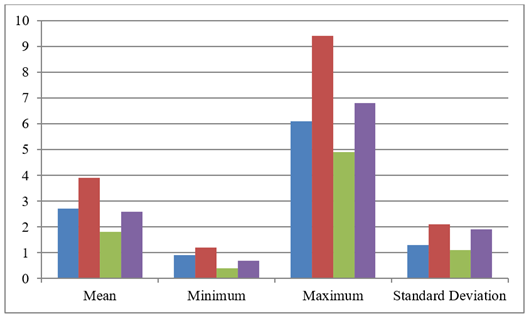
Table 1 shows the descriptive statistics for a list of macroeconomic stability indicators such as output growth volatility, inflation volatility, primary balance as a percentage of GDP, and the real interest rate. Each of the mentioned indicators is portrayed in the table, along with measures of central tendency and variations mean, minimum, maximum, and standard deviation to briefly represent the macro environment being portrayed in the data sample. Figure 1 seeks to create a visual representation based on the descriptive statistics of the discussed variables.
Table 1
|
Table 1 Descriptive Statistics of Selected Macroeconomic Stability Indicators |
||||
|
Indicator |
Mean |
Minimum |
Maximum |
Standard
Deviation |
|
Output
Growth Volatility (%) |
2.7 |
0.9 |
6.1 |
1.3 |
|
Inflation
Volatility (%) |
3.9 |
1.2 |
9.4 |
2.1 |
|
Primary
Fiscal Balance (% of GDP) |
1.8 |
0.4 |
4.9 |
1.1 |
|
Real
Interest Rate (%) |
2.6 |
0.7 |
6.8 |
1.9 |
Figure 1
|
Figure 1 Graphical Representation of Descriptive Statistics of Selected Macroeconomic Stability Indicators |
Based on the findings, it is evident that the volatility in output growth showed a mean average of 2.7 percent with moderate dispersion. In contrast, inflation volatility had a higher average variation of 3.9 percent compared to the output growth. In conclusion, the analyses revealed that the primary fiscal balance showed a positive average variation of 1.8 percent. In contrast, the average variation of the real interest rate was estimated to be 2.6 percent with significant dispersion. These findings are consistent with the observations suggested by the graphical trend depicted in Figure 1, showing higher dispersion in inflation volatility and the real interest rate.
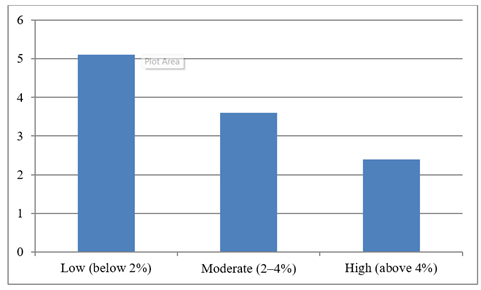
Table 2 below highlights the categorization of real interest rate levels as well as the related inflation volatility measure. A categorization of real interest rates under low, moderate, and high levels is undertaken with the aim of establishing differences attributed to monetary policy intensity and their related effects. Figure 2 illustrates a graphical representation of differences attributed to monetary policy and those attributed to inflation stability with regard to their real interest levels.
Table 2
|
Table 2 Real Interest Rate Levels and Inflation Volatility |
|
|
Real
Interest Rate Level |
Average
Inflation Volatility (%) |
|
Low
(below 2%) |
5.1 |
|
Moderate
(2–4%) |
3.6 |
|
High
(above 4%) |
2.4 |
Figure 2
|
Figure 2 Graphical Representation of Real Interest Rate Levels and Inflation Volatility |
The results show that as real interest rate levels increased, inflation volatility fell. Economies with low real interest rates recorded the highest average inflation volatility at 5.1 percent while moderate real interest rates were associated with lower volatility at 3.6 percent. The lowest volatility under high real interest rate conditions was 2.4 percent. The trend represented in Figure 2 further substantiates this inverse relationship, emphasizing how higher real interest rates promote price stability and lower the level of inflation variability.
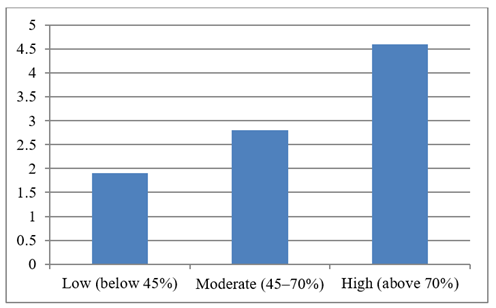
Table 3 below indicates the classification of the level of public debt as a percentage of Gross Domestic Product and the resulting measure for output growth volatility. In the table above, the level of public debt is classified into low, moderate, and high, which helps in the unambiguous evaluation of the comparison to economic stability based on the level of debt sustainability. Figure 3 below is a graphical illustration for the above contrast in the level of output growth volatility based on the classifications for public debt.
Table 3
|
Table 3 Public Debt Sustainability and Output Growth Volatility |
|
|
Public
Debt Level (% of GDP) |
Average
Output Volatility (%) |
|
Low
(below 45%) |
1.9 |
|
Moderate
(45–70%) |
2.8 |
|
High
(above 70%) |
4.6 |
Figure 3
|
Figure 3 Graphical Representation of Public Debt Sustainability and Output Growth Volatility |
The findings indicate that volatility in output growth increased with rising levels of public debt. Economies with low levels of public debt recorded an average level of volatility of 1.9 percent, while those with moderate levels of debt possessed higher levels of 2.8 percent. Volatility in output was highest under the conditions of high public debt at 4.6 percent. Figure 3 also shows this trend, where higher public debt results in higher macroeconomic instability.
Overall, the findings obtained from the above models demonstrate that both monetary policy variables as well as fiscal policy variables are significant in governing the macroeconomic stability conditions. Based upon the above findings obtained by the models, it is clear that disciplined monetary conditions play a significant role in governing the inflammation volatility; on the other hand, higher debt conditions result in higher instability or volatility in the economic output. In addition to the above conditions, changes in fiscal balance and interest rate conditions also underscore the need to ensure the sustainability of both monetary and fiscal policy variables in governing the macroeconomic stability conditions.
5. CONCLUSION
This research aimed at investigating the role of monetary and fiscal policies in ensuring economic stability under a macroeconomic setting with a focus on various economic stability indicators such as fiscal balance and the interest rate conditions of the macroeconomic system in question. The research findings showed that while monetary policies are crucial in stabilizing inflation rates within the macroeconomic system in question, fiscal sustainability is fundamental if economic stability as indicated by output fluctuations is to be a sustained feature of the macroeconomic system under study. On the other hand, the research findings showed that fiscal imbalances often contribute to the macroeconomic instability of the macro system under investigation; thus, the significance of disciplined economic policies cannot be overemphasized in ensuring the sustainability of macroeconomic stability within a complex economic system.
CONFLICT OF INTERESTS
None.
ACKNOWLEDGMENTS
None.
REFERENCES
Agenor, P. R., Alper, K., and da
Silva, L. P. (2018). Capital Regulation, Monetary
Policy, and Financial Stability. International Journal of Central Banking, 32.
Agénor, P. R., and Flamini, A. (2016). Institutional Mandates for Macroeconomic and Financial Stability (Centre for Growth and Business Cycle Research Discussion Paper Series No. 231).
Agénor, P. R., and Pereira da Silva, L. A. (2023). Towards a New Monetary-Macroprudential Policy Framework: Perspectives on Integrated Inflation Targeting. In Macro‑Financial Stability Policy in a Globalised World: Lessons from International Experience (618-673). https://doi.org/10.1142/9789811259432_0030
Arifin, A., Sugiyanto, F. X., Widodo, W., and Firmansyah, F. (2017). Macroeconomic Stability in Indonesia: Fiscal and Monetary Policies' Framework. Journal of Economic & Management Perspectives, 11(4), 341-350.
Bova, E., Medas, P., and Poghosyan, T. (2018). Macroeconomic Stability in Resource‑Rich Countries: The Role of Fiscal Policy. Journal of Banking and Financial Economics, 1(9), 103-122. https://doi.org/10.7172/2353-6845.jbfe.2018.1.5
Chugunov, I., Pasichnyi, M., Koroviy, V., Kaneva, T., and Nikitishin, A. (2021). Fiscal and Monetary Policy of Economic Development. European Journal of Sustainable Development, 10(1), 42-42. https://doi.org/10.14207/ejsd.2021.v10n1p42
Goldberg, J. E., Klee, E., Prescott, E. S., and Wood, P. R. (2020). Monetary Policy Strategies and Tools: Financial Stability considerations. https://doi.org/10.17016/feds.2020.074
Martinez‑Miera, D., and Repullo, R. (2019). Monetary Policy, Macroprudential Policy, and Financial Stability. Annual Review of Economics, 11(1), 809-832. https://doi.org/10.1146/annurev-economics-080218-025625
Nikiforov, P., Greshko, R., Marych, M., Marusiak, N., Kharabara, V., and Gladchuk, O. (2022). Mutual Influence of Fiscal and Monetary Policy in the Context of Ensuring Macro‑Financial Stability of the State. Management Theory and Studies for Rural Business and Infrastructure Development, 44(4), 435-442. https://doi.org/10.15544/mts.2022.43
Slepov, V. A., Burlachkov, V. K., Danko, T. P., Kosov, M. E., Volkov, I. I., Ivolgina, N. V., and Sekerin, V. D. (2017). Model for Integrating Monetary and Fiscal Policies to Stimulate Economic Growth and Sustainable Debt Dynamics. https://doi.org/10.35808/ersj/847
Smets, F. (2018). Financial Stability and Monetary Policy: How Closely Interlinked? International Journal of Central Banking, 35th.
Tan, C. T., Mohamed, A., Habibullah, M. S., and Chin, L. (2020). The Impacts of Monetary and Fiscal Policies on Economic Growth in Malaysia, Singapore and Thailand. South Asian Journal of Macroeconomics and Public Finance, 9(1), 114-130. https://doi.org/10.1177/2277978720906066
Unsal, D. F. (2018). Capital Flows and Financial Stability: Monetary Policy and
Macroprudential Responses. International Journal of Central Banking, 30th.
Weerakoon, D., and Hewage, K. (2017). Fiscal Policy, Growth and Macroeconomic Stability. In Tax Policy in Sri Lanka: Economic Perspectives (17).
Yevdokimov, Y., Melnyk, L., Lyulyov, O., Panchenko, O., and Kubatko, V. (2018). Economic Freedom and Democracy: Determinant Factors in Increasing Macroeconomic stability. Problems and Perspectives in Management, 16(2), 279-290. https://doi.org/10.21511/ppm.16(2).2018.26
 This work is licensed under a: Creative Commons Attribution 4.0 International License
© Granthaalayah 2014-2024. All Rights Reserved.