A Classification Study of Web-Based Physics Resources for Senior Secondary Education Based on Web Page Types
Vinod Kumar 1 ,
Dr. Ajay Surana 2
,
Dr. Ajay Surana 2
1 Research
Scholar, Department of Education, Banasthali
Vidyapith, Jaipur, Rajasthan, India
2 Head,
Department of Education, Banasthali Vidyapith,
Jaipur, Rajasthan, India
|
|
|
ABSTRACT |
|
|
The study aims
to comprehensively categorise and assess web-based
Physics resources for senior secondary education according to several web
site kinds, focussing on their accessibility,
pedagogical efficacy, and alignment with the curriculum. The study used a
quantitative research approach, gathering primary data from 384 respondents
with varied demographic and institutional backgrounds using a standardised Likert-scale questionnaire sent via Google
Forms. The gathered data were examined using SPSS to determine reliability,
validity, and to assess differences across web site categories utilising ANOVA and t-tests. The findings indicate that
online Physics materials are mostly viewed favourably,
exhibiting adequate accessibility, significant educational merit, and
substantial congruence with the senior secondary Physics curriculum. Marked
discrepancies were noted across various web site kinds regarding
accessibility and educational efficacy. Moreover, static online pages
demonstrated much superior curriculum alignment relative to dynamic web
sites, indicating that organised material
presentation improves syllabus adherence. The research shows that online
Physics materials serve as a useful additional educational tool for senior
secondary students. A harmonious blend of static and interactive online
materials is advised to maintain curriculum relevance while enhancing student
engagement and facilitating successful Physics education. |
|||
|
Received 07 February 2025 Accepted 08 March 2025 Published 30 April 2025 DOI 10.29121/granthaalayah.v13.i4.2025.6652 Funding: This research
received no specific grant from any funding agency in the public, commercial,
or not-for-profit sectors. Copyright: © 2025 The
Author(s). This work is licensed under a Creative Commons
Attribution 4.0 International License. With the
license CC-BY, authors retain the copyright, allowing anyone to download,
reuse, re-print, modify, distribute, and/or copy their contribution. The work
must be properly attributed to its author.
|
|||
|
Keywords: Web-Based Physics Resources, Senior
Secondary Education, Physics Education Websites, Pedagogical Usefulness,
Curriculum Alignment, Web Page Types, Digital Learning Resources |
|||
1. INTRODUCTION
Advanced technology has rendered modern societies dependent on it. The same is the case with the public from everything from the purchasing of energy-efficient air conditioners to legislative choices on atomic power plants Sutradhar (2022). Virtually all technologies are underpinned by scientific principles and teaching multiple concepts is possible community. This mission cannot be realized without the active participation of students at various levels and from diverse backgrounds. Physics education on all levels is aimed at developing a new type of science leadership and technical literacy a trained workforce. Improvement in physics syllabus introduction is an important measure in science education. They are the least expensive and best way of providing information to society in order to attain scientific ends making decisions, and technically training human resources to renew them.
Physics is a highly stimulating course as a course of study. And a most rewarding subject, its study prepares the students to and acquire skills in thinking critically, and in solving problems by a process. Physics is a natural science that involves the study of matter and motion of objects in space and time along with other associated meanings like energy and force. In other words, it is the phenomenon or system pertaining to the physical aspects. Physics is a science of great importance. Subject demands making enormous academic demands on the students within its learning system Factors and Effect of Poor Background on the Students’ Academic Performance in Physics at Senior Secondary School in Birnin Kebbi Metropolis (2020). The learning of physics is difficult at best, and almost impossible at worst. But because of its great importance to science and technological processes, there remains huge interest in Students’ achievement in physics, Therefore, the background of how students perform in their study of physics has created a huge deal of discussion for a long time. Most 'Physics Included' physics course offered at the senior secondary school level have some factors which have problems that affect assimilation of the students. In regard to the academic standing: performance of students in physics at senior secondary Students' performance in physics in school level is a topic of concern to many people including parents, administrators, educators, Psychologists and counsellors.
The development of science and technology in the field of IT has impacted all areas of life including education Series (2021c). Internet media, as an IT product, is "a global collection of thousands of networks that are interconnected to share information managed freely. The Internet is becoming popular as it is the proper medium to acquire the latest in various forms in a quick and simple way. Besides, in addition to this, "the web, as a mediating technology between the internet and its users, has" and the user, and it is an evolving concept that has even been integrated with interactive multimedia. Web-based learning Is a learning activity presented within a media site (website) through an internet network.
"The additional value which might exist in 'Web based learning' as opposed to teacher and/or textbook based learning: “The basis of this instruction would lie in supporting the learner in helping them realize adequate knowledge and skills in a bid to secure their functioning as active, self-reflected, and collaborative learners Hadjerrouit (2010). Thus, the students have to be encouraged to be this cannot be realized without a move away from learning environments where the teacher and the "a textbook structure of the learning process," toward "learning environments in which the students" control, with guidance from teacher, order of learning and performing which is within themselves to control activities according to their needs.
Web-based resources for learning (WBLRs) "has the potential to create an environment within which students could explore the nature of knowledge and ways to improve their own learning”. To be effective in this regard, the "process of developing WBLRs involves the ability to." WBLRs has to be user-centered. The term “user-centered” is defined as “An approach to design in which the user plays a central role in the design process. “Users of WBLRs at the center of its own design and development Winograd (1996). In school education, students are seen as users of WBLRs of most importance alongside their teachers as guides and facilitators of learning.
Nowadays, Websites are considered as one of important sources of information for a wide spectrum of users. There are different kinds of websites which include websites for government organizations, business, sports, and education. Educational websites are designed by universities, schools and research centers to introduce experiences to the to a relevant audience at various levels of academia themselves. Many numerous studies have pointed to the importance of "educational sites within the information infrastructure of everyday life." interactive learning anytime and anywhere, and also the development of further skills such as effective communication, leadership, critical thinking problem solving Elayyan (2016). These sites also present the possibility to instructors and researchers to develop their skills through participation in communication with their counterparts and follow-up to related scientific journals.
Physics Education Websites (PEWs) provide an appropriate virtual platform for users to engage with physics. Numerous physical phenomena, including motion in space, Comprehension of electricity, magnetism, atoms, and the nucleus requires practical laboratory activities, which might sometimes provide challenges. Through models, photographs, diagrams, and videos given by PEWs, learners may comprehend events and phenomena, establish connections among their constituents, manipulate mathematical equations, and formulate physics theories. These sites include all types of publications, including manuals, booklets, and articles, which assist interested individuals in fostering critical thinking and acquiring profound information. When studying a certain subject, a follower aims to explore several pertinent websites; yet, the challenge is in determining which of these sites has reliability and superior accuracy. While it is impossible to regulate the quality of published content across every website on these platforms, researchers are endeavouring to establish standards applicable to websites in order to assess their attributes and achieve the requisite level of accuracy for all users and visitors to access the pertinent site securely.
2. Literature Review
Elayyan (2016) The present study is compatible with the scientific mobility in dealing with the Internet as a source of knowledge. It strives to present Physics Education websites (PEWs) and guide their followers to the best credibility of them by analysing their content. The sample It consisted of (36) websites, which were selected according to specific criteria by utilizing the Alexa search engine. To collect data, data, a questionnaire was used as a tool of analysis included (25) items for distribution to (5) standards: authority, coverage, currency, accuracy, and objectivity. The findings showed variations in the availability ratio of credibility standards and indicators in relevant websites. Finally, the study recommended that it was important to review and update "the PEWs periodically; because physics as a natural science" needs to observe its accelerating discoveries and activities.
Gökalp (2013) The study investigated the functions of the web as a teaching/learning aid in science education, concentrating specifically on users' perceptions of physics education websites. The research study pursued a causal-comparative method of research, seeking to "[explore] the influence of demographic factors." An online instrument, a scale named "Perceptions of the Internet and Education Scale," was constructed as a mode of data collection from 340 web users. It turned out that gender, occupation, and volume of internet use were variables affecting perceptions, but that age and internet experiences did not affect perceptions.
Terrana et al. (2016) The purpose of this study was to understand the use of educational internet sources in the case of university Physics students through conducting surveys on students of undergraduate and graduate programs in 20 different Canadian university settings. It sought to understand the use of online texts, videos, and courses in support of Physics students’ educational process. It has been noted that even though students could support their own studies through the use of the internet, they did not prefer online courses. The article has offered useful insights based on the research carried out in this case. Suggestions have been made to those who use Internet material in their university settings.
Series (2021b) The study discussed the development of education systems with information technology, especially developing e-learning. It focuses on learning media development in physics, using Moodle, to help increase students' motivation. Using the framework of the development of the ADDIE model-which involves analysis, design, implementation, and evaluation-the product was validated by experts and teachers as being practical. Effectiveness tests showed that there was a significant increase in motivation, as evidenced in an N-gain value of 0.80, categorized as high. It provides insights for physics teachers on how to design technology-based learning in order to increase student engagement.
Novotny et al. (2023) The study Investigated science practical’s, specifically those that organize and apply information through online teaching in reaction to the lockdown of schools following the emergence of COVID-19. Science teachers from Slovakia, Czech Republic, Slovenia, France, and Spain provided information that highlighted 89 inputs of 50 distinctive resources. Science teachers strongly supported free resources in reviewing knowledge, with 36% of the teachers uncovering more information by virtue of distance teaching. Top-scored resources enabled peer interaction, were appropriate to subjects, ICT-audio visual, and well-organized. PhET (Interactive Simulations in Science and Math) was studied and topped in distance teaching. Other features like innovativeness and flexibility were not significant in rating.
Education et al. (2019) This study sought to established the influence of teaching materials on Physics teaching and learning within secondary schools within the Ado LGA of Ekiti State. This study used a descriptive research design and relied on 20 teachers and public student samples. The study relied on a questionnaire and used a combination of means and percentage to establish findings. The research established that there were many differences when teaching Physics based on teaching materials. Recommendations include promoting government support for these materials, seeking donations from individuals and organizations such as NGOs, and utilizing these teaching learning interactions without necessarily seeking to learn elsewhere.
Sulawesi and Styles (2023) The study aimed to explore the influence of internet use on the physics outcomes of junior high schools in Tana Toraja Regency, highlighting the influence of student learning styles, including visual, auditory, and kinesthetic styles. The research study comprised a population of 314 students, with a study conducted through a process of questioning and documentation. Statistical SPSS 22 software facilitated the processing of the study dataset, resulting in an important finding that internet use significantly impacts physics outcomes, but not the student learning styles. Notably, the study revealed that the influence of the visual style contributed the greatest, were influential in 82.9% of the overall influence of 33.8%.
Lotriet and Gouws (2025) The study explored how educational robotics (ER) enhances physics teaching and learning. It highlights the discipline's challenges, such as innovation and learner motivation. Findings suggest that ER positively influences physics education, improving problem-solving skills and allowing learning as effectively as traditional methods, often in less time. ER acts as a mindtool, facilitating active and collaborative learning, and boosting learner motivation. It fosters the development of meta-competencies like scientific thinking, collaboration, technology use, and learner autonomy. However, implementing ER in extracurricular physics activities requires careful planning with knowledgeable tutors for optimal outcomes.
Suyatna et al. (2018) The study investigated the effectiveness of interactive electronic books as opposed to printed physics books, considering gender and material characteristics, among senior high school students in Lampung, Indonesia. It utilized a research design, a quasi-experimental approach, and an ANOVA test. It found out that there were significant improved outcomes when interactive electronic books were used as opposed to printed physics books, considering both genders (p = 0.000 < 0.05). Gender differences were not significant (p = 0.963 > 0.05) and also did not influence outcomes, considering an interaction between genders (p = 0.298 > 0.05). Material characteristic effects were also significant (p = 0.000 < 0.05). The study also concluded that interactive electronic books were effective as a resource to improve outcomes, considering senior high school students.
Series (2021a) The aim of the overall research is to develop interactive multimedia material in a website for teaching elasticity and Hooke's law to senior high school students through the use of the ADDIE model for instructional development. The emphasis of this research will be given to investigating and understanding what was determined in reference to the process of developing through use of the expert validation concerning display, programming, usefulness, and language in regard to the developed multimedia material concerning teaching senior high school students about elasticity and Hooke's law. The results of material expert validation show that it was valid in display, teaching material quality, content, usefulness, and language; therefore, it was deemed applicable in teaching senior high school students physics in general.
Sanjaya et al. (2022) The study explored the role of interactive multimedia in physics learning using the qualitative literature approach. According to the research, the role of multimedia in physics learning is such that it may be rendered effective in the illustration of phenomena. Moreover, the novelty in the application of the learning media based on ICT exhibits itself as relevant to both abstract and concrete physics learning.
2.1. Research Gap
Despite literature clearly demonstrates the increasing significance of web-based and technology-enhanced resources in Physics education, underscoring its efficacy in improving student engagement, motivation, and educational results across diverse settings. Nevertheless, the majority of current research mostly focusses on the evaluation of certain digital tools, like interactive simulations, e-books, robots, multimedia modules, or learning management systems, as well as on the assessment of users' perceptions, credibility criteria, and learning results. Insufficient focus has been directed into the systematic categorisation of web-based Physics materials according to web page kinds, especially at the senior secondary school level. Furthermore, whereas several studies investigate pedagogical efficacy and learner outcomes, few empirical research concurrently compares the impact of various web page layouts on availability, pedagogical utility, and curriculum alignment. Moreover, current research mostly focusses on higher education or discrete instructional interventions, resulting in a deficiency in the comprehension of comprehensive resource categorisation specific to school-level curriculum. Consequently, a systematic, quantitative analysis is necessary to categorise web-based Physics resources by web page kinds and assess their educational significance and curriculum alignment for senior secondary education, which this research aims to do.
3. Methodology
3.1. Research Design
The present
study adopted a quantitative research design to systematically classify
web-based physics resources for senior secondary education based on the web
page type. The quantitative approach was considered appropriate as it enables
objective measurement and statistical analysis of respondent’s perceptions
regarding the availability of physis web resources, their pedagogical
usefulness, and their alignment with senior secondary physics curriculum. A
structured survey method was employed to obtain measurable data suitable for
statistical interpretation
3.2. Objectives
·
To
classify the available web resources for Physics on the basis of their types of
web pages.
3.3. Sample size
The study used a sample size of 384 respondents, considered sufficient for quantitative research and ensuring population representativeness.
3.4. Data collection
Data was collected by using a structured questionnaire. It was specifically prepared to suit the aims of investigation. It was made up of Likert scales that measured different parameters like the availability of physics web resources, the pedagogical value of physics web resources, and the curriculum relevance of physics web resources. It was delivered through Google Forms. A total of 384 responses were recorded. Statistical analysis of this data was made by using the Statistical Package for the Social Sciences (SPSS), which was used to prove the accuracy and reliability of the investigation. Along with primary methods of investigation, secondary methods like journals, internet resources, and earlier investigations relating to web-based physics were used to guide this investigation.
3.5. Measures
Data has been gathered with the help of a structured questionnaire. Questionnaire has been prepared using 5 Likert-scale (Strongly disagree to Strongly agree) where respondents will be asked to share their opinions regarding various research questions under study. Questionnaire has a set of both open ended and closed ended questions. Questions have been carefully crafted so as to gather meaningful information with respect to identified research variables. There are five categories of respondents in the survey and a separate questionnaire has been designed for each category of respondents. The bellow mention table show variables and no. items considered for the study.
|
No. Items |
||
|
1 |
Availability of Physics web resources. |
5 |
|
2 |
Pedagogical usefulness of Physics web resources. |
5 |
|
3 |
Curriculum alignment of Physics web resources |
5 |
4. Results
4.1. Introduction
The study analyses the features and efficacy of online-based Physics resources for senior secondary education, specifically categorising them by web page kinds. Given the growing dependence on digital platforms for education, it is crucial to evaluate both the accessibility of online materials and their pedagogical efficacy in relation to established curriculum. The study examines respondents' demographic traits, assesses the reliability and validity of the measuring constructs, and analyses variations in availability, pedagogical utility, and curricular alignment across different kinds of web sites. The results provide an empirical basis for comprehending how various web page styles enhance successful Physics instruction at the senior secondary level.
4.2. Demographic Variables
Table 1
|
Table 1 Demographic Variables |
|||
|
|
Frequency |
Percentage |
|
|
Gender |
Male |
186 |
48.4 |
|
Female |
198 |
51.6 |
|
|
Total |
384 |
100 |
|
|
Age |
Bellow 30 Years |
108 |
28.1 |
|
31–40 Years |
77 |
20.1 |
|
|
41–50 Years |
106 |
27.6 |
|
|
Above 50 years |
93 |
24.2 |
|
|
Total |
384 |
100 |
|
|
Educational Qualification |
Graduate |
191 |
49.7 |
|
Postgraduate |
193 |
50.3 |
|
|
Total |
384 |
100 |
|
|
School |
Government |
196 |
51 |
|
Private |
188 |
49 |
|
|
Total |
384 |
100 |
|
|
Location of institution |
Urban |
126 |
32.8 |
|
Semi-urban |
128 |
33.3 |
|
|
Rural |
130 |
33.9 |
|
|
Total |
384 |
100 |
|
Figure 1
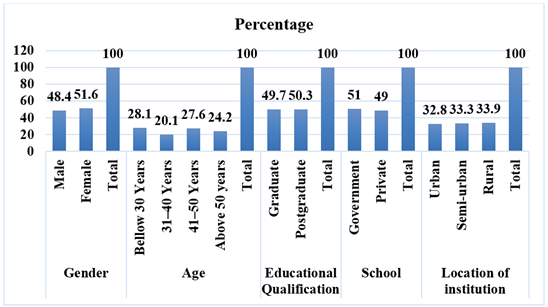
The demographic profile of the respondents indicates a fair and representative sample for the investigation. The representation of male and female respondents is almost equal, guaranteeing gender balance in views of web-based Physics materials. The age distribution reveals involvement from all age categories, with respondents under 30 and those aged 41–50 constituting a significant fraction, indicating a blend of youth and experience. The educational qualifications of graduates and postgraduates are equally divided, indicating sufficient intellectual readiness to assess Physics online resources. Respondents are almost evenly sourced from government and private institutions, allowing comparison analysis across different educational environments. The distribution of institutions reflects a nearly equal representation from urban, semi-urban, and rural areas, thereby ensuring geographic diversity and improving the generalisability of findings concerning the availability, pedagogical efficacy, and curriculum alignment of web-based Physics resources at the senior secondary level.
4.3. Validity and Reliability
Table 2
|
Table 2 Validity and Reliability |
|||
|
Construct |
Cronbach’s Alpha |
AVE |
CR |
|
Availability of Physics web
resources |
0.879 |
0.699 |
0.836 |
|
Pedagogical usefulness of
Physics web resources |
0.897 |
0.709 |
0.84 |
|
Curriculum alignment of
Physics web resources |
0.892 |
0.698 |
0.836 |
The investigation of validity and reliability shows that the measurement constructs used in the research are both dependable and accurate. The Cronbach’s alpha values for the three constructs availability of Physics web resources, pedagogical usefulness of Physics web resources, and curriculum alignment of Physics web resources exceed the acceptable threshold, indicating robust internal consistency among the items assessing each construct. The Average variation Extracted (AVE) values for all constructs surpass the suggested minimum, demonstrating sufficient convergent validity and affirming that a significant percentage of variation is accounted for by the corresponding constructs. The Composite dependability (CR) values further substantiate the dependability of the measurement model, indicating consistent and steady measurement across indicators. These findings confirm that the constructs exhibit adequate reliability and validity, making them appropriate for further statistical analysis and interpretation in the study.
4.4. Mean and standard deviation
Table 3
|
Table 3 Mean and standard deviation |
||
|
Construct |
Mean |
Std. Deviation |
|
Availability of Physics web
resources |
3.6073 |
0.78334 |
|
Pedagogical usefulness of
Physics web resources |
3.7031 |
0.79001 |
|
Curriculum alignment of
Physics web resources |
3.7427 |
0.79163 |
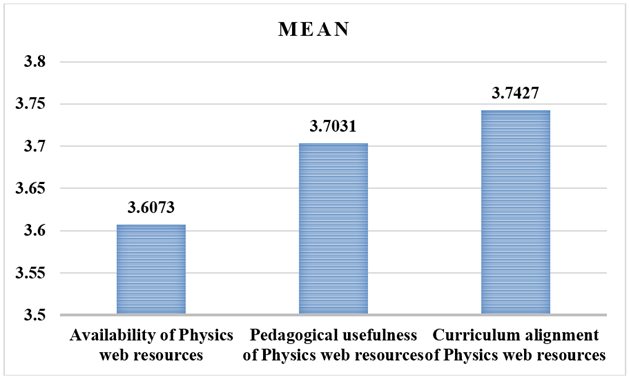
The descriptive statistics indicate that respondents mostly maintained favourable opinions of the web-based Physics materials across all examined variables. The average score for the alignment of Physics online resources with the senior secondary curriculum is the highest among the three components, suggesting that these resources are seen as well-aligned with the curriculum. This is followed by pedagogical efficacy, indicating that the materials are deemed helpful in facilitating teaching and learning processes while augmenting conceptual comprehension. The availability of Physics web resources, however much diminished, nevertheless demonstrates a satisfactory level, signifying sufficient access to online information. The similar and modest standard deviation values across all conceptions indicate a fair consistency in respondents' views, with no significant diversity in replies. The results provide a favourable and equitable assessment of the accessibility, educational efficacy, and curricular congruence of online Physics resources for senior secondary education.
Figure 2
4.5. Hypothesis Implementation
H1: There is a significant difference in the
availability of Physics web resources across different types of web pages.
Table 4
|
Table 4 ANOVA |
|||||
|
Availability of Physics web
resources |
|||||
|
|
Sum of Squares |
df |
Mean Square |
F |
Sig. |
|
Between Groups |
25.553 |
3 |
8.518 |
15.452 |
.000 |
|
Within Groups |
209.466 |
380 |
.551 |
|
|
|
Total |
235.020 |
383 |
|
|
|
The results have been derived by performing a test that is known as "One-Way ANOVA" to ascertain whether there is any sort of differing value with respect to the availability of Physics web resources through various categories of web pages. Based on the deductions that have been derived from the test results, it may be stated that there is a differing value with respect to the availability of Physics resources through various categories of web pages, as indicated by the high value compared to the results obtained through categories of web pages that have much less compared to the desired level. This enhances an affirmation of the hypothesis that such an application of the sort of web page results in the evaluation of the overall availability of Physics resources as presented through the internet platforms. Based on such scrutiny of the deductions that have been revealed through such an inquiry, it may be stated that, as indicated by such an inference, the overall availability of Physics resources as presented through web platforms cannot be determined through any sort of particular scrutiny due to its affiliation with the sort of application that is presented through platforms dedicated to internet use.
H2: The pedagogical usefulness of Physics web resources
significantly varies according to the type of web page.
Table 5
|
Table 5 ANOVA |
|||||
|
Pedagogical usefulness of
Physics web resources |
|||||
|
|
Sum of Squares |
df |
Mean Square |
F |
Sig. |
|
Between Groups |
25.165 |
3 |
8.388 |
14.904 |
.000 |
|
Within Groups |
213.871 |
380 |
.563 |
|
|
|
Total |
239.036 |
383 |
|
|
|
Whether the level of pedagogical usefulness of the web resource materials for Physics differs in a significant manner in accordance with the types of web page resource materials made use of in senior secondary level classes, the test carried out was the One-Way Analysis of Variance test. From the data obtained in the study, it was established that the difference in the level of pedagogical usefulness with regard to various types of web page resource materials made use of in the classes was seen in a significant manner through the F value calculated in accordance with the data obtained in the study. Hence, the null hypothesis could be rejected, and the research hypothesis was seen to hold true in accordance with the data obtained in the study; in fact, the pedagogical usefulness of web resource materials for Physics was seen to vary in a significant manner in accordance with various types of web page resource materials made use of in the classes.
H3: Interactive web page types provide significantly
higher curriculum alignment for senior secondary Physics compared to static web
pages.
Table 6
|
Table 6 Group Statistics |
||||||
|
Nature of web page |
N |
Mean |
Std. Deviation |
t-value |
Sig. |
|
|
Curriculum alignment of Physics web resources |
Static |
212 |
3.9377 |
0.69657 |
5.461 |
0.000(<0.01) |
|
Interactive |
172 |
3.5023 |
0.83645 |
|||
The findings reveal a statistically significant disparity in the curricular alignment of Physics online resources contingent upon the kind of web pages. An independent samples t-test was used to evaluate curricular alignment between static and interactive webpage types. The results indicate that static web pages show a superior mean score for curricular alignment in comparison to dynamic web sites. The calculated t-value is statistically significant at the 0.01 level, suggesting that the disparity in curricular alignment between the two categories of web sites is not attributable to chance. This indicates that the design of web pages significantly influences the alignment of online-based Physics materials with the senior secondary curriculum. Although interactive online sites aim to improve student engagement, static web resources tend to be more systematically organised and tightly aligned with defined curricular goals, therefore providing better conformity with senior secondary Physics syllabi.
5. Discussion
The study's results provide a comprehensive understanding of the characteristics and efficacy of web-based Physics resources for senior secondary education, categorised by web page kinds. The demographic variety of respondents enhances the interpretive breadth of the data, since viewpoints are gathered from different age groups, institutional categories, and geographic regions. The measuring methodology exhibits robust reliability and validity, affirming that the notions used to evaluate availability, pedagogical utility, and curricular alignment are theoretically coherent and consistently quantified. General attitudes towards web-based Physics materials are positive, suggesting that these tools significantly contribute to Physics education. The research indicates that various kinds of web pages substantially impact the accessibility and educational efficacy of Physics resources, implying that the design and architecture of online platforms influence the manner in which material is accessible and used for instruction and learning. Furthermore, the disparities noted between static and dynamic web sites indicate that while interactive platforms foster greater interaction, static resources are more likely to adhere closely to established educational goals. These results jointly emphasise the significance of evaluating web page attributes when incorporating online materials into senior secondary Physics instruction.
6. Conclusion
The study finds that web-based Physics resources serve as a beneficial and effective support system for senior secondary education, with their influence differing dependent on the type and character of the web sites. The findings confirm that the accessibility, educational efficacy, and curricular coherence of online Physics materials are affected by their design and presentation. Interactive online pages enhance student engagement and instructional diversity, but static web pages exhibit superior alignment with curricular standards, making them especially appropriate for syllabus-focused education. The developed assessment system and favourable overall impressions suggest that meticulously selected online resources may substantially improve Physics instruction and learning at the senior secondary level. The study underscores the need for educators and curriculum developers to implement a balanced strategy that incorporates both static and interactive online resources to maintain curricular relevance and promote significant learning experiences.
CONFLICT OF INTERESTS
None.
ACKNOWLEDGMENTS
None.
REFERENCES
College of Education, Ekiti State. (2019). Effects of Availability and Utilization of Instructional Materials on the Teaching of Physics in Senior Secondary Schools in Ekiti State, Nigeria., 6(2), 935–942.
Conference Series. (2021a). Development of Interactive Multimedia Based on Web Elasticity and Hooke’s Law Topic in High School. Journal of Physics: Conference Series, 1811(1), 012117. https://doi.org/10.1088/1742-6596/1811/1/012117
Conference Series. (2021b). Development of Web-Based Learning Media for Physics Materials Using Moodle in High School. Journal of Physics: Conference Series, 1869(1), 012179. https://doi.org/10.1088/1742-6596/1869/1/012179
Conference Series. (2021c). Relationship Between the Use of the Internet as a Learning Resource and Physics Learning Outcomes. Journal of Physics: Conference Series, 1882(1), 012029. https://doi.org/10.1088/1742-6596/1882/1/012029
Elayyan, S. R. (2016). Analytical Study of Physics Education Websites’ Content. Universal Journal of Educational Research, 4(12), 2832–2839. https://doi.org/10.13189/ujer.2016.041217
Factors and Effect of Poor Background on the Students’ Academic Performance in Physics at Senior Secondary School in Birnin Kebbi Metropolis. (2020). Science Journal of Education and Technology, 5(3), 114–119. https://doi.org/10.36348/sjet.2020.v05i03.004
Gökalp, M. S. (2013). Perceptions of the Internet and Education: A Study with Physics Education Website Users. International Journal of Environmental and Science Education, 8(2), 289–302. https://doi.org/10.12973/ijese.2013.210a
Hadjerrouit, S. (2010). Developing Web-Based Learning Resources in School Education: A User-Centered Approach. Interdisciplinary Journal of E-Learning and Learning Objects, 6, Article 1172. https://doi.org/10.28945/1172
Lotriet, H. H., and Gouws, P. M. (2025). Educational Robotics in Physics Education: A Systematic Review. Studies in Science Education, 61(1), 1–30. https://doi.org/10.1080/03057267.2025.2455334
Novotny, P., Chlebounova, I., and Jans, V. (2023). Identifying Key Features of Digital Resources Used During Online Science Practicals. PLOS ONE, 18(3), e0283054. https://doi.org/10.1371/journal.pone.0283054
Sanjaya, L. A., Budi, M. A. H., and Haeruman, M. D. (2022). Trends of Web-Based Instructional (WBI) in Physics Learning: A Literature Review. Journal of Physics: Conference Series, 2377(1), 012082. https://doi.org/10.1088/1742-6596/2377/1/012082
Sulawesi, S., and Styles, L. (2023). The Effect of Internet Use on Physics Learning Outcomes in Terms of Student Learning Styles., 557–569.
Sutradhar, A. (2022). Physics Education to Develop Society and Education. International E-Learning and Development Studies, Article e01.008. https://doi.org/10.52756/ieldps.2022.e01.008
Suyatna, A., Maulina, H., Rakhmawati, I., and Khasanah, R. A. N. (2018). Electronic Versus Printed Book: A Comparison Study. Jurnal Pendidikan IPA Indonesia, 7(4), 391–398. https://doi.org/10.15294/jpii.v7i4.14437
Terrana, A., Leung, A. C. K., and Jerzak, S. (2016). Use of Online Resources by Physics Students in Canada: A Cross-Sectional Study., 1–22.
 This work is licensed under a: Creative Commons Attribution 4.0 International License
© Granthaalayah 2014-2025. All Rights Reserved.