
Original Article
Impact of Visual Organizer Assisted Science Instruction on Students’ Academic Achievement: A Comparative Investigation
|
Prabha Devi 1*, Dr. Shalini
Singh 2 1 Ph.D. Scholar Department
of Teacher Education V.M.L.G College Ghaziabad, India 2 Associate Professor Department of Teacher
Education V.M.L.G, College Ghaziabad, India |
|
|
|
ABSTRACT |
||
|
Profound educational transformation emerges when instructional strategies move beyond traditional delivery and engage learners through structured, concept-oriented approaches. The present investigation explores the educational impact of visual organizer–assisted science instruction on secondary students’ academic achievement. Grounded in constructivist theory, the approach emphasizes conceptual clarity, meaningful association of prior and new knowledge, and active participation in the learning process. Specially designed visual organizers, aligned with the prescribed curriculum, were systematically implemented in an experimental group, while a control group received conventional teaching. A pre-test–post-test control group design was employed, and a standardized achievement test assessed comprehension, retention, application, and overall performance. The findings revealed remarkable improvement in students’ post-test achievement scores, demonstrating that instruction supported with visual organizers significantly strengthens learning outcomes. Comparative analysis indicated positive academic gains among both boys and girls, affirming its universal applicability and effectiveness. Beyond quantitative enhancement, the method also contributed to improved engagement, cognitive organization, and sustained interest in science learning. The study ultimately asserts that visual organizer–based instruction holds substantial pedagogical promise, offering a scientifically validated, meaningful, and enriching pathway to academic success and improved classroom experience for secondary school learners. Keywords: Visual Organizer, Academic
Achievement, Science Achievement Test |
||
INTRODUCTION
In the present
psychological era of education, the focus of teaching is not merely on the
content to be delivered but on the learner who receives it. Modern education
emphasizes that instructional strategies should correspond to the mental level,
needs, interests, and learning abilities of the children. Education is
meaningful only when learners are actively engaged in understanding concepts,
establishing relationships, solving problems, and applying knowledge to
real-life situations. Therefore, it becomes essential to adopt such methods
which not only transmit knowledge but also encourage creativity, critical
thinking, and independent learning among students.
As Vygotsky
stated, “Learning is a socially mediated activity where knowledge is
constructed through active participation.”
Traditional
methods of teaching, especially lecture-based approaches, often remain limited
to the passive reception of knowledge. Although they transmit information, they
fail to ensure meaningful understanding, retention, and application of
knowledge in new contexts. In contrast, constructivist approaches emphasize
that knowledge is not delivered but constructed by learners through active
involvement. Bruner rightly asserted that “The purpose of education is not to
impart knowledge but to facilitate thinking.” Hence, constructivist teaching
encourages students to explore, discover, and relate new ideas with prior
experiences.
In this context,
the use of Visual Organizers has emerged as an effective pedagogical tool.
Visual organizers provide a structured representation of concepts, enabling
learners to visualize relationships among ideas, organize information
meaningfully, and develop deeper conceptual understanding. They support
meaningful learning by integrating newly acquired knowledge with previously
learned concepts, thereby facilitating comprehension, retention, and transfer
of learning. Novak (1993) emphasized that
learning becomes more powerful when students can visualize and interrelate
different elements of knowledge. Visual organizers also encourage active
participation, collaborative learning, and reflective thinking, which are
essential elements of modern education.
Thus,
incorporating visual organizers into teaching science and other school subjects
is not only pedagogically sound but also psychologically significant. They
promote clarity of understanding, enhance memory, stimulate interest, and
develop higher-order thinking skills. As Ausubel highlighted, “The most
important factor influencing learning is what the learner already knows;
teaching must connect with it.” Visual organizers effectively bridge this
connection and therefore hold great relevance in contemporary educational
practice.
Definitions of Key Terms
Visual Organizer
1) Novak
and Gowin (1984)
“A visual
organizer is a structured diagram that represents concepts and their
relationships, helping learners arrange knowledge meaningfully and connect new
information with prior understanding.”
2) Academic
Achievement
The measurable
learning outcomes of students, reflected through test scores and performance
indicators, demonstrating their comprehension, retention, and application of
academic content.
3) Science
Achievement Test
A Science
Achievement Test is a standardized and scientifically constructed assessment
tool designed to measure students’ comprehension, retention, application, and
overall mastery of science concepts, thereby providing a reliable indicator of
academic performance and learning effectiveness in science.
Review of Related Literature
An examination of
earlier and contemporary studies reveals a sustained scholarly emphasis on the
role of visual and physical organizers in enhancing learning outcomes in
science education. Ausubel
(1978) provided the theoretical basis by asserting
that advance organizers facilitate meaningful learning through the integration
of new information with prior knowledge. Adcock
(2000) later emphasized that visual structuring of
content reduces cognitive load and improves learners’ processing efficiency.
Empirical investigations by Chang et
al. (2002) demonstrated that concept mapping enhances
comprehension and summarization skills, a finding further supported by
classroom-based studies in science education Asan (2007). Chen (2007) reported that the use of advance organizers
in web-based environments improves learning and retention, while Akinbobola
(2008) highlighted their positive influence on
students’ attitudes and achievement in science. At the secondary level, studies
by Adesola
and Salako (2013) and Cheema
and Mirza (2013) confirmed the effectiveness of visual
organization strategies in improving academic performance. With the integration
of technology, Aljaser (2017) and Amar (2019) emphasized the growing effectiveness of
electronic and graphic visual organizers.
Recent research
conducted between 2020 and 2024 further supports that digital and interactive
visual organizers enhance conceptual understanding, student engagement, and
long-term retention Hwang and Kim (2020), Wu and Chen (2022), Kim
(2023). In conclusion, the collective evidence clearly establishes that
visual organizers play a central role in structuring knowledge, simplifying
complex scientific concepts, and promoting meaningful and lasting learning,
thereby making them an indispensable instructional tool in contemporary
science.
Need and Significance of this Research Paper
The experiences of
traditional science classrooms reveal that conventional methods largely
emphasize the mechanical acquisition of facts rather than meaningful
understanding and practical application. Consequently, students often fail to
transfer their scientific knowledge to real-life situations, and misconceptions
frequently emerge due to incorrect interpretation of scientific experiences. In
recent times, students’ interest in studying science and their academic
achievement has shown a declining trend, indicating the urgent need for
innovative, learner-centered, and cognitively
stimulating instructional strategies.
Therefore, it
becomes essential to question whether traditional approaches are truly
producing desirable educational outcomes or whether more effective and dynamic
methodologies are required for science teaching.In
this context, the use of Visual Organizers appears to be a powerful pedagogical
innovation, as they help learners visualize relationships among concepts,
construct knowledge meaningfully, and actively participate in the learning
process. Albert Einstein’s view is highly relevant here: “Education is not the
learning of facts, but the training of the mind to think.” Similarly, David
Paul Ausubel emphasized that meaningful learning occurs when new ideas are
clearly related to previously acquired knowledge. Hence, the present study
seeks to investigate the comparative influence of teaching science through
Visual Organizers on students’ academic achievement, with the aim of
determining whether this approach can make science learning more effective,
engaging, and applicable to real life.
Research Objectives
1)
To
examine the effectiveness of Visual Organizers on the Science achievement of
Class IX female students by analyzing the difference
between their pre-test and post-test achievement scores.
2)
To
examine the effectiveness of Visual Organizers on the Science achievement of Class
IX male students by analyzing the difference between
their pre-test and post-test achievement scores.
3)
To
examine the effectiveness of Visual Organizers on the Science achievement of
Class IX students by analyzing the difference between
their pre-test and post-test achievement scores.
4)
To
examine the effectiveness of Traditional Method on the Science achievement of
Class IX students by analyzing the difference between
their pre-test and post-test achievement scores.
Hypothesis of the study
H0-1
There is no
significant difference between the pre-test and post-test achievement scores of
class IX science students after being taught through Traditional Method.
H0-2
There is no significant difference between the
pre-test and post-test achievement scores of class IX science Female students
after being taught through visual organizers.
H0-3
There is no
significant difference between the pre-test and post-test achievement scores of
class IX science Male students after being taught through visual organizers.
H0-4
There is no
significant difference between the pre-test and post-test achievement scores of
class IX science students after being taught through visual organizers.
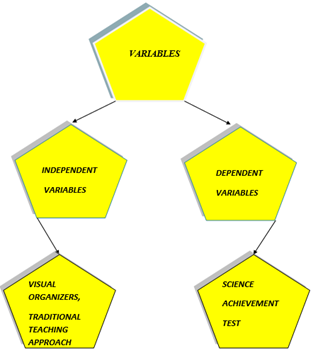
Variables of the study
Sample of the Study
A sample refers to
a specific group of participants selected from the target population for
conducting research. In the present study, the sample consisted of Class IX
Science students selected from Aadharshila the School
Chandpur, Bijnor. The students were chosen using a purposive sampling
technique, ensuring relevance and suitability to the research purpose.
Tools of the Study
In the present
study, two major categories of tools have been employed, namely structural and
measuring tools. The structural tool comprises the use of visual organizers,
which have been systematically developed and implemented as an instructional
strategy to promote clarity of concepts, organization of knowledge, and
meaningful learning among students. In this research, the visual organizers
have been specifically designed on the basis of the Class IX NCERT Science
curriculum, and these structured tools were consistently used during
instructional sessions. The measuring tool of the study is science achievement,
assessed through a standardized Science Achievement Test prepared to evaluate
students’ comprehension, retention, application, and overall academic
performance in science. Thus, from the researcher’s perspective, the study aims
to determine the effectiveness of visual organizers developed from NCERT Class
IX Science content in enhancing students’ science achievement, by
scientifically examining the relationship between the instructional
intervention and learners’ achievement outcomes.
Validity and Reliability of the Test Instrument
Validity: To ensure the academic rigor and
authenticity of the present study, special emphasis was placed on establishing
the validity of the research tool. A test is considered valid when it
accurately measures the attribute or capability for which it has been constructed.
In this study, the validity of the Science Achievement Test was assured through
content validity, wherein subject experts critically evaluated whether the test
items truly represented the prescribed content and instructional objectives.
Their expert judgment confirmed that the tool appropriately covered essential
areas of the curriculum, ensuring that the test genuinely measures students’
science achievement.
Reliability: Along with validity, equal importance was
accorded to ensuring the reliability of the test, so that the obtained results
remain consistent and dependable. Reliability refers to the stability and
consistency of scores when a test is administered under similar conditions. In
the present research, reliability was established using the Split-Half Method,
wherein the test was divided into two equivalent halves and the correlation
between their scores was calculated. The obtained reliability coefficient of
0.85 reflects a high degree of internal consistency, indicating that the test
is trustworthy, dependable, and scientifically sound for measuring students’
performance.
Study
Description: In the present
research an experimental approach was employed to examine the effect of Visual
Organization strategies in comparison with the conventional teaching method on
the academic achievement of Class IX science students. The study aimed to
produce strong empirical evidence supporting innovative instructional practices
for improving student learning outcomes.
Study Design
The study adopted
a pre-test–post-test control group experimental design. One group was taught
through visual organizers, whereas the control group received traditional
instruction. Pre-tests and post-tests were administered to both groups to
compare achievement levels, thereby ensuring reliability, objectivity, and a
scientifically controlled evaluation of instructional effectiveness.
Results and Interpretation
H0-1 There is no significant difference the
pre-test and post-test achievement scores of class IX science students after
being taught through Traditional Method.
|
GROUP |
NUMBER (N) |
MEAN (M) |
STANDARD DEIATION (S.D) |
‘t’ VALUE |
SIGNIFICANCE LEVEL |
Column1 |
|
0.05 |
0.01 |
|||||
|
SUDENTS
PRE-TEST CONTROL GROUP |
40 |
20.25 |
6.62 |
2.42 |
Rejected |
Accepted |
|
STUDENTS POST-TEST CONTROL GROUP |
40 |
23.925 |
6.99 |
Significant Difference |
Not significant Difference |
The table presents
a comparison of the pre-test and post-test achievement scores of Class IX
science students taught through the traditional method. The post-test mean
score (M = 23.925) shows an improvement over the pre-test mean score (M =
20.25), indicating a learning gain after instruction. With 78 degrees of
freedom, the calculated t-value (2.42) is higher than the critical value at the
0.05 level (1.99), showing a significant difference at this level. However, the
calculated t-value is lower than the critical value at the 0.01 level (2.64),
indicating that the difference is not significant at the 0.01 level. This
suggests that teaching through the traditional method leads to some improvement
in students’ post-test achievement, but the effectiveness is not strong at a
higher level of significance. In comparison, the improvement observed through
visual organizer–based teaching appears to be more effective than the
traditional method in enhancing students’ academic achievement.
H0-2 There is no significant difference between
the pre-test and post-test achievement scores of class IX science Female
students after being taught through visual organizers.
|
GROUP |
NUMBER (N) |
MEAN (M) |
STANDARD DEIATION (S.D) |
‘t’ VALUE |
SIGNIFICANCE LEVEL |
Column1 |
|
0.05 |
0.01 |
|||||
|
FEMALE PRE-TEST EXPERIMENTAL GROUP |
20 |
21 |
6.91 |
5.9 |
Rejected |
Rejected |
|
FEMALE POST-TEST EXPERIMENTAL GROUP |
20 |
31.65 |
4.17 |
Significant Difference |
The table
demonstrates the academic growth of Class IX science students taught through
the traditional method and the visual organizer approach. The pre-test results
show a mean score of 21 with a standard deviation of 6.90, whereas the
post-test results after instruction through visual organizers reveal a higher
mean score of 31.65 and a reduced standard deviation of 4.17. With 38 degrees
of freedom, the calculated t-value of 5.90 exceeds the critical values at both
0.05 (2.02) and 0.01 (2.71) levels. Hence, the null hypothesis is rejected,
indicating a significant difference between pre-test and post-test mean scores.
This confirms that the use of visual organizers significantly enhances the
academic achievement of Class IX science Female students.
H0-3 There is no significant difference
between the pre-test and post-test achievement scores of class IX science Male
students after being taught through visual organizers.
|
GROUP |
NUMBER (N) |
MEAN (M) |
STANDARD DEIATION (S.D) |
‘t’ VALUE |
SIGNIFICANCE LEVEL |
Column1 |
|
0.05 |
0.01 |
|||||
|
MALE PRE-TEST EXPERIMENTAL GROUP |
20 |
20 |
6 |
6.96 |
Rejected |
Rejected |
|
MALE POST-TEST EXPERIMENTAL GROUP |
20 |
31.35 |
4.17 |
Significant Difference |
The table demonstrates the academic growth of
Class IX science students taught through the traditional method and the visual
organizer approach. The pre-test results show a mean score of 20 with a
standard deviation of 6.00, whereas the post-test results after instruction
through visual organizers reveal a higher mean score of 31.35 and a reduced
standard deviation of 4.17. With 38 degrees of freedom, the calculated t-value
of 6.96 exceeds the critical values at both 0.05 (2.02) and 0.01 (2.71) levels.
Hence, the null hypothesis is rejected, indicating a significant difference
between pre-test and post-test mean scores. This confirms that the use of
visual organizers significantly enhances the academic achievement of Class IX
science Male students.
H0-4 There is no significant difference between
the pre-test and post-test achievement scores of class IX science students
after being taught through visual organizers.
|
GROUP |
NUMBER (N) |
MEAN (M) |
STANDARD DEIATION (S.D) |
‘t’ VALUE |
SIGNIFICANCE LEVEL |
Column1 |
|
0.05 |
0.01 |
|||||
|
SUDENTS
PRE-TEST EXPERIMENTAL GROUP |
40 |
20.5 |
6.4 |
9.14 |
Rejected |
Rejected |
|
STUDENTS POST-TEST EXPERIMENTAL GROUP |
40 |
31.5 |
4.12 |
Significant Difference |
The table
demonstrates the academic growth of Class IX science students taught through
the traditional method and the visual organizer approach. The pre-test results
show a mean score of 20.50 with a standard deviation of 6.40, whereas the
post-test results after instruction through visual organizers reveal a higher
mean score of 31.50 and a reduced standard deviation of 4.12. With 78 degrees
of freedom, the calculated t-value of 9.14 exceeds the critical values at both
0.05 (1.99) and 0.01 (2.64) levels. Hence, the null hypothesis is rejected,
indicating a significant difference between pre-test and post-test mean scores.
This confirms that the use of visual organizers significantly enhances the
academic achievement of Class IX science students.
Conclusion
The present study
concludes that visual organizer–assisted science instruction constitutes a more
meaningful and effective pedagogical approach than conventional teaching
methods at the secondary school level. By fostering conceptual clarity,
systematic organization of knowledge, and active learner engagement, visual
organizers significantly enhance students’ academic achievement in science. The
comparative investigation indicates that while traditional instruction may lead
to limited improvement, the integration of visual organizers creates richer
learning experiences that support comprehension, retention, and application of
scientific concepts. The effectiveness of this approach across diverse learner
groups further highlights its universal pedagogical value. Overall, the
findings affirm that visual organizer–based instruction holds substantial
promise for improving science learning outcomes, strengthening classroom
interaction, and promoting deeper cognitive processing, thereby contributing to
more effective and learner-centered science education.
ACKNOWLEDGMENTS
None.
REFERENCES
Adcock,
A. (2000). Effects of Cognitive Load on Processing and Performance.
Adesola, O. O., and Salako, E. T. (2013). Effect of Concept Mapping Instructional Strategy on Junior Secondary School Students' Knowledge of Multiculturalism in the Global 21st Century Social Studies Classroom. Journal of Education and Practice, 4(13), 123–131.
Akinbobola, A. O. (2008). Facilitating Nigerian Physics Students' Attitude Towards the Concept of Heat Energy. Scientia Paedagogica Experimentalis, 45(2), 353–366. https://doi.org/10.4314/afrrev.v2i2.41041
Aljaser, A. M. (2017). The Effectiveness of Electronic Mind Maps in Enhancing Academic Achievement and the Attitude Towards Learning English Among Primary School Students. International Education Studies, 10(12), 80–95. https://doi.org/10.5539/ies.v10n12p80
Amar,
M. (2019). The Effect of Graphic Organizers Strategy on Reading Comprehension
of Students with Different Learning Styles. Language-Edu,
8(1).
Asan, A. (2007). Concept Mapping in Science Class: A Case Study of Fifth Grade Students. Educational Technology and Society, 10(1), 186–195.
Ausubel, D. P. (1978). In Defense of Advance Organizers: A Reply to the Critics. Review of Educational Research, 48(2), 251–257. https://doi.org/10.2307/1170083
Chang, K. E., Sung, Y. T., and Chen, I. D. (2002). The Effect of Concept Mapping to Enhance Text Comprehension and Summarization. The Journal of Experimental Education, 71(1), 5–23. https://doi.org/10.1080/00220970209602054
Cheema,
A. B., and Mirza, M. S. (2013). Effect of Concept Mapping on Students’ Academic Achievement.
Journal of Research and Reflections
in Education, 7(2), 125–132.
Chen, B. (2007). Effects of Advance Organizers on Learning and Retention from a Fully Web-Based Class (Doctoral Dissertation, University of Central Florida).
 This work is licensed under a: Creative Commons Attribution 4.0 International License
© Granthaalayah 2014-2026. All Rights Reserved.

