Original Article
|
Dr. Sanjeeb Kumar Nath 1, Dr. Sushil Das 2 1 HOD and Associate
Professor, Department of Botany Dhing College Dhing Nagaon, Assam, India 2 Associate Professor and HOD, Department of
Botany, Rabindranath Tagore University, (Sir J. C. Bose Campus) Sagar Basti,
Post Office and District – Hojai, Assam, India |
|
|
|
ABSTRACT |
||
|
Indian medicinal plants constitute a rich source of structurally diverse bioactive metabolites with significant therapeutic relevance. Advances in analytical technologies, particularly liquid chromatography–tandem mass spectrometry (LC–MS/MS), have greatly enhanced the identification and characterization of complex phytochemical profiles. This review critically summarizes published literature on LC–MS/MS-based phytochemical investigations of Indian medicinal plants, focusing on the identification of major classes of secondary metabolites, including flavonoids, alkaloids, phenolic acids, terpenoids, glycosides, and saponins. Evidence from multiple studies demonstrates that LC–MS/MS enables high-resolution metabolite annotation and provides molecular-level insights that support traditional medicinal applications. The review highlights the role of metabolomics-driven approaches in linking ethnopharmacological knowledge with chemical evidence and discusses their significance in drug discovery, quality control, and standardization of herbal formulations. Keywords: Indian Medicinal Plants, Phytochemical
Profiling, LC–MS/MS Analysis, Bioactive Metabolites, Secondary Metabolites,
Metabolomics |
||
INTRODUCTION
India is globally
recognized for its extensive medicinal plant diversity and long-standing
traditional medical systems. A large proportion of herbal medicines derive
their therapeutic efficacy from secondary metabolites such as flavonoids,
alkaloids, phenolic acids, terpenoids, and glycosides. While ethnobotanical
knowledge provides valuable information on plant usage, scientific validation
of these claims requires detailed phytochemical characterization.
Conventional
phytochemical screening techniques often fail to capture the full complexity of
plant metabolomes. In this context, LC–MS/MS has emerged as a powerful
analytical platform capable of resolving structurally diverse metabolites
within complex plant matrices. By enabling high-throughput, sensitive, and
accurate metabolite identification, LC–MS/MS has become central to modern
phytochemical and metabolomics research. This review aims to consolidate
existing LC–MS/MS-based studies on Indian medicinal plants and to highlight
their contributions to phytochemical mapping and therapeutic understanding.
LC–MS/MS in Phytochemical Research
LC–MS/MS combines
chromatographic separation with mass-based detection, allowing simultaneous
analysis of multiple metabolite classes. Literature reports demonstrate that
the use of both positive and negative electrospray ionization modes
significantly enhances metabolite coverage. Fragmentation data generated
through tandem mass spectrometry further support compound annotation by
providing structural information.
Several studies
have successfully employed LC–MS/MS to profile complex herbal extracts,
revealing metabolites that are often undetectable using traditional analytical
approaches. Database-assisted annotation and spectral libraries have further
strengthened the reliability of LC–MS/MS-based phytochemical identification.
Major Classes of Bioactive Metabolites Identified
Flavonoids and Phenolic Compounds
Flavonoids and
phenolic acids are among the most frequently reported phytochemicals in
LC–MS/MS-based studies of Indian medicinal plants. These compounds are widely
associated with antioxidant, anti-inflammatory, cardioprotective, and
neuroprotective activities. Their abundance in medicinal plants underscores
their importance in redox regulation and cellular protection.
Alkaloids
Alkaloids
identified through LC–MS/MS analyses exhibit diverse pharmacological
properties, including antimicrobial, analgesic, anticancer, and neuroactive
effects. Literature evidence suggests that LC–MS/MS is particularly effective
in detecting low-abundance alkaloids and distinguishing structurally similar
compounds.
Terpenoids and Glycosides
Terpenoids
represent a structurally diverse class of metabolites frequently reported in
metabolomics studies. They are associated with anti-inflammatory, anticancer,
and antiviral activities. Glycosides, although less abundant, contribute
significantly to therapeutic efficacy through their role in bioavailability and
biological modulation.
Saponins
LC–MS/MS-based
studies have also reported the presence of saponins in several Indian medicinal
plants. These compounds are known for their immunomodulatory, cytoprotective,
and membrane-stabilizing properties, supporting their traditional medicinal
applications.
Therapeutic Relevance and Ethnopharmacological Correlation
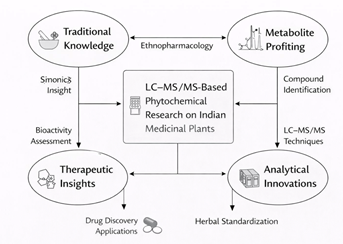
A consistent
observation across reviewed studies is the strong correlation between
traditionally reported medicinal uses and the presence of pharmacologically
relevant metabolites identified by LC–MS/MS. This chemical validation
strengthens the credibility of ethnopharmacological knowledge and highlights
the value of metabolomics in bridging traditional medicine and modern drug
discovery.
|
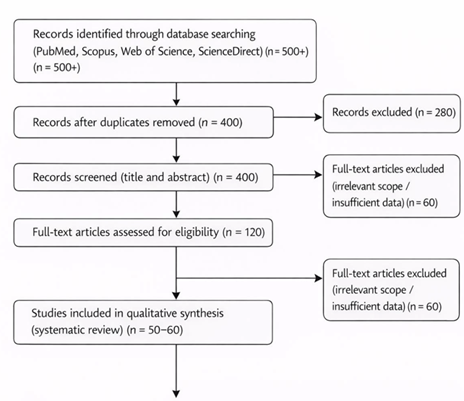
Figure 1 |
|
|
|
Figure 1 PRISMA Flow Diagram Illustrating
the Selection Process of Studies Included in the Systematic Review |
Methods:
Literature Search
Strategy
A comprehensive
literature search was carried out across major scientific databases including
PubMed, Scopus, Web of Science, and ScienceDirect. Search terms included
combinations of:
“Indian medicinal
plants,” “LC–MS/MS,” “phytochemical profiling,” “metabolomics,” “bioactive
metabolites,” and “secondary metabolites.”
Only peer-reviewed
articles published in English were considered.
Inclusion Criteria
Studies were
included if they:
Reported
LC–MS/MS-based phytochemical or metabolomic analysis
Focused on Indian
medicinal plants
Identified or
discussed bioactive secondary metabolites
Were original
research articles or high-quality reviews
Exclusion Criteria
Studies were
excluded if they:
Did not involve
LC–MS/MS analysis
Lacked
phytochemical relevance
Were conference
abstracts, editorials, or non-peer-reviewed sources
Study Selection
Process
Titles and
abstracts were screened initially, followed by full-text assessment of eligible
studies. Relevant data related to plant species, metabolite classes, analytical
approaches, and therapeutic relevance were extracted and synthesized
qualitatively.
Applications in Drug Discovery and Herbal Standardization
LC–MS/MS-based
phytochemical mapping has important implications for natural product research.
It facilitates the identification of lead compounds, supports quality control
of herbal formulations, and aids in standardization by ensuring chemical
consistency. The integration of metabolomics data with biological assays
further enhances the translational potential of medicinal plant research.
Challenges and Future Perspectives
Despite its
advantages, LC–MS/MS-based phytochemical analysis faces challenges such as
limited spectral databases for plant metabolites and difficulties in absolute
compound identification without reference standards. Future research should
focus on expanding metabolite libraries, integrating multi-omics approaches,
and linking metabolomic profiles with clinical outcomes to fully exploit the
therapeutic potential of Indian medicinal plants.
Conclusion
This review
highlights the significant contribution of LC–MS/MS-based approaches to the
comprehensive phytochemical mapping of Indian medicinal plants. The
identification of diverse bioactive metabolites provides molecular support for
traditional medicinal claims and advances natural product-based drug discovery.
LC–MS/MS-driven metabolomics represents a powerful and indispensable tool for
modern herbal research, offering new opportunities for therapeutic innovation
and standardization.
ACKNOWLEDGMENTS
None.
REFERENCES
Fabricant, D. S., and Farnsworth, N. R. (2001). The Value of Plants used in Traditional Medicine for Drug Discovery. Environmental Health Perspectives, 109(Suppl. 1), 69–75. https://doi.org/10.1289/ehp.01109s169
Heinrich, M., Barnes, J., Gibbons, S., and Williamson, E. M. (2009). Fundamentals of Pharmacognosy and Phytotherapy. Elsevier.
Newman, D. J., and Cragg, G. M. (2020). Natural Products as Sources of New Drugs Over the Nearly Four Decades from 1981 to 2019. Journal of Natural Products, 83(3), 770–803. https://doi.org/10.1021/acs.jnatprod.9b01285
Wolfender, J.-L., Marti, G., Thomas, A., and Bertrand, S. (2015). Current Approaches and Challenges for the Metabolite Profiling of Complex Natural Extracts. Journal of Chromatography A, 1382, 136–164. https://doi.org/10.1016/j.chroma.2014.10.091
Zhang, A., Sun, H., Yan, G., Wang, P., and Wang, X. (2016). Metabolomics for Biomarker Discovery: Moving to the Clinic. BioMed Research International, 2016, Article 354671. https://doi.org/10.1155/2015/354671
 This work is licensed under a: Creative Commons Attribution 4.0 International License
© Granthaalayah 2014-2025. All Rights Reserved.