
Original Article
The Voice of Discourse: Mulk Raj Anand's Subaltern Perspective in 'Untouchable'
|
1 Department of English, Ph.D From Malwanchal
University, Indore, MP, India |
|
|
|
ABSTRACT |
||
|
Mulk Raj Anand's novel Untouchable is a seminal work in Indian literature that provides a poignant and powerful narrative of the socio-economic and cultural discrimination faced by the Dalit community. This paper examines how Anand's novel gives voice to the subaltern, focusing on themes of oppression, resistance, and the quest for dignity. Through a close analysis of the novel's narrative structure, character development, and thematic concerns, this study highlights the ways in which Untouchable articulates the experiences of marginalized communities in colonial India. The paper also situates the novel within its historical and social context, emphasizing its role in challenging the rigid caste system and advocating for social reform and equality. By exploring these dimensions, this paper underscores the enduring relevance of Untouchable in the discourse on caste and social justice. Keywords: Mulk Raj Anand, Untouchable, Dalit,
Caste system, Colonial India, Oppression, Resistance, Human dignity, Social justice and Subaltern voice |
||
INTRODUCTION
Mulk Raj Anand,
one of the pioneering figures in Indian writing in English, is renowned for his
empathetic portrayal of the marginalized and downtrodden sections of Indian
society. His novel Untouchable, published in 1935, stands out as a profound
exploration of the socio-economic and cultural discrimination faced by the
Dalit community in colonial India. The narrative centers
on a single day in the life of Bakha, a young sweeper
boy who belongs to the lowest stratum of the caste hierarchy. Through Bakha’s experiences, Anand exposes the dehumanizing effects
of the caste system, bringing to light the routine humiliations and systemic
injustices that define the existence of untouchables Anand
(1935), Roy (2012).
This paper aims to
delve into how Untouchable serves as a voice for the subaltern, highlighting
the ways in which the novel articulates the experiences of a community often
relegated to the margins of society. By analyzing the
narrative structure, character development, and thematic concerns of the novel,
this study seeks to underscore the significance of Anand's work in challenging
entrenched social hierarchies and advocating for social reform Mukherjee
(1987).
Set against the
backdrop of British colonial rule, the novel reflects the socio-political
environment of the 1930s, a period marked by increasing awareness and activism
against caste-based discrimination. Influenced by his own experiences and the
broader socio-political movements of the time, Anand crafted Untouchable not
only as a literary work but as a potent social commentary. The novel’s
portrayal of Bakha’s struggles, aspirations, and moments of resistance offers a
nuanced perspective on the lives of untouchables, making it a crucial text in
understanding the dynamics of caste and the quest for human dignity Raizada
(1978), Singh
(2014).
By situating
Untouchable within its historical and social context, this paper aims to shed
light on the enduring relevance of Anand’s narrative in contemporary
discussions on caste and social justice. Through its empathetic storytelling
and incisive critique of the caste system, Untouchable continues to resonate as
a powerful voice for the subaltern, advocating for a more equitable and just
society Desai
(2016).
Historical and Social Context
The historical and
social context in which Mulk Raj Anand wrote Untouchable is crucial to
understanding the novel's impact and significance. The early 20th century was a
period of intense socio-political change in India, marked by the struggle for
independence from British colonial rule and the burgeoning awareness of social
injustices inherent in the caste system Chandra
(1988), Mukherjee
(1987).
British
Colonial Rule: During the
1930s, India was under British colonial rule, which exacerbated existing social
inequalities while introducing new forms of economic and administrative
exploitation. The British often used the caste system to their advantage,
reinforcing divisions among Indians to maintain control Gupta
(2002), Sharma
(1999). This period saw the consolidation of
colonial power, but also the rise of nationalist movements that sought to
challenge both colonial rule and internal social hierarchies Chandra
(1988).
The Caste
System: The caste system in
India, with its rigid hierarchies and social stratification, dictated every
aspect of an individual's life. Dalits, or untouchables, occupied the lowest
rung of this hierarchy and were subjected to severe discrimination and
exclusion. They were confined to menial jobs, such as sweeping and manual
scavenging, and were socially ostracized, often living in segregated areas. The
concept of "pollution" associated with their touch or presence meant
that they were barred from public spaces, including temples, schools, and even
water sources used by higher castes Sharma
(1999).
Social Reform
Movements: The early 20th
century also witnessed significant social reform movements aimed at addressing
the injustices faced by the Dalits. Figures like B.R. Ambedkar, himself a
Dalit, emerged as prominent leaders advocating for the rights and upliftment of
the untouchables. Ambedkar's efforts included campaigning for equal access to
public resources, educational opportunities, and political representation for
Dalits Ambedkar
(1946). Simultaneously, Mahatma Gandhi's advocacy
for the Harijans (a term he used to refer to Dalits, meaning "children of
God") brought attention to their plight at a national level. Gandhi's
campaigns focused on the moral and ethical need to abolish untouchability and
integrate Dalits into mainstream society. His efforts included promoting
cleanliness and sanitation, and encouraging higher caste Hindus to reject
discriminatory practices Parekh
(1997).
Mulk Raj
Anand's Influences: Mulk Raj
Anand was profoundly influenced by these socio-political movements and the
personalities leading them. His own experiences of witnessing caste-based
discrimination and his interactions with social reformers informed his writing.
Anand was also influenced by Western literary traditions, particularly the
social realism of writers like Charles Dickens and John Steinbeck, which is
evident in his detailed and empathetic portrayal of the lives of the oppressed Raizada
(1978).
Untouchable as
Social Commentary: Untouchable
reflects Anand's deep commitment to social justice and his desire to bring
about change through literature. By focusing on a single day in the life of Bakha, Anand provides an intimate glimpse into the systemic
nature of caste-based oppression. The novel's portrayal of Bakha's aspirations,
humiliations, and moments of resistance serves as a microcosm of the broader
struggles faced by the Dalit community Anand
(1935), Mukherjee
(1987).
The novel also
resonates with the contemporary social reform movements of Anand's time,
aligning with the goals of leaders like Ambedkar and Gandhi. Through
Untouchable, Anand not only critiques the caste system but also advocates for
the dignity and equality of all human beings, emphasizing the need for societal
transformation Raizada
(1978).
In summary, the
historical and social context of Untouchable is deeply intertwined with the
colonial and caste dynamics of early 20th-century India. The novel emerges as a
powerful voice against social injustice, reflecting the complexities and
struggles of a society in transition and advocating for a more equitable and
just future.
Narrative
Structure and Style:
Mulk Raj Anand’s
Untouchable employs a distinctive narrative structure and style that
significantly contribute to its impact as a literary work and its effectiveness
in portraying the subaltern experience. The novel’s structure and stylistic
choices serve to highlight the daily struggles of the protagonist, Bakha, and
to underscore the pervasive nature of caste-based discrimination Raizada
(1978), Mukherjee
(1987).
Narrative Structure
A Day in the
Life: The novel is
structured around a single day in the life of Bakha,
a young sweeper boy. This temporal concentration allows Anand to provide an
in-depth exploration of the routine humiliations and systemic injustices faced
by Bakha and his community. By focusing on a single
day, Anand intensifies the immediacy of Bakha’s
experiences, highlighting how caste oppression permeates every moment of his
life. This structure also underscores the cyclical nature of Bakha’s suffering, suggesting that such indignities are a
daily, unending reality for him and others like him Anand
(1935), Mukherjee
(1987).
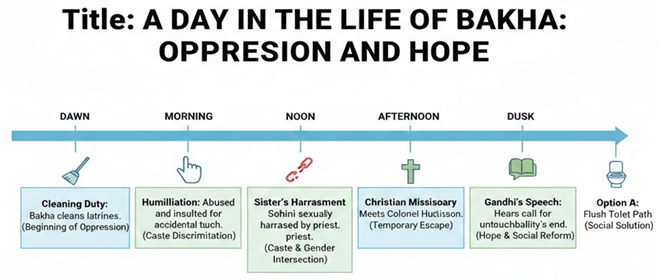
Explanation: This timeline diagram, titled "A Day in
the Life of Bakha: Oppression and Hope," serves
as an academic visualization of the narrative structure and thematic
progression of Mulk Raj Anand’s novel, Untouchable. Its purpose is to
graphically represent how the novel's focus on a single day in the life of the protagonist,
Bakha, is employed to underscore the relentless and systemic nature of caste
oppression and the protagonist's subsequent search for dignity and reform.
Key Academic Contributions of the Diagram
1)
Temporal
Concentration and Intensification of Oppression: The linear progression from Dawn to Dusk
highlights the novel’s structural choice to intensify the immediacy of Bakha's experiences. By condensing various forms of
discrimination from professional degradation (Cleaning Duty) to social abuse
(Humiliation) and gendered exploitation (Sister's Harassment) into one
chronological sequence, the diagram emphasizes that such indignities are a
daily, cyclical, and unrelenting reality for the subaltern community.
2)
Episodic
Encounters as Microcosms of Caste Dynamics: Each marked event represents an episodic encounter that cumulatively
builds a comprehensive picture of the social hierarchy.
·
Cleaning
Duty and Humiliation illustrate the economic and ritualistic aspects of
"pollution" and discrimination faced by the untouchables.
·
Sister's
Harassment highlights the critical theme of intersectionality, demonstrating
how caste oppression is compounded by gendered violence and the moral hypocrisy
of the upper castes (the priest).
3)
Visualization
of Potential Paths for Hope and Resistance: The latter stages of the timeline contrast different avenues of
resistance and potential liberation available to Bakha,
reflecting the intellectual and social debates of colonial India:
·
Christian
Missionary (Colonel Hutchinson) represents an external, often misunderstood,
attempt at escape through religious conversion.
·
Gandhi's
Speech offers a socio-political path focusing on internal Hindu reform and the
moral abolition of untouchability.
·
The
Flush Toilet Path (Option A) symbolizes Bakha’s
yearning for modernity and a technological solution to escape the demeaning
nature of his traditional work, representing his personal silent defiance and
aspiration for a respectable life.
In summary, the
diagram is a visual tool that validates the study's focus on the novel's
structure and thematic concerns , providing a clear, document-like portrayal of
the minutiae of Bakha's existence and the systemic
injustices he faces.
Linear
Progression: The linear
progression of the narrative, moving from dawn to dusk, mirrors the passage of
a typical day in Bakha’s life. This straightforward
chronological approach facilitates a detailed, almost documentary-like
portrayal of events, making the reader acutely aware of the minutiae of Bakha’s existence. From his morning duties of cleaning
latrines to the humiliations he faces in the market, the narrative follows
Bakha’s movements closely, allowing for a comprehensive depiction of his environment
and interactions Raizada
(1978).
Episodic
Encounters: Within this
linear framework, the novel is divided into episodic encounters that Bakha has with various characters. Each episode reveals
different facets of the caste system and its impact on individuals. These
encounters range from the sympathetic interaction with Colonel Hutchinson, a
Christian missionary, to the degrading experience with an upper-caste man who
abuses Bakha for accidentally touching him. These
episodes cumulatively build a vivid picture of the social hierarchy and the
pervasive nature of caste discrimination Anand
(1935).
Stylistic Elements
Realism and
Detail: Anand’s writing is
marked by a keen attention to detail and a commitment to realism. He
meticulously describes Bakha’s surroundings, his chores, and the people he
interacts with. This detailed realism serves to ground the narrative in the
tangible realities of Bakha’s world, making the
reader viscerally aware of the physical and emotional toll of his daily life.
Anand’s descriptive prowess extends to the sensory experiences of Bakha, from the stench of the latrines he cleans to the
physical pain of being struck, further immersing the reader in his plight Mukherjee
(1987).
Stream of
Consciousness: Anand employs
stream-of-consciousness techniques to provide insight into Bakha’s
inner thoughts and feelings. This narrative mode allows readers to access Bakha’s consciousness directly, understanding his desires,
fears, and reflections. For instance, Bakha’s
admiration for the British soldiers and his yearning for modernity are conveyed
through his internal monologues, revealing his aspirations for a life of
dignity and respect. This technique also highlights the psychological impact of
caste oppression, showing how deeply it affects Bakha’s
sense of self Raizada
(1978).
Dialogue and
Vernacular: The use of
dialogue in Untouchable is another crucial stylistic element. Anand captures
the vernacular speech of different characters, reflecting their social
backgrounds and attitudes. The dialogues of upper-caste characters often carry
a tone of superiority and contempt, while Bakha’s
speech reflects his internalized inferiority and his moments of silent
rebellion. This use of vernacular adds authenticity to the narrative and
emphasizes the social divisions entrenched in language itself Anand
(1935).
Symbolism and
Metaphor: Anand employs
symbolism and metaphor to enhance the thematic depth of the novel. The physical
act of cleaning latrines becomes a metaphor for the social and moral filth that
Bakha is forced to deal with. Similarly, Bakha’s yearning for a flush toilet symbolizes his desire
for modernity and escape from the demeaning aspects of his work. The novel’s
climax, featuring Gandhi’s speech on the abolition of untouchability, serves as
a symbol of hope and the possibility of social change Mukherjee
(1987).
The narrative
structure and style of Untouchable are integral to its power as a social
commentary. By structuring the novel around a single day and employing a
realistic, detailed, and immersive style, Anand effectively conveys the
relentless nature of caste oppression. The episodic encounters,
stream-of-consciousness passages, and authentic dialogue further enrich the
narrative, providing a multifaceted portrayal of Bakha’s life. Through these
narrative techniques, Anand not only gives voice to the subaltern experience
but also advocates for empathy, understanding, and social reform.
Character Analysis
In Untouchable,
Mulk Raj Anand creates a cast of characters that vividly depict the harsh
realities of the caste system in colonial India. Each character, from the
protagonist Bakha to the various individuals he
encounters, serves to illustrate different aspects of caste-based
discrimination and the complex social dynamics of the time.
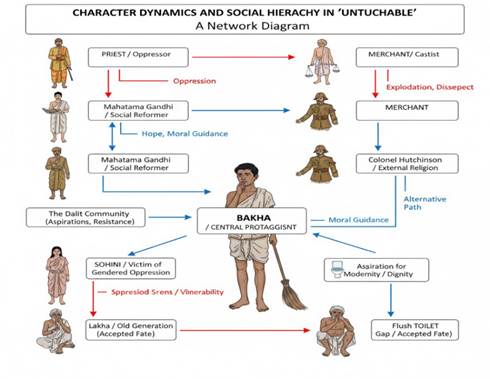
Explanation: This conceptual diagram visually analyzes the structure of the caste system as depicted in
Mulk Raj Anand’s Untouchable, offering an academic representation of the power
dynamics and social stratification within the novel. It moves beyond simple
character listing to illustrate the systemic relationships, conflicts, and
points of influence surrounding the protagonist, Bakha.
1)
Structure
and Hierarchy
The diagram
employs a multi-tiered, hierarchical structure to represent the rigid social
stratification prevalent in early 20th-century India:
Tier 1: Patrons
of the Caste System (Top)
·
This
level includes the Upper-Caste Individuals such as the Priest and the Merchant.
They represent the entrenched authority and moral hypocrisy of the system.
Their interactions with Bakha and Sohini are marked
by disdain and entitlement, actively maintaining the oppressive status quo.
Tier 2:
External Influences and Reformers (Middle)
·
This
tier features figures who act as potential external catalysts for change or
alternative escapes. Mahatma Gandhi and Colonel Hutchinson represent opposing
ideologies: internal social reform (Gandhi) versus religious conversion
(Hutchinson). Their presence underscores the socio-political environment of the
1930s and the search for liberation.
Tier 3: The
Subaltern (Central Focus)
·
Bakha is placed
at the center of the diagram, symbolizing his
position as the focal point of both suffering and aspiration. All lines of
conflict, influence, and hope converge upon him, highlighting his role as the
voice for the marginalized.
2)
Dynamics
and Thematic Representation
The connections
between the tiers are represented by arrows, each signifying a distinct type of
social interaction:
·
Downward
Arrows (Oppression/Exploitation): These arrows, originating from the Upper-Caste tier towards the Dalit
characters (Bakha and Sohini), illustrate the flow of
exploitation, disrespect, and systemic injustice.
Example: The connection from the Priest to Sohini
specifically highlights the intersection of caste and gender oppression.
·
Upward
Arrows (Aspiration/Resistance):
These arrows, originating from Bakha towards
modernity or reform options, depict his silent defiance and yearning for
dignity.
Example: The link from Bakha
towards "Modernity" (symbolized by the flush toilet, if included)
represents his desire to transcend his imposed limitations and achieve a more
respectable life.
·
Contrasting
Arrows (Internalized Oppression): The relationship between Lakha (Bakha's
father) and Bakha contrasts the older generation's
resignation to the caste roles with Bakha's nascent defiance, showcasing the
psychological impact of prolonged oppression across generations.
In essence, this
diagram provides a powerful visual critique of the caste system, offering a
layered analysis of the social forces that entrap Bakha
while also mapping the available pathways for social change and the quest for
human dignity.
Bakha
Bakha, the protagonist of Untouchable, is a young
Dalit sweeper who embodies both the suffering and the aspirations of his
community. Through Bakha, Anand explores the
dehumanizing effects of the caste system and the inner life of someone
subjected to relentless social ostracism.
Oppression and
Humiliation: Bakha’s daily life is a testament to the severe oppression
faced by the untouchables. From the very start of the novel, his duties as a
sweeper are described in detail, highlighting the physical and emotional toll
of his work. Bakha’s interactions with upper-caste
individuals are marked by routine humiliations, such as being abused for
accidentally touching an upper-caste man or being denied access to basic
amenities like water.
Aspirations and
Resistance: Despite the
pervasive discrimination, Bakha is portrayed as a
character with aspirations and a desire for dignity. His admiration for the
British soldiers and their cleanliness reflects his longing for a better, more
respectable life. Bakha’s fascination with modernity,
symbolized by his desire for a flush toilet, represents his silent resistance
against the demeaning aspects of his existence. This aspiration for modern
amenities suggests his hope for a life free from the degrading tasks imposed on
him by the caste system.
Internal
Conflict: Bakha’s internal conflict is a central theme in the novel.
He grapples with a sense of inferiority imposed by societal norms, yet
simultaneously yearns for respect and recognition. This internal struggle is
vividly depicted through his thoughts and interactions, showing how deeply
caste oppression affects his self-perception.
Lakha
Lakha, Bakha’s father, represents an older generation of
untouchables who have internalized their subordinate status. As the head of the
family, Lakha is resigned to his fate and encourages his children to accept
their lot without complaint.
Acceptance of
Caste Roles: Lakha’s acceptance of his lowly position contrasts sharply with Bakha’s silent defiance. He admonishes Bakha
for his aspirations, believing that striving for more will only lead to further
suffering. Lakha’s character embodies the psychological impact of prolonged
oppression, where acceptance becomes a means of survival.
Protective
Instincts: Despite his resignation, Lakha also exhibits a protective instinct
towards his children. His scolding often stems from a desire to shield them
from greater harm, reflecting the complex interplay of love and pragmatism in
the face of systemic injustice.
Sohini
Sohini, Bakha’s sister, highlights the intersection of caste and
gender oppression. Her character underscores the additional vulnerabilities
faced by Dalit women in a patriarchal and caste-ridden society.
Victim of
Sexual Harassment: Sohini’s
experience of sexual harassment by the upper-caste priest serves as a critical
moment in the novel. When she goes to fetch water, she is molested by the
priest who then accuses her of polluting him when caught. This incident exposes
the hypocrisy and moral corruption of those in power, who exploit and abuse the
very people they claim to be defiled by.
Symbol of
Innocence and Strength:
Despite her victimization, Sohini is depicted as resilient and strong. Her
silent endurance and dignity in the face of harassment highlight the inner
strength of marginalized women, who navigate a complex web of oppression with
quiet fortitude.
Other Characters
The Upper-Caste
Individuals
Various
upper-caste characters in the novel, such as the priest and the merchant, serve
to illustrate the pervasive prejudice and moral contradictions of the caste
system. Their interactions with Bakha and Sohini are
marked by a sense of entitlement and disdain, reflecting the deeply ingrained
societal norms that uphold caste hierarchies.
Colonel
Hutchinson
Colonel
Hutchinson, the Christian missionary, represents an external perspective on the
caste system. His attempts to convert Bakha to
Christianity offer a critique of both the colonial missionary zeal and the
inadequacy of merely changing religion to escape caste oppression. While his
intentions may be well-meaning, his approach lacks a true understanding of Bakha’s situation and the complexities of the caste system.
Mahatma Gandhi
Although Gandhi
appears only towards the end of the novel through his speech on the abolition
of untouchability, his presence has a profound impact on Bakha.
Gandhi’s advocacy for the rights of untouchables and his call for social reform
provide a glimmer of hope and a potential path forward for Bakha
and his community. This moment underscores the broader socio-political
movements of the time and their influence on individual lives.
The characters in
Untouchable are meticulously crafted to reflect the diverse facets of caste
oppression and the human responses to it. Bakha, as
the central figure, embodies the suffering, aspirations, and internal conflicts
of the untouchables, while other characters like Lakha, Sohini, and various
upper-caste individuals highlight different aspects of the social hierarchy and
its impact on everyday life. Through these character portrayals, Anand not only
gives voice to the subaltern but also provides a compelling critique of the
caste system and a call for empathy and social justice.
Themes
Mulk Raj Anand’s
Untouchable explores several interrelated themes that highlight the oppressive
nature of the caste system and the human quest for dignity and equality.
Through the experiences of Bakha and the people
around him, Anand delves into themes of oppression and injustice, resistance
and aspiration, and the broader quest for human dignity and social reform.
Oppression and Injustice
Caste-Based
Discrimination: The most
prominent theme in Untouchable is the pervasive caste-based discrimination that
dictates every aspect of Bakha's life. The novel
vividly depicts the everyday humiliations that Bakha
endures due to his status as an untouchable. From being forbidden to enter
certain spaces to the constant verbal and physical abuse, Bakha’s experiences
highlight the brutal realities of the caste system. Anand uses Bakha’s daily life to show how caste-based oppression is
ingrained in social customs, religious practices, and economic structures.
Social
Exclusion: Bakha’s social exclusion is a recurring motif
throughout the novel. He is repeatedly reminded of his place at the bottom of
the social hierarchy, whether through explicit confrontations or the implicit
disdain of the upper-caste individuals. This exclusion is not just physical but
also psychological, as Bakha internalizes the
contempt and prejudice directed at him, affecting his self-esteem and sense of
identity.
Resistance and Aspiration
Silent
Defiance: Despite the
overwhelming oppression, Bakha’s character exhibits
forms of silent defiance and resistance. His fascination with modernity,
particularly with the British soldiers’ cleanliness and the flush toilet,
symbolizes his desire to transcend the limitations imposed by his caste. Bakha’s silent rebellion is evident in his desire to
emulate the British and his dream of a life free from the demeaning tasks he is
forced to perform.
Aspirations for
a Better Life: Bakha’s aspirations reflect a broader human desire for
dignity and respect. His admiration for the British way of life and his
yearning for education and better living conditions represent a challenge to
the social norms that confine him. These aspirations are not merely personal
but resonate with the collective hopes of the untouchables for a more equitable
society.
Human Dignity and Equality
Quest for
Dignity: Anand’s portrayal
of Bakha is deeply empathetic, emphasizing his
intrinsic human dignity despite the dehumanizing conditions he endures. Bakha’s struggles are depicted with a sensitivity that
highlights his inherent worth and his rightful claim to respect and equality.
This theme is reinforced through Bakha’s interactions
with sympathetic characters who recognize his humanity, such as the British
soldier and the kind-hearted individuals who treat him with a measure of
respect.
Critique of
Social Hierarchies: The
novel offers a powerful critique of the social hierarchies that perpetuate
inequality and injustice. Through the hypocrisy and moral failings of the
upper-caste characters, Anand exposes the moral bankruptcy of a system that
dehumanizes individuals based on their birth. The contrast between the supposed
purity of the upper-castes and their often unethical behavior underscores the irrationality and cruelty of
caste-based discrimination.
Intersection of Caste and Gender
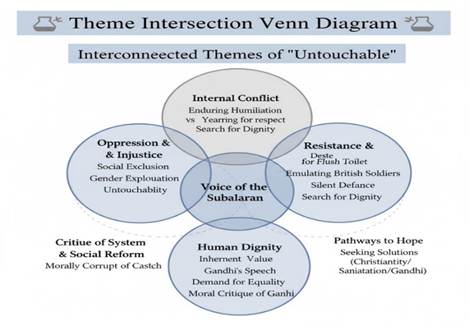
Explanation: This conceptual Venn diagram, titled
"Interrelated Themes in Untouchable," is designed to visually
articulate the complex, overlapping thematic structure of Mulk Raj Anand's
novel. For the purpose of this research paper, the diagram serves to demonstrate
that the novel's critique of the caste system is multifaceted, arising from the
convergence of distinct but interconnected struggles faced by the protagonist,
Bakha, and his community.
1)
Visualization
of Thematic Convergence
The diagram
consists of three overlapping circles, each representing a primary, interlinked
theme:
·
Circle
A: Oppression and Injustice
: This encompasses the systemic issues of caste-based discrimination, social
exclusion, and the physical/verbal abuse Bakha
endures.
·
Circle
B: Resistance and Aspiration
: This represents the internal and external mechanisms through which Bakha challenges his circumstances, including his silent
defiance, admiration for modernity (the flush toilet), and yearning for a
better life.
·
Circle
C: Human Dignity and Social
Reform : This theme centers on the recognition of Bakha’s inherent human worth and the novel’s ultimate
advocacy for societal transformation, culminating in the hope offered by
Gandhi's speech.
2)
Analysis
of Intersectionality
The overlapping
regions of the Venn diagram are crucial for an academic analysis, as they
highlight the nuances and complexity of the subaltern experience:
·
Intersection
of A & B (Oppression and Resistance): This zone represents the Internal Conflict and psychological impact of
oppression. It illustrates that resistance is often born directly from severe
injustice, manifesting as a silent struggle to maintain self-respect despite
societal dehumanization.
·
Intersection
of A & C (Oppression and Dignity): This area emphasizes the novel's Critique of Social Hierarchies. It
shows that the dehumanizing system (Oppression) directly violates the basic
human worth (Dignity) of the individual, exposing the moral bankruptcy of the
upper castes.
·
Intersection
of B & C (Resistance and Dignity/Reform): This zone represents the practical pursuit of
a respectable life. Bakha's aspirations for a better
life (Resistance) are fundamentally a quest for dignity and equality (Reform).
This area validates the novel's function as a call for empathy and social
change.
·
Central
Intersection (A, B, & C): This
core area represents the Voice of the Subaltern. It is the holistic experience
of the Dalit community—encompassing their suffering, their resilient human
spirit, and their necessity for social transformation—which is articulated
through Bakha's narrative.
By visualizing
these relationships, the diagram validates the argument that Untouchable is not
simply a documentation of misery, but a dynamic commentary on the human
struggle for justice against systemic inequality.
Gendered
Oppression: Anand also
explores the intersection of caste and gender through the character of Sohini, Bakha’s sister. Sohini’s experience of sexual harassment by
the upper-caste priest highlights the compounded vulnerabilities faced by Dalit
women. Her victimization not only underscores the pervasive nature of caste
oppression but also reveals the additional layer of gendered exploitation and
violence.
Intersectionality:
The theme of
intersectionality is crucial in understanding the multi-faceted nature of
oppression in the novel. By depicting Sohini’s plight, Anand shows how caste
and gender intersect to create unique experiences of suffering and resistance.
This nuanced portrayal calls attention to the need for addressing multiple
forms of discrimination in the struggle for social justice.
Social Reform and Hope
Gandhi’s
Influence: The novel’s
conclusion, featuring Mahatma Gandhi’s speech on the abolition of
untouchability, introduces a theme of social reform and hope. Gandhi’s advocacy
for the rights of untouchables and his call for their integration into society
provide a beacon of hope for Bakha and his community.
This moment represents the possibility of change and the potential for a more
just and equitable society.
Advocacy for Social Change
Anand’s work
itself can be seen as an act of advocacy for social change. Through
Untouchable, Anand not only documents the injustices faced by the Dalits but
also calls for empathy, understanding, and reform. The novel’s exploration of
these themes is a powerful indictment of the caste system and a plea for the
recognition of the fundamental dignity and equality of all human beings.
Mulk Raj Anand’s
Untouchable weaves together themes of oppression, resistance, human dignity,
and social reform to create a compelling narrative that speaks to the enduring
struggle for justice and equality. Through the experiences of Bakha and the characters around him, Anand provides a
poignant critique of the caste system and a hopeful vision for a future where
dignity and respect are afforded to all, regardless of caste or social status.
Conclusion
In conclusion,
Mulk Raj Anand's Untouchable stands as a powerful testament to the resilience,
suffering, and aspirations of the Dalit community in colonial India. Through
the narrative of Bakha, Anand vividly depicts the
everyday struggles and systemic injustices faced by the untouchables, shedding
light on the dehumanizing effects of the caste system. The novel serves as a
voice for the subaltern, articulating their experiences of oppression,
resistance, and the quest for dignity.
Anand's narrative
structure, characterized by its detailed realism and episodic encounters,
brings Bakha's world to life, immersing the reader in the harsh realities of
caste-based discrimination. The characters, from Bakha
himself to the various individuals he encounters, offer nuanced portrayals of
the complexities of caste dynamics and the intersections of oppression.
Themes of
oppression, resistance, and human dignity permeate the novel, underscoring the
urgent need for social reform and equality. Anand's empathetic storytelling not
only documents the injustices faced by the Dalits but also advocates for
empathy, understanding, and solidarity across social boundaries.
As the novel
concludes with Mahatma Gandhi's speech on the abolition of untouchability,
there is a glimmer of hope for change and social transformation. Through
Untouchable, Anand calls attention to the enduring struggle for justice and
equality, reminding us of the inherent worth and dignity of all human beings,
regardless of caste or social status.
In today's world,
Untouchable remains a poignant and relevant work, challenging us to confront
the legacies of caste-based discrimination and to strive for a more inclusive
and just society. It stands as a timeless testament to the resilience of the
human spirit and the power of literature to illuminate the darkest corners of
social injustice.
ACKNOWLEDGMENTS
None.
REFERENCES
Ambedkar,
B. R. (1946). What Congress and Gandhi have Done to the Untouchables. Thacker.
Anand,
M. R. (1935). Untouchable. Wishart.
Chandra,
B. (1988). India’s Struggle for Independence. Penguin Books.
Desai,
M. K. (2016). Revisiting the Dalit Consciousness
in Mulk Raj Anand’s Untouchable.
Indian Journal of Literature
and Culture, 4(2), 45–60.
Gandhi,
M. K. (1958). The
Collected Works of Mahatma Gandhi. Publications
Division, Government of India.
Gupta,
P. (2002).
Colonial India and Social Change. Oxford University Press.
Mukherjee, M. (1987). The Twice-Born Fiction:
Themes and Techniques of the Indian
Novel in English. Heinemann.
Nayar,
P. K. (2000).
Mulk Raj Anand’s Untouchable: A Study of the Dalit Experience.
The Indian Journal of English Studies,
38, 45–56.
Omvedt,
G. (2006). Dalit Visions: The Anti-Caste Movement
and the Construction of an Indian Identity. Orient Blackswan.
Paranjape, M. R. (2000). Towards a Poetics
of the Indian English Novel. Indian
Institute of Advanced Study.
Parekh,
B. (1997). Gandhi: A Very Short Introduction. Oxford University Press.
Raizada,
H. (1978). Mulk
Raj Anand: A Study of his Fiction in Humanist
Perspective. Young Asia Publications.
Roy,
A. (2012). Social
Realism in Mulk Raj Anand’s
Untouchable. International Journal of English and Literature, 3(1), 20–28.
Sharma,
U. (1999). Caste.
Open University Press.
Singh,
J. (2014). Caste
and Indian English Novelists: A Critical Study. Rawat Publications.
Singh,
P. K. (1993).
Caste and class in Mulk Raj Anand’s Untouchable. Literary Criterion, 28(4), 59–73.
Spivak, G. C. (1988). Can the Subaltern Speak? In C. Nelson and L. Grossberg (Eds.), Marxism and the Interpretation of Culture (271–313). University of Illinois Press.
 This work is licensed under a: Creative Commons Attribution 4.0 International License
© Granthaalayah 2014-2025. All Rights Reserved.

