|
|


Article Type: Research Article
Article Citation: Dr. Anjali Pandey. (2020). LACQURED
CRAFT OF SHEOPUR- A SUSTAINABLE CRAFT OF MADHYA PRADESH. ShodhKosh: Journal of Visual and Performing Arts,
1(2), 1-11.
https://doi.org/10.29121/shodhkosh.v1.i2.2020.5
Received Date: 19 May 2020
Accepted Date: 15 December 2020
Keywords:
Woodcraft
Lathe-Turned
Lacquered Craft
Lac
Craft
Craftsmen
Eco-Friendly
ABSTRACT
The world of arts and handicrafts represents a great saga of
culture, traditions and historical legacy associated with each particular
region. India, in general and Madhya Pradesh, in particular are known for the
impressive range of hand-made artifacts that enthrall onlookers, buyers and
collectors of art.
The innate are honored with the characteristic specialty of
cutting and make extremely appealing things. There are wooden chowkies made for estimating grains. Wedding mainstays of Bharia and wooden entryways of Gonds
and Korkus are extremely appealing and unordinary.
Machines turned and lacquered toys in splendid hues and at moderate costs are
famous everywhere throughout the state. Cut wooden toys, dolls and elephants
displaying the abilities of the craftsman are likewise made.
The Woodcrafts of Madhya Pradesh are self-viable and have
contributed in maintaining the environment healthy by using all the natural
colors and polishes. Moreover, it generates the employments to the artisans,
which encourages them to design and produce the products as per the market
demands. And as per the demand it
encourages the Social-distance which is much need in present scenario.
1. INTRODUCTION OF MADHYA PRADESH
Taking an excursion along the core of India we go over
entirely saved medieval urban communities, invigorating and captivating natural
life havens, and probably the holiest and most venerated traveler habitats that
pull in the pioneer profound into its reality. Madhya Pradesh is the core of India, and geologically involves
conclusive spot in the nation's gather in territories which are creating
different items like handloom fabric, silk and fleece. Wood work and finish
product of Madhya Pradesh are likewise extremely acclaimed. Coal and iron are
generally significant of the minerals found in Madhya Pradesh. For the creation
of concrete, limestone is required which can be found in excessive sum in
Madhya Pradesh. In a few regions of the state, Marble is likewise accessible.
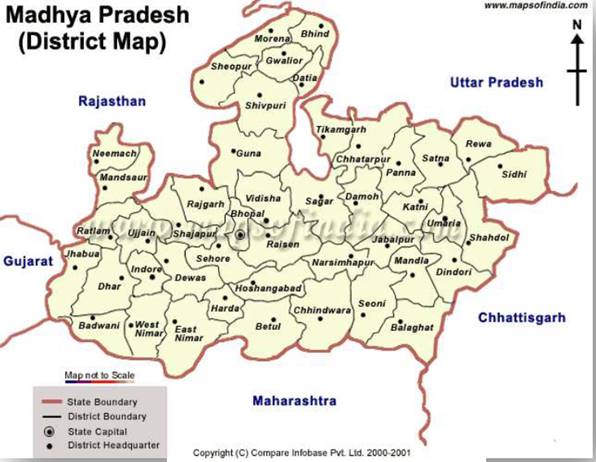
Figure 1: Google image
1.1. ART AND CULTURE
Madhya
Pradesh is the home ground for most of innate populace of India which by and
large, live away from the standard India. Traditional village crafts such as Chanderi sarees, leather, clay toys make it famous. It is
especially known for its lacquer-ware products. Being centrally located amidst
a vast span of forest covered land some of the areas like Sheopur,
Rewa and Gwalior have exposure to a wide range of the
available wood, which nurtures the art of lacquer-ware in these areas. In spite
of the infringing impact of twentieth century urban life, the clans have to a
great extent figured out how to hold their own specific manner of life,
generally immaculate by modernization. [2]
2. ABOUT THE CLUSTER
2.1. HISTORY
Sheopur
town likewise called Sheopur kalan,
is situated in the north western part of Madhya Pradesh state in central India.
The town and stronghold were established in 1537 by gaur Rajputs
and filled in as capital of the previous Sheopur
regal state. A street intersection and rail end, it is a significant market
known for its lacquered woodwork and playing a game of cards. [3]
2.2. GEOGRAPHICAL LOCATION
Sheopur
is situated at the north western part of Madhya Pradesh. The region is all
around associated by Road and Railway Network. It is associated by normal
transport service with Gwalior, Morena, and Kota. Sheopur
is 210 km away from Gwalior and 230 km away from Morena. The significant
streams like Chambal, Seep and Kuno are famous in the
area. [4]
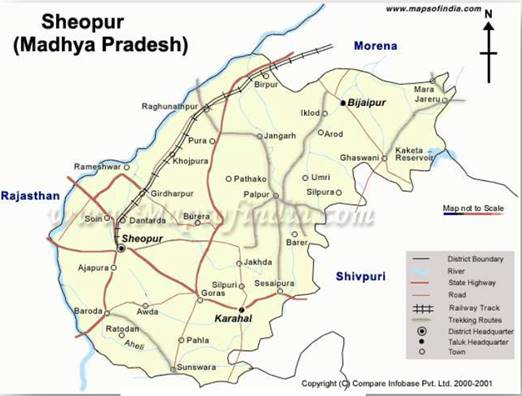
Figure 2: Google image
2.3. ARTS AND CRAFTS
The
specialty of woodcarving has prospered in the area of Sheopur
and the wonderfully decorated wooden roofs, entryways and lintels with finely
cut plans are quiet tributes of its greatness. The wood carvers of Sheopur, with extraordinary affectability and aptitude
change various assortments of wood. The specialty people of Sheopur
make pipes, covers, toys, entryways, stands, windows, wooden remembrances,
blossom jars, bedposts and support posts etc. [5]
2.4. ABOUT THE CRAFT
Lacquer-craft
is the utilization of enamel on wood in satisfying shades to make a particular
allure. This art creates an enormous assortment of beautifying just as utility
things. Lacquering is done on a machine, hand or machine worked. For turning
thin and fragile things, the hand-machine is liked. Lac is applied in a dry
state. The lac stick is squeezed against the woodenware to be lacquered. As the
last continues spinning the warmth from erosion mollifies the lac, empowering
the shading to stick. Plans are painted with a brush on figures, protests and
toys.
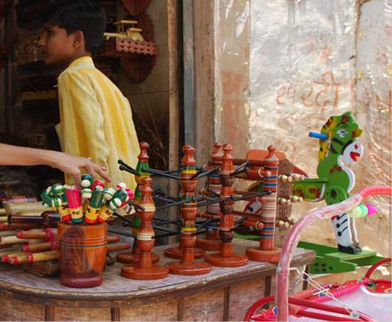
Figure 3: Picture by Mitali Pandey Minare
For its application lac is warmed to get a semi fluid state
then it is worked and colors are added, at that point attracted to be made into
sticks and afterward covered over the wooden articles. It is a reasonable or
shaded covering that dries by dissolvable dissipation and frequently a
restoring cycle too that creates a hard, tough completion in any sheen level
from super matte to shiny and that can be additionally cleaned as required. [5]
 The specialty
delivers a huge assortment of improving just as utility things including little
models of kitchenware, toys, seats, table lights, etc. Mathematical and
botanical examples are usually utilized in the plans. These plans are painted
in a few blends as indicated by the craftsman extravagant. Among the most well
known veneer product are the lac bangles. Heretofore studded with gold and
valuable stones, today they are likewise accessible with dots, glass, stones,
mirrors and that's just the beginning.
The specialty
delivers a huge assortment of improving just as utility things including little
models of kitchenware, toys, seats, table lights, etc. Mathematical and
botanical examples are usually utilized in the plans. These plans are painted
in a few blends as indicated by the craftsman extravagant. Among the most well
known veneer product are the lac bangles. Heretofore studded with gold and
valuable stones, today they are likewise accessible with dots, glass, stones,
mirrors and that's just the beginning.
Colored
lacquer ware is made in Sheopur, Rewa Budhi, Bhopal, Gwalior, Ratlam and Sabalgarh
in Madhya Pradesh. Etikoppaka in Andhra Pradesh
is one of the most important centers of this craft. The lacquerware of Savantvadi, once a princely state, is a traditional craft.
Chennapatna6 in Karnataka state holds an honored place in the
lacquer ware world.
2.5. DIVISION OF LACQUER WARE INDUSTRY
The
lacquer industry can be divided into:
1) Independent workshop units,
2) Small scale enterprises and
3) Medium scale industries.
1) Number of family members which
incorporates men, ladies and kids may create polish product. They have around
2-3 machine worked either by hand or lathe machine in their homes or little
workshops developed close by. The vast majorities of them is independently
employed and are showcasing their items to neighborhood market or obliging
greater brokers.
2) Limited scope undertakings are
set-up in specialists’ houses with a base 5 machines. The recruited specialists
deal with per piece rate premise. These limited scale undertakings sell their
items straightforwardly to exporters. These limited scale ventures don't have
an enormous edge of benefit as the specialists are generally government driven
organizations which utilize weighty charges and manipulative commissions.
3) Medium scale ventures are set up
or possessed by exporters as it were. Significant urban communities like
Bangalore possessing colossal edges of benefits as the transportation and work
charges are exceptionally less. There are a couple of exporters in Bangalore
who have contracts with craftsmans for the ideal
amount of creation of the given things. Exporters give particulars depicting
the ideal items with a severe spotlight on quality. These ventures are
available to new and innovative thoughts of plan and imaginativeness as they
take into account a lot higher objective market. [7]
2.6. ECONOMIC STATUS OF CRAFTSMEN
The
craftsmen are solely dependent on this art for their livelihood. The women in
the house work as bidi makers to support the house financially. When these
craftsmen source their products to the neighboring villages they get a much
higher amount of work than the amount they get after selling the products in
main cities as there is no taxation taking place during the transport and
handling of the products. Due to their one track traditional designs they have
been following since a long time their products have not yet reached the
corporate market or the main arena of creative lacquer design. Fare items
should meet and satisfy to new requests and particulars. These new items need
to keep up all the more demanding principles of value and may require more mind
boggling and complex work of art or completing than different items which are
sold in nearby business sectors. There were 15 families following the tradition
of making lacquer-ware products. These families have been inheriting this art
as their hereditary trait and all the boys in the families are presumed to do
the same. [8]
3. MATERIAL AND TOOLS USED
3.1. LAC
Lac is the resinous discharge delivered by the insect Technadria
lacca. It is found on a huge numbers of the woods
trees, especially in kusum (Schleichera
oleosa). At present, it is gathered in different
states like Bihar, Orissa, Uttar Pradesh and West Bengal, Madhya Pradesh,
Maharashtra
There are three distinct assortments of lac that are being utilized in
the enamel product measure. The exceptional quality lac is referred to as catch
lac for what it's worth in the catch structure. It is light and brilliant in
hued and can cost up to Rs. 450/kg. The second is in medium earthy colored tone
and accessible in Rs. 300/kg. The third and the least fortunate quality lac is
in dull dark tone and is Rs 250/kg.
Lac
sticks are manufactured on a domestic basis by the women folk or the craftsmen
themselves in the village. They buy the raw lac that is in the form of crystals
according to the requirement of the work. The crystal material is usually light
brown in color. Water is boiled at a very high temperature in a pot and the
crystals are then put into it for melting. The crystals melt into a sticky
elastic substance which is then handled with the help of long wooden sticks.
When the lac becomes soft, it is taken on the ground and with the help of
wooden sticks is stretched and batted on the floor till it turns into a thick
lac stick. This takes a time span of 15-20 minutes.
|
|
|
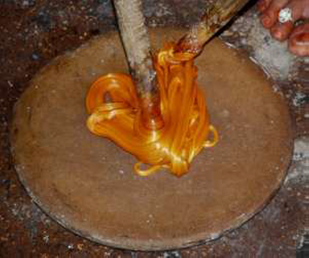
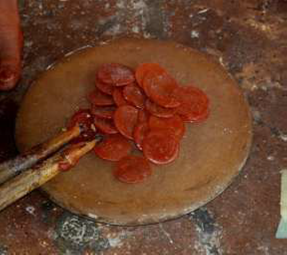
Figure
4: Picture by Mitali Pandey Minare
3.2. COLOR PIGMENTS
The lac
with no extra color pigment gives natural color to the wood. For obtaining
different colors, oxides of iron, zinc and magnesium are added during the
process of batting the lac on the floor. Colors like turquoise, red, green,
black, white and purple are obtained.
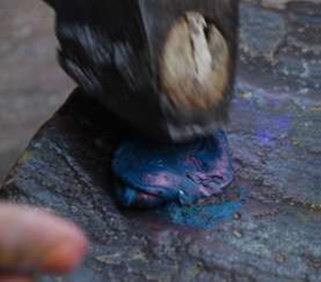
Figure 5: Picture by Mitali
Pandey Minare
3.3. MEDIUM OF APPLICATION
Talegiri
(Pandanus odoratissimus) is otherwise called screw
pine and privately known as "keware ka patta" among the neighborhood specialists. This
evergreen tree has palm-like leaves which can either have lots of long thick
leaves or have an unmistakable bole up to 6 meters in stature. The screw pine
frequently has flying roots and are horse regularly found on the coast and
along banks of waterways, trenches, fields and lakes,. The leafs
are the significant embellishment in enamel product creation and are chiefly utilized
for cleaning and give reflexive completion to the item. A heap of 100 leaves
costs around Rs. 20. [9]
3.4. HAND LATHE MACHINE
Many of
the craftsmen still engage in traditional methods, evolving suitable kinds of
hand lathes called patris in their
local language. This consists of a heavy block of wood and stone which act as
the object holder and the rotating shaft which is made by a bow string. This
prevails as a popular method as the older craftsmen find it more convenient,
easier and faster to work on hand lathes rather than the fast moving modern
lathe machines, as hand lathe gives them the freedom of speed of the work
according to the art on the object and they can adjust it easily according to
their sitting positions.
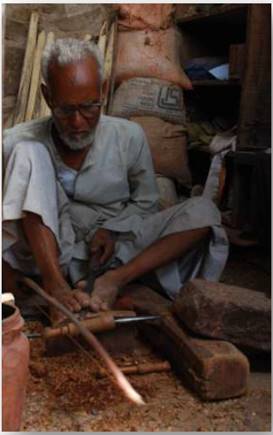
Figure 6: Picture by Mitali
Pandey Minare
The hand
lathe arrangement is very precisely calculated and then developed, the distance
of the stone holding the object is manually adjusted according to the size of
the foot from one of the corners of the supporting wood. The angles are kept
such that the object does not fly off while the rotation process, this analysis
helps them work more efficiently and creatively. [10]
3.5. ELECTRIC POWER LATHE MACHINE
With the
expanding market for polish product the electric force machine has been
presented. A force machine has a head stock that comprises of a rotating pivot
connected to two belt pulleys. The belt runs over a pulley mounted on a
spinning shaft that is driven by an electric engine.
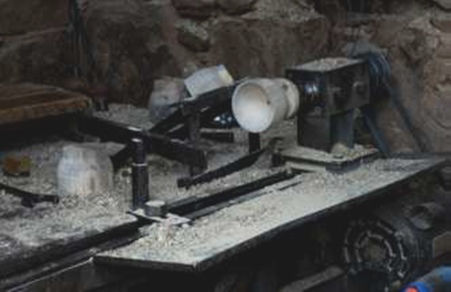
Figure 7: Picture by Mitali
Pandey Minare
The creation time impressively lessens on the power lathe
machine, as both the hands are allowed to work turning devices. Force machines
are for the most part situated in little processing plant settings, where there
is no or less issue of power. Also, the modern lathe machine helps the young craftsmen of the
community to mass produce the products at a much faster speed. The craftsmen in
Sheopur had been trained by a professional craftsman
in Bangalore about the proper use of the machines. The young members of the
community use the lathe machines to produce more commercially viable and
intricate designs which helps them take their craft one step further from the
traditional designs and techniques. [11]
4. WORKING PROCESS
4.1. WORKING STYLE
The work
is carried out in a workshop and in places where the artisans have turned one
part of their house into a workshop. Their workshops are so small that it can
only adjust at the most 2-3 people inside apart from the person working on his
machine. Working space per worker is 2 X 3 ft. The same condition is in the
entire workshop. The space is very less yet it has every possible thing
required by them in that area.
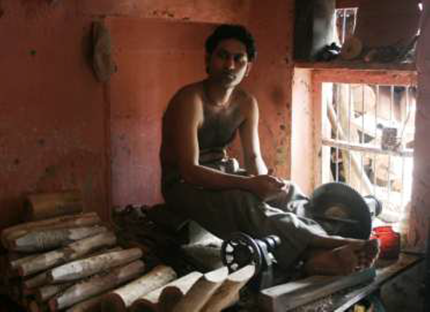
Figure 8: Picture by Mitali
Pandey Minare
Every
worker has his own set of tools which is spread on the ground at an arms
distance. The lighting condition is bad as they have only one source of light
that is placed wrongly in many cases. So, when the natural light is not strong
it become darker and hence difficult to work with perfection. This happens
mostly between evening hours.
Those
workshops which are situated in the market get affected by the other activities
in the surrounding. The work also gets hampered in the works hops which have a
retail counter in front of the workshop. This is due to the fact that craftsmen
would be required to attend to the customers.
They do
not have any recreational or entertaining activities taking place around them
as the only source of entertainment is to keep talking to the person beside you
or the women of the family who keep sitting beside and making bidis. [12]
4.2. PRODUCTION PROCESS
The
production of lacquered items consists of a series of processes. This work is
accomplished on a hand or mechanized lathe machine placed within the house and is
turned into a workshop. The arrangement of log wood for lac-turnery starts with
preparing.
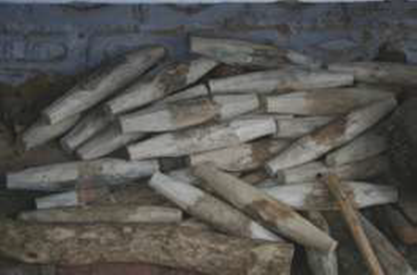
Figure 9: Picture by Mitali
Pandey Minare
1) Logs are cut into
little pieces (billets) and put away in a airy spot away from warmth and
daylight for around ten days to a month, contingent on the dampness substance
of the wood.
2)  The edges of the
prepared billets are then etched until a chamber is framed. Presently the wood
is fit to be turned on a machine.
The edges of the
prepared billets are then etched until a chamber is framed. Presently the wood
is fit to be turned on a machine.
3) Cutting instruments are utilized
to the rotating wood-piece with the goal that undesirable flimsy ceaseless
chips are scratched off. Gifted specialists can eliminate uniform and dainty
layers of wood to frame it into wanted shapes.
4) Once the ideal shape is
accomplished, it is sanded with sandpaper on pivoting machine, until the
surface is smooth and uniform.
|
|
|
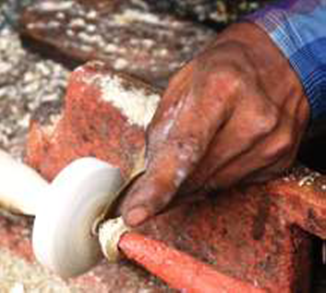
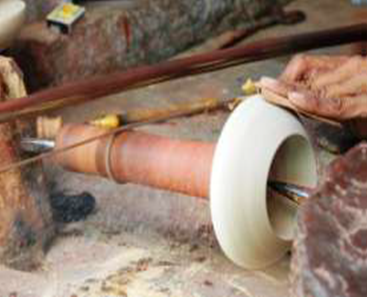
Figure 10: Picture by Mitali Pandey Minare
5) At this stage the article is fit
to be lacquered. The nature of the eventual outcome relies upon the ability
with which finish is applied to the turning wood. A lac stick of the picked
shading is squeezed to the spinning wood. The contact makes the lac dissolve
and spread consistently over the region on which it is applied.
6) Final completing is finished
utilizing a screw pine leaf to help spread the lac on the turning wood and
finish the article. Polishing by kewra leaf loans a clarity to the completed
item.
7) The lacquered article is isolated
with a cutting instrument and eliminated from the machine. Now, a few articles
are additionally ornamented with paint. [13]
|
|
|
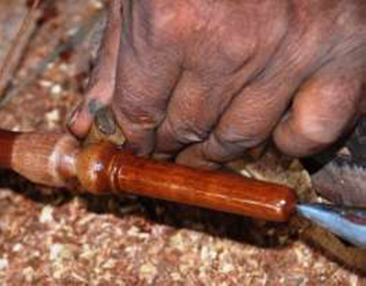
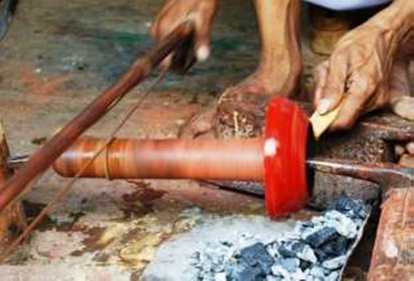
Figure 11: Picture by Mitali Pandey Minare
5. PRODUCTION OF LACQUER
1) The process of preparation of enamel from lac starts with warming and mellowing.
2) Lac is adhered on to the finishes of two wooden sticks which are warmed until the lac gets plastic and pliant.
3) The warming cycle is sometimes rehashed to look after versatility. A particular measure of lithophene is then added to the mellowed lac and is constantly beaten until a white color shows up.
4) A little part of powdered color is blended in with a little bit of water and this is added to the warm white lac.
5) The blend is then beaten until the right shade develops. The lac at that point starts to expect the consistency of elastic.
6) The lac is warmed, and is taken out from the splinters before it sets. A long flimsy stick of colored lacquer of 1 cm thick and 3 cm wide is molded and afterward cut into 15-20 cm lengths.
7) Around Four to five sticks of one tone can be set up at an equivalent time. These sticks have a time span of usability of just a single month before they become hard and unsuited for lacquering. [14]
|
|
|
|
|
|
|
|
|
|
|
|
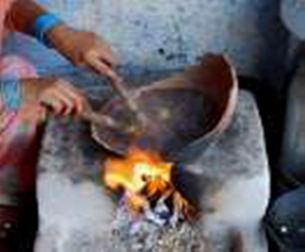
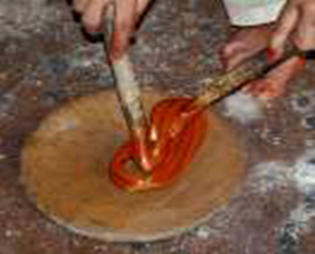
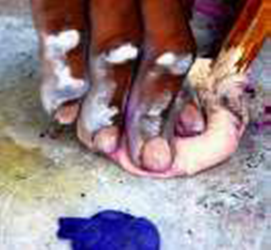
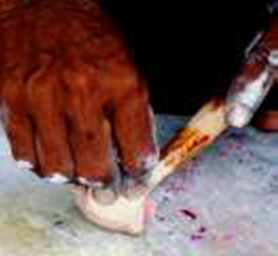
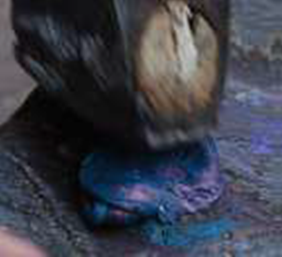
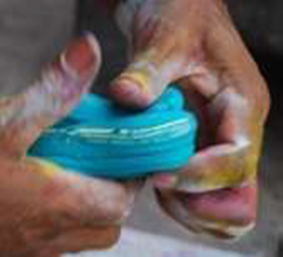
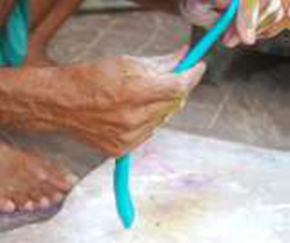
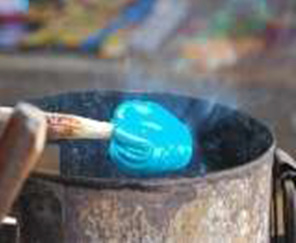
Figure 12: Picture by Mitali Pandey Minare



6. ABOUT THE MASTER CRAFTSMEN
The
design development program was conducted in the direction of Mr. Sarkar Ahmed.
He was the master craftsmen of this program. He is 65 yrs. old and is associated
with this traditional craft sector since 45 yrs. He is continuing the heritage
art of his forefather which is 500 yrs. old. He also encourages his sons to
take forward this craft.
He has
registered himself with MPHSVN, DCH and many other Govt. organizations and
attended many workshops and training program organized by them. He also has
showcased his craft in many exhibitions held at Bhopal, Jaipur and Delhi.He himself had made various products according to the
market demand and change but his best works out of this craft is Corner table,
dolls, saras lamp, wall plate (painting), and
cannons.
The
products which are now seen in the market were very different as compared to
the previous ones. Mr. Sarkar Ahmed adds to this that earlier they made products
which were widely used like toys or kitchen items or decorative stuff. Which
includes Itradaan, kamal ka phool, shatranj, chaupad, shahnai, surme-dani, fan, In toys- aeroplane,
chidiya gadi, jhunjhuna,
tricycle, bat-ball, In decoration stuff they made- lantern, flowerpot, doll lamp, keyring, peacock. dancing dolls,
bangle stand etc. At this age also he is very proactive and attends
workshops being organized and participates in exhibitions.
7. CONCLUSION
Sheopur
has a vast potential in lathe-turned wood craft. Since ages this craft is
flourishing in this area and has gradually astonished the potential buyers of
handicrafts. Craftsmen have evolved this craft from the basic household items
like chair, table and toys for kids to the home-décor and souvenir products. On
my field work, I figured out the challenges and the strength of the craft. The
kind of patience it demands and the way it portray its uniqueness in terms of
self-sustainability. Many Govt. organizations are coming forward to promote and
uplifting this craft as it is eco-friendly and has no hazardous impact on the environment;
furthermore, it provides employment for the craftsmen and Wood-turned craft is
therefore are attracting not only the Indian craft lovers but also the foreign
buyers from different countries. Moreover, in today’s context it promotes the
new campaign started by the Govt. called “VOCAL
FOR LOCAL”
SOURCES OF FUNDING
None.
CONFLICT OF INTEREST
None.
REFERENCES
[1] https://en.wikipedia.org/wiki/Madhya_Pradesh
[3] https://sheopur.nic.in/en/history/
[4] http://www.mponline.gov.in/Portal/Content/districts/Sheopur.html
[5] http://handicrafts.nic.in/CmsUpload/2039201602393132%20craft%20process.pdf
[6] http://www.craftandartisans.com/wooden-lacquerware-of-chennapatna-karnataka.html
[7] http://www.fao.org/3/X5859E/x5859e04.htm
[8] Interview with the master craftsmen. Shri. Sarkar Ahmed
[11] https://en.wikipedia.org/wiki/Lathe#Woodworking_lathes
[12] Interview with the artisans Shri Zakir Hussain
[13] Interview with the artisans Shri Sartaj Ahmed (Son of Sarkar Ahmed)
[15] Picture 1-2 from google source
[16] Picture 3-12 taken by me
|
|
 This work is licensed under a: Creative Commons Attribution 4.0 International License
© ShodhKosh 2020. All Rights Reserved.