
|
|
|
|
MODELING AND SIMULATION-BASED COMPARISON OF MAMDANI AND TAKAGI–SUGENO FUZZY INFERENCE APPROACHES
Ankit Kumar 1, Dr. Sanjay Bhadoriya 2
1 Student, Department of Computer Technology Application, Dr. A.P.J. Abdul Kalam University, Indore, India
2 Professor, Department of Computer
Technology Application, Dr. A.P.J. Abdul Kalam University, Indore, India
|
|
|
ABSTRACT |
|
|
In many different fields, fuzzy inference systems (FIS) have become effective tools for managing complex and uncertain systems. The Takagi-Sugeno Fuzzy Model (TSFM) and the Mamdani Fuzzy Inference System (MFIS) are the two most used FIS models. The fuzzy inference processes used in these two models are compared in this research. The Mamdani Fuzzy Inference System uses membership functions and linguistic variables in conjunction with fuzzy rules to map input variables to output variables. To produce clear output values, it uses a fuzzy rule basis, fuzzy logic operators, and defuzzification approaches. The MFIS's capacity to capture linguistic information through rule-based modeling makes it especially appropriate for handling complicated and nonlinear systems. The Takagi-Sugeno Fuzzy Model, on the other hand, is a fuzzy rule-based model that uses a collection of linear or nonlinear functions to mimic the behavior of a system. The TSFM directly uses input variables to create rule consequents rather than using language variables. This model is renowned for its computing efficiency, interpretability, and simplicity. The operating principles, architecture, and salient features of the Takagi-Sugeno Fuzzy Model and the Mamdani Fuzzy Inference System are examined and contrasted in this research. The rule inference procedure, membership functions, aggregation procedures, and defuzzification strategies used in each model are all covered. It also outlines the advantages and disadvantages of both models in terms of handling uncertainty, computational efficiency, interpretability, and system modeling. |
|||
|
Received 15 September 2022 Accepted 16 October 2022 Published 30 November 2022 DOI 10.29121/ijetmr.v9.i11.2022.1764 Funding: This research
received no specific grant from any funding agency in the public, commercial,
or not-for-profit sectors. Copyright: © 2022 The
Author(s). This work is licensed under a Creative Commons
Attribution 4.0 International License. With the
license CC-BY, authors retain the copyright, allowing anyone to download,
reuse, re-print, modify, distribute, and/or copy their contribution. The work
must be properly attributed to its author.
|
|||
|
Keywords: FIS, MFIS,
TDFM, Virtualization, Defuzzification etc |
|||



1. INTRODUCTION
Because Fuzzy Inference Systems (FIS) can manage
complicated and uncertain systems, they have attracted a lot of interest and
are used in many different industries. By combining linguistic variables, fuzzy
rules, and membership functions, fuzzy logic offers a versatile framework for modeling and reasoning under uncertainty. The Takagi-Sugeno Fuzzy Model (TSFM) and the Mamdani Fuzzy Inference
System (MFIS) are two popular fuzzy inference models.
One of the first and most well-known fuzzy inference models is the Mamdani
Fuzzy Inference System, which Mamdani first presented in 1975. Based on
membership functions and linguistic variables, the MFIS uses fuzzy rules to
translate input variables to output variables. A fuzzy rule foundation, fuzzy
logic operators, and a defuzzification technique make up its three primary
parts. The MFIS is appropriate for systems involving sophisticated human
reasoning because it permits the representation and application of expert
knowledge in the form of linguistic rules. On the other hand, a more effective
and broadly applicable fuzzy inference model is the Takagi-Sugeno
Fuzzy Model, which was put forth by Takagi and Sugeno
in 1985. The TSFM uses a collection of linear or nonlinear functions to mimic
the behavior of the system. The TSFM does not
explicitly use linguistic variables in the rule consequents, in contrast to the
MFIS. Rather, it uses input variables to create mathematical functions that
represent rule consequents. The TSFM is appropriate for both modeling and control applications due to its ease of use,
computational efficiency, and interpretability.
This work aims to examine and contrast the fuzzy inference methods used in the Takagi-Sugeno Fuzzy Model and the Mamdani Fuzzy Inference System. The analysis will cover a number of topics, including the rule inference procedure, membership functions, aggregation techniques, and defuzzification strategies applied in each model. Researchers and practitioners can choose and use fuzzy inference systems with confidence if they are aware of the similarities and differences between these models.
Additionally, this research seeks to shed light on the advantages and disadvantages of the MFIS and the TSFM. For every model, it will examine the trade-offs between interpretability, computing efficiency, handling uncertainty, and system modeling skills. We'll talk about real-world situations where these models have been effectively used, illuminating the areas where the MFIS or the TSFM might be more suitable.
The fuzzy inference processes used in the Takagi-Sugeno Fuzzy Model and the Mamdani Fuzzy Inference System will be compared in this research. Researchers and practitioners will be better equipped to make decisions when using fuzzy inference systems in a variety of applications thanks to the analysis, which will provide them a greater knowledge of these models.
2. PROPOSED METHODOLOGY
Diabetes is a global issue. It is one of the illnesses that is rapidly spreading over the world. Diabetes, commonly referred to as diabetes mellitus, is a medical condition in which an individual has elevated blood glucose (blood sugar) due to either inadequate insulin production or improper cellular response to insulin. Diabetes type 1 and type 2 are other names for diabetes. The necessity of early diabetes research is a major source of disagreement. The number of people with diabetes has dramatically increased in recent years, mostly due to population growth, western eating patterns, and inactivity.
Diabetes type 1 and type 2 are the labels given to the two main types of the disease. Type 1 diabetes is inherited by families. Diabetes type 1, also referred to as insulin-dependent diabetes, arises when the body cannot produce enough insulin. Type 2 diabetes, sometimes referred to as adult-onset diabetes, is a non-insulin-dependent type of the disease when the body is unable to create enough insulin to sustain normal biological processes.
3. FUZZY LOGIC SOLUTION APPROACH
Fuzzy logic is a method of problem-solving that can handle decision-making ambiguity and imprecision. It is based on the concept of fuzzy sets, which allow ambiguous or subjective information to be represented and manipulated. The fuzzy logic approach to issue solving includes the following steps: Clearly state which option or problem has to be resolved. This is a crucial phase in problem definition. Learn about the variables involved and their range of values. To define a linguistic variable, map the situation's numerical variables to linguistic phrases that represent qualitative interpretations. Linguistic concepts are typically defined using fuzzy sets. These sets assign varying degrees of membership to each term dependent on the value that is inputted into the system. Design membership functions that specify the shape and range of each linguistic word.
3.1. Method
Begin
Step1: Enter the crisp values for the cells A1, A2,
A3, A4, A5, A6, and A7.
Step 2: Calculate the equation for the fuzzy number's triangle membership function, then set it.
Step 3: Constructed the fuzzy numbers for the input set using A1, A2, A3, A4, A5, A6, A7, and A8.
Step 3.1: Constructed the uncertain number for DM for the output set.
Step 4: Mamdani's approach is used to perform fuzzy inference analysis.
· The Mamdani approach is well-known for its interpretability as well as its capacity to deal with complicated laws of language. It produces linguistic outputs that are simple enough for humans to comprehend and understand how to interpret. The process of defuzzification, on the other hand, may lead to a reduction in precision and may be computationally expensive for systems that have a high number of rules.
· When the link between the input variables and the output variables can be described using mathematical functions or equations, the Sugeno technique is frequently chosen as the method of choice. In comparison to the Mamdani approach, it is capable of producing results that are both more accurate and less resource intensive to compute. However, due to the fact that it does not directly supply language outputs, the interpretability of the output may be diminished.
Both the Mamdani and the Sugeno approaches have advantages and disadvantages, and selecting one over the other is contingent on the nature of the issue at hand as well as the qualities that are sought for in a fuzzy inference system.
Step 4.1: Enter the rule in the format Rule 1,2,...k.
Step 4.2:
Calculations are made to determine the matching degree of rule using OR
fuzzy disjunction for the fuzzy input set (A11, A12, A13, A21, A22, A23, A31,
A32, A33, A41, A42, A43, A51, A52, A53, A61, A62, A63, A71, A72, A73, A81, A82,
A83, DM1, DM2, and DM3).
Step5: Using
the centroid approach, defuzzify the data into its
crisp values.
Step6: Organize the information so that it is presented in the
language of human nature.
End.
3.2. Membership Function
In fuzzy logic, the mapping of input or output values to fuzzy sets is accomplished with the use of membership functions. The level of honesty or membership that an element in a fuzzy set possesses is determined by a function known as a membership function. It does so by assigning a value in the range of 0 to 1 to each element, depending on its position within the set.
Membership functions can come in a wide variety of guises and configurations, depending on the kind of variable and the kind of problem that needs to be solved. The following are some examples of common types of membership functions:
1) Triangular:
This is one of the membership functions that is the easiest to understand and the one that is used the most frequently. It does so by forming a curve in the shape of a triangle, with left boundary, peak, and right boundary as its three parameters. When going from the left boundary to the peak of the membership function, the value of the function linearly grows, while when going from the peak to the right boundary, it linearly drops.
2) Trapezoidal:
The trapezoidal membership function, which is very similar to the triangle membership function, contains four parameters: the left shoulder, the left boundary, the right shoulder, and the right boundary. It curves in the shape of a trapezoid with a horizontal top between the left and right edges of the shape.
3) Gaussian:
The Gaussian membership function has a bell-shaped distribution and is characterized by two parameters: the mean and the standard deviation. It creates a curve that is symmetrical and has a peak at the mean value. According to a bell-shaped distribution, the degree of participation in the group drops as the input is moved further and further away from the mean value.
4) Sigmoidal:
The sigmoidal membership function depicts a gradual transition between two membership levels using a curve in the shape of a S. It is characterized by a set of parameters that determine the form and degree of incline of the curve.
Generalized bell The membership function of a generalized bell is a flexible curve that can be used to represent a broad variety of different forms. The form, the centre, and the width are the three factors that it has, and these are what determine the properties of the curve.
4. RESULTS AND DISCUSSION
Surface Plot for
Input data with Mamdani Fuzzy Inference Output system
The output of a Mamdani fuzzy inference system can be used to create a
surface plot for input data that shows how the output varies across various
combinations of input variables. An extensive guide that will guide you through
the creation of a surface plot is provided below:
1) Describe the input variables and the ranges in which they fall: Choose your Mamdani fuzzy inference system's input variables and give each one a range or value. You must decide which range of values you want to display, for example, if you have two input variables named "Temperature" and "Humidity," each of which has a range that spans between [0, 100] and [0, 1].
2) Produce the data for the inputs by generating a grid or a set of input values that encompass the possible values for each input variable. Create input values for both of the variables while making sure there is enough density to record the system's activity. You could, for instance, generate a grid with temperature values ranging from 0 to 100 with increments of 5, and humidity values ranging from 0 to 1 with increments of 0.1.
3)
Before using the input data to create the fuzziness, fuzzify it by applying the membership functions of the
input variables. Calculate each linguistic term's degree of membership based on
the provided values. Each linguistic word is given a degree of membership for
every point in the input data set at this stage.
4)
Apply your Mamdani fuzzy inference system's fuzzy rules
to the fuzzified data to perform fuzzy inference. Based on the input data's
degree of inclusion in the antecedent circumstances, determine each rule's
activation level. For every rule, this needs to be done separately.
5)
Aggregate the fuzzy outputs: Use a rule aggregation
mechanism, such as maximum, minimum, or weighted average, to combine the
outputs of the rules that have been triggered. This phase results in an
aggregated fuzzy output for each individual input data point.
6)
Defuzzify the output by employing a defuzzification process
to transform the aggregated fuzzy output into a crisp output value. For
example, you can utilize the centroid technique to find the aggregated fuzzy
output's center of gravity.
7)
Plot the input variables on the x and y axes and the defuzzified output on the z-axis using a surface plot
visualization tool, such as MATLAB's "surf" function. The seventh and
final phase in the procedure is this one. The height of the surface shows the
value that is produced, and each point on the surface reflects a distinct
combination of inputs.
Plotting the surface may give you a visual depiction of how the Mamdani
fuzzy inference system's output changes in response to different input variable
permutations. This facilitates comprehension of the relationships and behavior inside the system and can provide insights for
system optimization or decision-making.
Figure 1
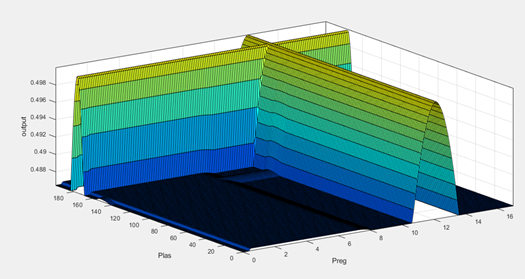
|
Figure 1 Surface Plot of Input Variable Plas and Preg |
Figure 2
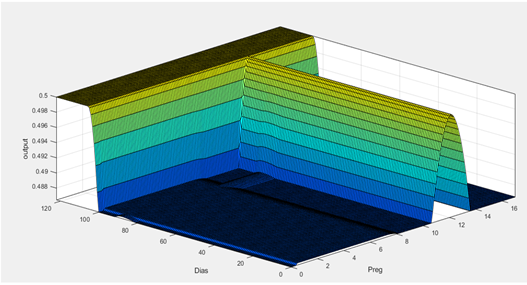
|
Figure 2 Surface Plot of Input Variable Dlas and Preg |
Figure 3
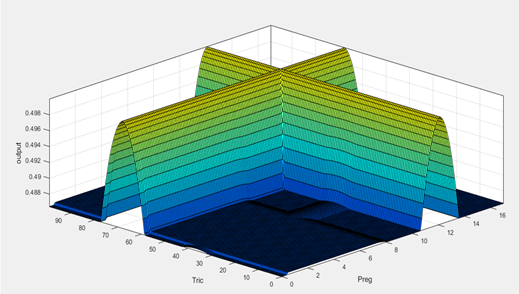
|
Figure 3 Surface Plot of Input Variable Tric and Preg |
Figure 4
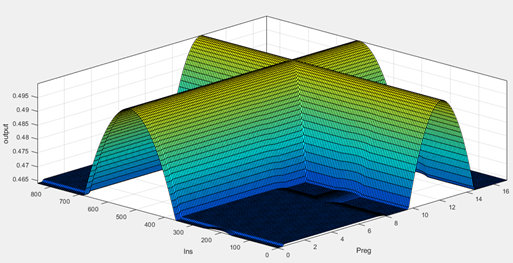
|
Figure 4 Surface Plot of Input Variable Ins and Preg |
Figure 5
|
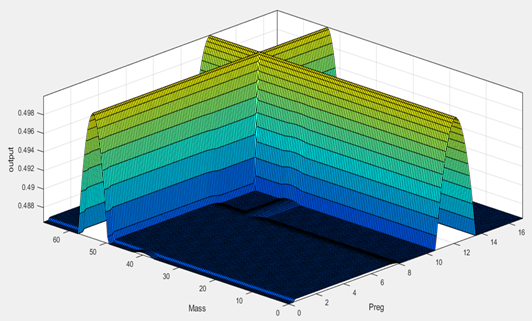
Figure 5 Surface Plot of Input Variable Mass and Preg |
Fiugre 6
|
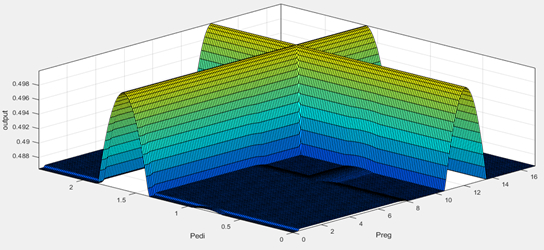
Figure 6 Surface Plot of Input Variable Pedi and Preg |
The surface plot of input variables with preg is depicted in figures 32 through 37. These figures
include the plots for Plas and Preg, Dlas and Preg, Tric and Preg, Ins and Preg, Mass and Preg, and Pedi and
Preg.
The field of fuzzy logic frequently makes use of a
rule-based framework called Sugeno rules. They were
conceptualized in the early 1980s by Professors Takagi and Sugeno, both of whom
are honored by their namesake designations. In fuzzy
inference systems, Sugeno rules are frequently used
to model complicated interactions between the variables that are input and the
variables that are output.
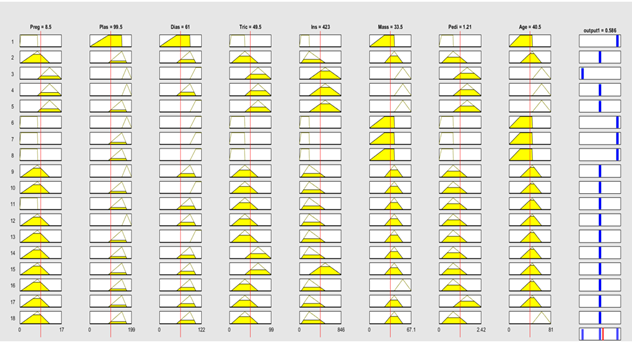
The rules of a Sugeno rule-based
system are made up of a series of conditional statements, and the assertions
are often organized in a "IF-THEN" structure. Sugeno
rules use crisp (non-fuzzy) input variables and linear functions for the rule
consequences, as opposed to Mamdani-type fuzzy systems, which use fuzzy sets
and language variables for the antecedents and consequents of the rules.
The following format is used for every rule in a Sugeno system:
IF (condition) THEN (consequence)
The conditional portion of the expression defines the
requirements that must be met based on the variables that are fed into it, and
the consequent portion of the expression sets the output that must correspond
to the condition. The result of applying a Sugeno
rule is often a linear function of the variables that are used as input. This
result can take the form of a constant value, a linear combination of the
variables that are used, or a weighted average of the variables that are used.Take, for instance, the case
of a straightforward Sugeno rule-based system for
regulating the rate at which a fan rotates in response to changes in
temperature and relative humidity. Here's a sample rule:
The first rule is that if the temperature is high and the
humidity is low, the fan speed should be 80.
The conditional component of this rule requires the
following values to be met: the temperature must be very high, and the humidity
must be very low. The value 80 is a fixed constant that is specified for the
fan speed in the consequence component.
The output of a Sugeno system is
determined by analyzing all of the rules and
integrating their implications in accordance with specific aggregation methods,
such as weighted average. This process yields the final result. The
defuzzification process typically results in a clear value being delivered at
the end of the process.
Sugeno rules are particularly
helpful in situations in which the connection between the variables that are
being input and those that are being output can be correctly characterized by
linear functions. They create a model that is both transparent and interpretable,
making it simple for domain experts to comprehend and make changes to the
model.
Figure 7
|
Figure 7 Sugeno Rules |
Figure 8
|
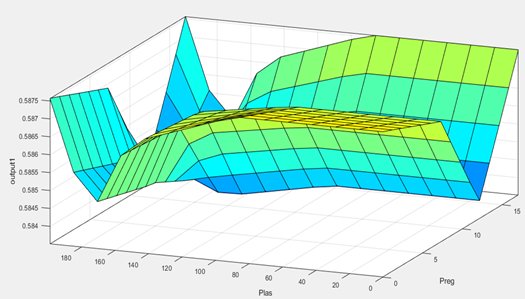
Figure 8 Surface Plot of Input Variable Plas and Preg of Sugeno |
Figure 9
|
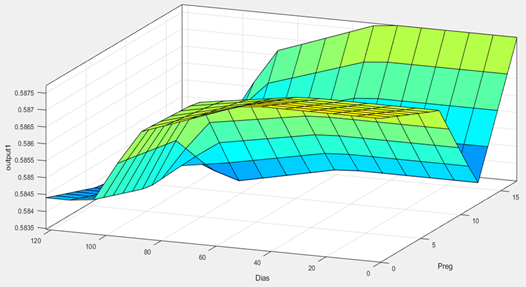
Figure 9 Surface Plot of Input Variable Dlas and Preg of Sugeno |
Figure 10
|
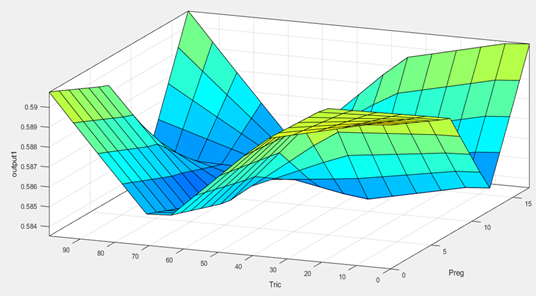
Figure 10 Surface Plot of Input Variable Tric and Preg |
Figure 11
|
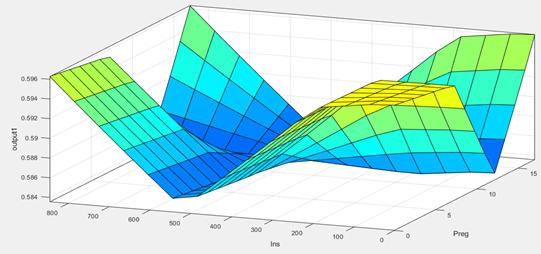
Figure 11 Surface Plot of Input Variable Ins and Preg of Sugeno |
Figure 12
|
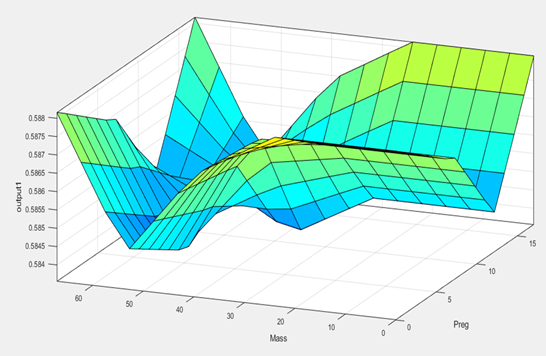
Figure 12 Surface Plot of Input Variable Mass and Preg of Sugeno |
Figure 13
|
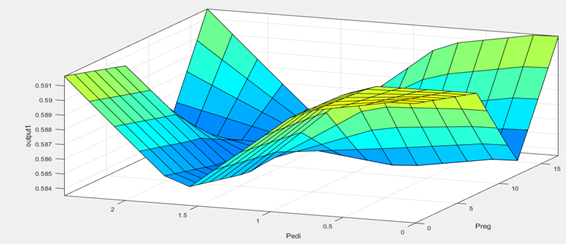
Figure 13 Surface Plot of Input Variable Pedi and Preg of Sugeno |
6. CONCLUSION
A technique for solving problems that can deal with ambiguity and imprecision in decision-making is fuzzy logic. It is predicated on the idea of fuzzy sets, which enable the representation and manipulation of ambiguous or subjective data. The following procedures are part of the fuzzy logic approach to problem solving: Indicate exactly which choice or issue needs to be fixed. This stage of problem definition is very important. Discover the range of values for the variables involved. Map the situation's numerical variables to linguistic terms that reflect qualitative interpretations in order to define a linguistic variable. Fuzzy sets are commonly used to define linguistic ideas. Conversely, the Takagi-Sugeno Fuzzy Model (TSFM) provides interpretability, computational efficiency, and simplicity. The TSFM uses a collection of linear or nonlinear functions to approximate system behavior. It does not require linguistic variables because it directly uses input variables to create rule consequents. For modeling and control activities where efficiency is critical, the TSFM is especially well-suited. It might not have the same language interpretability as the MFIS, though. The particular requirements of the application determine which of the MFIS and TSFM to use. The MFIS is a good option if interpretability and language representation of knowledge are crucial. On the other hand, the TSFM might be better suitable if computational simplicity and efficiency are given priority.
Both the TSFM and the MFIS have been effectively used in a number of practical applications. The MFIS has been used in domains where interpretability and human-like reasoning are essential, such as medical diagnosis, traffic control, and decision support systems. The TSFM has been used in fields that prioritize computing simplicity and efficiency, such as control systems, pattern recognition, and system modeling.
CONFLICT OF INTERESTS
None.
ACKNOWLEDGMENTS
None.
REFERENCES
Akram, M., Alsulami, S., and Zahid, K. (2021). A Hybrid Method for Complex Pythagorean Fuzzy Decision Making. Mathematical Problems in Engineering, 2021, Article 9915432. https://doi.org/10.1155/2021/9915432
Castillo, O., and Melin, P. (2021). A New Fuzzy Fractal Control Approach of Non-Linear Dynamic Systems: The Case of Controlling the COVID-19 Pandemics. Chaos, Solitons and Fractals, 151, 111250. https://doi.org/10.1016/j.chaos.2021.111250
Chen, H. X., Fu, S., and Wang, H. (2021). Optical Coherence Tomographic Image Denoising Based on Chi-Square Similarity and Fuzzy Logic. Optics and Laser Technology, 143, 107298. https://doi.org/10.1016/j.optlastec.2021.107298
Du, X., et al. (2021). Assessing the Adequacy of Hemodialysis Patients Via the Graph-Based Takagi–Sugeno–Kang Fuzzy System. Computational and Mathematical Methods in Medicine, 2021, Article 9036322. https://doi.org/10.1155/2021/9036322
Gao, X. Y. Y., Ali, A. A., Hassan, H. S., and Anwar, E. M. (2021). Improving the Accuracy for Analyzing Heart Diseases Prediction Based on the Ensemble Method. Complexity, 2021, Article 6663455. https://doi.org/10.1155/2021/6663455
Nivethitha, T., Palanisamy, S. K., Prakash, K. M., and Jeevitha, K. (2021). Comparative Study of ANN and Fuzzy Classifier for Forecasting Electrical Activity of Heart to Diagnose COVID-19. Materials Today: Proceedings, 45, 2293–2305. https://doi.org/10.1016/j.matpr.2020.10.400
Roumeliotis, S., et al. (2021). Oxidative Stress Genes in Diabetes Mellitus Type 2: Association with Diabetic Kidney Disease. Oxidative Medicine and Cellular Longevity, 2021, Article 2531062. https://doi.org/10.1155/2021/2531062
Safi, H., Nourinia, R., Safi, S., Hadian, E., Kheiri, B., and Ahmadieh, H. (2021). Retinal Vascular Response to Hyperoxia in Patients with Diabetes Mellitus without Diabetic Retinopathy. Journal of Ophthalmology, 2021, Article 9877205. https://doi.org/10.1155/2021/9877205
Thakkar, H., Shah, V., Yagnik, H., and Shah, M. (2021). Comparative Anatomization of Data Mining and Fuzzy Logic Techniques Used in Diabetes Prognosis. Clinical eHealth, 4, 12–23. https://doi.org/10.1016/j.ceh.2020.11.001
Tsegaw, A., et al. (2021). Diabetic Retinopathy in Type 2 Diabetes Mellitus Patients Attending the Diabetic Clinic of the University of Gondar Hospital, Northwest Ethiopia. Journal of Ophthalmology, 2021, Article 6696548. https://doi.org/10.1155/2021/6696548
Ullah, H., Youn, H. Y., and Han, Y. H. (2021). Integration of Type-2 Fuzzy Logic and Dempster–Shafer Theory for Accurate Inference of IOT-Based Health-Care System. Future Generation Computer Systems, 124, 369–380. https://doi.org/10.1016/j.future.2021.06.012
Wardana, H. K., Ummah, I., and Fitriyah, L. A. (2020). Mamdani Fuzzy Inference System (FIS) for Early Diagnosis of Diabetes Mellitus (DM) and Calorie Needs. Advances in Engineering Research, 196, 387–394. https://doi.org/10.2991/aer.k.201124.070
Wu, J., et al. (2021). Diagnosis of Sleep Disorders in Traditional Chinese Medicine Based on Adaptive Neuro-Fuzzy Inference System. Biomedical Signal Processing and Control, 70, 102942. https://doi.org/10.1016/j.bspc.2021.102942
Yang, X., Han, X., Wen, Q., Qiu, X., Deng, H., and Chen, Q. (2021). Protective Effect of Keluoxin Against Diabetic Nephropathy in Type 2 Diabetes Mellitus Models. Evidence-Based Complementary and Alternative Medicine, 2021, Article 8455709. https://doi.org/10.1155/2021/8455709
Yap, M. H., et al. (2021). Deep Learning in Diabetic Foot Ulcers Detection: A Comprehensive Evaluation. Computers in Biology and Medicine, 135, 104596. https://doi.org/10.1016/j.compbiomed.2021.104596
Zheng, I., Yang, S., and Li, L. (2021). Aperiodic Sampled-Data Control for Chaotic System Based on Takagi–Sugeno Fuzzy Model. Complexity, 2021, Article 6401231. https://doi.org/10.1155/2021/6401231
|
|
 This work is licensed under a: Creative Commons Attribution 4.0 International License
© IJETMR 2014-2022. All Rights Reserved.