
|
|
|
|
Original Article
Structure, Segment and Grid Reliabilities: A Proposal
|
Sriram Kalaga
1* 1 Civil-Structural
Engineering Consultant (Retired) 509 MK Gold Coast, Yendada Visakhapatnam
530045, Andhra Pradesh, India |
|
|
|
ABSTRACT |
||
|
The paper proposes the outline of a method for estimating electric utility grid structural reliability as a function of reliabilities of individual poles and segments. Structural pole reliability is defined in terms of selected weather and load cases. Probability distributions for ice and wind loads, along with their associated statistical parameters, are discussed. It is suggested that separating the effects of ice and wind may help to simplify the computations. An example segment is analyzed to illustrate one of the concepts described in the paper. Suggestions for further studies and extensions are offered. Keywords: Distribution, Grid, Ice, Poles,
Probability, Reliability, Segment, Transmission, Wind |
||


INTRODUCTION
Every year,
climatic events such as hurricanes and ice storms cause severe damage to
overhead utility lines. The main component of a post-storm system rebuilding
process is the hardening of the electrical power infrastructure to prevent
future damage and reduce or eliminate outages due to structural failures. This
can be performed in various ways, including using only engineered pole
materials to guarantee a reliable structural capacity and/or upgrading existing
pole designs to achieve better structural reliability, and thereby, resilience.
The significance of this effort can be assessed from the fact that about 150
million wood utility poles are in service across North America. Some studies Kalaga, S. (2013). Composite
Transmission and Distribution Poles: A New Trend. Energy Central Grid Network. indicate that about 3.6 to 3.7 million wood
poles are replaced each year in addition to installation of 1.9 million new
poles.
A significant
amount of research has been performed in the past on structural reliability Utilities One. (2023, September).
Transforming Grid Infrastructure with Pole Upgrades [Brochure]. New Jersey., Kalaga, S., Jayanti, P., and
Kalyanaraman, A. (2024). Wind and Ice Loads on Transmission Structures: A
State-of-the-Art Review. European Journal of Theoretical and Applied Sciences,
2(6)., Kalaga, S., Holmes, S., and Fecht,
G. (2023). Structural Reliability of Wood and Composite Poles Subject to
Hurricane Winds. Canadian Journal of Pure and Applied Sciences, 17(3),
5775–5782.. Most studies are focused on evaluating
individual structure or pole reliabilities, not the surrounding grid. To the
extent the author knows, there is no specific study aimed at connecting the
calculated structural or pole reliabilities to that of the line segment and
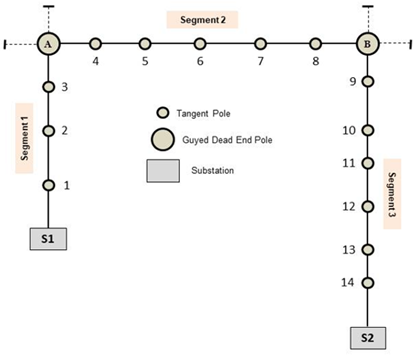
then relate them to the line or overall grid itself (see Figure 1). This study is a small step in that
direction and focuses on poles within a line segment between dead ends and
between terminal substations. Only tangent, self-supporting poles are
considered. Guyed and DDE (double dead end) poles are not considered since they
are subject to minimum bending and therefore have greater nominal reliability.
This article is also intended only to suggest exploring a possible means of
computing grid reliability and does not purport to present a definitive
solution to the problem.
|
Figure 1
|
|
Figure 1 Pole Segments and Line Comprising the Gird |
The definitions of
climactic loads and their variations, and regulatory criteria, are briefly
discussed in the next sections. These definitions refer to the North American
subcontinent but can be adjusted to reflect local conditions at any other
location.
BACKGROUND
Between the early
80’s to 2017, continental USA witnessed a 10-fold increase in frequency of
severe climate events where nearly 80% of the outages are weather-related Kenward, A., and Raja, U. (2014).
Blackout: Extreme Weather, Climate Change and Power Outages. Climate Central.. This experience led policymakers and
utility stakeholders to focus on developing the necessary tools and processes
that can describe and quantify reliability of the utility grid. One of the
benefits of upgrading a utility grid infrastructure is improved reliability,
and therefore, resilience, which are interdependent.
Resilience can be
of two types: Operational and Infrastructure Panteli, M., and Dimitri, N., et al.
(2017). Power Systems Resilience Assessment: Hardening and Smart Operational
Enhancement Strategies. Proceedings of the IEEE, 105(7).. Operational Resilience refers to
maintaining operational strength and robustness during a severe climactic
event. Infrastructure Resilience refers to the physical strength of a power
system for minimizing damage or preventing collapse. This explicitly implies
the performance of the pole structures supporting the utility cables and
equipment. The North American Electric Reliability
Corporation. (2007). Definition of Adequate Level of Reliability. defines Reliability as a combination of
Adequacy and Ability of a physical system to withstand unexpected disturbances
without losses. From an engineering viewpoint, this refers to pole reliability.
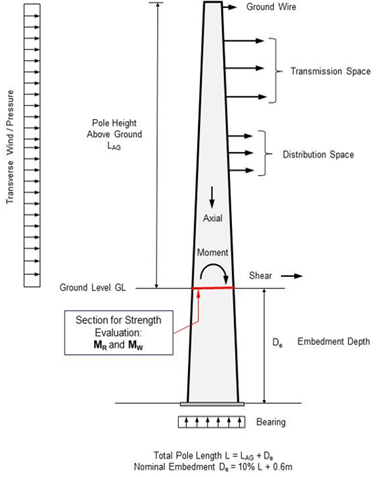
Referring to Figure 2, most tangent poles are directly embedded
into the ground to a given depth. Design is governed by bending moments at the
ground line and embedment depth needed to resist lateral overturning forces.
Wood, where used,
is a bio-degradable material, and therefore from a structural perspective,
strength reduction factors are normally specified in wood design to account for
the statistical variation, decay and decrease of wood strength with time American National Standards
Institute. (2017). American National Standard for Wood Poles—Specifications and
Dimensions (ANSI O5-1)., Institute of Electrical and
Electronics Engineers. (2023). National Electrical Safety Code (ANSI C2-23).. For others (steel, concrete, composite), no
such reduction applies. A typical single-circuit transmission pole, with an
overhead ground wire and under-build distribution is shown in Figure 2 but the concepts are applicable to any
tangent utility pole (and poles with line angles less than 2 degrees) with a
specified geometry, load points and loading regimen.
|
Figure 2
|
|
Figure 2 Typical T and D Pole Loading and Geometry |
GOVERNING CRITERIA
Utility structures
in the United States Institute of Electrical and
Electronics Engineers. (2023). National Electrical Safety Code (ANSI C2-23). and Canada Canadian Standards Association.
(2015). Canadian Standards for Overhead Systems (CSA C22.3). Mississauga,
Ontario, Canada., and elsewhere in the world, are designed on
the basis of Load and Resistance Factor Design (LRFD) American Society of Civil Engineers.
(2019). Manual of Practice no. 74: Guidelines for Electrical Transmission Line
Structural Loading (4th ed.). Reston, VA. where the statistical variability of applied
loads is matched with that of the resistance to reduce the potential for
failure. This method is also called Reliability-Based Analysis and Design
(RBAD) since it provides a specified level of design reliability based on the
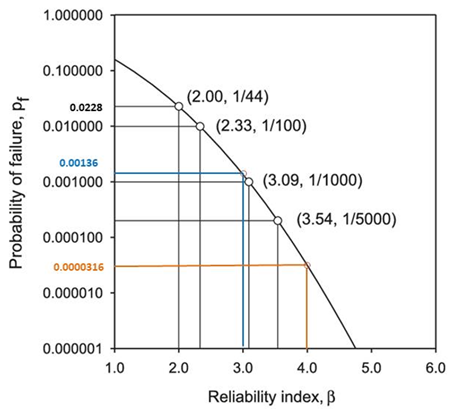
occurrence of climactic events such as hurricanes and ice storms. Figure 3 shows a typical relationship between
Reliability Index β and Probability of Failure Pf. Engineers often use a
target value of β = 3.0 as a reasonable design goal to achieve. The
complimentary relationship between β and the Probability of Success is
shown in Table 1. For any β of 2.5 and above, the chance
of success approaches 1.0.
|
Table 1 |
|
Table 1 Probability of Success for Selected Values
of Reliability Index |
|
|
Reliability
Index |
Probability
of Success |
|
1 |
0.81 |
|
1.5 |
0.9332 |
|
2 |
0.9772 |
|
2.5 |
0.99379 |
|
3 |
0.99865 |
|
3.5 |
0.999767 |
|
4 |
0.9999683 |
|
4.5 |
0.9999966 |
|
5 |
0.999999981 |
This β index
is dependent on the MRI (mean recurrence interval, in years) of the climactic
events. The MRI provides a time-based perspective on the likelihood of extreme
events while the Reliability Index quantifies the structural safety. It can be also
seen that the MRI and β are inversely related through the probability of
failure. That is, a structure designed for a higher MRI will have a lower
probability of failure and consequently a higher reliability index. The current
ASCE standards stipulate a minimum MRI of 100 years, although the codes American Society of Civil Engineers.
(2019). Manual of Practice no. 74: Guidelines for Electrical Transmission Line
Structural Loading (4th ed.). Reston, VA. provide for consideration up to 300 to 700
years, should one need a much stronger long-term design safety.
For more
understanding of the various loading criteria and structural element resistance
related to an RBAD, the reader is referred to the abundant literature available
on the topic Ang,
A. H.-S., and Tang, W. H. (1984). Probability Concepts in Engineering Planning
and Design. John Wiley and Sons., Kharmanda, G., and El-Hami, A.
(2016). Reliability in Biomechanics (1st ed.). John Wiley and Sons., Kalaga, S., and Yenumula, P. (2017).
Design of Electrical Transmission Lines: Structures and foundations (1st ed.).
CRC Press.. The standards of reliable performance of
utility pole structures are discussed in American Society of Civil Engineers.
(2006). Manual of Practice no. 111: Reliability-Based Design of Utility Pole
Structures. Reston, VA..
|
Figure 3
|
|
Figure
3 Relationship Between Reliability Index and Probability
of Failure |
Some basic
features of RBAD, as used in this study, and referring to Figure 3, are as follows.
The definition of
a Reliability Index β for a normally distributed variable is:
 (1)
(1)
where:
MR = Mean value of Resistance
MW = Mean Value of Applied Load Effect (as a
function of MRI)
σR = Standard Deviation of Resistance = (COVR) (MR)
σW = Standard Deviation of Load Effect = (COVW)
(MW)
COVR = Coefficient of Variation of Resistance
COVW = Coefficient of Variation of Load Effect
Load Effect MW is
the applied bending moment at the ground line (GL) due to vertical and lateral
loads; Resistance MR is the bending moment capacity at the ground line based on
section properties.
From statistical
perspectives, pole resistance MR is a random variable, and most pole strengths
are historically known to follow a Normal (Gaussian) Distribution. Loading MW
on utility poles in North America, both transmission and distribution, is
limited to effects of ice and wind. While the magnitude and occurrence of these
loads vary with their geographical location, their effect is manifested in
single poles as GLBM (ground line bending moment). Radial ice accumulation on
wires is known to follow a Normal Distribution Transportation
Research Board. (2003). NCHRP report 489: Design of Highway Bridges for Extreme
Events. Washington, DC. but wind speeds are a different proposition.
Low-to-moderate winds 64 kmph to 96 kmph (40 mph to 60 mph) are often assumed
to follow a Weibull Distribution with higher winds 145 kmph (90 mph) and above
taken to be an Extreme Value Type 1 (EVT) Distribution. These distributions can
be 2- or 3- parameter distributions depending on the approach adopted Ellingwood, B. R., and Tekie, P. B.
(1999). Wind Load Statistics for Probability-Based Structural Design. Journal
of Structural Engineering, 125(4)., Simiu, E., Lombardo, F. T., and Yeo,
D. H. (2012). Discussion on Ultimate Wind Load Design Gust Wind Speeds Effects
in the United States for Use in ASCE 7. Journal of Structural Engineering,
138(5).. Previous studies also suggested that wind
speed distributions concurrent with ice are best described by a Weibull
Distribution.
The values of
COV’s of loads and resistances vary widely depending on location, topography
and MRI of climactic loads. For example, some typical values often cited in the
industry are:
Wood COVR = 0.17
to 0.20 applied to the bending stress American National Standards
Institute. (2017). American National Standard for Wood Poles—Specifications and
Dimensions (ANSI O5-1).
Steel, Concrete
and Composite Poles COVR = 0.05 (nominal)
COVW = 0.08 to 0.10 applied to the wind load
(general) Joffre, S. M., and Laurila, T.
(1988). Standard Deviations of Wind Speed and Direction from Observations Over
a Smooth Surface. Journal of Applied Meteorology, 27(5).
= 0.13 (EVT-1 Distribution,
100-year MRI) Ellingwood, B. R., and Tekie, P. B.
(1999). Wind Load Statistics for Probability-Based Structural Design. Journal
of Structural Engineering, 125(4).
COVW = 0.18 applied to the radial ice Transportation
Research Board. (2003). NCHRP report 489: Design of Highway Bridges for Extreme
Events. Washington, DC.
Equation 1 cannot
be used in situations where one of the variables is non-normal. In such cases,
the evaluation must consider any of the alternative theoretical methods such as
variate transformation to Normal Distribution, Box-Cox transformation, Monte Carlo
Simulation (MCS) etc. The accuracy of the transformations depends on the values
of the location, scale and shape parameters of the parent EV distributions,
especially those of high wind speeds Bureau of Indian Standards. (1995). Institute
of Standards and Technology. (2015). Maps of Non-Hurricane and Non-Tornadic
Wind Speeds with Specified MRIs for the Contiguous United States Using a
Two-Dimensional Poisson Process Extreme Value Model and Local Regression (NIST
Special Publication 500-301)..
Separation of Ice and Wind Reliability Components
Alternatively, if
the situation involves both normal (ice) and non-normal (wind) variables, then
the pole reliability can be considered as a sum of individual reliabilities
β_n and β_nn (for example, when the load effect involves both ice and
wind). That is, the load effects are considered and processed separately.
 (2)
(2)
In the event that
the governing loading is just wind (non-normal), Equation 2 reduces to:
 (3)
(3)
In the event that
the governing loading is just ice (normal), Equation 2 reduces to:
 (4)
(4)
PROPOSED MODEL
We propose a
simple model for grid reliability index as applied to a hypothetical North
American grid shown in Figure 1. The grid runs between 2 substations S1 and
S2 and contains 3 segments: S1 to A, A to B and B to S2. The segments taken
together constitute a line or grid with 14 tangent poles with different
effective spans. Poles A and B are dead ends and rarely fail as they are guyed
in both directions. The load cases shown in Table 2 give typical weather loading for this model.
It must be noted
that this is NOT a comprehensive, global model but only offers guidance towards
developing such models for other locations. Weather is most South Asian
countries such as India is mostly dominated by high winds and high temperatures
Bureau of Indian Standards. (1995).
IS 802-1-1: Structural Steel in OHTL Towers: Part 1—Loads, Materials and
Permissible Stresses. New Delhi, India. and the model can be appropriately adjusted
to such situations. The model implicitly assumes that statistical data related
to the main variables is readily available. For example, in the continental
USA, climactic wind and ice data is collected and processed by National Institute of Standards and
Technology. (2004). Extreme Wind Speeds: Overview (NIST Publication 898).
Washington, DC, United States. with the help of hundreds of weather
stations located strategically across the country.
Assumptions
1)
Each
pole’s structural reliability index is an explicit function of the pole’s
strength under a given set of controlling load cases as applied to the spans
comprising the segment.
2)
Statistical
variation of applied load effects and pole resistances is known and data is
available.
3)
Poles
considered for the process are tangent poles (zero to small line angles, <=
2o)
|
Table 2 |
|
Table 2 Typical Weather and Load Cases |
||||||
|
LC No. |
Description |
Radial Ice Thickness (mm) |
Wind Speed (kmph) |
Wind |
Comment |
Assumed Distribution |
|
Load |
||||||
|
(kPa) |
||||||
|
LC1 |
District
Load Case |
0 |
96 |
431 |
Light |
Ice:
Normal Wind: Weibull |
|
6 |
64 |
192 |
Medium |
|||
|
12 |
64 |
192 |
Heavy |
|||
|
LC2 |
Extreme
Wind |
0 |
145
to 241 |
991
to 2758 |
Location-
dependent |
Extreme
Value Type 1 |
|
LC3 |
Combined
Ice and Wind |
12
to 25 |
Variable |
Variable |
Location-
dependent |
Ice:
Normal Wind: Weibull |
|
LC4 |
Heavy
Ice on Conductors |
25
to 75 |
0 |
0 |
Location-
dependent |
Ice:
Normal |
|
*non-standard,
but utility-mandated load based on local experience **See
IEEE-Institute of Electrical and
Electronics Engineers. (2023). National Electrical Safety Code (ANSI C2-23). for
various values based on location (1 inch =
25.4 mm, 1 psf = 47.88 kPa, 1 mph = 1.608 kph) |
||||||
Individual Pole Reliability Index βi
Each pole
reliability index βi is the lowest of those computed for the 4 load cases
shown in Table 2. Note that loading cases LC1 and LC3 contain
both ice and wind and this implies presence of two different random variates
with different distributions. As mentioned before, the analytical treatment of
the situation requires either a variate transformation to Normal or a Monte
Carlo Simulation with specified COVs, plus consideration of Equation 2 (or 3,
as required).
βi =
Minimum (βiLC1, βiLC2, βiLC3,
βiLC4); i = 1 to 14 (5)
If we assume that
Extreme Wind (LC2) controls the design of tangent poles at that location, then
Equation 5 can be reduced to:
βi
= Minimum (βiLC2); i = 1 to 14 (6)
If we assume that
Extreme Ice (LC4) controls the design of tangent poles at that location, then
Equation 5 can be reduced to:
βi = Minimum (βiLC4); i = 1 to 14) (7)
Segments
This idealization
assumes that effects of any structural failure in a segment will be confined to
that segment. The pole system in each segment is analogous to a connected set
of components (poles) where failure of any one unit leads to the failure of the
entire segment. Additionally, the reliability of the segment is a function of
the lowest component (pole) reliability, often called the “weakest link” of the
system. When the failure of each component is independent of the others, the
reliability of the segment, β𝑠eg is the taken equal to the lowest
reliability of the individual components.
β𝑠eg =
Min [β1, β2, β3 … β𝑛] (8)
β𝑛 is
the reliability of the nth component (pole) in the segment.
For the entire
grid of Figure 1we define Segment Reliabilities simply as
follows:
βseg1
= Min [β1, β2, β3] (9a)
βseg2 = Min [β4, β5,
β6, β7, β8] (9b)
βseg3 = Min [β9, β10,
β11, β12, β13,
β14] (9c)
Grid Reliability
can now be simply defined as an RMS average of the 3 segment minimums:
βG
= √ [(β2seg1 + β2seg2 + β2seg3)/3] (10)
Knowledge of
individual βis and grid βGs can help utility planners identify weak
spots within the grid and take remedial action before the next catastrophic
climactic event. Poles with lesser β values can be either replaced or
upgraded to enhance the overall segment and grid.
APPLICATION
To illustrate the
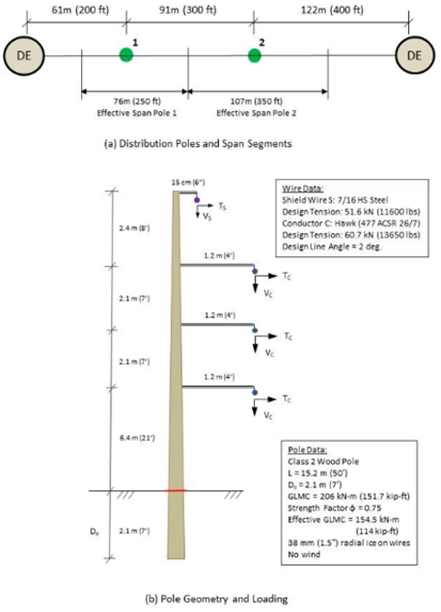
computational concepts discussed above, a small 2-pole, 3-span segment between
dead ends (see Figure 4a) is considered. The load case considered is Extreme Ice (LC4 of Table 2) with radial ice thickness of 38 mm (1.5
inches), normally distributed. The structure loading for the single circuit
pole (Figure 4b) consisted of vertical loads Vs and Vc and transverse loads Ts and Tc
(due to line angle) applied at the end of davit arms. Values of the loads Ts
and Tc corresponding to a line angle of 2 degrees are calculated using Excel
spreadsheets and standard equations from textbooks Kalaga, S., and Yenumula, P. (2017).
Design of Electrical Transmission Lines: Structures and foundations (1st ed.).
CRC Press..
The following
numerical values are used in the calculations:
MW1 =
96.5 kN-m (71.2 kip-ft)
MR1 =
MR2 = 154.5 kN-m (114 kip-ft)(identical poles)
MW2 =
`104.2 kN-m (76.8 kip-ft)
COVW =
0.18 (ice)
COVR =
0.20 (wood)
σR1
= σR2 = (COVR)
(MR) = 0.20 154.5 =
30.9 kN-m (41.9 kip-ft)
σW1
= (COVW) (MW1) =
0.18 96.5 = 17.4 kN-m (12.8 kip-ft)
σW2
= (COVW) (MW2) =
0.18 104.2 = 18.8 kN-m (13.9 kip-ft)
From Equations 1
and 4, the reliability indices for the poles are:
βpole1
= 1.64 βpole2 = 1.39
Minimum of βpole1 and βpole2: 1.39
Therefore, Segment
Reliability R = 1.39
The value of
Probability of Success is about 0.906.
If the segment
were to use steel poles of the same height and capacity instead of wood, the
reliability increases several-fold as shown below:
MW1 =
96.5 kN-m (71.2 kip-ft)
MR1 = MR2
= 206 kN-m (151.7 kip-ft) (no strength reduction)
MW2 =
`104.2 kN-m (76.8 kip-ft)
COVW =
0.18 (ice)
COVR =
0.05 (steel)
σR1 = σR2 =
(COVR) (MR) =
0.05 206 = 10.3 kN-m (7.6 kip-ft)
σW1
= (COVW) (MW1) =
0.18 96.5 = 17.4 kN-m (12.8 kip-ft)
σW2
= (COVW) (MW2) =
0.18 104.2 = 18.8 kN-m (13.9 kip-ft)
From Equations 1
and 4, the reliability indices for the poles are:
βpole1
= 5.41 βpole2 = 4.75
Minimum of βpole1 and βpole2: 4.75
Therefore, Segment
Reliability R = 4.75
The value of
Probability of Success is about 0.999999.
|
Figure 4
|
|
Figure 4 Structure Scheme for Pole and Segment Reliability
Indices |
This example has
only one segment; in the event there are more, Equations 9 and 10 come into
play.
Selecting steel as
a pole material will provide for a higher pole/segment reliability owing to the
low coefficient of variation associated with steel strength. In the above
example, steel pole minimum reliability is about 3.4 times that of wood for the
specific load case considered. A similar level of reliability is also observed
for composite poles Kalaga, S., Holmes, S., and Fecht,
G. (2023). Structural Reliability of Wood and Composite Poles Subject to
Hurricane Winds. Canadian Journal of Pure and Applied Sciences, 17(3),
5775–5782., Kalaga, S., Jayanti, P., and
Kalyanaraman, A. (2024). Wind and Ice Loads on Transmission Structures: A
State-of-the-Art Review. European Journal of Theoretical and Applied Sciences,
2(6)..
CONCLUSIONS
In the previous
sections, we discussed the definitions of reliability and resilience and
proposed a simple mathematical model for the structural reliability of a small
grid. Ground line resistance of a tangent pole is considered along with load
effects resulting from wind and ice. Mathematical expressions are proposed to
connect the individual pole reliabilities to segment values and then to the
overall line. An important inference from this brief study is that explicit,
location-dependent statistical distributions of the climactic variables are
essential to accurately evaluate individual pole reliabilities. The
computations are somewhat simplified if high wind loading controls the behavior
of a tangent pole and Equation 3 can be employed.
The application of
the concepts is illustrated with a 3-span, 2-pole segment containing wood and
steel poles subject to Extreme Ice loading.
The next step of
this continuing study is finding a way to numerically evaluate Equations 1, 2,
3 and 4 and then the subsequent expressions 5 to 9. Efforts are presently
directed towards that goal. The suggestion to separate the “effects” of the
variables (say, wind and ice) per Equation 2, and define βi accordingly,
should be investigated further. Computing the structural reliability index of
each pole first as a function of each load effect separately and then assessing
its minimum value seems to be a rational approach. Reasonably good grid
reliability estimates can assist in identifying weak spots and in maintaining
reliable transmission and distribution lines.
This study
considered only poles, but the theoretical basis can be applied to other
structural systems including concrete, laminated wood and composite poles.
REFERENCES
American National Standards Institute. (2017). American National Standard for Wood Poles—Specifications and Dimensions (ANSI O5-1).
American Society of Civil Engineers. (2006). Manual of Practice no. 111: Reliability-Based Design of Utility Pole Structures. Reston, VA.
American Society of Civil Engineers. (2019). Manual of Practice no. 74: Guidelines for Electrical Transmission Line Structural Loading (4th ed.). Reston, VA.
Ang, A. H.-S., and Tang, W. H. (1984). Probability Concepts in Engineering Planning and Design. John Wiley and Sons.
Bureau of Indian Standards. (1995). IS 802-1-1: Structural Steel in OHTL Towers: Part 1—Loads, Materials and Permissible Stresses. New Delhi, India.
Canadian Standards Association. (2015). Canadian Standards for Overhead Systems (CSA C22.3). Mississauga, Ontario, Canada.
Ellingwood, B. R., and Tekie, P. B. (1999). Wind Load Statistics for Probability-Based Structural Design. Journal of Structural Engineering, 125(4). https://doi.org/10.1061/(ASCE)0733-9445(1999)125:4(453)
Haynes, R. (2011). How to Transform a Weibull Distribution. Smarter Solutions.
Institute of Electrical and Electronics Engineers. (2023). National Electrical Safety Code (ANSI C2-23).
Joffre, S. M., and Laurila, T. (1988). Standard Deviations of Wind Speed and Direction from Observations Over a Smooth Surface. Journal of Applied Meteorology, 27(5). https://doi.org/10.1175/1520-0450(1988)027
Kalaga, S. (2013). Composite Transmission and Distribution Poles: A New Trend. Energy Central Grid Network.
Kalaga, S., and Yenumula, P. (2017). Design of Electrical Transmission Lines: Structures and foundations (1st ed.). CRC Press. https://doi.org/10.1201/9781315755687
Kalaga, S., Holmes, S., and Fecht, G. (2023). Structural Reliability of Wood and Composite Poles Subject to Hurricane Winds. Canadian Journal of Pure and Applied Sciences, 17(3), 5775–5782.
Kalaga, S., Holmes, S., and Fecht, G. (2024, May). Reliability of Wood and Composite Distribution Poles. In IEEE PES TandD Conference, Anaheim, CA, United States. https://doi.org/10.1109/TD47997.2024.10556232
Kalaga, S., Jayanti, P., and Kalyanaraman, A. (2024). Wind and Ice Loads on Transmission Structures: A State-of-the-Art Review. European Journal of Theoretical and Applied Sciences, 2(6). https://doi.org/10.59324/ejtas.2024.2(6).56
Kenward, A., and Raja, U. (2014). Blackout: Extreme Weather, Climate Change and Power Outages. Climate Central.
Kharmanda, G., and El-Hami, A. (2016). Reliability in Biomechanics (1st ed.). John Wiley and Sons. https://doi.org/10.1002/9781119370840
National Institute of Standards and Technology. (2004). Extreme Wind Speeds: Overview (NIST Publication 898). Washington, DC, United States.
Bureau of Indian Standards. (1995). Institute of Standards and Technology. (2015). Maps of Non-Hurricane and Non-Tornadic Wind Speeds with Specified MRIs for the Contiguous United States Using a Two-Dimensional Poisson Process Extreme Value Model and Local Regression (NIST Special Publication 500-301).
North American Electric Reliability Corporation. (2007). Definition of Adequate Level of Reliability.
Panteli, M., and Dimitri, N., et al. (2017). Power Systems Resilience Assessment: Hardening and Smart Operational Enhancement Strategies. Proceedings of the IEEE, 105(7). https://doi.org/10.1109/JPROC.2017.2691357
Simiu, E., Lombardo, F. T., and Yeo, D. H. (2012). Discussion on Ultimate Wind Load Design Gust Wind Speeds Effects in the United States for Use in ASCE 7. Journal of Structural Engineering, 138(5). https://doi.org/10.1061/(ASCE)ST.1943-541X.0000341
Transportation Research Board. (2003). NCHRP report 489: Design of Highway Bridges for Extreme Events. Washington, DC.
Utilities One. (2023, September). Transforming Grid Infrastructure with Pole Upgrades [Brochure]. New Jersey.
|
|
 This work is licensed under a: Creative Commons Attribution 4.0 International License
© IJETMR 2014-2026. All Rights Reserved.