
|
|
|
|
ANALYSING THE FACTORS AFFECTING INTERDEPARTMENTAL COORDINATION AND PROJECT FLOW EFFICIENCY
Nidhi
Yutish Patrikar 1
1 Student, Amity University Mumbai, Mumbai, Maharashtra, India
|
|
|
ABSTRACT |
|
|
Effective departmental coordination has
become essential to corporate success in today's cutthroat business climate.
Decision-making, general productivity and project flow efficiency are all
directly impacted by interdepartmental collaboration. This study investigates
the different elements that impact interdepartmental coordination in business
settings and looks at how these elements impact the effectiveness of project
execution and delivery. The study makes use of primary data gathered via a
survey given to 100 individuals working in medium- to large-sized companies
in departments like marketing, finance, human resources, and operations.
According to the findings, the primary obstacles to efficient coordination
are a lack of standardized project management tools, leadership disputes,
communication gaps, and disparate departmental agendas. The study comes to
the conclusion that increasing leadership alignment, digital integration, and
cross-functional communication can greatly improve organizational performance
and project flow efficiency. |
|||
|
Received 05 March 2025 Accepted 02 April 2025 Published 31 May 2025 DOI 10.29121/ijetmr.v12.i5.2025.1696 Funding: This research
received no specific grant from any funding agency in the public, commercial,
or not-for-profit sectors. Copyright: © 2025 The
Author(s). This work is licensed under a Creative Commons
Attribution 4.0 International License. With the
license CC-BY, authors retain the copyright, allowing anyone to download,
reuse, re-print, modify, distribute, and/or copy their contribution. The work
must be properly attributed to its author.
|
|||
|
Keywords: Communication,
Organizational Performance, Cross-Functional Teams, Interdepartmental
Coordination, And Project Flow Efficiency |
|||



1. INTRODUCTION
Interdepartmental
cooperation is crucial for attaining efficiency and creativity in the complex
environments in which organizations operate today. To complete projects on time
and under budget, departments like marketing, operations, finance, and human resources
must collaborate. Departmental silos, however, frequently result in
inefficiencies, redundant effort, and misunderstandings, which can postpone
project completion and lower quality.
Projects in many
business contexts involve several departments; for instance, supply chain
management, marketing, design, and finance must all contribute to the
introduction of a new product. Decision-making bottlenecks, uneven information
flow, and misaligned goals might result from these units' lack of cooperation.
Interdepartmental integration is essential to attaining total business
effectiveness; claim Kahn and Mentzer (1998).
This study
examines the variables influencing interdepartmental collaboration and how they
affect the effectiveness of project flow. The study focuses on organizational
structure, technology adoption, leadership support, and communication methods
as the main factors affecting the efficacy of collaboration.
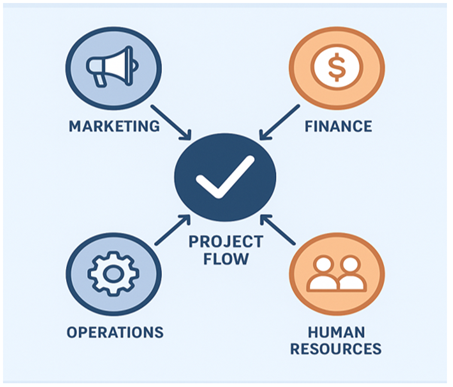
2. Literature Review
A common theme in
organizational research has been efficient interdepartmental coordination.
According to Lawrence
and Lorsch (1967), the level of departmental integration and
divergence determines how well departments coordinate. Stronger integrative
mechanisms, like open lines of communication, common objectives, and a
collaborative culture, are necessary for highly differentiated organizations.
Kahn (1996) highlighted that two important factors
influencing interdepartmental integration are the frequency of collaboration
and the quality of communication. Ineffective communication frequently leads to
misinterpretations and disputes, which lowers operational effectiveness. In a
similar vein, Moenaert and
Souder (1990) discovered that poor communication between
the marketing and R&D departments results in unsuccessful product launches.
Cross-functional
project teams have been shown to improve project outcomes and shorten
time-to-market Clark
and Wheelwright (1992). They proposed that collaborative planning
tools and shared information systems improve departmental visibility and
promote more efficient project flow.
On the other
hand, Turkulainen and
Ketokivi (2012) noted that despite sophisticated
technologies, departmental priorities and performance targets frequently make
collaboration difficult. Employee annoyance, resource duplication, and project
delays might result from this imbalance.
All things
considered, prior research highlights that effective coordination necessitates
striking a balance between leadership, technology, communication structures,
and common goals. Building on these discoveries, this study investigates how
they interact to affect project flow efficiency in a contemporary business
setting.
3. Research Methodology
This study
combines quantitative and qualitative methods in a mixed-method research
design. An online survey was used to gather primary data from staff members in
five corporate organizations who worked in various departments.
100 responders
make up the sample size.
The
distribution of respondents:
·
25% for
marketing
·
20% in
finance
·
30% for
operations
·
15% HR
·
Support/IT:
10%
Research Methods:
The study used a descriptive methodology with an emphasis on determining and
examining the variables affecting interdepartmental collaboration. The poll
asked about perceived coordination efficiency, technology use, leadership
support, and communication frequency.
Data Analysis
methods: Simple statistical methods including percentage analysis, mean score
ranking, and graphical interpretation were used to examine the responses.
Thematic analysis was used to investigate qualitative data from open-ended
responses.
4. Data Analysis and Interpretation
1)
Understanding
the Value of Coordination
·
Interdepartmental
cooperation was deemed "highly important" for project performance by
85% of the 100 respondents, and "moderately important" by 10%.
·
The
fact that only 5% of respondents thought it was not a significant problem shows
how widely recognized its importance is.
2)
Effectiveness
of Communication
·
Interdepartmental
communication was deemed "effective" by 40% of respondents.
·
It was
deemed "average" by 35%.
·
25%
said it was "ineffective," pointing to unclear responsibilities and
response times.
·
This
implies that although there are avenues for communication, problems with
clarity and consistency still exist.
3)
Assistance
with Management and Leadership
·
Just
45% of respondents thought there were clear mechanisms to support
cross-departmental collaboration,
·
Despite
60% of respondents believing top management supports it.
·
Project
delays are a result of a lack of coordination policies led by leadership.
4)
Digital
Tools and Technology
·
Project
management apps like Asana, Trello, or MS Teams were used by 55% of
participants.
·
However,
30% of respondents stated that disparate platforms utilized by departments
resulted in inconsistent data and monitoring issues.
5)
Priorities
and Conflicts Within the Department
·
According
to 50% of respondents, the most frequent reason for project delays is
"differing departmental goals."
·
"Disputes
over resource allocation" were mentioned by 35%.
·
"Communication
breakdowns" were mentioned by 15%.
6)
Effect
on the Efficiency of Project Flow
·
65% of
respondents said that well-coordinated projects successfully met their
deadlines.
·
Delay
rates increased by 30–40% in projects with inadequate coordination.
·
"Weekly
interdepartmental meetings" were selected by respondents as the best
method for preserving flow.
5. Findings from Questionnaires:
The findings
below have been taken from a sample size of 100 people
1)
Awareness
and Importance of Coordination
100 Responses
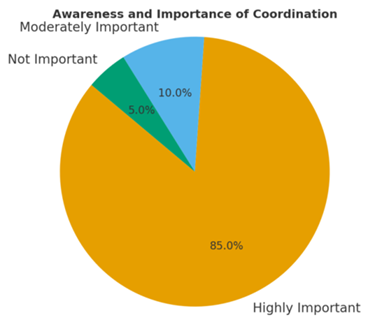
Most of the
people from the sample believe that Awareness and Importance of Coordination is
highly important
2)
Communication
Effectiveness
100 Responses
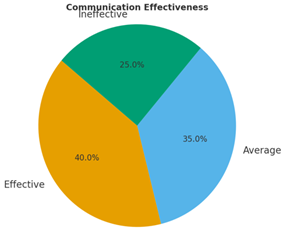
Majority of
departments have effective
3)
Leadership
and Management Support
100 Responses
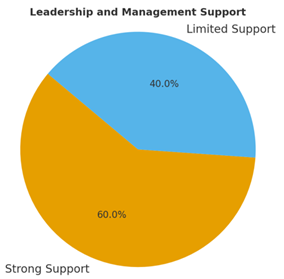
Majority of
departments have strong Leadership and Management Support
4)
Technology
and Digital Tools
100 Responses
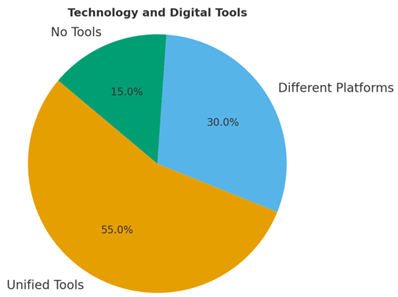
Most of the
people use unified tools
5)
Departmental
Conflicts and Priorities
100 Responses
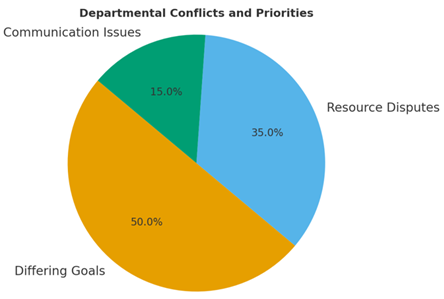
Most of the
people believe that Departmental Conflicts happens due to Differing Goals
6)
Impact
on Project Flow Efficiency
100 Responses
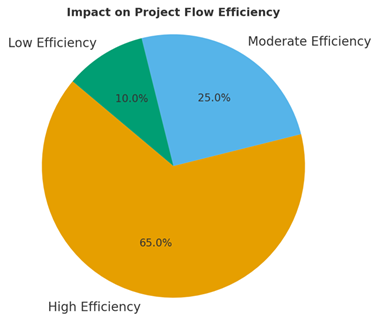
Various factors
have high efficiency on impact on project flow efficiency
6. Discussion
The findings show
that maintaining project flow efficiency requires interdepartmental
coordination. According to Kahn (1996) research, the most important aspect was
communication quality. Additionally, leadership had a big impact, especially
when it came to assigning shared resources and creating collaborative norms.
According to the
findings, even though a lot of firms have embraced digital collaboration
technologies, new obstacles are created by their dispersed use across
departments. This is consistent with the systemic misalignment argument put
forth by Turkulainen and
Ketokivi (2012). Moreover, disparities in departmental KPIs
discourage collaboration and promote rivalry, which lowers project efficiency
overall.
According to the
statistics, enhancing coordination through centralized platforms, regular
communication practices, and leadership-driven initiatives improves
organizational agility and project flow overall.
7. Conclusion
The study comes
to the conclusion that one of the most important factors influencing the
effectiveness of project flow in corporate organizations is interdepartmental
collaboration. The three main factors that facilitate efficient coordination
are technological integration, leadership, and communication. Better
performance and less delay are attained by projects that retain open lines of
communication, departmental goals that are in line, and consistent tool
utilization.
The study does,
however, also draw attention to issues including departmental silos, competing
objectives, and uneven leadership involvement. It will take strategic
alignment, better management techniques, and a shift in culture toward
cooperation to get beyond these obstacles.
8. Suggestions
1) Create Clear Communication Frameworks: To guarantee prompt and transparent information flow, organizations should establish official interdepartmental communication channels.
2) Use unified project management platforms: standardized digital solutions help minimize job duplication and expedite project tracking.
3) Leadership Training: Managers should receive training on how to foster teamwork and settle disputes across departments amicably.
4) Cross-Functional Team Building: To foster trust and understanding, promote cross-departmental workshops and rotating projects.
5) Align Departmental Goals: Performance goals and KPIs should show departmental achievement as a whole, not just for each person.
6) Constant Feedback Mechanisms: To evaluate coordination performance, schedule frequent project reviews and feedback meetings.
7) Invest
in Technology Integration: To guarantee departmental interoperability,
update IT systems.
CONFLICT OF INTERESTS
None.
ACKNOWLEDGMENTS
None.
REFERENCES
Clark, K. B., and Wheelwright, S. C. (1992). Organizing Leading “Heavyweight” Development Teams. California Management Review, 34(3), 9–28. https://doi.org/10.2307/41167421
Deloitte. (2024). Global Project Management Collaboration Trends Report. Deloitte
Insights.
Harvard Business Review. (2023). Collaboration Productivity in Cross-Functional Teams. Harvard Business Publishing.
Kahn, K. B. (1996). Interdepartmental Integration: A Definition with Implications for Product Development Performance. Journal of Product Innovation Management, 13(2), 137–151. https://doi.org/10.1111/1540-5885.1320137
Lawrence, P. R., and Lorsch, J. W. (1967). Organization Environment: Managing Differentiation Integration. Harvard Business School Press.
Moenaert, R. K., and Souder, W. E. (1990). An Information Transfer Model for Integrating Marketing R. Journal of Marketing Research, 27(4), 291–303. https://doi.org/10.1177/002224379002700401
Turkulainen, V., and Ketokivi, M. (2012). Cross-Functional Integration Performance: The Role of Organizational Context. Industrial Marketing Management, 41(4), 715–723. https://doi.org/10.1016/j.indmarman.2012.07.004
|
|
 This work is licensed under a: Creative Commons Attribution 4.0 International License
© IJETMR 2014-2025. All Rights Reserved.