ShodhKosh: Journal of Visual and Performing ArtsISSN (Online): 2582-7472
|
|
Practice-Based PhD in Visual Art: An Inquiry Regarding the Current Situation of Indian Art Education
Prosenjit Raha 1
 ,
Dr. Pallavi Majumder 2
,
Dr. Pallavi Majumder 2
1 Research
Scholar (SRF), Visual Arts, Himachal Pradesh University, Shimla, Himachal
Pradesh, India
2 Assistant
Professor, Visual Arts, Chandigarh University, Chandigarh, India
|
|
|
ABSTRACT |
|
|
This research
paper deals with a research methodology for Visual Art related research.
Practice-based research is common in the art institutions of Europe, America,
Australia, and Asian countries like China and Japan. In India, it is not
well-known. This paper has been written on the basis of
the experience gathered during the practice-based doctoral research of the
first author (In India) and second author (In Hungary). To understand the
exact scenario the views of senior art educators and research scholars in
India were also taken. It has also included the experience through
participation in the workshop on practice-based doctoral research, organized
by Banaras Hindu University. These experiences and views lead this research
to conclude with the requirements and possibilities of implementation of the
Practice-based PhD as a suggestion for Indian Art Academia. |
|||
|
Received 22 September 2023 Accepted 28 March 2024 Published 06 April 2024 Corresponding Author Prosenjit
Raha, prosenjitraha002@gmail.com
DOI 10.29121/shodhkosh.v5.i1.2024.979 Funding: This research
received no specific grant from any funding agency in the public, commercial,
or not-for-profit sectors. Copyright: © 2024 The
Author(s). This work is licensed under a Creative Commons
Attribution 4.0 International License. With the
license CC-BY, authors retain the copyright, allowing anyone to download,
reuse, re-print, modify, distribute, and/or copy their contribution. The work
must be properly attributed to its author.
|
|||
|
Keywords: Visual Art, Practice-Based Research, PhD, Art
Education, Art Institutions, Research Methodology |
|||



1. INTRODUCTION
Practice-based research is a cognitive approach to observing, exploring, and analysing primarily practical and technical aspects of a particular practice like medicine, engineering, visual art and performing art. From the perspective of visual art, according to scholars, practice-based research is to observe and analyse the cognitive coalition between the technicalities of art practice and its inspirational phenomenon by engaging the researcher as a practising artist. Sullivan (2006) In Practice-based research, prose-oriented self-observation is engaged to specify and categorize the process of creation of form, style, and artistic dialogue over social and political issues, conscious and subconscious inclusion and resection of symbols and aesthetic idioms within the framework of the technical, executive and presentation aspects of the art projects.
Practice-based research in visual art is not popular in Indian art academia. It is mainly conducted in Europe, America, and Australia. Developed Asian countries like China and Japan have also introduced practice-based PhD programs in their leading universities. This research is to investigate this format of research, to develop an understanding which may be influential for the required reshaping of the present curriculum of PhD level research in Indian art academia.
2. LITERATURE REVIEW
The
research first focuses on the literature explaining practice-based research's
nature, method, and utility. The book, ‘Artist with PhDs’ edited by Prof. James
Elkins is mentionable here. The book consists of 17 chapters written by
distinguished art academicians from several countries around the globe, along
with 9 examples which are brief descriptions of the practice-based PhDs in visual
art done from several universities in Europe, America, Australia and Asia Elkins (2014), 19. The study has also included examples of
practice-based research reports (thesis). Scholars across the world have
discussed the conflation of philosophical and pragmatic approaches in a
practice-based format, Hamilton & Jaaniste (2009), Irwin (2013), Springgay et al. (2008), Eisner (2002) and Stewart (1994). Some of them
have raised the issue of the research effort in terms of text (number of words)
and number of pictures Paltridge et al. (2011). Some others
have submitted their concern about ethical norms of research culture in this
format Macleod & Holdridge (2004). Here the main
question was about knowledge and objectivity. The discussion about material
thinking from the perspective of practice is also highly considerable in this
regard Carter (2004). To know
practice-based research, the writings on the functionality of a studio from a
research perspective and how there have been acknowledged issues like cultural,
social, educational, and political concerns, are also very important Baxter et al. (2008). In that
context, a comparison between the social-science-based paradigm and
practice-based paradigm to explore moderation in art training and teaching is
mentionable Mason (2008). Notable
researchers accepted that art practice is a creative and critical form of human
engagement that can be conceptualized as research Sullivan (2004), Sullivan (2005), Sullivan (2006).
3. Literatur Gap
There are some
arguments and counterarguments over the topic among researchers across the
world. Here we have to keep in mind that, it is about
art practice and art education. Art is rooted in its respective culture, tradition,
and heritage. The discussion above has been done by foreign researchers. In
Indian art academia, practice-based research is still a matter of discussion.
The academic structure is quite different here. If we search from this perspective we may find a prominent literature gap where the
topic is gradually becoming significant in the Indian art academia.
4. Methodology
After having a general conception of the
existing literature this qualitative research focuses on the ground condition.
The doctoral research experiences in a practice-based format of both the
authors (One in India and another in Europe), the interviews of research
scholars, faculties, and senior faculties from different states of India and
the experience and views shared in the workshop on practice-based doctoral
research, organized by the Department of visual arts, Banaras Hindu University,
are the prime sources of information here. More than 10 interviews have been
taken. Both kinds of close-ended and open-ended questions were asked.
Close-ended questions were for whether they knew about the concept or not. If
yes what were the sources? Open-ended questions were for those who were aware
of the topic and willing to share their opinion on the topic from the Indian
context. Many of them were unaware of
the topic and refused to make any comment.
10 interviews have been mentioned in this paper who have shared their
statements on practice-based research. Discussion and activities in the BHU
workshop and the statements of art researchers and educators have been analyzed
to have an overview of how Indian art academia is thinking about practice-based
research.
5. objectives
The objective of this research are:
•
To understand the
concept, method, and processes of practice-based PhD.
•
To find out the
necessity and possibility of implementation of practice-based PhD in Indian art
academia.
6. Practice-based Research in Visual Art
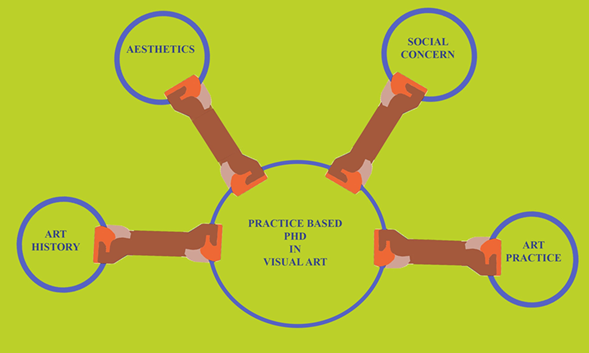
Figure 1
|
Figure 1 Multidimensionality
of Practice-Based Research in Visual Art. Source Designed by
the Author of this paper |
The
diagram above (Which was designed by the author himself) presents and explains
the entire concept and objectives of practice-based research in Visual Arts at
the PhD level. It shows the multidisciplinary nature of this method where the
ring of the practice-based research has been holed by four different hands. The
other ends of the hands are holding the four different enterprises of visual
art. The interlinked relationship between Art History, Aesthetics, Social concern,
and art practice can be better explained through practice-based research. This
diagram has been presented to clarify that the concept of practice-based
research does not avoid bringing theory or new knowledge. It delivers the
language of teaching and learning the technical and philosophical
correspondence in art practice.
7. Practice-Based Research in art academia
According
to the recent higher education system in India, having a PhD degree is almost an
essential criterion for getting a job as an assistant professor. It will be
very effective for the progress of all the theory-based subjects of languages
and social science but in the case of practice-based subjects like performing
art and visual art, the scenario is different.
There
is no doubt about the necessity of practice to hold the label of performance. A
dancer can be ruined for a lack of practice. A painter can learn many things by
reading the critical history of art but if he does it for too long without
practicing what will happen? We will get great scholars by sacrificing the
artists in this way.
Something
like that is happening in PhD research in Visual Art in India. Students of
Painting, Sculpture, Ceramics, Textile, Applied Art, Graphics, and other
practice-based subjects spend their entire six years of BFA and MFA developing
their skills at their best. Among those who want to hand over their knowledge
or skill to the next generation of artists, they only choose the way of NET and
PhD to be a faculty in an art college which takes 5 to 7 years more where they
generally study only the critical or historical facts of art. 6 to 7 years are
more than enough to forget all the skills they
developed during BFA and MFA. Some scholars manage to continue their practice
simultaneously. They must steal time for
their practice from the theory-based research load.
Fine
art scholars should not struggle with the academic system to create fine art.
Their ultimate academic duty is to develop and encourage the practice of the
art medium through their experience and skill.
PhD is
the terminal and most prestigious academic degree in visual art in India. It is
very discouraging for art students when they do not get any academic
recognition or consideration for their practice during their long PhD tenure.
It affects their performance as a teacher or demonstrators in practical classes
in the future.
It
does not happen in foreign universities in Europe, America, and Australia. They
offer two different modes of PhD for visual art students Mackh (2022). The first one is the
conventional theory-based PhD. This is done generally under the guidance of the
professors of History of Art. Students who are good at writing on critical and
analytical issues and scored well in History of art during BFA and MFA are only
eligible to do a PhD in a theory-based format. The second one is a
practice-based PhD which is the main topic of this chapter. This format
incorporates the real practice of art and its inspirational context with the
periodic progress of the art creation, as a systematically documented research
report. Practice-based PhD in visual art is also known as a studio-based PhD or
interdisciplinary PhD in creative art practice. For example, we may see the
official website of Ruskin School of Art, London under Oxford University where
it is reportedly categorized that they are offering two different programs. One
is the theory-based PhD and another is the
practice-led PhD.
“The
Ruskin DPhil program includes two strands: the practice-led DPhil (which
includes a substantial written component) and the contemporary art history and
theory DPhil (by written thesis only).” The Ruskin School of Art. (2024)
8. The BHU workshop on practice-based doctoral research
In
India, visual art academia has already begun to discuss practice-based doctoral
research in this field. Recently Banaras Hindu University has organized an
academic workshop on ‘Practice/ Practice Based doctoral research in Visual art,
from 23rd May to 29th May 2022. Distinguished personalities in the field of
visual art, like the eminent artist and art Historian Suresh Jayram, Prof.
Jayaram Poduval (MSU Baroda), and Prof. Atul Valla
(Shiv Nadar University), and eminent artist HG Arun Kumar were the main speakers
at the workshop. They all agreed on the necessity of the implication of
practice-based research in visual art at the PhD level and delivered their
suggestions according to their work and research experiences. Besides their
role as academicians, most of the speakers were acclaimed art practitioners.
They demonstrated their famous artworks and deliberately explained the research
behind them and how these artworks share knowledge, philosophy, and ideologies
with the viewer. There was a session in the workshop where the process of mind
mapping was practised. The participants experienced how thoughts and associated
thoughts pulsating in our mind may organize an idea where we may identify the
sources of art inspirations with the emotional impulses. It has been well
discussed that the challenges faced by the artist during creation is highly
important to know the art properly.
Without a practice-based approach, we are staying away from that
process. It was a lively interactive exchange of ideas and experiences among
more than 100 research scholars and faculties from all over India and abroad. Convener
of the workshop concluded that practice-based research is a new concept in
Indian visual arts academia but it is an important
aspect of this sector to maintain the international standards of visual
art-oriented research in India. This workshop was a great initiative to
generate awareness of this research methodology.
9. The experience of pursuing practice-based doctoral research in Europe
The 2nd
author has completed DLA (Doctor of Liberal Arts) at the Hungarian University
of Fine Arts, in Budapest, Hungary. She was born and brought up in Kolkata.
After finishing her MFA in painting from Kalabhaban,
she went to Budapest looking for a practice-based PhD course. This research
article considers her journey to Europe from India and the experience of
pursuing practice-based research there as substantial knowledge about the
subject.
Since her last academic year during her MFA,
she has been aspiring to pursue a PhD degree and her interest was applying for
a PhD in practice. She started looking for such opportunities and she already
knew that such a structure of academics has not yet been developed or even
incorporated in our educational system in India, at least in Visual art. At the
same time ‘PhD in practice’ is not something new in the West, in fact also in
some other Asian Countries. She ardently started looking for such Universities
over the internet and found quite a few opportunities open and in relation to
her research area.
The act of cohabiting with the art practice,
i.e. being able to continue your practical researches
by not only depending on the bookish knowledge and writing theories is what she
finds the most inspiring and engaging aspect of this program. This independence
that it offers and the expectation of evolving through paying attention to the
art practice equally is the best thing that any practising visual artist would
crave.
In this kind of research, you are equally
engaged in learning, researching, data collection, analyzing
and then most importantly incorporating your gathered knowledge and reasoning
into the practice. The theoretical findings and art practice are never
considered as separate arenas, that demand divided focus or concentration for
both the branches of research. Hence there is an altogether development,
enrichment and evolution in your approach and execution. The entire
assimilation of learning, art making and strengthening your creative processes
through practical and theoretical approaches seamlessly blend
together resulting in the overall conceptual growth.
The
only difficulty she has realized is that this independence of being able to
totally immerse oneself in the art-making process that happens to be a crucial
part of the research becomes overpowering, especially for a visual artist, who
tends to enjoy practical creation over theoretical learning. In that case,
sometimes the study or theoretical part of the research gets a bit neglected
and procrastinated and at the same time, the activity of learning and writing
takes time and draws effort away from the creative practice. This mild struggle
of balance between the two sometimes needs to be disciplined.
Practice-based research develops one’s
sensibility, concerns, and interests in totality. It aids a visual art
practitioner in evolving not only with literary knowledge and scientific or
artistic facts but also with an overall maturity in one’s artistic process.
Here art making is never a separate or individual approach that one needs to
engage in. It is rather a more important path of the studies that one must be
involved with. The research topic must also be in coherence with one’s artistic
practice. For example, a researcher whose personal art practice deals with socio-political
stigmas, cannot be commonly expected to theoretically research on influence of
ready-made in contemporary art. Your theoretical and practical research must be
congruent and complementary; more appropriately your final thesis should
support your art-making process and artistic engagement which stands to be the
foundation upon which you build your own individual approach to research. The
practice-based PhD is hence more open experimental and ‘informal’. There are no
commonly agreed research methodologies in practice-based research and, for such
researchers, analyzing and developing an approach
fitting for their own needs becomes one of the prior tasks. Consultations,
guidance and inspiration from supervisors and artists/practitioners working in
relevant domains play a major part in the development of individual research
frameworks or methodologies. In many cases, methodology is ignored altogether
and this openness towards research practice encourages the students to develop
their own parameters of discourse. The process opens the students to new
opportunities and wider networks that facilitate them beyond the degree of a
PhD. Thus practice-based PhD aims at the total development and growth of an
artist beyond the acquisition of esteem knowledge, prestige, and a higher
degree.
10. The views of the eminent art academicians and Research Scholars in India
1) Prof.
Him Chatterjee (HOD, Visual Arts, Himachal Pradesh University)
Prof.
Him Chatterjee is the chairman of the Department of Visual Art, Himachal
Pradesh University. This does not introduce his versatile excellence in the
field of art and design. He is an outstanding Painter, designer, art collector
and researcher. He has worked as the advisor and coordinator in a number of state and central government art projects. He
has also directed and supervised several large projects of murals and city
beautification. Apart from these, he
belongs to a family which is deeply associated with art and culture. His father
Sri Sanath Chatterjee is one of the last prominent practitioners of the Famous
Bengal School style.
As
this article deals with the PhD curriculum for visual art which is new and in a
state of growth in India, the view of such a senior professor in this field is
very important. Under his supervision, more than 23 scholars have finished
their PhD research. As an influential and senior academician, he is actively
associated with the PhD programs of the leading universities of North India,
especially in Himachal Pradesh, Punjab, Haryana, Uttarakhand, Madhya Pradesh and Uttar Pradesh. Some scholars are pursuing their PhD
research under him at present.
The
detachment of the scholars from the art practice during PhD tenure is a big
concern for Prof. Chatterjee. He always encourages the PhD scholars to
participate in all types of art activities happening around them. He always
instructs the research scholars “You are an artist first. Don’t be a bookish
person”. It has been tried to take it to the next level. With his
encouragement, the author has already started to study the practice-based
methodology of visual art-oriented research activities and the curriculum of
foreign universities to implement them in his own doctoral research.
According
to Prof. Him Chatterjee, the actual UGC guidelines for PhD level research is
very flexible and liberal. It has not been mentioned anywhere that the research
must be theory-based in Visual and Performing Art. It is absolutely
up to the researchers to make the research convincing to be considered
as productive and contributing. So visual art researchers may approach
practice-based research by introducing it to every possible platform of
research like PhD, writing research papers and combined research projects.
2) Indrapromit Roy (Associate Professor,
Fine Arts, MSU, of Baroda)
Eminent
artist and associate professor, faculty of fine arts MSU, Baroda, Indrapromit Roy is known for his contributions in both
fields of academics and the art field of India. He spent his student life
experiencing the highly enriched learning environment of prestigious
institutions like Kalavaban, MSU of Baroda and the
Royal College of Art London. Through art practice and as a renowned art
activist in India he is associated with the leading league of Indian artists
like Vivan Sundaram, Gulam Mohammed Sheikh, Achuthan Kudallur
and others. In India personalities like him, who know both the modern Indian
art practice and modern Indian art education along with, what is happening
across the art world, are very rare.
A lot
of important information came out from the interaction with him. He was one of
the fore-frontiers of the movement which raised questions of the rules and
regulations imposed on art academia by UGC from 2010 to 2014 which strengthened
the norms of PhD in visual art for recruitment and promotions of art educators
by the format of API scoring. According to him “It was total marginalization of
art practice and art practitioners”. He and his associates arranged a petition
revealing the upcoming disputes for Indian art education. They sent three
letters to the UGC Chairman. They tried to bring it to the attention of the
Indian Ministry of Culture and Broadcasting. According to him, nothing functional
happened about it.
He
also added that theory-based PhD holders by system generally stay out of
practice during their doctoral research. To save the standard of practice in
Indian Academia Practice-based format is something which is at least better
than nothing.
3) Dr
Ritwij Bhowmik (Associate Professor, Fine Arts, IIT
Kanpur)
Eminent
art educator, and Fulbright fellow, Dr Ritwij Bhowmik
is working as an Associate Professor of Fine Arts at IIT Kanpur and has also
taught in different universities in Europe, America, and Asia. He comes from a
family which has a wonderful artistic environment. His father Prof. Ashok
Bhowmik was also an eminent artist and art educator who bore valuable
experience and knowledge about the evolution of art education in
post-independent India. Regarding Practice-based PhD, Ritwij
says-
There
are distinctions among learners in art. Major distinctions are the artists and
art historians. Some people get confused when they mix up these things. Around
the 1970s CAA in the USA established a format where MFA was the terminal degree
in fine arts. By and large India and other South Asian Countries followed that
format. The notion of a PhD came from the UK and other European countries. In
the 1980s and 90s, we may see there the merger of different disciplines like
Fine Arts, Design, Polytechnics, and Humanities under the rule of the
universities. To maintain the uniformity PhD in Fine Arts was required. In
India, the problem started in 2000 and onwards. The weightage of PhD in API
started to play a big role in the recruitment of Fine Art Faculties in the
universities. In Art History, a PhD and publication are essential. More or less they get the training in handling art theory from the
days of BFA and MFA. But the students of other subjects like Painting,
Sculpture, Graphics and applied arts are trained in a
curriculum where art practice and art theory share a ratio of 10:1 (more or
less). In most cases, they do not have the set of skills required for pursuing
doctoral research.
Practice-based
PhD in Art like Western universities is only possible when Indian institutions
upgrade their UG and PG programs where there will be a strong base of art
theory along with art practices.
4) Dr
Ramesh Sampui (Assistant Professor, Painting, Amity
University, Gurgaon)
According
to Dr. Ramesh Sampui the option of Practice-based
research will be beneficial for the candidates who belong to the
practice-oriented disciplines like painting and sculpture. Here the question
is, how academia will be benefited by letting them stay in their zone of
comfort? The practice-based methods should be allowed only for those who have
stylistic continuity with the research like tendency for gradual developments
in their work. For example, we may notice that kind of continuous research in
the works of the eminent artist Sanchyan Bose.
5) Neha
Saha, BHU (PhD Scholar, Visual Arts, Banaras Hindu University, Banaras)
Research
scholar Neha Saha says Practice-based research is essential to developing
technical theory and applying it to your work. How can we make a good painting
with the help of technical principles of painting? This becomes very important
to teach because we can make a painting, but we can know whether that technical
principle applies to our painting or not, only when we apply the theoretical
rules to our practical work. Another advantage of this thing is that we can
evaluate the paintings technically, whether that painting is good or bad based
on the rules of art theory.
6) Swati
Mehta (PhD Scholar, Visual Arts, IIS (Deemed to be University) Jaipur)
Research
Scholar from applied Arts background, Swati Mehta from Rajasthan elaborates the
implementation of practice-based research in Indian art academia is a great
idea. It encourages artists to be creative and try new things, which can lead
to unique and exciting art. It also lets artists explore important ideas
through their art. In India, where we have a rich heritage of traditional art,
practice-based research can help keep these traditions alive by mixing them
with modern ideas. Plus, it allows artists to work with people from different
fields, which can make art even more interesting. While there are some
challenges, like how to evaluate this kind of research?
With the right support and resources, it can really boost the Indian art scene
and help artists get global recognition. So, it's a positive step for our art
community.
7) Mandira
Das Gupta (PhD Scholar, Visual Arts, Tripura University)
According
to Mandira, regarding the field of visual art, other institutions may prefer
the theory-based approach but in our University which is based upon the UGC
guidelines has provided us with lots of flexibility in our research. “I myself
have done a lot of practical study regarding the civil engineering of the
architectures From drawing designs, to physically
working on the construction sites, researching the preservation and restoration
of ancient monuments etc.” Yes, it is mandatory to do practice-based research
in the PhD of the Visual art field. Since without practically realising the
methodology of any artwork, you won't be able to analyse it.
8) Ashu
Chawla (PhD Scholar, Visual Arts, IIS (Deemed to be University) Jaipur)
Research
scholar Ashu Chawla says, scientific Academic writing
is the need of the hour and is being promoted in Fine Art researchers. However we as fine art scholars come with negligible
understanding of what academic writing really is when we enroll
into PhD programmes. Very few scholars then make efforts to learn the process.
Reviewing literature itself becomes tedious for serious scholars since the
process of publishing low-quality literature is quite convenient in this field.
Considering this ground-reality, practice based
research seems to create more confusion than solutions. I do believe that
practice-based research is the way forward in fields like Fine Art but we need some serious brains behind the construction
of a system. The evaluation criteria, methodology, data collection tools etc need
to be redefined completely for theoretical research as well. Although an
unhinged promotion of practice-based research might get dangerous for the field
at the moment.
9) Apu Acharya (PhD Scholar,
Visual Arts, Tripura University)
According
to Apu Acharya from Tripura producing art is the
ultimate job for an art learner. This is the only expectation from the society
to us. The theory-based format of a PhD does not recognize or encourage any
practical competencies. “I think it is ruining the art practice in art
education.” Practice-based PhD can be a better option for India.
10) Nishant Kumar (PhD Scholar, Visual Arts,
Himachal Pradesh University)
Nishant
Kumar says the long tenure of doctoral research makes us stay away from the
studio. In the case of sculpture managing the studio and developing the art
there, is completely a matter of practical experience which cannot be
maintained by staying out of it. The
process, handling the mechanized infrastructure and the eco-system of material
suppliers, artists, transport, and gallery operations all are essential to
knowing the complex process of art creation and its presentation. The practice-based approach is more focused
on the study of the process which may develop awareness about it. This kind of
research becomes more important from the Indian perspective where we are
struggling with the lack of awareness about technical and infrastructural
aspects of art studios.
11. The format of the research report or thesis as the final submission for practice-based Research
To
understand the concept of Practice-based research two examples have been
mentioned and they will be analyzed from three main
sections of research. The sections are contextual review, analysis, and
practice. Here it has been tried to
understand how practice-based research functions.
The
first example is the doctoral thesis of Fritha Langerman. The title of the
thesis is ‘The exploded book: a disarticulation of visual knowledge systems
within sites of natural history display’ Langerman (2013). This doctoral research
was done in the Mchaelis School of Fine Art,
University of Cape Town.
Figure 2

|
Figure 2 Structure of the Thesis of Fritha Langerman. |
Its
research area was the curatorial aspects of museums. It was particularly
focused on the display of natural history (with dioramas) at the museums. In
the contextual review part, this research thoroughly studied the existing
literature and the display of natural history in different reputed museums
showing the overall scenarios of conventional curatorial strategies. In the
analysis part, the pros, and cons of the conventional curatorial system for
natural history display were discussed.
After understanding the basics and pros and cons of the natural history
display the researcher curated two exhibitions of natural history at the Iziko
South African Museum which was the practice section of the research and the
prime output also.
The
thesis concludes with the presentation of two exhibitions produced for this
submission, Subtle Thresholds in the year 2009 and R-A-T in the year 2012,
which ask about how the experiential and sensorial nature of creative practice
can facilitate different kinds of understanding within a museum context and how
acts of curatorship can be used to explain or reveal the cultural nature of
systems of organisation that underpin natural history display. This is answered
through practice rather than through textual analysis. Elkins (2014), p.363
The
next example is the thesis of Trish Barnet, done at the Creative Faculty,
Queensland University of Technology, Australia Barnett (2012). The title of the thesis
was ‘An Investigation into paintings transformation and regeneration through
post-photographic intervention in the digital archive’. The main objective of the research is to analyze the artistic inherent of abstraction in modern art.
In the contextual review section, this research thoroughly studied Modern Art,
Abstraction, and the abstract works of Gerhard Richter, Jackson Pollock, Lucio
Fontana, Goshka Macuga, Christian Boltanski,
Bernd and Hilla Becher, Ann Hamilton and Janet Laurence. In the analysis part,
this research explores the artistic potential and approach of abstraction in
modern art. After getting a deep understanding of it the research produces
wonderful digital paintings as a practice.
Figure 3

|
Figure 3 Structure of the Thesis of Trish Barnet |
12. Conclusion and recommendation
The entire deliberation above was focused on developing an understanding of the
practice-based method and its fusibility, especially in Indian art academia.
Primary observations and study of existing literature show a gradually
increasing popularity of the practice-based method in different countries
across the world. Examples of institutes of world repute were mentioned where
practice-based and theory-based classifications have been demarked and
announced officially. Statements of eminent artists and academician Indrapromit Roy and Dr Ritwij
Bhowmik clarify that the concept of doctoral research in fine arts is not well
developed like other disciplines even in developed countries. Some of the
countries like USA consider MFA as a terminal degree not Phd
in Fine Arts. Which countries want a uniform decorum of higher studies in their
universities, they are asking for PhD in fine Arts. Now the question is if we
want PhDs which will be the choice? Options are practice-based and
theory-based. Many of the universities
all over the world offering practice-based PhDs but a large
number of scholars are raising the question of the fusibility of this
research. Many of them think practice does not deliver any original knowledge.
This paper considers all these arguments and has tried to investigate the idea
of practice-based research among Indian art scholars and academicians with the
study of finished doctoral projects in foreign universities. Eminent art
academician Indrapromit Roy described ‘the present
system of consideration of PhD and its benefits in Indian art Academia’ as the
ultimate marginalization of practice. Prof. Him Chatterjee is also concerned
about the impertinence of practice among doctoral research patterns in India.
The interactions with the Indian PhD candidates have reflected a kind of
frustration for having less opportunity or recognition for art practice during
doctoral research. A large number of them like Apu Acharya, (Including Senior faculties) are expecting
that the practice-based format may give us a better solution to this problem.
Prof. Him Chatterjee and Mandira Das Gupta from Tripura, believes UGC rules
regarding research are flexible and liberal enough to accept the the format of practice-based research in fine art. It is
nowhere mentioned that PhD in fine art must be in theory-based format. Research
scholars Ashu Chawla and Neha Shaha have mentioned their concerns about the
evaluation of the research work. It depends on the outcome of the research.
After studying a considerable number of theses done in practice-based method Proquest. (n.d.) this work has noticed a
confusion among Indian scholars about the outcome. There is a concept that
outcome of a practice-based research is a series of art works, designs or
completion of a curatorial project or art conservation project. The examples
mentioned in this paper Langerman (2013), and Barnett (2012) have demonstrated that the
work or the practice is not the only outcome of the research. Source of
inspiration, analysis of the philosophy and relevance of that inspiration to be
transferred and presented in the artwork, social concern, history of the style,
development of artistic technicalities, processing, and steps of the medium and
managing the presentation and many more things are there to be researched, reported,
and explained. Nishant
Kumar has shown the essentiality of knowledge behind the studio management of
an art practitioner. These are the huge amount of knowledge behind the creation
of a work of art which must be conserved to inspire, guide, and upgrade the art
academia and practice for the future generation. Here the quotation from RSA
website The Ruskin School of Art. (2024) is highly mentionable. In
this regard Dr
Ramesh Sampui raised the topic of eligibility of
practice-based researcher from the perspective of stylistic continuity which
reflects the seriousness and focused area of research. Swati Mehta is hopefull for getting the new scope of multi-disciplinary
research through practice-based format. According to Dr Ritwij
Bhowmik and some other scholars, Indian art academia has yet to do a lot of
work to match the global standard of BFA and MFA before thinking about the PhDs.
The BHU workshop was full of these arguments and counter-arguments but above all the doubts there was one thing decisive. Practice-based research is an option which should be brought under consideration to stay in the rhythm in which the world art academia is moving. To have more clarity we must develop a habit of studying of practice-based thesis reports available on internet repositories like ProQuest and others as we do in Shodhganga to know the conventional way of research. We must apply and avail the modern means of communication with foreign universities especially where practice-based PhDs are offered. We should become more serious during BFA regarding analytical and rational communication over our practice and about the dissertation during MFA. The research aptitude must be developed from the early steps of BFA and MFA at the institutions where students become able to communicate the knowledge and cognitive character artists build in their soul during the exploration of their style which is a cumulative culmination of their skill and philosophy. The awareness about the knowledge behind the practice and operational management of the process and presentation may be brought into the literature by the practice of practice-based research.
CONFLICT OF INTERESTS
None.
ACKNOWLEDGMENTS
This paper may not come to an end if it does not mention the contribution, guidance, help and advice from some kind-hearted and wise persons. All the honourable academicians and scholars who stated their thoughtful stand through interviews are highly mentionable in this regard. This work also conveys its gratitude to all the editors and anonymous reviewers for their precious and supportive observations to enrich it in many ways.
REFERENCES
Barnett, T. (2012). An Investigation into Painting's Transformation and Regeneration Through Post-Photographic Intervention in the Digital Archive [Doctoral Dissertation, Queensland University of Technology]. QUT ePrints.
Baxter, K., López, H. O., Serig, D., & Sullivan, G. (2008). The Necessity of Studio Art as a Site and Source for Dissertation Research. International Journal of Art and Design Education, 27(1), 4-18. https://doi.org/10.1111/j.1476-8070.2008.00553.x
Carter. P. (2004). Material Thinking: The Theory and Practice of Creative Research. Melbourn University Press.
Eisner, E. W. (2002). The Arts and the Creation of Mind. United Kingdom: Yale University Press.
Elkins, J. (2014). Artist with PhDs on the New Doctoral Degree in Studio Art', (2nd Ed.), New Academia Publishing.
Hamilton, J., & Jaaniste, L. (2009). The Effective and the Evocative: Practice-Led Research Approaches Across Art and Design. QUT e-prints.
Irwin, R. L. (2013). 'Becoming a/r/tography', Studies in Art Education, 54(3), 198-215. https://doi.org/10.2307/1320862
Langerman, F. (2013). The Exploded Book: A Disarticulation of Visual Knowledge Systems Within Sites of Natural History Display. [Doctoral dissertation, University of Cape Town]. Open UCT.
Mackh, B. M. (2022). The American Visual Arts PhD: A Response to James Elkins' Artists with PhDs. Retrieved 2022, Augast 8.
Macleod, K., & Holdridge, L. (2004). The Doctorate in Fine Art: The Importance of Exemplars to the Research Culture. Journal of Art and Design Education, 23(2). https://doi.org/10.1111/j.1476-8070.2004.00394.x
Mason, M. (2008). Problems of Interdisciplinary: Evidence-Based and/or Artist-Led Research?. Journal of Art and Design Education, 27(3). https://doi.org/10.1111/j.1476-8070.2008.00586.x
Paltridge, B., Ravelli, S., Ravelli, L., & Nicholson, S. (2011). Doctoral Writing in the Visual and Performing Arts: Issues and Debates. Journal of Art & Design Education, 30(2), 241-55. https://doi.org/10.1111/j.1476-8070.2011.01700.x
Proquest. (n.d.). Dissertations & Theses.
Springgay, S., Irwin, R. L., Leggo, C., & Gouzouasis, P. (2008). Being with A/r/tography, Brills Publishers, Netherlands. https://doi.org/10.1163/9789087903268
Stewart, R. (1994). Neonarratives of Visuality: Contemporary Aesthetic Constructs about Artistic Learning, [Ph.D. thesis, University of Queensland]. UQ eSpace.
Sullivan, G. (2004). Studio Art as Research Practice, in E. Eisner and M. Day (eds), Handbook of Research and Policy in Art Education, 795-814. National Art Education Association. UK.
Sullivan, G. (2005). Art Practice as Research: Inquiry in the Visual Arts, Sage. USA.
Sullivan, G. (2006). Research Acts in Art Practice, Studies in Art Education, 48(1). https://doi.org/10.1080/00393541.2006.11650497
The Ruskin School of Art. (2024). DPhil Programme.
|
|
 This work is licensed under a: Creative Commons Attribution 4.0 International License
© ShodhKosh 2024. All Rights Reserved.