ShodhKosh: Journal of Visual and Performing ArtsISSN (Online): 2582-7472
|
|
Shaping Machines in Our Image: The Influence of Science Fiction Cinema on Public Perception of Artificial Intelligence
Aditya Negi 1  , Dr. Sakshi Negi 2, Sunaina
Harit 3, Dr. Atika Tewari 4
, Dr. Sakshi Negi 2, Sunaina
Harit 3, Dr. Atika Tewari 4
1 Research
Scholar, Central University of Jammu, Jammu and Kashmir, India
2 Assistant
Professor, Dev Bhoomi Uttarakhand University, Naugaon, India
3 Research
Scholar, Central University of Jammu, Jammu and Kashmir, India
4 Assistant
Professor, Amity University, Noida, India
|
|
|
ABSTRACT |
|
|
This
exploratory study investigates how science fiction cinema influences public
perceptions of Artificial Intelligence (AI) among students at the Central
University of Jammu. Grounded in Medium is the Message,
Cultivation, and Reception theories, the research examines the role of film
in shaping understanding of AI’s societal impact. A survey of 151 students
across Computer Science and Humanities disciplines was conducted, utilizing
statistical tools like ANOVA and Pearson correlation for data analysis. Findings
indicate that 67.5% of participants acknowledge Sci-fi movies as a primary
influence on their views. While Hollywood films were more frequently
consumed, both domestic and international cinema significantly shaped
opinions. Results reveal a dualistic perception: respondents are optimistic
about AI’s potential in healthcare and automation, yet
remain deeply concerned regarding ethical misuse and loss of control.
Notably, the study found that media exposure bridges the knowledge gap
between technical and non-technical students. While limited by its specific
demographic, the study suggests that Sci-fi acts as a critical cultural lens.
Future research should employ longitudinal designs to further explore the
causal relationship between sustained media consumption and evolving AI
attitudes. |
|||
|
Received 18 February 2026 Accepted 27 March
2026 Published 29 April 2026 Corresponding Author Aditya
Negir, aditya.negi@outlook.com DOI 10.29121/shodhkosh.v7.i5s.2026.7866 Funding: This research
received no specific grant from any funding agency in the public, commercial,
or not-for-profit sectors. Copyright: © 2026 The
Author(s). This work is licensed under a Creative Commons
Attribution 4.0 International License. With the
license CC-BY, authors retain the copyright, allowing anyone to download,
reuse, re-print, modify, distribute, and/or copy their contribution. The work
must be properly attributed to its author.
|
|||
|
Keywords: Artificial Intelligence, Science Fiction Cinema,
Public Perception, Media Influence, Student Attitudes |
|||



1. INTRODUCTION
“One day the AIs are going to look back on us the same way
we look at fossil skeletons on the plains of Africa. An upright ape living in
dust with crude language and tools, all set for extinction.”
—Nathan Bateman
Every human being is a social animal. Humans and society are interdependent on each other, influencing identity, values, and societal advancement. Humans thrive on social relationships for support, cooperation, and emotional well-being, whereas relationship in society promotes trust, culture, and shared experiences, which affect individual development and societal harmony. A healthy society fosters positive human relationships, guaranteeing stability and advancement. Relationship in humans’ banks on communication, which allows people to exchange ideas, establish connections, and promote understanding. Communication is so crucial for the society that if society wants to punish an individual it cuts off its communication from rest of the world by putting him behind the bars while providing him all the basic necessities of life like food, clothing, shelter, etc. Communication defines culture, government, and social advancement. From the ancient word to the internet, communication unites people, inspires innovation, and shapes change.
Communication has progressed from primitive symbols to complex visual media. Cave paintings and gestures were employed by early humans to communicate information Fischer (1999). Writing systems, like cuneiform and hieroglyphs, allowed for recording and transmission of knowledge Ong (1982). The invention of the printing press during the 15th century transformed mass communication by making information readily available Eisenstein (1979). The 19th and 20th centuries witnessed the invention of telegraph, telephone, and radio, expanding communication speed Castells (2009). The advent of cinema and television revolutionized storytelling, as visual narratives began to reach people all over the world Cook (2016). Early movies, like those by the Lumière Brothers during the 1890s, brought motion pictures into the world of storytelling Cook (2004). The advent of sound and colour during the 20th century widened the reach of cinema, cementing cultural stories and social ideologies Monaco (2009).
Movies are both a reflection of what is real, and tools for change, influencing the masses’ views on politics, gender, and ethics Hall (1980). Artificial Intelligence (AI) was also one of the topics which was discussed often in cinema’s specific genre named “Science fiction” Zhu and Zhang (2022). Artificial Intelligence (AI) term was coined by “John McCarthy” in the Dartmouth Conference in 1956 Nilsson (1998). But the topic drew attention of the public when “Deep Blue” a super computer developed by IBM beats world chess champion Garry Kasparov in 1997, which raise a question in the public’s mind “Is artificial intelligence is better than humans?” Zhu and Zhang (2022). Later after 2 years film “Matrix” released, which shows the humanity ruled by technology. Movies like “Matrix”, “The Wandering Earth”, “Bicentennial Man” and others was created to show different possibilities of technological civilization development and so that we can be prepared Huang (2021). Film has evolved from silent black-and-white movies to an influential medium in constructing societal perception. Today, movies continue to shape audiences across the globe, reinforcing mainstream ideologies as well as subverting social norms.
2. Literature review
In the current digital era, AI is increasingly being
embedded in different industries, such as healthcare, education, and business,
to boost efficiency and innovation Brynjolfsson and McAfee (2014). Its capacity to
process large volumes of data and automate intricate processes makes it a gem
for societal advancement Ng (2018). As AI advances, its
ethical considerations and responsible use are still key factors in
guaranteeing fair benefits across various communities Bostrom
(2014). The early success of
Artificial Intelligence (AI) in the 1960s and 1970s, which saw breakthroughs in
symbolic reasoning and problem-solving, resulted in positive predictions of its
future abilities. The restrictions of computational capabilities and the
impossibility of scaling initial AI frameworks created stagnation, resulting in
what has been referred to as the “AI winter,” an era of lower funding and
interest in AI research McCorduck
(2004). Early in the 21st
century, though, this paradigm shifted as there became accessible enormous
amounts of data, superior computing capacity, and advancements in machine
learning technologies, notably deep learning, such that AI advanced beyond
previous achievements Russell
and Norvig (2021). Parallel to this
development, cinema, which is apt to reflect broader societal directions,
started embracing AI as a pivotal theme for sci-fi movies that shaped the mass
perception of, and discussions concerning, the benefits and risks posed by AI.
Films like The Matrix (1999) and I, Robot (2004) were responsible
for making AI stories mainstream, helping to feed the general societal
imagination of what AI can do and what it should do Geraci
(2008).
Narratives have profound impacts on dominant conceptions of
artificial intelligence since they situate the technology as a utopian or
dystopian technology Sartori
and Theodorou (2022). Mainstream narratives
are mostly produced by tech giant corporations, mass media organizations, and
science fiction authors with various motives and bias Chubb
et al. (2024). The narratives have
the power to influence society's comprehension, interpretation, and
organization in terms of technology, instilling hope and fear towards the
future of AI Sartori
and Theodorou (2022). It is crucial to
incorporate various voices and perspectives when constructing AI narratives to
complement a truer, multiple, and diverse comprehension of the technology Chubb
et al. (2024).
Bollywood films provide a different vision of artificial
intelligence, with a tendency to mirror the Indian cultural and social
environment Nagar (2016). Although Bollywood
has touched upon issues related to advanced technology and robots, its vision
of AI will be different from Hollywood, depending on cultural values, social
concern, and the particular issues India is facing Nagar
(2016). A study of AI narratives presented in Bollywood can give
significant insight into the way various cultures perceive and react to the
development of artificial intelligence.
3. AI in Cinema: The
Medium is the Message
In 1964, Marshall McLuhan was fascinated by the way that
the message is shaped not only by the content that it contains, but by the
medium in which it is embedded, too an idea embodied by the phrase, widely
attributed to him, “The Medium is the Message.” For the factor of AI in
the film medium, the owners thus play a vital role in shaping the societal view
on it, but the technology itself in visual or aural form, these film-makers in
a way shape (an event) through presenting themselves McLuhan
(2018). Hollywood movies like The
Matrix (1999), I, Robot (2004), Ex Machina (2014), and Her
(2013) employ CGI and sophisticated cinematography to present visually engaging
AI stories, which reaffirm the vision of AI as either a potential threat or
changing partner to humans Hermann
(2023). These movies don't
just represent AI but actually build its meaning via the cinematic medium.
In Bollywood, AI-themed films such as Robot (2010), Ra-One (2011) and 2.0 (2018) employ vibrant visual effects and traditional Indian storytelling techniques to integrate AI within a sociocultural context that emphasizes morality, duty, and ethics. Unlike Hollywood’s often dystopian narratives, Bollywood uses AI as an extension of human values and divine intervention, aligning with McLuhan’s view that the medium itself reshapes the message to fit cultural paradigms.
McLuhan’s ideas provide a useful framework for comparing Hollywood and Bollywood’s AI narratives. Hollywood’s cinematic language often aligns with Western anxieties about technological control and corporate hegemony, reinforcing fears of AI surpassing human intelligence Russell (2020). In contrast, Indian dystopian fiction tries to posit a unique interplay between socio-cultural traditional Indian knowledge and technology Goyal (2025). These Indian dystopian fiction gives valuable insights of complexities of AI-driven futures and ethical plurality of AI ethics Goyal (2025).
4. Proposed Study
Movies have always been the refection of the society and
also tool to explore the possibilities of future. Our future is so intricately
connected to the AI technologies with escalated use of it in various sector of
the society. As the evolution of AI is irreversible, the impact of it in the
society is the major concern. Thus, it is the correct time, we ponder on the
issue to analyse the influence of AI in the society. Many theories from mass
communication like Hypodermic Needle Theory, Cultivation Theory, Reception
Theory, etc. suggests that movies play an imperative role in forming the
perception of an individual in the society. Films such as Matrix, Terminator,
Ra-One would have generated an awareness about AI technology in how people
in general view its advantages (e.g., automation, medical progress) and
disadvantages (e.g., loss of control, ethical issues). Despite their
popularity, not much empirical work has been done to investigate how these
movie stories influence public opinion towards actual AI development. This
exploratory study aims to close this gap through an investigation into the
relationship between exposure to sci-fi films and attitudes towards AI, and offering a platform to inform future confirmatory
studies. Therefore, through taking reference from AI based Sci-fi films, this
study would investigate the views of students with Computer Sciences and
Humanities& Social Sciences streams that have had a diverse exposure
towards sci-fi movies and AI related technologies.
5. Research Objectives
· To explore how exposure to sci-fi movies influences public perceptions of AI technologies.
· To identify the perceived benefits and risks of AI as shaped by sci-fi narratives.
· To examine the relationship between demographic factors (e.g., age, education, tech familiarity) and AI perceptions influenced by sci-fi movies.
6. Methodology
In this cross-sectional study, researcher want to explore
the perception of AI developed from watching Sci-Fi movies with AI theme, for
this an online survey was conducted on the students and scholars at Central
University of Jammu using Google Forms. As researcher also wanted to find out,
does the formal education on computers contribute to the engagement with AI or
not, therefore researcher took the samples of two distinguish fields: students
and scholars from Computer Sciences background and Humanities & Social
Sciences background, where Computer Sciences background consists of ‘Computer
Science and Engineering’ and ‘Electronics and Communication Engineering’
departments and Humanities & Social Sciences background consists
‘Economics’, ‘Public Policy and Public Administration’, ‘Social Work’,
‘Comparative Religion and Civilization’ and ‘Mass Communication and New Media’
departments. The link of survey was circulated directly by email and indirectly
by circulating the links in their official departmental Whatsapp
groups through faculties and class representatives to the Computer science and
Humanities & Social Science departments with enrolments strength of 634 (as
of 26 March, 2025) from which the total of 151 respondents filled the survey,
with the response rate of 23.8%. The field work continued from 18 March to 26
March 2025, where respondents were asked about their familiarity with AI and
has explored the effect of Sci-Fi movies on their thinking about AI.
6.1. Demographics
The demographic characteristics of the respondents (N=151) are shown in Table
1. The sample mainly
consist of respondents within the age group of 18-25 (n=126, 83.4%); male (n=97,
64.2%); most of them are pursuing their Bachelor’s degree (n=110, 72.8%); while the education
streams of the respondents are in a ratio of approx. 2:1, where respondents
from Computer sciences are (n=101, 66.9%)
and respondents from Humanities & Social Sciences are (n=50, 33.1%).
Table 1
|
Table
1 Demographic Details of the Study Sample (N=151). |
||
|
Demographic
Variables |
|
Percentage (%) |
|
Age Group |
Below 18 18-25 26-35 36-50 51+ Total |
6 83.4 8.6 0 2 100 |
|
Gender |
Male Female Other Total |
64.2 33.8 2 100 |
|
Educational Degree
Level (Pursuing) |
Bachelor’s Degree Master’s Degree Doctoral Degree Total |
72.8 17.2 10 100 |
|
Educational Stream |
Computer Sciences Humanities and Social Sciences Total |
66.9 33.1 100 |
6.2. Measures
The familiarity with AI technologies is measured with a 5-point Likert-scale (1=Not familiar at all, 2=Little familiar, 3=Neutral, 4=Quite familiar, 5=Very familiar). The frequency to watch Sci-Fi movies by respondents in general and specifying Bollywood and Hollywood separately is measured in a 4-point Likert-scale (1=Never, 2=Rarely, 3=Occasionally, 4=Frequently). For calculating the influence by Sci-Fi movies on the views of respondents, shaping public perception and future implications about AIis measured with a 5-point Likert-scale (1=Strongly agree, 2=Agree, 3=Neutral, 4=Disagree, 5=Strongly Disagree). The potential benefits of AI is measure with a 5-point Likert-scale (1=Not important, 2=Less important, 3=Neutral, 4=More important, 5=Very important). The potential risks of AI is measured with a 5-point Likert-scale (1=Not at all concerned, 2=Concerned, 3=Neutral, 4=Quite concerned, 5=Very concerned).
6.3. Statistical Analysis
The analysis of the study relies on frequency distribution and descriptive statistics for the visualization of data by calculating mean, median, mode, and standard deviation. To demonstrate the relation between independent variables (demographic variables) and dependent variables or between two dependent variables correlation, ANOVA, Chi-square tests and Pearson’s correlation coefficient is used. To calculate percentage of high levels of importance or agreement, only 4/5-point Likert scale data were used. The data underwent statistical analysis with Microsoft Excel and JASP software accordingly.
7. Results
Familiarity with AI
technologies
The study reveals that about 65.6% of respondents are familiar with AI technologies in 5-point Likert-scale (M=4, SD=1.14) as 41.1% and 24.5% of respondents are quite familiar and very familiar with AI technologies like ChatGPT, self-driving cars respectively, while 21.2% of respondents are not much familiar with AI as 4.6% and 16.6% of respondents are not at all or little familiar with AI respectively. 13.2% of respondents share a neutral response towards AI.
Figure 1
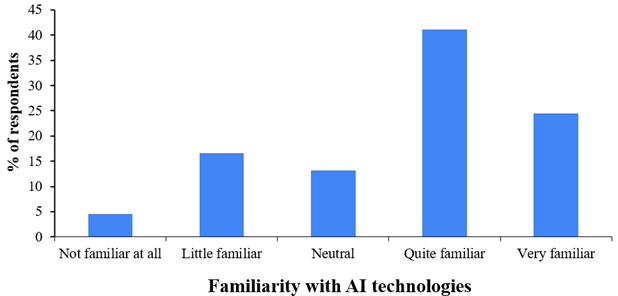
Figure 1
Respondents’
familiarity with AI technologies (N=151)
Interest towards
Sci-Fi movies
The study showcases that over 86% of the respondents use to watch Sci-fi movie at least once a year (M=2.54, SD=0.95) with 18.5% of respondents are frequent viewers of Sci-fi movies (more than five times a year), 30.5% of respondents are occasional viewers of Sci-fi movies (3-5 times a year), 37.1% of respondents rarely watches Sci-fi movies (1-2 times a year), meanwhile 13.9% never watched any Sci-fi movie.
Figure 2
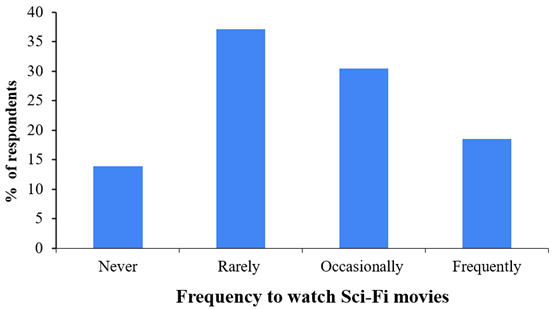
Figure 2
How often respondents’
watch Sci-Fi movies (N=151)
Interest towards Hollywood Sci-fi movies
The study represents that over 83.4% of the respondents use to watch Hollywood Sci-fi movies at least once a year (M=2.44, SD=0.92) with 13.2% of respondents are frequent viewers of Hollywood Sci-fi movies (more than five times a year), 34.4% of respondents are occasional viewers of Hollywood Sci-fi movies (3-5 times a year), 35.7 % of respondents rarely watches Hollywood Sci-fi movies (1-2 times a year), meanwhile 16.5% never watched any Hollywood Sci-fi movie.
Figure 3
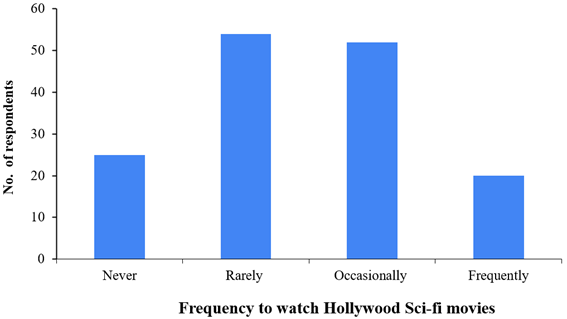
Figure 3 How often respondents’ watch Hollywood Sci-fi movies (N=151)
Interest towards Bollywood Sci-fi movies
The study shows that over 79.4% of the respondents use to watch Bollywood Sci-fi movies at least once a year (M=2.10, SD=0.78) with 5.2% of respondents are frequent viewers of Bollywood Sci-fi movies (more than five times a year), 19.8% of respondents are occasional viewers of Bollywood Sci-fi movies (3-5 times a year), 54.3% of respondents rarely watches Bollywood Sci-fi movies (1-2 times a year), meanwhile 20.5% never watched any Bollywood Sci-fi movie.
Figure 4
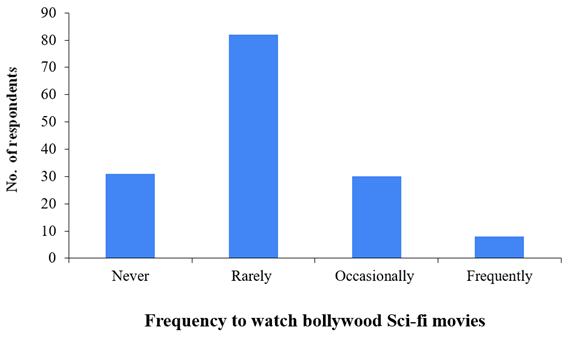
Figure 4 How often respondents’
watch Bollywood Sci-fi movies (N=151)
Influence of Sci-fi movies on the views
of AI
The study acknowledged some level of influence on the
views of AI after watching Sci-fi Movies Specifically, 13.9% of respondents (n
= 21) strongly agreed, 53.6% agreed, 27.2% were neutral, 4% disagreed, and 1.3%
strongly disagreed. The responses yielded a mean score of (M = 3.74) with a standard deviation of (SD = 0.81), indicating a general tendency toward agreement and a
relatively moderate spread of responses. These findings suggest that science
fiction films play a meaningful role in shaping public perceptions of
artificial intelligence, with over two-thirds of participants (67.5%)
expressing agreement or strong agreement with the statement.
Figure 5
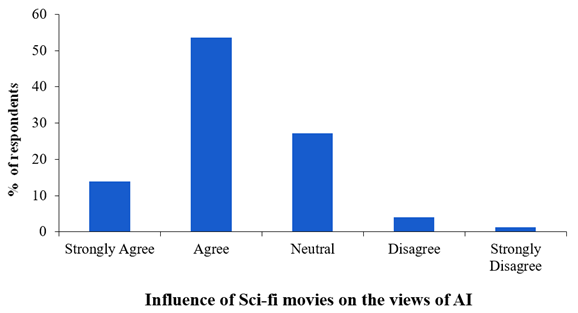
Figure 5 Did the Sci-fi movies have a significant impact of the views of AI (N=151)
Potential benefits of AI
Participants were asked to rate the importance of three potential benefits of artificial intelligence improving healthcare, automating repetitive tasks, and advancing scientific research based on their impressions from movies or other sources. For improving healthcare, responses showed that 9.9% (n = 15) viewed it as not important, 9.3% (n = 14) as less important, 37.1% (n = 56) as neutral, 23.8% (n = 36) as more important, and 19.9% (n = 30) as very important (M = 3.34, SD = 1.23). Regarding automating repetitive tasks, 6% (n = 9) rated it as not important, 9.3% (n = 14) as less important, 31.8% (n = 48) as neutral, 33.1% (n = 50) as more important, and 19.9% (n = 30) as very important (M = 3.51, SD = 1.15). For advancing scientific research, only 4% (n = 6) marked it as not important, 5.3% (n = 8) as less important, 25.8% (n = 39) as neutral, 35.1% (n = 53) as more important, and 29.8% (n = 45) as very important (M = 3.81, SD = 1.08). These results suggest that while all three AI applications were generally viewed positively, advancing scientific research emerged as the most highly valued benefit, followed by automating repetitive tasks and then improving healthcare.
Figure 6
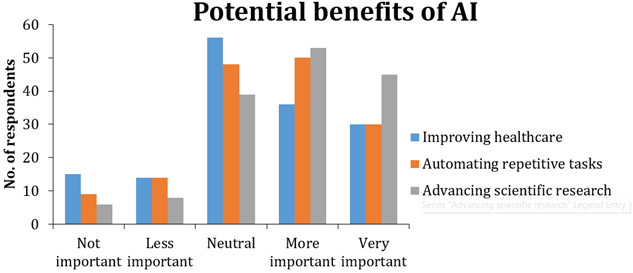
Figure 6 Rating about potential benefits of AI (N=151)
Potential risks of AI
In the study exploring their concerns about potential risks associated with AI, responses varied across three key domains. Regarding job loss due to automation, the mean concern level was 2.84 (SD = 1.16) on a 5-point scale ranging from “Not at all concerned” (1) to “Very concerned” (5), indicating a moderately neutral stance with a slight lean toward concern. For the risk of AI surpassing human control, the mean was slightly lower at 2.82 (SD = 1.17), suggesting a similar distribution of opinion. In contrast, the concern about ethical misuse of AI was notably higher, with a mean of 3.57 (SD = 1.24), reflecting greater anxiety among respondents about the ethical implications of AI technologies. These findings suggest that while students show moderate concern about automation and control, ethical misuse is perceived as a more serious risk.
Figure 7
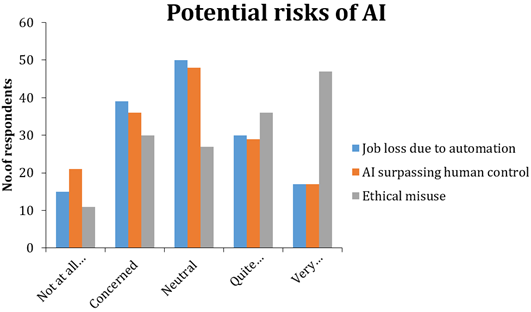
Figure 7 Rating about potential
risk of AI (N=151)
Sci-fi movies shaping public perception of AI with
statements
To explore how sci-fi movies shape students’ perceptions of AI technologies, 151 respondents at the Central University of Jammu rated their agreement with five related statements. On whether sci-fi movies create fear among the public, the average response leaned slightly toward neutrality, with a mean score of 2.64 (SD = 1.02). Regarding the view that sci-fi movies help people understand and adopt AI, students largely agreed, with a higher mean of 3.62 (SD = 0.87). When asked if sci-fi movies create a perception that AI will take over humanity, responses were again moderately aligned, with a mean of 3.05 (SD = 1.10). The belief that AI will develop emotions and subjugate humans one day garnered mixed views, averaging 2.84 (SD = 1.17). Finally, the statement that AI can make human life easier and more comfortable received the strongest agreement, reflected in the highest mean of 3.70 (SD = 1.00). These findings suggest that while students are somewhat divided on sci-fi movies role in spreading fear or dystopian views, they also acknowledge its positive role in awareness and see AI as a beneficial tool for the future.
Figure 8
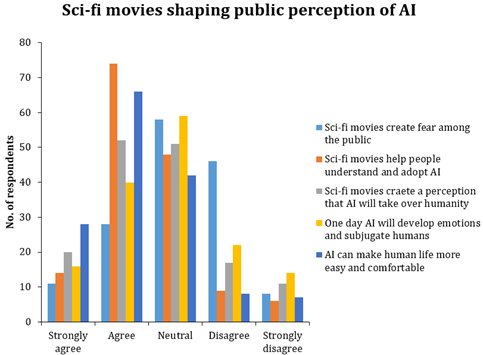
Figure 8 Sci-fi movies shaping
public perception of AI with statements (N=151)
Agreement with the following statements with respect to
Sci-fi movies
The study focused on the agreement of following statements in which the majority supported the idea that more sci-fi movies should be made to popularize AI technologies, with a mean agreement level of 3.63 (SD = 0.91), reflecting a generally positive attitude. The statement that sci-fi movies should be more accurate in terms of scientific facts received even stronger support, with a mean of 3.85 (SD = 1.01), suggesting that scientific authenticity is important to viewers. On whether sci-fi movies should be more futuristic, responses were similarly favorable, with a mean score of 3.63 (SD = 1.04). These findings suggest that students not only value the potential of sci-fi films to promote AI awareness but also advocate for more realism and imaginative foresight in such representations.
Figure 9
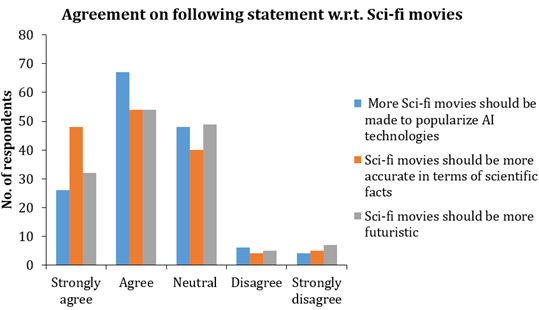
Figure 9 Agreement on the following statements w.r.t. sci-fi movies
8. Discussions
The present study explores how science fiction cinema influences students’ perceptions of artificial intelligence (AI) at the Central University of Jammu. Findings suggest that sci-fi films play a significant role in shaping public understanding of AI, balancing between utopian optimism and dystopian fears. A majority of the respondents were familiar with AI technologies, despite of being from computer sciences or humanities background they were still aware of AI technologies, indicating that exposure of AI concepts is equal in all both the backgrounds.
Consistent with Cultivation Theory and Reception Theory, the data revealed that 67.5% of respondents agreed or strongly agreed that sci-fi movies had influenced their views on AI. Notably, sci-fi films were seen not only as instruments of fear—such as concerns about AI surpassing human control (M=2.82) but also as tools for learning and awareness, with high agreement that AI could improve life quality (M=3.70) and scientific research (M=3.81). These results resonate with prior literature, which emphasizes how narratives in media both reflect and shape collective consciousness (Geraci, 2008; Sartori, 2022).
Furthermore, Hollywood and Bollywood’s treatment of AI reveal cultural nuances in narrative construction. While Hollywood films often highlight themes of domination and existential threat, Bollywood tends to frame AI within moral and social frameworks, reinforcing ethics and human values. This distinction aligns with McLuhan’s theory that the medium and by extension, cultural context shapes the message. The respondents’ preferences and exposure patterns also reflect this, with Hollywood sci-fi movies being more frequently watched than their Bollywood counterparts, potentially due to their global appeal and technologically advanced depictions. The Terminator is a top favorite amongst the all-other AI based Sci-fi movie in Hollywood on the other hand Ra. One and ROBOT are the favorites amongst all in the Bollywood.
Interestingly, despite AI being portrayed as a threat in some films, the overall perception among students leaned towards its potential for societal benefit, especially in healthcare and automation. However, ethical misuse remains a key concern (M=3.57), emphasizing the duality in public imagination: awe at AI’s promise and anxiety about its consequences. These mixed feelings suggest a population informed yet uncertain indicating a strong influence of cinematic narrative over empirical knowledge.
The study also finds that respondents desire more sci-fi films that are both futuristic and scientifically accurate (M=3.85), highlighting the role of cinema not just as entertainment but as an educational and anticipatory tool for emerging technologies. These results are particularly relevant for media creators, educators, and policymakers aiming to responsibly shape AI discourse in society.
9. Conclusion
This exploratory study sheds light on the influential role of sci-fi cinema in shaping public perception of AI technologies, particularly among university students. The findings demonstrate that while sci-fi movies can instill fear and skepticism, they also serve as powerful mediums to generate awareness, curiosity, and optimism about AI. Respondents generally expressed moderate familiarity with AI and reported that films had significantly impacted their views, especially regarding AI’s ethical implications and futuristic potential. The research highlights the cultural differences in cinematic portrayal of AI Hollywood often leaning toward cautionary tales and Bollywood embedding AI within socio-cultural and moral narratives. These portrayals deeply inform how audiences understand and interpret technological advancements. Given the growing integration of AI in everyday life, the importance of accurate and responsible media representation cannot be overstated. As cinema continues to influence public discourse, it is vital for filmmakers to consider their role in educating, inspiring, and guiding society’s relationship with technology. Future research may build upon these findings with longitudinal data, experimental studies, or comparative analyses across broader populations and media forms
CONFLICT OF INTERESTS
None.
ACKNOWLEDGMENTS
None.
REFERENCES
Bostrom, N. (2014). Superintelligence: Paths, Dangers, Strategies. Oxford University
Press.
Brynjolfsson, E., and
McAfee, A. (2014). The Second Machine Age: Work, Progress, and Prosperity in a Time of Brilliant
Technologies. W. W. Norton and Company.
Carey, J. W. (1992). Communication as Culture: Essays on Media and Society. Routledge.
Castells, M. (2009). Communication Power. Oxford University
Press.
Chen, L. (2020). Empathy Toward Machines: How Sci-Fi Films Shape AI Perception. Journal of Media Psychology, 34(2), 135–149.
Chubb, J., Reed, D., and Cowling, P. (2024). Expert Views About Missing AI Narratives: Is There an AI Story Crisis? AI and Society, 39, 1107–1126. https://doi.org/10.1007/s00146-022-01548-2
Cook, D. A. (2016). A History of Narrative Film. W. W. Norton and Company.
Eisenstein, E. L. (1980). The Printing Press as an Agent of Change. Cambridge University Press. https://doi.org/10.1017/CBO9781107049963
Fischer, S. R. (1999). A History of Writing. Reaktion Books.
Geraci, R. M. (2008). Spiritual Robots: Religion and Our Scientific View of the Natural World. Theology and Science, 6(3), 229–246. https://doi.org/10.1080/14746700600952993
Gerbner, G. (1976). Cultivation Theory and Media Influence. Communication Research, 3(4), 321–345.
Goyal, V. (2025). AI and Indian Dystopias: Cultural Disruption and Ethical Dilemmas in Asur and Ok Computer. The Voice of Creative Research, 7(1), 35–45. https://doi.org/10.53032/tvcr/2025.v7n1.05
Hall, S. (1973). Encoding/Decoding in the Television Discourse. Centre for Contemporary Cultural Studies.
Hermann, I. (2023). Artificial Intelligence in Fiction: Between Narratives and Metaphors. AI and Society, 38, 319–329. https://doi.org/10.1007/s00146-021-01299-6
Hoffman, D., and Novak, T.
(2022). Framing AI in Cinema: An Experimental Study on Perception Shifts. Media and Society
Journal, 29(1), 85–102.
Huang, M. F. (2021). Analyzing Civilization Transmission From the Perspective of Creativity in Science Fiction Films. New Films, 2, 12–18.
Kumar, A. P., and Rukmini, S. (2024). Technology, the Latent Conqueror: An Experimental Study on the Perception and Awareness of Technological Determinism Featuring Select Sci-Fi Films and AI Literature. AI and Society, 39, 65–73. https://doi.org/10.1007/s00146-023-01763-5
Kumar, S., and Ray, P. (2022). Cross-Cultural AI Narratives: Hollywood vs. Bollywood. International Journal of Film Studies, 17(3), 250–270.
McCorduck, P. (2004). Machines Who Think: A Personal Inquiry Into the History and Prospects of Artificial Intelligence. A K Peters. https://doi.org/10.1201/9780429258985
McLuhan, M. (1962). The Gutenberg Galaxy: The Making of Typographic Man. University of Toronto Press.
McLuhan, M. (1964). Understanding Media: The Extensions of Man. McGraw-Hill.
McLuhan, M. (2018). The Medium Is the Message: AI and Film Narratives. In Understanding Me: Lectures and Interviews. Routledge. https://doi.org/10.4324/9781315080918-31
Methuen, C. D. A. (2004). A History of Narrative Film. W. W. Norton
and Company.
Monaco, J. (2008). How to Read a Film: Movies,
Media, and Beyond. Oxford University Press.
Ng, A. (2018). AI Is the New Electricity. O’Reilly Media.
Niemann, J., et al. (2019). Cognitive Biases and AI Representation
in Media. Cognitive Science Review, 22(4), 289–307.
Nilsson, N. J. (1998). Artificial Intelligence: A New Synthesis. Morgan Kaufmann Publishers.
Ong, W. J. (1982). Orality and Literacy: The Technologizing of the Word. Routledge. https://doi.org/10.4324/9780203328064
Russell, S. (2020). Human Compatible: Artificial Intelligence and the Problem of Control. Viking. https://doi.org/10.1093/oso/9780198862536.003.0001
Russell, S., and Norvig, P. (2021). Artificial Intelligence: A Modern Approach (4th ed.). Pearson.
Sartori, L., and Theodorou, A. (2022). A Sociotechnical Perspective for the Future of AI: Narratives, Inequalities, and Human Control. Ethics and Information Technology, 24, Article 4. https://doi.org/10.1007/s10676-022-09624-3
Sharma, V. (2023). The Influence of AI Films on Public Perception:
A Comparative Study. Journal of Cross-Cultural Media Studies,
21(2), 110–129.
Sundar, S., and Kim, J. (2021). Media Effects on AI Perception: A Psychological Perspective. Computers in Human Behavior, 115, Article 106586.
Zhu, Y., and Zhang, B. (2022). AI Film Creation Oriented Transformation in the Era of Artificial Intelligence. Art and Design Review, 10, 272–279. https://doi.org/10.4236/adr.2022.102020
|
|
 This work is licensed under a: Creative Commons Attribution 4.0 International License
© ShodhKosh 2026. All Rights Reserved.