ShodhKosh: Journal of Visual and Performing ArtsISSN (Online): 2582-7472
|
|
A Study on the Design Strategy of Suzhou Tourist Souvenirs Incorporating Elements of Wu Culture from the Perspective of Cultural Semiotics
Jiahao Lu 1 , Chanoknart Mayusoh
2
, Chanoknart Mayusoh
2 , Akapong Inkuer
3
, Akapong Inkuer
3 , Permsak Suwannatat
4
, Permsak Suwannatat
4
1 Doctoral Student of Philosophy Program
in Visual Arts and Design, Faculty of Fine and Applied Arts, Suan Sunandha
Rajabhat University, Thailand
2 Advisor in Visual Arts and Design,
Faculty of Fine and Applied Arts, Suan Sunandha Rajabhat University, Thailand
3 Visual Arts and Design,
Faculty of Fine and Applied Arts, Suan Sunandha Rajabhat University, Thailand
4 Program in Creative Arts Department, Faculty of Fine and Applied Arts Chulalongkorn University, Thailand
|
|
|
ABSTRACT |
|
|
This study
focuses on the design of Suzhou embroidery tourism souvenirs within the
context of Wu culture, employing a comprehensive approach that integrates
field research, interviews, and case analysis to thoroughly examine tourist
perceptions, industry challenges, and pathways for design innovation. The
findings reveal that while tourists have limited understanding of the
cultural essence of Wu culture, there is a strong demand for it. Suzhou
embroidery tourism souvenirs have room for improvement in terms of price,
patterns, craftsmanship, and design concepts. By extracting symbols of Wu
culture and integrating them into modern design to strengthen cultural
identity, the study proposes a sustainable development model from multiple
dimensions, including cultural preservation and socio-economic development.
This provides theoretical and practical guidance for the design of Suzhou
embroidery tourism souvenirs, promoting the integration of Wu cultural
heritage and the tourism industry. |
|||
|
Received 20 March 2026 Accepted 30 April 2026 Published 07 May 2026 Corresponding Author Jiahao Lu, DOI 10.29121/shodhkosh.v7.i1.2026.7865 Funding: This research
received no specific grant from any funding agency in the public, commercial,
or not-for-profit sectors. Copyright: © 2026 The
Author(s). This work is licensed under a Creative Commons
Attribution 4.0 International License. With the
license CC-BY, authors retain the copyright, allowing anyone to download,
reuse, re-print, modify, distribute, and/or copy their contribution. The work
must be properly attributed to its author.
|
|||
|
Keywords: Wu Culture, Suzhou Embroidery, Souvenir Design,
Cultural Heritage, Cultural Symbols |
|||



1. INTRODUCTION
Wu
culture, as an important branch of Chinese civilisation, has a long and rich
history, spanning the regions of Jiangsu, Zhejiang, and Shanghai along the
lower reaches of the Yangtze River. Beginning with Tai Bo's migration to Wu,
which marked the dawn of a new chapter in Jiangnan civilisation, the culture
has evolved over thousands of years, forming a cultural system centred on the
‘Zhi De’ spirit, integrating diverse characteristics such as rice-fishing
culture, bronze culture, and commercial culture. Within Wu culture, Tai Bo's
‘three refusals of the throne’ exemplify humility, inclusivity, integrity, and
practicality, profoundly influencing the formation of regional values. This has
shaped the moral and literary standards of Jiangnan scholars and the tradition
of conducting business with integrity among modern industrialists and
merchants.
Suzhou
embroidery, as an outstanding representative of Wu culture, is renowned
worldwide for its exquisite and elegant craftsmanship and beautiful patterns.
It is not merely a traditional craft but also a direct expression of the
aesthetic sensibilities and philosophical outlook of the people of the Wu
region. In terms of stitching techniques, Suzhou embroidery emphasises
flatness, evenness, fineness, density, uniformity, smoothness, harmony, and
lustre. A single silk thread can be split into dozens of strands, which are skillfully woven together by the embroiderers to create
vivid and lifelike scenes, reflecting the Wu culture's pursuit of exquisite and
delicate craftsmanshi The patterns cover a wide range
of subjects, from flowers, birds, fish, and insects to landscapes and figures,
all drawn from the natural scenery and humanistic life of the Wu region. They
carry profound cultural meanings, such as the peony symbolising wealth and the
mandarin duck representing love, conveying the people of the Wu region's
aspirations for a better life.
In
the current boom of the tourism industry, tourist souvenirs serve as an
important medium for disseminating regional culture, and their design and
development have garnered significant attention. Suzhou embroidery tourist
souvenirs, with their unique cultural charm, have become an important choice
for tourists to understand Wu culture and preserve their travel memories.
However, currently, such souvenirs lack cultural expression, design innovation,
and industrial synergy in the market. Additionally, due to the rising cost of
labour for embroiderers, these souvenirs are expensive, making it difficult to
fully meet tourists' cultural consumption needs. Conducting in-depth research
into the essence of Wu culture, exploring the artistic value of Suzhou embroidery,
and seeking innovative design approaches hold significant practical
significance for enhancing the quality of Suzhou embroidery tourism souvenirs,
promoting the inheritance of Wu culture, and driving the high-quality
development of the tourism industry.
2. Research Objectives
1)
To Exploring the living heritage and innovative expression of Wu
culture.
2)
To research connection between Suzhou embroidery souvenirs and “Wu
culture”.
3)
To design a series of Suzhou embroidery tourist souvenirs that
meet modern aesthetic and practical needs combining Chinese painting,
hand-pushed embroidery, and hand embroidery techniques, as well as various
cultural expression methods in cloth bag design. Design a website to protect
intangible cultural heritage, promote cultural inheritance, popularise Suzhou
embroidery, and enhance the local tourism economy.
3. Literature Review
In
recent years, significant progress has been made in the design of cultural
tourism souvenirs and research related to Wu culture. In terms of cultural
tourism souvenir design theory, scholars have pointed out that the extraction
and transformation of cultural elements are key processes. For example, by
encoding cultural symbols such as regional architectural styles and folk
patterns, a design element library can be created to revitalise traditional
culture in modern products Huang
(2024). Enriching
product forms and cultural experiences while breaking free from traditional
design constraints.
Regarding
the study of Wu culture, many scholars have focused on its origins,
developmental trajectory, and core spirit. Tai Bo's flight to Wu played a
foundational role in the formation of Wu culture. The fusion of Central Plains
civilisation and local Jiangnan culture brought by Tai Bo (1123 BC) shaped the
unique character of Wu culture, with the ‘Zhi De’ spirit becoming the core
value of Wu culture, permeating various aspects such as social governance and
people's daily lives Chen and Yao (2023). Wu culture
has played a significant role in the economic, social, and cultural development
of the Jiangnan region, fostering regional cultural traits such as a reverence
for education and openness, thereby providing a powerful spiritual driving
force for local development.
In
the field of Suzhou embroidery research, existing studies have primarily
focused on the inheritance and preservation of embroidery techniques, with
in-depth exploration of technical aspects such as embroidery stitches, colour
application, and pattern design. These studies emphasize the challenges faced
by traditional techniques in the modern context, including a shortage of
skilled artisans and market pressures. However, from a broader perspective of
Wu culture, there is a relative lack of systematic research on the design of
Suzhou embroidery tourism souvenirs, particularly in areas such as the
extraction and innovative application of cultural symbols, as well as the
mechanisms for integrating souvenir design with the tourism industry. This
study will build on existing research to conduct in-depth exploration and
address these gaps.
4. Research Methodology
4.1. Research methods
This study employs
a mixed-methods approach, combining qualitative and quantitative methods. In
terms of qualitative analysis, traditional handicrafts and cultural
connotations were documented through field observations and interviews with
practitioners of Suzhou embroidery culture. In terms of quantitative analysis,
we distributed a structured questionnaire to 406 participants, including 122
students, 142 government/public institution employees, and 142 business
professionals, to assess the appeal of Suzhou tourism products and Suzhou
embroidery products, using the Likert scale for measurement. Subsequently, we
used descriptive statistical data to summarise participants' feedback to guide
subsequent design.
4.2. Research design
This study
comprehensively employs primary and secondary sources to explore design
strategies for Suzhou tourism souvenirs incorporating elements of Wu culture
from a cultural semiotics perspective. Primary sources were obtained through
on-site visits to the Suzhou Museum and tourist attractions, observing visitor
feedback on existing tourism souvenirs, and conducting in-depth interviews with
traditional Suzhou artisans, souvenir designers, tourism professionals, and
cultural heritage custodians to gather first-hand information on the
application of Wu cultural symbols, visitor preferences, and challenges in
design practice. Secondary data includes historical texts on Wu culture, local
documents, folklore studies, and academic papers on cultural semiotics and
tourist souvenir design from both domestic and international sources. These
provide theoretical support and historical context for analysing the symbolic
connotations, evolutionary trajectories, and design application trends of Wu
cultural elements. This organic integration of multi-dimensional data enables a
comprehensive exploration of the value of Wu cultural elements in Suzhou
tourism souvenir design from both practical and theoretical perspectives,
thereby aiding in the development of design strategies with greater cultural
depth and market competitiveness.
4.3. Data collection
This study employs
a mixed-methods approach combining qualitative and quantitative research to
comprehensively and deeply analyse the application strategies of Wu cultural
elements in the design of Suzhou tourist souvenirs from a cultural semiotics
perspective. In the qualitative research phase, field investigations were
conducted at representative cultural sites and areas such as the Suzhou Museum,
the Wu Culture Museum, the Suzhou Embroidery Museum, Suzhou Embroidery Street,
and Pingjiang Road, as well as well-known local
tourist souvenir shops in Suzhou. The study observed the forms and application
scenarios of Wu cultural elements in existing souvenirs. Additionally,
semi-structured interviews were conducted with scholars specialising in Wu
culture research, cultural inheritors of Suzhou embroidery, and tourist
souvenir designers. These interview participants were carefully selected based
on their expertise in Wu culture, their ability to inherit and innovate
traditional crafts, to deeply explore the symbolic meaning, cultural
connotations, and application challenges and innovative ideas of Wu cultural
elements in souvenir design. Additionally, local annals, Wu culture-related
classics, and academic research articles were referenced to supplement the historical
context and cultural heritage of Wu culture development.
In terms of
quantitative research, a structured questionnaire was designed and administered
to 406 participants, including tourists visiting Suzhou, consumers of tourist
souvenirs, and experts. The participants represented diverse age groups,
professions, and regional backgrounds, constituting the potential user base for
Suzhou tourist souvenirs. The questionnaire focused on the cultural
distinctiveness, artistic aesthetic appeal, and purchasing intent of Wu
cultural elements in souvenir design, using the Likert scale for assessment. By
calculating descriptive statistics such as mean and standard deviation, the
study analysed participants' overall acceptance of souvenirs incorporating Wu
cultural elements, identified strengths and areas for improvement in design,
and provided data support for the development of Suzhou souvenir design
strategies.
4.4. Data collection
Rooted in Wu
culture, this study uses Suzhou embroidery as a cultural medium, constructing a
research framework from three dimensions: tourists, cultural inheritors and
designers, and industrial development. The tourist dimension focuses on their
perception and demand for Wu culture and embroidery souvenirs; the cultural
heritage bearers and designers dimension centres on their assessment of the
current state of souvenir design and their visions for future development; the
industrial development dimension revolves around souvenir design innovation,
industrial integration, and sustainable development. Through cross-analysis of
these dimensions, this study explores effective pathways for Suzhou embroidery
tourist souvenir design in terms of cultural heritage preservation, meeting
market demand, and industrial upgrading, and designs a series of tourist
products.
4.5. Data analysis
4.5.1. Data collection
Conducting on-site
research to document the current state of Suzhou embroidery tourist souvenirs:
Take detailed photographs of various types of Suzhou embroidery tourist
souvenirs available in the market, record product dimensions, materials,
patterns, and craftsmanship details, observe product packaging design and price
tag information, and analyse how product display methods attract tourists'
attention.
Collecting
information on Wu culture and Suzhou embroidery: Review historical texts and
research works on Wu culture to trace its development
and core spiritual essence; collect literature on the inheritance of Suzhou
embroidery techniques, Suzhou embroidery craftsmanship, and Suzhou embroidery
production processes to provide a theoretical foundation for subsequent
research.
Exchange with
Suzhou embroidery art experts: Organise expert symposiums, inviting embroidery
masters, cultural scholars, design experts, etc. to participate, and conduct
in-depth discussions on issues such as cultural inheritance and development,
and cultural symbol expression in the design of Suzhou embroidery tourist
souvenirs, and record the experts' views and suggestions.
Data collection
from field research, literature, and expert discussions: Field observation
records, interview content, questionnaire survey data, and literature materials
were organised and categorised. Quantitative data from the questionnaire survey
was statistically analysed using SPSS software to calculate statistical
indicators such as frequency, percentage, and mean value, revealing the
patterns behind the data.
Develop design
guidelines for Suzhou embroidery tourist souvenirs: Based on the results of
data analysis, develop detailed design guidelines covering aspects such as
cultural element extraction, pattern design principles, craft selection and
innovation, design concept updates, and product evaluation standards, to
provide operational guidelines for souvenir design practices.
Presentation of
research findings on Suzhou embroidery tourism souvenir design: Present
research findings in the form of design case studies, design manuals, website
promotions, e-books, etc., using text and images to explain innovative ideas
and practical methods for Suzhou embroidery tourism souvenir design, providing
reference examples for industry practitioners.
The following
research methods were used to conduct a satisfaction survey on Suzhou
embroidery tourist souvenir designs:
Sample selection:
From among the tourists who participated in the questionnaire survey, 406
people were selected as the satisfaction survey sample through stratified
sampling based on factors such as age, gender, and region to ensure that the
sample was representative.
Research tools:
Design a special satisfaction survey questionnaire covering aspects such as the
appearance design, cultural connotation, craftsmanship quality, price
reasonableness, and practicality of souvenirs. Use a 5-point Likert scale
scoring method for easy quantitative analysis.
Data analysis:
Statistical software was used to analyse the questionnaire data, calculate the
mean and standard deviation of each evaluation indicator, and draw a
satisfaction radar chart to visually display tourists' satisfaction with the
design of Suzhou embroidery souvenirs. Based on the analysis results, the
design guidelines were further optimised.
4.5.2. The Design Process of Suzhou Embroidery Souvenirs
Analysing the
cultural elements and design characteristics of Suzhou embroidery artworks:
Select representative classic Suzhou embroidery works and conduct an in-depth
analysis from aspects such as pattern themes, colour coordination, needlework
techniques, and compositional forms. Utilise image recognition technology and
colour analysis software to quantitatively analyse the frequency of pattern
elements and colour harmony relationships, and uncover the underlying Wu
cultural connotations and aesthetic concepts embedded in the works.
Attempting to
design souvenirs suitable for market demand based on artistic style: Based on
prior research, focus on affordable, practical souvenirs such as canvas bags.
Present the
results of data analysis and research findings in the form of illustrations and
design proposals: Present the analysis of cultural elements, the design
process, and the final design proposals in an intuitive manner through
illustrations, accompanied by textual explanations of design concepts, cultural
connotations, and production methods, to form a comprehensive collection of
Suzhou embroidery tourism souvenir design proposals, providing visual
references for industrial applications.
5. Research Results
5.1. Tourists' perceptions of Wu culture and the tourism industry
Understanding the
historical and cultural significance of Wu culture: Surveys show that over 70%
of tourists are familiar with the name ‘Wu culture,’ but only about 30% can
accurately explain its origins and core spirit. Most tourists have heard of
historical stories such as Tai Bo's flight to Wu and the Wu-Yue rivalry, but
their understanding of the profound influence of Wu culture on social life,
economic development, and artistic creation in the Jiangnan region is limited.
During their travels, tourists primarily engage with Wu culture through visits
to museums and historical sites, but their understanding of its cultural
essence often remains superficial, lacking in depth.
Assessment of the
value of Wu culture and Suzhou embroidery to the tourism industry: Over 85% of
tourists believe that Wu culture enriches their travel experience and enhances
the appeal of tourist destinations. Suzhou embroidery, as a iconic element of Wu culture, is viewed by 90% of
tourists as a representative choice for tourist souvenirs. Tourists generally
acknowledge the exquisite craftsmanship and beautiful patterns of Suzhou
embroidery, believing it effectively embodies the refined and delicate characteristics
of Wu culture. They have a high willingness to purchase embroidery souvenirs,
particularly those that combine cultural significance with practical
functionality.
Issues Faced by
Suzhou Embroidery in Tourism Industry Development: Tourists have feedback that
Suzhou embroidery tourism souvenirs in the market suffer from severe product
homogenisation, with over 60% of tourists believing that souvenirs from
different scenic spots are highly similar and lack uniqueness. Additionally,
some products have rough craftsmanship, failing to showcase the refined and
elegant essence of Suzhou embroidery techniques; in terms of pricing, some
products are overpriced, with prices not matching their quality, affecting
tourists' purchasing decisions; in terms of cultural expression, some souvenirs
merely replicate embroidery patterns without delving into their cultural
significance, making it difficult to evoke emotional resonance among tourists.
5.2. Views of cultural heritage researchers and designers on the future development of souvenir design
Advantages of
Suzhou Embroidery-Related Tourist Souvenir Product Design in the Context of Wu
Culture: Cultural inheritors and designers alike agree that the rich heritage
of Wu culture provides a wealth of inspiration for the design of Suzhou
embroidery tourist souvenirs. As a national-level intangible cultural heritage,
Suzhou embroidery possesses exceptional artistic value and brand influence,
enjoying widespread recognition both domestically and internationally.
Additionally, Suzhou's well-developed cultural tourism industry infrastructure
provides extensive sales channels and a large pool of potential customers for
embroidery souvenirs.
The incorporation
of Wu cultural symbols in the design of Suzhou embroidery tourism souvenirs:
They pointed out that the current application of Wu cultural symbols in
souvenir design suffers from issues of simplification and fragmentation. It is
necessary to conduct in-depth research into the Wu cultural symbol system, such
as incorporating abstract elements like the spatial layout of Suzhou gardens
and watertown living scenes into designs. Through
innovative design techniques, cultural symbols should be organically integrated
with embroidery techniques to enhance the cultural depth and artistic appeal of
souvenirs. In pattern design, emphasis should be placed on storytelling and
narrative expression, allowing tourists to experience the lifestyle and humanistic
emotions behind Wu culture through souvenirs.
The integration of
Wu cultural symbols with Chinese painting: In the design of Chinese
painting-style embroidered souvenirs, select Wu-region-specific themes such as
flowers, birds, and fish. First, create a Chinese painting with Chinese
characteristics, then use modern technology to produce large-scale flat-stitch
embroidery through hand-pushed embroidery techniques, and finally employ the
unique needlework techniques of Suzhou embroidery to delicately capture the
brushwork and ink nuances of Chinese painting. Achieving innovative integration
of multiple elements of Wu culture to create tourist souvenirs with a unique
cultural identity.
5.3. Suzhou embroidery tourist souvenirs continue to improve
Pattern Design:
Drawing inspiration from the cultural essence of Wu culture, innovative pattern
designs have been created. Develop a series of patterns themed around flowers,
birds, and fish from the Wu region, reflecting the water town culture and fish and
rice culture of Wu culture. These patterns are presented using delicate
embroidery techniques, showcasing the distinctive features of Wu civilization.
Combining Chinese painting techniques with physical patterns and traditional
embroidery patterns, the designs highlight Chinese characteristics, Wu regional
characteristics, and Suzhou characteristics while also aligning with modern
aesthetic preferences and the purchasing power of the general public.
Craftsmanship
Enhancement: Deepening the inheritance and innovation of traditional embroidery
techniques, integrating hand-painted art with manual embroidery skills. Drawing
inspiration from traditional Chinese painting, 18 hand-painted patterns
featuring flowers, birds, and fish with an Eastern aesthetic are meticulously
rendered on canvas bags, serving as the blueprint for embroidery creation.
Hand-pushed embroidery techniques were used to highlight key areas, setting a
dynamic tone for the work. Skilled embroiderers then performed the hand
embroidery, employing various specialised techniques such as seed stitch
embroidery and lock stitch embroidery to skillfully
handle different elements of the design. During the creation process, the
embroiderers broke free from the limitations of traditional needlework
techniques, experimenting with innovative needlework combinations. They used
seed stitch embroidery to depict the texture of the fish's eyes, infusing
traditional embroidery techniques with new artistic brilliance on the canvas
bags.
Design Philosophy:
Adhering to the design philosophy of ‘culture as the soul, creativity as the
core, and practicality as the foundation.’ Deeply exploring the spiritual
essence of Wu culture, the design conveys cultural value through patterns,
colours, and material selection, breaking away from traditional thinking. It
combines modern lifestyles and aesthetic trends to develop innovative product
forms.
Product
Evaluation: A scientific product evaluation system has been established to
assess souvenirs from multiple dimensions, including cultural connotations,
design creativity, craftsmanship quality, and market acceptance. A evaluation team comprising cultural experts, design
experts, and consumer representatives has been formed to score and evaluate
design proposals and finished products.
5.4. Suzhou embroidery tourist souvenirs continue to improve
5.4.1. Cultural preservation
Through symbol
decoding and translation, cultural symbols such as Wu-style gardens and Suzhou
embroidery are precisely integrated into the design to preserve the cultural
core.
5.4.2. Environmental protection
In terms of
environmental protection, low-carbon production and ecological materials are
used to reduce negative impacts on the environment.
5.4.3. social and economic development
Promote industrial
upgrading through distinctive souvenirs, create jobs, and increase residents'
income.
The research
findings provide innovative strategies for the design of Suzhou's tourism
souvenirs and offer theoretical and practical references for the integration of
cultural heritage protection and the tourism industry.
Figure 1
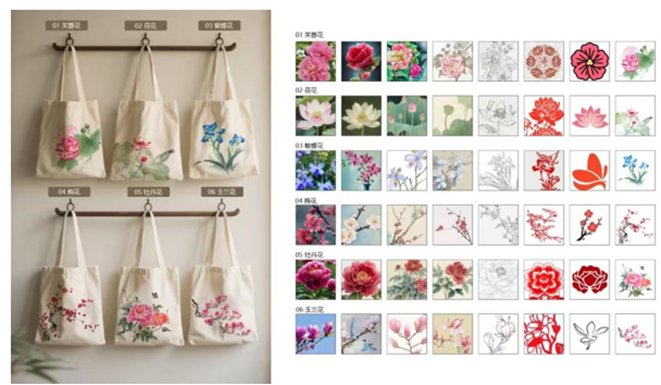
Figure 1
Innovative Design of
Suzhou Tourism Products: The ‘Flower
Series’ and Pattern Sources
Source: Illustrated by the Author
(15 June 2025)
Figure 2
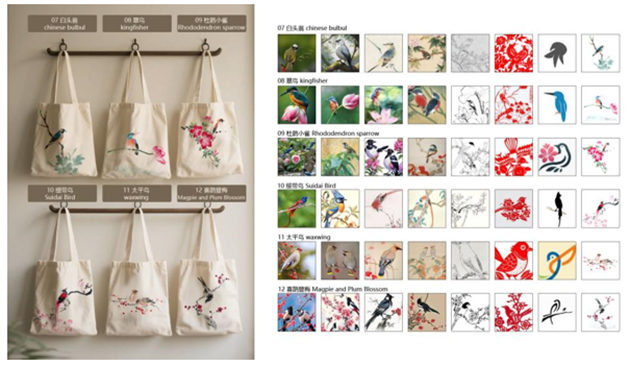
Figure 2
Innovative Design of Suzhou
Tourism Products, The ‘Bird Series’ and
the Source of the Patterns
Source: Illustrated By the Author (15
June 2025)
Figure 3
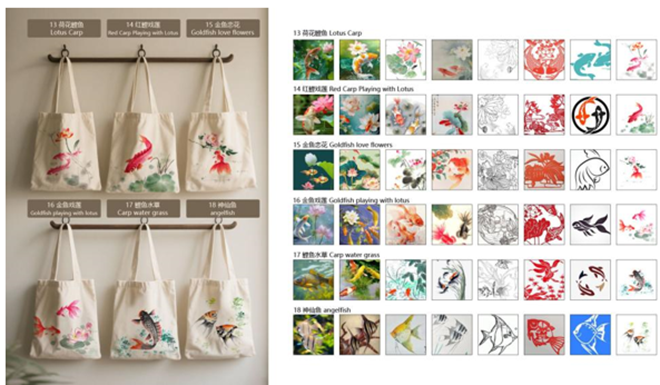
Figure 3
Innovative Design of Suzhou
Tourism Products, The ‘Fish Series’ and
the Source of the Patterns
Source: Illustrated by the Author
(15 June 2025)
Figure 4
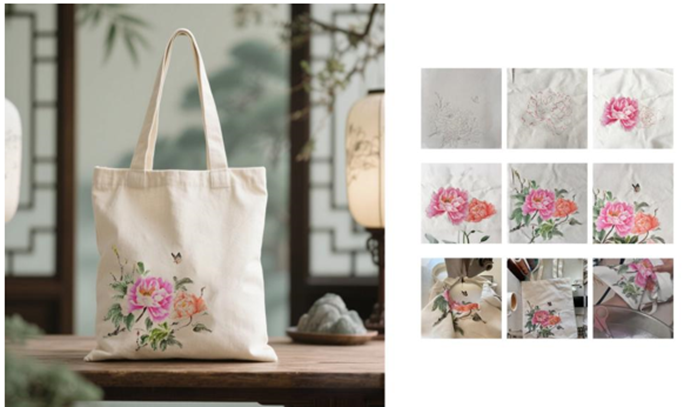
Figure 4 The Innovative Design of Suzhou Tourism Products: The Production Process of the ‘Flower Series’
Source: Illustrated by the Author
(15 June 2025)
Figure 5

Figure 5 The production process of the innovative design of Suzhou tourism products, the ‘Bird Series’
Source: Illustrated by the author
(15 June 2025)
Figure 6

Figure 6
The Innovative Design of Suzhou
Tourism Products: The Production
Process of the ‘Fish Series’
Source: Illustrated By the Author (15
June 2025)
6. Discussions
Firstly, market
research should be deepened to accurately identify the target consumer group
and design Suzhou embroidery products that align with public aesthetic
preferences and practical needs, such as home goods and fashion accessories
that incorporate modern lifestyles, for example, canvas bags, to expand the
market audience. Second, efforts should be made to strengthen the inheritance
and innovation of Suzhou embroidery techniques. This can be achieved by
establishing studios and offering video tutorials to cultivate a new generation
of inheritors. Additionally, designers should be encouraged to collaborate with
embroiderers to blend traditional craftsmanship with modern design concepts,
thereby developing more innovative products. Furthermore, the cultural essence
of Wu culture should be deeply explored, with elements such as water town
ecology and folk customs incorporated into the design of Suzhou embroidery
tourist souvenirs to enhance the cultural value of the products. Additionally,
emphasise the practicality and cost-effectiveness of products, such as
designing canvas bags featuring Suzhou embroidery, allowing tourists to
experience the charm of Suzhou embroidery in their daily lives. Finally,
strengthen cultural inheritance and promotion, utilise online media channels to
enhance the visibility and influence of Suzhou embroidery tourism souvenirs,
and drive their expansion into broader markets.
7. Conclusions and Recommendations
To promote the
living inheritance and innovative development of ‘Wu Culture,’ it is necessary
to establish a multi-dimensional practical system: First, deeply integrate the
design of Suzhou embroidery tourism souvenirs with the essence of Wu Culture.
By extracting cultural symbols such as Jiangnan gardens and water town ecology,
and combining Chinese painting composition with hand-pushed embroidery and
traditional hand-embroidery techniques, create cultural and creative products
such as fabric bags and calendars that blend practicality with artistic value,
meeting modern aesthetic demands; Second, establish a digital platform for
intangible cultural heritage protection, integrating Wu culture databases,
Suzhou embroidery technique demonstrations, and online interactive functions.
Utilise virtual reality technology to bring historical scenes to life and
enhance public engagement; Finally, with cultural heritage preservation as the
core, integrate tourism resources through a website to provide customised tourism
services and e-commerce channels for Suzhou embroidery products, forming a
virtuous cycle of ‘cultural experience consumption conversion economic
feedback,’ achieving a win-win situation for intangible cultural heritage
protection, cultural dissemination, and tourism economic development.
8. NEW KNOWLEDGE AND THE EFFECTS ON SOCIETY AND COMMUNITIES
On the cultural
front, Suzhou embroidery has moved from museum display cases into the daily
creative work of young people. Through initiatives such as ‘Garden Embroidery
Classes’ and ‘Ancient Patterns, Modern Interpretations’ workshops, traditional
techniques have become ‘tangible and accessible,’ sparking young people's
identification with Wu culture and fostering innovative transformations. For
example, the integration of the Taiping Bird pattern with street graffiti has
transformed intangible cultural heritage into a medium for youthful expression.
Economically, cultural and creative products like functional canvas bags and
embroidered watches leverage museum gift shops and intangible cultural heritage
markets to form an industrial chain, driving dual improvements in tourism
economy and craftsmanship value, and transforming ‘finger-tip craftsmanship’
into ‘finger-tip economy.’ At the community level, the ‘craftsman-youth
dialogue’ mechanism between resident designers and embroiderers, combined with
the ‘apprenticeship points system’ incentive framework, has reconfigured the
intergenerational inheritance network. Landmarks such as the Dongshan Town Plant Dyeing Workshop and Taihu
Lake Sketching Base have become cultural landmarks, driving the coordinated
development of surrounding industries. At the technological level, motion
capture databases and the development of natural mordant enzymes have addressed
challenges related to process standardisation and environmental sustainability,
providing a model for the modernisation of traditional industries. This model
not only safeguards Suzhou embroidery techniques but also ensures the continued
growth of this millennia-old intangible cultural heritage within contemporary
societal systems through educational restructuring, economic empowerment, and
community participation
CONFLICT OF INTERESTS
None.
ACKNOWLEDGMENTS
Researcher would like to express her sincere to the thesis advisor, Asst. Prof. Dr. Chanoknart Mayusoh for her invaluable help and constant encouragement throughout the course of this research. In addition, the researcher has to give thanks to all lecturers for their assistance: Asst. Prof. Dr. Akapong Inkuer and Asst. Prof. Dr. Pisit Puntien. At the same time, the researcher gratefully thanks to Miss Sasanant Rattanapornpisit, Mr. Chat Sukarin, Miss Vistha Chintaladdha, Miss Kanyanee Phangsua, etc. for their strong support.
Finally, the researcher would like to express her gratitude to Suan Sunandha Rajabhat University School of Fine and Applied Arts for their support in all aspects.
Researcher would like to thank all the information providers who were involved in providing information as knowledge that can be used in this research
REFERENCES
Chapman, J. (2012). Emotionally Durable Design: Objects, Experiences and Empathy. Routledge. https://doi.org/10.4324/9781849771092
Chen, L., and Yao, S. (2023). The Core Spirit of Wu Culture and its Historical Evolution. Studies in Jiangnan Culture, 15(3), 76–92.
Chen, X., and Wang, Y. (2018). Strategies for Inheriting Suzhou Intangible Cultural Heritage Through Modern Cultural Creativity. Economic and Trade Update, (9), 98–99.
Clarke, D. S. (2016). Principles of Semiotics. Routledge. https://doi.org/10.4324/9781315533773
Du, Y., and Yu, M. (2020). Expression of Suzhou Embroidery Techniques in Modern Jewelry Design. Light Industry and Technology, 49(3), 67–68.
Elmastas, M., Isildak, O., Turkekul, I., and Temur, N. (2007). Determination of Antioxidant Activity and Antioxidant Compounds in Wild Edible Mushroom. Journal of Food Composition and Analysis, 20(1), 337–345. https://doi.org/10.1016/j.jfca.2006.07.003
Howkins, J. (2002). The Creative Economy: How People Make Money from Ideas. Penguin UK.
Huang, X. (2024). Cultural Symbol Encoding in Tourism Souvenir Design. Journal of Cultural Heritage
Innovation, 10(2), 45–58.
Ji, G., and Bao, S. (2018). Research and Application of Suzhou Embroidery art in Modern Home Design. Art Education Research, (19), 60–61.
Langer, S. K. (2009). Philosophy in a New Key: A Study in the Symbolism of Reason, Rite, and Art. Harvard University Press.
National Statistical Office. (2019). Survey of Working Situation of Population 2019.
Pierce, J. R. (2012). An Introduction to Information Theory: Symbols, Signals and Noise. Courier Corporation.
Stoneman, (2010). Soft Innovation: Economics, Product Aesthetics, and the Creative Industries. Oxford University Press. https://doi.org/10.1093/acprof:oso/9780199572489.001.0001
Sun, (1982). Suzhou Embroidery. Light Industry Press.
Sunretphol, N. (2004). A Development
of Educational Indicators
for Lifelong Learning (Doctoral Dissertation, Srinakharinwirot University).
Wang, X. (2018). Design Innovation of Suzhou Embroidery
Cultural Creative Products. Modern Silk Science and Technology, 33(5), 26–27, 30.
Worakham, (2018). Time Series
Analysis for Economics and
Business (4th ed.). Chulalongkorn
University Printing House.
Wu, E. (2006). Introduction to Wu Culture. Southeast University Press.
Ye, J. (2005). Traditional
Craftsmanship and Cultural Regeneration: A Sociological Investigation of Suzhou Zhenhu
Embroiderers. Qunyan Press.
Zhao, Y. (2016). Semiotics Principles and Deduction. Nanjing University Press.
|
|
 This work is licensed under a: Creative Commons Attribution 4.0 International License
© ShodhKosh 2026. All Rights Reserved.