ShodhKosh: Journal of Visual and Performing ArtsISSN (Online): 2582-7472
|
|
PLURAL CONTINUITIES AND FEMININE VISUALITIES IN CONTEMPORARY INDIAN SCULPTURE: PRACTICES OF VANDANA SINGH AND SOJWAL SAMANT
Dr. Shree Kant 1
 ,
Dr. Ganesh Urala H.G. 2
,
Dr. Ganesh Urala H.G. 2
1 Institute
of Design, Nirma University, S. G. Highway, Ahmedabad–382481, Gujarat, India
2 Assistant
Professor, Manipal School of Architecture and Planning, Manipal Academy of
Higher Education, Manipal, Karnataka – 576104, India
|
|
|
ABSTRACT |
|
|
In Indian contemporary art, the concepts of diversity, tradition, and global dialogue are clearly reflected through various geographical and cultural art centers. This research paper explores the diversity and richness of Indian art through selected sculptural works by contemporary Indian women sculptors Vandana Singh (Varanasi) and Sojwal Samant (Vadodara). Emerging from the cultural and spiritual traditions of Varanasi, Vandana Singh’s sculptural practice articulates Indian classical sensibilities, human experiences, and inner emotional consciousness. Formal balance, rhythm, and cultural memory in her works strengthen the continuity of Indian art. In contrast, Sojwal Samant’s practice, associated with the contemporary art environment of Vadodara, engages with experimentation, conceptual approaches, and global contemporary art discourse. In her sculptural works, modernity and international influences are clearly visible at the levels of material, structure, and concept. This paper
analyzes that both artists’ practices reflect various and complementary
aspects of contemporary Indian sculpture. Continuity arises from feminine
perspectives, regional uniqueness, and material transition. In order to show that Indian contemporary art has
historical roots and is involved in the global discourse on art, the paper
situates women's sculptural practice within larger, international
discussions. The study present new perspectives on the various manifestations
of plural continuity as well as the viewpoint of women on modern Indian
sculpture. |
|||
|
Received 22 February 2026 Accepted 21 April 2026 Published 29 April 2026 Corresponding Author Dr. Shree
Kant, shreekant331@gmail.com DOI 10.29121/shodhkosh.v7.i5s.2026.7723 Funding: This research
received no specific grant from any funding agency in the public, commercial,
or not-for-profit sectors. Copyright: © 2026 The
Author(s). This work is licensed under a Creative Commons
Attribution 4.0 International License. With the
license CC-BY, authors retain the copyright, allowing anyone to download,
reuse, re-print, modify, distribute, and/or copy their contribution. The work
must be properly attributed to its author.
|
|||
|
Keywords: Contemporary Indian Sculpture, Feminine Visualities,
Women Sculptors, Regional Artistic Practices, Cultural Memory |
|||



1. INTRODUCTION
The increasing presence of women sculptors in India marks a critical shift within the discourse of contemporary art, contesting the historically established belief that sculpture is an exclusively male domain. For a long period, sculptural practice was aligned with male artists, while women were largely associated with painting or craft traditions, often characterized as more delicate or suitable for manual hand skill Nochlin (1988). In contrast, sculpture came to be perceived as a masculine practice due to its dependence on physical manual, heavy tools, and industrial materials an assumption reinforced through institutional structures and cultural representation Pollock (1988).
Artistic practices involving intensive physical engagement and robust tools were historically framed as inaccessible to women. This exclusion was further reinforced within religious and ritual sculpture, particularly in the production of icons and sacred forms, where ideas of purity, bodily restriction, and social regulation limited women’s participation Kramrisch (1981). Consequently, women’s engagement with sculpture remained peripheral within both traditional and modern art histories, frequently over looked from canonical narratives.
Despite these structural and social constraints, women artists continued to negotiate access to sculptural practice and gradually asserted their presence within the field. Their increasing visibility reflects broader transformations in social attitudes, institutional support, and artistic education. Across historical and contemporary contexts, several women sculptors challenged excluding convention and the development of sustained artistic practice that redefined both material practice and thematic engagement Mitter (2007). In contemporary India, women sculptors actively articulate personal experience, social realities, and experimental material strategies, thereby expanding the conceptual and formal vocabulary of sculpture.
Varanasi is widely regarded as a culturally layered city with a continuous artistic tradition. In contrast, Vadodara has emerged as a site of experimental pedagogy and conceptual inquiry. Despite operating within these distinct contexts, women sculptors across regions continue to confront doubt regarding technical competence due to sustained gender bias. Nevertheless, their sustained artistic practices have secured visibility within contemporary Indian art discourse.
From the late twentieth century onward, several women sculptors began to challenge established gender roles and assert independent artistic identities. Among them, Meera Mukherjee plays a pivotal role position for her engagement with indigenous metalworking traditions and socially grounded themes, which significantly influenced the development of contemporary Indian sculpture Kapur (2000).
In the twenty-first century, the number of women sculptors in India has expanded considerably due to enhanced to formal art education, institutional platforms, and shifting perceptions regarding women as professional artists. Artists such as Anjolie Ela Menon, Arpana Caur, and Kanak Sahu have contributed distinct visual languages and thematic concerns, enriching the diversity of contemporary Indian art Kapur (2014). Within this evolving landscape, the present study focuses on the sculptural practices of Vandana Singh and Sojwal Samant to examine how regional context, material engagement, and feminine visuality contribute to plural forms of continuity in contemporary Indian sculpture.
2. LITERATURE REVIEW
Indian art historical research has long engaged with questions of tradition, colonial encounter, and the emergence of modernism in the nationalist and post-independence periods. Pioneering thinkers such as Ananda K. Coomaraswamy and Stella Kramrisch interpreted Indian art through philosophical and symbolic frameworks, emphasizing its metaphysical and civilizational dimensions Coomaraswamy (1956), Kramrisch (1981). Their work established an intellectual foundation for understanding Indian artistic traditions within broader cultural and spiritual paradigms.
Subsequent historian, including Partha Mitter and Tapati Guha-Thakurta, redirected attention toward the institutional and political conditions under which Indian modernism developed. By examining the intersections of nationalism, colonial power, and artistic autonomy, they demonstrated that modern Indian art emerged through complex negotiations rather than linear imitation of Western models Mitter (2000), Guha-Thakurta (2004). This shift expanded art historical inquiry from stylistic analysis to questions of power, identity, and institutional formation.
Geeta Kapur further complicates the category of the “contemporary” by situating it within uneven postcolonial modernities. Her writings argue that contemporary Indian art must be read as a historically contingent field shaped by political tensions, social contradictions, and participation in global art circuits Kapur (2000), Kapur (2014). While these contributions provide a critical framework for understanding modern and contemporary art in India, sculptural practice particularly by women artists has received comparatively limited sustained attention within mainstream art historical discourse.
In parallel, developments in global contemporary art theory have redefined sculpture beyond object-based formalism. Concepts such as relational aesthetics, material and embodied perception foreground process, interaction, tactility, and temporality, repositioning sculpture as an experiential and discursive practice Bourriaud (2002), Bennett (2010). Feminist art history and material culture studies further extend this discourse by recognizing domestic work, care, and everyday material engagement as legitimate aesthetic and conceptual concerns Pollock (1988), Parker and Pollock (1981). These perspectives are particularly relevant for analyzing sculptural practices shaped by gendered experience.
Within the Indian context, the Faculty of Fine Arts in Vadodara has played a formative role in encouraging experimental and interdisciplinary approaches to sculpture. Its pedagogical emphasis on conceptual inquiry and material exploration has influenced generations of artists to move beyond conventional sculptural forms Khullar (2015). In contrast, Varanasi offers a historically layered environment where artistic production remains informed by ritual temporality, collective memory, and lived spiritual experience rather than explicit iconographic repetition.
Although these regional distinctions have been acknowledged in broader art historical discourse, sustained comparative analyses of sculptural practices across such contexts remain limited. In particular, few studies examine how regional specificity, gendered embodiment, and material practice intersect to produce plural forms of continuity within contemporary Indian sculpture. Addressing this gap, the present study situates the practices of Vandana Singh and Sojwal Samant within both national and global frameworks. This perspective on gender and artistic practice finds resonance in Prayag Shukla’s reflections on women artists within Indian art discussion.
According to Shukla (1996), “An artist, whether woman or man, should be seen with the same perspective without any discrimination. If we refer to this artist as an important woman sculptor or painter, it should be understood that she is not only a capable artist, but that as a woman, there is something distinctive in her art. There is certainly a strength and a feminine vision active in her work. She is both an artist and a homemaker.”
Artists should be evaluated on the basis of their talent and skill, regardless of their gender. Referring to an artist as a woman sculptor or painter should not diminish her abilities but rather acknowledge the unique perspective she may bring to her work. It is necessary to recognize the strength and feminine vision present in the art of women artists. She is not only an artist but also a homemaker, demonstrating that women are capable of balancing multiple roles while pursuing their passion.
3. RESEARCH OBJECTIVES AND QUESTIONS
3.1. OBJECTIVES
· To examine how diversity and continuity manifest in contemporary Indian sculpture.
· To analyze the influence of regional contexts on sculptural practice.
· To situate the works of Vandana Singh and Sojwal Samant within global contemporary art discourse.
3.2. RESEARCH QUESTIONS
· How do contemporary Indian sculptors negotiate continuity with tradition while engaging with modern and global concerns?
· In what ways do regional environments such as Varanasi and Vadodara shape sculptural language and material choices?
· How can regional specificity be understood as a form of participation in global contemporary art rather than cultural isolation?
4. METHODOLOGY
This research is based on a qualitative, interpretative methodology combining formal visual analysis, material analysis, contextual interpretation, and comparative study. Formal analysis focuses on form, texture, scale, spatial relationships, and surface treatment. Material analysis examines the significance of chosen media, processes, and techniques in shaping meaning.
Contextual interpretation situates the artworks within regional, cultural, and institutional frameworks, considering how local environments inform artistic practice. A comparative framework is used to identify both divergences and convergences between the two case studies. Primary sources include documented artworks, exhibition catalogue, and personal interview and artist statements, while secondary sources consist of scholarly texts on Indian contemporary art, material culture, feminist theory, and globalization.
5. CASE STUDY I: VANDANA SINGH (VARANASI)
The creative personality of an artist is fundamentally distinct from that of an ordinary individual. An artist’s perceptual framework is simultaneously critical, sensitive, and imaginative, enabling an engagement with the complecated relationships between form, emotion, and environment. Although artistic ideas emerge from deeply personal experiences, they remain intrinsically connected to nature, society, and cultural context. In this sense, an artwork may be understood as a dialogue between the artist and her surroundings one that becomes meaningful to viewers who approach it with awareness and sensitivity.
Born in 1969 in Sunderpur, Varanasi, Vandana Singh completed her Bachelor of Fine Arts (1987–1992) and Master of Fine Arts (1993–1995) from the Faculty of Visual Arts, Banaras Hindu University. She was trained under Shri M. K. Das and sculptor Balveer Singh Katt. Through sustained intellectual experimentation, participation in numerous art camps, and fellowships awarded by the Ministry of Human Resource Development, Singh has established a distinct position among contemporary Indian women sculptors. Her practice, often rooted in stone and wood, gives sculptural form to the dual attitudes of a male-dominated society toward women, shaped through her independent observation of social and environmental realities.
Vandana Singh’s artworks reflect the events that have occurred in her life. She comes from a middle-class family and is the youngest member of the family. She received support from everyone around her, which gave her ample opportunities to think, understand, and learn. From the moment of birth, a human being becomes connected to their surroundings. Home, family, nation, time, society, and nature all constitute elements of one’s environment.
Although she received considerable affection from her family and surroundings, she did not receive the kind of maternal affection that should ideally be present, as her mother was mentally unwell. As a result, she remained deprived of maternal love, which led to a sense of dissatisfaction in her life a void that could not be fulfilled. These unfulfilled emotions can be clearly observed in her artworks.
Over time, feelings of resentment also expanded, and other human frustrations gradually became part of her expressive language. In the initial phase, these emotions were often expressed in the form of poetry and later as drawings. These poems and images together form the essence of the inner and outer struggles of sculptor Vandana Singh’s life.
As a woman artist balancing artistic practice with familial responsibilities, Singh’s work reflects the lived challenges of women within male dominated social structures. Despite shifts toward gender equality, deeply ingrained beliefs regarding women’s inferiority continue to persist in Indian society an issue that forms a central concern in her sculptural practice. Human figures and faces frequently appear in her work, carefully detailed to express inner emotional states such as joy, anxiety, hostility, and conflict. For Singh, the human face becomes a site of psychological revelation, reflecting how individuals are shaped by social circumstances and lived experience.
Her academic training introduced her to a wide range of materials, including clay, plaster of Paris, cement, fiberglass, metal, wood, and Chunar sandstone. During her postgraduate studies, she focused on stone carving, a medium that allowed her to express delicate emotions through physical resistance and material hardness. Singh believes strongly in aligning subject matter with medium, striving to maintain a natural relationship between form, material, and meaning.
Singh’s sculptural works challenge traditional social norms by representing women’s life journeys in both positive and negative dimensions. In Mohbhang Figure 1, two human faces one turned inward and the other outward symbolize reality and disguise, revealing the middle-class tendency to conceal truth beneath social masks. The work reflects the distortions generated by social ideology and serves as a meditation on human conscience.
Figure 1
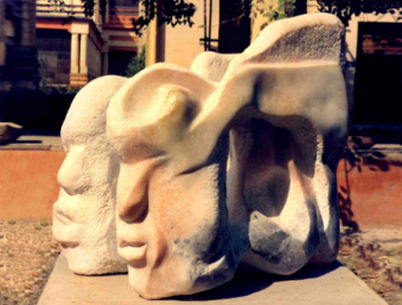
Figure 1 Singh, V. (1991). Mohbhang [Sculpture]. Pink Marble, 90 × 50 × 60 cm. Photograph Courtesy of the Artist.
In Judate sapne Figure 2, Hand carved in seasam wood, Human creations strive to connect with one another because human beings adapt themselves according to changes in nature. Through this adaptation, distances once again turn into closeness, though their form is transformed. In this artwork, slanted and distinct lines attempt to merge the forms with each other. The variations and fluctuations used within the composition encourage them to take different paths. This aspect of life is clearly reflected in the idea of connecting dreams.
Figure 2
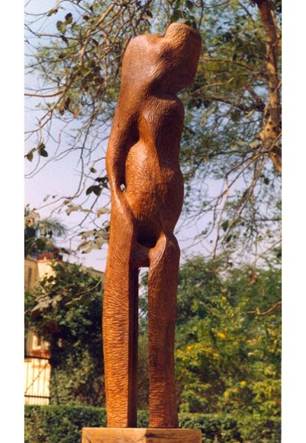
Figure 2 Singh, V. (1994). Judate Sapne [Sculpture]. Sesame Wood, 20 × 20 × 120 cm.
Photograph Courtesy of the Artist.
Figure 3
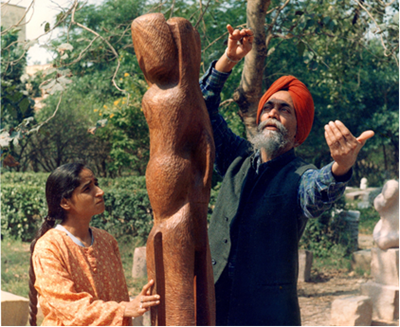
Figure 3 Sculptor Balbir Singh Katt Observing a Sculpture by Vandana Singh, 1994.
Similarly, Shadow Entangled in a Whirlpool Figure 3, executed in Chunar sandstone, embodies a state of psychological dilemma. The face appears to struggle against an complex dynamics, symbolizing human limitation within emotional and inner conflict. The contrast between rough texture and polished surface heightens the tension between vulnerability and endurance, reinforcing the sculptural articulation of internal conflict.
Figure 4
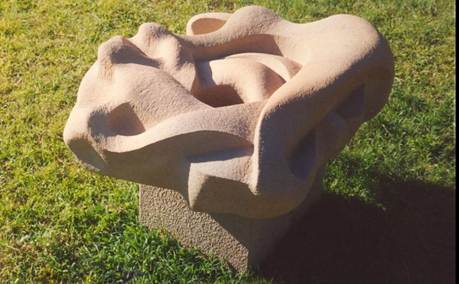
Figure 4 Singh, V. (1992). Whirlpool [Sculpture]. Chunar Sandstone, 83 × 75 × 26 cm. Photograph Courtesy of the Artist.
Singh’s engagement with paper mache further expands her symbolic language. By employing this ancient medium in relief and three-dimensional form, she addresses women’s struggles alongside broader political, social, and familial tensions. Interconnected lines and rough surfaces express universal emotions such as fear, love, and hatred, while also suggesting resilience and the persistence of possibility within uncertainty.
In Shrinking Relationships Figure 4, created during the COVID-19 pandemic, Singh responds to isolation, emotional distance, and the reduction of relationships to digital interactions. Linear forms visually articulate confinement and disconnection, while accompanying poetic elements evoke the anticipation of transformation. Similary, Flow Figure 5 presents movement against resistance, drawing parallels between human resilience and the river’s ability to navigate obstacles. Through this work, Singh affirms that art’s spirituality is inseparable from lived reality, and that creative expression remains a means of negotiating complexity, continuity, and transformation
Figure
5
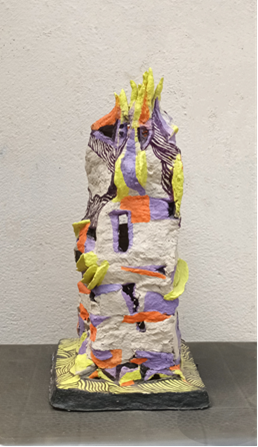
Figure 5 Singh, V.
(2022). Shrinking Relationships [Sculpture]. Paper Mache, 12 × 6 inches.
Photograph Courtesy of the Artist.
Figure 6
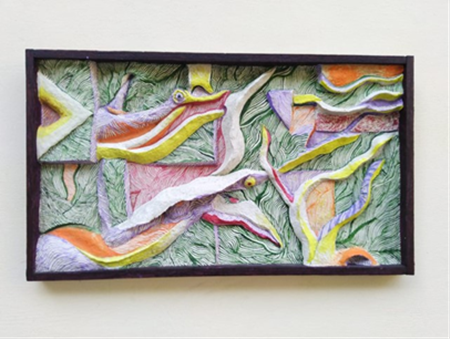
Figure 6 Singh, V. (2022). Flow [Relief sculpture]. Paper Mache, 24 × 12 Inches. Photograph courtesy of the Artist.
Ultimately, Vandana Singh’s sculptural practice demonstrates how contemporary Indian sculpture sustains continuity not through repetition of tradition, but through material transformation, emotional depth, and an enduring engagement with the realities of human experience.
6. CASE STUDY II: SOJWAL SAMANT (VADODARA)
Sojwal Samant was born in 1972 in Vadodara. She completed her Bachelor’s degree in Applied Arts from the Faculty of Fine Arts, Maharaja Sayajirao University (M.S.U.), in 1994, followed by a Diploma (1998) and Post-Diploma (2000) in Sculpture. She further expanded her artistic exposure through a three-month exchange program at the École des Beaux-Arts, Paris, during 1999–2000. Her academic training, combined with international experience, laid the foundation for a practice that is both conceptually rigorous and materially sensitive.
In the early phase of her career, Samant created humorous and playful sculptures by combining multiple media. Over time, however, her practice evolved toward subtlety and restraint, marked by an intense focus on a single material at a time. She attributes this shift largely to the experience of motherhood and the birth of her first child, which profoundly altered her perception of time, attention, and everyday life. This transformation redirected her artistic focus from overt visual wit to quiet, process-oriented exploration.
Samant’s sculptures draw inspiration from simple life, small details, and personal concerns elements she seeks to share with her viewers in the hope of forging emotional recognition rather than spectacle. Domestic labor and routine tasks often reappear within her sculptural vocabulary, where everyday gestures are re-enacted and elevated into material form. In this way, the domestic sphere becomes a site of artistic observation rather than limitation.
Her first solo exhibition was held in 2002 at Sakshi Gallery, Mumbai. Since then, she has participated in numerous national and international exhibitions, including Whose Touch This Is, I Think I Know at Gallery Threshold, New Delhi (2008–2009); Everything at Willem Baars Arts Project, Amsterdam (2008); Drawn from Life: Drawing Space at Green Cardamom, London (2008); and exhibitions at Gallery Espace, New Delhi; Sakshi Gallery, Mumbai; and India Habitat Centre, New Delhi. She has also exhibited in Jaipur and Bali, establishing a sustained presence within contemporary art circuits.
Sojwal Samant’s recent work, Whisper, exemplifies her emphasis on surface sensitivity, inviting viewers to observe minute undulations beyond line and color. Her close attention to detail developed during the four years she spent at home caring for her daughter Maya, a period that sharpened her awareness of fabrics, objects, and imperfections. This sensitivity is central to her current practice, in which paper pulp is layered over wire mesh to create a fabric-like material that retains sculptural form. Wrinkles and grooves generate a visual tension between surface and solidity.
Her use of paper pulp recalls Somnath Hore’s Wounds series, yet the conceptual orientation differs significantly. While Hore’s work was shaped by political commitment, Samant’s sculptures arise from the ordinary incidents of daily life. In Bile Figure 7, for example, she recreates the shape and texture of her dog’s vomit on a carpet, finding beauty in irregular organic forms that disrupt geometric order. Such works invite viewers into a slow, attentive mode of seeing that mirrors the artist’s own process.
Figure 7

Figure 7 Samant, S. (2007). Bile [Sculpture]. Paper Pulp and
wire, 19 × 36 Inches. Photograph Courtesy of the Artist.
In Undertow Figure 8, a sculptural sheet (relief work) appears as though a single thread has been pulled, suggesting potential unraveling. A wire element evokes a nerve emerging from a spine, By recalling a Mercator projection map, the flattened form underscores Samant’s engagement with surface markings, cartography, and spatial translation. Similarly, Unfolded Boundaries Figure 9 incorporates origami fold marks, with tonal variations suggesting land and sea. Her wooden works, featuring coiled rings, engage with temporality and growth, as if subtly altering the biography of the material itself.
Figure 8
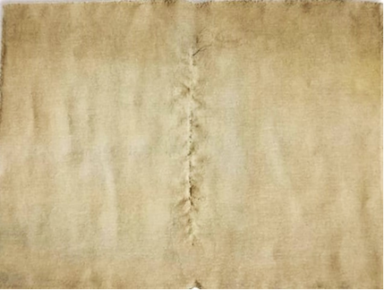
Figure 8 Samant,
S. (2007). Undertow [Sculpture]. Paper Pulp, 24 × 32.5 inches. Photograph Courtesy
of the Artist.
Figure 9
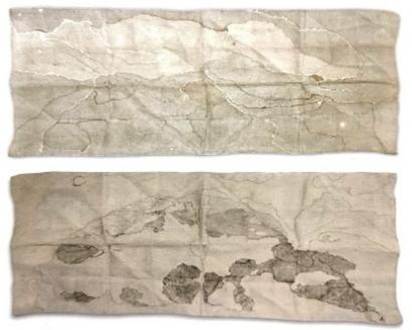
Figure 9 Samant, S. (2007). Unfolded Boundaries [Sculpture].
Paper pulp and wire, 35 × 71 inches. Photograph courtesy of the artist.
Her exhibition Two Feet Above Ground Figure 10 further expanded this inquiry through sculptures, installations, photographs, and video. Works such as Colbalish Figure 11 a vivid pink sofa inspired by the Bengali term for “body pillow”—and a two-foot-high wooden sculpture referencing historical footwear offered viewers a literal and metaphorical shift in perspective.
Figure 10
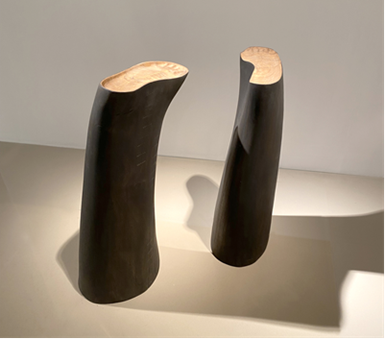
Figure 10 Samant, S. (2021). Two Feet Above Ground [Sculpture]. Wood, Graphite, and Oil Paint, 24 × 6.5 × 9 Inches and 24 × 6.5 × 7 inches. Photograph Courtesy of the Artist.
Figure 11

Figure 11 Samant, S. (2021). Colbalish [Sculpture]. Cushioning Foam, Silk Fabric, Wood, and Imitation Gold Leaf, 50 × 31 × 30 Inches. Photograph Courtesy of the Artist.
Samant’s practice is marked by imagination, sensitivity, and playful reflection. Whether through self-portrait photographs, sculptural body fragments, or poetic gestures such as Cloud Hunt Figure 12, her work affirms the subjective nature of perception and the quiet power of lived experience. Ultimately, Sojwal Samant’s sculptural practice demonstrates how contemporary art can emerge from subtle observation, material intimacy, and sustained reflection, transforming the ordinary into a space of meaning and renewal.
Figure 12

Figure 12 Samant, S. (2021). Cloud
Hunt [Print]. Archival ink on Hahnemühle Paper, 24 ×
9 Inches. Photograph Courtesy of the Artist.
7. FINDINGS AND DISCUSSION: DIVERSITY, CONTINUITY, AND GLOBAL DIALOGUE
This study finds that continuity in contemporary Indian sculpture should not be understood as the static preservation of tradition. Instead, it can be understood as ongoing process of reinterpretation and change. As Geeta Kapur suggests, contemporary Indian art develops through a continuous dialogue between historical memory and present realities Kapur (2000). The sculptural practices of Vandana Singh and Sojwal Samant clearly reflect this process, though in different ways.
In the work of Vandana Singh, continuity emerges through cultural memory and a sense of ritual time. While her sculptures are deeply influenced by the cultural atmosphere of Varanasi, they do not rely on direct religious symbols or traditional imagery. Rather, tradition appears through subtle elements such as rhythm, surface texture, and spatial tension. Her work carries an emotional and sensory connection to the past rather than a literal one. This approach supports Partha Mitter’s idea of “plural modernities,” where modern Indian art evolves through multiple engagements with indigenous histories instead of following a single Western model Mitter (2007)
By contrast, Sojwal Samant’s sculptural practice reveals continuity through material processes and lived, bodily experience. Her work engages with global contemporary art ideas, especially minimalist and process-based practices, yet remains closely tied to everyday domestic life. Materials, repetition, and careful surface treatment become central to her visual language. Feminist art history helps frame this approach, as scholars such as Griselda Pollock and Linda Nochlin have emphasized the importance of care, domestic worker, and everyday experience in women’s artistic practices. Samant transforms these ordinary gestures into meaningful sculptural forms, giving them artistic and conceptual value.
Together, these findings show that diversity in contemporary Indian sculpture does not lead to fragmentation. Instead, it reflects regional difference and conceptual richness. Engagement with global art discourse does not weaken regional identity; rather, it allows artists to generate new meanings through dialogue and reinterpretation. Continuity and diversity, therefore, function as interconnected forces that sustain the creative energy of contemporary Indian sculpture.
8. CONCULSION
This research examines contemporary Indian sculpture through a comparative study of the sculptural practices of Vandana Singh and Sojwal Samant, with a focus on diversity, continuity, and global dialogue. Working within different regional contexts,Varanasi and Vadodara their practices show that contemporary Indian sculpture cannot be understood through a single style or fixed ideology. Instead, it should be seen as a plural and evolving field shaped by cultural memory, material exploration, lived experience, and ongoing engagement with global artistic ideas.
The study highlights that continuity in Indian sculpture does not function as the rigid preservation of tradition. Rather, it can be understood as a process of reinterpretation and transformation. Vandana Singh’s work demonstrates how cultural memory and ritual time can be expressed through contemporary sculptural language without relying on direct symbolism. Her practice sustains tradition through material, sensory, and emotional engagement, allowing continuity to emerge through experience rather than repetition. In contrast, Sojwal Samant’s work emphasizes process, material sensitivity, and subtle intervention. While her practice engages with global contemporary art discourse, it remains closely connected to domestic life and embodied worker.
Through this comparative approach, the research shows that diversity in contemporary Indian sculpture does not imply fragmentation. Instead, it reflects regional specificity and conceptual richness. Both artists demonstrate that engaging with global art practices does not weaken regional identity rather, it enables new meanings to develop through dialogue between local experience and global aesthetics.
By focusing on women sculptors, this study also contributes to feminist art historical discussions by questioning long-standing patriarchal assumptions within sculpture and art history. The practices of Vandana Singh and Sojwal Samant reveal how gendered experience influences material choices and artistic thinking. Ultimately, this research argues that the strength of contemporary Indian sculpture lies in the dynamic balance between continuity and change, tradition and experimentation, and regional context and global dialogue. Recognizing this balance is essential for understanding the position of Indian sculpture within contemporary international art discourse while remaining attentive to its cultural and historical roots.
Author Contributions
Dr. Shree Kant (Corresponding Author) led the research as the principal investigator. He conceptualized the study, designed the research framework, conducted visual and contextual analysis, and developed the core arguments. He also prepared the original manuscript and structured the discussion.
Dr. Ganesh Urala H.G. contributed through literature review, theoretical development, and critical revisions. He assisted in refining arguments and improving the manuscript’s clarity and academic rigor.
Both authors have reviewed and approved the final manuscript.
Transparency Statement
The authors declare that the research was conducted independently, without any external funding or conflict of interest. All sources have been properly acknowledged, and the study adheres to academic integrity and ethical standards.
CONFLICT OF INTERESTS
None.
ACKNOWLEDGMENTS
The author gratefully acknowledges the generous support and cooperation of sculptors Vandana Singh and Sojwal Samant, whose insights, time, and willingness to share their artistic processes greatly enriched the research. Their personal interactions, discussions, and explanations of their works provided invaluable perspectives that significantly contributed to the depth and clarity of this study. The author is sincerely thankful for their openness and encouragement throughout the research process.
REFERENCES
Bennett, J. (2010). Vibrant Matter: A Political Ecology of Things. Duke University Press. https://doi.org/10.1215/9780822391623
Bourriaud, N. (2002). Relational
Aesthetics. Les Presses du Réel.
Coomaraswamy, A. K. (1956). The Transformation of Nature in Art. Harvard University Press.
Guha-Thakurta, T. (2004). Monuments, Objects, Histories: Institutions of Art in Colonial and Postcolonial India. Columbia University Press. https://doi.org/10.7312/guha12998
Kapur, G. (2000). When Was Modernism: Essays on Contemporary Cultural
Practice in India. Tulika Books.
Kapur, G. (2014). In the Cause of Art: Texts 1986–2011. Tulika Books.
Khullar, S. (2015). Worldly Affiliations: Artistic Practice, National Identity, and Modernism in India, 1930–1990. University of California Press. https://doi.org/10.1525/9780520356054
Kramrisch, S. (1981). The Presence of Śiva. Princeton University Press. https://doi.org/10.1515/9780691224220
Mitter, P. (2007). The Triumph of Modernism: India’s Artists and the Avant-Garde, 1922–1947. Reaktion Books.
Nochlin, L. (1988). Women, Art, and Power and Other Essays. Harper and Row. https://doi.org/10.2307/431021
Parker, R., and Pollock, G.
(1981). Old Mistresses: Women, Art and Ideology.
Routledge.
Pollock, G. (1988). Vision and Difference: Feminism, Femininity
and the Histories of Art. Routledge.
Shukla, P. (1996). Rupankar [Exhibition catalogue]. Bharat
Bhavan.
V. Singh, personal communication, March 8, 2023.
S. Samant, personal communication, April 10, 2024.
Artville Academy. (2019, March 29). Artist of the day – Sojwal Samant.
Green Cardamom. (n.d.). Drawing process [PDF].
India Art Fair. (n.d.). 2 feet above: Sojwal Samant.
MutualArt. (n.d.). Sojwal Samant.
StoryLTD. (n.d.). Sojwal Samant – Untitled. https://www.storyltd.com
Gallery Espace. (n.d.). Sojwal Samant. https://www.galleryespace.com
|
|
 This work is licensed under a: Creative Commons Attribution 4.0 International License
© ShodhKosh 2026. All Rights Reserved.