ShodhKosh: Journal of Visual and Performing ArtsISSN (Online): 2582-7472
|
|
The Invisible Palette: A Strategic Composition of Financial Alchemy and Human Resource Management in the Visual and Performing Arts
Dr. C. S. Jyoti Arora 1
 ,
Dr. V. Priyadharshini 2
,
Dr. V. Priyadharshini 2
 , Dr.
Praveen Kumar 3
, Dr.
Praveen Kumar 3
 ,
Dr. Jaspreet Kaur 4
,
Dr. Jaspreet Kaur 4 ,
Dr. Daljeet Kaur 5
,
Dr. Daljeet Kaur 5 ,
Rupinder Kaur 6
,
Rupinder Kaur 6
1 Associate
Professor, School of Management Studies, CGC University, Mohali, Punjab, India
2 Associate
Professor, Saveetha School of Management, Saveetha Institute of Medical and
Technical Sciences, Saveetha University, Chennai, Tamil Nadu, India
3 Assistant Professor, School of Hotel and Tourism Management, VIT
University, Vellore, India
4 Associate Professor, University school of Business, Chandigarh
University, Mohali-140413, Punjab, India
5 Assistant Professor, Department of Management, University of Niagara
Falls, Canada, India
6 Research Scholar, Department of Commerce, Desh Bhagat University,
Mandi Gobindgarh, India
|
|
|
ABSTRACT |
|
|
This
theoretical treatise examines strategic merging of financial alchemy and
human resource management (HRM) in the visual and performing arts industry in
terms of the so-called invisible palette. The paper is based on the knowledge
of cultural economics, the creative industries, and the HRM literature, which
defines the role of financial innovation and creative human capital in
contributing to sustainability, innovation, and the creation of
multidimensional values. The article uses a qualitative and conceptual
approach to research, which relies on a systematic review and a thematic
synthesis of the literature. It suggests a model in which financial alchemy
facilitates resource mobilization, HRM increases creative capabilities, and
digital transformation becomes an intervening variable increasing their
interaction. The research also formulates major propositions that focus on
the interdependence of financial and human resources towards organizational
success. This study will add to the body of theory and provide hands-on
information to arts managers and policymakers who need to traverse the
challenges of the changing creative economy by incorporating fragmented views. |
|||
|
Received 16 February 2026 Accepted 04 April 2026 Published 11 April 2026 Corresponding Author Dr Praveen Kumar, Praveen.spl143@gmail.com DOI 10.29121/shodhkosh.v7.i4s.2026.7523 Funding: This research
received no specific grant from any funding agency in the public, commercial,
or not-for-profit sectors. Copyright: © 2026 The
Author(s). This work is licensed under a Creative Commons
Attribution 4.0 International License. With the
license CC-BY, authors retain the copyright, allowing anyone to download,
reuse, re-print, modify, distribute, and/or copy their contribution. The work
must be properly attributed to its author.
|
|||
|
Keywords: Financial Alchemy, Human Resource Management,
Creative Industries, Digital Transformation, Value Creation |
|||



1. INTRODUCTION
1.1. Nature of the Visual and Performing Arts Sector
The visual and performing arts industry is a multifaceted and evolving industry in which creativity, cultural expression, and financial reality meet. The sector is characterized by intangible output, symbolic value and experience of the audience as opposed to the conventional industries; as a result, the operational and strategic structures of the sector are intrinsically different. Production and distribution of artistic work is entrenched in uncertainty, subjective valuation and changing demand trends which are disruptive to conventional managerial practices Menger (2021), Throsby (2014). Furthermore, the industry exists in interwoven networks of artists, institutions and audiences, which supports their reliance on cooperation and cultural ecosystems.
1.2. Financial Alchemy in the Arts Ecosystem
Financial management in the arts is not just about traditional budgeting and revenue collection, but it is what can be called as financial alchemy; the careful transformation of scarce and unpredictable resources into long-term artistic and economic value. Arts institutions tend to use hybrid funding models, such as governmental assistance and individual grants, and new initiatives, such as crowdfunding Demattos-Guimarães et al. (2024), Guimarães et al. (2025). Moreover, the financial sustainability is affected by the larger economic forces and the policy frameworks, which occur during the financial crisis and the digital transition Bonet and Donato (2011), Rossitti et al. (2021). Such complications require new financial approaches that combine artistic ambitions and economic feasibility.
1.3. Human Resource Management in Creative Industries
The visual and performing arts human resource management (HRM) is also a unique aspect, as it is influenced by the need to rely on creative talent, the work organization of projects, and intrinsic motivation. Freelance work, gig jobs, and portfolio careers tend to define the workforce that brings in issues of job security, equity, and productivity Hesmondhalgh and Baker (2013), Cunningham (2014). HRM practices such as talent development, performance management, and analytics are important in improving organizational results and maintaining creative excellence Jiang et al. (2012), Kulkarni et al. (2024). Moreover, the changing technological environment and algorithmized systems of management are transforming human capital management in the creative economy Duggan et al. (2019), Vrontis et al. (2021).
1.4. Digital Transformation and Strategic Integration
The high rate of modernization of digital technology has been a major contributor to the redrawing of the financial and human resource aspects of the arts sector. Digital platforms have increased access to worldwide audiences, allowed new monetization approaches, like streaming and virtual performances, and have allowed new sources of funding Towse (2020), Bonet (2024). At the same time, digital technologies have changed the workforce management and allowed collaboration remotely, basing decisions on data, and creating new creative production Sandriester et al. (2025). These changes were further intensified by the COVID-19 pandemic, and focused on promoting resilience and flexibility in both financial and HR strategies Banks and O'Connor (2021).
1.5. Need for an Integrated Strategic Perspective
Although the literature on cultural economics and creative labor is growing, there is little literature on the interface of financial management and human resource practices. The current literature is inclined to consider these areas separately, neglecting their interdependence in the determination of the performance and sustainability of the organization. This integration is emphasized in the concept of the invisible palette, which is the combination of financial resources and human capabilities, which synergize to create value in the arts industry. The paper will strive to create a conceptual model that would summarize this strategic formulation and provide an understanding of how financial alchemy and HRM can be synchronized to lead to innovation, resilience, and sustainability.
2. Literature Review
2.1. Financial Dynamics in the Visual and Performing Arts
The economic environment of visual and performing arts industry is not only unpredictable but also has hybrid fund models and value pluralism. In contrast to conventional industries, artistic productions not only create economic but also symbolic value but demand a more comprehensive conceptualization of financial sustainability Throsby (2014), Klamer (2016). The financial environment in which cultural organizations have to work is often a tight one, including both the public funding, personal sponsorship, and the revenue they make Bonet and Donato (2011). The world economic crisis and the ensuing economic changes have also highlighted the weaknesses of the conventional funding structure and require creative financial approaches.
According to recent research, new financing methods are coming up like the crowdfunding, which democratizes capital access and promotes community involvement Demattos-Guimarães et al. (2024), Guimarães et al., 2025; Rykkja and Bonet (2024). Moreover, sustainability of cultural projects is becoming more conditional on the integrated financial planning methods balancing between economic sustainability and preservation of the heritage and the formation of social values Rossitti et al. (2021). Such changing financial trends are indicative of a transition towards what can be theorized as the field of financial alchemy in which scarce resources are being used to intelligently exploit them to produce the greatest artistic and economic results possible.
2.2. Human Resource Management in Creative Industries
Human resource management (HRM) in the creative industries is a complicated issue by its nature because the industry depends on highly skilled, intrinsically motivated and precarious workers. Creative work is often structured to take short-term projects, freelance work, and portfolio work, which disrupt traditional HRM Hesmondhalgh and Baker (2013), Cunningham (2014). These forms of employment lead to systemic inequalities and job insecurity especially among the emerging artists and marginalized populations Eikhof and Warhurst (2013).
Meanwhile, HRM practices are significant in the process of improving the organizational performance and innovation. Having effective HR systems, according to meta-analytic evidence, plays an important role in the productivity, creativity, and overall organizational performance of employees Jiang et al. (2012). In relation to the arts, talent management, skill development and collaborative networks are vital in maintaining creative excellence (Comunian et al., 2015). The current trends include talent analytics and digital HR solutions, which are gradually changing the way the workforce is managed in the performing arts industry, allowing to make data-driven decisions and better utilize talent Kulkarni et al. (2024), Vrontis et al. (2021).
2.3. Entrepreneurship and Value Creation in the Arts
Entrepreneurship has become a very important aspect in the art and cultural industry, which fills the gap between creativity and economic sustainability. Business-oriented strategies are becoming necessary to artistic entrepreneurs, whereas preserving the aesthetic value of art is needed Essig (2015), Hausmann and Heinze (2016). This two-fold orientation requires strategic capabilities that would combine financial management and the creative processes.
Value creation is not only a financial measure in the arts but also a cultural, social and experience aspect Velthuis (2008). Innovative approaches, collaboration, and revenue diversification tend to be included in growth strategies in creative industries Sigurðardóttir and Candi (2019). Moreover, cultural industries clustering and the emergence of creative cities have been cited as some of the main factors of economic and cultural growth, which promote the knowledge exchange and value creation through networks Lorenzen and Frederiksen (2007), Pratt (2010), Scott (2014). These forces underpin the necessity of combined strategic planning to align the entrepreneurial practices with financial and human resource practices.
2.4. Digital Transformation and Its Implications
The visual and performing arts industry is a major industry that has been transformed by digital transformation, impacting its financial model as well as workforce management. The emergence of digital platforms has facilitated the distribution of content, engagement with an audience, and the generation of revenue, especially in such aspects as streaming and virtual shows Towse (2020). Digitalization has also increased the availability of cultural heritage and access to the availability of arts universally Bonet (2024).
Regarding the HR perspective, digital technologies have brought new forms of work organization, such as remote collaboration and algorithmic management Duggan et al. (2019). These changes have connotations in regard to autonomy of employees, job design and performance review. Besides, the digital transformation demands the emergence of new capabilities and leadership skills to cope with technological change and complexity in the organization Schiuma et al. (2024), Sandriester et al. (2025).
COVID-19 served as a catalyst to the adoption of digital in the arts, with the idea of resilience and flexibility in financial and human resource strategies becoming a reality Banks and O'Connor (2021). This leads to the fact that the digital transformation ceases to be a choice, but a strategy of remaining competitive in the creative economy.
2.5. Integration of Financial and Human Resource Strategies
Although there is a lot of research on financial management and HRM as independent entities, there are less studies regarding the overlap of the two in the arts sector. These fields should be intertwined to achieve the sustainable organizational performance because financial sources have a direct impact on the workforce potential and the other way around. As an example, the development of human capital can be more creative and innovative to increase financial performance Jiang et al. (2012).
The cultural and creative ecosystems concept also reinforces the interdependence of the flow of both financial and human resources in which networks, institutions and stakeholders as a whole come together to create value Comunian (2011). Moreover, the mission-oriented innovation policies emphasise the importance of strategic correspondence between resources and capabilities in long-term impact Kattel and Mazzucato (2018).
Regardless of these revelations, there is no detailed frameworks that conceptualize the synergistic association between financial alchemy and HRM in the visual and performing arts. Such a gap highlights the necessity of a holistic approach, which is the goal of this study in the form of the so-called invisible palette.
3. Research Gap
The literature in visual and performing arts has covered widely financial sustainability, cultural economics, and human resource dynamics as distinct areas, but the strategy of integrating them has not been well explored. Previous research has concentrated on hybrid funding models, financial resilience, and new mechanisms like crowdfunding to deal with economic uncertainty in the arts Bonet and Donato (2011), Demattos-Guimarães et al. (2024), Guimarães et al. (2025), and parallel lines of research have been found to examine the nature of creative labour, primarily focusing on project Also, the literature on digital transformation emphasizes the changes in the financial models and workforce management, such as platform-based revenues and algorithmic management systems Towse (2020), Duggan et al. (2019), Bonet (2024). Such studies are however quite fragmented and do not attempt to conceptualize the interaction of financial strategies and human resource capabilities in an interactive synergistic manner to create sustainable value in the arts sector. Moreover, little focus has been on the creation of an integrated theoretical framework that takes into account this interdependence in the specific context of creative industries where symbolic value, uncertainty, and human creativity are the focal points Menger (2021), Klamer (2016). Thus a considerable gap in research is identified in the joint strategic role of financial alchemy and human resource management and the need to integrate the conceptualisation is holistic as suggested in this research as the concept of the invisible palette.
4. Theoretical Framework
The current research will be based on an integrative theoretical approach that involves the Resource-Based View (RBV), Human Capital Theory, and Cultural Economics to discuss the strategic interdependence between financial alchemy and human resource management in the visual and performing arts. RBV assumes that the sustainable competitive advantage of organizations is the successful use of valuable, rare, and inimitable resources, especially the intangible ones, such as creativity, talent, and organizational capabilities, which are key in the arts sector Kattel and Mazzucato (2018), Scott (2014). In line with this, Human Capital Theory provides the essence of creativity workers and the skills, knowledge, and competencies as essential drivers of innovation and performance, which underscores the critical role of strategic HRM practices in terms of improving productivity and organizational results Jiang et al. (2012), Kulkarni et al. (2024). Cultural Economics In the light of Cultural Economics, the value creation in the arts is not only quantifiable by financial measures but also by symbolic, social, and experience levels, and the process of resource allocation and sustainability needs to be viewed more broadly Throsby (2014), Klamer (2016). Moreover, the uncertainty and project-based character of creative labor Menger (2021), Hesmondhalgh and Baker (2013) require a form of adaptive financial planning, in this case, financial alchemy, which should fit the dynamic human resource structure. This integration is further supported by the growing strength of the digital transformation due to changes in financial models and workforce management practices in the cultural sector as the technological advances transform the practices Towse (2020), Duggan et al. (2019), Bonet (2024). Together, these theoretical lenses are a holistic basis upon which strategic alignment of financial resources and human capital constitutes an invisible palette, which can sustain value creation and competitive advantage in visual and performing arts ecosystem.
5. Problem Statement and Objectives
The visual and performing arts sector is subjected to the circumstances of financial insecurity, disjointed financial systems and a highly dynamic labor force, and the strategic alignment of financial management and human resource practices is poorly researched in the current literature. Although the previous literature has analyzed the concept of financial sustainability in the context of hybrid funding models and emerging systems such as crowdfunding Bonet and Donato (2011), Demattos-Guimarães et al. (2024), Guimarães et al. (2025) and has considered separately the challenges of organizing creative work with project-based employment and skill intensity (Hes Moreover, the accelerated intensity of digital transformation and the changing workforce patterns have increased the necessity of having a combination of strategic approaches that can synchronize the financial innovation with the human capital development Towse (2020), Kulkarni et al. (2024), Vrontis et al. (2021). Against this background, the current research has the following objectives: (i) to research the interdependence of financial alchemy and human resource management in the visual and performing arts, (ii) to determine the main strategic factors that contribute to sustainable value creation, and (iii) to create a conceptual framework that will explain how integration of financial and human resource strategies can promote organizational effectiveness and resilience within the cultural and creative ecosystem.
6. Research Methodology
This research follows a qualitative and conceptual research design to come up with a framework of how financial alchemy and human resource management (HRM) can be integrated into the visual and performing arts sector. The synthesis of fragmented knowledge in interdisciplinary areas and further theoretical development is best done with conceptual research Rentschler and Liu (2023). The research is premised on the systematic review of the literature on cultural economics, creative industries, and HRM to determine the main constructs including financial sustainability, creative labor relations, and value creation Throsby (2014), Towse (2020), Flew (2012), Hesmondhalgh and Baker (2013).
In order to include modern changes, the recent research on digital transformation, crowdfunding, and talent analytics are also analyzed, where emerging financial models and workforce practices in the arts industry are outlined Bonet (2024), Demattos-Guimarães et al. (2024), Kulkarni et al. (2024), Duggan et al. (2019). The thematic analysis and critical synthesis method is applied to find the connections between financial strategies and human capital because this field has not been studied extensively in the literature. On this synthesis, the paper suggests a conceptual framework, the so-called invisible palette, which is used to represent the interaction between financial assets and human capacity to spur sustainability and innovation. The propositions are also developed with the help of the methodology, which will serve as the basis of the further empirical research.
7. Conceptual Framework: The Invisible Palette
The conceptual framework proposed is called The Invisible Palette and is a synergistic interaction between financial alchemy and human resource management (HRM) in promoting sustainability, innovation and value creation in the visual and performing art industry. The model incorporates cultural economics, creative labor and strategic management literature.
7.1. Financial Alchemy as a Strategic Resource
Financial alchemy is the creative re-invention of scarce and unpredictable financial assets into sustainable creative and organizational productivity. Financial management in the arts industry goes beyond the conventional budgeting approach and incorporates hybrid funding strategies like the public subsidy, the private sponsorship, and the crowdfunding Bonet and Donato (2011), Demattos-Guimarães et al. (2024), Guimarães et al. (2025).
The riskiness surrounding artistic production compels adaptable and dynamic approaches to finances Menger (2021). Also, the creation of cultural values has the economic and non-economic components, and the financial performance should be viewed in a wider context Throsby (2014), Klamer (2016). Online resources also increase financial alchemy through the opportunities of new revenue sources, including streaming and online performances Towse (2020), Bonet (2024).Thus, financial alchemy acts as a foundational input that enables resource mobilization, risk management, and long-term sustainability.
7.2. Human Resource Management as Creative Capital
HRM in arts sector is about handling creative talent, which is dynamically oriented, a project based, and intrinsically motivated. Creative employees tend to work in the gig-based and freelance economy and need flexible HR practices Hesmondhalgh and Baker (2013), Cunningham (2014).
HRM can improve productivity, creativity, and organizational performance by developing talent, collaborating, and sharing knowledge Jiang et al. (2012), Comunian et al. (2015). New measurement tools of talent analytics and digital HR systems reinforce the management of the workforce and decision-making even more Kulkarni et al. (2024), Vrontis et al. (2021).
The concept of human capital in arts has thus been conceptualized as creative capital, which is a critical intangible asset that is used to spur innovation and artistic excellence.
7.3. Digital Transformation as an Enabling Moderator
The moderating variable is the digital transformation which increases financial and HR capabilities. It facilitates novel financial frameworks, such as digital distribution and crowdfunding, and also alters workforce administration with the assistance of remote cooperation and algorithmic frameworks Duggan et al. (2019), Towse (2020).
In addition, digitalization increases the reach of the audience and enhances cultural accessibility, reinforcing not only revenue generation but also the use of talent Bonet (2024), Sandriester et al. (2025). The COVID-19 pandemic also emphasized the significance of digital flexibility in resiliency Banks and O'Connor (2021).
Therefore, the process of digital transformation becomes a driving force that enhances the bond between financial and human resource aspects.
7.4. Interaction Between Financial Alchemy and HRM
The main part of the framework is the interdependence of financial resources and human capital. Investment in talent development, training, and innovation leads to an increase in creative output, and talented human resources increases financial performance by innovating and being efficient Jiang et al. (2012).
This interaction is also strengthened by creative ecosystems, through which networks, institutions, and stakeholders play a role in creating values together Comunian (2011). Financial and HR practices are to be aligned strategically to gain sustainable competitive advantage Kattel and Mazzucato (2018).
This interaction is the metaphor of the blending of colors in the invisible palette where none of the elements works effectively as a standalone.
7.5. Outcomes: Sustainability, Innovation, and Value Creation
Financial alchemy and HRM integration have several outcomes on the organization:
· Sustainability: It is ensured with diversified funding and optimal use of resources Rossitti et al. (2021).
· Innovation: Innovation is instigated by innovative skill and enabling financial frameworks Sigurðardóttir and Candi (2019).
· Value Creation: This is inclusive of economic, cultural, and social value Velthuis (2008), Throsby (2014)
These results lead to the success and sustainability of organizations in the arts sector in the long term.
Figure 1
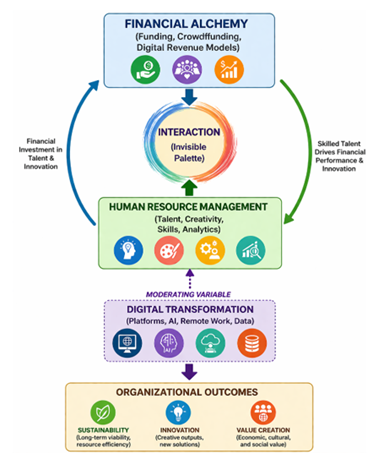
Figure 1 Conceptual Framework Diagram
8. Propositions
|
Proposition |
Relationship |
Detailed Statement |
Expected Outcome |
|
P1 |
Financial Alchemy →
Sustainability |
The adoption of innovative
financial strategies such as diversified funding sources, crowdfunding, and
digital revenue models enhances the long-term financial sustainability of
visual and performing arts organizations. |
Improved financial stability
and reduced dependency on single funding sources |
|
P2 |
Financial Alchemy →
HRM Practices |
Effective financial resource
allocation enables better human resource practices, including talent
acquisition, training, performance management, and retention in creative
organizations. |
Strengthened workforce
quality and improved talent management |
|
P3 |
HRM → Organizational
Performance |
Strategic human resource
management positively influences creativity, innovation, and productivity by
fostering skill development, collaboration, and motivation among creative
professionals. |
Enhanced creative output and
operational efficiency |
|
P4 |
HRM (Mediator) between
Financial Alchemy → Outcomes |
Human resource management
mediates the relationship between financial alchemy and organizational
outcomes by transforming financial investments into creative capabilities and
performance improvements. |
Stronger linkage between
financial inputs and performance outcomes |
|
P5 |
Digital Transformation
(Moderator) between Financial Alchemy → HRM |
Digital transformation
strengthens the relationship between financial alchemy and HRM by enabling
data-driven decision-making, automation, and efficient resource allocation. |
Improved alignment between
financial strategies and workforce management |
|
P6 |
Digital Transformation
→ HRM → Outcomes |
Digital tools and platforms
enhance HR effectiveness through remote collaboration, talent analytics, and
skill development, thereby improving innovation and performance outcomes. |
Increased adaptability,
collaboration, and innovation capacity |
|
P7 |
Financial Alchemy + HRM
Interaction → Value Creation |
The synergistic interaction
between financial resources and human capital leads to multidimensional value
creation, including economic, cultural, and social value in the arts sector. |
Holistic value generation
beyond financial returns |
|
P8 |
Integrated Strategy →
Resilience & Sustainability |
Organizations that
strategically integrate financial alchemy with HRM practices demonstrate
higher resilience and long-term sustainability in uncertain and dynamic
environments. |
Greater organizational
adaptability and long-term success |
All the propositions above are brought to highlight the fact that the financial and human resources are the complementary and mutually enhancing factors in the visual and performing arts field. Financial alchemy gives the required base since it ensures the availability of resources and strategy in investments, whereas the human resource management converts these into creative capabilities and innovations. The mediating effect of HRM underscores the significance of HRM in transforming financial investments into concrete performance results as witnessed in a talent and creativity-driven sector. Moreover, digital transformation represents a critical facilitator that enhances both financial and HR operations with the help of technological innovations and data-driven operations. These aspects are in an interaction that results in increased sustainability, innovation and multidimensional value creation, which is known as the invisible palette. In the end, the framework implies that organizations that follow an integrated strategy approach are more likely to succeed in resilience and in the long term in an ever more complex and uncertain arts ecosystem.
9. Discussion
The current research adds to the body of literature on arts and cultural management in the sense that it may offer an integrated model that emphasizes interdependence between financial alchemy and human resource management (HRM) as the primary drivers of sustainability and value creation in the visual and performing arts sector. The results confirm that the traditional methods are inadequate when financial and HR practices are taken as separate ones, especially in an industry that is full of uncertainty, intangible values, and project-based work formats Menger (2021), Hesmondhalgh and Baker (2013).
It is highlighted in the study that the organizational viability and resilience are underpinned by financial alchemy, i.e., the diversified funding sources, including crowdfunding, sponsorships, and digital revenue models Bonet and Donato (2011), Demattos-Guimarães et al. (2024), Guimarães et al. (2025). Nevertheless, HRM practices are key to the successful use of these financial resources as they are considered creative capital in terms of improving organizational performance by developing skills, creating innovations, and increasing the level of innovation Jiang et al. (2012), Cunningham (2014). The HRM mediating role is especially significant, and it turns the financial inputs to the creative outputs and sustainable results.
Moreover, the digital transformation is introduced as one of the most important facilitators that enhance the association between financial strategies and HRM. Digital technologies enable new sources of revenue, better management of the workforce with the help of data-driven tools, and more engagement with the audience Towse (2020), Duggan et al. (2019), Bonet (2024). Such developments have gained particular significance in the post-pandemic environment with its adaptability and integration with technology as the key to survival Banks and O'Connor (2021).
The introduction of the concept of the invisible palette makes the study step forward to holistic viewpoint that encompasses the interaction between financial and human resources that is synergistic. Such integration creates multidimensional value including economic, cultural, and social outputs, which is in line with cultural economics literature Throsby (2014), Klamer (2016), Velthuis (2008). The discussion in totality shows that the critical success of the arts sector in the long run lies in the alignment of financial innovation, human capital and digital capabilities.
10. Implications and Limitations
10.1. Theoretical Implications
The proposed study adds to the current body of knowledge through the provision of a synthesized framework blending financial alchemy and human resource management (HRM) to the visual and performing arts. Although previous studies have focused much on the issues of financial sustainability and creative labor separately, this study seals the gap by highlighting the fact that the two are interdependent in terms of influencing organizational outcomes. The research builds upon the theoretical background by relying on insights provided by cultural economics, Resource-Based View (RBV), and human capital theory and emphasizes the role of such intangible resources as creativity, skills, and cultural value Throsby (2014), Klamer (2016), Jiang et al. (2012).
Moreover, the concept of the introduction of the so-called invisible palette as the conceptual prism makes a new contribution by capturing the symbiotic interplay of financial and human resources. That is in line with eco-systems and net-based approaches in creative industries that emphasize collaboration, interdependencies, and exchange of knowledge Comunian (2011), Scott (2014). The paper also adds to the emerging discussion of digital transformation by placing it as a moderating element that drives financial plans as well as HR practices Towse (2020), Bonet (2024). Altogether, the framework facilitates research progress by reconciling fragmented research streams into an integrated framework of value creation in arts sector.
10.2. Managerial and Practical Implications
Managers wise, the study brings to fore the issue of organizations in the arts sector adopting a holistic and integrated strategy of strategic management that integrates financial management with human resources practices. The managers have to go beyond the conventional approaches of funding and consider new financial instruments like crowdfunding, digital platforms, and diversified revenue sources to become more sustainable Demattos-Guimarães et al. (2024), Guimarães et al. (2025). Simultaneously, human capital, i.e., training, talent management, and performance management, should be invested in to unlock the creative potential of the workforce to the fullest Kulkarni et al. (2024), Jiang et al. (2012).
The results also highlight the significance of digital capabilities in arts management in the present day. Companies ought to also make use of digital resources both in terms of optimization of the financial sphere and the management of the workforce, such as data analytics, distance collaboration, and audience engagement approaches Duggan et al. (2019), Vrontis et al. (2021). Moreover, these findings can be applied by policymakers and cultural institutions to create enabling structures to drive innovation, skills growth, and financial sustainability in the arts ecosystem. The research therefore offers practical lessons to improve the performance of organizations and sustainability in the fast changing environment.
10.3. Limitations and Future Research Directions
Although the contribution is made, the study has some limitations. To begin with, being a conceptual paper, it is based on theoretical synthesis as opposed to empirical validation. Although the proposed framework presents useful insights, the relationships and propositions should be empirically tested in the future based on quantitative or mixed-method research. This would contribute to confirming the mediating position of HRM and mediating influence of digital transformation under various conditions.
Second, the current study takes a general approach to visual and performing arts industry, which can miss out on industry-related differences. Future research can be based on specific areas like music, theatre, or visual arts to offer more detailed information. Also, the dynamicity of the digital change and the changing workforce organization implies that longitudinal studies would be necessary to investigate change over time Sandriester et al. (2025).
Lastly, although the study reflects global views, situational elements like policies, cultural variations, and institutional settings in the region might affect the framework applicability. The next step of research might be investigations of such contextual differences in order to increase generalizability and practical use Mandel and Lambert (2020).
11. Conclusion and Future Scope
To sum up, this paper highlights that the strategic combination of financial alchemy and human resource management is the key to sustainable success in the field of visual and performing arts and not their individual application. The paper describes the conceptualization of this relationship as the in-invisible palette and how it works together with financial innovation and creative human capital to support organizational sustainability, innovation and multidimensional value creation. The conclusions are consistent with cultural economics views of understanding the co-presence of economic and symbolic value in the arts Throsby (2014), Klamer (2016) as well as with recognizing the importance of human capital to the performance and creativity of an organization Jiang et al. (2012), Hesmondhalgh and Baker (2013). Moreover, the increased significance of digital transformation in transforming not only financial models, but also workforce practices, is noticeable, which makes technology one of the primary sources of resilience and flexibility in the industry Towse (2020), Bonet (2024), Duggan et al. (2019). In the future, the proposed framework should be empirically validated in new areas of art and geographical settings, and the role of digital ecosystems, talent analytics, and creative funding models like crowdfunding in the future of arts management should be explored Demattos-Guimarães et al. (2024), Kulkarni et al. (2024). These inquiries would simultaneously reinforce the theoretical basis of the research as well as offer practical implications to policymakers and practitioners in their quest to navigate the intricacies of the modern creative economy.
CONFLICT OF INTERESTS
None.
ACKNOWLEDGMENTS
None.
REFERENCES
Bakhshi, H., and Throsby, D. (2014). Digital Complements or Substitutes? A Quasi-Field Experiment from the Royal National Theatre. Journal of Cultural Economics, 38(1), 1–26. https://doi.org/10.1007/s10824-013-9201-2
Banks, M., and O'Connor, J. (2021). “A Plague Upon your Howling”: Art and Culture in the Viral Emergency. Cultural Trends, 30(1), 3–18. https://doi.org/10.1080/09548963.2020.1827931
Bonet, L. (2024). The Economic Dimensions of Digitalisation of Cultural Heritage. Economia Della Cultura, 34(2–3), 425–439. https://doi.org/10.1446/116302
Bonet, L., and Donato, F. (2011). The Financial Crisis and its Impact on the Current Models of Governance and Management of the Cultural Sector in Europe. European Journal of Cultural Management and Policy, 1(1), 4–11. https://doi.org/10.3389/ejcmp.2023.v1iss1-article-1
Bragas, C. M., Bragas, L. F., and Soliman, C. (2022). The Changing Workforce and its Implications to Productivity: A Literature Review. Sachetas, 1(2), 55–69. https://doi.org/10.55955/120005
Comunian, R. (2011). Rethinking the Creative City: The Role of Complexity, Networks and Interactions in the Urban Creative Economy. Urban Studies, 48(6), 1157–1179. https://doi.org/10.1177/0042098010370626
Comunian, R., Gilmore, A., and Jacobi, S. (2015). Higher Education and the Creative Economy: Creative Graduates, Knowledge Transfer and Regional Impact Debates. Geography Compass, 9(7), 371–383. https://doi.org/10.1111/gec3.12220
Cunningham, S. (2014). Creative Labour and its Discontents: A Reappraisal. In Creative Work Beyond the Creative Industries ( 25–46). Edward Elgar Publishing. https://doi.org/10.4337/9781782545705.00010
Demattos-Guimarães, A., Maehle, N., and Bonet, L. (2024). The Relational forms of Cultural-Creative Crowdfunding: A Typology of Practices Through Mapping Platforms in Europe and Latin America. Poetics, 105, 1–15. https://doi.org/10.1016/j.poetic.2024.101913
Duggan, J., Sherman, U., Carbery, R., and McDonnell, A. (2019). Algorithmic Management and App-Work in the Gig Economy: A Research Agenda for Employment Relations and HRM. Human Resource Management Journal, 30(1), 114–132. https://doi.org/10.1111/1748-8583.12258
Eikhof, D. R., and Warhurst, C. (2013). The Promised Land? Why Social Inequalities are Systemic to the Creative Industries. Employee Relations, 35(5), 495–508. https://doi.org/10.1108/ER-08-2012-0061
Essig, L. (2015). Means and Ends: A Theory Framework for Understanding Entrepreneurship in the US Arts and Culture Sector. The Journal of Arts Management, Law, and Society, 45(4), 227–246. https://doi.org/10.1080/10632921.2015.1103673
Flew, T. (2012). The Creative Industries: Culture and policy. SAGE Publications Ltd. https://doi.org/10.4135/9781446288412
Furnari, S. (2016). Candace Jones, Mark Lorenzen, and Jonathan Sapsed (Eds.): The Oxford Handbook of Creative Industries. Administrative Science Quarterly, 61(3), NP1–NP5. https://doi.org/10.1177/0001839216655772
Guimarães, A. D., Munim, Z. H., Maehle, N., Rykkja, A., and Bonet, L. (2025). Cultural and Creative Crowdfunding: How Project Categories Shape Adoption and Success on Kickstarter. The Journal of Arts Management, Law, and Society, 1–19. https://doi.org/10.1080/10632921.2025.2519715
Hausmann, A., and Heinze, A. (2016). Entrepreneurship in the Cultural and Creative Industries: Insights from an Emergent Field. Artivate: A Journal of Entrepreneurship in the Arts, 5(2), 7–22. https://doi.org/10.1353/artv.2016.0005
Hesmondhalgh, D., and Baker, S. (2013). Creative Labour: Media Work in Three Cultural Industries. Routledge. https://doi.org/10.4324/9780203855881
Jiang, K., Lepak, D. P., Hu, J., and Baer, J. C. (2012). How does Human Resource Management Influence Organizational Outcomes? A Meta-Analytic Investigation of Mediating Mechanisms. Academy of Management Journal, 55(6), 1264–1294. https://doi.org/10.5465/amj.2011.0088
Kattel, R., and Mazzucato, M. (2018). Mission-Oriented Innovation Policy and Dynamic Capabilities in the Public Sector. Industrial and Corporate Change, 27(5), 787–801. https://doi.org/10.1093/icc/dty032
Klamer, A. (2016). The Value-Based Approach to Cultural Economics. Journal of Cultural Economics, 40(4), 365–373. https://doi.org/10.1007/s10824-016-9283-8
Kulkarni, P., Namjoshi, A., and Kalamkar, M. (2024). Emergence of Talent Analytics in Human Resource Management with Reference to Music and Performing Arts Industry in India. ShodhKosh: Journal of Visual and Performing Arts, 5(1). https://doi.org/10.29121/shodhkosh.v5.i1.2024.852
Lorenzen, M., and Frederiksen, L. (2007). Why do Cultural Industries Cluster? Localization, Urbanization, Products and Projects. In Creative Cities, Cultural Clusters and Local Economic Development ( 155–179). https://doi.org/10.4337/9781847209948.00015
Mandel, B., and Lambert, P. D. (2020). International Arts/Cultural Management: Global Perspectives on Strategies, Competencies, and Education. The Journal of Arts Management, Law, and Society, 50(1), 1–18. https://doi.org/10.1080/10632921.2020.1771495
Menger, P.-M. (2021). The Economics of Creativity: Art and Achievement Under Uncertainty. Harvard University Press.
Pratt, A. C. (2010). Creative Cities: Tensions within and Between Social, Cultural and Economic Development: A Critical Reading of the UK Experience. City, Culture and Society, 1(1), 13–20. https://doi.org/10.1016/j.ccs.2010.04.001
Preece, S. B. (2011). Performing Arts Entrepreneurship: Toward a Research Agenda. The Journal of Arts Management, Law, and Society, 41(2), 103–120. https://doi.org/10.1080/10632921.2011.573445
Raji, I., Bugaje, I. B., Usman, S., Aliyu, M., Aliyu, A., and Ardo, A. (2022). The International Journal of Business and Management Research. The International Journal of Business and Management Research, 13(1), 69.
Rentschler, R., and Liu, J. (2023). Methods and Methodologies in Arts and Cultural Management Research: A Review and Research Agenda. In The Oxford Handbook of Arts and Cultural Management. https://doi.org/10.1093/oxfordhb/9780197621615.013.3
Rossitti, M., Oppio, A., and Torrieri, F. (2021). The Financial Sustainability of Cultural Heritage Reuse Projects: An Integrated Approach for the Historical Rural Landscape. Sustainability, 13(23), 13130. https://doi.org/10.3390/su132313130
Rykkja, A., and Bonet, L. (2024). Drivers and Barriers of Institutional Cultural Crowdfunding Uptake: A Methodological Proposition. Economia della Cultura, 34(2–3), 495–498. https://doi.org/10.1446/116315
Sandriester, J., Harfst, J., Kern, C., and Zuanni, C. (2025). Digital Transformation in the Cultural Heritage Sector and its Impacts on Sustainable Regional Development in Peripheral Regions. Sustainability, 17(15), 6661. https://doi.org/10.3390/su17156661
Schiuma, G., Santarsiero, F., Carlucci, D., and Jarrar, Y. (2024). Transformative Leadership Competencies for Organizational Digital Transformation. Business Horizons, 67(4), 1–12. https://doi.org/10.1016/j.bushor.2024.04.004
Scott, A. J. (2014). Beyond the Creative City: Cognitive-Cultural Capitalism and the New Urbanism. Regional Studies, 48(4), 565–578. https://doi.org/10.1080/00343404.2014.891010
Sigurðardóttir, M. S., and Candi, M. (2019). Growth Strategies in Creative Industries. Creativity and Innovation Management, 28(4), 453–464. https://doi.org/10.1111/caim.12334
Throsby, D. (2014). Economics and Culture. Cambridge University Press. https://doi.org/10.1017/CBO9781107590106
Towse, R. (2020). Dealing with Digital: The Economic Organisation of Streamed Music. Media, Culture and Society, 42(7–8), 1450–1466. https://doi.org/10.1177/0163443720919376
Towse, R., and Navarrete, T. (2020). Handbook of Cultural Economics (3rd ed.). Edward Elgar Publishing. https://doi.org/10.4337/9781788975803
Velthuis, O. (2008). Michael Hutter and David Throsby (Eds.): Beyond Price: Value in Culture, Economics and the Arts. Journal of Cultural Economics, 32(4), 321–324. https://doi.org/10.1007/s10824-008-9076-9
Vrontis, D., Christofi, M., Pereira, V., Tarba, S., Makrides, A., and Trichina, E. (2021). Artificial Intelligence, Robotics, Advanced Technologies and Human Resource Management: A Systematic Review. The International Journal of Human Resource Management, 32(6), 1237–1266. https://doi.org/10.1080/09585192.2020.1871398
|
|
 This work is licensed under a: Creative Commons Attribution 4.0 International License
© ShodhKosh 2026. All Rights Reserved.