ShodhKosh: Journal of Visual and Performing ArtsISSN (Online): 2582-7472
|
|
Large Language Models for Generating Creative Concepts in Visual Art Pre-Production Processes
Dr. A. Vijayalakahmi 1
 ,
Dr. Vichitra M. 2
,
Dr. Vichitra M. 2 ,
Dr. M. Ulagammai 3
,
Dr. M. Ulagammai 3 ,
Anshun Cai 4
,
Anshun Cai 4
 ,
Dr. Manoranjan Parhi 5
,
Dr. Manoranjan Parhi 5 ,
Pawan Wawage 6
,
Pawan Wawage 6
1 Assistant Professor, Department of
English, Chaitanya Bharathi Institute of Technology, Hyderabad-500075,
Telangana, India
2 Assistant Professor, Department of
Civil Engineering, Faculty of Engineering and Technology, JAIN (Deemed-to-be
University), Bengaluru, Karnataka, India
3 Associate Professor, SRM Institute of Science and Technology, Vadapalani Campus, Chennai, India
4 Faculty of Education, Shinawatra University, Thailand
5 Professor, Department of Centre for Data Science, Institute of
Technical Education and Research, Siksha 'O' Anusandhan
(Deemed to be University), Bhubaneswar, Odisha, India
6 Assistant Professor, Department of Information Technology,
Vishwakarma Institute of Technology, Pune, Maharashtra 411037, India
|
|
|
ABSTRACT |
|
|
Pre-production
phase of visual art is a very significant stage because it entails
intellectual ideation, story development and search of design. The need to
possess smart looking systems that can be utilized to augment the traditional
ideation work is growing as well as requirements of fast and diverse creative
effort are escalating. The article dwells upon the application of Large
Language Models (LLMs) to generate creative concepts in pre-production in
visual art. With their abilities to manipulate and generate semantically rich
textual data, LLCs are in a good position to be utilized to assist in
supporting the early-stage artistic processes. The study proposes a formal
methodology that would involve timely engineering, notion generation, and
evaluation into a human-AI work system. System architecture is a developed
system that assists in the conversion of user specified inputs to structured
creative concepts like design of characters, descriptions of scenes and
thematic scripts. The paper also explains how LLC can be incorporated with
digital art tools in such a way that the ideation process through text may be
incorporated into a visual representation without interruption. The obtained
outcomes of the experiment show that the workflows that are assisted by LLM
have a positive influence on the diversity, originality, and the quality of
idea generation as compared to the traditional methods of idea generation.
The generated concepts are evaluated using a detailed evaluation framework to
assess the quality of the concepts generated by using various measures such
as coherence, relevance, aesthetic potential and diversity. In addition, the
user study, which will be carried out with artists and designers, will assist
in receiving the concept of the practical applicability and usability of the
offered approach. The findings demonstrate that LLMs can be regarded as
efficient co-creative partners that help users overcome the issue of creative
paralysis and expand the scope of their conceptual exploration without losing
their artistic control. Despite these advantages, the originality, bias and
creative evaluation problems are still present, which proves the need of more
research. The discussion of the future directions, including multimodal
integration, personalization of AI tools, and the development of the
standardized ways of creativity measurement, conclude the paper. Overall, the
work is applicable to the field of computational creativity as it
demonstrates the possibility of using LLM to enhance the pre-production
process related to the visual art and rebrand the human-AI collaboration in
the creative industries. |
|||
|
Received 25 January 2026 Accepted 23 March
2026 Published 11 April 2026 Corresponding Author Dr. A.
Vijayalakahmi, vijayalakshmi_english@cbit.ac.in DOI 10.29121/shodhkosh.v7.i4s.2026.7502 Funding: This research
received no specific grant from any funding agency in the public, commercial,
or not-for-profit sectors. Copyright: © 2026 The
Author(s). This work is licensed under a Creative Commons
Attribution 4.0 International License. With the
license CC-BY, authors retain the copyright, allowing anyone to download,
reuse, re-print, modify, distribute, and/or copy their contribution. The work
must be properly attributed to its author.
|
|||
|
Keywords: Large Language Models, Computational Creativity,
Visual Art Pre-Production, Concept Generation, Human–AI Collaboration, Prompt
Engineering, Creative AI, Digital Art Workflow |
|||



1. INTRODUCTION
Pre-production phase in visual art is a significant aspect that has a profound effect on conceptual, aesthetical and narrative direction of creative projects. It includes brainstorming, sketching, mood boarding, storyboarding, and conceptual visualizing, which are the basis of the ultimate artistic work in fields such as film, animation, gaming, advertising and digital media. Historically, this stage is very dependent on the human imagination, artistic skills, and the process of trial and error. Nevertheless, the growing visual storytelling complexity and the necessity of quick ideation in modern creative sectors of the industry has raised the issue of computational aids that can support and speed up the ideation design process. Over the past few years, there has been a noticeable shift in creative processes due to the development of artificial intelligence, which has been further supported by Large Language Models (LLMs) Bommasani et al. (2021). Their ability to interpret prompts, produce descriptive narratives and propose new ideas qualifies them as viable resources in helping with creative ideation on an early stage basis. Applied to the pre-production phase of visual art, the use of LLMs can be used to produce concept descriptions, thematic directions, character ideas, and narratives of scenes, thus filling the gap between visualization and textual imaginations. Although these developments have been made, the use of LLMs in visual art pre-production is a relatively new field of research with a number of unexplored issues. The current state of creative AI tools, and more specifically image-generating ones like Generative Adversarial Networks (GANs) and diffusion models, largely do not treat the process of generating a visual prompt as the end result, and instead neglect the conceptual reasoning that goes into its creation. Consequently, high-level artistic purpose and visuals generated do not always correlate. Moreover, the application of language as a channel of expression and honing of creative thoughts has not yet been comprehensively applied in computational contexts. This leaves a research gap in knowing how the use of LLMs could be systematized as a part of ideation stage to increase creativity instead of just automating the results OpenAI et al. (2023).
The main aim of this research will be to explore how Large Language Models are able to aid in creating original ideas when in the pre-production stage of visual art. Namely, the study will be dedicated to the exploration of how the idea of the LLMs will help artists and designers with their ideation, enable human-AI co-creation, and enhance the efficiency and variety of conceptual products. The paper is also aimed to examine how effective prompt engineering techniques can be in directing the creative generation and also to assess the quality of work, originality as well as usability of the generated concepts. Through the lenses of technical and artistic insights, the study aims to deliver an overall picture of the possibility of implementing LLM in current creative processes. the research paper is going to cover both theoretical and practical aspects of concept generation based on the use of LLM. It encompasses a literature review of the available literature on the topic of AI in the area of creativity, the emergence of a theoretical framework of interaction between people and AI, and the construction of an experimental pipeline of creative idea generation and analysis. Also, the research takes into account the real world applications in other industries like animation, game design and creation of digital content thus bringing out the practical usefulness of the proposed approach Kashyap et al. (2025). There is also the inclusion of ethical aspects such as authorship, originality and bias in AI generated content to bring a balanced and responsible approach. The paper is relevant to the emerging research in computational creativity because it places Large Language Models in the ideation process but not as content-generation tools. It provides information about how the language-driven AI systems can improve the artistic thinking, interdisciplinary cooperation, and transform the conventional pre-production processes. The research will focus on exploring new possibilities of intelligent, collaborative, and scalable concept generation in the visual art through combining technological innovation with creative practice.
2. Literature Review
The cross-section of artificial intelligence and visual art has changed dramatically in the last ten years as a result of the fast-paced machine learning and computational creativity development. First in AI applications were the procedural generation and rule-based systems, in which algorithms created patterns, textures and stylized images. As far as deep learning methods, especially Convolutional Neural Networks (CNNs), were introduced, image classification, style transfer, and automated content generation became covered as well Biswas (2023). It is worth noting that Generative Adversarial Networks (GANs) brought a much-needed change in the sphere as they were used to produce very realistic and varied visual images. Further better quality and control Diffusion models, despite being comparatively more recent, have become a popular data processing tool in the design and art processes. However, such models are good at generating visuals, although they are not typically very good at high-level conceptual reasoning which is needed when at the pre-production stage. Large Language Models (LLM) now represent a powerful tool of natural language understanding and natural language generation, simultaneously with the advancement of the visual generative models. BERT and GPT and its powerful successors as models have been astonishing at the generation of semantically rich contextually relevant text. Those models are also trained on large textual sources and so they can consume linguistic patterns, cultural allusions, as well as conceptual links. LLMs have been used in creative activities in narrating stories, scriptwriting, and generating/expanding ideas in the form of poetry. They can also be used best to support early-stage ideation due to their ability to decode abstract prompting into detailed descriptions of them. In contrast to visual models which directly produce images, LLMs are conceptual models, which is useful to organize ideas before they are converted into the visual representations Driess et al. (2023).
The theory behind the idea of computational creativity gives a reasonable perspective on how AI systems can be used to enhance artistic work. Research in computational creativity examines how machines can simulate or enhance human creativity by use of generative algorithms, evaluation systems and interactive systems. There are numerous models of creativity that have been postulated by scholars, such as combinational creativity (combinations of existing concepts), exploratory creativity (cognitive space navigation), and transformational creativity (changing rules and structures). LLMs are consistent with these models since they are able to recombine language elements, explore various conceptual possibilities and come up with new interpretations of prompts. This also makes them strong resources in enhancing human creativity and not eliminating it. Human-AI cooperation has also become one of the focal points of creative work processes. Instead of fully looking at AI as an autonomous creator, recent research outlines the concept of co-creation, in which human beings and AI systems collaborate in an iterative manner. Under this model, artists offer prompts, constraints, and feedback whereas with AI systems, suggestions, variations and refinements are generated. This is an improvement of creative exploration as it increases the pool of potential ideas and decreases the cognitive load on artists Raiaan et al. (2024). LLMs can be used as ideation partners in the context of visual art pre-production when artists can be stuck on a creative block, generate alternative perspectives, and refine narrative elements. Studies show that these collaborations may result in a broader and more innovative product than a process that is human-based.
Current visual art pre-production tools, including digital sketching software, mood board software, and storyboarding software, are mainly concerned with visual display and hand input. Although the tools are necessary in the organization and visualization of ideas, they do not provide much assistance in creating new ideas. New AI-assisted systems have been starting to combine text-driven interfaces and image-generation, meaning that users can generate images based on textual descriptions. Nonetheless, these systems tend to focus on the production instead of the development of the concept and create a disparity in serving the ideation phase. LLMs are capable of addressing this gap by creating detailed descriptions of concepts, thematic scans and narrative frameworks that can be used to direct further visual creation Blunsom (2004), Mikolov et al. (2013). In spite of the possibilities, AI-based creative systems have various limitations. The problem of originality is one of the key challenges because a model that is being trained on the known data can generate results similar to the previous ones. More so, the analysis of creativity is subjective, and it is hard to come up with a set of metrics to evaluate AI-generated ideas. These issues demonstrate the necessity of the additional research of the effective and responsible application of LLMs in pre-production in visual art. To conclude, the current literature shows that there is a tendency towards the merging of AI technologies and creative activities, and LLMs can become useful tools when it comes to ideation at the conceptual level. Although visual generative models have improved the production step, LLMs have distinct opportunities during the pre-production stage with the possibility of exploration of the idea using language. The combination of these technologies with the assistance of the computational creativity framework and the human-AI collaboration can change the conventional artistic processes. Nevertheless, this is necessary to overcome some of the drawbacks associated with originality, bias, and evaluation to achieve their full potential in creative applications Kashyap et al. (2025).
Table 1
|
Table 1 Summary of existing Methodologies |
||
|
Methodology / Approach |
Key Findings |
Relevance to Study |
|
Evaluation of 14 LLMs using creativity tests
(DAT, AUT) Mikolov et al. (2010) |
LLMs can match or surpass human creativity in
certain tasks but show inconsistency |
Highlights need for structured use of LLMs in
creative ideation |
|
Theoretical analysis using creativity frameworks
(novelty, value, surprise) Yu et al. (2019) |
LLM creativity depends on recombination of
learned knowledge and contextual prompts |
Provides theoretical basis for computational
creativity in art |
|
Comparative study of human vs. LLM creativity
using semantic diversity metrics Brown et al. (2020) |
LLMs approach human-level creativity but differ
in diversity and originality patterns |
Supports evaluation metrics for AI-assisted
ideation |
|
Review of generative AI applications in creative
industries Kosmyna et al. (2025) |
AI enhances ideation and production workflows but
requires human guidance |
Validates LLM role in creative pipelines and
pre-production |
|
Proof-of-concept integration of LLMs in product
design workflows Magesh et al. (2025) |
LLMs improve innovation by generating diverse
conceptual ideas |
Demonstrates applicability in structured design
ideation |
|
LLM-based role-play chatbot for character concept
development Kasnec et al. (2023) |
Enhances imagination, narrative depth, and artist
engagement |
Direct relevance to pre-production concept
generation |
|
LLM-based combinational creativity model
generating novel concept blends Weidinger et al. (2022) |
Produces ideas beyond human cognitive limitations |
Demonstrates LLM capability for novel artistic
ideation |
This paper summarizes the results of seven recent studies (20242026) that discuss the application of Large Language Models (LLMs) in creativity and design-related applications in the literature review Table 1. Taken together, these publications emphasize the fact that LLMs are gaining more and more ability to produce original and valuable ideas, which in many cases are close to or even in competition with human creativity. A connection of studies is devoted to the assessment of creativity in relation to structured measures, including novelty, diversity, and semantic variation, and it turns out that the LLMs are also effective in the generation of ideas, but qualitatively and quantitatively, they do not demonstrate consistency and profound originality relative to human authors. The relevance of human-AI collaboration, in which LLMs are used as facilitators, and not as creators, is also highlighted in the reviewed papers. Experiments in the area of design innovation, character development and creative industries show that LLMs have the potential to increase ideation, enhance the depth of narratives, and increase the space of conceptual possibilities in initial workflows. It is important to note that such systems as LLM-based creative assistants and role-play models demonstrate great potential in the visual art pre-production setting. Nevertheless, the researches also determine the main obstacles, such as the lack of originality, bias on the content created, and the necessity of more effective evaluation systems. In general, the table suggests that the use of the LLMs as instruments of concept generation and exploration of creative potential is promising, yet they require guided application, prompt design, and embedding into human expertise.
3. Theoretical Framework
Large Language Models (LLMs) integration into visual art pre-production has underpinnings in the inter-disciplinary field of computational creativity, which investigates and attempts to model creative mechanisms using computational apparatus. Computational creativity offers a conceptual approach to understanding how machines can produce novel, valuable and contextual ideas. In this paradigm, creativity can be grouped into three, namely, combinational, exploratory, and transformational. Combinational creativity: The combinational creativity type entails using existing ideas in novel combinations, exploratory creativity: The exploratory type of creativity moves around inside a conceptual space to come up with variations, transformational creativity: The transformational type of creativity rewrites the rules of the space to create literally new things. Large-scale textual knowledge turns out to be inherent to these paradigms, as LLLMs use it to recombine ideas, investigate the semantic connection, and come up with new meanings. This puts them in especially good positions to aid in the initial ideation of visual art, where creative diversity and novelty are obligatory. The other essential element of theoretical framework is the concept of artistic cognition; this signifies the intellectual procedure that goes in creative contemplation, such as imaginations, abstraction, association and interpretation. In conventional artistic processes, these mental activities are instigated by human experience, culture, and self-expression. Nonetheless, since the advent of LLMs, the externalization of aspects of artistic cognition and their enhancement by computational tools is possible. LLMs can produce associative thinking by attempting to connect unrelated ideas, produce descriptive stories that a human writer can be unintuitive about, and suggest alternative ways of looking at particular problems that a human writer would not necessarily notice. This enhancement does not eliminate human creativity but instead improves it by increasing the thinking capacity where the ideas are thought and developed.
Another model that is used as a foundation of this framework is human-AI co-creation models. The models are focused on human users and smart systems working together, as the human user and smart system are involved in the creative process. Unlike fully automated systems, co-creative models put AIs in the role of partners that facilitate ideation by engaging in an iterative process. Visual art The application of prompts, constraints, or thematic guidance to a visual art piece can be run through an LLM, which in turn generates various variations of concepts, story extensions, or stylistic recommendations. The feedback loop enables the artworks to be polished to achieve a better result, direct the process of creation, and retain the control of creativity. This model of collaboration is compatible with modern perspectives of AI as a facilitator of creativity, but not human agency. Another important theoretical topic to consider is the role of language in visual ideation. The language acts as a relay between the abstract and the concrete through which an artist can express a concept prior to its visualization. The linguistic basis used by LLM to create extended descriptions, scene-compositions, and theme-explorations that can be made visual. The convergent way in which textual prompts are turned into systematized conceptual outputs enables a more systematic and scaled ideation process with the help of an LLM. This would especially be useful in pre-production processes, where the articulation of ideas is essential in informing the next steps of sketching, modeling and rendering. To evaluate the usefulness of the concepts created with the help of LLM, one will have to take into account measures of creativity evaluation within the theoretical framework. Although creativity is subjective, various measures have been put forward to measure the creative products and they include novelty, usefulness, coherence, and aesthetics. Other areas of consideration in the context of an LLM-assisted ideation include diversity of generated content, prompt relevance, and interpretability of generated information. Those metrics give a systematic way of evaluating the quality of the produced concepts and their ability to generate ideas in practical creative workflow. Moreover, user-based assessment, with the feedback provided by artists and designers, is important in testing the viability of ideas produced by LLM.
4. Large Language Models in Creative Concept Generation
Large Language Models (LLM) have become revolutionary instruments in the field of creative concept generation, specifically in the pre-production stage of the visual art industry. Based on the sophisticated deep learning models, especially transformer-based models, these models can process and generate human-like text because they can capture complex contextual relationships on large datasets. The wide range of knowledge about language, culture, and concept associations that the LLMs obtain through training on a range of textual corpora enables them to generate rich, descriptive, and contextual responses. This feature renders them very useful in the development of innovative ideas, stories, and conceptual orientations that could be used to guide visual design procedures. The most significant feature of using LLMs to generate creative processes is prompt engineering whereby the input queries are structured to encourage the model to generate preferred outputs. Artistically, prompts may be descriptions of themes, moods, styles, characters or environments. These prompts are very specific and structured and this matters a lot as far as the quality and relevancy of the generated concepts are concerned. Indicatively, a carefully designed prompt, which incorporates both narrative and stylistic prompts, can yield very detailed and rich productions that can form good basis in visual development. Prompt engineering is therefore a mediator between the creativity of humans and machine generated creativity allowing artists to mediate and refine the ideation. Another aspect of translation of textual ideas into structured concepts frameworks is also provided by LLLMs and may be referred to as text-to-concept transformation. In this way, abstract concepts described in natural language are elaborated with detailed descriptions, with visual qualities, emotional coloring, and contextual background. They can be immediately used as the reference when sketching, storyboarding, or processing through visual generative models. The description of the concepts is coherent and elaborated, which is why LLMs help to minimize ambiguity in the initial design phase and facilitate more productive communication among the creatives.
5. Methodology
5.1. Research Design and Approach
To test the effectiveness of Large Language Models (LLMs) in the context of visual art pre-production, this paper has chosen a mixed-method research design, which is a combination of a qualitative and quantitative approach. The study is the exploratory one, targeting to comprehend how the LLMs might assist in ideation processes with the evaluation of the quality and usefulness of the generated products as well. Design-based research design is used in which the iteration and refinement of designs are carried out to achieve the optimal prompt structures and concept generation processes. The experiment combines both computational and user-based assessment, which allows the study to analyze the human perception of the system as well as the performance of the system. In this way, the findings will be based on practical applications in the creative process and at the same time, the results will be rigorous methodologically.
Figure 1
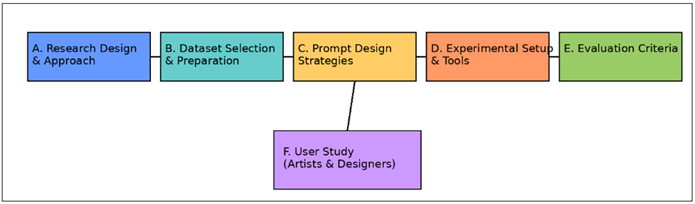
Figure 1 Methodology Workflow
The Figure 1 depicts a chronological and cyclical process of applying Large Language Models to visual art pre-production. It starts with the research design, then there is the preparation of the dataset, in which curated artistic and textual contributions are organised. The second step entails timely design plans, which help the LLM to come up with innovative ideas. This setup consists of the few prompts executed by AI tools and generates numerous outputs of the experiment. These outputs are assessed by measuring them with creativity measures of relevance, coherence and novelty. Last but not the least, user study which is done by artists and designers verifies the usefulness of the generated concepts in practice. The feedback loops show that the evaluation and user study insights are used to refine prompts and optimize the system refinement.
5.2. Dataset Selection and Preparation
The information utilized in the study is a set of revised written and visual material related to the visual art pre-production, descriptions of conceptual artworks, plots, character comments, and descriptions of the setting. Such databases and portfolios of design which are publicly available are as well repositories of creative writing. The data is preprocessed to remove noise, redundancies and irrelevant data to have high quality inputs to be utilized in the experimentation process. To develop the concept in different ways, the textual information is categorized into such themes as fantasy, science fiction, realism and abstract art. In addition, a system of systematic prompts is elaborated based on such data to bring the data formats to the same level during experiments. This preparation permits some comparisons with other prompt strategies and model output which are controlled and consistent all over the board, and analysis.
5.3. Prompt Design Strategies
The timely design is the key to the process of the concept generation based on LLM. Several prompt engineering approaches are also used in this study such as descriptive prompts, narrative prompt, and constraint based prompts. Descriptive prompts are interested in visual qualities like color, composition and lighting whereas narrative prompts include features of the story like character role and setting. Prompts made in terms of constraints add either explicit constraints or stylistic rules to the model in order to steer the model towards particular outputs. Prompt refinement is repeated in order to reveal the best structures which can produce cohesive, varied and imaginative ideas. Other methods of improving the quality of output include few-shot prompting and contextual priming. The success of every strategy is measured on how rich and relevant are the concepts that have been generated.
5.4. Experimental Setup and Tools Used
The experimental design will imply the employment of the state-of-the-art LLMs, which will be reached via API-based platforms, which will be incorporated into a controlled computational environment. Python-based frameworks and interactive notebooks are some of the tools that are used to automate the execution of prompts, gather outputs, and analyze outcomes. The process involves the generation of several concept variations to one prompt, then the identification and reporting of the outputs. Besides text generation, some of the selected outputs are also forwarded to visual generative models (e.g., diffusion-based image generators) to determine whether they can be used in visual processes.
5.5. User Study Design (Artists and Designers)
A user experiment is carried out to prove the practical usefulness of the ideas generated by the LLM in the creative process in the real world. The participants consist of professional artists, design students, and creators of visual contents at different stages of experience. The research design mirrors a task-based assessment in which participants have been requested to utilize the ideas provided by LLM to inspire them to create a visual idea or drawing. The feedback is obtained by using the questionnaires, interviews, and rating scales based on the usability, increase of creativity, and satisfaction. The difference between conventional methods of ideation and the workflow with the help of LLM are compared. This human-centered assessment gives an understanding of how effective the use of the LLMs is in assisting the creative processes and on which aspects of the human-AI collaboration, it can be enhanced.
6. Implementation and Workflow
6.1. System Architecture for Concept Generation
The architecture of the system to be used in the LLM-based generation of creative concepts is structured into a modular and scalable system that incorporates the input processing, language model inference, and output management. In its simplest form, the architecture has three major layers, the processing layer, the input layer, and the output layer. The input zone receives the prompts of the user-programmed prompts, thematic constraints and stylistic preferences provided by artists or designers. These are then fed to the central LLM engine in the processing layer and it processes these inputs therein where contextual knowledge, semantic expansion, and concept generation takes place. One can also add other auxiliary modules to the system such as the prompt enhancement engines and knowledge bases that help to increase relevance of the output. The output node makes ideas generated in structured forms ready e.g. textual explanation, categorized ideas and optional downstream tools visual hints. This composite structure ensures flexibility to enable integration with external applications with ease and enable recurring creative processes.
Figure 2
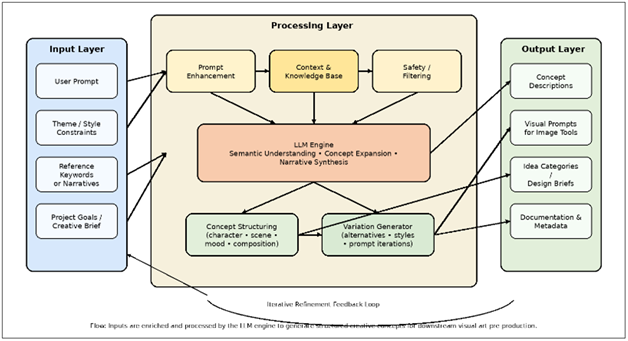
Figure 2 System Architecture
The architecture of the concept generation system is understood as a layered and modular system in the process of transforming textual inputs into structured creative ideas of visual art pre-production. It consists of three large layers viz. the input Layer, Processing Layer and the output Layer which are supported by the iteration feedback system that makes sure that it is constantly refined. The process begins with the Input Layer in which the users enter the required creative inputs that comprise prompts, thematic constraints, keywords of references, and project objectives. It is the artistic will that makes these contributions and this constitutes the basis of generating ideas. It also ensures it is flexible system in that it would allow a great deal of input, and would accommodate a broad spectrum of design requirements, such as abstract, and highly detailed design briefs. Processing Layer is the core of the architecture, it is where the actual creation of concepts is done. Prompt Enhancement module within this layer cleanses user queries to promote improvement in clarity and a richer context and ensures that the LLM is presented with structured queries. Context and Knowledge Base module is introduced into the input whereby the system can give more qualified and significant output. It possesses Safety and Filtering module where it eradicates the inappropriate or irrelevant contents to give reliability and ethical characteristics. The central part of the processing layer is the LLM Engine which is applied to perform the semantic understanding, concept expansion, and narrative synthesis. This component decodes the prompts provided at the input, describes the correlations between concepts and develops rich conceptualization. After that, the Concept Structuring module eliminates the established materials into functional categories such as characters, scenes, moods and compositions. Meanwhile, Variation Generator creates a number of alternative concepts, which allows diversity and exploration. These outputs are then forwarded to the Output Layer whereby they are packed into more manageable formats such as description of concepts, graphical prompts in image generation tools, compiled sets of ideas and documents with metadata. It is formatted output, which can easily be integrated with the downstream tools, and, moreover, make sound decisions in a creative workflow. The Structural element of the architecture is the Loop of Feedback of the Structural Refinement that connects the output phase with input phase. With this loop, the user can also filter the prompts, constrain further, and generate more valuable ideas based on the past outcomes. The architecture promotes the process of building and growing creative forces through the importance of maintaining constant communication between the system and the user.
6.2. Step-by-Step Pre-Production Pipeline
It is implemented on the basis of an organized pre-production pipeline which incorporates the traditional creative steps, and the AI-generated improvements. It begins with initiation of an idea where the user develops a theme, story or image agenda. This is followed by timely development where descriptive and contextual inputs are modeled so as to propel the LLM. The next stage is the concept generation stage where the model produces some creative products, whether it be the description of scenes, character conception or theme variations. This is then filtered and the irrelevant or poor results are filtered off. The selected ideas will be taken to concept structuring whereby concepts are simplified into actionable and viable design briefs. These coded concepts can be sent to visual generation software at will to be created. It is a conduit that ensures a systematic direction of abstract idea to certain creative directions.
6.3. Integration with Digital Art Tools
Combination of the generated ideas with the assistance of LLM with the digital art tools which are typically a part of the working process is one of the most important points of the implementation. The textual images generated by the LLM may serve as the direct input in the image generation websites in such a way that a person can turn a textual description of an image into a visual one. Also, it may be computer generated paintings and computer generated design software, whereby artists may use generated ideas as a guideline when creating hand generated works. Workflow integration is achieved through standardized data formats and API based integration and ensures the smooth flow of data between systems. This integration together with efficiency will also aid in bridging the gap between conceptual creation and visual execution and hence gives a coherent and continuous creative flow.
6.4. Iterative Concept Refinement Process
The content creation process which is conducted with the assistance of LLMs is also iterative, and the concepts may always be improved based on the feedback, given by the users, and the outcomes of the assessment. After the first concept generation step, the user can have a chance to edit prompts, include new constraints or ask variations to improve the quality and relevance of outputs. This cycle is made possible by the ability to hold onto history and propose other interpretations of the same thought. The refinement process is also also given feedback by evaluation metrics and user studies and thus ensures that the generated concepts adhere to the artistic intent and to the requirements of the project. This mutual exchange between the user and the system brings in an air of cooperation where a creative solution gets slowly created under various steps of creation and improvement.
6.5. Output Visualization and Documentation
The developed ideas should be visualized and documented successfully in order to be incorporated in the pre-production stages. The system works on the output to be organized into organized forms in concept sheets, narrative description and grouping of ideas. Visualization tools, including text-based summaries, annotated reference and optional generated previews can be used to provide concepts in a plain and easy to grasp format. Traceability and reproducibility are also achieved by means of metadata such as prompt details, generation parameters and evaluation scores that are recorded. The systematic presentation enables the creative teams to peruse and contrast ideas with others and determine the ones that they desire in the most efficient and easy manner to enable the team to collaborate and make decisions in the working place.
7. Results and Analysis
7.1. Quality Assessment of Generated Concepts
Considering the results of the evaluation of the concepts generated by the LLM, it is possible to say that the system is able to create very much detailed, coherent, and contextually relevant outputs in response to a range of artistic themes. The resulting concepts have high narrative structure, descriptive richness, and adherence to input prompts, especially when the input prompts are created well. Novelty wise, most of the works have creative combinations of ideas, originally designed character, setting, and theme. Nevertheless, repetitions and predictability were noted in some cases, particularly those cases where the prompts were not specific. All in all, the findings suggest that LLMs could be utilized successfully in the ideation process to produce conceptual materials of high quality that can be turned into visual translation.
7.2. Comparison with Traditional Ideation Methods
The workflows supported by LLM are very faster and more diverse compared to the conventional methods of ideation, which include manual brainstorming, exploration with sketches, etc. The capability to produce numerous variants of concepts within a few minutes gives the artists the opportunity to search a greater creative area without a lot of manual labor. Although traditional techniques provide more personal expression and are conducive to intuitive control, they can be time-consuming and be restricted by cognitive restraints. However, the opposite is true with LLM, which offers an augmentation to the generation of ideas by individual imagination.
7.3. User Feedback and Artist Experience
Respondents noted that the system assisted in getting around creative blocks, offered new insights and that the ideation process was faster. The multiple users loved the features to rapidly iterate on ideas and look into other directions. Nevertheless, other participants also mentioned that some of the outputs would have to be refined further to match a particular artistic style or a project need. The general user experience indicates that LLMs are useful as group-working tools to improve creativity with the presence of human supervision and interpretation.
7.4. Quantitative and Qualitative Analysis
Evaluation metrics like novelty, coherence, relevance, and diversity are quantitatively analyzed with the performance being quite high in the majority of cases. The diversity scores state that the system will produce very varying concepts especially with advanced prompt strategies. The qualitative analysis can also confirm these results and show that generated concepts may contain descriptive details and imaginations which are helpful to pre-production. However, there were instances of logical inconsistency and lack of depth in the contexts, which indicated that there is a way to improve model tuning and prompt design.
7.5. Performance Metrics and Observations
The proposed system is efficient and scalable, as performance metrics indicate. The time that is spent in developing a variety of concept variants is considerably less than the conventional practices, proving that the system can ideate faster. Moreover, the flexibility of the system in the various artistic realms like character development, environment, and plot development, denotes its flexibility. Another observation made is that specificity and refinement through iterations is very critical in the pursuit of best outcomes. Although the system has been successful on balance, issues of originality, stylistic uniformity, and bias are critical issues that should be considered when developing the system in the future.
Table 2
|
Table 2 Performance Evaluation of LLM vs Traditional Ideation |
|||
|
S. No. |
Metric |
LLM-Based Approach |
Traditional Method |
|
1 |
Novelty |
8.5 |
7.5 |
|
2 |
Coherence |
8.8 |
8.5 |
|
3 |
Relevance |
9.0 |
8.7 |
|
4 |
Diversity |
8.7 |
7.8 |
|
5 |
Aesthetic Potential |
8.6 |
8.2 |
The Table 2 compares the approaches to ideation, including LLM-based and traditional approaches, in terms of the important measures of creativity. The findings reveal that the methods that are supported by LLM present a greater score in novelty, diversity, and relevance, which means that they are effective when it comes to enlarging the creative exploration. The level of coherence and aesthetic potential are quite similar, and it is proven that the concepts created with the help of LLM remain of high quality and increase the efficiency of ideation.
Figure 3
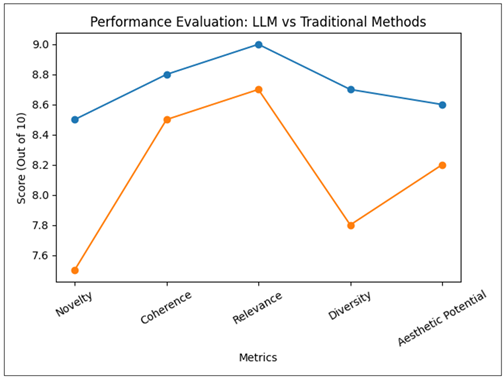
Figure 3 The Performance Comparison
The Figure 3 presents the comparison of the performances, and the results indicated that the workflows with the help of LLM were significantly higher, which confirmed the effectiveness of the idea generation process in the pre-production phase.
8. Conclusion and Future Directions
The current rapid development of Large Language Models (LLMs) in creative fields provides multiple opportunities in the research and development of visual art pre-production in the future. Another prospective direction of high importance is the multimodal AI systems integration where the text, image, audio, and even the ability to generate video are all integrated into a single framework. These systems would allow smooth converting conceptual ideation to visual realization, and artists could create, develop and visualize ideas in one interactive platform. Moreover, real-time co-creation platforms should be developed, which will further improve cooperation between the human being and AI and provide dynamic interaction in which artists can guide the creative process step-by-step with immediate responses of intelligent systems. It is also paramount to address the problem of bias, originality, and ethical concerns so that AI-generated content will be responsible, diverse, and respectful to intellectual property.
The other area to explore is to apply the use of LLMs to other fields of visual art. Advanced concept generation systems can be applied in such fields as interactive media, virtual reality, game design, and digital storytelling. Also, the combination of LLMs with newer technologies such as digital twins and immersive experience would result in more advanced and context-sensitive creative processes. The next logical step of creativity evaluation research ought to be the creation of standardized assessment procedures that can be applied to creativity, including both computational and human-based measurements of the quality and value of AI generated ideas. To conclude, this paper has shown that Large Language Models have a prominent potential of revolutionizing the pre-production stage of visual art because it is capable of improving the generation of creative concepts. The research notes the potential of creating and sustaining ideation, enhancing efficiency, and increasing the range of creative outputs through structured methodologies, system architecture design, and user-centered evaluation with the help of the LLM. The results reveal that the LLM can be used best as a collaborative tool that enhances human creativity, but not substitute it. Although the issue of originality, bias and evaluation exists, the benefits of applying the use of LLMs in the creative processes are extensive.
CONFLICT OF INTERESTS
None.
ACKNOWLEDGMENTS
None.
REFERENCES
Biswas, S. S. (2023). Role of ChatGPT in Public Health. Annals of Biomedical Engineering, 51, 868–869. https://doi.org/10.1007/s10439-023-03172-7
Blunsom, P. (2004). Hidden Markov Models. Lecture
Notes, 15, 48.
Bommasani, R., Hudson, D. A., Adeli, E., Altman, R., Arora, S., von Arx, S., ...
and Liang, P. (2021). On The Opportunities
and Risks of Foundation Models.
arXiv preprint
arXiv:2108.07258.
Brown, T., Mann, B., Ryder, N.,
Subbiah, M., Kaplan, J., Dhariwal, P., ... and Amodei, D. (2020). Language Models
are Few-Shot Learners. In Advances
in Neural Information Processing Systems
(Vol. 33, 1877–1901).
Driess, D., Xia, F., Sajjadi, M. S. M., Touvron, H., Yin, H., Bachem, O., ... and Rus, D. (2023). PaLM-E: An Embodied Multimodal Language Model. arXiv preprint arXiv:2303.03378.
Kashyap, S. V., Purohit, S., Kumar, D. A., Jawaid, F. I. M., Kumar, J. R. R., and Ajani, S. N. (2025). Visual Storytelling and Explainable Intelligence in Organizational Change Communication. Shodhkosh Journal of Visual and Performing Arts, 6(5s), 696–707. https://doi.org/10.29121/shodhkosh.v6.i5s.2025.6965
Kasneci, E., Sessler, K., Küchemann, S., Bannert, M., Dementieva, D., Fischer, F., ... and Kasneci, G. (2023). ChatGPT for Good? On Opportunities and Challenges of Large Language Models for Education. Learning and Individual Differences, 103, 102274. https://doi.org/10.1016/j.lindif.2023.102274
Kosmyna, N., Luu, T., Bouchard, K., and Cummings, M. L. (2025). Your Brain on ChatGPT: Accumulation of Cognitive Debt When Using an AI Assistant for Essay Writing Task. arXiv Preprint arXiv:2506.08872.
Magesh, V., Sundararajan, R., and Krishnan, A. (2025). Hallucination-Free? Assessing the Reliability of Leading AI Legal Research Tools. Journal of Empirical Legal Studies, 22, 216–242. https://doi.org/10.1111/jels.12413
Mikolov, T., Chen, K., Corrado, G., and Dean, J. (2013). Efficient Estimation of Word Representations in Vector Space. arXiv preprint arXiv:1301.3781.
Mikolov, T., Karafiát, M., Burget, L., Černocký, J., and Khudanpur, S. (2010). Recurrent Neural Network Based Language Model. In Proceedings of Interspeech (1045–1048). Chiba, Japan. https://doi.org/10.21437/Interspeech.2010-343
OpenAI, Achiam, J., Adler, S., Agarwal, S., Ahmad, L., Akkaya, E., ... and Zoph, B. (2023). GPT-4 Technical Report. arXiv preprint arXiv:2303.08774.
Raiaan, M. A. K., Rahman, M. M., Hossain, M. S., Al Nahian, M. J., and Al Nahian, M. S. (2024). A Review on Large Language Models: Architectures, Applications, Taxonomies, Open Issues and Challenges. IEEE Access, 12, 26839–26874. https://doi.org/10.1109/ACCESS.2024.3365742
Weidinger, L., Uesato, J., Rauh, M., Mellor, J., Anderson, K., Gabriel, I., ... and Kohli, P. (2022). Taxonomy of Risks Posed by Language Models. In Proceedings of the ACM Conference on Fairness, Accountability, and Transparency (FAccT) (214–229). Seoul, South Korea. https://doi.org/10.1145/3531146.3533088
Yu, Y., Si, X., Hu, C., and Zhang, J. (2019). A Review of Recurrent Neural Networks: LSTM Cells and Network Architectures. Neural Computation, 31, 1235–1270. https://doi.org/10.1162/neco_a_01199
|
|
 This work is licensed under a: Creative Commons Attribution 4.0 International License
© ShodhKosh 2026. All Rights Reserved.