ShodhKosh: Journal of Visual and Performing ArtsISSN (Online): 2582-7472
|
|
Blockchain Technology for Securing Digital Art Ownership and Enhancing Artist Authenticity Records
Pratibha V. Kashid
1 , Avinash Somatkar 2
 , Qingchang
Guo 3
, Qingchang
Guo 3
 , Sharayu
Rinkal Kawale 4
, Sharayu
Rinkal Kawale 4 , Arivukkodi
R 5
, Arivukkodi
R 5 , Shanthi
R 6
, Shanthi
R 6
1 Department
of Information Technology, Sir Visvesvaraya Institute of Technology, Nashik, SPPU,
Maharashtra, India
2 Assistant
Professor, Department of Mechanical Engineering, Vishwakarma Institute of
Technology, Pune, Maharashtra 411037, India
3 Faculty of Education Shinawatra University, Thailand
4 Department of Computer Technology, Yeshwantrao
Chavan College of Engineering, Nagpur, Maharashtra, India
5 Assistant Professor, Computer Science, Meenakshi College of Arts and
Science, Meenakshi Academy of Higher Education and Research, Chennai, Tamil
Nadu 600080, India
6 Assistant Professor, Department of Mathematics, Meenakshi College of
Arts and Science, Meenakshi Academy of Higher Education and Research, Chennai,
Tamil Nadu 600080, India
|
|
|
ABSTRACT |
|
|
The digital
art blistering phenomenon has transformed the manner in
which art is produced and contextualized in the art markets in the
world, though it has occasioned concerns that border issues of ownership,
authenticity and provenance which are horrifyingly questioned. Easy
reproduction, editing and re transmission, and proving the authorship and protecting of the artists is difficult in digital art. The
provided paper explores the possibility of the blockchain
technology being a secure and open method of controlling the ownership of the
digital art object and enhancing the authenticity records. Blockchain helps
in the creation of verifiable histories of digital assets that cannot be
changed and this is done by allowing decentralized ledger keeping,
cryptographic hash and smart contracts to be used to create the records. The article
also involves the research of blockchain-based systems in
particular with the involvement of Non-Fungible Tokens (NFTs) as the
embodiment of a unique digital piece of art. It proposes a theoretical model
that entails artist registration, tokenization of artwork, ownership
tracking, and verifications to ensure the safety of provenance and
authenticity. The implementation plan will outline the process of the
implementation of a blockchain-based tool, namely, the decentralized storage
and the automation of smart contracts, which will allow facilitating an
effective transaction and the payment of royalty. Furthermore, a comparison
of the advantages of introducing blockchain-based systems over traditional
models of art ownership is described in terms of the
security, transparency, and accessibility. The paper does list such
problems as scalability, regulatory uncertainty and environmental issues,
despite these advantages. Based on the findings, it can be concluded that
blockchain technology can change the digital art ecosystems which provide a
reliable platform of ownership verification and empowering artists,
and also emphasize the need to conduct further research and
sustainable development. |
|||
|
Received 18 January 2026 Accepted 26 March
2026 Published 11 April 2026 Corresponding Author Pratibha
V. Kashid, wajepratibha23@gmail.com
DOI 10.29121/shodhkosh.v7.i4s.2026.7483 Funding: This research
received no specific grant from any funding agency in the public, commercial,
or not-for-profit sectors. Copyright: © 2026 The
Author(s). This work is licensed under a Creative Commons
Attribution 4.0 International License. With the
license CC-BY, authors retain the copyright, allowing anyone to download,
reuse, re-print, modify, distribute, and/or copy their contribution. The work
must be properly attributed to its author.
|
|||
|
Keywords: Blockchain Technology, Digital Art, Non-Fungible
Tokens (NFTs), Art Authentication, Digital Ownership, Provenance Tracking,
Smart Contracts, Decentralization, Artist Rights, Cryptographic Security |
|||


1. INTRODUCTION
The rapid evolution of digital technologies altered the way the art is created, distributed, and consumed in the new age. Digital art has been embraced in its unique way as a graphic representation and as an animation and can also be seen as an immersive multimedia environment as a legitimate and effective mode of creative expression. Online platforms and market places have also linked the world and artists are able to show their work around the world without the traditional barrier that is attached to the physical gallery and middlemen. However, this has also had its share of critical problems particularly on matters concerning ownership, authenticity and provenance as a result of this digital proliferation. Online files can be simply copied, amended, and redistributed without any data of ownership, which is not the case with tangible artworks, and thus artists cannot protect their rights, and the collectors have no means of proving the authenticity. Absence of a trusted system to define and control ownership is one of the strongest issues of the digital art ecosystem. The traditional copyright and intellectual property protection paradigms do not prove effective when it comes to responding to the challenge of digital reproduction and distribution. Artists frequently encounter the risk of unauthorized copying, reproduction, and forgery as well as consumers are left with the unpredictability of originality and originality of digital art objects. This mistrust and absence of certification is a hit to the digital art and to the even greater assimilation of the digital art into the official art markets and museum collections.
The answer to these problems has been observed in the blockchain technology which offers a decentralized, transparent and tamper resistant system that can be used to store the transactions and ownership data. The blockchain can be applied to create an unalterable record which may contain the data on digital assets in a secure way with the use of the distributed ledger technology and cryptographic authentication. In a Non-Fungible Tokens (NFT), also referred to as a unique digital identifier recorded in blockchain that proves provenance and ownership, digital art employs blockchain to tokenize artworks. Smart contracts contribute to this ecosystem with an additional advantage of automated transactions, royalty payments and fair compensation of artists due to secondary sales Benhamou and Heinich (2024).
The advent of digital art has significantly altered the manner in which artistic expression and distribution occurs; as well as introduced some challenging problems of ownership and authenticity. It is easy to copy, share and make changes on the digital files with ease without losing their originality as opposed to the physical works and hence it becomes difficult to develop a distinct boundary between original and duplicate works. This reproducibility, which is one of them, squanders the theory of uniqueness which is traditionally central to the value of art. This means that artists can scarcely enjoy the rights to own their artwork, and collectors do not know of the originality and authenticity of digital property. Provenance can be documented using conventional art systems either in form of certificates, gallery records and expert validation. On the other hand, the digital art lacks the systematic frameworks of recording and validation of records of possession and originating. Without an effective structure, it is difficult to think of who created a digital work and whether it has been distorted or lied to across the decades. This kind of unverifiable records contributes to the risks of fraud, forgery, and illegal duplication. The copyright infringement is another significant problem of digital art ecosystems. Artists are normally confronted with cases where one finds their work being duplicated, distributed or even sold against their consent. The current copyright laws find themselves frequently unprepared to address the impediments of digital distribution through the platforms in the global arena. This is especially difficult to enforce because of the issue of jurisdiction and the anonymity of online transactions. As a result, it might deprive artists of the right to their intellectual property and they might undercompensated. Besides, the intermediaries in the digital art markets have an opportunity and a restriction. Exposure and sales are made possible via online forums, galleries and marketplaces which are often operated by centralized systems, which may not be transparent. These agents can have high commissions and only offer few guarantees on authenticity or verification of ownership. Moreover, the use of centralized databases will present possibilities of data manipulation, loss or unauthorized access. The other problem is to create a trust among the stakeholders. Buyers should also trust the information of sellers or websites when buying digital artworks and this may cause people to be skeptical and lose trust in the industry. This problem is also not helped by the fact that no standardized authentication techniques are in place, and various platforms can have different practices of authenticating works of art.
2. Background and Theoretical Foundations
The emergence of the digital art as a powerful movement in modern visual culture is directly related with the evolution of the computing technologies, the accessibility of the internet and online distribution channels. Over the past two decades, artists have become increasingly open to the use of digital equipment in the creation, editing, and market of the artworks to the international networks. The online gallery, social media and digital market place enable the possibility of reaching more audiences and maximization. However, this transformation has also brought forward certain underlying limitations of traditional art ownership/authentication systems which were largely constructed through physical art. The issue of illegal duplication, lack of provenance data and the impossibility to authenticate the originality has become widespread in the digital realm. Blockchain technology provides a foundation over these issues because of its decentralized and immutable nature. Essentially, blockchain is a decentralized register system that records transactions between many nodes within a system rendering it transparent and difficult to interfere with. Each transaction is coded with cryptography and linked with the previous records in the form of a chain of data blocks that cannot be altered unless the agreement of the parties involved in the network. Such design enhances trust among the users since there is no necessity of having a centralized body. Also, smart contracts are self-executing programs on the blockchain that permit the agreements like the transfer of the ownership and royalty payments to be more transparent and automatic, as they are specifically relevant in the exchange of the digital art Kashyap et al. (2025).
The major innovation in this ecosystem is the so-called Non-Fungible Tokens (NFTs), distinct digital objects in the blockchain. NFTs also have unique metadata, unlike cryptocurrencies, which are interchangeable and define the identity, ownership, and provenance of a particular digital artwork. This will enable artists to tokenize their works, which in effect can put records of authenticity and ownership on the blockchain. Also, NFTs help with traceability, as a collector and an institution can confirm the history of an art piece, including its provenance and sale history. Theoretical bases of blockchain in digital art can be related to the notions of decentralization, trustless systems, and digital scarcity as well. Decentralization ensures that there is no dependence on intermediaries (galleries or auction houses), as well as trustless mechanisms ensure that transactions are validated through consensus and not through institutional authority.
3. Literature Survey
Among the issues that have been discussed in the existing literature, there are digital ownership, provenance tracking, copyright protection, and the economics of tokenized art. Researchers have underlined that blockchain is a paradigm shift in the establishment of authenticity and ownership because it provides a transparent and immutable system, which is not comparable with the traditional centralized ones. Such early research has mostly been done on the technical architecture of blockchain systems, whereas more recent research has taken an interdisciplinary approach to make a combination of art theory, law, and digital economics. A number of researches have examined the scope of NFTs in creating verifiable ownership of digital assets. NFTs are commonly known as a system of giving digital art object uniqueness and traceability in the form of metadata using blockchain-based methods. Scholars emphasize the fact that NFTs allow artists to incorporate ownership rights into the digital identity of the artwork itself and minimize confusion associated with its duplication and illegal sale. Furthermore, studies also note that NFTs enable automated royalty payments via smart contracts where artists can earn a portion of sales on a secondary sale, which this is a feature that used to be hard to implement in the classic art markets. Nevertheless, some critics believe that even though NFTs just certify ownership of a token, it does not necessarily mean control over the underlying digital file, and it is problematic to differentiate between ownership and access Clark (2021).
The other valuable area of research is blockchain applications in the protection of intellectual property (IP). The study suggests that a blockchain can be applied as a decentralized copyright claim register, which, in its turn, has time-stamped records which can serve as evidence of authorship. This has serious repercussions as far as legal battle is concerned because blockchain entries are difficult to doctor and can be verified in open platforms. There are also studies by scholars on hybrid mechanisms combining blockchain with the existing order of copyright to make it more legally enforceable. Irrespective of these advantages, the literature acknowledges the drawbacks of the jurisdictional difference of the copyright law and the lack of comparable regulatory frameworks on the sales of art based on blockchain platforms. A case study can be examined using examples of blockchain-based art platforms, such as OpenSea, Rarible, and Foundation, which can demonstrate how these technologies are applied in reality. These platforms have the ability to demonstrate that blockchain may be employed to facilitate peer-to-peer transactions, eliminate middlemen, and open up markets to aspiring artists. Evidence indicates that marketplaces based on blockchain technology have democratized the art transmission process in the world, eliminating the barriers to entry and enabling the participation of the global population. However, the academia also cites the following challenges as market instability, speculative trading, and concerns about the sustainability of NTF-based economies DappRadar (2024). The energy usage of certain blockchain networks concerning the environmental issue has been a popular topic as well, and more environmentally friendly methodologies, such as proof-of-stake systems, have been investigated as well.
In addition, the multidisciplinary research investigations mention the cultural and philosophical outcomes of blockchain in relation to art. It is suspected that the blockchain calls into question the concept of the authenticity as it redeems the emphasis on the material item to the online record of the ownership. The shift breaks the traditional premise of originality and aura, as an art theory concept and upsets the place of technology in the creation of artistic value Fitzpatrick (2023). The connection between blockchain and the general trends of decentralization and Web3 is also examined by other researchers, which makes artists participants in a distributed creative economy. Although more and more research is being done, certain gaps exist. It needs holistic systems that incorporate technical, legal and artistic features of blockchain-based art systems. The existing literature is inclined to focus on such individual problems of NFTs or smart contracts but does not discuss the entire ecosystem on the whole Kent (2022). Moreover, no empirical research on the user experience, factors of the adoption, and the role this technology will play in the art market in the long run is left. The discovery of the gaps allows concluding that further studies have to be done to create scalable, secure, and artist-centric blockchain solutions and this paper will occupy the gaps with the presented model and analysis Sotheby’s (2021).
Table 1
|
Table 1 Summary of Recent Methods used in the Domain |
||
|
Methodology |
Key Contribution |
Limitations |
|
Qualitative interviews DappRadar (2024) |
Identifies consumer
perception and value creation in NFT-based digital art markets |
Limited sample size and
early-stage market analysis |
|
Bibliometric analysis of 99
studies Fitzpatrick (2023) |
Provides comprehensive
mapping of NFT research evolution and trends |
Focuses more on trends than
technical frameworks |
|
Scientometric and data-driven analysis Kent (2022) |
Highlights blockchain’s role
in authentication and security of digital assets |
Limited domain-specific
application to art systems |
|
Blockchain-based queueing
model Sotheby’s (2021) |
Proposes optimized auction
model improving fairness and efficiency in NFT markets |
Complex implementation and
scalability concerns |
|
Analytical study Priya (2026) |
Examines economic growth,
sustainability, and impact of NFTs in art |
Raises concerns on
environmental and speculative issues |
|
Conceptual + technical
analysis Zalan and Toufaily
(2024) |
Explores NFT lifecycle,
artist empowerment, and cybersecurity challenges |
Limited empirical validation |
|
Mixed-method approach Pradana (2025) |
Demonstrates practical
implementation of NFT marketplace and identifies challenges |
Lacks scalability and user
adoption insights |
Table 1 of the literature review provides a concise overview of the recent researches regarding the application of blockchain technology and NFTs to digital art ecosystem. The selected articles shed light on the key shifts in such directions as the ownership of digital media, authentication, competition on the market and empowerment of artists. Some of the papers highlight the importance of NFTs in facilitating provenance, open ownership naming and securing, and others dwell upon economic frameworks, auction systems, and consumer patterns in the settings of the new Web3 art markets. The table, too, represents an increased academic focus on interdisciplinary issues, such as legal, cultural, and sustainability issues. Some constraints that can be identified in the analysis of the existing research are also found, including absence of large-scale empirical validation, difficulties with scale, and regulatory ambiguities. Although the blockchain frameworks have a long history of technical progress, it still requires increasingly integrated models that fulfill usability, access, and sustainability. On the whole, the table highlights the promising nature of blockchain in the establishment of ownership of digital art and the need to conduct more research to address the gaps that persist and enable more people in the creative sector to embrace it.
4. Proposed Model / Framework
4.1. Conceptual Framework for Blockchain-Based Art Authentication
The suggested blockchain-based art authentication architecture is set to create a secure, transparent, and tamper-resistant ecosystem of administering information of ownership and authenticity of the digital art pieces. The framework deals with the significant shortcomings of traditional systems of digital art, in which the pieces of art could be duplicated, modified, or reshared without a sound system of establishing originality. The framework, through the introduction of blockchain technology into the lifecycle of the digital art, provides a platform of trust, upon which artists, collectors, galleries, and marketplaces can interrelate with confidence. Conceptually, the framework is designed to be based on five integrating components, including artist identity verification, art work tokenization, ownership recording, transaction validation and authenticity verification. First, the artist identity verification feature is used to guarantee that the unique entity, who created the artwork, is registered in the system using a set of authenticated credentials. This is necessary since the validity of the overall framework will be based on the connection of a digital piece of art to its author. Second, the step of tokenization of artwork converts the digital artwork into a unique blockchain token usually in the form of NFT with metadata presented as artwork title, date of creation, creator ID, file hash, and ownership data. Third, the ownership recording component captures all the transactions of the art piece on the blockchain, and this constitutes a verifiable provenance history that is impossible to change. Fourth, blockchain consensus and smart contracts will be used in the validation transaction element, in such a way that the transfer of ownership can only occur under given and legal conditions. Finally, the authentication verification section enables the users to verify the authenticity of a digital artwork by deciding whether or not it has been altered, and who is the owner of it today. This model is also not a technical system model but a model of digital art ecosystem trust. It combines decentralization and cryptographic validation therefore decentralizing authentication to decentralized digital infrastructure. So doing, it will advance on transparency, reduce fraud, strengthen the rights of artists and encourage more responsible digital art dealings.
4.2. System Architecture Design
1) Artist
Registration Module
The system has a registration module, which is its entrance point. The artists in this module are expected to establish an authentic online identity through presenting their professional and personal information including name, contacts, links to their portfolios, and evidence of authoring. After being authenticated to the platform or through an identity verification system, the artist is given a special identifier, which is linked to their blockchain. This identifier is retained safely and it is linked to all future artworks uploaded by the same artist. This module aims at making sure that all the works of art that are being added into the system have a traceable and authenticated creator Khan (2025).
2) Tokenization
of Artworks Process
The artwork tokenization is what enables the artist to upload a digital piece of artwork file to the site after registration. The system creates a cryptographic hash of the uploaded file and this serves as a digital fingerprint. This hash makes it impossible to make the slightest change in the artwork unnoticed. The artwork is then tokenized to a one-off digital blockchain. The metadata that can be gathered with the token can be the name of the artwork, the type of file, description, date, the author, license and royalty. The resulting work of art is a tokenized artwork, which can be sold, collected or purchased without losing the information on its origin.
3) Tracking
Mechanism on ownership
The ownership tracking protocol records an unbroken and unchangeable list of all ownership transfers of the tokenized artwork. When the artwork is sold, transferred or resold, it is stored in the blockchain through time stamps and wallet addresses of the sender and the receiver. This characteristic will form an auditable provenance of the initial creator through to the present proprietor. It also minimizes the uncertainty in questions of ownership and gives confidence to the collectors of the validity of their purchases. Since records of all the transactions are kept forever, the system provides an openness in the lifecycle of any given artwork Kumar et al. (2025).
4) Verification
and Validation Layer
The verification and validation layer ensures that it verifies the authenticity and integrity of the artworks that are stored in the system. The blockchain can be queried by the user, buyer, gallery, or institutions with the artwork token ID or file hash to confirm the authenticity of the creator, ownership history, date of creation, and originality. The present layer will also calculate the hash of the file and compare it with the previously registered file hash to identify unapproved changes. Through this, the system facilitates the provenance verification and content integrity validation.
Figure 1
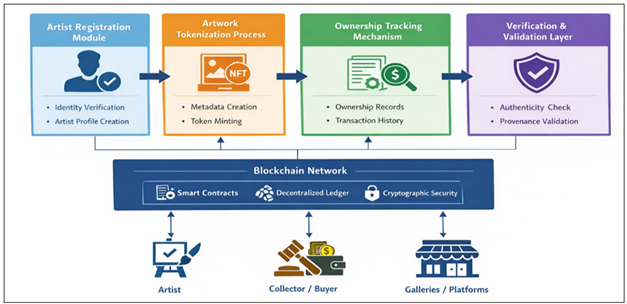
Figure 1
Blockchain Based
Digital Art Authentication System Architecture
Figure 2 depicts an authentication system of a blockchain-based digital art where the mechanism of the system consists of four primary steps: artist registration, tokenization of the artwork (creation of NFTs), ownership tracking, and verification. Any of these modules is backed by a blockchain network providing secure, transparent and tamper-free records. It reveals the process of creation and registration of artworks by artists, the interaction of buyers with transactions, and the system proving authenticity and a history of ownership.
4.3. Smart Contract Design for Ownership and Royalties
The logic of running the proposed framework is made up of smart contracts. These self-executing digital agreements are coded on the blockchain to automate the transfer of ownership, licensing regulations and payment of royalties. In the case of selling an artwork, the smart contract will ensure that the seller is the owner of the rightful artwork and automatically send the token to the buyer when he/she confirms payment. Meanwhile, the contract imposes some specific royalty conditions, as a certain percentage of every secondary sale is donated directly to the original artist. It is particularly useful in art ecosystems that are digital in nature, where artists have traditionally not been able to enjoy the fruits of resale markets. The smart contracts also minimize the reliance on intermediaries through directly incorporating the trust into the transaction.
4.4. Data Flow and Interaction Model
The process starts with the registration of an artist on the platform and a verified identity is obtained. The artist at this point uploads a digital work of art which is hashed with a hashing function to create a unique fingerprint. The metadata and hash of the file are sent to blockchain network wherein a tokenization smart contract is established to generate a distinct token of the artwork. Upon the minting, the token is added to the digital wallet of the artist and can be listed or transferred. Once a buyer makes a purchase, the smart contract takes ownership transfer request and verifies payment and updates blockchain ledger with ownership record. The further transactions work in the same way, and royalties are automatically distributed in accordance with the terms of the smart contract Mohammed (2025).
5. Implementation Strategy
The proposed blockchain-based approach to the authentication of digital art presupposes the combination of decentralized technologies, smart contract programming, and user-friendly interfaces to make their functionality efficient. A proper blockchain platform should be chosen as the first step in the implementation process. Common platforms that may be considered include Ethereum, Polygon, or Hyperledger that have support of smart contracts, relying on scalability options, and have active developer communities. Etherium-based networks are especially favored when it comes to the NFT-based application due to the established standards such as ERC-721 and ERC-1155, which make it possible to provide secure tokenization of digital assets. The development stage will involve the design and implementation of smart contracts that will regulate the tokenization of artwork, owner-ship transfer and payment of royalty. Solidity is one of the languages used to write these contracts and they are deployed on the blockchain, thus automating the transactions without the need of intermediaries. In tandem with this, a front-end interface is created with the help of web technologies to enable artists to create accounts, submit artworks, and messages, and buyers to search, authenticate, and buy digital art works. Connection to digital wallets (MetaMask) makes it possible to safely authenticate users and provide transactional protection.
The first step is the registering of the artists and uploading the artwork files onto the decentralized storage system, i.e., IPFS (InterPlanetary File System). The art piece is stamped as a cryptographic hash that is further linked with the blockchain. Once tokenized, the work of art will be added to the blockchain registry and can be transacted. Ownership transfers and provenance records are automatically kept and royalty paid to the original owner. The analysed performance metrics that are used to establish the system are user experience, scalability, transaction speed, and gas fees. The real world environment is also simulated, e.g. a sequence of transactions and verification requests, in order to be tested. In total, the implementation strategy is aimed at creating the balance between the technical strength, the usability, and the cost-effectiveness, with a view to the fact that the system will be realistic under the conditions of the real-life implementation to the digital art ecosystems Li et al. (2024).
6. Comparative Analysis
6.1. Traditional vs Blockchain-Based Art Systems
These systems are in many cases manualized, hence prone to forging, loss of data and absence of transparency. Provenance tracking is in most cases distributed and hard to authenticate. Contrastingly, systems based on blockchain offer a decentralized and immutable registry in which all transactions are safely stored and can be followed easily. This helps a lot in boosting trust and decreases reliance on middlemen.
Table 2
|
Table 2 Comparative Analysis of Traditional Art Systems Vs Blockchain Based systems |
||
|
Parameter |
Traditional Art Systems |
Blockchain-Based Systems |
|
Ownership Verification |
Manual, paper-based |
Automated, blockchain
records |
|
Transparency |
Limited |
High (public ledger) |
|
Security |
Vulnerable to fraud |
Cryptographically secured |
|
Provenance Tracking |
Fragmented |
Immutable and traceable |
|
Intermediaries |
Required (galleries, agents) |
Reduced or eliminated |
|
Cost |
High transaction and
commission fees |
Variable (gas fees) |
|
Accessibility |
Restricted |
Global and open access |
|
Artist Royalties |
Rarely enforced |
Automatically enforced via
smart contracts |
The differences between the traditional and blockchain-based art systems are depicted in the comparative Table 2. It demonstrates that traditional systems are based on the use of manual operations and intermediaries and are less transparent, expensive, and prone to fraud. The systems built on blockchain, in its turn, provide automated ownership validation, immutable and secure records, as well as the ability to track provenance transparently. Also, blockchain provides accessibility worldwide and equitable compensation of an artist using smart contracts, which makes it a more effective and stable when it comes to managing ownership of digital art.
6.2. Comparison of Blockchain Art Platforms
It has different blockchain models like Ethereum, Polygon and flow with different rates of performance. Ethereum is also popular because it has a solid ecosystem and standards of NFTs but has problems with high gas fees and scalability. Polygon is cheaper and comes with a more scalable option and still is compatible with Ethereum. Flow is optimistic towards digital assets and can provide better transaction speed but with a smaller ecosystem.
Figure 2
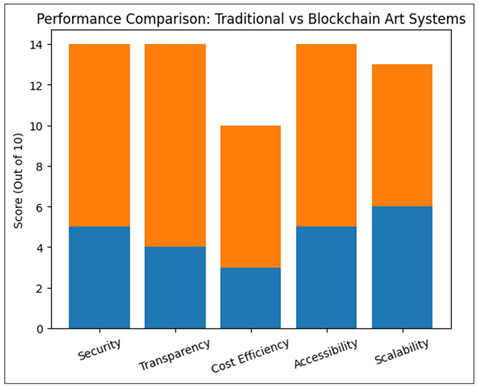
Figure 2
Comparative Analysis
of the Two Methods
The chart shows that the systems based on blockchain perform better than the traditional systems in most important aspects. The most significant improvement is on security and transparency because cryptographic validation and decentralized record-keeping can be used. There is also increased accessibility since blockchain allows everyone in the world to participate without intermediaries. Nevertheless, cost-effectiveness and scalability remain moderately problematic as a result of transaction charges and network congestions, even though newer blockchain-based solutions are resolving the problem.
6.3. Merits and Shortcomings of Proposed Model
The suggested structure has a number of benefits, such as a greater level of authenticity verification, automated division of royalties, and safe ownership monitoring. It guarantees the artists of ownership of their work and it also gives the buyers verifiable ownership with regards to the possession of ownership. Smart contracts make operations more complex and efficient. Nevertheless, some limitations should be admitted. The blockchain systems can experience a problem of scalability when the number of transactions is high and the user can experience technical limitations such as management of wallets and gas fees. Also, such aspects as regulatory uncertainty and environmental issues when using energy are significant factors to consider. All in all, the comparative analysis proves that blockchain technology offers much more robust and transparent solution to the ownership of digital art than the traditional systems and marks out the opportunity to improve.
7. Conclusion
It is possible that blockchain technology can be used as a radical solution to ownership of digital art and enhancement of the records of authenticity of artists, as discussed in this paper. The paper began by discovering the constraints of the traditional digital art systems that included unlicensed reproduction, lack of provenance and ineffective system of asserting ownership rights. These challenges have conventionally eroded trust and respect towards electronic forms of art markets. The proposed studies revealed the potential of the three aspects in addressing the prevailing gaps within the digital art systems through the theoretical framework of the blockchain technology, including decentralization, cryptographic security, and smart contracts. It turned out that in the literature review as well, blockchain, particularly in the format of NFTs, is already beginning to bring a change to how the issue of ownership, authenticity, and value in the digital realm is perceived. However, it also demonstrated the need of more concentrated and logical models that go beyond the few things that were done on the technological implementations. Trying to fill out this gap, the paper introduced a digital art authentication based on blockchain, and key building blocks are the registration of artists, tokenization of any artwork, ownership tracking, and validation. The implementation plan had practical steps to deploy such a system as compared to the comparison analysis that demonstrated that it has more advantages as opposed to other traditional methods in terms of transparency, security and efficiency. Despite the existence of such developments, the challenges of scalability, cost, and uncertainty of regulations and complexity of technology remain. Therefore, the paper indicates the need to innovate further, conduct interdisciplinary collaboration, and policymaking that would enable the widespread application of blockchain in the art industry. Lastly, blockchain technology is hugely capable of redefining the concept of ownership and genuineness of digital art. Its open-source and safe structure where power is vested in the artists gives the artists the power to be unstoppable, instils trust in the collectors and ensures that the digital art world becomes more just and trustworthy.
CONFLICT OF INTERESTS
None.
ACKNOWLEDGMENTS
None.
REFERENCES
Benhamou, F., and Heinich, N. (2024). Le Marché De L'art Au Risque Du Numérique: L'énigme Des Nft. Odile Jacob.
Blockchain Based Intelligent System for Non-Fungible Token (NFT) Marketplace. (2024). International Journal of Engineering Trends and Technology, 72(7). https://doi.org/10.14445/22315381/IJETT-V72I7P136
Clark, F. (2021, July 8). What are the Legal Issues Concerning Non-Fungible Tokens (NFTs)? Art Law and More.
DappRadar. (2024). Dapp Industry Report.
Fitzpatrick, S. (2023). A Guide to Non-Fungible Tokens (NFTs). Boodle Hatfield.
Kashyap, S. V., Purohit, S., Kumar, D. A., Jawaid, F. I. M., Kumar, J. R. R., and Ajani, S. N. (2025). Visual Storytelling and Explainable Intelligence in Organizational Change Communication. ShodhKosh Journal of Visual and Performing Arts, 6(5s), 696–707. https://doi.org/10.29121/shodhkosh.v6.i5s.2025.6965
Kent, C. (2022). Can You be an NFT Artist and an Environmentalist? Wired.
Khan, M. I., et al. (2025). A Scientometric Analysis on Blockchain and NFTs: Trends and Future Directions. Humanities and Social Sciences Communications. https://doi.org/10.1057/s41599-025-05979-2
Kumar, C. S., Singh, A. P., and Reddy, K. H. K. (2025). Optimized Non-Fungible Tokens (NFT)-Based Auctions for Digital Art: A Blockchain-Enabled Queueing Model Approach. Peer-to-Peer Networking and Applications, 18. https://doi.org/10.1007/s12083-025-02098-2
Li, R., Yecies, B., Wang, Q., Chen, S., and Shen, J. (2024). Empowering Visual Artists with Tokenized Digital Assets with NFTs. arXiv.
Mohammed, D. S. A. (2025). Agent-vs-Agent Cyber Warfare: Autonomous AI Systems Defending Against AI-Enabled APTs. International Journal of Advanced Computer Engineering and Communication Technology, 14(2), 9–17. https://doi.org/10.65521/ijacect.v14i2.926
Pradana, M. (2025). Revisiting Non-Fungible Token (NFT) Research Trends: A Bibliometric Analysis. Cogent Business and Management. https://doi.org/10.1080/23311975.2025.2469764
Priya, J. M. J. (2026). Understanding Consumer Behaviour Towards Eco-Friendly Products in the Context of Sustainable Consumption. International Journal of Research in Development Management Review, 14(2), 144–150. https://doi.org/10.65521/ijrdmr.v14i2.1428
Sotheby’s. (2021). Natively Digital: A Curated NFT Sale.
Zalan, T., and Toufaily, E. (2024). A Nascent Market for Digital Assets: Exploration of Consumer Value of NFTs. Digital Business, 4(1), Article 100084. https://doi.org/10.1016/j.digbus.2024.100084
|
|
 This work is licensed under a: Creative Commons Attribution 4.0 International License
© ShodhKosh 2026. All Rights Reserved.