ShodhKosh: Journal of Visual and Performing ArtsISSN (Online): 2582-7472
|
|
Marketing Strategies and Consumer Purchase Decisions: The Role of Product Quality, Customer Satisfaction, and Brand Image in Visual and Cultural Consumption Contexts
Rahat Arora 1
 ,
Harvinder Singh 2
,
Harvinder Singh 2
1 Research
Scholar, Department of Commerce, School of Management Studies, CT University,
Ludhiana – 142024, Punjab, India
2 Dean
Professor, Department of Commerce, School of Management Studies, CT University,
Ludhiana – 142024, Punjab, India
|
|
|
ABSTRACT |
|
|
Consumers in
modern markets are making choices on what they will buy based upon more than
just functional characteristics, but being influenced by visual, artistic,
and cultural factors. This conceptual paper seeks to come up with a holistic
model of consumer purchase decisions in contexts of visual, performing and
cultural consumption. Based on the existing marketing constructs, the paper
assesses how product quality and customer satisfaction are antecedents that
affect brand image, which subsequently leads to purchase decisions. Using the
argument that the visual appeal, artistic expressions, and symbolic meanings
would improve consumer perceptions and brand association, the paper maintains
that culturally enriched and aesthetically motivated consumption environments
would be more beneficial to consumer perceptions and brand associations.
Combining conventional marketing variables with the findings of the visual
and cultural consumption literature, the work offers a multidisciplinary
approach which identifies the similarity of consumer behavior to the fields
of performing and visual arts. The suggested conceptual framework has a
contribution to both marketing and arts-based research because it brings out
the topicality of aesthetic and cultural aspects in influencing consumer
decision-making. The paper also provides a guideline to future empirical
studies to prove the proposed relationships in different cultural contexts |
|||
|
Received 11 February 2026 Accepted 03 April 2026 Published 11 April 2026 Corresponding Author Rahat
Arora, rahat.arora20@gmail.com
DOI 10.29121/shodhkosh.v7.i4s.2026.7475 Funding: This research
received no specific grant from any funding agency in the public, commercial,
or not-for-profit sectors. Copyright: © 2026 The
Author(s). This work is licensed under a Creative Commons
Attribution 4.0 International License. With the
license CC-BY, authors retain the copyright, allowing anyone to download,
reuse, re-print, modify, distribute, and/or copy their contribution. The work
must be properly attributed to its author.
|
|||
|
Keywords: Consumer Purchase Decision, Product Quality,
Customer Satisfaction, Brand Image, Cultural Consumption |
|||



1. INTRODUCTION
1.1. Background of Consumer Behavior in Modern Markets
The modern business world has transformed consumer behavior into a very dynamic and complex phenomenon due to the development of technology, globalization, as well as the shifting socio-cultural trends. Contemporary consumers are more sophisticated, connected digitally, and they are more value-oriented, and their decision-making patterns are more complex than ever. The spread of online platforms, social media, and digital communication has greatly improved the access to information among consumers, allowing them to compare products, weigh alternatives, and create perceptions based on personal experience and external sources of information like electronic word-of-mouth Yadav and Rahman (2018). This leads to alterations in consumer buying behavior since it is no longer entirely rational, but a mix of cognitive judgments, emotion, and social pressure Sarkar and De Bruyn (2022). This change requires an in-depth investigation of the hidden issues that trigger consumer behavior in contemporary markets.
1.2. Importance of Marketing Strategies
The growing complexity of consumer behavior has necessitated the marketing strategies to be considered as important resources that organizations wish to use to shape their purchase decisions and gain competitive advantages. Firms exploit product quality, customer satisfaction, and brand image as some of the determinants that firms can use strategically to achieve difference and consumer interest. The quality of the product is one of the pillars that shape the values and trustworthiness, which directly impact customer satisfaction and loyalty Kannan and Li (2017). Customer satisfaction, in its turn, is a result of satisfying the expectations of the consumers, which is one of the primary predictors of the repeat purchase behavior and the development of relationships in the long term Dwivedi et al. (2021). Moreover, brand image is a strong intangible asset that affects the consumer perception, enhances emotional attachment, and impacts the process of decision-making Liu et al. (2017). These marketing variables collectively are important in influencing the consumer preferences in the competitive market environments.
1.3. Role of Arts, Culture, and Visual Consumption
In addition to conventional marketing aspects, increased appreciation has been placed on the influence of arts, culture and visual aspects in determining consumer behavior. The consumption in areas like personal care, fashion and cultural industries is becoming more symbolic in meaning, aesthetic and experiential value. Pictorial display, artistry and cultural stories make products more attractive and bring more emotional appeal to consumers. These help to create brand identity and affect consumer perceptions by introducing layers of meaning on top of functional attributes Murshed et al. (2023). In consumption situations that are culturally diverse, products are usually viewed as identity, status, and self-expression carriers, thus, visual and artistic aspects become dominant in consumer decision-making. This paradigm signifies the necessity to incorporate cultural and aesthetic orientations in conventional marketing paradigms.
2. Literature Review
2.1. Concept of Product Quality
Consumer evaluation and buying behaviour are major determinants based on the quality of products which is the perceived excellence or superiority of a product. It has a significant impact on perceived value, trust, and satisfaction and eventually consumer intentions Kato and Hoshino (2021). In competitive markets quality is an important point of difference that brand positioning.
The quality of a product is multidimensional, which includes performance, durability, reliability and aesthetics. Whereas performance and durability are functional measures, aesthetics is associated with the visual appeal and design. Aesthetic quality has become an important factor significantly affecting consumer perceptions and product appeal in the modern markets and visual-oriented industries in particular Bilro et al. (2022). Therefore, both functional and visual features contribute to the perception of quality in general.
2.2. Customer Satisfaction
Customer satisfaction gives the extent to which consumer expectations are fulfilled or even more and it is described as being explained using Expectation-Confirmation Theory (ECT). Positive behavioral outcomes are obtained when the product performance is in line with the expectations, and satisfaction is reached Nesset et al. (2021).
Customer satisfaction will have a higher likelihood of creating loyalty, trust, and positive word-of-mouth, which will reinforce brand perception Rather (2021). Also, satisfaction helps to build brand image due to positive reinforcement of emotions and experiences Hoyer et al. (2022). It has become critical in the digital era to affect the purchase intention and consumer relationships in the long run.
2.3. Brand Image
Brand image is how consumers view and relate to a brand which affects their attitudes and buying choices. The brand image is a powerful tool and a mental shortcut that lowers the level of uncertainty and makes the choices easier Liu et al. (2017).
In addition to functionality, brand image is also characterized with a symbolic and emotional dimension, which means that the consumers can have expression of identity and values through their decisions. The role of cultural and visual in brand image creation is very high, especially in the markets that are driven by aesthetics Murshed et al. (2023). Artistic presentation, visual design, and cultural storytelling improve the brand uniqueness and emotional resonance Verma and Yadav (2021).
2.4. Purchase Decision
The last phase of consumer decision-making process is purchase decision, which entails a process of evaluating and choosing alternatives. The process is complicated and dynamic as it is influenced by both rational and psychological factors Hoyer et al. (2022), Kato and Hoshino (2021).
Behavioral intention is a key factor that has been used to predict the purchase decisions. The Theory of Planned Behavior holds that attitudes, norms, and perceived control determine intentions Ajzen (2020). The quality of the product, satisfaction and brand image are among the factors that have a big part in these intentions which in the end determines the behavior of the consumer in the market Bilgihan (2016), Park et al. (2017), Rather (2021).
2.5. Cultural and Visual Consumption Context
Contemporary consumption is being more and more culturally and visually oriented, as consumers are no longer interested in only functional advantages, but also in symbolic and experience value. Cultural consumption is identity and meaning and visual consumption is more focused on aesthetics and design.
Visual and artistic contents can improve consumer interest by promoting emotionally vivid experiences and connecting the brand Pereira ete al. (2022). In this kind of situation, goods are viewed in their identity and lifestyle and not as utilities. The adoption of cultural and aesthetic variables in marketing initiatives helps companies to distinguish their products and be more in line with the changing consumer preferences Murshed et al. (2023).
3. Research Gap
The impact of product quality, customer satisfaction, and brand image on consumer purchases has been extensively studied in the existing literature, as these elements have a major effect on consumer behavior Bilgihan (2016), Shokouhyar et al. (2020), Park et al. (2017). Nevertheless, the majority of the research concentrated on each of these constructs separately or their direct impacts but little has been done to examine them in a combined relationship, especially the mediating role of brand image Pereira et al. (2022), Algharabat et al. (2020). Moreover, most of the past studies have focused on either functional or cognitive attributes of consumption without considering the increasing role of aesthetic, symbolic, and cultural attributes in consumer perception Septianto et al. (2020), Hoyer et al. (2022). Furthermore, the research on these relationships in the visually and culturally rich contexts of consumption has not been conducted, particularly in the emerging markets Kannan and Li (2017), Dwivedi et al. (2021). Thus, the research will fill these gaps by developing an intersecting conceptual framework that includes both the conventional marketing variables and the cultural-visual orientations in order to understand consumer buying decisions better Murshed et al. (2023).
4. Theoretical Framework
The current paper is based on synthesis of the existing behavioral and communication theories to elaborate how the consumers develop the perceptions and make purchase decisions in culturally and visually enhanced scenarios of consumption Kannan and Li (2017), Dwivedi et al. (2021). According to the Theory of Planned Behavior (TPB), attitudes, subjective norms, and perceived behavioral control influence consumer intentions, and this is the specific aspect that shapes the behavioral intentions of the consumer Ajzen (2020). The quality of the product and customer satisfaction are things that lead to the development of a positive attitude in this study, whereas brand image enhances intentions to purchase behavior Bilgihan (2016), Park et al. (2017). In line with this, Expectation-Confirmation Theory (ECT) is used to explain that customer satisfaction occurs when perceived performance meets or exceeds expectations and that this affects repeat purchase intentions and reinforces positive brand perceptions Shokouhyar et al. (2020), Nesset et al. (2021). Moreover, the Signaling Theory implies that visible signals like product quality, branding, and aesthetics are signals that decrease the information asymmetry and increase consumer trust, especially when the markets cannot easily be evaluated Liu et al. (2017), Ha et al. (2021). Simultaneously, the Stimulus-Organism-Response (S-O-R) model offers a complete perspective on consumer behavior in which marketing stimuli (e.g., product quality and visual appeal) can affect internal mental and emotional states (e.g., satisfaction and brand image), which, in turn, can lead to behavioral responses (e.g., purchase decisions) Hoyer et al. (2022), Septianto et al. (2020). Combined, these theories provide a strong conceptual base to consider the dynamics of interaction between functional qualities and aesthetic dimension to form consumer perceptions and decision-making in modern cultural consumption settings.
5. Problem Statement and Objectives
The growing sophistication of consumer behavior in contemporary markets, which is brought about by digitalization, cultural forces, and visual consumption patterns, has rendered the task of marketers to learn all the factors that affect the purchasing decision a difficult task. Although the current literature has already proven the relevance of product quality, customer satisfaction, and brand image, they tend to analyze these variables in isolation and appear to pay little attention to the combined impact of these variables in culturally and aesthetically enhanced consumption settings. In addition, less focus has been placed on brand image mediation role in converting functional and experiential assessments to actual purchase decisions. To address this gap, the current research seeks to provide a holistic conceptual framework that will explore the relationship between product quality and customer satisfaction and consumer purchase decisions, with the brand image as the mediating variable, and the mediating role of cultural and visual dimensions of consumption to have a more comprehensive explanation of consumer behavior.
6. Research Methodology
The current paper uses a conceptual and descriptive research design in order to come up with a holistic framework that explains consumer buying behavior in the context of visual and cultural consumption. The research is grounded on literature based methodology where existing theories and previous literature in the field of marketing, consumer behavior and cultural consumption are reviewed and synthesized in order to determine the major constructs and derive a relationship between the quality of products, customer satisfaction, brand image and purchase decision Bilgihan (2016), Liu et al. (2017), Nguyen and LeBlanc (2001), Park et al. (2017). The model has a theoretical basis that is underpinned by such existing frameworks as the Theory of Planned Behavior (TPB) Ajzen (2020), Expectation-Confirmation Theory (ECT), Signaling Theory, and the Stimulus-Organism-Response (S-O-R) model, which together can explain the cognitive, emotional, and behavioral components of consumer decision-making Hoyer et al. (2022), Chaudhuri and Holbrook (2001), Rather (2021). It is a conceptual study because it does not entail the primary data collection or empirical testing; nevertheless, it forms a solid foundation on which empirical validation can be conducted in future Dwivedi et al. (2021), Kannan and Li (2017). The suggested model will be applicable to various consumer groups and cultural backgrounds with the help of quantitative methods, including structural equation modeling (SEM), to increase its generalizability and practical applicability Ali et al. (2018)
7. Conceptual Model
7.1. Conceptual Model
The quality of the product is theorized as one of the key cognitive evaluation criteria that shape the perceptions of value, reliability, and excellent of the product. The product quality in the proposed model will include both the functional (e.g. performance and durability) and aesthetic (e.g. design and visual appeal) attributes. In a visual market, aesthetic quality is especially important, as it increases the attractiveness of products and leads to positive brand associations. Perceived high product quality has a direct impact on purchase decisions and at the same time on brand image by cueing credibility and superiority.
·
Independent Variables: Product Quality and
Customer Satisfaction
Quality of products is theorized as one of the main cognitive evaluation elements which determine consumer attitudes towards value, reliability, and excellence in general Bilgihan (2016), Shokouhyar et al. (2020). In the model proposed, the quality of the product would include both functional features (performance, longevity) and aesthetic features (design and appeal). Aesthetic quality is especially important in the context of visually oriented markets, where it is a factor that makes the product more appealing and adds to the positive brand associations Septianto et al. (2020). High perceived product quality has a direct effect on the purchase behaviors and also determines brand image through connoting credibility and excellence Liu et al. (2017), Ha et al. (2021).
Customer satisfaction, conversely, is the affective reaction of the customers that are brought about by the comparison of the expectations and the actual performance of the product Nguyen and LeBlanc (2001), Shokouhyar et al. (2020). It is a post consumption assessment which strengthens trust, emotional attachment and long term loyalty Chaudhuri and Holbrook (2001), Nesset et al. (2021). Customer satisfaction, in this model, has a direct impact of influencing the purchase decision by making the likelihood of repeat buying behavior to increase Kato and Hoshino (2021). Moreover, the consumers who are satisfied are likely to form better and positive perceptions about the brand, hence positively affecting the brand image Park et al. (2017), Rather (2021).
·
Mediating Variable: Brand Image
The brand image is placed as one of the central mediating variables that fill the gap between the independent variables (product quality and customer satisfaction), and the dependent variable (purchase decision) Liu et al. (2017), Bilro et al. (2022). It is a product of the aggregate perceptions, associations and emotional meanings that consumers are likely to attribute to a brand Chaudhuri and Holbrook (2001), Ha et al. (2021).
Brand image as a mediating variable implies that product quality and customer satisfaction do not directly affect the decision to purchase but instead have a considerable impact on consumer perceptions of the brand, which consequently affects the decision making process Pereira et al. (2022), Algharabat et al. (2020). Symbolic value, artistic representation and aesthetic appeal further build brand image in cultural and visual consumption situations Septianto et al. (2020). A good brand image minimizes perceived risk, builds trust and makes the decision-making process simpler, further increasing the impact of quality and satisfaction on the purchase behavior Nguyen and LeBlanc (2001), Rather (2021), Yadav and Rahman (2018).
·
Dependent Variable: Purchase Decision
Purchase decision is the ultimate result of consumer decision making process which shows the intention and actual decision of the consumer to purchase a product Kato and Hoshino (2021), Yadav and Rahman (2018). It depends on rational perceptions (e.g., product quality and satisfaction) and emotional perceptions (e.g., brand image) Liu et al. (2017), Chaudhuri and Holbrook (2001).
The model presumes that consumers will make more positive purchase decisions where:
· They feel the high product quality Bilgihan (2016), Ha et al., 2021).
· They experience satisfaction Shokouhyar et al. (2020), Nesset et al. (2021).
· They have a good and favorable brand image Park et al. (2017), Rather (2021).
Therefore, purchase decision is not a single result but a product of a holistic process of cognitive and emotional assessment Hoyer et al. (2022), Dwivedi et al. (2021).
Figure 1
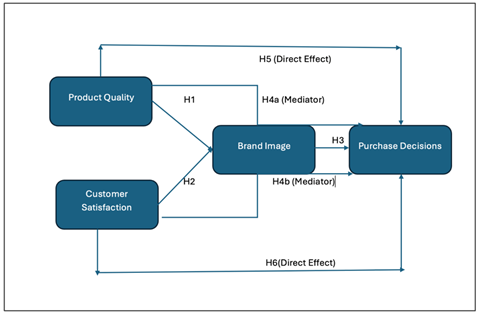
Figure 1 Conceptual Model Framework
The theoretical framework includes three mechanisms which have significance in consumer buying choices. First, it establishes direct impacts, which hold that product quality and customer satisfaction are independent and positively related to purchase decisions, which means that functional value plays an essential role in consumer assessment. Second, the model incorporates indirect or mediated effects, which indicate that product quality and customer satisfaction influence purchase decisions because of the brand image development as the important mediating variable between the functional attributes and the perceived value. Third, the model lays stress on an integrated influence that consumer choices are not made by solely functional determinants like quality and satisfaction but are highly influenced by perceptual and emotional determinants, including brand image and aesthetics. A combination of these processes offers a comprehensive view of the interaction of rational decision making and emotional perception to influence consumer behaviour.
The proposed model adds to the literature of the field by providing an integrated view that integrates conventional aspects of marketing, including quality of the product and customer satisfaction, with the findings of cultural and visual consumption theories, hence enriching the study of consumer behavior. It lays stress on the mediating importance of brand image, which shows how the functional attributes are subjected to the transformation of meaningful consumer perceptions that lead to purchase decision. Moreover, the model broadens the scope of consumer behavior that is based on utilitarianism to aesthetic and symbolic consumption contexts, which emphasize the significance of emotional, cultural, and experience aspects in developing the modern consumer decision-making process.
8. Hypotheses Development
The hypotheses of the current research are formulated on the basis of the developed theoretical underpinnings and the previous empirical knowledge of consumer behavior and marketing literature Kannan and Li (2017), Dwivedi et al. (2021). The model hypothesizes that the antecedents are product quality and customer satisfaction that determine consumer perceptions and behavioral consequences Bilgihan (2016), Shokouhyar et al. (2020). Quality of products helps improve the level of perceived value and trust, and customer satisfaction indicates positive consumption experiences, which can help to create a positive brand image Liu et al. (2017), Chaudhuri and Holbrook (2001), Park et al. (2017).
Table 1
|
Table 1 Hypotheses of the Study |
||
|
Hypothesis |
Statement |
Justification |
|
H1 |
Product Quality →
Brand Image |
Product quality plays a
crucial role in shaping consumers’ perceptions and evaluations of a brand.
High-quality products signal reliability, performance, and superiority, which
contribute to forming favorable brand associations. In visually driven markets,
aesthetic aspects of quality further enhance brand perception by creating
strong visual and emotional appeal. As consumers often rely on quality cues
to judge brands, superior product quality is expected to positively influence
brand image. |
|
H2 |
Customer Satisfaction
→ Brand Image |
Customer satisfaction
reflects the consumer’s post-consumption evaluation and significantly
contributes to brand perception. When consumers experience satisfaction, they
develop positive emotions and trust toward the brand, which strengthens brand
associations. Over time, repeated satisfactory experiences reinforce a
favorable brand image. Thus, higher levels of customer satisfaction are
expected to positively influence brand image. |
|
H3 |
Brand Image → Purchase
Decision |
Brand image serves as a
cognitive and emotional representation of a brand that influences consumer
behavior. A strong and positive brand image reduces perceived risk, enhances
trust, and simplifies decision-making. In addition, symbolic and aesthetic
associations attached to a brand make it more appealing to consumers.
Therefore, consumers with a favorable brand image are more likely to make
positive purchase decisions. |
|
H4 |
Brand Image mediates the
relationship between Product Quality, Customer Satisfaction, and Purchase
Decision |
Brand image acts as a
crucial intervening mechanism through which product quality and customer
satisfaction influence purchase decisions. While quality and satisfaction
directly affect consumer behavior, their impact is significantly enhanced
when they contribute to building a strong brand image. This mediation
reflects the transformation of functional and experiential evaluations into
perceptual and emotional responses, which ultimately drive purchase
decisions. |
|
H4a |
Brand Image mediates between
Product Quality and Purchase Decision |
Product quality influences
purchase decisions not only directly but also indirectly by shaping brand
image. High-quality products enhance brand credibility and perceived value,
which strengthens consumer confidence and leads to favorable decisions. Thus,
brand image mediates the relationship between product quality and purchase
decision. |
|
H4b |
Brand Image mediates between
Customer Satisfaction and Purchase Decision |
Customer satisfaction
contributes to purchase decisions through the development of a positive brand
image. Satisfied consumers tend to form strong emotional connections and
trust toward the brand, which enhances their likelihood of repurchase.
Therefore, brand image mediates the relationship between customer
satisfaction and purchase decision. |
|
H5 |
Product Quality →
Purchase Decision |
Product quality directly
influences purchase decisions by affecting consumers’ perceptions of value,
performance, and reliability. Consumers are more likely to choose products
that meet their expectations and offer superior quality. In addition,
high-quality products reduce perceived risk and increase confidence in the
decision-making process, leading to a positive impact on purchase decisions. |
|
H6 |
Customer Satisfaction
→ Purchase Decision |
Customer satisfaction
directly affects purchase decisions by fostering loyalty and repeat buying
behavior. Satisfied consumers are more likely to trust the brand and engage
in future purchases. Moreover, positive consumption experiences strengthen
behavioral intentions, making satisfaction a key determinant of purchase
decisions. |
The brand image, in its turn, is also instrumental in determining the purchase decision, as it lowers the uncertainty levels and enhances emotional and symbolic connections with the brand. Moreover, the research presupposes both the direct and indirect relationships, when the quality of products and customer satisfaction directly influence the purchase decision and indirectly affect the latter through the mediating factor of brand image. The integrated approach emphasizes the fact that consumer decision making is influenced by a mix of both functional and perceptual factors especially in the consumption situations that are visually and culturally enriched.
9. Discussion
The current conceptual research presents a synthesized view of consumer buying decision-making with the amalgamation of classic marketing constructs and cultural and visual consumption aspects. The suggested model indicates that the quality of products and customer satisfaction have a lot of direct and indirect influence on purchase decisions via brand image. This is consistent with the previous studies that high product quality contributes to perceived value and trust thus reinforcing consumer assessment Kato and Hoshino (2021). Likewise, positive attitudes can be reinforced by customer satisfaction as a post-consumption evaluation and lead to long-term relationships with the brand Nesset et al. (2021), Rather (2021).
One of the main contributions of this research is the role of brand image as a mediator. The framework implies that brand image converts functional and experiential inputs to meaningful perceptions upon which consumer behavior is directed. This confirms the existing research findings that brand image is a mental shortcut and decreases the perceived risk, making the process of making a decision easier Liu et al. (2017). In addition, brand image in visually and culturally rich settings is not only functional but symbolic and experiential, as it is about identity, aesthetics, and emotional resonance Murshed et al. (2023), Pereira et al. (2022).
The fact that cultural and visual consumption is included also adds another strength to the explanatory power of the model. Consumers are to a greater extent demanding products that are not only useful but also aesthetically pleasing and symbolic. This transition means that marketing efforts need to go beyond conventional features and add arts, visual, and cultural components to the marketing mix to increase interest and distinction. Therefore, the suggested framework offers a comprehensive insight into the interaction of cognitive, emotional, and cultural variables to determine the consumer buying behavior.
10. Implications and Limitations
10.1. Theoretical Implications
The given research adds to the current body of literature by incorporating several theoretical approaches, such as Theory of Planned Behavior (TPB), Expectation Confirmation Theory (ECT), Signoring Theory, and Stimulus-Organism-Response (S-O-R) model, into a single concept of consumer behavior. It builds on previous works by highlighting the mediating impact of brand image and integrating cultural and visual aspects into the conventional systems of marketing. Although previous research has mostly analyzed the two topics of product quality and customer satisfaction separately, the current research outlines the mutual impact of the two variables via brand image, thus providing a more in-depth concept of consumer decision-making. Moreover, the research fills the gap between marketing and arts-based consumption literature and offers a multidisciplinary approach to the literature which enriches both areas.
10.2. Practical Implications and Limitations
As a manager, the conclusions are that organizations need to take a balanced approach that focuses on functional excellence and experiential value. To gain trust and long-term relationships firms should pay attention to providing high quality of the products and consistent customer satisfaction. At the same time, marketers ought to invest in enhancing the brand image by using visual aesthetics, narration, and cultural fit. With personal care and cultural industries, where appearance and symbolic value are very important, the use of artistic features, novel design, and culturally specific branding methods can contribute greatly to consumer attraction and a positive effect on a purchasing decision. Nevertheless, regardless of these implications, there are some limitations of the study. Since it is a conceptual paper, the suggested framework has not been empirically validated, which can weaken its generalizability and require research in the future based on quantitative or mixed-method methods. Moreover, the research considers few constructs, product quality, customer satisfaction, and brand image, but other pertinent elements like price, social influence, and digital engagement are not included. The applicability may also be limited by the contextual interest in visual and cultural consumption, especially in the emerging markets. Additionally, the high dynamics of digital consumer behavior indicate that technology adoption, online interactions, and social media influence may be regarded as additional factors that should be taken into consideration in future research to help to enhance the model.
11. Conclusion and Future Scope
The current research constructs an elaborate conceptual model in order to interpret the consumer buying decisions integrating product quality, customer satisfaction, and brand image in a cultural and visual consumption environment. It emphasizes the fact that even though quality of the product and satisfaction of the customers are the key determinants of consumer behavior, the influence of the former is greatly enhanced by the mediating effect of the brand image that translates the functional and experiential assessment into a meaningful perception. The fact that the aesthetic, symbolic and cultural aspects are included also demonstrates the dynamic nature of consumer tastes in contemporary markets where emotion and experience value are playing a larger role in decision-making along with functional characteristics. The paper highlights the importance of having an integrated marketing strategy that would combine product superiority with a powerful brand image and cultural appeal. Based on this, it is possible to conduct future studies where the framework proposed will be empirically substantiated through the application of more sophisticated methods, including Structural Equation Modeling (SEM). Moreover, digital marketing, social media influence, brand trust, and consumer engagement should also be considered as additional variables that can contribute to the model. Comparative analysis of various market settings and qualitative research of visual and artistic consumption can contribute to a better understanding of consumer action, which would further interdisciplinary research in marketing and cultural analysis.
CONFLICT OF INTERESTS
None.
ACKNOWLEDGMENTS
None.
REFERENCES
Ajzen, I. (2020). The Theory of Planned Behavior: Frequently Asked Questions. Human Behavior and Emerging Technologies, 2(4), 314–324. https://doi.org/10.1002/hbe2.195
Algharabat, R., Rana, N. P., Alalwan, A. A., Baabdullah, A., and Gupta, A. (2020). Investigating the Antecedents of Customer Brand Engagement and Consumer-Based Brand Equity in Social Media. Journal of Retailing and Consumer Services, 53, 101767. https://doi.org/10.1016/j.jretconser.2019.01.016
Ali, F., Rasoolimanesh, S. M., Sarstedt, M., Ringle, C. M., and Ryu, K. (2018). An assessment of the use of Partial Least Squares Structural Equation Modeling (PLS-SEM) in Hospitality Research. International Journal of Contemporary Hospitality Management, 30(1), 514–538. https://doi.org/10.1108/IJCHM-10-2016-0568
Bilgihan, A. (2016). Gen Y Customer Loyalty in Online Shopping: An Integrated Model of Trust, User Experience, and Branding. Computers in Human Behavior, 61, 103–113. https://doi.org/10.1016/j.chb.2016.03.014
Bilro, R. G., Loureiro, S. M. C., and dos Santos, J. F. (2022). Masstige Strategies on Social Media: The Influence on Sentiments and Attitude Toward the Brand. International Journal of Consumer Studies, 46(4), 1113–1126. https://doi.org/10.1111/ijcs.12747
Chaudhuri, A., and Holbrook, M. B. (2001). The Chain of Effects from Brand Trust and Brand Affect to Brand Performance: The Role of Brand Loyalty. Journal of Marketing, 65(2), 81–93. https://doi.org/10.1509/jmkg.65.2.81.18255
Christ-Brendemühl, S., and Schaarschmidt, M. (2020). The Impact of Service Employees' Technostress on Customer Satisfaction and Delight: A Dyadic Analysis. Journal of Business Research, 117, 491–502. https://doi.org/10.1016/j.jbusres.2020.06.021
Dwivedi, Y. K., Ismagilova, E., Hughes, D. L., Carlson, J., Filieri, R., Jacobson, J., Jain, V., Karjaluoto, H., Kefi, H., Krishen, A. S., Kumar, V., Rahman, M. M., Raman, R., Rauschnabel, P. A., Rowley, J., Salo, J., Tran, G. A., and Wang, Y. (2021). Setting the Future of Digital and Social Media Marketing Research: Perspectives and research Propositions. International Journal of Information Management, 59, 102168. https://doi.org/10.1016/j.ijinfomgt.2020.102168
Ha, K. C., Song, R., and Erickson, G. (2021). Multidimensional Brand Equity and Asymmetric Risk. International Journal of Research in Marketing, 38(1), 1–15. https://doi.org/10.1016/j.ijresmar.2020.10.002
Hanaysha, J. R. (2022). Exploring the Impact of Social Media Marketing Features on Purchase Intention in the Fast-Food Industry. Metamorphosis: A Journal of Management Research, 21(2), 75–85. https://doi.org/10.1177/09726225221098792
Hoyer, W. D., Kroschke, M., Schmitt, B., Kraume, K., and Shankar, V. (2022). Transforming the Customer Experience through New Technologies. Journal of Interactive Marketing, 51, 57–71. https://doi.org/10.1016/j.intmar.2020.04.001
Kannan, P. K., and Li, H. (2017). Digital Marketing: A Framework, Review, and Research Agenda. International Journal of Research in Marketing, 34(1), 22–45. https://doi.org/10.1016/j.ijresmar.2016.11.006
Kato, R., and Hoshino, T. (2021). Unplanned Purchase of New Products. Journal of Retailing and Consumer Services, 59, 102397. https://doi.org/10.1016/j.jretconser.2020.102397
Liu, M. T., Wong, I. A., Tseng, T.-H., Chang, A. W.-Y., and Phau, I. (2017). Applying Consumer-Based Brand Equity in Luxury Hotel Branding. Journal of Business Research, 81, 192–202. https://doi.org/10.1016/j.jbusres.2017.06.014
Murshed, F., Dwivedi, A., and Nayeem, T. (2023). Brand Authenticity Building Effect of Brand Experience and Downstream Effects. Journal of Product and Brand Management. https://doi.org/10.1108/JPBM-02-2021-3377
Nesset, E., Bergem, O., Nervik, B., Sørlie, E. S., and Helgesen, Ø. (2021). Building Chain Loyalty in Grocery Retailing by Means of Loyalty Programs: A Study of the Norwegian Case. Journal of Retailing and Consumer Services, 60, 102450. https://doi.org/10.1016/j.jretconser.2021.102450
Nguyen, N., and LeBlanc, G. (2001). Corporate Image and Corporate Reputation in Customers' Retention Decisions in Services. Journal of Retailing and Consumer Services, 8(4), 227–236. https://doi.org/10.1016/S0969-6989(00)00029-1
Park, E., Kim, K. J., and Kwon, S. J. (2017). Corporate Social Responsibility as a Determinant of Consumer Loyalty: An Examination of Ethical Standard, Satisfaction, and Trust. Journal of Business Research, 76, 8–13. https://doi.org/10.1016/j.jbusres.2017.02.017
Pereira, T., Loureiro, S. M. C., and Sarmento, E. M. (2022). Achieving Brand Engagement and Brand Equity Through Co-Creation Process. Journal of Creative Communications, 17(3), 303–318. https://doi.org/10.1177/09732586221095618
Rather, R. A. (2021). Customer Brand Identification, Brand Loyalty, and Brand Commitment. Journal of Hospitality and Tourism Management, 47, 64–72. https://doi.org/10.1016/j.jhtm.2021.02.001
Sarkar, M., and De Bruyn, A. (2022). LSTM Response Models for Direct Marketing Analytics: Replacing Feature Engineering with Deep Learning. Journal of Interactive Marketing, 53(1), 80–95. https://doi.org/10.1016/j.intmar.2020.07.002
Septianto, F., Kemper, J. A., and Choi, J. (2020). The Power of Beauty? The Interactive Effects of Awe and Online Reviews on Purchase Intentions. Journal of Retailing and Consumer Services, 54, 102066. https://doi.org/10.1016/j.jretconser.2020.102066
Sheth, J. (2020). Impact of COVID-19 on Consumer Behavior: Will the Old Habits Return or Die? Journal of Business Research, 117, 280–283. https://doi.org/10.1016/j.jbusres.2020.05.059
Shokouhyar, S., Shokoohyar, S., and Safari, S. (2020). Research on the Influence of After-Sales Service Quality Factors on Customer Satisfaction. Journal of Retailing and Consumer Services, 56, 102139. https://doi.org/10.1016/j.jretconser.2020.102139
Verma, S., and Yadav, N. (2021). Past, Present, and Future of eWOM. Journal of Interactive Marketing, 53, 111–128. https://doi.org/10.1016/j.intmar.2020.07.001
Yadav, M. S., and Rahman, Z. (2018). The Influence of Social Media Marketing Activities on Customer Loyalty: A Study of E-Commerce Industry. Benchmarking: An International Journal, 25(9), 3882–3905. https://doi.org/10.1108/BIJ-05-2017-0092
|
|
 This work is licensed under a: Creative Commons Attribution 4.0 International License
© ShodhKosh 2026. All Rights Reserved.