ShodhKosh: Journal of Visual and Performing ArtsISSN (Online): 2582-7472
|
|
THE INTELLIGENT CANVAS: INTEGRATING AI ACROSS THE HR, MARKETING, LEGAL, AND FINANCIAL PILLARS OF MODERN VISUAL ARTS ORGANIZATIONS
Dr. Kiruthiga V 1
 ,
Dr. Umamaheswari S 2
,
Dr. Umamaheswari S 2 ,
Dr. Joyce R 3
,
Dr. Joyce R 3 ,
Dr. A. Geetha 4
,
Dr. A. Geetha 4
 ,
Dr. Rudhra TS 5
,
Dr. Rudhra TS 5 ,
Dr. Veena Christy 6
,
Dr. Veena Christy 6
1 Assistant
Professor, Faculty of Management, SRMIST, Ramapuram Part-Vadapalani, India
2 Associate
Professor, School of Management Studies, Sathyabama Institute of Science and
Technology Chennai, Tamil Nadu, South India
3 Associate Professor, School of
Management Studies, Sathyabama Institute of Science and Technology Chennai, Tamil
Nadu, South India
4 Associate Professor and Head, Department
of Business Administration, School of Commerce and Management, Bharath
Institute of Higher Education and Research, Chennai, India
5 Assistant Professor, Department of
English, Easwari Engineering College, Chennai Ramapuram, India
6 Assistant Professor, Directorate of
Online and Distance Education, SRM School of Management, SRM Institute of
Science and Technology, Chennai, India
|
|
|
ABSTRACT |
|
|
The fast
development of artificial intelligence (AI) is shifting the environment in
which the visual arts organizations are organized and operate, as more and
more of them implement the digital technologies in order to become more
creative, efficient, and appealing to their audience. Nevertheless, even with
the increased topicality of AI, its implementation in the arts industry is
still sporadic and mostly limited to separate functional areas. This paper
fills this gap by introducing the Intelligent Canvas framework, a
three-dimensional conceptual framework integrating AI into four main pillars
of an organization, namely human resource management, marketing, legal
governance, and financial management. Based on the established theoretical
lenses, such as the Resource-Based View, the Dynamic Capabilities Theory and
the models of technology adoption, the paper builds a comprehensive picture
of how AI can be used as an enabling and integrative process. The framework
also focuses on the use of AI to improve talent management, customized
marketing, the protection of intellectual property as well as in making
financial decisions alongside the significance of cross-functional
integration and ethical considerations. The paper adds to the literature by
applying AI studies to the under-researched domain of visual arts
organizations and providing a multi-dimensional solution to the digital
revolution. The suggested model offers important implications to the
researchers and practitioners who would like to use AI to achieve sustainable
expansion, innovation and organizational results in the creative industry. |
|||
|
Received 19 January 2026 Accepted 23 March
2026 Published 03 April 2026 Corresponding Author Dr
Kiruthiga V, kiruthiv@srmist.edu.in DOI 10.29121/shodhkosh.v7.i3s.2026.7413 Funding: This research
received no specific grant from any funding agency in the public, commercial,
or not-for-profit sectors. Copyright: © 2026 The
Author(s). This work is licensed under a Creative Commons
Attribution 4.0 International License. With the
license CC-BY, authors retain the copyright, allowing anyone to download,
reuse, re-print, modify, distribute, and/or copy their contribution. The work
must be properly attributed to its author.
|
|||
|
Keywords: Artificial Intelligence, Visual Arts Organizations,
Digital Transformation, Human Resource Management, AI Marketing, Legal
Governance |
|||



1. INTRODUCTION
The accelerated process of digitizing the visual arts industry has dramatically changed the way art is produced, distributed, and experienced as a practice of being tangible, physically restrained and containing practices, to being more dynamic and technological in nature. Virtual exhibitions, online archives, online markets, and other technologies have increased the accessibility and interaction with the audience, forcing companies to reconsider its strategic and operational structure Verhoff et al. (2021), Dwivedi et al. (2021). In the context of this change, artificial intelligence (AI) has become a vital facilitator, which can carry out sophisticated creative and analytical processes like artificial generation of works of art, media consumption pattern, and even prediction. AI is not only a more efficient tool but also tends to disrupt traditional concept of creativity and authorship, putting itself in the role of a collaborative partner in the creative process Jordan and Mitchell (2015), Elgammal et al. (2017). As it is emphasized in the given framework, the given technological change is reshaping the core framework of visual arts organizations by making data-driven decision-making a part and parcel of their operations Wamba et al. (2017), Brynjolfsson et al. (2021).
Moreover, AI is not solely applied to the creative production to other main pillars of an organization, such as human resource, marketing, legal governance, and financial management, and thus the overall functioning of an institution is altered. In HR, AI enables talent acquisition, performance assessment, and workforce planning based on predictive analytics, whereas in marketing, it helps to engage with people individually and adopt a personalized communication approach Dima et al. (2024), Jatobá et al. (2023). In a similar way, AI facilitates the enforcement of the law via protection of intellectual property and ensuring compliance, and financial management via forecasting, risk evaluation, and real-time analytics Ashley (2017), Gu et al. (2020). Nevertheless, even with these developments, the use of AI is still very disjointed in these areas, which curbs its strategic capacity. According to all the points highlighted in the text, the non-integration at the level of functional areas requires a more unified framework that could integrate these capabilities Murugesan et al. (2023).
The Intelligent Canvas framework, in that case, is an all-encompassing structure that places AI as a middle ground that integrates all organizational functions and allows them to be synergized, efficient, and innovative. The framework is based on theoretical insights, including the Resource-Based View and Dynamic Capabilities Theory, and conceptualizes the AI as some strategic resource that can increase the adaptability and competitive advantage of organizations Barney (1991), Teece (2018). AI can help visual arts organizations transition to a more interconnected and sustainable model by streamlining the flow of cross-functional data and establishing cross-functional decision-making. Finally, such integrative strategy does not only enhance the organizational performance but also promotes the future innovation and expansion in the changing digital and creative environment Benbya et al. (2020), Gadde (2025).
2. LITERATURE REVIEW
2.1. THEORETICAL FRAMEWORK
This research has a theoretical basis that builds on the combination of the Resource-Based View (RBV), the Dynamic Capabilities Theory, and technology adoption models to describe why artificial intelligence (AI) can revolutionize the visual arts organizations. According to RBV, competitive advantage of organizations is realized by the presence of valuable, rare, and inimitable resources, and AI can be seen as a strategic resource providing organizations with the ability to achieve competitive advantage and improve their performance Barney (1991). To add to that, Dynamic Capabilities Theory focuses on how organisations can implement evolving, integrating and restructuring internal and external capabilities in response to a quickly changing technological environment, with AI noted as a force of innovation and organisational flexibility Teece (2018). Also, TAM and the Theory of Planned Behavior (TPB) give some understanding of the behavioral and organizational determinants that affect the adoption of AI, such as the perception of usefulness, ease of use, and intention of adopting new technologies Venkatesh et al. (2003), Davis (1989), Ajzen (1991). All these theoretical perspectives provide an all-encompassing perspective to learn how AI operates as an integrative and enabling process in the realms of human resource, marketing, legal, and financial landscapes to contribute to the creation of the suggested Intelligent Canvas framework.
2.2. Artificial Intelligence and Digital Transformation
The artificial intelligence (AI) has become the cornerstone of digital transformation that can help organizations make the shift to data-driven and intelligent systems instead of the conventional mode of operating. Digital transformation refers to the incorporation of state-of-the-art technologies into organizational operations to improve their efficiency, innovativeness, and competitiveness Verhoef et al. (2021), Dwivedi et al. (2021). The AI, which is backed by machine learning and big data analytics, takes a pivotal role in this transformation, as it allows predictive capabilities, automation, and the improved decision maker Dwivedi et al. (2021). Researchers note that AI must be regarded as a competitive organizational asset and not a technological instrument Raisch and Krakowski (2021). This point of view is further reinforced by the increased relevance of data analytics and business intelligence as organizations become more and more dependent on data-driven insights during their strategic decision-making Chen et al. (2012). Also, the developments in machine learning and probabilistic modeling have widened the use of AI in industries Jordan and Mitchell (2015), Ghahramani (2015). In this regard, AI is playing an important role in the changes within organizations by boosting productivity, facilitating innovation, and redesigning the value creation processes Benbya et al. (2020), Brynjolfsson et al. (2021).
2.3. AI in Human Resource Management
The introduction of AI into the human resource management (HRM) field has shifted the conventional HR into more data and strategy based functions. Regarding efficiency and decision quality, AI technologies are actively applied in the recruitment, performance assessment, talent analytics, and workforce planning thus helping organizations to enhance their performance Stone et al. (2020). Studies emphasize that AI can be used to improve the HR ability by automating the regular processes and providing predictive analytics of employee performance and organizational demand Minbaeva (2021). HR analytics also contributes to this change by allowing HR to cease as an office to act as a strategic aspect of organizations Boudreau and Ziskin (2011). Nevertheless, fairness, prejudice, and transparency are also the issues that emerge in the context of the use of AI in HRM. Ethics deserve a special place, as AI systems can contribute to existing disparities in case they are not handled Binns (2018). These issues explain why responsible AI implementation is necessary, particularly in areas related to creativity where human talent and creativity are core aspects.
2.4. AI in Marketing and Customer Engagement
One of the most progressive spheres where AI is used is marketing because of the necessity to offer customers individual experience and use specific data to make decisions. Artificial intelligence helps companies to study the behavior of consumers, forecast their preferences, and provide tailored marketing Huang and Rust (2021), Wamba et al. (2017). Research indicates that AI increases the effectiveness of marketing by automating marketing, applying real-time analytics, and gaining a better understanding of customers Davenport et al. (2020). One of the ways to engage customers personally is through AI-based tools like recommendation systems or chatbots, which can enhance customer communication Kaplan and Haenlein (2019). Moreover, AI allows transitioning to personalized and interactive communication paradigm out of the traditional mass one Huang and Rust (2021). Within the context of the visual arts, these abilities apply specifically to the segmentation of the audience, online outreach, and visitor experience improvement, which will result in better engagement and institutional exposure.
2.5. AI in Legal Governance and Ethical Considerations
AI use in the legal field has brought along fresh opportunities of enhancing efficiency and accuracy in the legal procedures. The use of AI in legal analytics, contract analysis, and predicting the outcome of judicial cases increases Ashley (2017), Aletras et al. (2016). These technologies will allow organizations to handle complicated legal information and make better decisions in the regulatory context. The law in visual art is especially high because of the problem of intellectual property rights and copyright protection, as well as ownership of digital art. These issues are also complicated by the emergence of AI-created artworks, which casts a shade of doubt on the authorship and originality. The application of AI to the law and organization is largely an ethical issue. Researchers also note that fairness, accountability and transparency are important aspects to consider in AI systems Floridi et al. (2018). The notion of algorithmic bias and the necessity of ethical AI systems contribute to the need to have responsible governance in the adoption of AI Binns (2018), Dima et al. (2024).
2.6. AI in Financial Management
Artificial intelligence has advanced financial management practices in terms of accuracy and efficiency in addition to predictability. Financial forecasting, risk evaluation, and investment analysis are the most common areas where AI-driven models are applied Gu et al. (2020). These technologies can assist organizations in handling high amounts of financial information and extracting viable insights. Machine learning applications in finance have enhanced asset pricing model and have helped in making decisions in complex financial settings Heaton et al. (2016). Also, AI helps to improve financial efficiency through the automation process and minimizing human error. Financial sustainability is a sensitive issue in the visual arts organizations, and AI has the potential to enhance the budgeting, allocation of resources, and predicting revenue Gadde (2025). Nevertheless, the use of AI in financial management is expensive in terms of investment and technical knowledge that might be a challenge to smaller institutions.
2.7. AI, Work, and Organizational Implications
The implications of AI on work and organizational structures have been generally discussed in the literature. AI can be used to automatize the workflow and supplement the human capabilities, causing the job positions and skills demands to change Autor (2015), Acemoglu and Restrepo (2020). The effect of AI on productivity and organizational performance is also under research (cited in Cockburn 2018, Brynjolfsson et al. (2021) where AI is proved to increase efficiency and innovation. What is more, since the collaborative intelligence notion implies that AI capabilities can be optimally utilized when human and machine potentials are merged Wilson and Daugherty (2018). It is due to these developments that organizational structures and management practices require re-evaluation especially in industries which are creative in nature with human creativity being one of its main assets.
2.8. AI in Creative and Visual Arts
The use of AI in creative industries has greatly extended the scope of creativity and innovativeness in the production of art. Generative adversarial networks (GANs) are AI technologies that can produce original works of art, thus undermining the idea of creativity and authorship Elgammal et al. (2017). Studies indicate that AI could complement the human creative process by introducing new tools and new ways of thinking through offering a fresh perspective to the creative process Epstein et al. (2020). The application of AI in visual arts organizations is growing in terms of curatorial practice, analysis of the audience, and digital exhibitions. Nonetheless, the use of AI in visual art is not completely uniform, which points to the necessity of a more coherent and coordinated approach toward the use of AI across the organizational functions Murugesan et al. (2023).
3. RESEARCH GAP
Current artificial intelligence (AI) literature is mostly siloed, being concerned with how AI can be applied to specific areas of activity, including human resource management, marketing, legal systems, and finance, but does not consider how all of them relate to each other Stone et al. (2020), Davenport et al. (2020), Gu et al. (2020). This disjointed thinking restricts the insight into the role of AI as an integrative organizational power. Moreover, whereas digital transformation research focuses on the strategic purpose of AI Dwivedi et al. (2021), Verhoef et al. (2021), a small amount of research is conducted in terms of visual arts organizations that can work on the intersections of creativity, culture, and management. The current literature of creative industries encompasses efforts aimed at AI-computed art and creativity, with little consideration of the other aspects of an organization Elgammal et al. (2017). Also, the discussion of ethics and governance is still functional and is not often included in an overall organizational structure Floridi et al. (2018). Thus, it is obvious that a comprehensive conceptual framework is required and should incorporate AI in the areas of HR, marketing, legal, and financial pillars. To fill this gap, the current paper presents the Intelligent Canvas model, where AI is considered a layer of integration to make visual art institutions deliver on organisational performance and innovation.
4. PROBLEM STATEMENT AND OBJECTIVES
Although the use of artificial intelligence (AI) in industries has been growing, its use in organizations of visual arts has been divided and highly separated in functions that are isolated as marketing analytics or creative production, therefore unable to fully apply AI to transform the entire organization. The current studies are largely siloed and do not touch the concept on how AI is malleable to be strategically incorporated into the critical pillars of functionalities, such as human resource management, marketing, legal governance, and financial management. This failure to understand the integrated opportunity poses a problem to visual arts organizations in terms of using AI to bolster efficiency, innovation, and sustainability. To this end, this paper focuses on the creation of a unified conceptual architecture, dubbed the Intelligent Canvas that would place AI as an integrative and facilitating layer in these fundamental areas. In particular, the study aims at analyzing the role of AI in every functional pillar, the interrelations between them, and suggest a multidimensional model that would improve organizational performance and aid strategic decision-making in contemporary visual arts institutions.
5. METHODOLOGY
In this paper, the conceptual research design will be implemented in order to create a holistic model of implementing artificial intelligence (AI) throughout the functional pillars of visual arts organizations. In contrast to empirical research, the current study is founded on a comprehensive and rigorous search of the literature available in the field of AI and digital transformation and its implementation in the human resource management, marketing, law, and financial management. Peer-reviewed journal articles, books, and scholarly sources that were relevant were identified and analysed to synthesise the main concepts, theoretical perspectives, and trends. The researchers utilize a theory-building method combining the knowledge about the Resource-Based View (RBV), Dynamic Capabilities Theory, and technology adoption theories like TAM and TPB to create an effective theoretical framework. It is based on this synthesis that a conceptual framework, which is termed the Intelligent Canvas, is put forward to demonstrate the integrative nature of AI within the organizational domains. The research design focuses on the qualitative synthesis and reasoning with the purpose of overcoming the lack of coherence in the literature and offering a comprehensive perspective on the AI-driven change in the organization of visual art.
6. CONCEPTUAL MODEL AND FRAMEWORK: THE INTELLIGENT CANVAS
6.1. Overview of the Intelligent Canvas Framework
Intelligent Canvas framework frames artificial intelligence (AI) as a focal layer of integration that unites and augments the main functional pillars of visual arts organizations, i.e. human resource management, marketing, legal governance, and financial management. This framework places AI at the center of coordinating data to integrate these domains unlike the traditional models where these domains are considered separately. The framework is based on the assumption that AI would facilitate organizations shift their fragmented decision-making to a system that is more interrelated in a way that knowledge of one domain can be used to inform and optimize other domains. This is especially important in visual arts organizations, where the areas of creativity, audience participation, legal complexity, and financial sustainability are highly dependent.
Figure 1
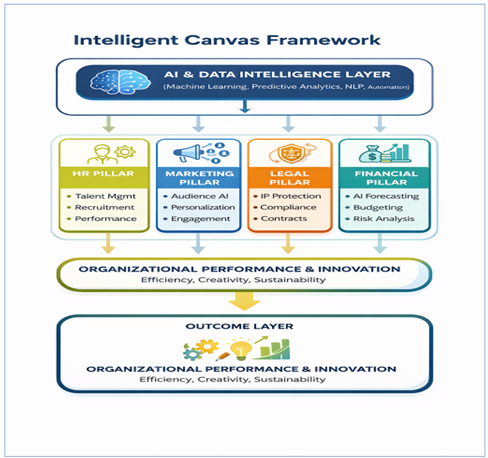
Figure 1
Framework of the
Study
The Intelligent Canvas framework conceptual model establishes artificial intelligence (AI) as a pivotal intelligence layer that spurs the integration of essential functional pillars of visual arts organizations. The AI layer and data intelligence is the central enabler, and it integrates technologies of machine learning, predictive analytics, and natural language processing to gather, process, and analyze large amounts of organization data. This layer will turn the traditional decision-making process into the process based on data and prediction, which will increase the organization agility and responsiveness Dwivedi et al. (2021), Jordan and Mitchell (2015). As an intelligent engine, AI can also promote a smooth flow of information throughout the organization, meaning that knowledge created in one area can be used in the others, which is consistent with the idea of AI as a strategic organizational competence Raisch and Krakowski (2021).
On operational level, the framework incorporates four pillars of core which are human resource management, marketing, legal governance and financial management all of which are improved and enhanced by AI-driven applications. Artificial intelligence in HR is helpful in talent recruitment, analytics of performance, and workforce planning, allowing managing creative human resources more efficiently Stone et al. (2020). AI in marketing provides an opportunity to interact with the audience more personally, analyze potential behavior by prediction, and deploy targeted communication strategies to reach out to a greater number of people and be more visible to the institution Davenport et al. (2020), Huang and Rust (2021). Intellectual property tracking, copyright safeguarding, and compliance mechanisms are some of the areas that the legal pillar can be positively impacted by AI and that can now be seen as essential especially in relation to digital and AI-created art Ashley (2017), Floridi et al. (2018). Equally, AI can boost forecasting, budgeting, and risk assessment in financial management, as well as, increase financial sustainability and accuracy of decisions Gu et al. (2020). These pillars are not standalone but and through AI-driven data flows are interrelated and work together, producing synergistic effects within the organization.
The result layer indicates strategic influences of this integrated system where there is improved performance of the organization, innovation, operational efficiency and sustainable growth. The theoretical foundations of the framework are the Resource-Based View and Dynamic Capabilities Theory, which places AI as a resource that is of great value and difficult to find and is capable of making the organization flexible and competitive Barney (1991), Teece (2018). Besides, technology adoption theories like TAM and TPB describe the role of the organizational readiness and user acceptance in the successful introduction of AI systems Venkatesh et al. (2003), Ajzen (1991). This innovative combination is in the fact that it does not focus on fragmented and silo-based AI applications, but as an all-encompassing multi-pillar approach to integration, especially in the under-researched area of visual arts organizations. The framework presents a single conceptualization of AI as an Intelligent Canvas that integrates creativity, technology, and management to transform an organization on a long-term basis Benbya et al. (2020).
7. PROPOSITIONS AND HYPOTHESES
Table 1
|
Table 1 Propositions and Hypotheses of Study |
|||
|
Proposition / Hypothesis
Code |
Statement |
Linked Pillar |
Expected Outcome |
|
P1 / H1 |
Artificial Intelligence
adoption positively influences the effectiveness of human resource management
in visual arts organizations. |
HR Pillar |
Improved talent acquisition,
performance management, and skill development |
|
P2 / H2 |
AI-driven systems
significantly enhance marketing capabilities by enabling personalized
audience engagement and predictive analytics. |
Marketing Pillar |
Increased audience reach,
engagement, and brand visibility |
|
P3 / H3 |
The integration of AI
improves legal governance by strengthening intellectual property protection
and regulatory compliance. |
Legal Pillar |
Enhanced copyright
protection and reduced legal risks |
|
P4 / H4 |
AI adoption positively
impacts financial management through improved forecasting, budgeting, and
risk assessment. |
Finance Pillar |
Greater financial efficiency
and sustainability |
|
P5 / H5 |
The integration of AI across
multiple functional pillars leads to synergistic improvements in overall
organizational performance. |
Cross-functional Integration |
Enhanced efficiency,
innovation, and strategic alignment |
|
P6 / H6 |
The effectiveness of AI in
visual arts organizations is positively influenced by organizational
readiness and technology acceptance. |
Adoption Factor (TAM/TPB) |
Higher adoption rates and
successful implementation |
|
P7 / H7 |
Ethical AI practices
positively moderate the relationship between AI adoption and organizational
outcomes. |
Legal/Ethical Dimension |
Improved trust,
transparency, and governance |
|
P8 / H8 |
Cross-functional data
integration mediated by AI enhances decision-making quality across
organizational pillars. |
AI Core Layer |
Better coordination and
informed strategic decisions |
The suggested propositions put forward jointly clarify the integrative value of the artificial intelligence (AI) in the Intelligent Canvas system through connecting its effect on the main pillars of the organization. The use of AI will improve human resource management by creating more talent recruiting, performance appraisal, and skill improvement based on data-driven insights. Likewise, in marketing, AI allows customizing the audience, predictive analytics, and personalized communication, which enhances the coverage and institutional appearance. Regarding the legal aspect, AI contributes to the protection of intellectual property, adherence, and contract administration, minimizing the legal risks and improving governance. AI can help enhance financial efficiency and sustainability by making financial management forecasts, budgets, and risk assessment more accurate in financial management. In addition to the functions of each pillar, the prevalence of AI in these pillars is suggested to produce synergy, which results in better organizational performance, innovation, and strategic alignment. Moreover, organizational readiness and technology acceptance factors contribute to the effectiveness of AI implementation, whereas ethical practices of AI moderately affect it because they contribute to transparency, trust, and accountability. Lastly, cross-functional data integration based on AI enables improved decision-making, which strengthens the argument that it is a core facilitator of holistic organizational change in visual arts organizations.
8. DISCUSSION
The results of this research point to the importance of artificial intelligence (AI) as a strategic and integrative capability in visual arts organizations. In line with the literature on digital transformation, AI improves efficiency, decision-making, and innovation through the ability to facilitate data-driven processes Dwivedi et al. (2021), Raisch and Krakowski (2021). On the functional level, AI enhances human resource management in terms of talent analytics Stone et al. (2020), reinforces marketing with the help of personalizing and speaking to the audience Davenport et al. (2020), Huang and Rust (2018), supports legal governance by protecting intellectual property Ashley (2017), and improves financial decision-making with the assistance of predictive analytics Gu et al. (2020). Notably, the paper notes that the potential of this AI is cross-functional integration, which will give the chance to achieve the synergy, enhance the coordination and the performance of the organization. It goes hand in hand with the opinion that AI can be perceived as a strategic tool and engine of dynamic capabilities Benbya et al. (2020), Teece (2018). Also, the successful implementation depends on organizational preparedness and ethical practices of AI, which underscores the need to adopt AI responsibility and management Venkatesh et al. (2003), Floridi et al. (2018). All in all, AI can be seen as an intelligent canvas that incorporates various organizational territories, which allows visual arts organizations to reach a new level of efficiency, novelty, and sustainable development.
9. IMPLICATIONS AND LIMITATIONS
The work has valuable theoretical and practical implications. It is theoretically based on an extension of the literature on the field of artificial intelligence (AI) and digital transformation, offering an integrated, multi-pillar framework the Intelligent Canvas that goes beyond silo-based strategies and introduces AI as a strategic organizational capability Raisch and Krakowski (2021), Teece (2018). It is also a part of the small amount of research on AI in visual arts organizations, filling in the gap between management theory and creative industries.
Practically, the framework suggests that managers and policymakers in institutions of visual arts should use it to show how AI may be systematically used in human resource, marketing, legal, and financial functions. It emphasizes on cross-functional integration, readiness of the organization, and ethical AI implementation to increase efficiency, audience-engagement, governance, and financial sustainability Dwivedi et al. (2021), Floridi et al. (2018).
In spite of its contribution the study has its limitations. To start with it is a conceptual research and lacks empirical testing and thus cannot be applied to other organizational or context. Second, the framework is highly concentrated on the visual arts organizations which can limit its application in other industries without tailoring. Third, the research is based on the existing literature that might leave behind the fast-changing AI technologies and practices. Lastly, organizational culture, resource limitations, and technological infrastructure that can affect the adoption of AI are not discussed in detail, indicating that the issue requires more empirical research.
10. CONCLUSION AND SCOPE FOR FUTURE RESEARCH
Finally, this paper has conceptualized artificial intelligence (AI) as an Intelligent Canvas that significantly brings together and improves the fundamental function pillars of visual arts organizations such as human resource management, marketing, legal governance, and financial management, which will ultimately allow organizations to increase their efficiency, innovation, and performance. When shifting away from fragmented, capability-specific conceptualizations, the proposed framework lends AI the strategic significance of coming together and providing a transformative capability to the creative industry. The research can also benefit theory and practice because it presents a comprehensive view of the AI-mediated organizational change within the visual arts institutions. But, as a conceptual model, it has to be empirically tested in terms of applicability. Hence, it is necessary that future studies should be aimed at validating the framework proposed by means of quantitative and qualitative research, investigate the variations peculiar to the sector, and consider other influencing and shaping factors like the organizational culture, technological preparedness, and ethical governance. It can also be further researched as to cross country comparisons and the dynamic input of up and coming AI technologies in future creative industries.
CONFLICT OF INTERESTS
None.
ACKNOWLEDGMENTS
None.
REFERENCES
Acemoglu, D., and Restrepo, P. (2020). Robots and Jobs: Evidence from US Labor Markets. Journal of Political Economy, 128(6), 2188–2244. https://doi.org/10.1086/705716
Agrawal, A. K., Gans, J. S., and Goldfarb, A. (2018). Exploring the Impact of Artificial Intelligence: Prediction Versus Judgment (NBER Working Paper No. 24626). National Bureau of Economic Research. https://doi.org/10.3386/w24626
Ajzen, I. (1991). The Theory of Planned Behavior. Organizational Behavior and Human Decision Processes, 50(2), 179–211. https://doi.org/10.1016/0749-5978(91)90020-T
Aletras, N., Tsarapatsanis, D., Preoțiuc-Pietro, D., and Lampos, V. (2016). Predicting Judicial Decisions of the European Court of Human Rights: A Natural Language Processing Perspective. PeerJ Computer Science, 2, e93. https://doi.org/10.7717/peerj-cs.93
Ashley, K. D. (2017). Artificial Intelligence and Legal Analytics. Cambridge University Press. https://doi.org/10.1017/9781316761380
Autor, D. H. (2015). Why are There Still so Many Jobs? The History and Future of Workplace Automation. Journal of Economic Perspectives, 29(3), 3–30. https://doi.org/10.1257/jep.29.3.3
Barney, J. (1991). Firm Resources and Sustained Competitive Advantage. Journal of Management, 17(1), 99–120. https://doi.org/10.1177/014920639101700108
Benbya, H., Davenport, T. H., and Pachidi, S. (2020). Artificial Intelligence in Organizations: Current State and Future Opportunities. MIS Quarterly Executive, 19(1), 9–21. https://doi.org/10.2139/ssrn.3741983
Bessen, J. E. (2017). AI and Jobs: The Role of Demand. SSRN Electronic Journal. https://doi.org/10.2139/ssrn.3078715
Binns, R. (2018). Fairness in Machine Learning: Lessons from Political Philosophy. In Proceedings of the 1st Conference on Fairness, Accountability and Transparency (Proceedings of Machine Learning Research, Vol. 81,149–159).
Brynjolfsson, E., and McAfee, A. (2017, July 18). The Business of Artificial Intelligence. Harvard Business Review.
Brynjolfsson, E., Rock, D., and Syverson, C. (2021). The Productivity J-Curve: How Intangibles Complement General Purpose Technologies. American Economic Journal: Macroeconomics, 13(1), 333–372. https://doi.org/10.1257/mac.20180386
Chen, H., Chiang, R. H. L., and Storey, V. C. (2012). Business Intelligence and Analytics: From Big Data to Big Impact. MIS Quarterly, 36(4), 1165–1188. https://doi.org/10.2307/41703503
Cockburn, I. M., Henderson, R., and Stern, S. (2019). The Impact of Artificial Intelligence on Innovation: An Exploratory Analysis. In A. Agrawal, J. Gans, and A. Goldfarb (Eds.), The Economics of Artificial Intelligence: An Agenda (115–146). University of Chicago Press. https://doi.org/10.7208/chicago/9780226613475.003.0004
Davenport, T. H., Guha, A., Grewal, D., and Bressgott, T. (2020). How Artificial Intelligence Will Change the Future of Marketing. Journal of the Academy of Marketing Science, 48(1), 24–42. https://doi.org/10.1007/s11747-019-00696-0
Davis, F. D. (1989). Perceived Usefulness, Perceived Ease of Use, and User Acceptance of Information Technology. MIS Quarterly, 13(3), 319–340. https://doi.org/10.2307/249008
Dima, J., Gilbert, M.-H., Dextras-Gauthier, J., and Giraud, L. (2024). The Effects of Artificial Intelligence on Human Resource Activities and the Roles of the Human Resource Triad: Opportunities and Challenges. Frontiers in Psychology, 15, 1360401. https://doi.org/10.3389/fpsyg.2024.1360401
Dwivedi, Y. K., Hughes, L., Ismagilova, E., Aarts, G., Coombs, C., Crick, T., Duan, Y., Dwivedi, R., Edwards, J., Eirug, A., Galanos, V., Ilavarasan, P. V., Janssen, M., Jones, P., Kar, A. K., Kizgin, H., Kronemann, B., Lal, B., Lucini, B., Medaglia, R., Le Meunier-FitzHugh, K., Le Meunier-FitzHugh, L. C., Misra, S., Mogaji, E., Sharma, S. K., Singh, J. B., Raghavan, V., Raman, R., Rana, N. P., Samothrakis, S., Spencer, J., Tamilmani, K., Tubadji, A., Walton, P., and Williams, M. D. (2021). Artificial Intelligence (AI): Multidisciplinary Perspectives on Emerging Challenges, Opportunities, and Agenda for Research, Practice and Policy. International Journal of Information Management, 57, 101994. https://doi.org/10.1016/j.ijinfomgt.2019.08.002
Elgammal, A., Liu, B., Elhoseiny, M., and Mazzone, M. (2017). CAN: Creative Adversarial Networks, Generating “Art” by Learning About Styles and Deviating from Style Norms. arXiv. https://doi.org/10.48550/arXiv.1706.07068
Epstein, Z., Hertzmann, A., Herman, L., Mahari, R., Frank, M., Groh, M., Schroeder, H., Smith, A., Akten, M., Fjeld, J., Farid, H., Leach, N., Pentland, A., and Russakovsky, O. (2023). Art and the Science of Generative AI: A Deeper Dive. arXiv. https://doi.org/10.48550/arXiv.2306.04141
Floridi, L., Cowls, J., Beltrametti, M., Chatila, R., Chazerand, P., Dignum, V., Luetge, C., Madelin, R., Pagallo, U., Rossi, F., Schafer, B., Valcke, P., and Vayena, E. (2018). AI4People—An Ethical Framework for a Good AI Society: Opportunities, Risks, Principles, and Recommendations. Minds and Machines, 28(4), 689–707. https://doi.org/10.1007/s11023-018-9482-5
Gadde, S. (2025). Artificial Intelligence Integration in HR and Finance: A Framework for Strategic Transformation. International Journal of Scientific Research in Computer Science. https://doi.org/10.32628/CSEIT25112781
Ghahramani, Z. (2015). Probabilistic Machine Learning and Artificial Intelligence. Nature, 521(7553), 452–459. https://doi.org/10.1038/nature14541
Gu, S., Kelly, B., and Xiu, D. (2020). Empirical Asset Pricing Via Machine Learning. Review of Financial Studies, 33(5), 2223–2273. https://doi.org/10.1093/rfs/hhaa009
Heaton, J. B., Polson, N. G., and Witte, J. H. (2016). Deep Learning in Finance. arXiv. https://doi.org/10.48550/arXiv.1602.06561
Huang, M.-H., and Rust, R. T. (2018). Artificial Intelligence in Service. Journal of Service Research, 21(2), 155–172. https://doi.org/10.1177/1094670517752459
Huang, M.-H., and Rust, R. T. (2021). A Strategic Framework for Artificial Intelligence in Marketing. Journal of the Academy of Marketing Science, 49(1), 30–50. https://doi.org/10.1007/s11747-020-00749-9
Jarrahi, M. H. (2018). Artificial Intelligence and the Future of Work: Human–AI Symbiosis in Organizational Decision Making. Business Horizons, 61(4), 577–586. https://doi.org/10.1016/j.bushor.2018.03.007
Jatobá, M. N., Ferreira, J. J., Fernandes, P. O., and Teixeira, J. P. (2023). Intelligent Human Resources for AI Adoption: A Systematic Literature Review. Journal of Organizational Change Management. https://doi.org/10.1108/JOCM-03-2022-0075
Jordan, M. I., and Mitchell, T. M. (2015). Machine Learning: Trends, Perspectives, and Prospects. Science, 349(6245), 255–260. https://doi.org/10.1126/science.aaa8415
Kaplan, A., and Haenlein, M. (2019). Siri, Siri, in my Hand: Who’s the Fairest in the Land? On the Interpretations, Illustrations, and Implications of Artificial Intelligence. Business Horizons, 62(1), 15–25. https://doi.org/10.1016/j.bushor.2018.08.004
Minbaeva, D. (2021). Disrupted HR? Human Resource Management Review, 31(4), 100820. https://doi.org/10.1016/j.hrmr.2020.100820
Murugesan, U., Subramanian, P., Srivastava, S., and Dwivedi, A. (2023). A Study of Artificial Intelligence Impacts on Human Resource Digitalization in Industry 4.0. Decision Analytics Journal, 7, 100249. https://doi.org/10.1016/j.dajour.2023.100249
Mwita, K. M., and Kitole, F. A. (2025). Potential Benefits and Challenges of Artificial Intelligence in Human Resource Management in Public Institutions. Discover Global Society, 3, 35. https://doi.org/10.1007/s44282-025-00175-8
Palos-Sánchez, P. R., Baena-Luna, P., Bădică, A., and Infante-Moro, J. C. (2022). Artificial Intelligence and Human Resources Management: A Bibliometric Analysis. Applied Artificial Intelligence, 36(1), e2145631. https://doi.org/10.1080/08839514.2022.2145631
Raisch, S., and Krakowski, S. (2021). Artificial Intelligence and Management: The Automation–Augmentation Paradox. Academy of Management Review, 46(1), 192–210. https://doi.org/10.5465/amr.2018.0072
Stone, D. L., Deadrick, D. L., Lukaszewski, K. M., and Johnson, R. (2020). Artificial Intelligence in Human Resource Management: Challenges and a Path Forward. Human Resource Management Review, 30(1), 100679. https://doi.org/10.1016/j.hrmr.2019.100679
Teece, D. J. (2018). Business Models and Dynamic Capabilities. Long Range Planning, 51(1), 40–49. https://doi.org/10.1016/j.lrp.2017.06.007
Venkatesh, V., Morris, M. G., Davis, G. B., and Davis, F. D. (2003). User Acceptance of Information Technology: Toward a Unified View. MIS Quarterly, 27(3), 425–478. https://doi.org/10.2307/30036540
Verhoef, P. C., Broekhuizen, T., Bart, Y., Bhattacharya, A., Dong, J. Q., Fabian, N., and Haenlein, M. (2021). Digital Transformation: A multidisciplinary reflection and research agenda. Journal of Business Research, 122, 889–901. https://doi.org/10.1016/j.jbusres.2019.09.022
Wamba, S. F., Gunasekaran, A., Akter, S., Ren, S. J.-F., Dubey, R., and Childe, S. J. (2017). Big Data Analytics and Firm Performance: Effects of Dynamic Capabilities. Journal of Business Research, 70, 356–365. https://doi.org/10.1016/j.jbusres.2016.08.009
Wilson, H. J., and Daugherty, P. R. (2018). Collaborative Intelligence: Humans and AI are Joining Forces. Harvard Business Review. https://doi.org/10.2139/ssrn.3178371
|
|
 This work is licensed under a: Creative Commons Attribution 4.0 International License
© ShodhKosh 2026. All Rights Reserved.