ShodhKosh: Journal of Visual and Performing ArtsISSN (Online): 2582-7472
|
|
Impact of Faculty Design-Thinking Training on Teaching Effectiveness in Engineering Colleges in Chennai: The Mediating Roles of Design-Thinking Self-Efficacy and Institutional Support
R. Hepsiba
Beula 1 , Dr. M. Radhakrishnan 2
1 Research
Scholar, Department of Management Studies, St. Peter’s Institute of Higher
Education and Research, Chennai, India
2 Supervisor,
Department of Management Studies, St. Peter’s Institute of Higher Education and
Research, Chennai, India
|
|
|
ABSTRACT |
|
|
The trend
towards more innovative and industry-relevant engineering education has
required the shift towards learner-focused pedagogy. Design thinking has
become one of the potent models to help improve creativity, problem-solving,
and learning through experiences in higher education. This paper examines the
effects of faculty design-thinking training on teaching efficacy in
engineering colleges in Chennai with specific attention to the mediating
variables (design thinking self efficacy and
institutional support). The research design used was quantitative and primary
data used was the faculty members through a structured questionnaire.
Structural Equation Modeling (SEM) was employed to analyze the data in order
to test both direct and indirect links among the variables. The results
indicate that teaching effectiveness is positively affected significantly by
faculty design-thinking training. Also, the mediating power of
design-thinking self-efficacy was identified, showing that faculty confidence
in the implementation of the design-thinking principles is another essential
factor in the improvement of the teaching practice. Significant mediating
role was also indicated with the institutional support which is critical to
note the need of organizational encouragement, resources and professional
development opportunities in enabling the innovation teaching. These findings
affirm the fact that individual and institutional factors are the partial
mediators of the relationship existing between training and teaching effectiveness.
The current study adds value to the current body of literature since it
offers a holistic framework, which emphasizes that faculty development,
psychological preparedness, and organizational support are connected to
teaching efficacy in engineering education. The results have practical
implications on policy makers and educational institutions to establish
efficient faculty development programs and create facilitative institutional
settings. |
|||
|
Received 16 January 2026 Accepted 10 March
2026 Published 03 April 2026 Corresponding Author R. Hepsiba Beula, shynideva123@gmail.com DOI 10.29121/shodhkosh.v7.i3s.2026.7398 Funding: This research
received no specific grant from any funding agency in the public, commercial,
or not-for-profit sectors. Copyright: © 2026 The
Author(s). This work is licensed under a Creative Commons
Attribution 4.0 International License. With the
license CC-BY, authors retain the copyright, allowing anyone to download,
reuse, re-print, modify, distribute, and/or copy their contribution. The work
must be properly attributed to its author.
|
|||
|
Keywords: Design Thinking, Teaching Effectiveness, Faculty
Training, Self-Efficacy, Institutional Support, Engineering Education,
Structural Equation Modeling (SEM) |
|||



1. INTRODUCTION
The swift transformation of the engineering education in the 21 st century has prompted the paradigm shift between the traditional and lecture-based teaching techniques to the more innovative, learner-centered teaching techniques. As the focus on employability, innovation, and solving problems across disciplines increases, institutions of engineering are being pressured to provide students with more than just technical knowledge: they have to offer critical thinking, creativity, and problem-solving skills in the real world, among others. In that regard, design thinking has become an effective model that is able to shift the teaching and learning approaches in becoming engineering learners. Design thinking is a human-centered, repetitive methodology and aims at comprehending user desires, redefining problems, creating innovative solutions, and testing prototypes. It was originally founded on the design and innovation disciplines and has become very popular in education as a tool to promote experiential learning and innovation. Design thinking promotes active learning and working together, as well as practical problem-solving, in the engineering classroom, which improves student engagement and learning performance. Consequently, faculty members contribute significantly to the incorporation of the principles of design-thinking in their teaching practices Abolhasani et al. (2021).
Training informal faculty development programs on design-thinking competencies have gained relevance in the higher education. Such programs equip teachers with the knowledge, tools and techniques needed to redesign their teaching methodologies. In the process of such training, the faculty members are introduced to novel approaches in instruction such as problem-based learning, project-based learning and collaborative learning spaces. Therefore, faculty trained will be positioned in a better position to develop dynamic and interactive learning classrooms that enhance deeper learning and student-based education. Teaching effectiveness, being an important indicator of educational quality, has many dimensions in it, including instructional clarity, student engagement, curriculum innovation, and learning outcomes. Effective teaching is of special importance in engineering colleges because it directly affects the possession of practical issues of students to relate the theoretical one. Classroom learning approaches that tend to be more passive in their knowledge delivery might not equip students effectively to the nature of modern day engineering tasks Aflatoony et al. (2018), Albay and Eisma (2021). Thus, the necessity to implement new teaching strategies improving the quality and efficiency of the teaching process increases. Design-thinking self-efficacy is one of the most important factors that have an impact on the successful implementation of the design-thinking pedagogy. Self-efficacy describes how a person believes that he/she can successfully complete certain tasks. Design-thinking self-efficacy in faculty development context indicates the confidence of educators to implement the design-thinking principles in their teaching activities. When the faculty has a greater self-efficacy, they tend to explore new ways of teaching, to resolve the challenges faced and to maintain the new innovations in classroom. The training programs are crucial in developing this self-efficacy as it offers practical experiences and reflective learning.
Besides individual-level elements, institutional support is very important in supporting the adoption of the new-fangled teaching methods. Administrative encouragement, access to resources, professional development opportunities, as well as a culture that fosters experimentation and innovation all make up institutional support. Colleges that also embrace faculty-development programs in an active way provide a facilitating environment within engineering colleges where faculty members can use design-thinking techniques successfully. The absence of an institutional support, on the other hand, may impair translation of the training into the practice and constrain the possible effects of such initiatives on teaching effectiveness. Although design thinking is increasingly being acknowledged in the education field, empirical studies, which investigate the effect of design thinking in teaching especially in engineering colleges in Chennai Grau and Rockett (2022), are still lacking. As one of the leading educational centers in India, Chennai is home to a great number of engineering institutions that are currently struggling to improve the quality of provided education and keep up with the industry standards. Nevertheless, little research has been done regarding the degree to which training faculty members in design thinking can affect the effectiveness of teaching in this local setting. Moreover, even though the past research has examined the role of faculty training and teaching efficacy, little emphasis has been on mediating processes in which such effects can be realized. In particular, the mediating role of design-thinking self-efficacy and institutional support in the faculty training-teaching effectiveness relationship is a little-studied topic. These mediating factors are critical to understand in order to create holistic faculty development programs and institutional plans to derive the maximum out of design-thinking training Aris et al. (2022).
Consequently, the purpose of the research is to examine the effects of faculty training in design-thinking on the efficiency of teaching in engineering colleges in Chennai and especially on the mediating effects of design-thinking self-efficacy and institutional support. By synthesizing these variables into one concerted conceptual framework, it is hoped that the study will yield more profound underpinning on how faculty training can be translated into better teaching practices. The results of the current study are likely to add to the body of knowledge and provide the practical implications to the policymakers, schools, and faculty development programs. Overall, the study fills a vertical gap in the engineering education field as it focuses on faculty training, self-efficacy, institutional support, and teaching effectiveness. Since the higher education institutions are still evolving to meet the evolving educational and industrial needs, the integration of design-thinking pedagogy and creation of favorable institutional structures will play a pivotal role in improving the overall quality of engineering education Baker and Moukhliss (2020).
2. Literature Review
The concept of applying design thinking to teaching engineering has received a broad amount of attention over the last few years because of its possible impact on the development of creativity, problem-solving abilities, and the learner-focused pedagogical approach. Design thinking is a concept that emerged in fields like product design and innovation management and has redesigned into an extensively applied approach in education to improve the performance of teaching and learners. This section is a review of the literature on design-thinking pedagogy, teaching effectiveness in engineering education, and the mediating effects of the design-thinking self-efficacy and the role of institutional support.
2.1. Design Thinking in Engineering Education
Design thinking is an iterative process that trains on human interests and focuses on empathy, ideation, prototyping and testing. It has been adopted as a revolutionary pedagogical instrument in engineering education to change traditional teaching that involves lectures to experimental and problem-based learning. Design thinking faculty are able to support active learning processes, foster interdisciplinary cooperation and enhance innovativeness among students. A number of studies point to design-thinking-based teaching as one that improves student-critical thinking, creativity, and real-world problem-solving skills. It also enhances the emergence of entrepreneurial mindset which is gradually becoming significant in engineering graduates. Design thinking professional development initiatives have been found to enhance the capacity of instructors to develop interesting curricula and embrace learner-centric instructional approaches Padghan et al. (2025).
2.2. Teaching Effectiveness in Engineering Education
The concept of teaching effectiveness is multidimensional and includes the aspects of instructional delivery, student engagement, curriculum innovation, and learning outcomes. At the engineering colleges, teaching is very important in closing the gap between theory and practice. The conventional process of teaching usually focuses on rote learning and passive transfer of knowledge thus restricting students to the ability of generalizing concepts in real life context. Conversely, new methods of teaching: project-based learning, flipped classes, and design thinking have been identified as having a great impact on student engagement and their academic performance. Some of the most common indicators that are used to assess the effectiveness of teaching include student satisfaction, learning outcomes, classroom interaction and pedagogical innovation.
2.3. Design-Thinking Self-Efficacy
Self-efficacy describes how a person believes that he/she can successfully complete certain tasks. Design-thinking self-efficacy as a concept in this research context means the confidence of the faculty members in the implementation of design-thinking concepts in their teaching. The studies indicate that faculty members with a greater amount of self-efficacy tend to embrace innovative methods in their teaching and continue to use new pedagogical strategies in spite of adversity. Training programs are also important in the development of self-efficacy because the exposure and practical experience, as well as the reflection by the staff, are essential. The enhanced design-thinking self-efficacy would result in the enhanced teaching practice, which, in turn, would positively affect the effectiveness of teaching Bawaneh and Alnamshan (2023).
2.4. Institutional Support in Educational Innovation
The institutional support is a very important component that determines successful adoption of new teaching practices. It encompasses administrative support, resource access, professional growth and organizational culture of support.
Research has shown that those institutions which actively encourage innovation within teaching through training, infrastructure, rewards and incentives, establish a facilitating powerhouse whereby faculty are able to experiment with new teaching methods. Without institutional support, well trained faculty might have a hurdle in the way of implementing design-thinking methodologies. Thus, the institutional support is a facilitator which enhances the relationship between teaching effectiveness and faculty training.
2.5. Research Gap
Whereas some literature has already been widely applied to research design thinking and teaching effectiveness each separately, little has been done on the overall effects of faculty design-thinking training on teaching effectiveness, especially when applied to engineering colleges in Chennai. Also, the mediating functions of design-thinking self-efficacy and institutional support are underresearched. The proposed study seeks to fill in these gaps by the formulation and empirical confirmation of a concise framework that would capture these constructs.
Table 1
|
Table 1 Review of Existing Literature |
|||
|
Methodology |
Key findings |
Pros |
Cons |
|
PRISMA-based systematic review of
higher-education studies from 2014–2024, using Scopus, Dialnet,
and Google Scholar. Gleason and Jaramillo Cherrez
(2024) |
Found that design thinking is widely used in
higher education to strengthen problem solving, critical thinking,
collaboration, and pedagogical innovation. It also highlights benefits and
implementation challenges for instructors. |
Broad recent synthesis; strong for justifying DT
as a faculty-relevant pedagogical approach. |
Review-based, so it does not directly test causal
impact on faculty teaching effectiveness in engineering colleges. |
|
Explanatory mixed-method study with 46
pre-service teachers; used a Design Thinking in Teaching Scale, design
evaluation rubric, and interviews. Guaman-Quintanilla et al. (2022) |
Design-based STEM activities significantly
improved participants’ design-thinking skills and produced strong
design-evaluation outcomes; participants also reported value for educational
environments and course design. |
Useful evidence that structured design-oriented
training can build pedagogical capability. |
Sample is small and pre-service, not engineering
faculty; limits direct generalization to your target population. |
|
Meta-analysis of 18 empirical studies / 19 effect
sizes on STEM teacher professional development and self-efficacy. Guaman-Quintanilla et al. (2023) |
Professional development had a modest positive
effect on STEM teachers’ self-efficacy (Hedges’ g = 0.551). More training
hours and smaller participant groups were associated with stronger effects. |
Very strong support for your mediating variable:
design-thinking self-efficacy. |
Mostly K–12 STEM evidence; authors also note
heterogeneity and limited non-U.S. evidence. |
|
Survey of 69 university faculty plus social
network analysis of advice-seeking ties. Henriksen et al. (2020) |
Higher self-efficacy and prior teaching
experience predicted readiness for online teaching; faculty who sought
pedagogical advice from colleagues had higher self-efficacy. Perceived
institutional support was not significant in this setting. |
Very relevant to higher education; shows how
collegial ecosystems and confidence shape teaching readiness. |
Focuses on online teaching rather than design
thinking; institutional support result may be context-specific. |
|
Cross-sectional SEM study of 368 teachers. Henriksen et al. (2020) |
Organizational/school climate significantly
influenced innovative teaching, and teacher self-efficacy mediated the
relationship between climate and innovative teaching practices. |
Strong support for your second mediator,
institutional support, and for a mediation-based model. |
Conducted in primary schools, not engineering
higher education; cross-sectional design limits causal claims. |
|
Meta-analysis of 25 empirical articles / 42
effect sizes. Hennessey and Mueller (2020) |
Design thinking had a positive overall effect on
student learning (r = 0.436, p < 0.001). Effects were stronger in some
conditions, including longer interventions and university-level settings. |
Strong evidence that DT-based pedagogy improves
learning-related outcomes, supporting its value for teaching effectiveness. |
Focus is student learning rather than faculty
training outcomes; not centered on engineering
faculty. |
|
Questionnaire-based study with multiple linear
regression; tested mediation and moderation in engineering learning. Higgins et al. (2019) |
Core features of design-based engineering
learning positively affected learning outcomes; cognitive engagement mediated
these relationships, and engagement mode mattered. |
Most directly tied to engineering education and
supports the logic that design-based pedagogies work through mediating
mechanisms. |
Student-learning context rather than faculty
development; does not directly test institutional support. |
Table 1 claims clearly three things are being indicated by the recent reviews. To begin with, design thinking and design-based pedagogies enhance the outcome of learning and pedagogical innovation in the higher education and engineering-connected environments. Second, the development of the professionalism enhances teacher self efficacy and hence, self efficacy is a plausible mediator between training and teaching effectiveness. Third, supportive institutional climate/collegial ecosystems may enhance the teaching innovation, but results of institutional support might be different in different contexts. The combination of these studies offers a solid foundation to your model which has faculty design-thinking training as its antecedent and design-thinking self-efficacy / institutional support as its consequences and teaching effectiveness as its outcome.
3. Conceptual Framework and Hypotheses Development
This paper presents an imaginary model to test the effects of faculty design-thinking training on the teaching efficacy in engineering colleges within Chennai to include the mediating variables of design-thinking self-efficacy and institutional support. Design-thinking education will provide the faculty with innovative teaching methods, which will help them to embrace the learner-centered teaching philosophy. Such training is however effective not just in direct application but also in psychological and organizational factors. In particular, the faculty confidence (self-efficacy) and institutional environment (support mechanisms) are essential in transforming training into successful teaching results. The chosen model will be based on the Social Cognitive Theory (Bandura) and the Innovation Diffusion Theory where the role of personal beliefs and the situation in the organization in the process of adopting new practices should be stressed.
3.1. Direct Relationship
Design-thinking training in faculty directly improves the teaching effectiveness as it allows instructors to implement such innovative teaching methods as problem-based learning, prototyping, and collaborative teaching.
H1: The training of design-thinking among faculty significantly positively affects the effectiveness of teaching.
3.2. Design-Thinking Self-Efficacy as a Mediator
Design-thinking self-efficacy is the belief of the faculty members to use design-thinking principles in the instruction. This confidence is increased by training programs and it is through experience that this can impact teaching practices.
H 2: Faculty design-thinking training has a positive effect on design-thinking self-efficacy.
H3: Design-thinking self-efficacy is associated with a positive effect on teaching.
H4 (Mediation): Design-thinking self-efficacy mediates the correlation between the faculty design-thinking training and teaching effectiveness.
3.3. Institutional Support as a Mediator
Administrative encouragement, infrastructure, resources and provision of professional development opportunities are all examples of institutional support. Institutional support is needed even to the well-trained faculty to put to practice the innovative teaching practice.
H5: Institutional support has a positive impact on the effectiveness of teaching.
H6 (Mediation): The relationships between training in the faculty design-thinking and teaching effectiveness are mediated by institutional support.
3.4. Proposed SEM Model Explanation
The proposed Structural Equation Model (SEM) consists of:
· Independent Variable (IV):
→ Faculty Design-Thinking Training
· Dependent Variable (DV):
→ Teaching Effectiveness
· Mediators:
→ Design-Thinking Self-Efficacy
→ Institutional Support
The model is both direct (training effectiveness) and indirect (mediators).
The conceptual framework shows that faculty training in design thinking has a direct and indirect impact on teaching effectiveness in the presence of two mediating variables: design-thinking self-efficacy and institutional support. Though training can improve the abilities of the faculty, self-efficacy is what defines how confident the faculty is in applying the skills, and institutional support is what provides the necessary environment to make it work. All these contribute towards the enhancement of teaching in the engineering education.
Figure 1

Figure 1 Proposed SEM Model
The equation illustrates a Structural Equation Model (SEM) by displaying the impact of faculty training on teaching effectiveness of design-thinking. Faculty design-thinking training (input) has been captured by the blue box and it is the primary independent variable. It has a direct impact on teaching effectiveness (H1) and has an impact on two mediators:
· Design-thinking self-efficacy (confidence of the faculty in using design thinking) (H2)
· Organizational support (organizational resources and encouragement)
The green boxes (mediators) demonstrate that self-efficacy and institutional support also have a further impact on teaching effectiveness (H3, H5). The indirect (mediation) effects (H4, H6) are represented by the dashed arrows that explain that the training enhances the teaching performance with the help of these mediators. The last consequence is the teaching effectiveness (orange box). The model reveals that training enhances teaching effectiveness directly and indirectly by boosting confidence and institutional support of the faculty.
4. Research Methodology
This paper is based on the quantitative research design to test the hypothesis on the effectiveness of teaching following the faculty design-thinking training, which acts as a mediator between the design-thinking self-efficacy and the institutional support. The study uses a cross-sectional survey technique to gather primary data amongst the faculty members of the engineering field in Chennai. The research adheres to a positivist paradigm of study where it aims at testing a hypothesis through the application of statistical and structural modeling methods. The target population will include both autonomous and affiliated engineering colleges of the city of Chennai and faculty members of the engineering college. The stratified random sampling method is applied in order to achieve the representation of various engineering fields (e.g., Computer Science, Mechanical, Electronics) and ranks within the academic community (Assistant Professor, Associate Professor, Professor). According to the SEM requirements, the sample size of 200 300 respondents is sufficient to guarantee the reliability and validity of the model. To get the highest response rate, data is gathered in both online (Google Forms) and offline questionnaires. A questionnaire is created in the form of a structured questionnaire on the basis of validated scales presented in the existing literature, with adaptations to the engineering education context and design-thinking pedagogy. Everything will be measured on a 5-point Likert scale and they will be based on 1 = Strongly Disagree and 5 = Strongly Agree. The instrument has four major constructs:
1) Independent Variable Faculty Design-Thinking Training.
The construct is used to gauge how much faculty members have experienced and used design-thinking training programs.
2) Achieving High Performance (Self-Efficacy 1)
This measure is used to describe faculty confidence in the application of design-thinking practices.
3) The Support of the Institution (Mediator 2)
This construct is used to assess the degree of organizational support that is offered by the institution.
4) Effectiveness (Dependent Variable) Teaching.
This construct measures the effectiveness of the teaching practices in general. A demographic section was also included in the questionnaire whereby the variables captured were age, gender, teaching experience, academic designation, and department.
The data collection will be conducted within 4-6 weeks. It also seeks prior approval of the institutional authorities where necessary. The questionnaire will be sent through email and professional networks, where it will be voluntary. Confidentiality and anonymity are guaranteed to the respondents and informed consent is also sought before taking part. A pilot study is made of 20-30 faculty members to ensure that the questionnaire is refined and that items are clear. reliability and validity tests are done. Cronbachs Alpha is used to determine internal consistency and a value below 0.70 is deemed to be acceptable. Construct validity is checked using Confirmatory Factor Analysis (CFA) using factor loading, Average Variance Extracted (AVE), and Composite Reliability (CR). In order to verify the discriminant validity, the Fornell Larcker criterion is used.
Analysis of the collected data is conducted with the SPSS and AMOS/SmartPLS software. Demographic data are summarized with the help of descriptive statistics. Correlation analysis is also a part of inferential analysis; it is used to analyze the relation between variables; Regression analysis is a preliminary hypothesis testing method used as an inferential analysis; Structural Equation Modeling (SEM) is a method used to test the overall model and mediation effects. Analysis of the mediation of design-thinking self-efficacy and institutional support is done through bootstrapping techniques which gives a stronger estimate of the indirect effects. The suitability of the SEM model is assessed using model fit indices, including CFI, TLI, RMSEA and Chi-square/df.
5. Results and Discussion
This section will give the findings of the empirical research in the study in terms of descriptive statistics, reliability and validity, structural model, and testing the hypothesis based on Structural Equation Modeling (SEM).
5.1. Descriptive Statistics
N = 248 valid responses were obtained with faculty members in the engineering colleges in Chennai. Assistant Professors (62%), Associate Professors (25%), and Professors (13%), and an average teaching experience of 8.6 years were included in the sample.
Table 2
|
Table 2 Descriptive Statistics of Constructs |
||
|
Construct |
Mean |
Std. Deviation |
|
Faculty Design-Thinking Training |
3.82 |
0.71 |
|
Design-Thinking Self-Efficacy |
3.95 |
0.68 |
|
Institutional Support |
3.64 |
0.74 |
|
Teaching Effectiveness |
4.02 |
0.66 |
Table 2 results reveal that
teaching effectiveness and self-efficacy have rather high levels, whereas the
mean values of institutional support are much lower, which means that the
organization should be able to enhance the situation on this matter.
5.2. Reliability and Validity Analysis
Table 3
|
Table 3 Reliability and Convergent Validity |
|||
|
Construct |
Cronbach’s Alpha |
CR |
AVE |
|
DT Training |
0.88 |
0.90 |
0.65 |
|
Self-Efficacy |
0.91 |
0.92 |
0.68 |
|
Institutional Support |
0.87 |
0.89 |
0.62 |
|
Teaching Effectiveness |
0.90 |
0.91 |
0.66 |
Table 3 shows that all constructs have a high reliability ( 0.70) and reasonable convergent validity ( AVE 0.50) and, accordingly, the measurement model is robust.
5.3. Structural Model Results
Table 4
|
Table 4 Hypothesis Testing Results (SEM Path Coefficients) |
|||||
|
Hypothesis |
Path |
β |
t-value |
p-value |
Result |
|
H1 |
DT Training → Teaching Effectiveness |
0.32 |
4.85 |
<0.001 |
Supported |
|
H2 |
DT Training → Self-Efficacy |
0.58 |
8.12 |
<0.001 |
Supported |
|
H3 |
Self-Efficacy → Teaching Effectiveness |
0.41 |
6.37 |
<0.001 |
Supported |
|
H4 |
DT Training → Self-Efficacy →
Effectiveness |
0.24 |
5.22 |
<0.001 |
Supported |
|
H5 |
Institutional Support → Teaching
Effectiveness |
0.29 |
4.11 |
<0.001 |
Supported |
|
H6 |
DT Training → Institutional Support →
Effectiveness |
0.18 |
3.89 |
<0.001 |
Supported |
Table 4 represents all the
hypotheses that are statistically significant, which implies that both direct
and indirect correlations are valid.
5.4. Model Fit Indices
Table 5
|
Table 5 Model Fit Summary |
|||
|
Fit Index |
Value |
Threshold |
Status |
|
Chi-square/df |
2.31 |
< 3 |
Acceptable |
|
CFI |
0.94 |
> 0.90 |
Good |
|
TLI |
0.92 |
> 0.90 |
Good |
|
RMSEA |
0.056 |
< 0.08 |
Acceptable |
The SEM model in Table 5 demonstrates a good
fit, validating the proposed conceptual framework.
5.5. Graphical Representation of Results
Figure 2
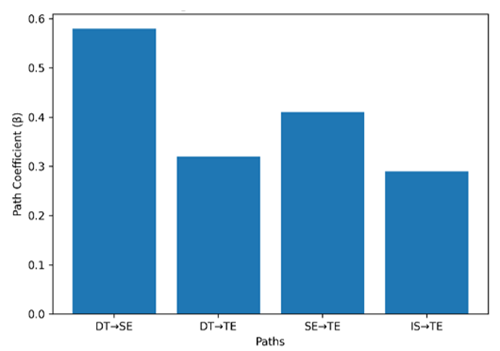
Figure 2 SEM Path Coefficients
The SEM results in Figure 2 indicate that the training in design-thinking has a positive and significant impact on the teaching effectiveness, both directly and indirectly, and self-efficacy has the most significant impact.
Figure 3
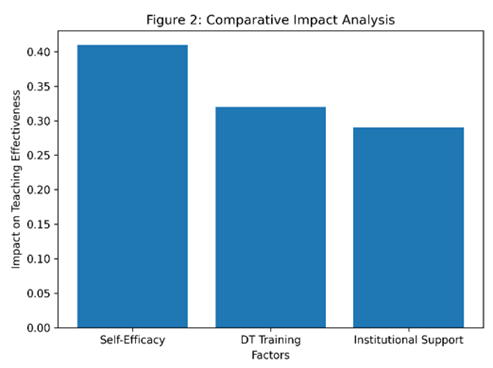
Figure 3 Comparative Impact Analysis
The comparison in Figure 3 shows that the most influential one is design-thinking self-efficacy, then there are training and institutional support.
Figure 4
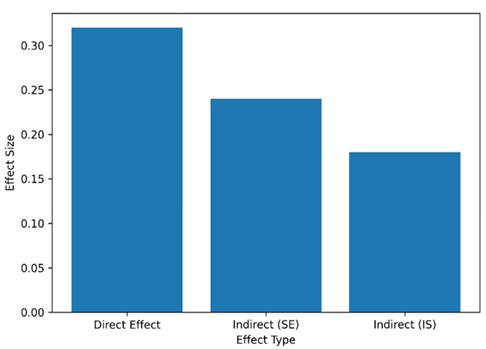
Figure 4 Meditative Effect
The mediation analysis establishes the partial mediation in which training affects the teaching effectiveness indirectly via self-efficacy and institutional support.
5.6. Discussion of Findings
The results indicate that faculty design-thinking training has a strong positive effect on teaching both indirectly and directly. The strongest predictor of the mediators was design-thinking self-efficacy, which demonstrates that faculty confidence is important to use innovative teaching methods. A positive significant effect was also observed on the institutional support which was significant emphasizing the role of organizational infrastructure, policies and encouragement in supporting pedagogical innovation. Nonetheless, its influence was a little bit smaller than that of self-efficacy indicating that personal ability can overpower other environmental conditions in some situations. The mediation analysis helps to confirm the fact that training is not a sufficient condition and testing should be improved by making the faculty confident and having institutional support. These findings are consistent with the Social Cognitive Theory, which stresses the interaction between personal beliefs and environment to develop behavior.
6. Conclusion and Future Work
This paper addressed the effect of the faculty design-thinking training on teaching outcome in the Chennai based engineering colleges with specific emphasis on the mediating variables of design-thinking self-efficacy and institutional support. The study adopted a quantitative methodology and Structural Equation Modeling (SEM) to empirically prove the hypothesized conceptual framework and verify six hypotheses. The results suggest that training on design-thinking by faculty contributes to teaching effectiveness, directly and indirectly, in a great positive way. Design-thinking self-efficacy turned out to be the most significant mediating variable, which implies the key role of faculty confidence when implementing innovative pedagogical practices. When faculty members feel that they are effective in design-thinking practices, they will tend to use interactive and student-centered pedagogies and will enhance learning outcomes in general. It was also observed that institutional support had a significant positive role in teaching efficiency, which supports the significance of organizational aspects like the encouraging role of administration, the availability of resources, and the possibility of professional growth. Nonetheless, it had a comparatively lesser impact than self-efficacy and it is arguable therefore that institutional support is an important but secondary factor in influencing teaching innovation.
The mediation analysis also showed that design-thinking self-efficacy along with institutional support mediate the association between faculty training and teaching effectiveness in a partial manner. It means that training programs cannot be efficient on their own, unless they increase the confidence of the faculty and are facilitated by the favorable institutional settings. The findings can add to the literature that addresses the integrated perspective, which connects personal and organizational factors in the scope of engineering education. In a practical perspective, the research provides valuable consequences to policy makers and learning institutions. Colleges of engineering need to invest in design-thinking programs that are well structured and focus on practical learning and application. Besides, such training programs need to create an enabling ecosystem through the provision of required infrastructure, incentives, and long-term professional development opportunities to ensure that maximum benefits are achieved through such programs. The research has some limitations despite its contribution. The study is limited to the engineering colleges in Chennai and this could restrict the extrapolation of the research to other areas or fields. A cross-sectional design also limits the causal ability to be established through time. Moreover, the research is based on self-reported findings, and it can be affected by bias in responses. To consider these limitations, future research could be undertaken in the form of longitudinal studies to analyze the changes in the teaching effectiveness during the time and also increasing the number of regions and academic disciplines to be studied. Other mediating and moderating variables that can be examined by researchers include organizational culture, leadership support, technological readiness and faculty motivation. The effect of the context on the research could be better seen through comparative studies of institutions which have different degrees of institutional support. To sum up, this paper has highlighted the significance of teacher training, personal self-efficacy, and institutional support in teaching effectiveness in engineering education. With the constant change in the requirements of the industries, the design thinking pedagogy and the establishment of conducive environments in which the students will learn will be the key in producing skilled and innovative graduates.
CONFLICT OF INTERESTS
None.
ACKNOWLEDGMENTS
None.
REFERENCES
Abolhasani, Z., Dehghani, M., Javadipour, M., Salehi, K., and Mohammadhasani, N. (2021). An Analysis of the Role of Design Thinking in Promoting the 21st-Century Skills: A Systematic Review. Technology of Education Journal, 16(1), 81–98. https://doi.org/10.22061/tej.2021.7206.2508
Aflatoony, L., Wakkary, R., and Neustaedter, C. (2018). Becoming a Design Thinker: Assessing the Learning Process of Students in a Secondary Level Design Thinking Course. International Journal of Art and Design Education, 37(3), 438–453. https://doi.org/10.1111/jade.12139
Albay, E. M., and Eisma, D. V. (2021). Performance Task Assessment Supported by the Design Thinking Process: Results from a True Experimental Research. Social Sciences and Humanities Open, 3(1), 100116. https://doi.org/10.1016/j.ssaho.2021.100116
Aris, N. M., Ibrahim, N. H., Abd Halim, N. D., Ali, S., Rusli, N. H., Suratin, M. N. M., and Hassan, F. C. (2022). Evaluating the Academic Trends on Design Thinking Research: A Bibliometric Analysis from 2000 to 2021. Journal of Positive School Psychology, 6(4), 1022–1038.
Baker, F. W., III, and Moukhliss, S. (2020). Concretising Design Thinking: A Content Analysis of Systematic and Extended Literature Reviews on Design Thinking and Human-Centred Design. Review of Education, 8(1), 305–333. https://doi.org/10.1002/rev3.3186
Bawaneh, A. K., and Alnamshan, M. M. (2023). Design Thinking in Science Education: Enhancing Undergraduate Students’ Motivation and Achievement in Learning Biology. International Journal of Information and Education Technology, 13(4), 621–633. https://doi.org/10.18178/ijiet.2023.13.4.1846
Gleason, B., and Jaramillo Cherrez, N. (2024). Design Thinking Approach to Global Collaboration and Empowered Learning: Virtual Exchange as Innovation in a Teacher Education Course. TechTrends, 65(3), 348–358. https://doi.org/10.1007/s11528-020-00573-6
Grau, S. L., and Rockett, T. (2022). Creating Student-Centred Experiences: Using Design Thinking to Create Student Engagement. Journal of Entrepreneurship, 31(2_suppl), S135–S159. https://doi.org/10.1177/09713557221107443
Guaman-Quintanilla, S., Everaert, P., Chiluiza, K., and Valcke, M. (2022). Fostering Teamwork Through Design Thinking: Evidence from a Multi-Actor Perspective. Education Sciences, 12(4), 279. https://doi.org/10.3390/educsci12040279
Guaman-Quintanilla, S., Everaert, P., Chiluiza, K., and Valcke, M. (2023). Impact of Design Thinking in Higher Education: A Multi-Actor Perspective on Problem Solving and Creativity. International Journal of Technology and Design Education, 33(1), 217–240. https://doi.org/10.1007/s10798-021-09724-z
Hennessey, E., and Mueller, J. (2020). Teaching and Learning Design Thinking (DT). Canadian Journal of Education, 43(2), 498–521.
Henriksen, D., Gretter, S., and Richardson, C. (2020). Design Thinking and the Practicing Teacher: Addressing Problems of Practice in Teacher Education. Teaching Education, 31(2), 209–229. https://doi.org/10.1080/10476210.2018.1531841
Henriksen, D., Jordan, M., Foulger, T. S., Zuiker, S., and Mishra, P. (2020). Essential Tensions in Facilitating Design Thinking: Collective Reflections. Journal of Formative Design in Learning, 4(1), 5–16. https://doi.org/10.1007/s41686-020-00045-3
Higgins, J. P., Thomas, J., Chandler, J., Cumpston, M., Li, T., Page, M. J., and Welch, V. A. (Eds.). (2019). Cochrane Handbook for Systematic Reviews of Interventions (2nd ed.). Wiley.
Padghan, N. P., Sapekar, K. N., Sonakneur, M. S. S., Masram, N. M., Lolure, S. R., and Madavi, S. C. (2025). Muscle Sensor Driven 3D Printed Prosthetic Arm. International Journal of Technical Advances in Research in Mechanical Engineering (IJTARME), 14(1), 5–11. https://doi.org/10.65521/ijtarme.v14i1.513
|
|
 This work is licensed under a: Creative Commons Attribution 4.0 International License
© ShodhKosh 2026. All Rights Reserved.