ShodhKosh: Journal of Visual and Performing ArtsISSN (Online): 2582-7472
|
|
THE ADAPTATION OF GOND ART AESTHETICS FOR CONTEMPORARY TOURISM POSTERS
Prashasti Banthia 1
 ,
Dr. Kumkum Bharadwaj 2
,
Dr. Kumkum Bharadwaj 2
1 Ph.D Scholar, (Drawing and Painting) Government Maharani Laxmi Bai Girls
PG College, Indore, India
2 Head
of Department and Supervisor, Government Maharani Laxmi Bai Girls PG College,
Indore, India
|
|
|
ABSTRACT |
|
|
This paper
analyses the convergence of visual cultural traditions of gond art and
contemporary digital posters used for Madhya Pradesh tourism publicity. The
study highlights how often the designers have been using these aesthetic art
motifs to raise awareness of tourism, culture and heritage because of the
gradual shifting focus of the global tourism sector towards authentic
cultural immersion. However this approach upraised
the crucial issues concerning the intersection of artistic tribute, publicity
and the ethics of taking cultural elements for profit purpose. From some
selected contemporary tourism e-posters issued by government departments of
culture and tourism of Madhya Pradesh, the qualitative visual analysis help to recognize the use of gond art appropriate for
contemporary advertisements. This paper focuses on the use of beautiful gond
painting motifs especially the Tree of Life, ornate details like flora, fauna
and such other intricate patterns as a commercial tool to drew travellers
globally; how these traditional paintings their themes, colour schemes and
patterns are modified for contemporary digital screen; the ethical tension
between protecting indigenous cultural aesthetics and their use as commercial
product. The research suggests that while the use of gond art in publicity
posters work as both for a preserving traditional art form and advanced
advertising design plan, they often have risk to misinterpret the original
narrative idea of the artwork. The paper concludes by recommending a collaborative
design plan that ensures the indigenous artisans to guide how their visual
heritage authentic artwork is represented, interpreted and used in global
tourism industry. |
|||
|
Received 11 February 2026 Accepted 23 March
2026 Published 29 April 2026 Corresponding Author Prashasti
Banthia, prashastib2@gmail.com DOI 10.29121/shodhkosh.v7.i5s.2026.7375 Funding: This research
received no specific grant from any funding agency in the public, commercial,
or not-for-profit sectors. Copyright: © 2026 The
Author(s). This work is licensed under a Creative Commons
Attribution 4.0 International License. With the
license CC-BY, authors retain the copyright, allowing anyone to download,
reuse, re-print, modify, distribute, and/or copy their contribution. The work
must be properly attributed to its author.
|
|||
|
Keywords: Gond Art, Tourism publicity, Contemporary Poster
Art, Visual Culture, Tribal Art |
|||



1. INTRODUCTION
The advertising field is very fast growing and dynamic. The advertisement designers are finding innovative ways to entice consumers with their creativity with those publicity materials which have completely distinctive design and purpose. Today every market including tourism, is adapting digital screens to advertise and reach potential customers to set up a brand identity. By adaptation of variety of art forms, specifically tribal and folk art in advertisement designs they made it suitable for covering both domestic and international market area. Tribal art inspired poster advertisements help to reach more tourist as they can feel the connection easily due to its authentic features and spread the information more effectively and efficiently. Both tribal art form and poster advertisement are different in terms of their purpose, use, design. One is made for emotions, beauty and own satisfaction while the other is prepared to persuade people to respond accordingly. But the connection between them is very old. It dates back to the 19th century when vanguard artists saw in advertising an opportunity to participate in the urban space artistically and commercially in the form of a poster. Vashishtha and Arya (2022)
Over the past decade, Madhya Pradesh Tourism Board have tried varied innovative digital campaigns to advertise and attract tourist all around the globe. This shows how tourism of Madhya Pradesh is fully aware of trends of new generation. Through social media advertisements they are able to reach a mass audience. And to achieve this, the advertisers used beautiful cultural and traditional tribal and folk paintings in their poster advertisements, particularly the art practised by gond community.
In India, more than 600 tribal communities and ethnic groups contribute to its cultural diversity. Mondal (2025) Each tribal group have their own way of performing art. Tribal art is generally an artwork done by indigenous group of people who may belong to any tribe of India. Today, there are many tribal art present in India. One of which is gond. This artform is inclusive of all painting, dancing, singing and is practised by people of gond tribal community.The word ‘Gond’ comes from the dravidian expression of kond, meaning ‘green mountain’. Green Mountain is a reference to the Vindhya and Satpura mountain ranges where most of the Gond people reside since the 14th century. Arur and Theodor (2016) Gond community resides in central India, mainly in Madhya Pradesh. With the help of their art the gond tribal people can convey their culture and traditions to the outside world. Originally, gond painting was done as murals on mud walls of houses by gond tribal community as a mode of reflection of their culture, tradition, rituals during festivals. They depict nature inspired motifs such as flora, fauna which helps them to remain attached to their origin. But now their artwork is represented everywhere even on art poster for commercial purpose. The rise of digital marketplaces, export demand, urban retail, tourism, and government handicraft initiatives has converted tribal art into a monetized industry. Alam (2025)
2. Visual analysis of tribal art in tourism posters
As brand image, the focal point of gond tribal art is that each motif used in paintings conveys a special narrative meaning which make it unique in its style. Its distinctive feature help to make it easily recognizable. Gond tribal art, itself is a brand image when incorporated in tourism publicity posters helps to bridge a visual gap as it benefits the modern travellers to understand the ancient heritage of state. The use of tribal art in tourism posters helps to differentiate a state from other.
Recently, M.P. state government had issued some publicity posters integrating gond art motifs which act as a visual identity. The use of unique motifs and symbols of gond art tells a visual story which helps to connect to audience far better than any photograph. They are created from detailed lines and patterns to delineate flora, fauna, heavenly bodies. These motifs and illustrations reflect the rich biodiversity and rich natural landscapes of Madhya Pradesh. In Figure 1, they chose the often used theme of gond tribal art for poster publicity which is the ‘Tree of Life’.5 This poster is published by M.P. Tourism and Cultural department of Madhya Pradesh as the logo of M.P. can be seen at left top corner. The artist used bright red colour for showcasing the famous Tree of Life painting surrounded by birds and an elephant at bottom. The painting is disappearing into the text making text readable. The background for this poster is kept white for negative space. In figure 2, issued by government department of M.P.6 the curved composition of the image depicts a big, vibrant red, orange with yellow bands stylized inverted fish body with fins in green detailed circular lines which are the main features of gond art style, at the bottom of the artwork. With the same bright orange coloured tree trunk merging directly from the fish tail to the top scattered into beautiful branches with lush green and dark blue coloured leaves represents the origin of life. The harmonious composition of drawing emphasize the smooth transition and depicts both sustain the same vital energy. The imagery conveys that life in water and life on land are inseperable. The text at the right bottom corner says gond art in vibrant red modern font merging with traditional art form. The background represents negative space of poster art having white wall texture to maintain the rawness of the artwork.
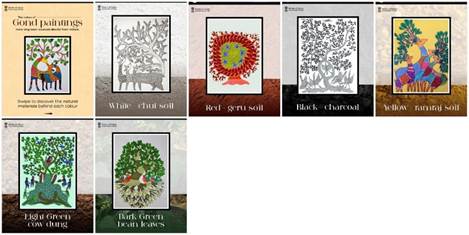
Another poster is an educational poster design issued by government department to enhance knowledge of viewers and also promote tourism through tribal art around the globe Figure 3. They provide information about the natural colours used to create traditional gond style paintings. The series of seven posters helps to understand the source of natural materials used for making pigment used for such paintings. All the posters follow same layout but have different theme drawings characterised with dots and lines to create detailed patterns and textures. All seven poster uses the same composition technique of picture layering. In this overlay design poster, the colourful gond art style painting is framed in modern white and black border which appears above the blurred double layered background consisting of image of natural source material used for making that particular pigment at the bottom half and plain area to enhance the painting at the top half. The blurred background highlights the text showing the source material for the pigment used in the painting. The text is written in neat contrasting serif font in white colour to seek all the attention on natural organic origin of the pigments. The logo features the Ministry of Culture, Government of India at the top left corner suggests that it was created for both promotional and educational purpose.7 From this design layout they shows the connection of gond tribe with the nature from both the drawing and the pigment. The first poster in this series provides a visual guide to the environmental origin of the pigment used in gond art with pastel yellow background and colourful gond painting placed at the centre of the poster. The next six posters provides information about the raw natural resources that help to compose the palette of traditional gond paintings. For white colour, chui soil is used by gond tribal people. White colour is mainly used making major shapes with thin line work and also for highlighting any part of artwork. Next poster is for red colour which is obtained from geru soil which helps to create a warm toned earthy palette and is mostly used for creating main motif of painting. Then they mentioned charcoal from which black colour is obtained. Artist usually uses black for making outlines and filling shapes with dots and lines. Ramraj soil is used for making yellow pigment. A mix of bright mustard and ochre colour is obtained from ramraj soil mainly used for colouring animal body also when artist wants to make vibrant coloured background for their paintings they use this colour. Second last poster in this series is for light green colour which is taken from cow dung which makes a soft organic green colour that connect the gond tribal people with agriculture. The last poster in this series is for dark green made from bean leaves. It is deep green in shade and help them to depict scenes of lush green forest, flora and foliage. The motifs used in these posters are mainly deer, birds and tree of life which are considered as signature motifs of gond art. All these posters have been incorporated with different paintings which suit the colour palette accordingly. From this poster series they want to reach people who are interested in rich culture and heritage of gond tribe.
Figure1
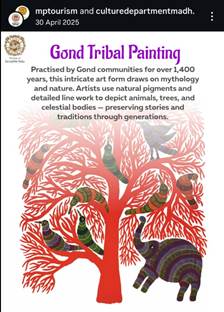
Figure 2
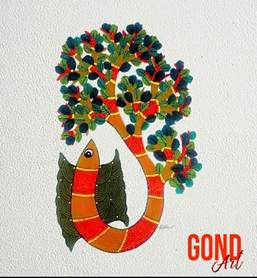
Figure 3
3. Conclusion
For travellers, gond painting is not merely just a piece of art or any product they can purchase but it offers them an experience to feel the connection of gond tribal people with their art from the nature. Travellers can visit gond tribe places to see the process, dot and line technique of making paintings and can also learn from them their unique art style. These posters published by government helps to bridge the gap between fine art and graphic art. By incorporating paintings in these poster designs the are somewhere promoting ecotourism as gond painting motifs are mostly nature inspired and they have a visual story to tell that helps to connect people easily. The use of neat lines and perfect layout shows the professionalism of government in achieving contemporary attempt to record and promote both ecotourism and cultural heritage rooted in nature on various modern advertising platforms globally. The artisans of gond village must be provided with better plan to ensure that their artwork is not misused by anyone. The plan must include the partnership of gond artisans and advertisement designers but the final approval must be of gond artist. The designers must not make art dull, boring and out of life by simplifying designs. To better understand the real story behind the artwork designer must add any tag linking it to the artisan of painting used for tourism poster. The main purpose of these poster is not only lure tourist around the globe from their intricate patterns of drawings but also to share the cultural and traditional heritage of gond tribe that they create proudly being grounded to mother earth.
CONFLICT OF INTERESTS
None.
ACKNOWLEDGMENTS
None.
REFERENCES
Afsar, A. M. (2025). Impact of Tribal art and
Handicraft Commercialization on Cultural Identity and Economic Growth.
Mahakoushal Journal of Multidisciplinary Studies (MJMS), 1(11), 2–?.
Alam, A. M. (2025). Impact of Tribal Art and Handicraft Commercialization on Cultural
Identity and Economic Growth. Mahakoushal Journal of Multidisciplinary Studies
(MJMS), 1(11), 2–?.
Arur, S., and Theodor, W. (2016). Exploring the Central India Art of the Gond People: Contemporary Materials and Cultural Significance. In Proceedings of the 20th International Conference on Information Visualisation (IV) (380–383). IEEE.
Culture Department, Government of Madhya Pradesh.
Ministry of Culture, Government of India.
Mondal, S. (2025). Gond art in Select Graphic Novels: Representing the Marginalized. TLH Journal, 11(4), 217–226.
Vashishtha, G., and Arya, U. (2022). A Study of the Appropriation of Folk art in Commercial/Advertising Communication in the Digital Age. Global Media Journal – Indian Edition, 14(1). ISSN 2249‑5835.
|
|
 This work is licensed under a: Creative Commons Attribution 4.0 International License
© ShodhKosh 2026. All Rights Reserved.