ShodhKosh: Journal of Visual and Performing ArtsISSN (Online): 2582-7472
|
|
Aesthetic Anchors: The Role of Visual Art and Design Semiotics in Shaping Consumer Loyalty within Personal Care FMCG
Paras 1
 ,
Dr. Mukesh Kumar 2
,
Dr. Mukesh Kumar 2 ,
Dr. Jayaashish Sethi 3
,
Dr. Jayaashish Sethi 3 ,
Dr. Shefali 4
,
Dr. Shefali 4
 ,
Dr. Himanshu Mathur 5
,
Dr. Himanshu Mathur 5 , Shweta Chauhan
6
, Shweta Chauhan
6
1 Research
Scholar, MM Institute of Management, Maharishi Markandeshwar University,
Mullana Ambala, Haryana, India
2 Associate
Professor, MM Institute of Management, Maharishi Markandeshwar (Deemed to be
University), Mullana- Ambala, India
3 Professor, MM Institute of Management, Maharishi Markandeshwar
University (Deemed to be University), Mullana–Ambala, India
4 Assistant Professor, School of Technology and Management, DPG Degree
College, Gurugram, Haryana, India
5 Assistant Professor, School of Business, Mody University of Science
and Technology, Laxmangarh, Rajasthan, India
6 Department of Commerce, School of Management Studies, CGC
University, Mohali-140307, Punjab, India
|
|
|
ABSTRACT |
|
|
Packaging is a
very significant part of the consumer perception and loyalty in the
competitive personal care FMCG segment. This concept paper suggests a
comprehensive model of presentation of how visual semiotics, such as signs,
symbols, and artifacts, are esthetic anchors that affect consumer loyalty.
The proposed study is based on the semiotic theory Mick (1986), customer-based brand equity model of Keller (1993), and the stimulus organism response paradigm Brakus et al. (2009) to suggest that visual semiotics boost aesthetic perception,
which forms brand personality, and eventually results in attitudinal and
behavioral loyalty. Consumer involvement and expertise is also a moderating
variable identified in the framework. The paper adds value by synthesizing
the isolated body of knowledge and providing the realistic insights on how to
use the packaging design as a brand differentiating and brand loyalty tool. |
|||
|
Received 22 December 2025 Accepted 24 March 2026 Published 28 March 2026 Corresponding Author Paras, pc95grd@gmail.com DOI 10.29121/shodhkosh.v7.i2s.2026.7347 Funding: This research
received no specific grant from any funding agency in the public, commercial,
or not-for-profit sectors. Copyright: © 2026 The
Author(s). This work is licensed under a Creative Commons
Attribution 4.0 International License. With the
license CC-BY, authors retain the copyright, allowing anyone to download,
reuse, re-print, modify, distribute, and/or copy their contribution. The work
must be properly attributed to its author.
|
|||
|
Keywords: Visual Semiotics, Packaging Aesthetics, Brand
Personality, Consumer Loyalty, FMCG |
|||



1. INTRODUCTION
The
global market of the Fast-Moving Consumer Goods (FMCG) segment, namely personal
care, is highly competitive, with the global packaging market revenue predicted
to increase to 99.7 billion by 2034 with a CAGR of 7.5 due to the need to use
innovative, sustainable, and attractive designs that will generate consumer
interest and loyalty Global Insight Services, (2025).
Packaging is a major silent salesperson in these already saturated markets, as
visual characteristics such as color, graphics, semiotics, etc. grab the eye
among thousands of other similar products and have a strong effect on the
purchase decision, brand recognition and brand repurchase of personal care
products such as shampoos, lotions, and cosmetics Liu et al. (2025), Wang
et al. (2024). These images are not only used by the brands in the first
attempt, but to create long-term loyalty, where visually appealing,
eco-conscious design creates trust and emotional bonds, especially in the new
markets where consumers are more interested in the visual appeal in addition to
functionality Quirk Design, (2024).
Nonetheless,
the available literature has shown that there is fragmentation in comprehending
the ways in which visual art and design semiotics can particularly contribute
to loyalty in personal care FMCG. Semiotics research focuses on the ability to
decode packaging meaning to create brand image and quality perception Shukla
and Purani (2021), Shukla
and Purani (2023), Mick (1986) but seldom combines it with loyalty results.
In the same way, the theory of art infusion shows the ability of artistic
elements to increase product judgments Hagtvedt
and Patrick (2008), but packaging aesthetics influence
personality attributions (e.g., sincerity, excitement, Andiani
and Nailul (2025), Attor et
al. (2022), but such streams do not interact
in a unified model to connect semiotics, perceptual responses, brand
personality, and loyalty Eisend
and Stokburger-Sauer (2013), Br This lack of connection is also
reflected in the FMCG-specific lapses, where visual strategies enhance impulse
purchases and perceptions in underlooking long-term loyalty channels in
personal care scenarios Reimann
et al. (2010), Orth and Malkewitz (2008).
This
conceptual paper aims at filling this gap by establishing an integrated
theoretical model that proposes visual design semiotics as aesthetic links
(signs, symbols and artistic motifs on packaging) triggering perceptual
mediators (e.g., unity, prototypicality) along with creating brand personality
perceptions and ultimately attitudinal and behavioral loyalty in the personal
care FMCG Veryzer
and Hutchinson (1998), Keller
(1993). This synthesis is based on the
stimulus-organism-response theory to make propositions that can be tested in
the future to be empirically validated Shukla
and Purani (2023).
2. Literature Review
2.1. Visual Art and Design Semiotics
The
semiotics of signs and symbols of communication is a field of study that offers
a initial framework of examining packaging as a visual
form of language that communicates brand meanings and affects consumer
interpretations Mick (1986). Semiotics, including icons, colors,
typography, and motifs, are used in product packaging to decipher cultural and
emotional messages, and this allows a brand to incorporate narratives that
touch consumers beyond the functionality Shukla
and Purani (2021). The recent extensions in the
emerging markets indicate that semiotic richness in the packaging of FMCGs
boosts the brand experience dimension such as the sensation and affective
involvement, which establishes trust and purchase intention via stimulus-organism-response
channels Shukla
and Purani (2023).
In
addition to semiotics, visual art impacts on packaging making it more
appealing. The art infusion effect demonstrates that the positive halo effects
are transferred to non art products when the subjects are simply exposed to
artistic images and this will enhance perception of luxury and quality through
cognitive spill over Hagtvedt
and Patrick (2008). Consumer responses are also
incited by the aesthetics of product design where ideal forms stimulate
approach behavior and loyalty in shelf competition Bloch
(1995). The combination of these streams
highlights the way artistic semiotics in packaging develops perceptual anchors
to stronger consumer relationships.
2.2. Brand Personality and Experience
Emotional
bond and differentiation is a product of brand
personality, which is perceived as human-like characteristics (e.g., sincerity,
excitement, competence, sophistication, ruggedness) Aaker
(1997), as cited in Ahmad
and Thyagaraj (2015). A meta-analysis affirms that its
antecedents consist of visual elements such as packaging, and influence on
attitudes and loyalty differ on the strength of dimension; such as excitement,
which influences hedonic preferences in personal care Eisend
and Stokburger-Sauer (2013). These features can be directly
packed into visuals, where holistic designs can be an indicator of competence
or sophistication, which affects purchase in competitive FMCG environments Attor et
al. (2022).
This is
further extended by brand experience as it includes sensory, affective,
behavioral and intellectual responses to stimuli such as packaging that
forecasts more loyalty than satisfaction Brakus
et al. (2009). Its measurement and causal relationship with
loyalty can be justified by empirical scales because visual triggers can
generate memorable experiences Brakus
et al. (2009). Relational outcomes are enhanced in the
context of semiotics-based views as packaging experiences mediate personality
perceptions Shukla
and Purani (2023).
2.3. Consumer Loyalty in FMCG
Attitudinal
commitment and repeat purchase are antecedents to consumer loyalty in personal
care FMCG where packaging visuals play a crucial role in ensuring consumer
loyalty when the levels of churn are high. The aesthetics of holistic packaging
are associated with the creation of positive brand perceptions, which is better
than non-visual stimuli in eliciting loyalty through symmetry and
prototypicality Orth and Malkewitz (2008). The neural and behavioral data
demonstrates that aesthetically pleasing designs extend the choice decision,
generate high premiums and reward centres and directly increase preference and
loyalty over existing brands Reimann
et al. (2010).
These
images affect loyalty in personal care in terms of apparent quality and
emotional attachment since in research design unity positively affects
repurchase intentions Wang et al. (2023), Liu et al. (2025). However, the backgrounds such as
semiotics are not fully explored that are connected to piece meal visual
influences Orth and Malkewitz (2008). This makes packaging a loyalty
driver in the FMCG, which needs integrated frameworks.
2.4. Theoretical Framework
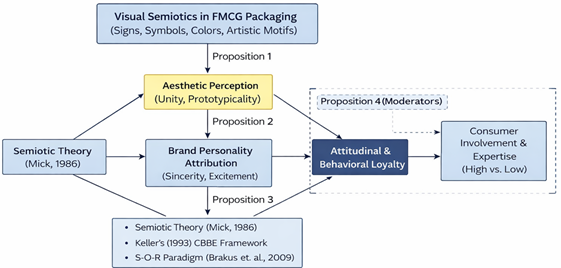
The proposed conceptual paper is a proposal to develop an
integrated model where visual semiotics in the packaging of personal care FMCG
are aesthetic anchors that in a sequential manner determine consumer loyalty.
This theory links visual semiotics through aesthetic perception to brand
personality attribution, which leads to attitudinal and behavioral loyalty and
rectifies the semiotic theory Mick (1986), Shukla
and Purani (2021)
by Keller (1993) customer-based brand
equity theory and the stimulus-organism-response reasoning Brakus
et al. (2009). This synthesis deals
with fragmentation by assuming perceptual and personality intermediate,
propositions are based on earlier literature on which empirical testing was
done.
·
Proposition 1:
Higher levels of semiotic content of packaging design (e.g., culturally
understandable symbols) cause an increase in aesthetic perception, increasing
unity and prototypicality in personal care FMCG Mick (1986), Veryzer
and Hutchinson (1998).
·
Proposition 2:
Greater aesthetic perception through infusion of art and saturation of color
strengthens brand personality attribution, especially the attributes of
sincerity and excitement Hagtvedt
and Patrick (2008), Hagtvedt
and Brasel (2017), Attor et
al. (2022).
·
Proposition 3:
Positive brand personality perceptions in mediating the association between
aesthetic reactions and loyalty lead to emotional attachment and subsequent
purchase Eisend
and Stokburger-Sauer (2013), Andiani
and Nailul (2025), Keller
(1993).
·
Proposition 4:
The entire route between the visual semiotics and the devotion is reinforced in
the high-involvement personal care situations and is moderated by the consumer
expertise Brakus
et al. (2009), Orth and Malkewitz (2008).
Table 1
|
Table 1 Core Constructs Table |
||
|
Core Constructs |
Key Dimensions |
Supporting References |
|
Visual Semiotics |
Signs, symbols,
archetypes |
Mick (1986), Shukla and Purani (2021) |
|
Aesthetic Perception |
Unity,
prototypicality, color |
Veryzer and Hutchinson (1998), Hagtvedt and Brasel (2017) |
|
Brand Personality |
Sincerity, excitement,
competence |
Attor et al. (2022), Andiani and Nailul (2025) |
|
Consumer Loyalty |
Attitudinal,
behavioral |
Brakus et al. (2009), Keller (1993) |
3. Discussion
The
framework suggested has practical implications on FMCG marketers in the
personal care segment to incorporate the use of packaging design as a method of
strategic loyalty through the exploitation of visual semiotics. Placing
culturally resonant cues and artistic patterns, the brands can enhance
aesthetic responses that generate personality characteristics such as sincerity
and excitement, distinguishing products among the vast ranges of products on
the shelf and increasing repurchase intentions Shukla
and Purani (2021), Hagtvedt
and Patrick (2008). In a given example, semiotic
tactics that include archetypal symbols that represent the natural purity can
increase brand equity, which aligns with the model of Keller
(1993) to encourage the emotional loyalty amid the
sustainability requirements.
In
practice, an impact of the personal care brands, such as those in shampoos or
lotions, may audit packaging of semiotic richness, experimenting with art
infusion effects in order to achieve competence appeals through optimizing
color saturation and unity Veryzer
and Hutchinson (1998), Attor et
al. (2022). This transforms design as a form
of aesthetics to designs as a leverage of loyalty, and potentially expands
market share in competitive emerging economies Andiani
and Nailul (2025).
These
have constraints such as cultural differences in semiotic meanings where
symbols that are resonant in one market are not resonant in another that are
not addressed in the Western-centric literature base Mick (1986). The model presupposes linear routes, ignoring
such moderators as demographics of consumers or digital unboxing experiences.
Propositions
that have been empirically tested through structural equation modeling in a
variety of personal care settings (i.e. cross-cultural experiments or
longitudinal loyalty panels) should be tested in future studies Brakus
et al. (2009), Orth and Malkewitz (2008). Neural validation of neural
responses to semiotic anchors could be achieved by neuroscience extensions,
which are extensions of Reimann
et al. (2010).
4. Practical Implications
The given framework can be of vital practical value to
FMCG marketers, brand managers, packaging designers, and policymakers who have
to work in the personal care segment. To begin with, it underlines that
packaging must not be viewed as an element of security or information but
rather as a strategic branding element that is operated by visual semiotics.
Through culturally relevant symbols and meaningful color schemes, as well as
artistic motives, the firms could develop a packaging that embodies stronger brand
stories and has an emotional appeal to the target consumers Shukla
and Purani (2021). This semiotic richness increases the level of perceptual fluency and
aestheticism, which makes the consumer more firmly attached to the point of
purchase.
Second, it is implied that the managers can
intentionally use the making of a package to optimize aesthetic perceptions,
especially with regard to the aspects of unity, harmony, and prototypicality.
Properly integrated design does not only attract attention but also enhances
the evaluation of the product and its quality Veryzer
and Hutchinson (1998). The art infusion strategies that firms can use to enhance positioning
of product and differentiate offerings in extremely crowded retailing settings
include using artistic illustrations, high quality visual textures, etc. Hagtvedt
and Patrick (2008). This is particularly important in the personal care categories where
product trial can be replaced by the visual cues.
Third, the structure emphasizes the necessity of
matching packaging visions to the target brand personalities. Visual elements
must always convey the desired personality dimensions, i.e. sincerity (e.g., to
use natural and eco-friendly designs) or excitement (e.g., bold colors and
dynamic graphics) as this should support brand image and emotion Eisend
and Stokburger-Sauer (2013), Attor et
al. (2022). The alignment can increase brand memory, self-congruence and
eventually consumer brand relationships.
Fourth, when considering packaging as a
loyalty-building approach, companies need to consider packaging to be a
long-term relationship-building tool, as opposed to a short-term sales tool.
Through consistently packaging products in aesthetically satisfying and
symbolically significant designs, the brands can develop attitudinal loyalty
(emotional attachment), as well as behavioral loyalty (repeat purchase) Keller
(1993).
This is especially important in the FMCG markets where the switching costs are
low and there is a high competition.
Fifth, consumer involvement and expertise moderating
role indicate that packages design decision ought to include segmentation
strategies. With high-involvement consumers (e.g., skincare fans), brands can
use more elaborate and informative semiotic messages, but in the case of
low-involvement groups, simple and more graphical designs may be more
appropriate Orth and Malkewitz (2008), Brakus
et al. (2009).
This helps companies to package based on the profile of consumers and usage
conditions.
Lastly, the model provides suggestions to sustainable
and ethical packaging. With the growing tendency of consumers to associate the
visual visuals of earthy colors, minimalistic design and natural symbols with
eco-friendliness, brands can use semiotics to convey a message of
eco-friendliness and corporate responsibility Verma
and Diwan (2024). This does not only build brand trust, but also meets the changing
regulatory and social demands.
In short, the research will urge practitioners to stop
focusing on functional packages design to adopt a holistic semiotics-based
strategy that merges aesthetics, symbolism, and brand personality as a way of
creating lasting consumer loyalty in the personal care FMCG industry.
5. Conclusion, Limitations, and Scope for Future
Research
Finally, this paper suggests a new and integrative theoretical framework, which would establish a bridge between visual art semiotics and consumer loyalty in the personal care FMCG industry through a systematic linkage between the packaging signs, aesthetic perception, brand personality, and the results of consumer loyalty. Conceptualizing semiotics as aesthetic anchors in the stimulus organism response paradigm, the model provides a logical explanation of how visual design components transfer to attitudinal and behavioral loyalty and therefore fills a gap in the existing literature Mick (1986), Keller (1993), Brakus et al. (2009). The model emphasizes the strategic position of the packaging as an emotional engagements and prolonged brand relationships motivator, prompting marketers to use competitive advantages based on culturally resonant symbols and art infusion strategies. Nevertheless, the research has its own limitations, it is a conceptual research which is not verified empirically and in addition to this, the study also assumes that the relationship between constructs is linear, that, in fact, can be more dynamic and recursive. Also, the meaning of the semiotic elements is very much situational, and the differences in culture may affect the consumer reaction, which restricts the external validity of the research on various markets Shukla and Purani (2021). Other new factors including digital retail spaces, unboxing, and demographic heterogeneity are also not explicitly captured in the framework. As a consequence, the proposed relationships should be empirically tested in future studies on the basis of advanced techniques like structural equation modelling in various cultural and product settings, moderating and mediating variables like age, gender, and digital exposure should be incorporated, and neuroscientific and experimental methods ought to be employed to better understand the subconscious reaction to aesthetics of packaging Orth and Malkewitz (2008), Reimann et al. (2010). The extensions in question will not only prove the model right, but also increase its utility in changing the FMCG landscapes.
CONFLICT OF INTERESTS
None.
ACKNOWLEDGMENTS
None.
REFERENCES
Ahmad, A., and Thyagaraj, K. S. (2015). Understanding the Influence of Brand Personality on Consumer Behavior. Journal of Advanced Management Science, 3(1), 38–43. https://doi.org/10.12720/joams.3.1.38-43
Andiani, P., and Nailul, M. (2025). Packaging Aesthetics and Brand Personality Shaping Consumer Preferences. West Science Interdisciplinary Studies, 3(7), 1209–1216. https://doi.org/10.58812/wsis.v3i07.2111
Attor, C., Jibril, A. B., Amoah, J., and Chovancova, M. (2022). Examining the Influence of Brand Personality Dimensions on Consumer Buying Decisions: Evidence from Ghana. Management and Marketing: Challenges for the Knowledge Society.
Bloch, P. H. (1995). Seeking the Ideal form: Product Design and Consumer Response. Journal of Marketing, 59(3), 16–29. https://doi.org/10.1177/002224299505900302
Brakus, J. J., Schmitt, B. H., and Zarantonello, L. (2009). Brand Experience: What is it? How is it Measured? Does it Affect Loyalty? Journal of Marketing, 73(3), 52–68. https://doi.org/10.1509/jmkg.73.3.052
Brunsø, K., Fjord, T. A., and
Grunert, K. G. (2002). Consumers' Food Choice and
Quality Perception. Aarhus School of Business.
Cahyorini, A., and Rusfian, E.
Z. (2011). The Effect of Packaging Design on
Impulsive Buying. Journal of Administrative Science and Organization, 18(1),
11–21.
Cortina-Mercado, M. (2017). Effect of Packaging Design in the Purchase Decision Process: A Comparison of Generations. Global Journal of Business Research, 11(2), 11–26.
Efandi, S., and Indrayeni, W. (2023). The Dynamics of Consumer Psychology of Street Food Transformation and Preferences in Indonesia: Systematic Literature Review. Jurnal Pendidikan Dan Keluarga, 15(2). https://doi.org/10.24036/jpk/vol15-iss02/1319
Eisend, M., and Stokburger-Sauer, N. E. (2013). Brand Personality: A Meta-Analytic Review of Antecedents and Consequences. Marketing Letters, 24(3), 205–216. https://doi.org/10.1007/s11002-013-9232-7
Farfán, M. E., and Sanchez, C. M. (2017). De Personalidad De Marca: Una Descripción De 1997 a 2015. RAN - Revista Academia and Negocios, 2(2), 29–42.
Grewal, D., Roggeveen, A. L., and Nordfält, J. (2017). The Future of Retailing. Journal of Retailing, 93(1), 1–6. https://doi.org/10.1016/j.jretai.2016.12.008
Hagtvedt, H., and Brasel, S. A. (2017). Color Saturation Increases Perceived Product Size. Journal of Consumer Research, 44(2), 396–413. https://doi.org/10.1093/jcr/ucx039
Hagtvedt, H., and Patrick, V. M. (2008). Art Infusion: The Influence of Visual Art on the Perception and Evaluation of Consumer Products. Journal of Marketing Research, 45(3), 379–389. https://doi.org/10.1509/jmkr.45.3.379
Henderson, P. W., and Cote, J. A. (1998). Guidelines for Selecting or Modifying Logos. Journal of Marketing, 62(2), 14–30. https://doi.org/10.1177/002224299806200202
Jindal, L. (2023). The Role Brand Personality Plays in Purchase Decisions. Journal of Propulsion Technology, 44(4), 322–329. https://doi.org/10.52783/tjjpt.v44.i4.839
Keller, K. L. (1993). Conceptualizing, Measuring, and Managing Customer-Based Brand Equity. Journal of Marketing, 57(1), 1–22. https://doi.org/10.1177/002224299305700101
Keni, K., and Esmeralda, V. S. (2021). Brand Personality as a Predictor of Consumer-Brand Relationships. Jurnal Manajemen, 25(2), 206–221. https://doi.org/10.24912/jm.v25i2.736
Krishna, A. (2012). An Integrative Review of Sensory Marketing: Engaging the Senses to Affect Perception, Judgment and Behavior. Journal of Consumer Psychology, 22(3), 332–351. https://doi.org/10.1016/j.jcps.2011.08.003
Kuo, L., Chang, T., and Lai, C. (2021). Visual Color Research of Packaging Design Using Sensory Factors. Color Research and Application, 46(5), 1106–1118. https://doi.org/10.1002/col.22624
Labrecque, L. I., and Milne, G. R. (2012). Exciting Red and Competent Blue: The Importance of Color in Marketing. Journal of the Academy of Marketing Science, 40(5), 711–727. https://doi.org/10.1007/s11747-010-0245-y
Lee, H. J., and Kang, M. S. (2013). The Effect of Brand Personality on Brand Relationship, Attitude, and Purchase Intention with a Focus on Brand Community. Academy of Marketing Studies Journal, 17(2).
Liu, C., et al. (2025). The Impact of Visual Elements of Packaging Design on Consumer Purchase Intention. Behavioral Sciences, 15(2), 181. https://doi.org/10.3390/bs15020181
Madzharov, A. V., Block, L. G., and Morrin, M. (2015). The Cool Scent of Power: Effects of Ambient Scent on Consumer Preferences. Journal of Marketing, 79(1), 83–96. https://doi.org/10.1509/jm.13.0263
Manchanda, D. (2022). Food Packaging Design—Its Concept and Application. In Food Packaging: Materials, Techniques and Environmental Issues (227–259). Springer. https://doi.org/10.1007/978-981-16-4233-3_7
Mick, D. G. (1986). Consumer Research and Semiotics: Exploring the Morphology of Signs, Symbols, and Significance. Journal of Consumer Research, 13(2), 196–213. https://doi.org/10.1086/209060
Mubarok, F. I., and Jakaria, R. B. (2024). Consumer-Driven Product Innovation Revolutionizes Indonesia's Snack Industry: Inovasi Produk Berbasis Konsumen Merevolusi Industri Makanan Ringan Di Indonesia. Indonesian Journal of Innovation Studies, 25(2), 10–21070. https://doi.org/10.21070/ijins.v25i2.1126
Nurendah, Y. (2015). Strategy to Improve Sustainability of Distinctively Local Snacks Based on Evaluation and Profile Mapping of SMEs. International Journal of Advanced Science, Engineering and Information Technology, 5(5), 334–338. https://doi.org/10.18517/ijaseit.5.5.573
Orth, U. R., and Malkewitz, K. (2008). Holistic Package Design and Consumer Brand Impressions. Journal of Marketing, 72(3), 64–81. https://doi.org/10.1509/jmkg.72.3.064
Permana, M. A., Aprianingsih, A., and Fadlullah, H. M. (2023). Consumer Behavior and Perception to Buy Ready-To-Eat Meat-Based Products: A Case Study of Rendang Processed Meats in Indonesia. Journal of Social Research, 2(9), 3098–3109. https://doi.org/10.55324/josr.v2i9.1369
Punyatoya, P. (2011). How Brand Personality Affects Products with Different Involvement Levels. European Journal of Business and Management, 3(2), 104–107.
Rahmatunnisya, H., Dopo, M. R., Kalsum, N., and Husnan, L. H. (2024). A Decade of Consumer Behavior Research in Indonesia: Cultural, Technological, and Economic Influences. Science, Technology and Society, 1(3), 33–42. https://doi.org/10.59324/stss.2024.1(3).02
Reimann, M., Zaichkowsky, J., Neuhaus, C., Bender, T., and Weber, B. (2010). Aesthetic Package Design: A Behavioral, Neural, and Psychological Investigation. Journal of Consumer Psychology, 20(4), 431–441. https://doi.org/10.1016/j.jcps.2010.06.009
Sari, K., and Pratama, A. I. (2021). The Effect of Packaging Design on Impulsive Buying Behavior: A Case Study on Mentos Products. Inovbiz: Jurnal Inovasi Bisnis, 1(1), 5–7. https://doi.org/10.35314/inovbizmik.v1i1.1874
Sari, N. L. D. I. D. (2013). Elemen Visual Kemasan Sebagai Strategi Komunikasi Produk. Profetik: Jurnal Komunikasi, 6(1).
Schmitt, B. (1999). Experiential Marketing. Journal of Marketing Management, 15(1–3), 53–67. https://doi.org/10.1362/026725799784870496
Shukla, M., and Purani, K. (2021). Semiotic Analysis of Product Packaging and Consumer Perception. Asia Pacific Journal of Marketing and Logistics. https://doi.org/10.1108/APJML-10-2021-0718
Shukla, M., and Purani, K. (2023). Exploring the Relationship Among Semiotic Product Packaging, Perceived Value, and Consumer Behaviour. Asia Pacific Journal of Marketing and Logistics. https://doi.org/10.1108/APJML-10-2021-0718
Thamilselvan, R., and Rakeshyanand, N. (2024). The Role of Emotions in Consumer Decision-Making: An Analysis of Emotional Appeal in Marketing. International Journal of Scientific Research in Engineering and Management, 8(10), 1–5. https://doi.org/10.55041/IJSREM37988
Underwood, R. L., Klein, N. M., and Burke, R. R. (2001). Packaging Communication: Attentional Effects of Product Imagery. Journal of Product and Brand Management, 10(7), 403–422. https://doi.org/10.1108/10610420110410531
Verma, S., and Diwan, H. (2024). Marketing Innovation for Sustainability: Review, Trends, and Way Forward. Business Ethics, the Environment and Responsibility. https://doi.org/10.1111/beer.12686
Veryzer, R. W., and Hutchinson, J. W. (1998). The Influence of Unity and Prototypicality on Aesthetic Responses to New Product Designs. Journal of Consumer Research, 24(4), 374–394. https://doi.org/10.1086/209516
Wang, H., Ab Gani, M. A. A., and Liu, C. (2023). Impact of Snack Food Packaging Design Characteristics on Consumer Purchase Decisions. SAGE Open, 13(2), 21582440231167108. https://doi.org/10.1177/21582440231167109
Wells, V. K. (2014). Behavioural Psychology, Marketing, and Consumer Behaviour: A Literature Review and Future Research Agenda. Journal of Marketing Management, 30(11–12), 1119–1158. https://doi.org/10.1080/0267257X.2014.929161
Yadav, S. K. (2024). The Influence of Packaging on Consumer Perception. Indian Scientific Journal of Research in Engineering and Management, 8(4), 1–5. https://doi.org/10.55041/IJSREM32315
|
|
 This work is licensed under a: Creative Commons Attribution 4.0 International License
© ShodhKosh 2026. All Rights Reserved.