ShodhKosh: Journal of Visual and Performing ArtsISSN (Online): 2582-7472
|
|
Digital Transformation of Performing Arts Management: Strategies, Challenges, and Future Directions
Vinitha M. 1 , Pushpa Nagini Sripada 2
 ,
Saraswati B. 3
,
Saraswati B. 3 , Baskaran Kuppusamy 4
 , Veda Vijaya T. 5
 , Ankur Singh Bist 6
1 Department
of Computer Science, Meenakshi College of Arts and Science, Meenakshi Academy
of Higher Education and Research, India
2 Professor,
Department of English, Meenakshi College of Arts and Science, Meenakshi Academy
of Higher Education and Research, India
3 Department of Computer Science, Meenakshi College of Arts and
Science, Meenakshi Academy of Higher Education and Research, India
4 Scientist, Central Research Laboratory, Meenakshi Medical College
Hospital and Research Institute, Meenakshi Academy of Higher Education and
Research, India
5 Professor, Department of Pharmacology, Meenakshi Ammal Dental
College and Hospital, Meenakshi Academy of Higher Education and Research, India
6 Graphic Era Hill University Bhimtal Campus and Centre for Promotion of Research Graphic Era (Deemed to be) University
Dehradun, India
|
|
|
ABSTRACT |
|
|
Data-driven digital platform and management practices
have caused a massive transformation to the performing art industry. The
traditional systems of the performing arts management are typically manual
coordinating based, minimal audience analytics and conventional means of
promotion that may hinder the growth and involvement of the audience in the
organization. New opportunities of efficiency and sustainability of work of
performance art organizations emerged due to development of data analytics,
cloud computing, artificial intelligence and digital platforms in the last
several years. As a recommendation of the current paper, a Data-Driven
Performing Arts Management model could be proposed that could also leverage
digital transformation to enhance the decision-making of operations, audience
involvement, and performance management. Some of the elements that are
incorporated in the proposed system architecture include data collection,
data storage, data processing, analytic engines, and visualization dash boards.
The data on various sources, such as but not limited to ticketing
information, social media, online streaming services companies, and the
feedback system of the audience, is gathered and processed using advanced
analytical software. The analytics layer uses machine learning and predictive
modeling to identify the behavioral pattern of the audiences, project
attendance and strategize actions of the performances and events. The
visualization level further enables the managers and the stakeholders to analyze
the analytics of the analytics in an interactive dashboard and reports. In
addition, the theoretical framework is dedicated to the role of cloud-based
infrastructures and online platforms in development of effective
communication between artists, administrators and audiences. This is because
digital transformation helps the performing arts institutions to extend
further into the physical space to the online performances, virtual
engagement, and participation of the global audience. Such technological combination
can not only optimise the efficiency of the work,
but also to make cultural conservation and the increase of the access to the
performing art possible. The findings suggest that a data approach might
bring a significant contribution to the decision-making, marketing and resource
management in the performing arts organizations. |
|||
|
Received 06 December 2025 Accepted 24 March 2026 Published 03 April 2026 Corresponding Author Vinitha
M., vinitham@maher.ac.in DOI 10.29121/shodhkosh.v7.i2s.2026.7316 Funding: This research
received no specific grant from any funding agency in the public, commercial,
or not-for-profit sectors. Copyright: © 2026 The
Author(s). This work is licensed under a Creative Commons
Attribution 4.0 International License. With the
license CC-BY, authors retain the copyright, allowing anyone to download,
reuse, re-print, modify, distribute, and/or copy their contribution. The work
must be properly attributed to its author.
|
|||
|
Keywords: Data-Driven Management, Performing Arts Management,
Digital Transformation, Data Analytics, Audience Engagement, Cultural
Technology, Smart Arts Management |
|||



1. INTRODUCTION
1.1. Background of Performing Arts Management
Performing arts management entails planning, arranging, marketing and administration of artistic productions like theatre, dance, music and cultural productions. Historically, these operations were based on manual forms of administration, physical methods of ticketing, and regional-based marketing. Nevertheless, the fast technological development, and the increase in digital economy have started to change the management process of cultural organizations. Alharoon and Gillan (2020). Digital transformation is an integration of digital technologies as illustrated in Figure 1 below, in organizational operations to improve operational efficiency, communication, and engagement with the audiences. This is the change that has brought about the use of digital ticketing systems, online promotion, virtual performances and integrated management systems that has allowed arts organizations to better manage audiences, resources and performances. The possibility of organizing operations, sharing data, and working remotely with more effective data security and scalability is now due to cloud-based solutions and special performing arts management software.
Figure 1
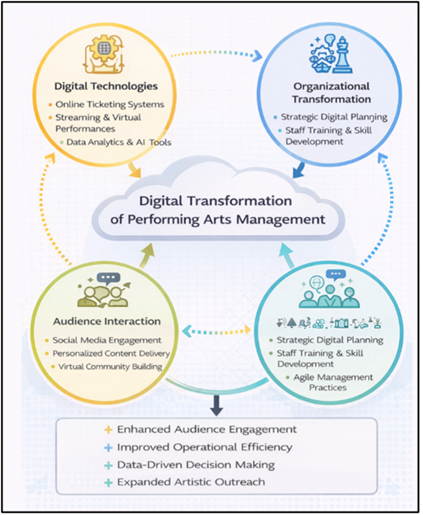
Figure 1 Conceptual Framework Illustrating How Digital
Technologies, Organizational Transformation, and Audience Interaction
Collectively Drive the Digital Transformation of Performing Arts Management.
1.2. Impact of Digital Transformation on Creative Industries
The overall creative and cultural sectors, film, music, theatre, and dance included, have greatly transformed due to digital transformation. Performances are now available in real time and in digital archives and social media venues allowing artists and organizations to present performances to audiences around geographic boundaries. The adoption of digital in performing arts in India and various other nations has been increasing at a high rate; it has been found that a significant percentage of cultural performances have found their way into digital medium through which they are promoted and distributed. The growth of streaming technologies and social media has been another reason of a significant rise in online attendance and international attendance on the performance arts events Brockinton et al. (2022).
1.3. Role of Technology in Performing Arts Organizations
Technological innovations are becoming more significant in enhancing the operational and creative factor of performing arts organizations. It has made the process of purchasing a ticket easier as a result of digital ticketing systems, mobile apps, and contactless entry technologies that have made the process more enjoyable and have improved overall experiences of the audience. Now, the audience is able to purchase tickets, choose the seats, and get real-time updates using mobile devices and do not have to use physical box-office transactions as much as before. Furthermore, AI, cloud computing, and immersive media are also being used to help companies to automatize their administrative work, streamline their marketing efforts and improve the design of production. These inventions enable the performing art managers to incorporate digital technology in stage creation, analytics of the audience and distribution of the performances.
1.4. Research Motivation and Problem Statement
Even though the use of digital technologies is rapidly growing, there are still numerous performing art organizations that have not been able to adopt digital transformation initiatives to the full extent. The factors that tend to reduce the efficient implementation of digital systems in cultural institutions are financial limitations, inadequate technological infrastructure, and incompetence in digital skills Doi and Murata (2020). Moreover, arts organizations should reconcile the technological revolution and the maintenance of artistic authenticity and culture. With the changing demands of the audiences to be more interactive and engaging, performing arts managers have to deal with the issue of changing the conventional models of management to respond to the needs of digitally connected audiences. These issues point to the necessity of systematic framework that would help performing arts organisations to embrace digital technologies and preserve artistic integrity.
1.5. Research Questions
This paper will deal with several research questions associated with the digitalization of performing arts management. To begin with, what are the effects of digital technologies on management of performing arts organizations? Second, which strategies are taken to improve the engagement of the audience and operational efficiency using digital platforms? Third, what are the challenges and barriers that performing arts managers encounter when they have to implement a digital transformation initiative? Lastly, what would be the technology changes that are expected to influence the management and sustainability of performing arts organisations in the digital age?
1.6. Structure of the Paper
The rest of the paper is structured in the following way. Section 2 provides a review of literature to date on digital transformation in creative industries and performing arts management. Section 3 addresses some of the most significant digital transformation strategies implemented by performing art organizations. Section 4 provides a theoretical framework of digital revolution in performing arts management. Section 5 will examine applicability and examples of how digital technologies have been used in the arts organizations. Section 6 looks at the key challenges and obstacles that are linked to digital transformation. Section 7 gives future developments of incorporating the emerging technologies in performing arts management. Lastly, the study ends with a conclusion where the main findings are summarized and research and practitioner recommendations provided to the performing arts industry.
2. Literature Review
2.1. Evolution of Performing Arts Management
The management of performing arts has developed considerably during the last several decades, changing the outdated administrative principle to the more professional and strategic management styles. Traditionally, performing arts organizations used manual systems as the main approach to ticketing, promoting and engaging the audience. Management practices were directed more towards artistic programmes, venue management, and reaching the local audience. Nevertheless, as the cultural industries in the world have become global and as digital media continue to grow, strategic planning, marketing management and audience relationship management as core elements of performing arts management have, over time, been introduced to the performing arts management field. However, this development has increased over the recent years with the advent of technologies, which allowed organizations to embrace digital platforms to promote performances, sell tickets, and engage the audience. Ebert et al. (2023). The digitalization of various tools has enabled the performing arts organizations to work more effectively, reach even more audiences, as well as experiment with new modes of artistic representation.
2.2. Digital Transformation in Cultural and Creative Industries
Digital transformation is a key trend in the process of cultural and creative industry development. Researchers have highlighted that digital technologies are transforming the creation, distribution and consumption of the cultural content in the areas of film, music, theatre and performing arts. Digital platforms, cloud computing, and online distribution channels have helped creative organizations to reach out to the global market without regard to geographical boundaries and interact with clients all over the world. Evidence shows that digital transformation produces better efficiency in operations, increased effectiveness in marketing, and it helps cultural organizations to establish new revenue models. These changes have prompted performing arts companies to consider the use of digital technologies in their management practices to be competitive and viable in the changing digital environment Hansen and Świderska (2024).
2.3. Role of Information and Communication Technologies (ICT) in Arts Management
ICT is a significant concept in contemporary arts management, as it helps organizations to streamline administrative processes and improve information exchange with the audience and other stakeholders. ICT tools can be used to streamline the performance arts organizations in managing audience data, ticket sales and performance attendance through digital ticketing systems, customer relationship management (CRM) systems and online event management systems. Moreover, new marketing and engagement opportunities are availed by the digital communication channels such as websites, mobile apps, and social media channels Navaneethakannan (2025).
2.4. Use of Data Analytics and Artificial Intelligence in Arts Organizations
Data analytics methods help the organization to analyze selling tickets trends, demographics of the audience, and estimation of the online engagement which would be invaluable in understanding the population tastes and the attendance rate. These capabilities can also be increased with the assistance of artificial intelligence technologies that will help in predictive analytics, automated marketing campaigns, and personal audience experiences. As an example, machine learning algorithms can be used to predict the demand of the audience and optimize the strategy of price of tickets by examining the past attendance patterns. Recommendation systems powered by AI can also recommend such performances to the audience basing on their interests in the past thus enhancing their satisfaction and interest. These technologies are slowly modifying the performing arts administration into more of a data-focused and strategic science. Katsaounidou et al. (2025). The Figure 2 refers to the different use of Data analytics and AI in Arts organization.
Fiugre 2
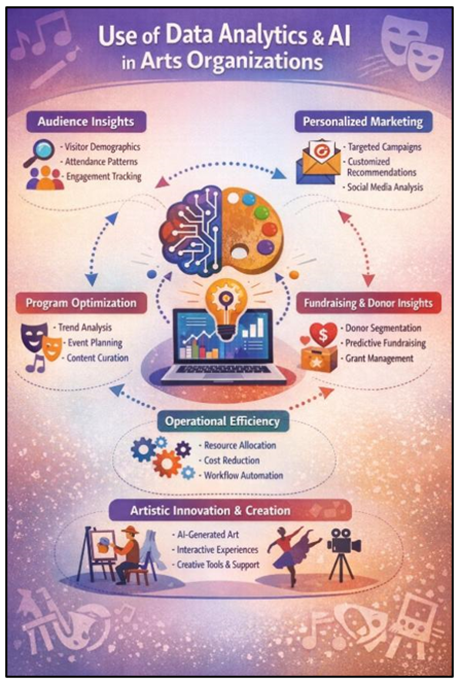
Figure 2 Application of Data Analytics and Artificial Intelligence in Arts Organizations
The Figure 2 shows that Data Analytics and Artificial Intelligence (AI) assist the arts organization operations and decision-making processes. AI-based systems are used to analyze the audience data, attendance trends, and metrics of the engagement to create audience insights and provide the opportunity to implement the personalized marketing strategies. Data analytics would also be useful in the optimization of the programs, as it allows organizations to design events and curate content based on the preferences and trends of the audience. Also, AI can be used to accelerate operational processes, optimize resources, and automate them to improve their efficiency, as well as promote artistic innovation using AI-enabled creative aids and interactive art experiences.
2.5. Existing Digital Transformation Frameworks
A large number of models stress the importance of the strategic alignment between technology competencies and organizational objectives as a guarantee of the success of digital transformation. Moreover, studies indicate that an effective digital transformation must be well supported by a robust leadership, investment in digital infrastructure, and sustained education of the staff to attain digital skills. These models offer good advice to performing arts organizations that are planning to incorporate the use of digital technologies in their management Li et al. (2022).
Figure 3
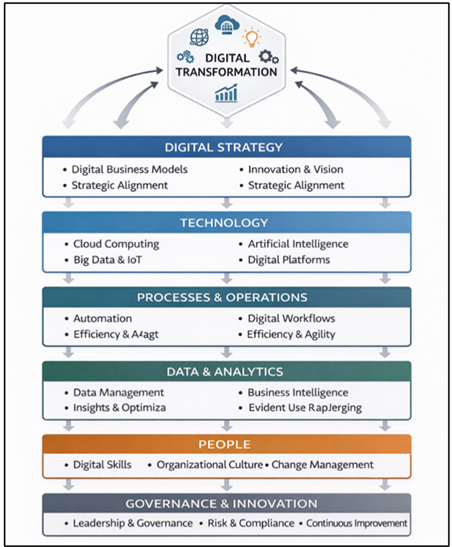
Figure 3
Existing Digital
Transformation Framework
2.6. Research Gaps in Digital Transformation of Performing Arts Management
Though the literature on the subject of digital transformation in creative sectors has yielded credible information on the matter, there are a number of research gaps in the performing arts management field. There is an abundance of research about the digital transformation in the movie, music, and media industries, with a relative lack of studies discussing its consequences on performing arts organizations. Moreover, the current literature does not focus on managerial strategies that may be necessary to implement successful digital transformation within arts institutions, and it tends to address the technological adoption issue. The studies of the impact of digital technologies on the organization culture, spectators and the long-term sustainability in performing arts management are limited as well. These gaps indicate that there is necessity of research that will allow the formulation of comprehensive frameworks and approaches that will facilitate digital transformation in performing arts organizations without compromising artistic creativity and cultural values.
Table 1
|
Table 1 Summary of Existing Technologies Applied in Digital Transformation of Performing Arts |
|||
|
Technique / Technology Used |
Application Area |
Key Contribution |
Limitations |
|
Data Analytics, Audience Behavior
Analysis Liu and Lan (2021) |
Performing Arts Audience Engagement |
Demonstrated how audience data from ticketing
platforms can be analyzed to personalize marketing
strategies and improve attendance. |
Limited dataset from a single theatre
organization; results may not generalize across cultures. |
|
Machine Learning, Recommendation Systems Melissourgos and Katsanos (2025) |
Digital Performance Platforms |
Developed recommendation algorithms for online
theatre platforms to suggest performances based on viewer preferences. |
Focused primarily on online streaming audiences
rather than live theatre environments. |
|
Social Media Analytics, Sentiment Analysis Novák et al. (2024) |
Performing Arts Promotion |
Analyzed social media feedback to evaluate audience perception of theatre
productions and guide promotional strategies. |
Social media data may be biased and not represent
the entire audience population. |
|
Artificial Intelligence, Predictive Analytics Pergantis et al. (2025) |
Arts Management & Programming |
Proposed AI models to predict audience attendance
and optimize scheduling of performances. |
Requires large historical datasets;
implementation may be difficult for small arts organizations. |
|
Data Visualization, Interactive Dashboards Tsita et al. (2023) |
Cultural Event Management |
Introduced visualization dashboards for
monitoring ticket sales, audience demographics, and performance popularity in
real time. |
Mainly descriptive analytics; limited predictive
or prescriptive capabilities. |
3. Digital Transformation Strategies in Performing Arts Management
3.1. Digital Infrastructure Development
Digital improvement Digital transformation successfully in performing arts organizations is based on digital infrastructure. The digital content, audience data, and administration can be handled more effectively through the implementation of modern technological infrastructure by the institutions. Performing arts organizations are now enabled by cloud computing platforms, digital content management systems and integrated enterprise systems to store and process high amounts of performance data and audience information. These systems make communication between artists, administrators, and technical people easily and they also do ensure that data is stored reliably and with ease of access. Țichindelean et al. (2021).
Besides, the creation of digital infrastructure facilitates the process of remote cooperation and virtual production rooms. Collaboration tools based on clouds are becoming popular with many performing arts organizations in coordinating rehearsals, stage design and planning production. Digital infrastructure also allows organizations to combine the ticketing systems, customer relationship management (CRM) systems, and digital marketing tools into a single management system. This integration will aid in the efficiency and effectiveness of the operations within performing arts institutions in making decisions.
3.2. Adoption of Online Ticketing and Streaming Platforms
Use of online ticketing and streaming is a significant change in the performing arts industry. Digital ticketing systems are slowly replacing the traditional ticketing systems which were characterized by use of physical counters and manual booking methods. These systems enable the viewers to book tickets online, choose their seats, and get digital tickets on their mobile phones. The online ticketing systems also allow the performing arts institutions to examine the data on ticket sales and keep tracking of audience attendance rates.
Besides ticketing systems, streaming have gained more relevance in terms of increasing the coverage of the performing arts performances. Live streaming technologies enable organizations to stream performances to distant audiences to provide people in other geographical locations an opportunity to watch live theatre, music, and dance productions. Hybrid performance models are physical and virtual experiences that have become effective measures to make more accessible and introduce new income streams. Digital archives are also supported by these platforms where performances can be stored and accessed both as a means of education and research opportunities Askitas (2025).
3.3. Social Media and Digital Marketing Strategies
Online promotion and audience building through digital marketing techniques has become the new tool in order to promote performing arts events. Instagram, Facebook, YouTube, and other digital media platforms help social media organizations to reach countless people in a short period of time. Via specific advertising campaigns, promotional videos, and backstage information, the arts organizations can create awareness regarding the future shows and ensure constant action and interaction with viewers.
Likes, shares, comments, and view counts are also some of the metrics of audience engagement that can be analysed through digital marketing. These metrics are quite useful to understand the preferences of the audience and help the managers of performing arts to organize more productive marketing campaigns Brookes et al. (2023). Moreover, more and more influence campaigns and interactive social media campaigns, as well as digital storytelling strategies, are being employed to popularize artistic productions and engage audiences.
3.4. Data-Driven Decision Making in Arts Management
Evidence-based decision making has become an important element of contemporary performing arts management. Through the analysis of the data gathered on the basis of ticketing services, social media communications, and audience feedback systems, organizations can receive some useful information about audience behavior and performance patterns. The insights guide the managers in making sound decisions about the programming, scheduling, pricing strategies and even promotional activities.
State-of-the-art analytics like predictive modelling and sentiment analysis helps organizations predict the demand of audiences and the factors that can make attendance. To illustrate, machine learning algorithms can examine the past performance of the sale of tickets to estimate the popularity of the next performance. Equally, the use of sentiment analysis applications can be applied to assess the audience response on social media to gauge the opinion of the people on productions. With the help of data analytics applied to the management processes, the performing arts organizations will be able to optimize their resources distribution and achieve better overall performance results Chesher and Albarrán-Torres (2023).
3.5. Integration of Emerging Technologies (AI, AR, VR)
The emergence of new technologies like artificial intelligence (AI), augmented reality (AR), and virtual reality (VR) is providing new opportunities in which performances can be experienced. The analysis of the audience data as well as the automation of marketing processes and the creation of an original content recommendation is more and more actively implemented using AI technologies. Such systems are able to detect trends in the behavior of the audience and make programming proposals that represent the interests of the audience. Gadre et al. (2025).
The use of augmented reality and virtual reality is also changing the production on the stage and interaction with the audience. AR can be used to improve performance on the stage by digitalizing physical space, and VR can be used to develop immersive virtual theatre experiences that can enable people to be involved in performances even without being on the stage. The technologies have been of great use especially in institutions of learning, museums and cultural institutions in need of offering new artistic experiences. The combination of AI, AR, and VR technologies is one of the important steps towards the future of the digital performing arts ecosystems.
4. Proposed System Architecture for Data-Driven digital transformation in Performing Arts Management
The section provides the suggested data-driven system architecture that will contribute to the digital transformation of performing arts management. The architecture combines digital platforms, data analytics and emerging technologies so as to facilitate smart decision making, audience interaction and optimization of performances. The given framework incorporates several functional layers such as data acquisition, data processing, analytics and application layers to facilitate the management and innovative process of performing arts organizations.
The architecture allows performing arts institutions to gather bulky amounts of audience and performance information of diverse kinds and varieties on multiple digital platforms including ticketing systems, streaming apps, and social media networks. Administrators, performers and marketing teams then use the results to enhance the artistic programming, the engagement with the audience and organizational decision-making.
4.1. System Overview
The system architecture in Figure 4 proposed is created to be a multi-layer framework, where the interaction between digital infrastructure, data analytics tools, and performing arts management systems occurs without any obstacles. The construction contains four main layers:
1) Data Acquisition Layer
2) Data Processing and Data Storage Layer.
3) Intelligence Layer and Analytics.
4) Application and Decision-Support Layer.
The layers have certain functions to perform that add to the efficiency and intelligence of the system in general.
Figure 4

Figure 4 Proposed System Architecture of Data Driven Digital Transformation
The multi-layer system architecture of data-driven performing arts management is shown in the Figure 4. It depicts the process of gathering data in the Data Acquisition Layer to include ticketing systems, streaming services, social media, and the IoT devices and processing and storing data in the Data Processing and Storage Layer to be further analyzed by analytics and machine learning models and ultimately used on the Application and Decision-Support Layer. The architecture also helps arts organizations to produce insights that facilitate audience engagement, performance optimization as well as making decisions using data.
4.2. Data Acquisition Layer
The data acquisition layer involves the retrieval of data of various sources related to the activity of conducting performances arts. Digital ticketing platforms, online streaming systems, social media communications, audience survey, and feedback mechanism are some of these sources. The gathered data will be useful information about the taste of the audience, attendance, demographic features, and the behavior of engagement.
Digital ticketing systems produce transactional data, i.e., purchasing of tickets, seat choices, and attendance data. In the same way, the streaming sites offer a viewership measurement such as viewing time, pattern of user interaction, and even the geographical location of the viewers. The social media can add further details which refer to the attitude of the audience, the work of the promotional campaign, and the attitude of people to works of art. By blending these various pieces of information, the organizations in the performing arts can formulate a broad insight into their viewer base and the activities they lead.
4.3. Data Processing and Storage Layer
The data processing/data storage layer is expected to arrange and control the information that is gathered via various sources. Raw data of ticketing, streaming service, and social media networks usually have inconsistencies, duplicate information, and lack of values. Thus, data cleaning, normalization and transformation are just some of the data preprocessing methods used in enhancing the quality of data.
Once preprocessed the processed data is stored in central cloud-based databases and data warehouses. The cloud computing technologies offer scalable storage facilities that enable performing arts organizations to handle big data of both structured and unstructured information. The information of various platforms is also integrated into one dataset using data integration tools, which can then be easily analyzed and retrieved. This layer also ensures that the system has accurate and reliable data that is easily accessible to undergo the process of analysis.
4.4. Analytics and Intelligence Layer
The analytics and intelligence layer is the main element of the proposed architecture. This layer employs a sophisticated data analysis and machine learning model to produce insights out of datasets that can be useful. The model of predictive analytics can be used to analyze the historical data on ticket sales to predict the attendance at the performance and predict the demand in future shows. Such forecasts are used to help event administrators to organize the schedule of the events, prices and promotions.
The method of sentiment analysis is implemented on the data of social media and audience reviews to gauge the audience perception of performances and artistic productions. NLP algorithms can be used to analyze comments, reviews, and posts on social media in order to determine the positive or negative attitudes towards the performances. Also, the machine learning algorithms are capable of identifying audience behavioral patterns, allowing to implement the marketing campaigns individually and apply the strategies of audience engagement.
Dashboards and reporting systems are also desktop tools that the analytics layer enables data visualization. These tools offer analytical information in the form of charts, graphs and performance indicators, enabling managers and administrators to make interpretation easier regarding the complex datasets.
4.5. Application and Decision-Support Layer
Application and decision-support layer is the last phase of the system architecture in which analytical understanding is utilized to feasible management choices. The analytics layer generates information that is used in various organizational aspects such as marketing strategy optimization, performance scheduling, audience engagement initiatives and financial planning.
As an example, predictive analytics outcomes can be used to enable administrators to determine the most appropriate time slots in which the performance will take place depending on the expected attendance. On the same note, audience segmentation strategies can allow organizations to create tailored marketing campaigns to a particular demographic group. Pricing strategies, promotional offers and content recommendations can also be informed by data.
Moreover, the decision-support layer enables the performing arts organizations to measure the performance of their programs and constantly optimize their operational plans. Combining the adoption of digital technologies with the use of data analytics will improve the efficiency, sustainability, and competitiveness of the digital era of performing arts institutions through the proposed system architecture.
5. Implementation and Application of the Proposed Framework
This section presents the implementation plan and practice of the suggested data-driven performing arts management model. The model combines e-technologies, data science, and smart decision-support to improve the efficiency and interest of the audience in the work of performing arts organizations. The system can help the arts institutions to organize the performances more efficiently and make a strategic choice basing on the data by integrating various digital platforms and analytical tools.
5.1. System Implementation Strategy
The proposed architecture implementation will entail the development of digital platform, data processing, and analytical tool integration into a single management system. Such a strategy of implementation can be implemented in performing arts organizations and enables them to gradually introduce digital technologies without interfering with the current working processes.
First, online ticketing systems, customer relationship management (CRM) systems, and online marketing software should be put in place. These systems are the main sources of primary data that produce useful data concerning the behavior of the audience and attendance at performances. After the data collection mechanisms are established, the organization can use the cloud-based storage system and data warehouses to store and centralize the information obtained.
After that, the analytics tools and machine learning models could be incorporated into the system and the data collected would be processed and analyzed. This can then be visualized using dashboards and reporting tools to present analytical information to the administrators so that they can make quality decisions on areas such as programming, marketing strategy and resources allocation.
5.2. Case Scenario: Application in a Performing Arts Organization
Data analytics are used to analyze attendance history and determine patterns in general attendance of a specific performance genre and audience demographics. On the basis of such insights, the organization organizes its performances in time frames which are likely to be attended by a larger audience and structures specific marketing campaigns concerning particular groups of the audience Chesher and Albarrán-Torres (2023).
Moreover, the organization also employs sentiment analysis to measure the feedback of the audience on latest productions. Positive feedbacks mean that things are coming out proper on the artistic side whereas the negative ones show where improvements are needed. The organization improves its performance planning and its audience engagement strategies through a continuous data analysis and feedback integration.
5.3. Benefits of the Proposed Implementation
The system also improves the general viewer experience by offering easy to access digital platforms like online ticketing, performance streaming, and interactive engagement platforms. Such features enable performing arts organizations to attract more audiences and increase their influence on culture.
6. Comparative Analysis and Performance Evaluation
This is where the proposed data-driven methods of performing arts management framework is evaluated to determine its effectiveness after comparing it with the traditional performing arts management systems. Conventional systems are majorly based on manual systems, gut-based decisions and minimal feedback systems by the audience. Conversely, the suggested framework will combine the digital technologies, data analytics, and intelligent decision support systems to improve operational efficiency and attract the audience.
Among the significant benefits of the suggested system, the possibility to gather and process vast amounts of audience data on several digital platforms should be mentioned. Conventional management methods are usually based on only a few information sources like records of ticket sales or post-performing surveys. The proposed structure, though, includes the information on social media and streaming services and audience interaction systems that allow understanding the likes and behavior of the audience more comprehensively. Moreover, the suggested framework aids predictive analytics and machine learning models that enable performing arts organizations to predict demand and performer optimization of the performance schedules Gadre et al. (2025), Jadhav (2027), Vijayakumar et al. (2026). These features empower the connection between the artists and the audiences and eventually improves the satisfaction and participation of the audiences. Vasanthan and Nandhini (2019)
Table 2
|
Table 2 Comparison Between Traditional and Data-Driven Performing Arts Management |
||
|
Parameter |
Traditional System |
Proposed Data-Driven System |
|
Decision Making |
Experience-based |
Data-driven |
|
Audience Analysis |
Limited |
Advanced analytics |
|
Marketing Approach |
Manual promotions |
Digital marketing & targeted campaigns |
|
Performance Planning |
Static scheduling |
Predictive scheduling |
|
Audience Engagement |
Limited interaction |
Personalized engagement |
|
Data Utilization |
Minimal |
Big data analytics |
As the comparison has shown, the proposed framework has a lot of enhancements in terms of efficiency, accuracy, and appeal to the audience, and it is an appropriate solution to performing arts management in the contemporary setting.
Figure 5
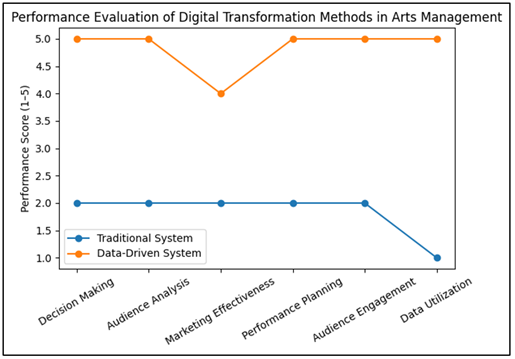
Figure 5 Performance Evaluation of Traditional and Data-Driven Digital Transformation Methods in Performing Arts Management Across Key Operational Parameters
The plot presented in Figure 5 provides a comparison of the performance of the traditional performing arts management system and the suggested data-driven digital transformation strategy that involves the comparison of the performance in terms of six major parameters: decision making, analysis of the audience, marketing effectiveness, performance planning, engagement with the audience, and data utilization. The scores of performance represent a scale between 1 (poor performance) and 5 (good performance). Rawandale and Kolte, (2021)
The findings indicate that the data-driven system has a high performance score on all parameters. Specifically, important changes are also observed in the analysis of the audience, its planning, its involvement, and the use of data, where digital solutions, including analytics and machine learning, can offer more information and predictability. On the contrary, the traditional systems present lower scores because of adherence to manual processes, minimal sources of data, and experience-based decision-making. Venkata et al. (2025)-Hazarika et al. (2024)
7. Challenges and Limitations
lthough digital transformation offers many opportunities to the management of performing arts, there are numerous challenges and limitations that need to be considered to achieve success in its implementation process. The initial challenge is the high price of technological infrastructure needed to support digital platforms, the use of cloud storage, and advanced analytics tools. A significant number of small and medium performing arts organizations do not have many financial resources and it is challenging to invest in advanced digital technologies.
The other challenge is technical skills and digital skills. The deployment of data-driven management systems will involve having personnel who have the skills in data analytics, machine learning, and digital marketing. Nevertheless, most performing arts institutions are more oriented towards artistic processes and do not necessarily have technical specialists who could administer complicated digital systems.
Privacy and security of data are also concerns in digital transformation projects. The nature of performing arts organizations is that they gather large volumes of audience data via the ticketing systems, online platforms and social media. The storage and ethical use of such data should be ensured so that the audience can trust it and the laws of data protection are not violated.
Moreover, the organizational resistance to change during the adoption of digital technologies can be present. Traditional working methods have been used by artists, administrators, and staff members who might be reluctant to employ new digital systems. Effective digital transformation is thus associated with training in the organization, executive support, and implementation plans.
Lastly, digital technologies do not need to harm the artistic integrity and creative freedom of the productions of the performing arts. Although a managerial decision may be informed by data, artistic creativity cannot be left out when developing a performance.
8. Future Research Directions
The introduction of digital technologies into the sphere of performing arts management introduces some prospects into the aspect of research in the future. A potential opportunity is the use of artificial intelligence and machine learning to study the behavior of the audience and create individual artistic experiences. The recommendation systems based on AI may recommend performances to the audiences depending on their preferences, just like the recommendation systems applied to the digital entertainment platforms.
The other possible research field is the creation of immersive performing arts experiences with the help of augmented reality (AR) and virtual reality (VR) technologies. These technologies have the ability to create interactive spaces in which audiences can engage in performances where they are not present or be seen or feel greater visual aspects in live productions.
The future research can as well involve the use of blockchain technology in the arts management especially with regard to ticketing systems and digital rights management. Online ticketing systems based on blockchain have the potential to decrease fraud, enhance transparency, and facilitate the distribution of digital content of performance.
Besides, more studies can be carried out about the incorporation of Internet of Things (IoT) technologies in performance venues. Smart gadgets and sensors would be able to gather real-time information on audience movement, engagement and environmental factors which would be of use in managing venues effectively and enhancing the audience experience. Lastly, arts management studies, data science, and digital media can be used in interdisciplinary investigation to create new models of digital performing arts ecosystems.
9. Conclusion
The blistering development of the digital technologies has had a great impact on the changing of the performing arts management landscape. Conventionally, performing arts organizations used manual operations, subjective decision making and the limited audience outreach system. Nonetheless, the advent of the modern technologies like data analytics, artificial intelligence, digital platforms, and interactivity media has introduced the performing arts to a new era where efficiency, inclusivity, and data-based decision-making are considered to be the best practices. This paper discussed the notion of Data-Driven Performing Arts Management and suggested an entire framework of embedding the concept of digital transformation into the performing arts ecosystem. The new system architecture is focused on the coordination of several technological elements such as data gathering systems, data processing systems, analytics systems, and visualization systems. All these elements make it possible to help performing arts organizations to gather and process vast amounts of information produced by ticketing systems, social media communications, feedback, and other electronic communication tools. Through such sources of data, the arts managers are able to obtain useful information on the audience preferences, attendance patterns and performance influence. In turn, this enables organizations to create more efficient marketing plans, schedule, and increase the interest of the audience. The other important area that is emphasized in this study is the contribution of digital platforms and cloud infrastructures to smooth management operations. Cloud technologies allow a centralized storage of the organizational data and real-time access, which enhance coordination of artists, managers, and stakeholders. Moreover, the incorporation of mobile apps and web-based portals provides a higher level of accessibility and enables the audience to engage with performances by booking tickets, having virtual experiences, and providing real-time feedback mechanisms.
CONFLICT OF INTERESTS
None.
ACKNOWLEDGMENTS
None.
REFERENCES
Alharoon, D., and Gillan, D. J. (2020). The Relation of the Perceptions of Aesthetics and Usability. Proceedings of the Human Factors and Ergonomics Society Annual Meeting, 64(1), 1876–1880. https://doi.org/10.1177/1071181320641452
Askitas, N. (2025). Notes on a World with Generative AI. Bonn: IZA–Institute of Labor Economics. https://doi.org/10.2139/ssrn.5466786
Brockinton, A., Hirst, S., Wang, R., McAlaney, J., and Thompson, S. (2022). Utilising Online Eye-Tracking to Discern the Impacts of Cultural Backgrounds on Fake and Real News Decision-Making. Frontiers in Psychology, 13, 999780. https://doi.org/10.3389/fpsyg.2022.999780
Brookes, I., Donald, E., Holmes, A., and O’Neill, M. (Eds.). (2023). Collins English Dictionary (4th ed.). HarperCollins.
Chesher, C., and Albarrán-Torres, C. (2023). The Emergence of Autolography: The “Magical” Invocation of Images from Text Through AI. Media International Australia, 189(1), 57–73. https://doi.org/10.1177/1329878X231193252
Desai, S. C., and Reimers, S. (2019). Comparing the Use of Open and Closed Questions for Web-Based Measures of The Continued-Influence Effect. Behavior Research Methods, 51(3), 1426–1440. https://doi.org/10.3758/s13428-018-1066-z
Doi, T., and Murata, A. (2020). Comparative Analysis of Website Usability between United States and Japan. In Advances in Physical, Social and Occupational Ergonomics. Springer. https://doi.org/10.1007/978-3-030-51549-2_66
Ebert, N., Scheppler, B., Ackermann, K., and Geppert, T. (2023, April 23–28). QButterfly: Lightweight Survey Extension for Online User Interaction Studies for Non-Tech-Savvy Researchers. In Proceedings of the 2023 CHI Conference on Human Factors in Computing Systems. Hamburg, Germany. https://doi.org/10.1145/3544548.3580780
Gadre, R., Lonkar, H., Gahule, T., Aashtankar, H., and Patle, M. (2025). Design and Fabrication of Burning Block Making Machine from Agriculture Waste. International Journal of Theoretical and Applied Research in Mechanical Engineering, 14(1), 12–16. https://doi.org/10.65521/ijtarme.v14i1.514
Hansen, K., and Świderska, A. (2024). Integrating Open- and Closed-Ended Questions on Attitudes Towards Outgroups with Different Methods of Text Analysis. Behavior Research Methods, 56(9), 4802–4822. https://doi.org/10.3758/s13428-023-02218-x
Hazarika, C. A. I., Khalfan, J., Ahmed, M., Yousif, A., and Hussain, J. (2024). Role of Fintech as an Enabler to Fulfill HR Requirements and Attain Sustainability. In A. Hamdan and A. Harraf (Eds.), Business development Via AI and Digitalization (Studies in Systems, Decision and Control, Vol. 537). Springer. https://doi.org/10.1007/978-3-031-62106-2_5
Jadhav, K. D. (2027). Integrating IoT, Sensors, and Machine Learning for Enhancing Crop Yield and Irrigation Efficiency Systems. In R. R. Janghel, R. Doriya, J. Lachure, and Y. K. Rathore (Eds.), Sustainable Agriculture Production Using Blockchain Technology (1–20). Wiley. https://doi.org/10.1002/9781394248711.ch11
Katsaounidou, A., Xylogiannis, P., Baltzi, T., Saridou, T., Papadopoulos, S., and Dimoulas, C. (2025). An AI-Driven News Impact Monitoring Framework Through Attention Tracking. Societies, 15(8), 233. https://doi.org/10.3390/soc15080233
Li, Y., Karreman, J., and De Jong, M. (2022, July 17–20). Cultural Differences in Web Design on Chinese and Western Websites: A Literature Review. In IEEE International Professional Communication Conference (ProComm). Limerick, Ireland. https://doi.org/10.1109/ProComm53155.2022.00023
Liu, P., and Lan, L. (2021). Museum as Multisensorial Site: Story Co-Making and the Affective Interrelationship Between Museum Visitors, Heritage Space, and Digital Storytelling. Museum Management and Curatorship, 36(4), 403–426. https://doi.org/10.1080/09647775.2021.1948905
Melissourgos, G., and Katsanos, C. (2025, September 24–26). UEQ-GR and UEQ-S-GR: Towards a Greek Adaptation of the User Experience Questionnaire and its Short Version. In Proceedings of the 3rd International Conference of the ACM Greek SIGCHI Chapter. Syros, Greece. https://doi.org/10.1145/3749012.3749059
Navaneethakannan, D. V. (2025). A Study on the Impact of Service Quality Dimensions on Consumer Satisfaction Among Electric Two-Wheeler Users in Chennai. International Journal of Research in Digital Marketing and Retailing, 14(2), 79–84. https://doi.org/10.65521/ijrdmr.v14i2.1282
Novák, J. Š., Masner, J., Benda, P., Šimek, P., and Merunka, V. (2024). Eye Tracking, Usability, and User Experience: A Systematic Review. International Journal of Human-Computer Interaction, 40(8), 4484–4500. https://doi.org/10.1080/10447318.2023.2221600
Pergantis, M., Limniati, L., Lamprogeorgos, A., and Giannakoulopoulos, A. (2025). AI-Powered User Experience Personalization in Academic Digital Art Repositories. In ICERI2025 Proceedings (6781–6789). Valencia: IATED. https://doi.org/10.21125/iceri.2025.1857
Rawandale, U. S., and Kolte, M. T. (2021). Design, Development and Analysis of Variable Bandwidth Filter Bank for Enhancing the Performance of Hearing Aid System. International Journal of Intelligent Engineering Systems, 14(6), 391–401. https://doi.org/10.22266/ijies2021.1231.35
Tsita, C., Satratzemi, M., Pedefoudas, A., Georgiadis, C., Zampeti, M., Papavergou, E., Tsiara, S., Sismanidou, E., Kyriakidis, P., Kehagias, D., et al. (2023). A Virtual Reality Museum to Reinforce the Interpretation of Contemporary Art and Increase the Educational Value of User Experience. Heritage, 6(5), 4134–4172. https://doi.org/10.3390/heritage6050218
Vasanthan, R., and Nandhini, R. (2019). Kinaesthetic Learning Styles and Activity-Based Content for Tailoring Language Teaching to Diverse Learning Preferences. Man in India, 99(4), 987–995.
Venkata, S. B., Ashirova, A., Karwande, V. S., Aruna, T., Kholiyarov, E., and Singh, S. (2025). Towards Accurate Maritime Surveillance: A Hybrid CNN-Transformer Architecture for Ship Detection in SAR Imagery. In International Conference on Innovations in Intelligent Systems: Advancements in Computing, Communication, and Cybersecurity (ISAC3 2025). IEEE. https://doi.org/10.1109/ISAC364032.2025.11156808
Vijayakumar, M., Muniyandy, E., Mirajkar, G., et al. (2026). Intrusion Detection and Localization Using Deep Learning Approaches in VANET Environments. SN Computer Science, 7, 234. https://doi.org/10.1007/s42979-026-04769-0
Țichindelean, M., Țichindelean, M. T., Cetină, I., and Orzan, G. (2021). A Comparative Eye Tracking Study of Usability—Towards Sustainable Web Design. Sustainability, 13(18), 10415. https://doi.org/10.3390/su131810415
|
|
 This work is licensed under a: Creative Commons Attribution 4.0 International License
© ShodhKosh 2026. All Rights Reserved.