ShodhKosh: Journal of Visual and Performing ArtsISSN (Online): 2582-7472
|
|
From Language to Visual Culture: Integrating Digital Media Arts in ESL Pedagogy and Higher Education Systems
Dr. Mohammad Saleh Al-Shizawi 1 , Omer Ahmed Siddig Ahmed 2
 , Dr. Adil Bin Hamdan Bin Zayed
Al-Rudaini 3
, Dr. Adil Bin Hamdan Bin Zayed
Al-Rudaini 3 , Dr. Abdullah Bin Khamis Bin
Abdullah Al-Neyadi 4
, Dr. Abdullah Bin Khamis Bin
Abdullah Al-Neyadi 4 , Sheikha Bint Suhail Al-Sawwafi 5
1 Assistant Professor of Grammar and
Morphology, Department of Arabic Language, College of Arts and Social Sciences,
Sultan Qaboos University, Muscat, Sultanate of Oman, Oman
2 Department of Arabic Language and Literature, College of Arts and Social Sciences, Sultan Qaboos University, Al-Khoud, Muscat, Oman
3
Sohar
University, Faculty of Education and Arts, Department of Arabic Language, Oman
4 Sohar University, Faculty of
Education and Arts, Department of Arabic Language, Oman
5 College of Arts and Social
Sciences, Sultan Qaboos University, Muscat, Sultan of Oman, Oman
|
|
|
ABSTRACT |
|
|
The high rate
of digital technology development has reshaped teaching and learning
processes at the higher education institution and English as a Second
Language (ESL) levels, increasingly fostering visual and multimodal learning
environments. The paper will also seek to compare and contrast the current
body of empirical and theoretical evidence concerning the impacts of digital
tools including digital media and visual communication tools, on student
engagement, motivation, academic achievement, and language acquisition and
the pedagogical and institutional factors that can allow technologies to be
successfully implemented. A systematic and integrative review approach (with
PRISMA 2020) yielded 27 peer-reviewed articles published in 2020-2025, and
conducted their analysis in terms of higher education and ESL/EFL. The review
is based on Constructivism, Self-Determination Theory, Cognitive Load Theory
and Connectivism to make sense of the literature patterns. The results
suggest that learning management systems, adaptive technologies based on AI,
gamified learning platforms, learning analytics, and immersion tools all have
a consistent and significant positive impact on learner engagement,
motivation, and academic and language achievement embedded in scaffolded
learner-centered pedagogies. Nonetheless, institutional preparedness, faculty
online competence, professional growth, and institutional ethical governance
models are very firm mediators of the effectiveness of these tools. The
review has concluded that the application of digital technologies has the
most educational benefits when it is combined with good pedagogical
principles, institutional strategy, and consideration of ethics. The findings
provide a very broad base to guide teachers, policy makers and researchers
who wish to maximize the use of technology integration in modern higher
education and ESL teaching contexts. |
|||
|
Received 23 January 2026 Accepted 27 February 2026 Published 28 April 2026 Corresponding Author Dr.
Mohammad Saleh Al-Shizawi, m.alshizawi@squ.edu.om DOI 10.29121/shodhkosh.v7.i1.2026.7303 Funding: This research
received no specific grant from any funding agency in the public, commercial,
or not-for-profit sectors. Copyright: © 2026 The
Author(s). This work is licensed under a Creative Commons
Attribution 4.0 International License. With the
license CC-BY, authors retain the copyright, allowing anyone to download,
reuse, re-print, modify, distribute, and/or copy their contribution. The work
must be properly attributed to its author.
|
|||
|
Keywords: Digital Learning Tools, Higher Education, ESL and
EFL Instruction, Student Engagement, Artificial Intelligence in Education,
Learning Management Systems, Pedagogical and Institutional Readiness |
|||



1. INTRODUCTION
The transformation in the sphere of higher education is getting deeper due to the rapid changes in the digital sphere which are reshaping the design and delivery of instruction in universities Huang and Yan (2025). The conventional lectures-based models are growing incompetent to satisfy the demands of the contemporary learners who anticipate flexible, interactive and personalized learning instead of the pass-down knowledge Zou et al. (2025). Moreover, the growing pace of incorporating digital learning environments, artificial intelligence (AI), learning analytics, and immersive characteristics is reorganizing the traditions of learning and widening access to high-quality learning across the globe Aytaç (2024). The needs of digital native learners have also been transformed by these innovations and include agile, adaptive, and twenty-first-century skills and global workforce needs Pinto and Leite (2020), Rosli et al. (2022), Downes (2022).
Besides these technological developments, modern education is also becoming influenced by the role of visual culture in contemporary learning where images, videos and symbolic representations are now central to the way knowledge is constructed and conveyed Guinibert (2020). The emergence of multimodal communication (images, video, media) has altered the traditional text based learning to be more dynamic and interactive in nature, and the learner is able to interact with the content in a variety of sensory and cognitive ways Yürüm (2025). In ESL settings, such a transition is especially crucial, as ESL students who engage in visual and textual interaction can better understand, interpret and generate language in contextually relevant and meaningful ways Rahmanu and Molnár (2024). Digital spaces, therefore, are not merely technological spaces but also visual and communicative ecosystems that promote various kinds of expression and knowledge.
These changes can be explained in theoretical terms by the concept of Constructivism, Self-Determination Theory (SDT), and Connectivism McLeod (2023). Constructivism focuses on active and student-centered learning by collaboration and reflection whereas SDT focuses on the way autonomy, competence, and relatedness facilitate intrinsic motivation Fuentes and LaBad (2025). Additionally, a significant focus is placed on digital networks and knowledge exchange in the concept of Connectedivism, which demonstrates how learners establish the links between sources of information, fellow learners, and technologies Aldalalah (2025). Altogether, these models explain the use of educational technologies in creating engagement, autonomy, and knowledge building in higher education as well as English as a Second Language ESEN (2025).
In this changing environment, digital technologies have particularly come to influence higher education and ESL teaching not only the way the content is presented but also the way learners communicate Mohammed (2023). LMSs, such as Moodle, Canvas, and Blackboard, have become active ecologies that facilitate asynchronous and synchronous learning and multimedia, as well as real-time analytics Herniawati et al. (2025). Moreover, peer learning and communication (through collaborative tools, video conferencing, discussion forums, and virtual group projects) is promoted by collaborative tools, which is critical to maintaining engagement and thoughtful processing Pinto and Leite (2020). These are further extended with AI-driven technologies which have made it possible to provide personalized tutoring and automated assessment and customized learning to meet the needs of individual learners Younas et al. (2025). Nevertheless, although such innovations increase motivation and performance with the help of immediate feedback and data-based responses, they also pose a grave threat to academic integrity, cognitive dependency, and AI decision-making transparency Luo et al. (2025). In spite of these opportunities, institutions are still experiencing great difficulties in the implementation of digital learning. The lack of infrastructure, lack of access to high-speed internet, and the presence of digital disparities between faculty and students prevents the full potential of technology Zou et al. (2025). As a result, studies emphasize the importance of institutional investment and ongoing professional growth that would help to make the process of technology integration pedagogically significant instead of superficial Shard and Koul (2024).
Besides, ethical and policy consequences of adopting educational technology have also been getting complicated. The emergence of generative AI demands the introduction of solid systems to protect the privacy of students, uphold academic integrity, and ensure fairness of the algorithmic decision-making process García-López et al. (2025). Students also express worries regarding excessive dependence on AI tools and the reinforcement of bias and that responsible innovation has to be efficient and focused on human control and pedagogical principles Kovačević et al. (2025). Although many studies have focused on individual technologies, including LMS platforms, adaptive learning systems, and learning analytics, the few studies that have critically synthesized their findings use a single, strategy-based framework Rodriguez et al. (2025), Ngulube and Ncube (2025). Much of the literature is descriptive and is based on tools instead of pedagogical strategies that provide the basis of successful integration. Moreover, to reveal the conceptual and empirical gap in ESL education, there is little research on the role of digital tools in developing language proficiency, intercultural competence, and learner autonomy in higher education.
Thus, the aim of the review is to fill these gaps by synthesizing the recent empirical findings and theoretical approaches to give a holistic perspective of the deployment of digital tools in the strategical implementation of enhancing general and language-specific learning outcomes. It is critical in the sense that by adopting a critical lens; it is able to not only analyze the advantages and issues of digital integration, but it also analyzes the institutional and ethical circumstances that facilitate the successful application of technology in higher education. Nevertheless, the digital transformation of higher education indicates the paradigm shift to the learner-centered, adaptive, and data-informed teaching. Nevertheless, to achieve its potential, it needs to be coherent in pedagogical design, supported by institutions and held accountable ethically Mathew et al. (2021). This review summarizes the research on the effects of digital tools on engagement and performance, outlines the ongoing issues, and provides the best-practice suggestions on successful and equitable integration.
Finally, the contribution of this review is that it provides a theoretically based and empirical informed synthesis upon which the gap between the digital innovation and pedagogical practice is bridged. It promotes existing knowledge by connecting engagement, learning outcomes, and ethical concerns in the context of higher education and ESL so that educators, policymakers, and researchers can have a strategic system on how best to integrate technology in learning in the twenty-first century.
To guide this synthesis, the following research questions are posed:
· How do digital tools influence student engagement, motivation, and participation in higher education and ESL learning environments?
· What are the measurable impacts of digital tools on students’ academic performance, language development, and overall learning outcomes?
· What pedagogical strategies and institutional conditions most effectively facilitate the successful integration of digital tools while addressing challenges such as accessibility, faculty readiness, and ethical considerations in higher education and ESL contexts?
2. Literature review
2.1. Theoretical Foundations of Technology Integration
Implementation of digital tools in higher learning institutions has its theoretical basis on a number of influential theoretical frameworks that elucidate the effectiveness of technology in improving learning, motivation and engagement. Constructivist Learning Theory is one of them that is especially essential Vygotsky (1978), Piaget (1973). Constructivism is learner-centered learning, which focuses on active learning or learning through experience, reflection, and social interaction instead of passive intake of information Zhao (2024). Digital technologies, including interactive simulation, collaborative application and multimedia environment, are mediating this process and allow learners to experiment, collaborate and co-construct meaning Nduati (2023). An example is virtual laboratories and simulated games which motivate students to test hypotheses and use theoretical knowledge in a controlled environment of practical use, which helps students develop deeper conceptual knowledge and critical thinking Ayer Miller et al. (2025). The perspectives of Social Constructivist go a step further because they require digital tools as a means of peer communication, feedback, and the collective creation of knowledge Jonassen et al. (2000).
Adding to this interactional emphasis, Self-Determination Theory offers a motivational model to realize how technology assists in engaging with higher education Lan and Hew (2020). According to SDT, intrinsic motivation thrives when the psychological needs of persons to be self-directed, competent and related are met. These needs can be fulfilled using digital tools by the adaptive system of learning that provides personalization, feedback systems that stimulate competence and collaborative environments that foster relatedness. Recent empirical studies attest to the fact that the motivation and persistence of technology-mediated feedback and collaboration are elevated greatly Fuentes and LaBad (2025), Rotar (2025), Nkomo et al. (2021). Whereas constructivism describes the ways digital environments promote active interaction and construction of knowledge, SDT demystifies the reasons why learners are motivated to engage and remain engaged in such environments thereby explaining the cognitive and affective processes through which technology integration occurs jointly Addas et al. (2024). Besides such frameworks, the Cognitive Load Theory also provides important information on how to design and sequence digital learning material. It emphasizes the role of controlling working memory and eliminating extraneous load by means of properly designed, multimedia content Sweller and Chandler (1991). Good digital devices thus use scaffolding, chunking, and apparent visual point of reference to maximize cognitive processing and avoid overload, a notion confirmed in the current study of learning design Mohammed et al. (2025), Godsk and Møller (2025).
Connectivism offers a more modern outlook that fits the digital learning that is networked. It states that digital learning is conducted by establishing and sustaining networks among individuals, digital resources, and knowledge networks Jeny (2024). Examples of this theory in practice are platforms that facilitate peer conversation, sharing of resources and social annotation. Recent empirical approvals indicate that the networked digital space enhances collaboration, self-regulation and digital literacy skills, which are the key factors of lifelong learning and global competency Palomino et al. (2025).
When combined, these theoretical perspectives shed some light on the multidimensionality of digital learning in comparative synthesis. Constructivism is centered on interaction and experience learning, SDT, its motivation, and persistence, Cognitive Load Theory is centered on well-designed instruction, and Constructivism is centered on networked and knowledge construction through collaboration Evans et al. (2024). Both of them provide a unique and complementary perspective on how and why digital tools can better digital learning settings in higher education. Cumulatively, these frameworks present the conceptual basis of this review. They offer a unified conceptualization on intersections of cognitive, motivational and social processes in technology-mediated learning. This theoretical synthesis is not only used to understand the empirical results but also to create the evidence-based strategies of optimization of digital tools integration in higher education and ESL settings.
2.2. Digital and Visual Media Tools in Higher Education
Over the last ten years, digital tools in higher education have developed significantly and can be used in various teaching, learning, assessment, and analytics Bennett and Abusalem (2024). Course organization, content delivery, and communication now use Learning Management Systems (LMS) like Moodle, Canvas, and Blackboard as their fundamental infrastructure and include assessment, analytics, and collaborative space tools Herniawati et al. (2025), Godsk and Møller (2025). According to meta-analyses, almost 80 percent of higher education institutions use LMS platforms to facilitate hybrid or online education, and the majority of studies (n=30) indicate that the engagement and the consistency of instruction have increased Rotar (2025). Personalization and adaptive learning features have been brought by AI-powered technologies that LMSs cannot match in the realm of their structural strengths Jiao (2024). Intelligent assessment and adaptive platforms, as well as generative AI tutors, respond to each student and adjust the content level and pace accordingly, enhancing the understanding and retention rates of the material by 15-25% relative to fixed materials Zhu et al. (2025), Rodriguez et al. (2025). Nonetheless, even though AI is superior in motivation and feedback personalization, LMSs are still more efficient in terms of scalability, clarity, and administrative consistency, which highlights that both technologies prioritize other pedagogical needs.
Video-conferencing, shared documents and discussion forums are other interactive tools that further enhance student collaboration and social presence. Empirical literature attest that, with the help of synchronous communication platforms, participation and satisfaction increase by approximately 65 percent relative to text-only platforms Al Aroud et al. (2022). Meanwhile, the learning analytics systems are recording the measurements such as the frequency of the logs and patterns of assignments, which allows interventions based on the data to be improved by 20 to 30% Kausar (2025), Ogunleye et al. (2024). Together, LMSs are a means of providing stability to the organization, AI systems are a means of providing adaptive personalization, and analytics tools are a means of generating predictive insights. With a strategic combination of these technologies, there will be a complete digital ecosystem that facilitates flexible, evidence-based, student-centered learning that will be in line with twenty-first-century learning needs.
2.3. Technology and Student Engagement
Student engagement has been widely defined as one of the key predictors of academic achievement and high retention in tertiary education. Digital tools have a lot of potential to increase the engagement through active interaction, sharing experiences, and customized learning Yaseen et al. (2025). The new empirical data suggests that the level of motivation and mental engagement among students in technology-assisted settings tend to be higher in comparison with conventional lecture-based courses. Nevertheless, such effects are not universal and heavily rely on the pedagogical model that drives the process of integrating technology Kulkarni et al. (2025).
In terms of a Self-Determination Theory (SDT), the engagement is boosted when the learners feel autonomy, competence, and relatedness He et al. (2025). Adaptive tutorials and gamified assessments are digital resources that can be used to satisfy these psychological needs because they can offer immediate feedback, provide incremental challenges, and self-paced learning Zhang and Huang (2024). On the other hand, according to studies, over-automation or absence of instructor presence can also decrease perceived autonomy or relationship and decrease motivation and long-lasting engagement Rotar (2025). Therefore, technology may support intrinsic motivation; however, its design and the instructional use define the differences between positive and superficial engagement outcomes.
Constructivist views also shed light on how digital means encourage group interaction via interaction and construction of social knowledge Lehtinen et al. (2023). Social media tools that facilitate peer review, group projects and forums of real-time discussion enable learners to cocreatively construct meaning, provide mutual feedback and construct advanced forms of thinking Steenkamp and Brink (2024). According to a study carried out recently, it is reported that such tools enhance the levels of belonging and mental investment of students in the learning activities. However, such advantages may be compromised in case it is not used equally or because of the lack of digital literacy, which does not allow successful cooperation, particularly when working with diverse or large groups Bellhäuser et al. (2025).
Besides thinking and interacting, Cognitive Load Theory puts emphasis on the idea of multimedia complexity and capacity of the learner. In case digital interfaces overwhelm with interactivity or visual stimuli, the focus can move to significant learning and be distracted and cognitively exhausted Surbakti et al. (2024). It is therefore important to design it effectively which means that scaffolded interactivity and alignment between technology and learning objectives should be provided so that engagement becomes cognitively productive but not extraneous Rathnasekara et al. (2025).
Collectively, these theoretical viewpoints indicate that online interactions are a multidimensional construct that is predetermined by motivational, cognitive, and social elements. It is possible to imagine that digital tools can be most efficient in the cases when they are incorporated intentionally and with educator facilitation, and in the cases when they are based on the principles of autonomy, collaboration, and cognitive balance. This is where the success of technology in helping to foster engagement is not in its novelty, but in its pedagogical orchestration, which is continuously repeated in the recent empirical and theoretical research.
2.4. Visual and Digital Engagement in ESL Learning
The
visual and digital interaction is now a key element of ESL education in modern
learning settings Sowell
(2022). The combination of multimedia
features (images, videos, animations, and interactive platforms) allows
learners to interact with language in more contextual and meaningful ways Karabulut
and Karadağ (2024). These digital and visual aids aid
understanding as they connect linguistic input with visual representations,
which promotes cognitive processing and memory Haq and Madany (2025). Additionally, online learning
encourages active learning by fostering collaboration, real-time engagement,
and individualized learning. Learners are not passive receivers of information,
but active participants who interpret and make sense through visual and textual
means Mehmeti
and Dervishi (n.d.). This multimodal interaction
promotes motivation, creativity and more profound language acquisition,
especially in the diversified and digitally mediated learning environments Selfa-Sastre
et al. (2022). In general, the visual and digital
strategy can be used to enhance an engaging, inclusive, and effective ESL
learning experience, which is consistent with the requirements of contemporary
students and the changing educational trends.
3. Methodology
3.1. Research Design
This study utilized a methodology that was systematically structured and integrative in that it was aimed to synthesize empirical and theoretical data on the impact of digital tools on engagement, motivation, and academic performance in higher education, and ESL/EFL learning. The PRISMA guidelines of 2020 were adhered to in the review so that the reporting was transparent and replicable. Theoretically, the synthesis was informed by the Technology Integration Maturity Model (TIMM) and the Technological Pedagogical Content Knowledge (TPACK) model that are used to provide a prism through which the mediation of institutional preparedness and pedagogical design are examined in relation to technology adoption.
3.2. Search Strategy
An extensive search was done in Scopus, Web of Science, ERIC, Taylor and Francis Online and Google Scholar between 2020 and December 2025. Search strings were the combination of the keywords with Boolean operators like.
Digital learning tools AND higher education, artificial intelligence in education, learning management systems, student engagement, academic performance, language learning, and learning analytics.
The filters only included peer-reviewed English articles between 2020 and 2025 in the form of journal articles, conference proceedings, and systematic reviews.
3.3. Inclusion and Exclusion Criteria
The inclusion and exclusion criteria were chosen in order to guarantee the methodological rigor and applicability to higher education and ESL/EFL settings. The studies were chosen according to their empirical focus, transparency of methods and applicability to digital tools integration (see Table 2).
Table 1
|
Table 1 Inclusion and Exclusion Criteria for Study Selection |
|
|
Category |
Criteria Description |
|
Inclusion Criteria |
·
Examined digital or AI-mediated tools within
higher-education or ESL/EFL learning settings |
|
·
Reported measurable or perceived impacts on engagement,
motivation, language development, or academic achievement. |
|
|
·
Utilized empirical, mixed-methods, or systematic review
designs with clearly identified methodologies. |
|
|
·
Published in peer-reviewed outlets between 2020 and
2025 in English language. |
|
|
Exclusion Criteria |
·
Focused exclusively on primary or secondary education,
informal learning, or non-academic contexts. |
|
·
Lacked methodological transparency (e.g., missing
design details, unclear analysis procedures). |
|
|
·
Represented non-empirical works such as commentaries,
editorials, or theoretical opinion pieces. |
|
|
·
Duplicated studies or those without full-text
availability. |
|
3.4. Screening and Selection Process
The database search initially identified 1,500 records across the selected electronic databases. After the removal of 1,044 duplicate records, 456 unique records remained for screening. Title and abstract screening resulted in the exclusion of 137 records, leaving 319 reports for full-text retrieval and eligibility assessment. Following full-text review, 292 reports were excluded for not meeting the inclusion criteria, and 27 studies were ultimately retained for inclusion in the final synthesis (see Figure 1). The final corpus comprised 11 quantitative or quasi-experimental studies, 7 qualitative investigations, 3 mixed-methods studies, and 6 systematic or conceptual reviews. Collectively, these studies demonstrated thematic saturation and represented diverse higher education and ESL/EFL contexts across Asia, the Middle East, Europe, and Africa, thereby supporting the robustness and international relevance of the review.
Figure 1
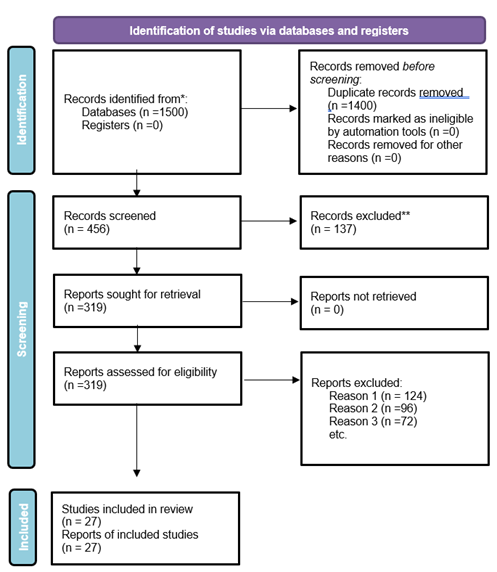
Figure 1 PRISMA 2020 Flow Diagram
3.5. Data Extraction and Coding
A structured extraction matrix was created in Excel to capture:
· Author(s) and Year
· Context and Participants
· Digital Tool / Intervention
· Research Design and Framework
· Measured Outcomes (e.g., engagement, motivation, achievement, institutional readiness)
· Key Findings and Limitations
Coding followed iterative cross-validation among reviewers to maintain reliability. Each study was then grouped under one of three guiding research questions corresponding to engagement (RQ1), learning outcomes (RQ2), and institutional integration (RQ3).
3.6. Quality Appraisal
An adapted version of Mixed Methods Appraisal Tool and Critical Appraisal Skills Programme checklist (CASP) were used to determine methodological rigor across the 27 included studies. The evaluation was based on five aspects; research design and purpose are clear, sampling and data integrity are sufficient, analytic transparency is achieved, instruments are valid and reliable, and control of triangulation or bias is evidenced. All in all, 22 studies (81 percent) were of high methodological quality, which was evident in the clarity of design, strong analytic models, and validated measures. Four (15 percent) of the studies were rated moderate, usually because of small sample sizes or low levels of triangulation and one study (4 percent) was rated low because it did not provide enough information on the analysis processes. The validity and precision of design were high in quantitative and quasi-experimental papers (e.g., Temel and Cesur (2024), Pane and Jannah (2023), Eltahir and Babiker (2024), whereas interpretative depth and transparency were rated as high in qualitative case and interview-based paper (e.g., Shiu (2025), Bitar and Davidovich (2024). Chan and Lo (2024) and Bizami et al. (2023) were found to reach all quality criteria of systematic reviews, as their triangulation and theoretical comprehensibility were consistent. The less rated papers were kept to provide contextual completeness and in order to provide thematic representativeness but they were weighed with caution during the synthesis. This approach of the balanced inclusion strategy contributes to the methodological rigor and interpretive credibility, which is consistent with PRISMA 2020 and MMAT instructions on integrative education research.
3.7. Data Synthesis and Analysis
A thematic synthesis approach integrated quantitative and qualitative findings. Descriptive statistics summarized measurable learning gains, while inductive coding identified recurring pedagogical, motivational, and institutional themes.
· The synthesis was organized around three analytical dimensions:
· Digital-tool influence on engagement and motivation;
· Measured effects on academic performance and language development;
· Pedagogical and institutional conditions shaping successful technology integration.
3.8. Ethical Considerations and Bias Mitigation
The studies included all claimed adherence to ethical research standards. This was a secondary data review that did not require any extra ethical consent. Selection bias was reduced by use of dual independency screening and, furthermore, publication bias was reduced by inclusion of mixed methodological designs. Interpretive bias was further decreased by reflexive discussion among the authors when they were synthesizing.
4. Result
4.1. Participation Visual and Digital Engagement in ESL Learning
In the studied works, the digital technologies produced a positive effect on the motivation and involvement of learners in the ESL and higher education settings. As an illustration, the introduction of gamified Web 2.0 tools (Kahoot!, Quizizz, Mentimeter) proved to be a highly effective means of increasing the interest and engagement of EFL learners in their courses, which can be explained by the motivational effect of interactive platforms Temel and Cesur (2024). This is in line with systematic review by Núñez et al. (2023), which discovered that game-based concepts such as feedback, competition, and narrative structures can support the engagement and the enjoyment of learners in the blended learning settings.
In a similar manner, new pedagogies, based on Flipped Classroom models, Google Classroom, Flipgrid, and digital storytelling, created inclusion and learner-centered engagement through the promotion of collaborative and creative learning Ojong and Addo (2024). Jassni et al. (2024) in higher education of Malaysia found the web-based learning technologies empowered the communication, collaboration, and motivation of ESL students and the growth of necessary skills of the 21st century.
Research on blended learning also demonstrates such dynamics: Liu (2025) discovered that online learning produced greater emotional response and less cognitive engagement than face-to-face learning, whereas Nusong and Watanapokakul (2025) found that blended learning had a beneficial impact on adaptability, motivation, and understanding with the help of interactive online learning. Building upon these results, Yang and Chano (2025) compiled more than fifty articles to demonstrate that flipped and mobile-assisted methods strengthen the engagement of these methods with the help of the interaction with peers and the presence of feedback loops. On the whole, the findings suggest that the engagement and motivation flourish when digital tools are integrated into interactive and collaborative pedagogies and learner-centered pedagogies that balance between emotional engagement and cognitive participation as shown in Table 2.
Table 2
|
Table 2 Summary of Empirical and Review Studies Examining the Impact of Digital and Gamified Learning Tools on Student Engagement, Motivation, and Participation in Higher Education and ESL/EFL contexts. |
||||
|
Author(s) & Year |
Context / Participants |
Digital Tools /
Approach |
Methodology &
Design |
Key Findings
(Engagement, Motivation, Participation) |
|
Temel and Cesur (2024) |
60 freshman EFL
learners, Türkiye |
Kahoot!, Socrative,
Quizizz, Mentimeter |
Quasi-experimental
mixed-methods design |
Gamified instruction
significantly increased learner motivation, course interest, and
participation compared to control group; enhanced online engagement. |
|
Ojong and Addo (2024) |
ESL learners in higher
education |
Flipped Classroom,
Google Classroom, Flipgrid, Digital Storytelling, Gamification |
Systematic review of
empirical studies |
Digital tools enhanced
motivation, inclusion, and participation through learner-centered pedagogy
and collaborative engagement. |
|
Liu (2025) |
223 college EFL
students, China |
Blended Learning
Platforms (online + in-person) |
Quantitative survey
(Hiver et al. engagement scale) |
Found differences
between behavioral, emotional, and cognitive engagement across
online/in-person modes; online learning showed higher emotional engagement. |
|
Nusong and Watanapokakul (2025) |
269 Thai EFL
undergraduates |
LMS, online content,
blended modules |
Mixed-methods
(pre/post-tests, questionnaire, interviews) |
BL improved
engagement, flexibility, and understanding; students expressed high
motivation and positive attitudes toward digital learning. |
|
Yang and Chano (2025) |
52 studies
(2020–2024), higher education EFL contexts |
Blended Learning
models (flipped, mobile-assisted, multimodal) |
Systematic review
(PRISMA 2020, PICO framework) |
Blended learning
improved interaction, feedback, and motivation; peer and instructor
collaboration key for sustained engagement. |
|
Jassni et al. (2024) |
5 Malaysian ESL
undergraduates |
Web-based technologies
(LMS, collaborative tools) |
Qualitative interviews |
Reported improved
motivation, communication, and collaboration; learners developed 21st-century
skills via digital participation. |
|
Núñez et al. (2023) |
32 reviewed studies in
HE |
Gamified Blended
Learning Environments |
Systematic review
(PRISMA guidelines) |
Gamification increases
participation, engagement, and interest; identifies narrative, feedback, and
competition as motivators. |
4.2. Language Development and Performance through Digital and Media-Rich Interventions
The recent studies show that AI-advanced and gamified online resources will always positively influence the academic performance, language acquisition and student confidence in ESL learning settings. Vincent et al. (2025) study showed that a combination of Immersive Reader, Speech Recognition APIs, and chatbots allowed improving speaking fluency by 25% and listening comprehension as well as the ability to communicate in the language by 30% in Malaysian classrooms, and this demonstrates how AI enables active and independent language learning. On the same note, Pane and Jannah (2023) discovered that Indonesian language students who were on the ELSA pronouncing application scored much higher in speaking fluency than when using traditional mobile applications, and this effect of AI on oral fluency and performance is valid (see Table 3).
AI interventions have also shown to be revolutionary in the development of writing. In the article by Jamshed et al. (2025), AI-generated corrective feedback using WhatsApp and evaluated with ChatGPT-4 had a significant impact on grammatical mistakes and writing accuracy in comparison to conventional feedback mechanisms. Similarly, Lai (2025) demonstrated that AI-based blended learning enhanced the writing self-efficacy, language accuracy, and resilience of the students in underlining the importance of adaptive feedback to mental development and learner confidence.
These gains at individual levels are reflected on institutional initiatives. A study by Eltahir and Babiker (2024) at Ajman University revealed that the integration of AI-based adaptive devices into Moodle created a tremendous academic performance, motivation, and retention rates among pre-service teachers. To reinforce this, a systematic review by Chan and Lo (2024) evaluated thirty empirical studies and the authors concluded that gamification tools like Kahoot! and Quizizz have a reliable effect on increasing engagement, achievement, and knowledge retention with the use of feedback, challenge and rewards systems.
Pedagogical scaffolding seems to be the most promising combination with AI in terms of the effectiveness of digital interventions. Ma and Chen (2025) were conducting a longitudinal quasi-experiment that observed that learners benefiting through teacher support in AI-powered language games realized more sustainable gain of proficiency and motivation compared to learners who used AI-powered instruments independently. Equally, a study by Perez-Jorge, Olmos-Raya, Gonzalez-Contreras, and Pérez-Jorge et al. (2025). found the advantages of immersive technologies such as VR, AR, and adaptive learning systems, which increased the vocabulary learning and personalized learning experiences in ESL settings.
The effectiveness of digital instructional resources like Padlet, Edmodo, and multimedia tools to improve language skills and academic success was also emphasized in the experimental studies conducted in the Indian higher education Francis et al. (2024). Continuing on such results, Asrifan et al. (2025) showed that AI-assisted collaborative ESP classrooms did not only yield better performance results but also increased levels of learner motivation by matching tasks with their learning styles and intelligences. Nonetheless, regardless of the experimental, quasi-experimental, and systematic designs, the evidence points to one commonality: the combination of AI, gamification, and adaptive feedback, which is applied in digital technologies, invariably results in quantifiable changes in academic performance and language acquisition. Such advantages are most evident in case of deliberate incorporation of technology into scaffolded, collaborative, and pedagogically congruent learning environments, with a focus on symbiotic relationship between the human instruction and intelligent systems.
Table 3
|
Table 3 Empirical and Review Evidence on the Effects of AI-Enhanced, Gamified, and Adaptive Digital Interventions on Academic Performance and Language Development in Higher Education And ESL/EFL Contexts. |
|||||||
|
Author(s) & Year |
Context / Participants |
Digital Tool /
Intervention |
Methodology &
Design |
Measured Outcomes |
Key Findings |
||
|
Vincent et al. (2025) |
60 primary ESL
students, Malaysia |
AI platforms
(Immersive Reader, Speech Recognition API, Chatbots) |
Quasi-experimental (AI
vs. traditional teaching) |
Listening &
speaking proficiency (pre/post test) |
AI group showed 25%
gain in fluency and 30% in listening comprehension; improved pronunciation
confidence. |
||
|
Pane and Jannah (2023) |
67 high school EFL
students, Indonesia |
ELSA app vs. English
Speaking Practice app |
Quasi-experimental
with pre/post-tests |
Speaking proficiency
scores |
ELSA group improved
15.21%, control 13%; statistically significant (p<0.05). |
||
|
Jamshed et al. (2025) |
112 undergraduate ESL
learners, India |
AI-driven WhatsApp
corrective feedback (ChatGPT-4 scoring) |
Quasi-experimental (AI
feedback vs. traditional) |
Writing proficiency
and grammatical accuracy |
AI-feedback group
outperformed control (p<0.001); major reduction in grammatical errors. |
||
|
Lai (2025) |
Lower-intermediate EFL
learners, Taiwan |
AI-assisted blended
learning platforms |
Quasi-experimental (AI
vs. traditional) |
Writing self-efficacy,
linguistic accuracy, and resilience |
AI group demonstrated
significantly greater accuracy, self-efficacy, and resilience (Cohen’s d >
0.8). |
||
|
Eltahir and Babiker (2024) |
110 pre-service
teachers, UAE |
AI-powered adaptive
Moodle tools |
Quasi-experimental
(AI-supported vs. control) |
Academic performance,
retention, motivation |
Experimental group
showed significant improvement (p<0.01) in performance and motivation. |
||
|
Chan and Lo (2024) |
30 empirical studies
(2010–2022) |
Gamification tools
(varied: Kahoot!, Quizizz, etc.) |
Systematic review
(PRISMA) |
Motivation,
performance, proficiency |
Meta-synthesis
confirms gamification enhances engagement and performance outcomes; game
mechanics increase retention. |
||
|
Ma and Chen (2025) |
150 university EFL
learners, China |
AI-powered language
games with scaffolding |
Mixed-methods
longitudinal quasi-experimental |
English proficiency
(IELTS), motivation, engagement |
“AI + Scaffolding”
group had higher sustained gains in proficiency and motivation than AI-only
or control. |
||
|
Pérez-Jorge et al. (2025) |
Systematic review
(diverse ESL contexts) |
VR, AR, Adaptive
Learning Tech |
Systematic review
(PRISMA) |
Vocabulary
acquisition, motivation |
VR/AR significantly
improved vocabulary retention and engagement; adaptive tech improved
personalized learning. |
||
|
Francis et al. (2024) |
Arts & Science
college students, India |
Digital teaching tools
(Padlet, Edmodo, Multimedia) |
Experimental study
with descriptive and inferential analysis |
Language skill
development and academic achievement |
Significant
improvement (p<0.05) in students’ language proficiency via digital
interventions. |
||
|
Asrifan et al. (2025) |
100 university ESP
students (Engineering, Medicine, Business) |
AI-supported
collaborative ESP platform |
Mixed-methods
experimental design |
Motivation,
collaboration, academic achievement |
Experimental group had
higher motivation and learning outcomes; AI adapted to multiple
intelligences. |
||
4.3. Pedagogical and Institutional Conditions for Digital and Media Integration in ESL
The literature review highlights that the interplay of the institutional strategy, pedagogical design, and the readiness of faculty is the key to successful digital integration in the higher education and ESL settings. One thing that is common in the research findings is that the long-term sustainability of innovation does not only depend on availability of technology but also on organized support systems, coherent policies and capacity-building efforts. The Ali (2024) study pointed at the influence of the vision of the leadership, teacher self-efficacy, and policy coherence on institutional adoption of blended learning. The application of the Diffusion of Innovations framework enabled Ali to discover that universities should continuously modify supporting structures to keep up with the role of the stakeholders as the use of technology mature. On a similar note, the longitudinal quasi-experimental intervention on Zhang et al. (2022) showed that the strategic alignment of an institutional structure, faculty development and support services based on the three-tier BL Adoption Framework of Graham made it possible to achieve the mature implementation stage of blended learning in one Chinese university in seven years.
Other supporting evidence included the human aspect of technological reform as highlighted by Antwi-Boampong (2023). Based on grounded theory, his faculty adoption model found that both internal motivation and environmental stimuli have a joint influence on the readiness of instructors to embrace blended approaches. Similarly, Zhao and Song (2021) established that the faculty readiness depends on the multilayered support multilayered support (pedagogical, technical, financial, emotional, and policy-related), indicating that lowering the workload and explaining the expectations of the institution are the conditions of sustainable adoption.
The cultural and contextual perspective showed that digital learning environments are culturally responsive and inclusive to facilitate pedagogical innovation Bitar and Davidovich (2024). In their phenomenological investigation of Israeli higher education, they pinpointed four overlapping areas, educational, personal, cultural-social, and institutional, and emphasized that technological adaptation has to be accompanied by diversity and accessibility concerns. In the same vein, Shiu (2025) developed a conceptual typology that combines TPACK and SAMR models that demonstrated that organized orientation in the use of technology improves the pedagogical and technological competence of the teachers in the ESL classroom.
Marigot and Dikilitaş (2022) presented an example of a cross-national analysis of institutional governance in the post-pandemic transition at the policy level. They discovered that leadership coherence, teacher training, and fair digital infrastructure are critical in the implementation of hybrid learning in the long-term educational policy. In line with the macro-view, Aithal and Aithal (2023) suggested an institutional accountability model based on the digital pedagogy training and constant faculty development whereby they argued that the adaptability of a system is the determinant of resilience of an institution in the digital age. At a larger pedagogical level, Bizami et al. (2023) compiled 59 articles in the context of Education 4.0 phenomena and found that the principles of heutagogy, peeragogy, and cybergogy correspond to the use of learning tools, such as LMSs, blogs, and social media, to facilitate self-directed and community-based learning. It has been proposed in this mapping that digital integration is best achieved when the pedagogical design takes advantage of technological affordances as well as cognitive learning aspects. Nevertheless, the evidence is brought to a number of very important enablers: institutional strategy and governance, organized professional development, and context-sensitive pedagogy. Digital transformation is achieved when institutions develop faculty preparedness in the form of long-term support, incorporate ethical and cultural awareness in digital policy and balancing technological innovation with pedagogical intent. Collectively, these conditions guarantee that digital tools not only improve the instruction but also sustainability of institutions of learning in the long term, equity, and inclusion as shown in Table 4.
Table 4
|
Table 4 Key Empirical and Conceptual Studies Examining Pedagogical Strategies, Faculty Readiness, and Institutional Conditions Influencing Effective Digital Integration in Higher Education and ESL Contexts. |
||||
|
Author(s) & Year |
Context / Participants |
Focus / Framework |
Methodology &
Design |
Key Findings on
Pedagogical Strategies & Institutional Conditions |
|
(Ali
2024) |
One university; 24
lecturers & 6 executives |
Diffusion of
Innovations (DOI) theory |
Qualitative case study
(interviews + document analysis) |
Identified enabling
and hindering factors: teacher self-efficacy, policy clarity, leadership
vision, and institutional readiness. Evolving roles of stakeholders critical
to diffusion success. |
|
Zhang et al. (2022) |
S University (China);
900 courses, 14,000 students, 2000 instructors |
Graham et al.’s BL
Adoption Framework (strategy–structure–support) |
Quasi-experimental
institutional intervention |
Demonstrated
successful seven-year institutional reform; strategic alignment, faculty
training, and support systems were key for sustainable BL adoption. |
|
Bitar and Davidovich (2024) |
Israeli higher
education; 15 lecturers |
Cultural–Institutional
Digital Learning Initiative |
Phenomenological
qualitative interviews |
Identified four
domains (educational, personal, cultural/social, institutional). Advocated
culturally responsive digital pedagogy and infrastructure investment for
inclusion and accessibility. |
|
Antwi-Boampong (2023) |
Ghanaian university;
22 academics |
Grounded Theory
Adoption Model |
Sequential qualitative
study (interviews, documents, LMS logs) |
Developed faculty BL
adoption model linking motivation, self-efficacy, and environmental factors.
Internal/external stimuli influence faculty’s readiness for BL adoption. |
|
Zhao and Song (2021) |
10 Chinese
universities; 123 faculty |
TPACK framework;
Teacher Support Analysis |
Quantitative survey
(need analysis) |
Identified five key
support areas: pedagogical, financial, policy, technical, and emotional.
Recommended reducing workload and increasing institutional guidance. |
|
Bizami et al. (2023) |
59 studies (Education
4.0 contexts) |
Heutagogy, Peeragogy,
Cybergogy; PRISMA-Gough Method |
Systematic literature
review |
Mapped pedagogical
principles with digital tool affordances (LMS, Blogs, Facebook). Highlighted
cognitive, time, and learning community-related factors. |
|
Aithal and Aithal (2023) |
Global higher
education context |
Exploratory
theoretical framework; Faculty Development |
Exploratory &
conceptual analysis |
Proposed faculty
empowerment postulates: training in digital pedagogy, continuous development,
accountability, and adaptive institutional structures. |
|
Shiu (2025) |
ESL classrooms; 3
English teachers |
TPACK and SAMR
integration model |
Qualitative multi-case
study |
Developed typology
linking technology functions with pedagogical purposes; improved teachers’
tech integration knowledge (TPACK). |
|
Marigot and Dikilitaş (2022) |
6 European
universities; 39 leaders & faculty |
Policy and
institutional management framework |
Qualitative policy
analysis & semi-structured interviews |
Identified leadership
strategies for institutional digital transformation. Stressed policy
coherence, governance, teacher training, and equitable infrastructure
post-COVID. |
5. Discussion
The results of this systematic review prove that digital technologies play a significant role in increasing engagement, motivation and academic achievement in higher education and ESL settings and offer support to the theoretical frameworks of Constructivism, Self-Determination Theory (SDT) and Constructivism. An example of the latter is the study by Temel and Cesur (2024), who demonstrated that gamified Web 2.0 tools like Kahoot! and Quizizz significantly enhanced motivation and engagement with the course activity by the learners, which can be directly linked to the principle of SDT that interactive feedback and autonomy stimulate intrinsic motivation. Equally, in the work of Ojong and Addo (2024), the combination of flipped classes, the use of Google Classroom, and digital storytelling also proved to bring about the sense of inclusiveness and learner-centeredness because it allowed collaboration and creativity to thrive, which Lan and Hew (2020) deemed as the core of motivation in the online environment.
Constructivist and Connectivist views are also supported by evidence of blended learning research. The empirical research by Liu (2025) demonstrated that online learning has been found to produce more emotional engagement as compared to face-to-face context, which prompted more cognitive engagement in blended models. Similarly, Nusong and Watanapokakul (2025) discovered that blended learning created flexibility, motivation, and understanding, which is congruent with Lehtinen et al. (2023), who highlighted that digital collaboration promotes the socio-emotional interaction and higher-order thinking. Moreover, peer feedback and ongoing engagement were established through meta-analysis by Yang and Chano (2025) as blended, flipped, and mobile-assisted learning models, which proved to support the idea of social constructivist environments, in which shared meaning-making occurs during the interaction Jonassen et al. (2000). All these studies together prove the theoretical assertion that student engagement thrives in a circumstance where digital tools are integrated into collaborative and reflective pedagogies instead of being introduced as an additional feature.
Coming to learning outcomes, Vincent et al. (2025) study proved that AI-based applications which include Immersive Reader and Speech Recognition API result in 25% fluency and 30% listening comprehension gains among ESL learners, which is empirical evidence that corroborates the research results published by Jiao (2024) and Rodriguez et al. (2025) who found that adaptive AI technologies enhance comprehension and retention via individualized learning. On the same note, Pane and Jannah (2023) found a considerable improvement in speaking proficiency with the use of ELSA app, which proves the claim by Zhu et al. (2025), who stated that adaptive learning systems increase linguistic precision. The article by Jamshed et al. (2025) also revealed that grammatical errors were significantly decreased through AI-generated corrective feedback through WhatsApp with the help of ChatGPT-4, which corresponds to the Cognitive Load Theory Sweller and Chandler (1991) because AI-based feedback minimizes extraneous processing through the presentation of clear and focused guidance. Simultaneously, Lai (2025) demonstrated that AI-assisted blended learning boosted the self-efficacy of writing and resilience of students, which is consistent with Fuentes and LaBad (2025), who found adaptive feedback to be related to competence and motivational development.
The importance of institutional factors came out as determining factors of success in integrating technology. Ali (2024) study, based on the theory of Diffusion of Innovations, found out the following to be the main enablers of successful digital adoption: leadership vision, faculty preparedness, and policy coherence. This conclusion supports Zhang et al. (2022), who in their longitudinal intervention confirmed that the strategic alignment of institutional structure, training, and support systems is a guarantee of sustainable adoption of blended learning. Likewise, the article by Bitar and Davidovich (2024) highlighted that the digital transformation should be culturally sensitive and accessible, which can be compared to Mathew et al. (2021) who stated that equity and accessibility are the keys to meaningful digital integration. Pedagogically, Shiu (2025) has discovered that the combination of TPACK and SAMR frameworks led to better technological and pedagogical competence among teachers, whereas Aithal and Aithal (2023) have suggested the concept of continuous training in digital pedagogy as a sustainability source on the institutional level.
On the whole, these findings present clear patterns which
are parallel to theoretical and empirical literature. Digital learning is
better off when the learners feel the sense of autonomy, feedback, and
collaboration that SDT and Constructivist theories anticipated. In the same
manner, the beneficial effect of adaptive and AI-based systems in the
development of cognitive effectiveness and self-efficacy is justified by
measurable improvements in language development and academic success. Coherent
policy, leadership backing, and long-term faculty development are among the
factors that facilitate successful digital transformation in the institutional
sphere, which Ali (2024), Zhang et
al. (2022) and Marigot
and Dikilitaş (2022) demonstrated. Overall,
this review highlights the fact that technology integration is most effective
when it is based on a solid pedagogical design, informed by the psychological
theory, and supported by institutional commitment, and bridging the gap between
digital innovation and effective educational practice. Further, the results can be explained further through the
role of visual and media based interaction in language learning in which visual
interaction aids in understanding through allowing learners to relate
linguistic input to images, symbols and contextual clues that can help in
understanding and memorizing. Meanwhile, the
growing popularity of digital platforms proves that media tools complement the
text-based communication and enable learners to convey ideas in the form of
video, audio, and interactive content that adds to the meaning-making
processes. This extended communication allows
more inclusive and interactive ESL learning, in which students actively build
knowledge in a multi-mode way instead of depending on the traditional
text-based methods.
6. Conclusion
This is a systematic and integrative review that explored the role of digital technologies in influencing student engagement and motivation as well as learning outcomes in higher education and ESL. Based on Constructivism, Self-Determination Theory, Cognitive Load Theory and the constructivist approach of connectivism, the review shows that digital tools are best employed with embedded coherent pedagogic designs that are facilitative of autonomy, collaboration and cognitive balance. Empirical data indicate that LMS platforms, AI-based adaptive systems, gamified applications, and learning analytics are proven to be effective in increasing learner engagement, increasing performance, and aiding language acquisition, especially when applied together with instructional scaffolding and facilitation by the instructor. Nevertheless, the results also prove that technological effectiveness depends on the institutional preparedness, such as the leadership vision, faculty digital competence, professional development, and ethical governance frameworks.
Besides, the results emphasize the increasing importance of visual culture in the development of modern learning spaces, where visual and symbolic communication methods are used to supplement the traditional text-based one and improve the comprehension and interaction of learners. The significance of media-rich ESL environments is also clear because media-rich environments give the learners a chance to engage with the language in a variety of formats including video, audio and interactive materials, thus facilitating more meaningful and context-driven language learning.
One limitation of this review is that the studies included have many differences in terms of the methodological design, settings, and outcome measures, which restrict the ability to compare studies directly and limit the external applicability of effect sizes to different disciplines and regions. The research ought to take two paths in the future. To address the question of how AI-driven and adaptive technologies have a long-term effect on deep learning, language proficiency, and learner autonomy, first, longitudinal and experimental research is required. Second, the ethical, cultural, and policy aspects of digital integration, how the concerns of bias, data privacy, and equity influence student trust and learning outcomes in various higher education and ESL settings, should be examined in the future.
CONFLICT OF INTERESTS
None.
ACKNOWLEDGMENTS
None.
REFERENCES
Addas, A., Naseer, F., Tahir, M., and Khan, M. N. (2024). Enhancing Higher-Education Governance Through Telepresence Robots and Gamification: Strategies for Sustainable Practices in the AI-Driven Digital Era. Education Sciences, 14(12), 1324. https://doi.org/10.3390/educsci14121324
Aithal, P. S., and Aithal, S. (2023). How to Empower Educators Through Digital Pedagogies and Faculty Development Strategies. International Journal of Applied Engineering and Management Letters (IJAEML), 7(4), 139–183. https://doi.org/10.47992/IJAEML.2581.7000.0198
Al Aroud, B., Yunus, K., and Migdadi, H. F. (2022). Yarmouk University EFL Undergraduate Students' Engagement with E-Learning Tools in Learning the English Language. International Journal of Education, Psychology and Counselling (IJEPC), 7, 431–440. https://doi.org/10.35631/IJEPC.747035
Aldalalah, O. M. A. A. (2025). Connectivism and E-Collaborative Learning: A Framework for Enhancing Digital Self-Efficacy in Higher Education Through Big Data Organization. Educational Process: International Journal. https://doi.org/10.22521/edupij.2025.19.584
Ali, R. (2024). Navigating for Smooth Sailing: A Qualitative Analysis of Factors Affecting Institutional Adoption and Diffusion of Blended Learning. Policy Reviews in Higher Education, 8(2), 212–234. https://doi.org/10.1080/23322969.2024.2404858
Antwi-Boampong, A. (2023). Transitioning into Fully Blended Learning: A Model for Faculty Blended Learning Adoption. Nordic and Baltic Journal of Information and Communications Technologies, 1, 1–36. https://doi.org/10.13052/nbjict1902-097X.2023.001
Asrifan, A., Cardoso, L. M. O. de B., and Vargheese, K. J. (2025). Fostering Collaborative Learning in ESP: AI-Driven Approaches Integrating Learning Styles and Multiple Intelligences. Englisia: Journal of Language, Education, and Humanities, 12(2), 275–298. https://doi.org/10.22373/ej.v12i2.29330
Ayer Miller, V., Marks, T., and Thompson, D. K. (2025). Student Performance and Perceptions in a Hybrid Laboratory Model: An Exploratory Study of Interactive Virtual Simulations and in-Person Integration in a Foundational Microbiology course. Journal of Microbiology and Biology Education, 26(1), e00203-00224. https://doi.org/10.1128/jmbe.00203-24
Aytaç, Z. (2024). Using Artificial Intelligence Tools in Higher Education. In Innovation in the University 4.0 System Based on Smart Technologies (164–175). Chapman and Hall/CRC. https://doi.org/10.1201/9781003425809-11
Bellhäuser, H., Siegfried, C., and Röpke, R. (2025). Digital Collaborative Learning in General, Higher, and Business Education. In Frontiers in Education (1572277). Frontiers Media SA. https://doi.org/10.3389/978-2-8325-6001-3
Bennett, L., and Abusalem, A. (2024). Building Academic Integrity and Capacity in Digital Assessment in Higher Education. Athens Journal of Education, 11(1), 71–94. https://doi.org/10.30958/aje.11-1-5
Bitar, N., and Davidovich, N. (2024). Transforming Pedagogy: The Digital Revolution in Higher Education. Education Sciences, 14(8), 811. https://doi.org/10.3390/educsci14080811
Bizami, N. A., Tasir, Z., and Kew, S. N. (2023). Innovative Pedagogical Principles and Technological Tools Capabilities for Immersive Blended Learning: A Systematic Literature Review. Education and Information Technologies, 28(2), 1373–1425. https://doi.org/10.1007/s10639-022-11243-w
Chan, S., and Lo, N. (2024). Enhancing EFL/ESL Instruction through Gamification: A Comprehensive Review of Empirical Evidence. In Frontiers in Education. https://doi.org/10.3389/feduc.2024.1395155
Downes, S. (2022). Connectivism. Asian Journal of Distance Education, 17(1).
ESEN, S. (2025). Digital Tools in Second Language Learning in Higher Education: A Systematic Review of Recent Research. Janus, 16(1, TD1). https://doi.org/10.26619/1647-7251.DT0325.4
Eltahir, M. E., and Babiker, F. M. E. (2024). The Influence of Artificial Intelligence Tools on Student Performance in E-Learning Environments: Case Study. Electronic Journal of E-Learning, 22(9), 91–110. https://doi.org/10.34190/ejel.22.9.3639
Evans, P., Vansteenkiste, M., Parker, P., Kingsford-Smith, A., and Zhou, S. (2024). Cognitive Load Theory and its Relationships with Motivation: A Self-Determination Theory Perspective. Educational Psychology Review, 36(1), 7. https://doi.org/10.1007/s10648-023-09841-2
Francis Joice, G., Felcida, G., and Deepa, P. (2024). An Analytical Study on Developing Language Skills Among L2 Learners Through Digital Teaching and Learning. Traduction et Langues, 23(1), 88–107. https://doi.org/10.52919/translang.v23i1.971
Fuentes, R. P., and LaBad, R. B. (2025). Impact of Digital Learning Tools on Student Engagement and Academic Achievement in Higher Education: A Systematic Review.
García-López, I. M., and Trujillo-Liñán, L. (2025). Ethical and Regulatory Challenges of Generative AI in Education: A Systematic Review. In Frontiers in Education. https://doi.org/10.3389/feduc.2025.1565938
Godsk, M., and Møller, K. L. (2025). Engaging Students in Higher Education with Educational Technology. Education and Information Technologies, 30(3), 2941–2976. https://doi.org/10.1007/s10639-024-12901-x
Guinibert, M. (2020). Learn from your Environment: A Visual Literacy Learning Model. Australasian Journal of Educational Technology, 36(4), 173–188. https://doi.org/10.14742/ajet.5200
Haq, T. F., and Madany, N. Z. (2025). Visual Media on Language Learning: How Different Visual Aids Affect Comprehension and Retention. QOSIM: Jurnal Pendidikan Sosial and Humaniora, 3(2), 671–686. https://doi.org/10.61104/jq.v3i2.1081
He, J., Wang, Q., and Lee, H. (2025). Enhancing Online Learning Engagement: Teacher Support, Psychological Needs Satisfaction, and Interaction. BMC Psychology, 13(1), 696. https://doi.org/10.1186/s40359-025-03016-0
Herniawati, A., Holifah, L., and Syakur, A. (2025). The Effectiveness of Learning Management System (LMS) use in Higher Education. International Journal Corner of Educational Research, 4(1), 20–29. https://doi.org/10.54012/ijcer.v4i1.625
Huang, P., and Yan, S. (2025). Digital Transformation in Higher Education: Logical Framework, Practical Dilemmas, and Implementation Approaches. Frontiers in Psychology, 16, 1565591.
Jamshed, M., Albedah, F., Ansari, M. S., and Banu, S. (2025). Assessing the Efficacy of AI-Driven Corrective Feedback Via Whatsapp Application to Improve ESL Learners' Writing Skills: An Experimental Study. International Journal of Interactive Mobile Technologies, 19(7). https://doi.org/10.3991/ijim.v19i07.52709
Jassni, N. F., Ismail, H. H., and Yunus, M. M. (2024). Blended Learning in Malaysian Higher Education: The use of Web-Based Technologies and ESL Learners' 21st-Century Skills. International Journal of Academic Research in Business and Social Sciences, 14(8), 922–936. https://doi.org/10.6007/IJARBSS/v14-i8/22457
Jeny, D. P. (2024). Classrooms to Networks: Applying Connectivism Principles in Pedagogy. Journal of Pedagogi, 1(5), 63–73. https://doi.org/10.62872/0ypqjy52
Jiao, D. (2024). AI-Driven Personalization in Higher Education: Enhancing Learning Outcomes Through Adaptive Technologies. Adult and Higher Education, 6(6), 42–46. https://doi.org/10.23977/aduhe.2024.060607
Jonassen, D. H., Hernandez-Serrano, J., and Choi, I. (2000). Integrating Constructivism and Learning Technologies. In Integrated and Holistic Perspectives on Learning, Instruction and Technology: Understanding complexity (103–128). https://doi.org/10.1007/0-306-47584-7_7
Karabulut, H. İ., and Karadağ, E. (2024). The Effectiveness of Technology-Enhanced Language Teaching Methods on Achievement in English: A Meta-Analysis. Bartın University Journal of Faculty of Education, 13(4), 802–822. https://doi.org/10.14686/buefad.1196993
Kausar, F. N. (2025). Effect of Digital Learning Tools on Students’ Engagement and Learning Outcomes in Higher Education. Policy Journal of Social Science Review, 3(9), 204–223.
Kovačević, M., Dagen, T., and Rajter, M. (2025). Leading AI-Driven Student Engagement: The Role of Digital Leadership in Higher Education. Education Sciences, 15(6), 775. https://doi.org/10.3390/educsci15060775
Kulkarni, S., Lawson-Smith, E., Mongan, L., Westacott, R., and Jackson, D. (2025). Exploring Student Perceptions of the Osmosis Digital Learning Platform in Undergraduate Medical Education and its Influences on Motivation and Inclusivity. BMC Medical Education, 25(1), 1041. https://doi.org/10.1186/s12909-025-07591-z
Lai, Z. C.-C. (2025). The Impact of AI-Assisted Blended Learning on Writing Efficacy and Resilience. International Journal of Computer-Assisted Language Learning and Teaching, 15(1), 1–21. https://doi.org/10.4018/IJCALLT.377174
Lan, M., and Hew, K. F. (2020). Examining Learning Engagement in MOOCs: A Self-Determination Theoretical Perspective Using Mixed Methods. International Journal of Educational Technology in Higher Education, 17(1), 7. https://doi.org/10.1186/s41239-020-0179-5
Lehtinen, A., Kostiainen, E., and Näykki, P. (2023). Co-Construction of Knowledge and Socioemotional Interaction in Pre-Service Teachers' Video-Based Online Collaborative Learning. Teaching and Teacher Education, 133, 104299. https://doi.org/10.1016/j.tate.2023.104299
Liu, F. (2025). Exploring College Students’ EFL Learning Engagement in the Context of Blended Learning. English Language Teaching, 18(6), 1–1. https://doi.org/10.5539/elt.v18n6p1
Luo, J., Zheng, C., Yin, J., and Teo, H. H. (2025). Design and Assessment of AI-Based Learning Tools in Higher Education: A Systematic Review. International Journal of Educational Technology in Higher Education, 22(1), 42. https://doi.org/10.1186/s41239-025-00540-2
Ma, Y., and Chen, M. (2025). The Human Touch in AI: Optimizing Language Learning Through Self-Determination. Frontiers in Psychology, 16, 1568239. https://doi.org/10.3389/fpsyg.2025.1568239
Marigot, F. X. R., and Dikilitaş, K. (2022). Handbook For Leaders in Higher Education: Developing and Designing Institutional Policies for Digitally Enhanced (Hybrid/Blended) Teaching and Learning.
Mathew, V., Abduroof, A., and Gopu, J. (2021). Digital Transformation of Higher Education: Opportunities and Constraints for Teaching, Learning, and Research. In Transforming Higher Education Through Digitalization (145–171). CRC Press. https://doi.org/10.1201/9781003132097-9
McLeod, S. (2023). Constructivism Learning Theory and Philosophy of Education. Simply
Psychology, 1–15.
Mehmeti, A., and Dervishi, A. (n.d.). Active Learning Methods: Increasing Performance, Engagement, and Collaboration in the Classroom. Scientific Committee, 16.
Mohammed, I. A., Ekpo, C. G., Olatunde-Aiyedun, T. G., Zakari, A. Y., and Ogar, S. I. (2025). The Effect of Moodle LMS on Distance Learning Undergraduates' Performance in Environmental Education. International Journal of Education and Teaching Zone, 4(1), 1–20. https://doi.org/10.57092/ijetz.v4i1.330
Mohammed, S. H. (2023). E-Learning usage from a Social Constructivist Learning Approach:
Perspectives of Iraqi Kurdistan Students in Social Studies Classrooms (Doctoral
Dissertation). PQDT Global.
Nduati, C. S. (2023). 5Es model: Effect on Secondary School Students' Achievement in Chemistry in Information Communication and Technology Integrated Lessons in Murang'a County, Kenya (Doctoral dissertation). Department of Educational Communication and Technology, School of Education.
Ngulube, P., and Ncube, M. M. (2025). Leveraging Learning Analytics to Improve the User Experience of Learning Management Systems in Higher Education Institutions. Information, 16(5), 419. https://doi.org/10.3390/info16050419
Nkomo, L. M., Daniel, B. K., and Butson, R. J. (2021). Synthesis of Student Engagement with Digital Technologies: A Systematic Review of the Literature. International Journal of Educational Technology in Higher Education, 18(1), 34.
Nusong, K., and Watanapokakul, S. (2025). Evaluating the Effectiveness of Blended Learning in an EFL Undergraduate Classroom. LEARN Journal: Language Education and Acquisition Research Network, 18(1), 320–351. https://doi.org/10.70730/JHII1331
Núñez, H. L., Guevara, C., Bassante Núñez, V., and Viera Pérez, D. (2023). Analysis of Gamification in B-Learning in University Higher Education: A Systematic Review of the Literature. Journal of Higher Education Theory and Practice, 23(19), 29–38. https://doi.org/10.33423/jhetp.v23i19.6674
Ogunleye, B., Zakariyyah, K. I., Ajao, O., Olayinka, O., and Sharma, H. (2024). A Systematic Review of Generative AI for Teaching and Learning Practice. Education Sciences, 14(6), 636. https://doi.org/10.3390/educsci14060636
Ojong, A. S., and Addo, E. H. (2024). Innovative Pedagogical Strategies: Fostering Inclusion and Motivation in the ESL Classroom. International Journal of English Language Studies, 6(2). https://doi.org/10.32996/ijels.2024.6.2.26
Palomino, S. S., Huamán-Romaní, Y.-L., Bocanegra García, C. A., Frisancho Triveño, Z. S., Bellido Ascarza, Y., León Ramírez, A., and Cañari Otero, C. (2025). Digital Competences and Collaborative Skills Among University Students. Heritage and Sustainable Development, 7(1), 1. https://doi.org/10.37868/hsd.v7i1.903
Pane, W. S., and Jannah, R. M. (2023). Comparative Efficacy of Elsa and English Speaking Practice: A Quasi-Experimental Study on EFL Learning Outcomes. Eduvelop: Journal of English Education and Development, 7(1), 22–31. https://doi.org/10.31605/eduvelop.v7i1.2974
Piaget, J. (1973). To Understand is to Invent: The Future of Education.
Pinto, M., and Leite, C. (2020). Digital Technologies in Support of Students’ Learning in Higher Education: Literature Review. Digital Education Review, 37, 343–360. https://doi.org/10.1344/der.2020.37.343-360
Pérez-Jorge, D., Olmos-Raya, E., González-Contreras, A. I., and Pérez-Pérez, I. (2025). Technologies Applied to Education in the Learning of English as a Second Language. In Frontiers in Education. https://doi.org/10.3389/feduc.2025.1481708
Rahmanu, I. W. E. D., and Molnár, G. (2024). Multimodal Immersion in English Language Learning in Higher Education: A Systematic Review. Heliyon, 10(19), e38357. https://doi.org/10.1016/j.heliyon.2024.e38357
Rathnasekara, K., Yatigammana, K., and Suraweera, N. (2025). Innovative Pedagogical Framework in K–12 Education: Enhancing Productivity and Engagement of Digital Natives Within resource-constrained environments. Quality Education for All, 2(1), 413–438. https://doi.org/10.1108/QEA-11-2024-0129
Rodriguez, J. M. P., Austria, G. S., and Millar, G. B. (2025). The Role of AI, Blockchain, Cloud, and Data (ABCD) in Enhancing Learning Assessments of College Students. arXiv Preprint. https://doi.org/10.20944/preprints202502.2010.v1
Rodríguez-Ortiz, M. Á., Santana-Mancilla, P. C., and Anido-Rifón, L. E. (2025). Machine Learning and Generative AI in Learning Analytics for Higher Education: A Systematic Review of Models, Trends, and Challenges. Applied Sciences, 15(15), 8679. https://doi.org/10.3390/app15158679
Rosli, M. S., Saleh, N. S., Ali, A. M., and Bakar, S. A. (2022). Self-Determination Theory and Online Learning in University: Advancements, Future Direction, and Research Gaps. Sustainability, 14(21), 14655. https://doi.org/10.3390/su142114655
Rotar, O. (2025). Beyond Technology Tools: Supporting Student Engagement in Technology-Enhanced Learning. Education Sciences, 15(12), 1617. https://doi.org/10.3390/educsci15121617
Selfa-Sastre, M., Pifarré, M., Cujba, A., Cutillas, L., and Falguera, E. (2022). The Role of Digital Technologies to Promote Collaborative Creativity in Language Education. Frontiers in Psychology, 13, 828981. https://doi.org/10.3389/fpsyg.2022.828981
Shard, D. K., and Koul, S. (2024). Digital Transformation in Higher Education: A Comprehensive Review of E-Learning Adoption. Human Systems Management, 43(4), 433–454. https://doi.org/10.3233/HSM-230190
Shiu, W. H. C. (2025). Conceptualising the Pedagogical Purposes of Technologies by Technological, Pedagogical Content Knowledge and Substitution, Augmentation, Modification, and Redefinition in English as a Second Language Classrooms. Education Sciences, 15(4), 411. https://doi.org/10.3390/educsci15040411
Sowell, J. (2022). Digital Multimodal Composition in the Second-Language Classroom. In English Teaching Forum.
Steenkamp, G., and Brink, S. M. (2024). Students’ Experiences of Peer Learning in an Accounting Research Module: Discussion Forums, Peer Review, and Group Work. The International Journal of Management Education, 22(3), 101057. https://doi.org/10.1016/j.ijme.2024.101057
Surbakti, R., Umboh, S. E., Pong, M., and Dara, S. (2024). Cognitive Load Theory: Implications for Instructional Design in Digital Classrooms. International Journal of Educational Narratives, 2(6), 483–493. https://doi.org/10.70177/ijen.v2i6.1659
Sweller, J., and Chandler, P. (1991). Evidence for Cognitive Load Theory. Cognition and Instruction, 8(4), 351–362. https://doi.org/10.1207/s1532690xci0804_5
Temel, T., and Cesur, K. (2024). The Effect of Gamification with Web 2.0 Tools on EFL Learners’ Motivation and Academic Achievement in Online Learning Environments. SAGE Open, 14(2), 21582440241247928. https://doi.org/10.1177/21582440241247928
Vincent, J., Yunus, M. M., and Said, N. E. M. (2025). Using AI Platforms to Improve Listening and Speaking Skills in ESL Primary Students. International Journal of Academic Research in Progressive Education and Development, 14(1). https://doi.org/10.6007/IJARPED/v14-i1/24848
Vygotsky, L. S. (1978). Mind in Society: The Development of Higher Psychological Processes (Vol. 86). Harvard University Press.
Yang, L., and Chano, J. (2025). The Impacts of Blended Learning on English Language Proficiency in Higher Education: A Systematic Literature Review. Higher Education Studies, 15(2), 83–96. https://doi.org/10.5539/hes.v15n2p83
Yaseen, H., Mohammad, A. S., Ashal, N., Abusaimeh, H., Ali, A., and Sharabati, A.-A. A. (2025). The Impact of Adaptive Learning Technologies, Personalized Feedback, and Interactive AI Tools on Student Engagement: The Moderating Role of Digital Literacy. Sustainability, 17(3), 1133. https://doi.org/10.3390/su17031133
Younas, M., El-Dakhs, D. A. S., and Noor, U. (2025). The Impact of Artificial Intelligence-Based Learning Tools in Academic Innovation: A Review of Deepseek, GPT, and Gemini (2020–2025). In Frontiers in Education. https://doi.org/10.3389/feduc.2025.1689205
Yürüm, O. R. (2025). Technology-Enhanced Multimodal Learning Analytics in Higher Education: A Systematic Literature Review. IEEE Access. https://doi.org/10.1109/ACCESS.2025.3572467
Zhang, C., Wen, M., Tong, K., Chen, Z., Wen, Q., Yang, T., and Liu, Q. (2022). Institutional Adoption and Implementation of Blended Learning in the Era of Intelligent Education. Applied Sciences, 12(17), 8846. https://doi.org/10.3390/app12178846
Zhang, Z., and Huang, X. (2024). Exploring the Impact of Adaptive Gamified Assessment on Learners in Blended Learning. Education and Information Technologies, 29(16), 21869–21889. https://doi.org/10.1007/s10639-024-12708-w
Zhao, F. (2024). Using Reflection and Collaborative Learning Exercises to Enhance Student Learning in an Accounting Course: An Application of Constructivism Learning Theory in Business Education. Business Communication Research and Practice, 7(2), 112–117. https://doi.org/10.22682/bcrp.2024.7.2.112
Zhao, S., and Song, J. (2021). What Kind of Support do Teachers Really Need in a Blended Learning Context? Australasian Journal of Educational Technology, 37(4), 116–129. https://doi.org/10.14742/ajet.6592
Zhu, X., Magee, L., and Mischler, P. (2025). Integrating Generative AI into LMS: Reshaping Learning and Instructional Design. arXiv Preprint.
Zou, Y., Kuek, F., Feng, W., and Cheng, X. (2025). Digital Learning in the 21st Century: Trends, Challenges, and Innovations in Technology Integration. In Frontiers in Education. https://doi.org/10.3389/feduc.2025.1562391
|
|
 This work is licensed under a: Creative Commons Attribution 4.0 International License
© ShodhKosh 2026. All Rights Reserved.