ShodhKosh: Journal of Visual and Performing ArtsISSN (Online): 2582-7472
|
|
Artificial Intelligence and Copyright in Digital Art: Legal Challenges for Contemporary Visual Culture
Dr. Bhavana Sharma 1
 ,
Dr. Sumit Agarwala 2
,
Dr. Sumit Agarwala 2 , Dr.
Sangita Sharma 3
, Dr.
Sangita Sharma 3
 ,
Bhavana C. Dhoundiyal 4
,
Bhavana C. Dhoundiyal 4 ,
Anuradha 5
,
Anuradha 5
1 Professor
of Law, Royal School of Law and Administration, The Assam Royal Global
University, Guwahati, Assam, India
2 Associate
Professor, Royal School of Law and Administration, The Assam Royal Global
University, Guwahati, Assam, India
3 Assistant Professor,
School of Liberal Arts, GD Goenka University, Sohna Rural, Haryana, India
4 Assistant Professor, IILM University Greater Noida Campus, Greater Noida,
Uttar Pradesh, India
5 Assistant Professor,
Jagannath University, Jaipur, Rajasthan India
|
|
|
ABSTRACT |
|
|
The
development of Artificial Intelligence in a short period of time has had a
crucial impact on the field of digital art, posing serious legal and ethical
concerns as a part of the Copyright Law. This paper explores the AI-generated
art and copyright, making a case of the issue of authorship, ownership,
originality, and infringement in the modern visual culture. The study is
multidisciplinary, incorporating legal analysis, comparative study and
conceptual modeling to analyze the current copyright systems in major
jurisdictions, such as the United States, European Union, United Kingdom and
India. The results show that the existing copyright models are largely human
centric and are poorly prepared to deal with the dynamics of AI-driven
creativity. The confusion of the role of developers, users, and AI systems in
the creative process makes attributing rights and responsibilities difficult.
In addition, the fact that AI models are trained on copyrighted datasets
poses infringement and fair use issues, and the international aspect of the
digital platform exacerbates the inconsistency of regulations. The paper also
examines how AI is affecting the wider visual culture, including how it is
democratizing creativity, changing artistic activities, and thus redefining
economic patterns within the creative sector. Nonetheless, it also highlights
the issues of authenticity and artistic identity as well as ethical use of
data. Through these reflections, this paper argues that adaptive law
frameworks, models of hybrid authorship, and the globalization of copyright
laws are necessary to handle the current situation in AI-generated art. |
|||
|
Received 26 December 2025 Accepted 18 March 2026 Published 28 March 2026 Corresponding Author Dr.
Bhavana Sharma, sharmabhavana44@gmail.com DOI 10.29121/shodhkosh.v7.i2s.2026.7299 Funding: This research
received no specific grant from any funding agency in the public, commercial,
or not-for-profit sectors. Copyright: © 2026 The
Author(s). This work is licensed under a Creative Commons
Attribution 4.0 International License. With the
license CC-BY, authors retain the copyright, allowing anyone to download,
reuse, re-print, modify, distribute, and/or copy their contribution. The work
must be properly attributed to its author.
|
|||
|
Keywords: Artificial Intelligence, AI-generated art, Copyright
Law, Digital Art, Authorship, Intellectual Property, Visual Culture,
Generative Models, Legal Challenges, Computational Creativity |
|||


1. INTRODUCTION
The emergence of Artificial Intelligence (AI) through blistering has transformed the landscape of digital art where the classical idea of creativity, author, and ownership is redefined. These developments have led to a reconsideration of the visual culture of the contemporary era as the distinction between people and the machine is becoming increasingly blurred. As artificial intelligence is increasingly producing art objects in the galleries, the online and even the commercial market, a body of critical legal questions concerning the safeguarding of copyright and the protection of intellectual property has been brought up. The concept of human authorship has traditionally underpinned the copyright law whereby an originality and creative expression are two significant determinants to protection. The traditional structures were developed to fit the identification of works created by an individual or the teams of human creators hence granting them the monopoly of reproduction, distribution, and adaptation of the works. These principles are however challenged by the creation of AI-generated art. When it comes to an artwork that has been created when acting alone by an algorithmic system, it becomes tricky who the actual creator is supposed to be Ahuja (2020). Is it the programmer who writes the algorithm, user inputting the prompts or the artificial intelligence system? This ambiguity lack of clarity gives a loophole in the law, since even the existing copyright laws of most countries do not specify non-human creators. The advancement in the use of AI in digital art has also brought up the issue of originality and infringement. The AIs are generally trained on huge datasets containing copyrighted content to questions of whether the results are derivative works or violate the rights of the original creators. As an example, when an AI system creates an artistic work, which is very similar to copyrighted work, it is difficult to prove that such a work has been created and take legal actions. What is more, AI algorithms are always opaque, which only worsens the problem since at times it is hard to tell where the inspiration or data applied to the creative process originated.
Along with the uncertainties of the law, the problem of incorporating AI into artistic processes has significant consequences on the modern culture of visuals. More artists are currently using AI as a collaborative medium and are utilizing its features to experiment with new forms of expression and creation. This has spawned the hybrid creative processes where human intuitions and machine intelligence are in coexistence. In as much as these trends increase the opportunities of artistic production, they also interfere with the classical economies of the creative industries Asif (2025). There is a concern about the value of the work created by AI, the issuance of royalties, and how it affects the livelihood of artists in a world where the world is getting more automated. These issues are further increased by the international character of digital platforms. Artworks created by AI can be easily transmitted across borders, and it is hard to enforce borders as there are large differences in copyright regulations across jurisdictions. As an illustration, whereas certain nations are looking into examining the legal frameworks on computer-generated creations, other nations still apply the traditional frameworks, which exclude the authorship of non-humans. Such absence of harmonization introduces inconsistency in protection of the law and makes it difficult to resolve the cross-border disputes. As a result, a unified and flexible legal system that would respond to the specifics of AI-generated materials is urgently required. The other crucial point of this argument is the moral side of AI and creativity. The fact that collections that are copyrighted are used without explicit consent is alarming in regards to just play and exploitation. There has been growing grumble about the fact that artists and creators of content are extensively being used to train AI without receiving any fee or credit at all. Moreover, it has also raised the issue of authenticity and artistic integrity due to the opportunities of reproducing the artistic styles with the help of AI. These ethical issues also incorporate with legal issues and that is why both legal and ethical viewpoints are taken into account of holistic approach to these issues Atilla (2024).
In the visual culture of the modern world, this paper will focus on discussing the copyright legal issues in relation to AI-generated digital art. It also tries among others to examine the current copyright paradigms, highlight the loopholes in the current laws and conjecture about the effects of the AI-driven creativity on creators and creators and policymakers. The analysis of the law of intellectual property and interaction with the cultural and technological vision would be offered to the changing nature of AI and intellectual property through the multidisciplinary perception of the study. The importance of the piece is that it may turn into the addition to the current discourse on copyright future in the era of artificial intelligence. In the modern world where AI is still advancing to transform the art industry, there is the pressing need to come up with legal frameworks that will be in a position to balance the issue of innovation and protection of human artists. The given study not only identifies the weaknesses of the existing models, but it also includes the facts concerning the potential alterations in the policies which would bring the just and sustainable evolution of the digital art space.
2. Existing Studies
The intersection between Artificial Intelligence and Copyright Law in digital art has gained more and more scholarly attention, especially as more and more generative technologies are in place, enabling them to generate independent creative output. The current literature addresses the changing concepts of authorship, originality, and ownership through the perspective of AI-generated content, both theoretically and practically uncovering the difficulty to apply traditional legal norms to the modern practices in digital contexts. There is a substantial amount of literature dedicated to the idea of AI-generated art and its impact on authorship. The classical copyright law is founded on the assumption that humans are creative, a fact that the scholars say is an issue when machines are used to generate creative work. This study of the generative adversarial networks (GANs) and diffusion models has demonstrated that the AI systems are able to create artworks independently, which resemble the human creativity, which compromises the anthropocentric premise of intellectual property rights. The researchers have indicated that AI is not a legal entity, however, the application of this technology to the creative process makes the attribution of authorship to it difficult. Some other authors propose to regard the human operator or programmer as the co-author of copyright, but others indicate the introduction of new copyright rights to AI-generated works Australian Copyright Council (2023).
Another theme in the literature that is significant is the concept of originality that is one of the key requirements of the protection of copyright. The classical norms of novelty demand intellectual effort and creativity in humans. Nonetheless, artificial intelligence creations make this difficult, as their products frequently are the product of an algorithm and do not necessarily represent the creativity of their creators. Some research has investigated the question of whether the outputs of AI can reach the level of originality, especially when the results are based on massive datasets of existing copyrighted work. This has led to the development of a new term, computational creativity, that implies AI systems can imitate creative processes, but there is still controversy about whether or not such outputs should be considered as original creative works. Another problem that has been explored by legal scholars regarding AI-generated art is that of infringement and derivative works. The models AI is usually trained on massive collections of visual data, some of which are under copyright. This has led to questions on whether the training process as such is infringement or not and whether the output can be said to be a derivative of the input data. Empirical and theoretical studies have shown that due to the absence of transparency in AI systems commonly referred to as the black box problem, it is hard to trace the impact of certain source materials. It therefore becomes a lot more difficult to establish the liability in copyright infringement cases especially where the developer, the users, and the platform providers are also the interested parties Babická and Giacomin (2024).
It is also possible to cite comparative legal studies that offer additional information on the way various jurisdictions deal with AI-generated content. Copyright law in the United States typically requires that the work must be created by a human, thus the law does not allow machine generated works to be protected. Conversely, the United Kingdom has made the provision of the computer-generated works, where the authorship is attributed to the individual who takes the required arrangements to create the works. The European Union has been conservative, aiming at aligning digital copyright laws but placing much emphasis on the human creativity. The Indian legal structure is mostly focused on the traditional values, but the most recent debates suggest that there is now a certain realization of the necessity to deal with the problems related to AI. These differences talk about the fact that there is no unified standard in the world and, therefore, there is a necessity to collaborate with different countries, and unite the policies. The wider consequence of AI on the modern visual culture is also discussed in the literature. Digital humanities and media scholars have been interested in the ways in which AI technologies are transforming artistic work, creating new modes of interaction between humans and machines. There is an increasing presence of AI-generated art in galleries, is being offered in online marketplaces, and is being incorporated in online platforms like NFTs. Although these inventions enhance the space of creativity, they also restrict the issues of commodification of art and replacement of human artists. It is theorized that AI can create art in a democratic way by decreasing technical production, but also by expanding inequality in the creative economy. Ethical considerations are another significant point of the research that is critical. A number of researchers have identified the issue of consent, attribution and fairness particularly in regard to training datasets. Mostly without express permission of the original creators, many AI systems are utilizing publicly available photographs, in most instances. This has raised some controversy with regard to ethical use of data and why AI usage should be transparent and accountable. What is more, the fact that an AI could be able to imitate art styles has brought about the issue of authenticity and the loss of artistic identity. These ethical problems are closely connected with legal ones, which is why the necessity to possess the integrated approach to governance Begemann and Hutson (2025), Blaszczyk et al. (2024).
Although major advances have been achieved in determining the major problems, including authorship, originality, infringement, and ethical considerations, there is an urgent need to consider adaptive legal frameworks to deal with the specific peculiarities of AI-generated digital art Bötticher (2019). The research is based on the current body of knowledge and results in a detailed examination of these issues and suggestions of legal and policy formulation trends.
Table 1
|
Table 1 Summary of Existing methods |
||
|
Methodology |
Key Findings |
Limitations |
|
Comparative legal analysis
(EU & China) Bukhari et al. (2023) |
Highlights ambiguity in
authorship and ownership of AI-generated art; emphasizes need for updated IP
frameworks |
|
|
Doctrinal legal analysis Canadian Intellectual Property
Office. (2021). |
AI challenges traditional
principles of authorship and originality; calls for re-evaluation of
copyright norms |
|
|
Theoretical and policy-based
analysis Chloupek and Taimr
(2024) |
Argues for recognizing AI as
a potential legal author under certain conditions |
Lacks practical legal
implementation examples (Taylor & Francis Online) |
|
Narrative review Varagani (2026) |
AI disrupts traditional
assumptions of creativity and ownership; emphasizes ethical and legal
challenges |
|
|
Economic and legal analysis Council of Europe. (2024) |
Identifies challenges at
both input (training data) and output (ownership) stages of AI systems |
|
|
Legal doctrinal study Dai and Keith (2023) |
Confirms that copyright
protection requires human authorship in most jurisdictions |
Does
not address hybrid AI-human works deeply (Indiana Law Repository) |
|
Empirical and analytical
study Gaffar and Albarashdi
(2024) |
Reveals gaps in global
copyright systems due to AI-generated content |
|
All the literature reviewed in Table 1 suggests that human authorship is still central to the copyright law, and AI-generated content reveals the important gaps in legal, ethical, and economic systems. The necessity to have adaptive and interdisciplinary models of law to address the issue of ambiguity in authorship, use of training data in art, and rightful ownership of art has been reiterated by scholars in the changing digital art ecosystem.
3. Conceptual Framework: AI, Creativity, and Ownership
The fast arrival of Artificial Intelligence in the spheres of creativity requires a solid conceptual model to interpret the changing relationships around technologies, creativity, and possession. This part creates a systematic model that discusses the ways AI-created digital art disrupts classic ideas of authorship, originality, and intellectual property. The synthesis of the perspectives of law, technology, and cultural studies gives the framework a platform to examine the legal complexities which follow. The central idea of this framework is the notion of AI-generated content where the artworks are created either in an autonomous or semi-autonomous manner by machine learning systems. Such systems, especially generative models colloquially known as GANs and diffusion-based models are conditioned to identify trends and produce new images of visual information. In contrast to the conventional digital tools that only facilitate the work of artists, AI systems become involved in the creative process, which in many cases has unpredictable and autonomy results that cannot be manipulated directly by human factors. This transformation makes creativity a multi- or interdisciplinary process of creativity, in which human creativity and machine intelligence play a role in the ultimate production. One of the main questions in this model is the human/machine authorship. The traditional copyright law has been formed on the assumption that creative works are a result of human intellectual activity and industry. Nevertheless, in AI-assisted or AI-generated art, there are many actors, such as the developer of the algorithm, the user who provides prompts or parameters, and the artificial intelligence that produces the result. This distributed authorship makes it hard to confer the ownership rights. According to some theoretical models, the authorship is assigned to the human, who wields the control over the creative process, whereas other ones propose the identification of a new type of the authorship, the so-called algorithmic authorship. However, non-human creators are not legally recognized, which is also a great obstacle.
The concept of originality is also an important intellectual property theory that is embedded in the framework. In copyright law originality normally demands an insignificant level of creativity and independent intellectual effort. Nevertheless, AI-generated works are usually based on already existing data, which begs whether they can be regarded as the original ones. The idea of computational creativity has been developed to explain the capability of machines to generate new outputs, which is however open to legal debate. The model therefore places originality as a spectrum and not binary state whereby, on the one end, it is mainly human made output, and on the other end, it is a complete machine generated output. The other significant aspect of the framework is the study of ownership in AI-generated art. The factors affecting ownership are various and depend on the rate of human intervention, design of AI system, and the contracting terms of parties involved. As an example, developers can assert their rights on their contribution to the algorithm, whereas users can assert their rights on their contribution to the production of particular outputs. Moreover, the platform providers and data controller also can have indirect claims, especially in the cases of proprietary tools and data covered by copyright. The relations between these stakeholders influence the shaping of the legal norms and the industry practices.
The proposed conceptual framework can be presented in the form of a multi-layered system including three interdependent dimensions which are (1) technological processes, (2) creative contributions and (3) legal implications. The data capture, model training and content generation are part of the technological layer. The creative layer deals with the human contribution, the machine contribution, and the hybrid creativity. The legal level concerns the issues of authorship, ownership, originality, and infringement. These layers are connected and results in one dimension influence development in the other. Actually, the degree of human involvement is alterable as a result of AI technology development, hence, affecting the definition of authorship and ownership in the law. Besides, the framework recognizes AI-assisted creativity which is dynamic. As AI systems evolve, the human and machine contributions will tend to blur into each other, becoming increasingly similar. This suggests that it should be dynamic and fluid towards the copyright law, which can be adaptable to the altering inputs of creativity without interfering with the interests of the human creators. The framework also emphasizes the importance of interdisciplinary collaboration, which includes the knowledge of computer science, legal, ethical, and cultural studies and building a more general view of the issue. The theoretical approach provided in this section provides a systematic approach to analyzing a complicated association of AI, creativity (as well as proprietary rights) with digital art.
Figure 1
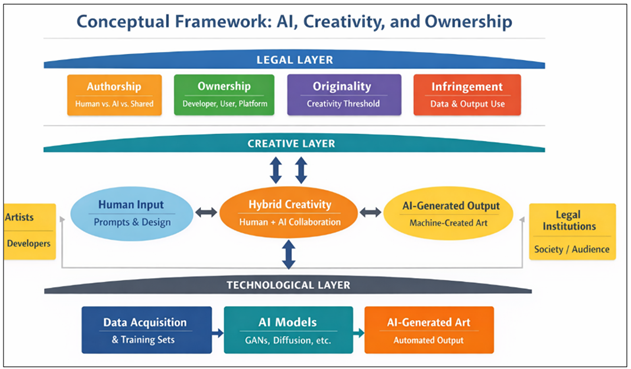
Figure 1 Conceptual Framework
The conceptual framework shows in Figure 1 the relation between technology, creativity and legal issues in AI-generated digital art illustrating a three-layered structure. The bottom layer is the technological one, and it encompasses data acquisition, training data and AI models such as GANs and diffusion systems that are used to create digital artworks. Over it is the creative layer, which is characterized as the contact between the human input and the machine generated output resulting into hybrid creativity where human intent and AI abilities interact to generate art. The most significant copyright problems, including the authorship, ownership, originality, and infringement, are presented at the first level, which highlights the instability of applying the legal traditional notions on the work developed by the artificial intelligence. Besides, the stakeholders, i.e., the artists, developers, legal institutions, and the society influence all the levels of the framework. Overall, the diagram allows one to understand that AI-powered art cannot be merely considered technological and creative but a portion of innovation, human collaboration, and law interpretation.
4. Legal Challenges in AI-Generated Digital Art
Conceptual art created through AI challenges the classical principles of copyright by offering protection to the works created by human artists. With AI systems generating autonomous or semi-autonomous creative products, legal institutions are encountering a lot of challenges in interpreting and enforcing the existing laws. In this part, the key legal issues in connection with AI-generated art are analyzed, and they are authorship and ownership, originality, infringement, and licensing. Authorship is one of the most important issues. Copyright laws generally dictate that a work must have a human author in order to be under protection. Nonetheless, with AI-generated art, the creative process is shared between several different parties, such as the developer who creates the algorithm and the user who feeds it with prompts or inputs and the AI system that produces the end product. This brings about the question of whether copyright needs to be accredited to the human actors, or be shared between stakeholders, or whether it should be reevaluated at all. Even in cases where it is possible to attribute authorship to some human agent, it is still not entirely clear who owns the AI-generated works. As an example, a developer might own as a result of the contribution made to the application technology and the user rights may be over the outputs produced as a result of his or her inputs. Also, AI tools can be hosted on platforms that include contractual terms that affect the ownership rights. With the use of this multi-layered ownership structure, conflicts may arise, especially in the commercial world where AI-generated art will be monetized. This absence of legal guidelines might sometimes force the use of contractual agreements which might not necessarily be fair in the resolution of all the concerned parties.
The other major legal issue is that of originality. In order to receive a copyright protection, works must usually exhibit some form of originality and innovation. Nevertheless, AI-generated art is commonly conducted under the reusing of pre-existing data and it is quite uncertain whether it satisfies the necessary standard of novelty. Some believe that the originality of AI productions makes them eligible to legal protection, but others, on the contrary, argue that the lack of direct human creativity is the reason they cannot claim any legal protection. This discussion also points to the necessity to revise the concept of originality when it comes to the realm of computational creativity, considering human interventions as well as algorithms. Another legal problem is the problem of infringement that makes it even harder. The AI models are trained using massive data collections, mostly without authorization of the actual owners of the copyrighted data. This begs the question of whether the training process is in itself a copyright infringement. Also, the content produced by AI systems can unwillingly duplicate or be similar to the already existing works, and as a result, intellectual property rights might be violated. Most AI systems are black box, which makes it difficult to do the trace of the origins of specific outputs, meaning that it is further difficult to enlist copyright laws and determine liability. Other problems connected to AI-generated art are licensing and fair use. The traditional licensing platforms cannot deal with the complexity of AI training and content development. Using an example, it is not always obvious how the usage of the copyrighted data to train the AI models could be considered as the fair use or it has to precede the direct licensing agreements. Furthermore, the commercialization of art that is created by AI is also a source of the issue of the royalty and the rights of the creators. As the technology of AI technology has further developed, there is an increased need to introduce new models of licensing that can take into account the specifics of the content generated by the machine.
5. Comparative Legal Analysis
The analysis of the methods in the United States, the European Union, and India allows identifying similarities and differences in the international jurisprudential reaction to Artificial Intelligence in the realm of Copyright Law. The copyright law of the United States is well established on the basis of human authorship. The U.S copyright office has always upheld the stance that works not created by man cannot be given copyright laws. The administrative rulings and legal interpretations have strengthened this stance by underlining that creativity has to be a creation of a human mind. Consequently, the works of art that are created entirely by AI are not typically subject to protection under copyright, whereas the artworks that include a high level of human activity can be covered. This will establish a clear standard and leave a loophole to fully autonomous AI-generated content, which will be unprotected and can be used.
The European Union follows a similarly conservative approach, showing the significance of human creativeness but at the same time trying to update copyright regulations to the digital-based innovations. Flexibility under EU directives including the digital single markets directives aims at harmonizing copyright protection policies among member states whilst making certain that creators are also given fair compensation. Though the EU does not officially acknowledge AI as an author it has been involved in policy debates on the effects of AI on intellectual property rights. The policy of the EU is defined by the balance between preserving human creators and promoting the technological innovation, and the tangible legal provisions of AI-generated works are in a state of development. Comparatively, the United Kingdom offers a more liberal system by its identification of computer-generated works. An authorship under the UK copyright law might be established on the individual who makes the essential preparations to produce the work that was created by a computer. This is an effective way out of the authorship dilemma since it provides rights to a human agent of the process, even in the cases of the work produced by an AI. Critics, however, believe that such a method can reduce the complexities of AI-driven creativity, and does not entirely solve the concerns of training data and algorithmic contribution. The copyright laws in India under the Copyright Act, 1957, mostly comply with the conventional concepts of human authorship. The law does not explicitly touch on the use of AI in creating works, although it has provisions on computer-generated works. With the increasing popularity of AI technologies, policymakers and scholars in India have grown increasingly aware of the necessity to revise the legal frameworks to meet the new challenges. There are no judicial precedents and explicit regulatory positions that cause uncertainty in situations involving AI-generated art and international transactions.
There are some major trends that can be identified in a comparative view. To start with, it is generally accepted that despite differences in jurisdictions, human intervention is always central in copyright protection. Second, the legal systems do not respond to the AI-generated works in the same way, with some of them being more lenient than others. Third, the majority of frameworks are reactive as opposed to proactive, which have difficulty keeping up with the fast technological changes. These inconsistencies pose problems to international enforcement especially in online space where artworks can be shipped to various jurisdictions with varied legal requirements. Some of the possible ways out are the creation of new types of rights on AI -generated works, the introduction of mandatory disclosure standards on training data, and international standards on AI and intellectual property. These practices would assist in closing the technological gap and legal regulation.
Figure 2
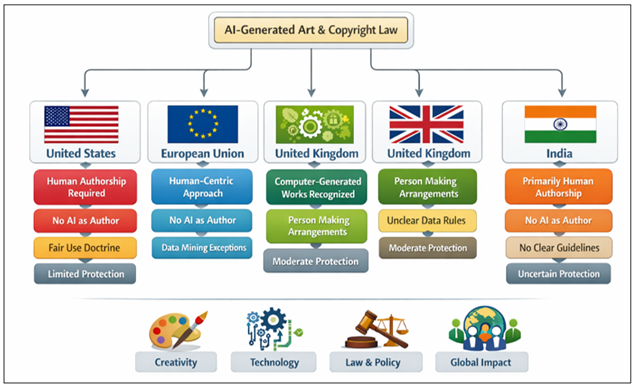
Figure 2 SEM-style comparative model
In Figure 2, the SEM-style diagram depicts a comparative model of the AI-generated art in various jurisdictions, where the central element, AI-Generated Art & Copyright Law has an impact on various regional frameworks. The model is placed on each country or region (United States, European Union, United Kingdom, and India) as a dependent node connected to this central concept to identify the way each country or region perceives and regulates creativity generated by AI. The figure brings out the fact that the United States and India adhere to rigorous human authorship norms, which provide no or ambiguous protection to AI-created works. The European Union is rather balanced and human-oriented, which permits some flexibility, i.e., data mining exceptions. Conversely, the United Kingdom offers a more flexible approach as it acknowledges computer generated works and attributes the ownership to the individual who does arrangements. The bottom part of the diagram illustrates wider influences- inventive power, technology, legal policies and international influence- that influence and affect all jurisdictions.
Table 2
|
Table 2 Comparative Analysis |
||||
|
Parameter |
United States |
European Union |
United Kingdom |
India |
|
Authorship Requirement |
Strictly human authorship
required |
Human-centric approach |
Recognizes
computer-generated works |
Primarily human authorship |
|
AI as Author |
Not recognized |
Not recognized |
Not recognized directly |
Not recognized |
|
Ownership Assignment |
Human creator only |
Human creator |
Person making
arrangements |
Ambiguous |
|
Protection for AI Art |
Limited (if human input
exists) |
Conditional |
Moderate protection |
Unclear/limited |
|
Training Data Usage |
Fair use (case-dependent) |
Data mining exceptions |
Not clearly defined |
No clear provisions |
|
Legal Adaptability |
Low–Moderate |
Moderate |
High (flexible law) |
Low (developing stage) |
Table 2 comparison shows that all jurisdictions are more concerned with human authorship, but vary in their flexibility. United States and India adhere to strict models that do not consider AI as a co-author, whereas the European Union tries to achieve a moderate regulatory policy. United Kingdom is the only country that acknowledges computer-generated works which provides a comparatively flexible legal framework. Nevertheless, the discrepancies in training data regulations and the ownership regulations among the regions present an immense challenge to the global enforcement and digital art markets.
6. Impact on Contemporary Visual Culture
The adoption of Artificial Intelligence in artistic activities has dramatically changed the modern visual culture in the sense that it has reconsidered the way art is produced, distributed, and consumed. The art created using AI has brought forth a new way of expression that breaks the conventional boundaries of art and allows artists and tech specialists to venture into new creative avenues. This is not only a change in technology but change in culture as the change in the creator-audience-ecosystem relationship is made. One of the most outstanding alterations to the visual culture one can discuss is the change in artistic practices. Artists are slowly turning to the use of AI as an engaging instrument and not an inactive process. With machine learning algorithms such as generative modeling and style transfer, artists can create complex visual images which would otherwise be difficult or impossible to create by hand. This has seen the creation of hybrid forms of art creation, with human creativity being enhanced with machine intelligence. Consequently, artists are changing their role as a unique author to becoming a curator, designer or orchestrator of AI processes. AI has also made the artistic creation more democratic. Having easy-to-use AI tools, any person who has no official artistic background can create artworks that are visually compelling. This democratization increases the involvement in the creative process and creates inclusiveness in the art community. Nevertheless, it also brings up the issue of the erosion of artistic talent and the possibility of the digital overload. With the increasing involvement of people in AI-generated art, it is becoming harder to separate the professional and amateur. There are also important economic grounds of AI-generated art. Artificial intelligence technologies are transforming the creative industries by changing their conventional revenue plans and market forces. The commercialization of AI-generated artworks, as well as those related to NFTs, have been facilitated by any digital platform or marketplace. Although this brings new monetization opportunities, it also brings in competition which can be unfavorable to the old artists. The fact that AI can create art in large quantities can cause pressure on prices towards the downward side, which may affect the livelihoods of ordinary creators.
Moreover, AI-generated art has implications in the cultural maintenance and representation. AIs trained on various datasets can be used to maintain and remake cultural heritage, and create new forms of digital archiving and storytelling. Nonetheless, biases on training data can result in misrepresentation or omission of a particular cultural view. The need to make AI development diverse and inclusive is underlined by this, which is to prevent the intensification of the existing disparities in the visual culture. The digital environment is a worldwide phenomenon which increases the influence of AI on the visual culture. Images and replicas can be transferred, copied and altered across the boundaries with ease thus establishing a very interconnected cultural space. Whereas this makes cross-cultural communication and cooperation possible, it also creates issues of cultural appropriation and the possibility of intellectual property theft. These issues are also complicated due to the unpredictable legal frameworks in several jurisdictions as discussed in earlier sections. Moreover, AI is affecting the way of contemporary art. The visual peculiarities and trends created by the AI systems are creating new movements and tendencies in art. They are aesthetics that usually mirror the algorithms and datasets involved, which creates artworks that are not similar to the artworks produced by humans. With the further development of AI, its role in the future of visual culture is bound to become more central.
7. Discussion and Policy Implications
The application of the Artificial Intelligence to digital art has revealed the inherent weaknesses of the current Copyright Law, especially regarding authorship, ownership, and originality. The results of this paper suggest that the conventional models of copyright, based on the idea of human creativity, become less and less sufficient to deal with the distributed and hybrid quality of AI-generated content. The AI systems need large datasets, and many of them include copyrighted works without the permission of the mentioned people. This raises some grave legal and ethics issues of infringement and fairness. Policymakers should be introduced to data governance structures that include openness in using the datasets, necessity to ask or license the original creators, and are willing to compensate them. The formulation of the right guidelines in this regard would lead to the control between innovation and protection of intellectual property right.
The harmonization of the laws among the countries is also not there and this complicates the legal scenario. This is because the content of the AI-generated art, which is now being distributed globally through digital platforms, implies that the lack of alignment of the laws of individual countries regarding copyright makes it difficult to enforce and comply with it. The global community is gradually requiring regulation co-operation in developing standards of uniform ideals on AI and intellectual property.
8. Conclusion
The recent advancement of Artificial Intelligence has radically transformed the sphere of digital art and challenged the principles of the Copyright Law that have been well-established. This paper has addressed the legal, technological, and cultural implications of AI-generated art that are restricted to the intricacy of authorship, ownership, originality, and infringement. According to the outcomes, the existing copyright laws are becoming ineffective to address the factuality of AI-enhanced innovativeness and requires a revision of the conventional legal constructs. In the list of the most critical findings of this paper, one must mention the idea that human authorship remains in the spotlight of the contemporary copyright regulations in most jurisdictions. But with AI generated content, one cannot tell where the creativity and responsibility is. The decentralization of AI-assisted creation when all the developers, users and algorithms are the participants makes it difficult to allocate the rights and is difficult to differentiate the discourse of the human and machine authorship. This makes it apparent that the definitions of the law also need to be liberalized and accommodative so that it could be able to accommodate the hybrid forms of creativity. Another important detail that is not provided in the regulation of training data and infringement is also mentioned in the study. The AI systems utilize gigantic data, including copyrighted data, and this has become a significant source of anxiety, with regards to unauthorized usage and other types of intellectual property abuse. The transparency of AI processes is also absent and complicates them even more difficult to enforce and hold them responsible. By those barriers, it means that the original creators have the need ضرورة (need) to provide more specifications of information usage, licensing, and have adequate compensation.
In the cultural context, AI altered the existing practices of the visuals by facilitating the creation of the new means of the art and democratizing the usage of the means of the activity. Although this move is associated with innovation and inclusiveness, it has influenced the validity, artistic identity and monetary viability of human creators. The article emphasizes that the AI ought to be incorporated into the visual culture with a moderate vision that not only considers the potential of AI application but equally concerns the threats. Various directions of the research and policy development can be identified in a prospective. Firstly, there is the need to create adaptive legal frameworks to enable them to respond to the dynamism of AI technologies. This may be by introducing the new types of intellectual property right, reshaping the originality standards and recognition of the degree of human aptitude in the development processes. Secondly, more empirical research is required to research the real-life example of the art produced with the help of AI and the legal implications of the technology as the field is in its infancy. Third, as the AI-generated content is international, the cooperation between countries will play a vital role in its management. With the copyright law, consistency between copyright laws across jurisdiction may help to reduce legal fragmentation, as well as promote border enforcement. The international organizations can play a crucial role in the establishment of standard guidelines and optimal practice of AI and intellectual property.
Continuing on, the ethical nature of AI in art might be further explored in the further future, particularly in relation to utilization of information, prejudice, and in particular, cultural reflection. The ethical frameworks and legal regulations can be developed to result in responsible and fair use of AI technologies. This will be particularly significant in the approaches that can integrate the knowledge of the law, and computer science with cultural studies and ethics, which are interdisciplinary. Finally, the artists and other creative specialists have to be supported in adapting to the changing technology.
CONFLICT OF INTERESTS
None.
ACKNOWLEDGMENTS
None.
REFERENCES
Ahuja, V. K. (2020). Artificial Intelligence and Copyright: Issues and Challenges. ILI Law Review, 270–285.
Atilla, S. (2024). Dealing with AI-Generated Works: Lessons from the CDPA Section 9(3). Journal of Intellectual Property Law and Practice, 19, 43–54. https://doi.org/10.1093/jiplp/jpad102
Begemann, A., and Hutson, J. (2025). Navigating Copyright in AI-Enhanced Game Design: Legal Challenges in Multimodal and Dynamic Content Creation. Journal of Information Economics, 3, 1–14. https://doi.org/10.58567/jie03010001
Blaszczyk, M., McGovern, G., and Stanley, K. D. (2024). Artificial Intelligence Impacts on Copyright law. RAND Corporation.
Bötticher, D. (2019). Copyright Protection for Artificial Intelligence Output (Master’s thesis, University of St. Gallen).
Bukhari, S. W. R., and Hassan, S. (2023). Impact of Artificial Intelligence on Copyright Law: Challenges and Prospects. Journal of Law and Social Studies, 5, 647–656. https://doi.org/10.52279/jlss.05.04.647656
Canadian Intellectual Property Office. (2021). Suryast—Canadian Copyright Database.
Varagani, S. H. N. S. (2026). Generative AI in Healthcare: Applications, Architecture, Implementation, and Benefits. International Journal of Advanced Computer Engineering and Communication Technology, 14(2), 53–63. https://doi.org/10.65521/ijacect.v14i2.1525
Council of Europe. (2024). Framework Convention on Artificial Intelligence and Human Rights, Democracy and the Rule of Law (Treaty Series No. 225).
Gaffar, H., and Albarashdi, S. (2024). Copyright Protection for AI-Generated Works: Exploring Originality and Ownership in a Digital Landscape. Asian Journal of International Law, 15, 23–46. https://doi.org/10.1017/S2044251323000735
Australian Copyright Council. (2023, May 17). Artificial Intelligence and Copyright (Fact Sheet).
Dai, Z., and Keith, K. (2023, December 20). Computer Love: Beijing Court Finds AI-Generated Image is Copyrightable in Split with United States. Art Law Blog. https://www.artlawgallery.com/2023/12/articles/artificial-intelligence/computer-love-beijing-court-finds-ai-generated-image-is-copyrightable-in-split-with-united-states/
Chloupek, V., and Taimr, M. (2024, May 29). Czech Court Denies Copyright Protection of AI-Generated Work in First Ever Ruling. Bird and Bird.
Babická, K., and Giacomin, C. (2024, November 5). Understanding the Scope of the Council of Europe Framework Convention on AI. Opinio Juris.
Asif, A. (2025, March 3). Remodelling the UK’s “Gold-Plated Copyright Regime” and its Impacts on Creative Industries and AI Training. Center for Art Law.
|
|
 This work is licensed under a: Creative Commons Attribution 4.0 International License
© ShodhKosh 2026. All Rights Reserved.