ShodhKosh: Journal of Visual and Performing ArtsISSN (Online): 2582-7472
|
|
The Human Canvas and Literary Echo: A Strategic HR Framework for Nurturing Talent, Organizational Commitment, and Narrative Identity in the Visual Arts Sector
Dr. Jaspreet Kaur 1
 ,
Dr. Minakshi Middha 2
,
Dr. Minakshi Middha 2 ,
Dr. Gunjan Sharma 3
,
Dr. Gunjan Sharma 3 ,
Dr. Priyanka Parthiv Desai 4
,
Dr. Priyanka Parthiv Desai 4
 ,
Jincy S. S. 5
,
Jincy S. S. 5 ,
Dr. Shyam B. Choudhury 6
,
Dr. Shyam B. Choudhury 6
 ,
Dr. Jyoti Prasad Kalita 7
,
Dr. Jyoti Prasad Kalita 7
1 Associate
Professor, University School of Business, Chandigarh University, Mohali –
140413, Punjab, India
2 Director,
the Research Beacon, Mohali, Punjab, India
3 Assistant Professor, Department of Management, CGC University, Mohali,
India
4 Assistant Professor, Faculty of Management Studies, Parul University, PO:
Limda, Taluka: Waghodia,
Gujarat – 391760, India
5 Research Scholar, Department of English, Chikkanna
Government Arts College, Tirupur, Tamil Nadu – 641602, India
6 Assistant Professor, Programme of Sociology, Faculty of Humanities and Social
Sciences, Assam down town University, Guwahati
– 781026, India
7 Assistant Professor,
Faculty of Commerce and Management, Assam down town
University, Guwahati – 781026, India
|
|
|
ABSTRACT |
|
|
The visual
arts industry is important in the cultural growth, socialization, and
innovation. Nevertheless, the administration of artistic talents in cultural
organizations is a specific issue because of the complicated interaction of
creativity, identity, and organizational systems. The present study presents
a theoretical framework which incorporates strategic human resource
management practices, talent nurturing, the role of narrative identity and
commitment to organizations within the framework of visual arts
organizations. Based on creativity theory, talent management theory,
self-determination theory and organizational identity theory, the research
hypothesis is that positive HR practices can develop artistic talents and
help artists to create meaningful narrative identities. These processes of
identity reinforce organization commitment which in the end leads to
sustainable creative performance in cultural institutions. The paper also
includes the practical implications of the study to museums, galleries, and
other arts organizations that are interested in creating enabling
environments among the creative professionals. Making use of the insights of
both the human resource management and the research of creative industries,
the paper contributes to the literature on reminding the significance of
identity-based HR practices in supporting artistic communities and
maintaining cultural organizations. |
|||
|
Received 21 December 2025 Accepted 16 March 2026 Published 28 March 2026 Corresponding Author Dr.
Jaspreet Kaur, ishar.jaspreet@gmail.com DOI 10.29121/shodhkosh.v7.i2s.2026.7274 Funding: This research
received no specific grant from any funding agency in the public, commercial,
or not-for-profit sectors. Copyright: © 2026 The
Author(s). This work is licensed under a Creative Commons
Attribution 4.0 International License. With the
license CC-BY, authors retain the copyright, allowing anyone to download,
reuse, re-print, modify, distribute, and/or copy their contribution. The work
must be properly attributed to its author.
|
|||
|
Keywords: Talent Management, Creative Industries, Narrative
Identity, Organizational Commitment, Visual Arts Sector |
|||



1. INTRODUCTION
The cultural and creative sector has become an important tool in economic growth, preservation and culture, as well as social innovation. The visual arts sector of the industry holds a distinct niche within these industries because it depends more on human creativity, symbolic production and artistic expression as opposed to a set manner of industrial procedures. The intellectual capital that leads to innovation and creation of cultural value within the artistic institutions is represented by artists, curators, designers and other cultural professionals. As a result, effective management of creative talent has become an important issue of concern in organizations in the arts sector Florida (2002), Throsby (2008).
The human resource management (HRM) is relevant to the productivity and viability of creative organisations. Creative industries do not rely on standardized outputs like it is the case in traditional industries as performance can be quantified. HRM strategies in that way focus on matching organizational strategies and talent formation, employee involvement, and knowledge innovation Collings and Mellahi (2009), Gallardo-Gallardo et al. (2020). The HR practices in these settings should shift away out of the administrative control and towards fostering creativity, promoting experimentation and artistic expression DeFillippi et al. (2007).
According to research on creativity, the interaction of personal motivation, organizational climate and supportive managerial practices over artistic performance has been established. A person develops creativity when he or she has appropriate skills, creativity thinking skills, and motivation Amabile (1996). Creative productivity can be facilitated in the organizational setting that encourages autonomy, collaboration and positive emotive Amabile et al. (2005).
In artistic career, identity is also an important aspect. The storytelling process enables artists to perceive their professional life based on the personal experience and the desire to create something. Narrative identity also enables persons to make sense of their careers and combine personal values and their work identities Ibarra and Lineback (2010). These identity processes are also impacted by organizational cultures, artistic missions, and professional recognition, which determine how the individuals relate to their institutions Academy of Management. (2024).
Organizational commitment thus comes out as a significant factor in the maintenance of creative institutions. According to the three-component model, Meyer and Allen (1991) suggest that affective commitment, continuance commitment and normative commitment are three major types of attachment of employees to the organisation. Of these, the affective commitment is the most significant, or the emotional attachment and identification with the organizational values in innovative settings where work is strongly connected with individual passion and identity.
Although creative industries acquire greater significance, there is scarcity of studies that incorporate strategic HR practices, talent development, narrative identity and organizational commitment on a single platform in the visual arts sector. This paper will thus put forward a theoretical framework of how strategic HR practices develop talent and narrative identity, which ultimately enhance organizational commitment to support sustainable creative performance in visual arts organizations.
2. Literature Review
2.1. HR in Creative Industries
The HRM in creative industries is a challenging issue since artistic workers need freedom, ability, and self-expression. Creative industries are based on imagination and innovativeness unlike other traditional industries that are based on standardized processes and hierarchies Throsby (2008). Thus, to handle creative professionals, HR strategies where collaboration, inspiration, and professional development are encouraged are essential. The creative class is an important economic and cultural focus on the role of creative workers, who play a role in bringing innovations and knowledge creation, as well as offering cultural output Florida (2002). Creativity management is however a matter of balancing artistic freedom to that of organizational coordination which is noted to be a contradiction commonly referred to as the paradox of creativity in cultural industries DeFillippi et al. (2007). Strategic HRM strategies are thus focused on ensuring that the HR practices are aligned to the organizational objectives and on the development of talent, employee engagement, and knowledge exchange Strachan and Burgess (2024). The evidence provided by performing arts organizations also demonstrates that contextualized HR practices could be used to improve not only the level of employee satisfaction but also the performance of an organization Opara and Waheduzzaman (2025).
2.2. Talent Development in Arts
One aspect of HRM in the creative industries is talent development. The artistic talent is related to technical mastery, imagination and cultural sensitivity and all this leads to creative work. When such talent is well cultivated in organizations, the individual creativity will improve as well as a good reputation of the organization. Strategic talent management is based on identification, development, and retention of people who make a tremendous contribution towards the success of the organization Collings and Mellahi (2009). This is particularly significant in the creative sector since artistic ability is distinctive and hard to substitute. Professional training and education are also important in equipping people with creative professions. As Bridgstock (2011) observes, artists require traits of creative talents, entrepreneurial strengths, as well as flexibility. Sustaining artistic excellence is consequently impossible without continuous learning opportunities. Motivation also affects the development of talent, as intrinsic motivation enhances creativity and innovation Ryan and Deci (2000). Nevertheless, excessive use of extrinsic rewards can decrease intrinsic motivation Deci et al. (1999).
2.3. Narrative Identity in Artistic Professions
Narrative identity is the term describing the personal narratives that individuals will create to comprehend their lives and career paths. This notion is especially relevant in the artistic careers since most artists tend to consider their art within the context of a bigger personal and cultural story. The construction of identity takes place by means of continuous communication between people and organizational settings in which the employees negotiate their positions and professional significances Academy of Management. (2024). Narrative identity helps the people to redefine experiences and to correlate personal values with the professional positions Ibarra and Lineback (2010). The forms of artistic expression and storytelling also have an impact on the organizational identity through the establishment of symbolic relationship between individual experiences and general institutional meanings Meisiek and Hatch (2014).
2.4. Organizational Commitment in Cultural Institutions
The term organizational commitment can be described as the psychological attachment of the employees to their organizations. Meyer and Allen (1991) stated that this attachment is based on three components, which are affective, continuance, and normative commitment. Among them, the affective commitment, which is an emotional attachment to the organizational values, is important in that it creates incentives that make employees stick to the organization and work towards its objectives beneficially Meyer et al. (2002). HR practices are also crucial towards enhancing commitment. Engagement and decrease the adverse behaviors at the workplace can be achieved through high-commitment HR systems that encourage employee involvement, skill development, and trust Tsui (2022). The appreciation of artistic works and the sponsorship of creative individuals in cultural organizations can also increase emotional attachment and commitment of employees to their employers.
3. Theoretical Foundations
The theoretical underpinning of the study is based on the theory of creativity and talent management to elaborate on the way in which artistic potential in the visual arts industry can be developed through human resource practices. The creativity theory focuses on the fact that creative results are the resultant force of interaction of individual skills, intrinsic motivation, and organizational environments of support Amabile (1996). Companies where creativity is promoted through autonomy, experimentation and group work foster environments that advance creativity and artistic creativity. Talent management also gains significant prominence in the creative sectors since the artistic professionals have special skills that can be used to add value to the culture production and organizational achievement. Strategic talent management deals with identification of individuals who have the potential through systematic development program, mentoring and professional learning Collings and Mellahi (2009). Arts organizations can enhance their creative capacity by investing in talent development initiatives, which can continue to perform on the long-term basis of the institution.
Self-determination theory, organizational identity theory, and organizational commitment theory are also in support of the framework. The theory of self-determination points out the effort of intrinsic motivation as a way of building creativity and professional involvement as people work better when their psychological needs such as autonomy, competence, and relatedness are met Ryan and Deci (2000). The organizational identity theory describes the ways in which people support their personal values and occupational identities with the organizational mission and culture, which influences their sense of belonging and involvement Ravasi and Canato (2013). Moreover, organizational commitment theory such as the three component model put forward by Meyer and Allen (1991) describes how employees come up with feelings of attachment, loyalty and this feeling of obligation to their organizations. The combination of these theoretical orientations enables a holistic basis of the understanding of how strategic HR practices can help develop artistic talent, foster the development of identity, and enhance the commitment of organizations in the visual art industry.
4. Conceptual Framework Development
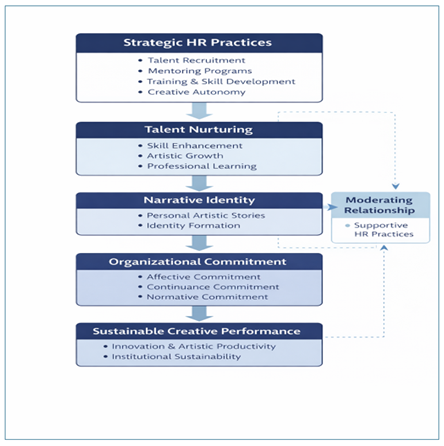
According to the theoretical basis, the proposed framework gathers strategic HR practices, talent nurturing, narrative identity, and organizational commitment. Strategic HR practices also provide conditions in which artists can develop their art by means of mentoring and training, as well as collaborations Collings and Mellahi (2009). This is facilitated by talent nurturing which allows artists to increase their creative abilities and professional confidence Bridgstock (2011). Artists gain narrative identities when they undertake creative work as the personal experience relates to artistic expression Ibarra and Lineback (2010). Such processes of identity reinforce emotional attachment among organizations, and hence, increase organizational commitment Meyer and Allen (1991). This process eventually adds to the sustainability of creative performance in visual arts institutions.
4.1. Proposed Conceptual Model
The hypothetical conceptual model displays the connections among strategic HR practices, talent nurturing, narrative identity and organizational commitment within the visual arts industry. It is proposed that enabling HR practices enhance talent growth and identity creation by the artists and this consequently improves organizational commitment and contributes to sustainable creative performance in the arts organizations.
Figure 1
Source:
Developed by Researcher
4.2. Propositions Development
P1: Strategic Hr practices have a positive effect on talent nurturing within visual arts organizations.
P2: Nurturing of talents has a positive influence on the process of narrative identity development in artists.
P3: Narrative identity has a positive impact on the organizational commitment.
P4: Organizational commitment has a positive relationship with the sustained creative performance.
P5: Narrative identity is associated with organizational commitment at a stronger level when supported by HR practices.
5. Implications for Arts Organizations
The suggested conceptual framework contains valuable implications on the arts organizations like museums, galleries, cultural institutions, and creative groups that largely rely on the artistic professionals as a source of innovation and cultural production. These organizations work in conditions of the intersection of creativity, identity, and institutional objectives, so strategic human resource management becomes necessary in maintaining the artistic development and organizational performance. Among the implications that can be outlined is a necessity of HR practices that focus on talent development and creative empowerment. Artists form the most treasured asset of the visual arts industry and as a result, talent management approaches that emphasize on mentorship, artist training, artist residency and collaborative learning are the approaches that should be adopted by organizations to develop new and existing talent Collings and Mellahi (2009), Gallardo-Gallardo et al. (2020). Also, arts organizations ought to focus on creating intrinsic motivation between creative professionals since studies reveal that creativity thrives when people are driven to work by intrinsic motivation to personal satisfaction and creative fulfillment as opposed to extrinsic rewards only Amabile (1996), Ryan and Deci (2000). Although recognition and financial rewards are still relevant, they need to be added and not substituted with the intrinsic motivation to prevent innovation of creativity Deci et al. (1999). The other important implication is associated with the need to support narrative identity among artists because the ability to create meaningful stories about their creative paths and work experience facilitates through the storytelling platform offered by exhibitions, artist conversations, and digital interaction support organizational culture and personal identity Ibarra and Lineback (2010), Brosnan (2024). Moreover, artistic organizations must attempt to align personal artistic identity and corporate identity since employees would tend to become emotionally attached and long-term committed when their individual creative principles are comparable to the vision and mission of the institution Ravasi and Canato (2013). This alignment can be cultivated via participatory decision making, collaborative curatorialism and inclusive organizational cultures where artists can help in institutional narratives. It is also emphasized in the framework the significance of the establishment of high organizational commitment in creative professionals, especially the affective commitment, the emotional attachment and organizational identification Meyer and Allen (1991), Meyer (2002). This commitment can be reinforced through acknowledgement of artistic contribution, access to professional growth and favorable leadership that fosters long term participation. In addition, arts organizations ought to foster collaborative and participatory practices in which artists, curators, and administrators can be able to share their ideas and work together on creative projects because such cultures can increase engagement and decrease turnover intentions Sugiono (2025). Lastly, the framework reflects the necessity of sustainable HR practices designed to ensure the well-being of employees, their creative autonomy, and professional development, which will unite cultural institutions with the ability to survive in the shifting cultural and economic environment and allow them to adjust to adverse conditions Strachan and Burgess (2024). Through the combination of talent development, narrative identity support and commitment-building HR practices, the arts organizations are able to develop dynamic environments and support creativity, institutional identity and provide sustainable artistic performance.
6. Conclusion and Future Research Directions
The creative professions that the visual arts industry relies on are perceived to influence cultural production as well as institutional success by defining artistic identity of the practitioners. In this research, the theoretical framework was developed that considers the combination of HR practices, talent nurturing, narrative identity, and organizational commitment. The framework observes the significance of identity-focused HR in the maintenance of creative institutions.Further studies ought to provide empirical validation of the suggested model to various creative industries and cultural settings. Research could further investigate leadership approaches, digital technologies and cross-cultural partnership in developing talent management in the creative sectors. With the help of strategic HR practices that foster artistic identity and devotion, cultural organizations can establish lively creative communities that are able to perpetuate artistic creativity and cultural growth.
CONFLICT OF INTERESTS
None.
ACKNOWLEDGMENTS
None.
REFERENCES
Academy of Management. (2024). Identity in and of Organizations: Docents' Guide Through the Academy of Management Journals. Academy of Management Collections, 4(1). https://doi.org/10.5465/amc.2022.0005
Amabile, T. M. (1996). Creativity in Context. Westview Press. https://doi.org/10.4324/9780429501234
Amabile, T. M., Barsade, S. G., Mueller, J. S., and
Staw, B. M. (2005). Affect and Creativity at Work.
Administrative Science Quarterly, 50(3), 367–403. https://doi.org/10.2189/asqu.2005.50.3.367
Bridgstock, R. (2011). Skills for Creative Industries Graduate Success. Education + Training, 53(1), 9–26. https://doi.org/10.1108/00400911111102333
Brosnan, K. (2024). The Challenges of Identity Work: Developing Ricoeurian Narrative Identity in Organisations. Ephemera: Theory and Politics in Organization, 24(1/2), 1–25.
Collings, D. G., and Mellahi, K. (2009). Strategic Talent Management: A Review and Research Agenda. Human Resource Management Review, 19(4), 304–313. https://doi.org/10.1016/j.hrmr.2009.04.001
Deci, E. L., Koestner, R., and Ryan, R. M. (1999). Meta-Analytic Review of Experiments Examining the Effects of Extrinsic Rewards on Intrinsic Motivation. Psychological Bulletin, 125(6), 627–668. https://doi.org/10.1037/0033-2909.125.6.627
DeFillippi, R., Grabher, G., and Jones, C. (2007). Introduction to Paradoxes of Creativity: Managerial and Organizational Challenges in the Cultural Economy. Journal of Organizational Behavior, 28(5), 511–521. https://doi.org/10.1002/job.466
Eisenhardt, K. M. (1989). Building Theories from Case Study Research. Academy of Management Review, 14(4), 532–550. https://doi.org/10.5465/amr.1989.4308385
Florida, R. (2002). The Economic Geography of Talent. Annals of the Association of American Geographers, 92(4), 743–755. https://doi.org/10.1111/1467-8306.00314
Gallardo-Gallardo, E., Thunnissen, M., and Scullion, H. (2020). Talent Management: Context Matters. International Journal of Human Resource Management, 31(4), 457–473. https://doi.org/10.1080/09585192.2019.1642645
Ibarra, H., and Lineback, K. (2010). Identity as Narrative: Prevalence, Effectiveness, and Consequences of Narrative Identity Work in Macro Work Role Transitions. Academy of Management Review, 35(1), 135–154. https://doi.org/10.5465/amr.35.1.zok135
Joseph, M., et al. (2017). Human Resource Management Practices and Organizational Commitment: A Comprehensive Review (2001–2016). Prabandhan: Indian Journal of Management, 10(9), 34–52. https://doi.org/10.17010/pijom/2017/v10i10/118810
Lampel, J., Lant, T., and Shamsie, J. (2000). Balancing Act: Learning from Organizing Practices in Cultural Industries. Organization Science, 11(3), 263–269. https://doi.org/10.1287/orsc.11.3.263.12503
Meisiek, S., and Hatch, M. J. (2014). Not Only Art's Task—Narrating Bridges Between Unusual Experiences with Art and Organizational Identity. Scandinavian Journal of Management, 30(2), 194–204. https://doi.org/10.1016/j.scaman.2013.11.001
Meyer, J. P., and Allen, N. J. (1991). A Three-Component Conceptualization of Organizational Commitment. Human Resource Management Review, 1(1), 61–89. https://doi.org/10.1016/1053-4822(91)90011-Z
Meyer, J. P., Stanley, D. J., Herscovitch, L., and Topolnytsky, L. (2002). Affective, Continuance, and Normative Commitment to the Organization. Journal of Vocational Behavior, 61(1), 20–52. https://doi.org/10.1006/jvbe.2001.1842
Opara, S., and Waheduzzaman, W. (2025). The Universal, Contingency or Configurational HRM Approaches for Organizational Performance: Lessons from Australian Performing Arts. Personnel Review. https://doi.org/10.1177/23970022241231538
Ravasi, D., and Canato, S. (2013). How Do I Know Who You Think You are? A Review of Research Methods on Organizational Identity. International Journal of Management Reviews, 15(2), 185–204. https://doi.org/10.1111/ijmr.12008
Ryan, R. M., and Deci, E. L. (2000). Intrinsic and Extrinsic Motivations: Classic Definitions and New Directions. Contemporary Educational Psychology, 25(1), 54–67. https://doi.org/10.1006/ceps.1999.1020
Strachan, G., and Burgess, J. (2024). Strategic Human Resource Management for Sustainability in Creative Industries: Review and Framework. World Journal of Advanced Research and Reviews, 21(3), 123–145. https://doi.org/10.30574/wjarr.2024.21.3.0738
Sugiono, A., et al. (2025). Empowering Talent: How Talent Management, Thriving at Work, and Employee Voice Reduce Turnover Intention. Cogent Business and Management, 12(1). https://doi.org/10.1080/23311975.2025.2596429
Thite, M. (2025). Talent Management: A Review and Research Agenda. Journal of Global Mobility. https://doi.org/10.1002/joe.70008
Throsby, D. (2008). Modelling the Cultural Industries. International Journal of Cultural Policy, 14(3), 217–232. https://doi.org/10.1080/10286630802281772
Thunnissen, M., Boselie, P., and Fruytier, B. (2013). A Review of Talent Management: “Infancy or Adolescence?” International Journal of Human Resource Management, 24(9), 1744–1761. https://doi.org/10.1080/09585192.2013.777543
Tsui, A. S., et al. (2022). High-Commitment HRM, Organizational Engagement, and Deviant Workplace Behaviors: The Moderating Role of Person-Organization Fit. European Management Review. https://doi.org/10.1111/emre.12542
|
|
 This work is licensed under a: Creative Commons Attribution 4.0 International License
© ShodhKosh 2026. All Rights Reserved.