ShodhKosh: Journal of Visual and Performing ArtsISSN (Online): 2582-7472
|
|
From Theatres to Algorithms: Data Analytics, OTT Platforms, and the Evolution of Tamil Cinema
Raja Kannan J. 1
 ,
Padmanabhan T. 2
,
Padmanabhan T. 2
1 Research
Scholar, Department of Visual Communication, Faculty of Science and Humanities,
SRM Institute of Science and Technology, Kattankulathur, 603203, Tamil Nadu,
India
2 Assistant Professor and Head,
Department of Visual Communication, Faculty of Science and Humanities, SRM
Institute of Science and Technology, Kattankulathur, 603203, Tamil Nadu, India
|
|
|
ABSTRACT |
|
|
The
Over-the-Top (OTT) streaming platforms have increased radically, transforming
the nature of the industrial, economic, and cultural landscape of the Tamil
cinema. With a conventional theatrical display background, star-oriented
box-office revenue model, and a network of distribution channels system
geographically mark-delimited, Tamil cinema operated within the event-based
revenue model whereby the success or failure of the movie rested on the
opening weekend performance. However, with the advent of the online streaming
service providers such as Netflix, Amazon Prime Video, and Disney+ Hotstar,
an information-based context that is characterized by monetization via
subscription, algorithmic zed recommendation engines, and global online
accessibility became a reality. The paper will discuss the paradigm shift in
the distribution of content as a theatre-centric to an algorithm-mediated
streaming model, which entails data analytics to commission content, optimize
its marketing, and tailor the audience. The research results in comparative
analysis of revenue systems, engagement life cycles and inequalities of power
of stakeholders, the study points how computational systems transform
discoverability, narrative pacing and cultural visibility in the Tamil cinema.
Although OTT platforms increase transnational distribution and decrease the
financial variability of producers, they also centralize the data ownership
and data gatekeeping authority in platform corporations. The results indicate
that the development of Tamil cinema can be seen as the repositioning rather
than substitution of theatrical culture, it is re-formulation in a hybrid,
platform-mediated media economy conditioned by analytics and personalization
technologies. |
|||
|
Received 30 November 2025 Accepted 13 March 2026 Published 27 March 2026 Corresponding Author Raja
Kannan J., rj9997@srmist.edu.in DOI 10.29121/shodhkosh.v7.i2s.2026.7214 Funding: This research
received no specific grant from any funding agency in the public, commercial,
or not-for-profit sectors. Copyright: © 2026 The
Author(s). This work is licensed under a Creative Commons
Attribution 4.0 International License. With the
license CC-BY, authors retain the copyright, allowing anyone to download,
reuse, re-print, modify, distribute, and/or copy their contribution. The work
must be properly attributed to its author.
|
|||
|
Keywords: Tamil Cinema, OTT Platforms, Data Analytics,
Algorithmic Culture, Recommendation Systems, Platform Economy, Digital
Distribution, Audience Personalization, Streaming Media, Cultural Industries |
|||



1. INTRODUCTION
Tamil movies otherwise referred to as Kollywood has long served as not only a local film industry, but has been a source of culture with deep rooted socio-political and economic roots in South India. Theatrical exhibition has been the dominant form of consuming the films over the decades, as it has formed the culture of stars, box-office economy, and shared cultural viewing. Not only distribution terminals, theatres (small town single screens and metropolitan city multiplexes) were also cultural spaces where film storylines overlapped with local identity, language pride, and mass politics Camilleri and Falzon (2020). The production cycles, marketing, and revenue forecasting models were arranged by the theatrical release windows hegemony, and the system of commercial success, through which the theatrical opening weekend collections, fan affiliations, and physical theatrical occupancy levels had been based, was enhanced.
However, in the last decade structural change in this ecosystem has occurred. Over the last years, the appearance of digital streaming platforms, also referred to as Over-the-Top (OTT) platforms has been one of the driving forces of film production, distribution, and consumption patterns. The online streaming platforms, including Netflix, Amazon Prime Video, and Disney+ Hotstar, have developed and entered the regional markets fully aware of the economic potential of the vernacular users. They now have the films and web series in Tamil language as part of their content acquisition strategy. In contrast to the traditional theatrical model, where the geographical distribution of releases and attendance in theatres was used, OTT services are grounded on the value of using algorithmic, recommendation services, user data analytics, and subscriptions as sources of revenue Chatterjee and Byun (2022). This is an indicator of the shift towards box-office determinism to data-induced personalization.
Figure
1
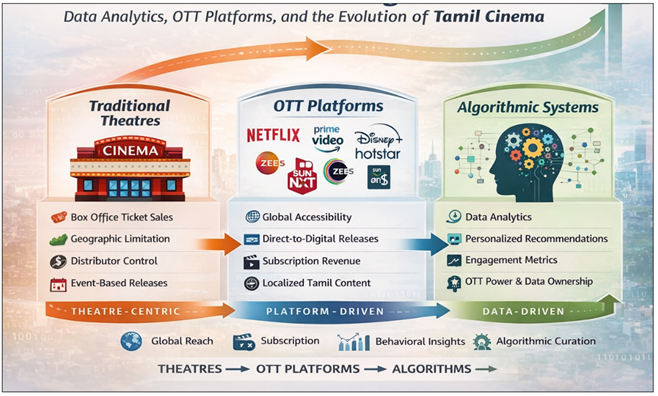
Figure 1
Journey of Tamil
Cinema
During the theatrical age, success was also estimated based on the number of tickets sold, satellite rights, and distribution abroad. The current streaming platforms have advanced analytics to monitor viewer activity, watch duration, genres, discontinuation statistics, device utilization, and even pause-rewind actions. Such measures have an impact on script approval, casting, budgeting, and release date. As a result, algorithms are having a larger mediational role in producing, selling, and exposing audiences to content. This radical change in the mode of targeting the mass audience by the micro-segmented personalization is indicative of a larger shift in industrial cinema to computational cinema Duykuluoglu (2021).
This development was enhanced by the COVID-19 pandemic. As theatres shut down and people were prohibited to hold large-scale meetings, some Tamil movies chose direct-to-digital releases. The disturbance made OTT premieres the norm of mid-budgets and experimental movies, decreasing the reliance on theatrical windows. The advent of hybrid release models, concomitant or delayed theatre and streaming releases, only added to the blur of the traditional and the digital channels of distribution. Consequently, producers started to think about projects through the prism of theatrical viability, but also platform popularity, bingeability, and algorithmic discoverability Gallo (2014) . In line with distribution changes, there has been a tremendous transformation in audience behavior. In the past, the consumption of cinema was a social event whose structure was defined by social networks and locality. Conversely, OTT platforms encourage personalized watching experiences through the recommendation engines. Hybrid recommendation models, collaborative filtering and content-based filtering create personal content libraries of each user. These algorithmic systems covertly influence the establishment of taste, exposure to genres, and culture. Tamil cinema which used to be regionally based and theatrical in its centralized form is now involved in a global stream economy where diaspora viewers and non-Tamil spectators can now access subtitled films without inconvenience Garoosiha et al. (2019).
Marketing and forecasting is also an important area of data analytics. There is an increasing trend in the use of social media sentiment analysis, trend mining and predictive modeling tools to predict the reception of the audience before release Gumasing et al. (2023). View statistics of trailers on such platforms as YouTube and discussion trends at Twitter (now X) are real-time predictors of the expectation of the population. The likelihood of high revenue would be predictable with the help of machine learning models that examine past box-office performance, the popularity of actors, and the tendencies of the genres and seasons. In this regard, cinema becomes a product of art-industry that transforms into a creative commodity with data. Is data-driven personalization a democratic way of content, allowing telling niche stories, or is it an act of reinforced algorithmic bias and homogenity? What effect do streaming services have on the storytelling, timing of episodes and experimentation of genres? How does it impact economically on the owners of theatres and the small distributors? Does the online economy enable independent film-makers or concentrate the power in the hands of the world tech giants? These issues put Tamil cinema in the context of general discussion of cultural industries, digital capitalism, and algorithmic governance.
This paper aims to discuss how Tamil cinema has developed over the years into an algorithm-based streaming ecosystem. The main aim is to examine how data analytics has contributed to the development of content creation, distribution patterns, and consumption patterns in the Tamil film industry. Also, the paper assesses the relative dynamics of theatrical versus OTT ecosystems, with structural changes in the way risks are distributed, globality, and in market accessibility. By so doing, the paper has established itself in three main areas: (1) transformation of the media industry within the regional cinema settings, (2) the impact of the algorithmic systems in cultural production, and (3) the interplay between data analytics and the creative industries. Tamil cinema is an interesting case study since it is a strong regional brand as well as a fast-digitizing distribution network. This shift of theatres into algorithms, therefore, is not only a revolution of screens, but a reorganisation, a radical reformulation of the cinematic culture in the information era.
2. Literature Review
The shift of Tamil cinema as the theatrically dominated ecosystem to the streaming ecosystem that is algorithmically mediated touches upon various academic fields, such as film industry studies, digital media economics, platform theory, and data analytics. The available literature proposes that digitization has brought about structural realignments of the cinema industries in the world, but localized cinemas like Tamil cinema have different tendencies based on linguistic identity, diaspora markets, and powerful cultures centered on stars. In this section, the author conducts a review of the theoretical and empirical literature in the five thematic areas, including, traditional distribution models, platformization and OTT disruption, data analytics in content production, algorithmic recommendation system, and changing audience behavior.
2.1. conventional distribution models in Tamil Cinema
Literature on Indian regional cinema, prior to 1998, places a significant focus on theatre exhibition as the primary source of revenue generation. Tamil film Industry, specifically, depended much on single-screen cinemas and subsequent multiplex expansions as a means of attaining commercial success. Movies like the star system, which were featured by well-known actors like Rajinikanth and Kamal Haasan, took center stage to maintain the box-office economics Hadhri et al. (2024). Film economies research informs about the role of opening-day collections, mobilization of fan clubs, and festival releases (e.g. Pongal, Diwali) as systematic risk-reduction tactics. The theatrical models according to researchers were on a windowed distribution system where movies were transferred one after another through the cinema halls to satellite television, and later home video systems. The basis of revenue forecasting was based mostly on the past performance data, pre-release business (distribution rights) and the value of stars but not on the granular consumer analytics. This type of systems, although allowing commercial productions of large scale, limited experimental narratives because of risk concentration of financial means Katya and Rahman (2025).
2.2. Online Disruption and the Emergence of OTT Platforms
Platform capitalism and digital convergence theory have become a popular way of analyzing the emergence of OTT platforms. Streaming websites like Netflix and Amazon Prime Video subverted the established exhibition chains as they cut out the middle men and linked the producers directly to the audiences. Disneyplus hotstar and regional aggregators further localized the content strategies in the Indian context Jia et al. (2023). It has been proposed in literature that OTT platforms are run on subscription-based (SVOD), advertisement-based (AVOD), or mixed revenue models, which have substantial shifts in the risk distribution. Producers can also sell off the digital rights or sell a portion of the rights rather than depending entirely on ticket sales before it is released. According to the scholars, this is a transition between the previous event-driven revenue peaks and long-tail content monetization, where movies create value throughout long-term streaming lifecycles Lavorata (2014).
The COVID-19 pandemic has often been mentioned as a turning point. The theatres shutting down caused streaming-first strategies to become normalized in direct-to-digital releases, which media theorists refer to as platform dependency. The introduction of the Tamil cinema to the global streaming platforms also boosted the cross-lingual visibility by using subtitles and dubbing, broadening the diaspora interactions.
2.3. Data Analytics in Motion pictures and Marketing
Data analytics is a decision support system that is receiving increasing attention by the new literature in the creative industries. Unlike the less sophisticated forecasting tools, which depended on intuition and past box-office trends, the new streaming ecosystems are based on the detailed information about users, which they utilize to make content acquisition and creation decisions Ong et al. (2022).
Research indicates that video streaming platforms rely on viewer activity data, such as the percentage of completion, genre, user watch time, frequency of rewatches and search patterns. These insights are applied in script choice, episode length and casting strategy optimization. Regression analysis and machine learning classification are the examples of such predictive modeling approaches that are employed in estimating the effect on the engagement and retention of subscription among the audience. Moreover, social media analytics is becoming a much more important marketing factor. Social media sentiment analysis like twitter and YouTube performance feedback loop provides feedback loop in real time Raman and Don (2013). Scholars assume that such a marketing makes the anticipation of the audience into quantifiable factors to reduce uncertainty in promotional investments.
There are also individuals who are cautious of data determinism as they think that excessive reliance on analytics will eliminate risky and innovative behavior and lock narrative patterns in place.
2.4. The Algorithms Recommendation Systems and the Cultural Visibility
The three popular approaches have been identified as collaborative, content-based, and hybrid models of filtering when it comes to computer science and media theory literature Roy et al. (2021). Such systems control customized content feeds, and it has an impact on the discoverability and consumption patterns. Such a concept is highlighted in the academic world through an algorithmic gatekeeping phenomenon when the computing machines take the place of the human kind, in relation to traditional curators. In the Tamil film industry, the recommendation algorithm will determine the existence of a local film in the feed of a user in the home page thereby affecting the global exposure of the same. Filter bubble studies and algorithmic bias suggest that personalization has the ability to reduce cross-genre discovery that results in reinforcement of already existing tendencies. The researchers also cover fairness and representation issues. Regional movies can be a beneficiary of the process depending on the power of the algorithmic amplification or they can be relegated by the global content hierarchies which encompass largely mainstream productions Shah and Mehta (2022). It is the dynamic world that makes the Tamil movies to be subjected to a broader discourse of cultural plurality at the digital ecosystem.
2.5. Changing the Behavior of the Audience in the Streaming Age
The audience research indicates that there is a growing shift in approach to theater where people can see movies separately and on demand. Previous studies described the process of cinema attendance as a social practice that is linked to place and social network Steiner and Xu (2018). Streaming platforms, on the other hand, encourage the individualized, device-based interaction among smart phones, tablets, and smart TVs. Researchers observe the emergence of the culture of binge-watching and nonlinear consumption. Personalization based on data promotes the constant loop of interaction and redefines the narrative in the form of episodic structures and cliffhanger storytelling. Web series and mid budget movies are becoming more and more adventurous in terms of the genres that were once viewed as commercially unsafe in theatres. Additionally, according to the diaspora studies, the OTT platforms have enhanced the links between the transnational audiences Talwar et al. (2022). Content in Tamil language is now available to the international audience in real time, which eliminates the reliance on foreign theatres. This globalization shifts Tamil cinema to a wider cultural economy that is determined by digital infrastructure Zahra et al. (2019).
2.6. Identified Research Gaps
Although the literature already talks extensively of the OTT disruption and the algorithmic recommendation system in a global context, there is a paucity of research examining precisely the interplay between the data analytics and the industrial development of the Tamil cinema. A majority of the regional cinema studies are either stark culture oriented, political oriented or box-office oriented without incorporating the computational viewpoints.
In addition, empirical comparison of theatrical and streaming revenue framework in Tamil cinema is under-researched. The systematic exploration of the role of algorithmic systems in the context of content diversity, genre experimentation, and narrative design remains uninvestigated in the regional environment, as well. The paper fills these gaps by integrating media industry theory with data analytics frameworks and providing a multidisciplinary approach to how Tamil cinema is moving away from the economics of theatres as the main provider of value to the algorithmically mediated platform ecosystems.
3. Evolution of Tamil Cinema: From Theatrical Dominance to Digital Platforms
Tamil cinema also known as Kollywood has gone through various industrial and technological changes. Since its first studio days to the growth of multiplex and more recently, algorithm-based streaming ecosystems, every phase was a product of its time with regard to more pervasive socio-economic and technological changes. The following section follows that development in five significant stages, namely, theatrical dominance, the star-based economy, multiplex modernization, pandemic acceleration, and the development of hybrid distribution models.
Figure
2
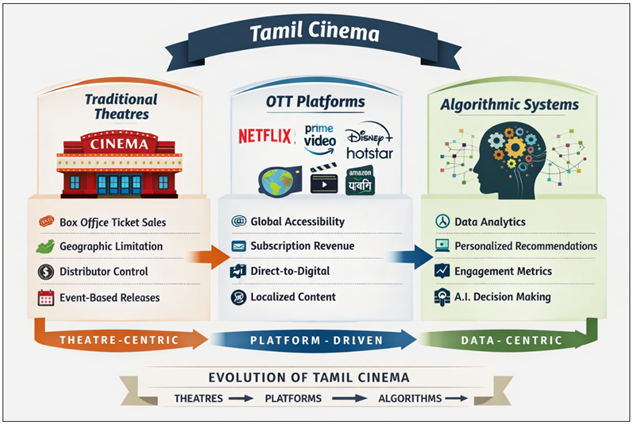
Figure 2 Evolution of Tamil Cinema
3.1. The Era of Theatrical Dominance
Theatrical exercise served as the foundation of the economic system of the Tamil cinema over several decades. Primary income generators were single-screen theatres in Tamil Nadu and adjacent state with box-office performance being the deciding factor on the commercial validity of a given film. Occupancy rates, ticket sales, and length of theatrical run (so-called 100-day or silver jubilee milestones) were used as measures of success. The distribution was by region based circuits, and rights were sold by territory. Producers avoided financial risk through pre-selling distribution rights, satellite rights and overseas rights.
3.2. Star System and Box Office Economics
The star system had become the staple of the theatrical Tamil cinema. Actors such as Rajinikanth, Vijay and Ajith Kumar had very large fan base that could impact on opening day collections. Star-driven economics has been employed in pre-release hype, teaser launches and festivals scheduling. This mechanism is known by the academic commentaries as risk concentration, and big-budget films rely on the influence of stars to ensure the attendance in the theaters. To project the revenue, actor market value and historic market trend of performance and distributor trust were used instead of the information on the granular audience.
3.3. Multiplex Expansion and Urban Audience Shift
The growth of multiplex theatres in major cities like Chennai, Coimbatore and Madurai happened in the early 2000s. Multiplexes brought about differentiated pricing, better infrastructure and targeting the audience. It was during this time that the content started to diversify slowly with urban-inspired content and experimentation which attracted niche viewers. The multiplex model changed the way of revenue distribution; it focused on premium pricing and reduced theatrical windows. It also enabled multi-screen releases which increased the amount of revenue that could be made on opening weekend. Nevertheless, even with modernization, the model relied on physical attendance and geographic reach and did not penetrate the countryside and could not be extended to overseas markets.
3.4. Pandemic Acceleration and Direct-to-Digital Releases
The Covid-19 pandemic was an act of structural disruption. As the theatres continued to stay closed, a number of the Tamil movies chose direct-to-OTT releases on services like Netflix and Amazon Prime Video. In contrast to theatrical releases, OTTs assessed content on the basis of numbers of subscribers, usage rates, and retention over time as opposed to opening weekend grosses. Film-makers enjoyed a head start in selling the rights digitally, avoiding the box-office unpredictability. Such a step represented a change of concept: the measurements of success were no longer considered in terms of ticket sales but watch time, completion rate, and engagement analytics.
3.5. Emergence of Hybrid Release Models
Recovery in the wake of the pandemic brought about hybrid releases, which is the mixture of theatrical releases and the reduced length of the OTT releases. Blockbuster movies were embracing staggered release: theatrical release and then digital release in 4-8 weeks. This redistribution risk was distributed by this hybridization. Theatric releases maintained the experience and spikes of revenue of the mass event, whereas OTT releases guaranteed the prolongation of the cycles of monetization and access to the global audience. Simultaneous accessibility was obtained by the diaspora audiences thus eliminating reliance on foreign theatrical circuits.
In terms of industrial aspect, Tamil cinema transformed to be geographically bound but theatre-reliant into platform-integrated and data mediated ecosystem. The decision-making parameter was moved away from the distributors and exhibitors, and on streaming platforms with predictive analytical capabilities and algorithmic curation.
4. OTT Platforms and
the Reconfiguration of the Tamil Cinema Ecosystem
Figure 3

Figure 3
Reconfiguration of
Tamil Cinema Ecosystem
4.1. Entry of Global Platforms into Regional Markets
The introduction of the global streaming services into regional Indian markets is a turning point in the industrial development of the Tamil cinema. Netflix, Amazon Prime Video, and Disney+ Hotstar companies identified the audiences of vernacular languages as the high-growth segments in the emerging digital economies. Tamil cinema with its strong domestic base and the widely spread diaspora in the world turned out to be a priority acquisition category. The streaming platforms also supported instant access with subtitle and dubbing providing a variety of theatrical circuits around the globe unlike traditional ones that relied on physical prints and restricted screenings. This platformization undid geographical borders and realigned Tamil cinema as a digital commodity that was transnational. Additionally, data-driven acquisition models were used in global OTT platforms where they invested in region-specific originals and rights to stream in order to gain subscription growth.
4.2. Regional OTT Platforms and Localization Strategies
Some of these localization strategies are the use of curated Tamil-only catalogs, promotion campaigns based on cultural resonance, premieres of films during events, and low-cost subscription pricing models. Regional OTT services keep the audience loyal despite the competition with global giants by identifying platform identity and linguistic and cultural particularity. This co-existence has formed a stratified digital market system whereby Tamil movies are distributed through both high-quality global streaming distribution systems and culturally integrated regional delivery systems, thus, diversifying distribution systems and revenue streams.
4.3. Direct-to-Digital Releases and Impact on Economy.
Direct-to-digital releases have been normalized and have restructured the distribution of the financial risks within the Tamil cinema. In the traditional approach, commercial viability was determined by theatrical performance, which exposed the producer to the vagaries of opening-weekend performance. OTT acquisitions on the other hand do not subject the acquiring company to pay upfront licensing fees thus cost recovery before release to the general public. Such redistribution of risk has increased the prospects of the mid-budget films and experimental films that are not necessarily guaranteed to attract theatres but have a high likelihood of being streamed. Furthermore, online premieres eliminate the reliance on physical logistics of the exhibition and massive marketing costs. Revenue is embedded within subscription-based monetization cycles as opposed to box-office spikes which can be very risky at times. Nonetheless, the non-transparency of performance data on the streaming level creates informational asymmetry, since viewerships are still the prerogative of platforms. Such a transition to the closed data ecosystems of reporting instead of the transparent box-office changes the system of accountability and makes it more difficult to evaluate the performance of films without internal economic evaluation.
4.4. Revenue Models: Subscription, Advertisement and Hybrid Structures.
OTT services are based on a subscription (SVOD), advertisement (AVOD) or hybrid revenue model, which redefines the Tamil cinema revenue logic. With SVOD, the income is produced by regular subscription payments, and the success of the content is measured by the engagement metrics and retention of the subscriber instead of the ticket sales. The AVOD systems widen accessibility through the provision of free streaming based on advertisement revenue, extending accessibility to the demographics that are sensitive to price. Hybrid models combine the two strategies and exploit the market to the maximum without being confined to a single source of revenue. In the case of Tamil movies, such a change is a move towards short-term concentration of theatrical revenues to long-term digital revenues. Content value is not about openingday performance but rather serves as a cumulative process that accrues through the process of streaming consumption, cross border connectivity and algorithmic rediscovery. Consequently, movies exist in a long-tail economy, where the duration of catalog life is adding a lot of financial stability.
4.5. Impact on Producers, Distributors, and Exhibitors
OTT revolution has made some dramatic changes in the stakeholder relationship in Tamil cinema. The alternative financing models, global exposure and theatrical dependency are beneficial to the producers. Online presales provide the predictability of the financial aspect and allow to experiment in the genre and narrative style. The traditional distributors, on the other hand, are becoming less and less relevant as streaming platforms disregard the rights segmentation on the territory basis. Their power is mostly restricted to theatrical circuits and foreign distribution in which physical exhibition is still maintained. These are revenue compressions to theatre owners, especially in mid-scale productions that have gone to OTT. As a result, to maintain occupancy rates, theatres have been relying on the high-budget films bearing the event character and polarising the market. This ecosystem then changes to a dual form that includes blockbuster-driven theatrical extravagance and digitally focused mid-budget narration. This division reconsiders the competitive strategies and production planning in the industry.
5. Algorithmic Culture and Audience Shaping in the OTT Era
The change in Tamil cinema where theatrical forms of exhibition are replaced by digital streaming forms is more than a technological change and is a change in the cultural mediation. Algorithms, in the OTT ecosystem, act as ghost curators, determining what viewers consequently watch and how much they watch and what genres become popular. In OTT, the allocation of screens depends on computational algorithms that streamline content feeds to individual users after distributors and exhibitors lose control of the same in theatre programming. This paragraph reviews the roles of algorithm systems in forming the taste, cultural visibility, narrative design, and power structures in Tamil cinema.
5.1. Collaborative Filtering and Collective Behavioral Modeling
One of the most popular methods in the recommendation in the streaming platform is collaborative filtering. It forecasts users preferences by taking into account similarity patterns in trends of behavior among large population of users. Provided that a subgroup of the viewers that watched a Tamil action movie also viewed a given thriller series, the algorithm will make an inference of a probabilistic relationship and suggest the series to other, similar users. This method is based on the matrix factorization approaches that minimize large user-item interaction matrices to latent feature representations. The similarity between users or content items is used to derive the predicted interaction score. As a Tamil cinema example, collaborative filtering will enable the niche movies to access viewers outside the immediate scope of their own marketing. When behavioral data shows some overlap into the general viewing group. Nonetheless, it also implies that exposure to collective patterns has a strong impact on individuals thus strengthening trends which already show high activity.
5.2. Content-Based Filtering and Personal Preference Reinforcement
Content based-filtering works differently in that it analyzes the characteristics of the content itself- genre, language, cast, narrative tone, length of content and thematic keywords. When the viewer regularly watches Tamil crime dramas with the urban settings, the system suggests similar movies by based on metadata similarity vectors. Although this method makes personalization more accurate, it can unintentionally make the exposure diversity less. Clients of Tamil and those who keep watching the same genre in Tamil might experience minimal story change. Algorithms in this sense enhance the feastings of preference and stabilize the user tastes patterns instead of promoting the exploratory viewing. This gives incentives to filmmakers to match projects with data-measured content attributes which are algorithmically preferable.
5.3. Hybrid Recommendation Architectures and Deep Learning
Contemporary OTT systems combine hybrid recommendation systems with a mixture of collaborative filtering algorithms, content-based analysis, and deep learning. Neural networks determine the intricate patterns in behavioral sequence and use this information to assess watch time patterns, frequency of sessions, time-of-day viewing and device switches. In the case of Tamil film, it implies that in addition to evaluating the content viewed, the way it is viewedssimilar to the frequency of rewatching, binge completion behaviorand episode skipping behavior. As such, there is a growing tendency to format episodic Tamil web series in a way that allows them to be structured around cliffhanger storytelling that can be monetized in terms of high retention rates. This means that algorithmic modeling has an impact on discoverability, as well as narrative pacing and experimentation of format.
5.4. Algorithmic Gatekeeping and Cultural Visibility
During the theatrical age, distributors and exhibitors had control over cultural gate keeping through the selection of movies that would be given good screens and time slots. The same role of gatekeeping content is also fulfilled by algorithms in the OTT ecosystem, in the form of homepage placement, trending lists and push notifications. The visibility will be conditional on the engagement measures and not just the marketing budgets. The movies produced in Tamil and that have high early interest ratings can be promoted to larger audiences through the algorithms to capture more than just Tamil audiences. On the other hand, movies which are average in their initial attraction can be given a second place and they will not find much coverage irrespective of their artistic quality. This algorithmic gatekeeping removes human gatekeepers in favor of automated systems of rankings, which query the ideas of transparency and cultural representation. Unless algorithmic optimization is adjusted to focus on culturally specific storytelling, regional narratives face the risk of being marginalized when the dominant influence on algorithmic optimization is the globally trending genres.
5.5. Filter Bubbles and Taste Homogenization
Annualistic personalization may give rise to the so-called filter bubbles, in which the user is mostly exposed to material that agrees with their past taste. This can lead to dispersed groupings of viewers in Tamil cinema in terms of action-oriented viewers versus romance-oriented viewers versus thriller-centric viewers rarely making genre cross-overs.
5.6. Data-Driven Narrative Structuring
Streaming analytics determines the films to be promoted as well as their organization. Completion rate measures bring about the tightening of runtimes, plot-advancement, and the presence of emotionally captivating teasers within the early minutes. The Tamil web series tend to have shorter episodes and mid-episode points of suspense to reduce the possibility of drops.
Heatmap visualizations of the viewer retention on timelines allow the platform to create segments in which viewers stop, rewind or drop off the content. These are insights to aid the decisions in production in the future. Therefore, computationally-driven feedback loops are becoming more and more a part of storytelling, with creative intuition and quantitative engagement optimization.
5.7. Ethical and Regulatory Considerations
The algorithmic systems work in opaque systems and the criteria of decision-making are proprietary. The streaming metrics are not publicly audited as opposed to theatrical box-office reporting. Such informational control concentration causes issues of accountability and fair dealings in terms of revenue. Moreover, the algorithms can favor the old players or high-budget films because of the past interaction patterns, which could disfavor the new filmmakers. Cultural theorists claim that these systems have a danger of supporting the dominant discourses whilst silencing the voices of minorities.
6. Comparative Analysis: Theatres vs OTT Era
Figure 4
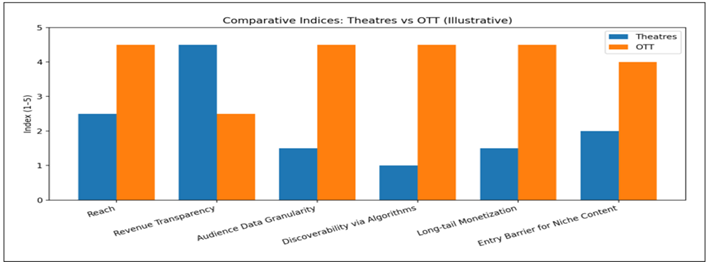
Figure 4 Comparative Indices: Theatres vs OTT
Figure 4 demonstrates the differences in the two
distribution regimes in six major ways through a scale between 1 and 5. The
larger the figures the greater the presence or benefit. Theaters score higher
regarding their transparency regarding revenues since the industry partners are
able to monitor their occupancy rates, gross collections, and box office
reports. This facilitates easier setting of standards. Conversely, theaters are
not as successful with reach and long-tail marketing since they are not able to
be located in as many locations and neither can they generate income during the
weeks they last. OTT platforms on the other hand are excellent in capturing a
lot of data about the user and using algorithms to simplify the location of
content. They are doing this by monitoring minute details such as the duration
of watching, the time people end up watching, and the time they discontinue
watching. They also employ recommendation engines to make more people watch
content other than promoting it. Video online is also useful in making niche
content visible since it allows focusing on the specific groups of people
without a large theater audience. On the whole, the narrative demonstrates a
massive change: the films of the Tamils cease to be based on the events and the
box office statistics, on the data and the visibility of the algorithms, in
which indicators of discoverability and engagement are the most significant
things.
Figure 5
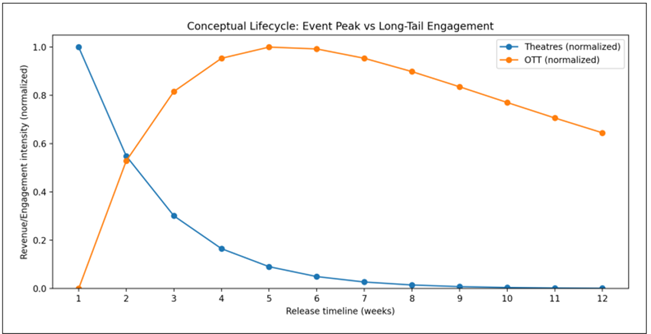
Figure 5 Conceptual Lifecycle: Event Peak vs Long-Tail Engagement
These
conceptual lifecycle represent in Figure 5, the course of development of theater sales and
online viewing habits during a 12 week release period.
The values have been brought to common place to enable easier comparison. The
theatrical curve starts with a peak and falls very fast. The performance of the
movie during the first weekend and at festivals, the number of screens the movie
is distributed through, the amount of people who watch the movie immediately
after its release, among others is very crucial. When new movies are released,
people do not become particularly concerned about their collections and TVs. In
case you check the OTT curve, it ascends more gradually, and remains in a
long-tail form. New shows are discovered with recommendations, popular lists,
social media spillover and delayed viewing such as binge watching. The content
can be viewed by people around the globe at various times, and therefore, OTT
use may take a long time. It is possible due to the fact that old titles can be
located again several months later by algorithms. Success of Tamils movies in
this case, is not only based on the sales during the first day. It is also
based on retention and completion rate and continued discoverability. The
change in the lifecycle also alters the creative design. To illustrate,
streaming material tends to be dependent on powerful opening, and a consistent
flow to entertain people and ensure their longevity.
Table 1
|
Table 1 Comparative Structural Analysis: Theatres vs OTT in Tamil Cinema |
|||
|
Dimension |
Theatrical Model |
OTT Platform Model |
Industrial Implication |
|
Primary Revenue Driver |
Ticket sales based on occupancy and screen count |
Subscription (SVOD), Advertisement (AVOD),
Licensing |
Shift from event-based spikes to recurring
revenue streams |
|
Revenue Transparency |
High (public box-office reporting) |
Low–Medium (proprietary streaming metrics) |
Information asymmetry increases platform power |
|
Audience Reach |
Geographically bounded (regional & overseas
circuits) |
Global, instant, multi-device access |
Expansion to diaspora and non-Tamil viewers |
|
Discoverability Mechanism |
Marketing campaigns, star pull, screen allocation |
Algorithmic recommendations, trending lists |
Computational gatekeeping replaces distributor
control |
|
Time-to-Peak Performance |
Opening weekend critical |
Distributed engagement over weeks/months |
Emergence of long-tail monetization |
|
Risk Structure |
High for mid-budget films |
Reduced via upfront licensing deals |
Financial stabilization for experimental content |
|
Data Granularity |
Limited to ticket sales & occupancy |
Fine-grained behavioral analytics (watch time,
completion rate) |
Data-driven commissioning & personalization |
|
Marketing Strategy |
Mass media, physical promotions |
Targeted digital ads, A/B testing, push
notifications |
Precision marketing reduces promotional
inefficiency |
|
Role of Exhibitors |
Central stakeholders |
Reduced influence; dependent on event films |
Market polarization toward blockbusters |
|
Creative Incentive |
Star-driven, mass appeal narratives |
Segment-based niche storytelling |
Growth of web series & genre experimentation |
Through
the platforms, Tamil film has ceased to be a theatrical-based industry and has
transformed itself to be a digital ecosystem as it can be seen in Table
1. The theater business plan relies on
representing itself and receiving lots of money during the first week, physical
screens need to be set aside, and lots of people have to go to it by having
stars lead. The OTT model, in its turn, rests on the principles of long-tail
engagement, the simplicity of algorithmic discoveries, and uninterrupted
subscriptions. One of the largest changes is the extent of detail and that data
is owned by an individual. The amount of money theaters generate is simple to
notice, whereas OTT platforms maintain their behavioral analytics. This
provides platform companies with greater informational presence. The payment of
the risk has also changed due to the change. Poorly performing movies in
cinemas can now earn them some money in the form of digital licenses. In the
case of algorithmic curation though, it opens up possibilities of keeping
content out in new ways. The visibility of content is no longer under the
control of the sender but rather it hinges on the extent to which content will
attract the user. In general, the comparison reveals that the Tamil film has
evolved not only to be played in a few places but streamed on all parts of the
world on computers due to personalization and data analytics systems.
7. Conclusion
The Tamil cinema has not only changed the theater to be used as a basis but also changed it to streaming services and algorithms. It is among the structural changes that have been of utmost importance in the history of the industry. The Tamil films used to have just a single theater and the sale was made on the basis of stars and box office hits on the first weekend. It relied on events in its economy and was weak in most places. These regulations were entirely altered with the introduction of over-the-top (OTT) services which introduced worldwide reach, subscription income, and data-driven decision-making tools. The analysis indicates that it is not only the technology that is changing the entire system. A movie was supposed to be viewed by many as a way of becoming successful. The quality of its promotion and the number of followers were also significant. Conversely, the OTT ecosystem is more of a matter of engagement rates, completion rates, personalized recommendations and retention of subscribers. Algorithms have now made the determination of what is viewed, and the number of people who view it. Data analytics can be used to decide who to hire, how to market, and even the speed of a story, among other things. It is now possible to use computer logic when making art. The analogy indicates that power in the Tamil film business has switched. The digital licensing allows producers to maintain their finances steady, yet traditional theaters and distributors are forced to become smaller since they rely on films with big budgets more. Meanwhile, the Tamil cinema has been made more accessible to the rest of the world by the global platforms through infrastructures of dubbing and subtitling that allow viewers of other languages and the diaspora to watch. However, due to this expansion, there is increased access to data on more platforms companies. This causes concern on transparency, algorithm bias and cultural fairness. The shift of movies by theaters to algorithms by Tamil movies demonstrates a greater transformation in the culture creation within the platform capitalism era. Such is the way the business industry functions now the large shows and personalized algorithms coexist. The future of the streaming age will be how people can successfully integrate various forms of creativity, emerging technology and a just government.
CONFLICT OF INTERESTS
None.
ACKNOWLEDGMENTS
None.
REFERENCES
Camilleri, S., and Falzon, L. (2020). Understanding Motivations to Use Online Streaming Services: Integrating the Technology Acceptance Model (TAM) and the Uses and Gratifications Theory (UGT). Spanish Journal of Marketing - ESIC, 25(2), 217–238. https://doi.org/10.1108/SJME-04-2020-0074
Chatterjee, S., and Byun, Y.-C. (2022). Voting Ensemble Approach for Enhancing Alzheimer’s Disease Classification. Sensors, 22(20), Article 7661. https://doi.org/10.3390/s22207661
Duykuluoglu, A. (2021). The Significance of Artificial Neural Networks in Educational Research: A Summary of Research and Literature. Technium BioChemMed, 2(3), 107–116.
Gallo, C. (2014). Artificial Neural Networks Tutorial. In Encyclopedia of Information Science and Technology (3rd ed., 6369–6378). IGI Global. https://doi.org/10.4018/978-1-4666-5888-2.ch626
Garoosiha, H., Ahmadi, J., and Bayat, H. (2019). The assessment of Levenberg-Marquardt and Bayesian Framework Training Algorithm for Prediction of Concrete Shrinkage by the Artificial Neural Network. Cogent Engineering, 6(1), Article 1609179. https://doi.org/10.1080/23311916.2019.1609179
Gumasing, M. J., Prasetyo, Y. T., Ong, A. K., Persada, S. F., and Nadlifatin, R. (2023). Factors Influencing the Perceived Usability of Wearable Chair Exoskeleton with Market Segmentation: A Structural Equation Modeling and K-Means Clustering Approach. International Journal of Industrial Ergonomics, 93, Article 103401. https://doi.org/10.1016/j.ergon.2022.103401
Hadhri, S., Hadiji, M., and Labidi, W. (2024). A Voting Ensemble Classifier for Stress Detection. Journal of Information and Telecommunication, 1–18. https://doi.org/10.1080/24751839.2024.2312456
Jia, X., Pang, Y., Huang, B., and Hou, F. (2023). Understanding Consumers’ Continuance Intention to Watch Streams: A Value-Based Continuance Intention Model. Frontiers in Psychology, 14, Article 1073301. https://doi.org/10.3389/fpsyg.2023.1073301
Katya, E., and Rahman, S. (2025). Applications of Natural Language Processing in Social Media Sentiment Analysis. International Journal of Recent Advances in Engineering and Technology, 13(1), 11–15.
Lavorata, L. (2014). Influence of Retailers’ Commitment to Sustainable Development on Store Image, Consumer Loyalty and Consumer Boycotts: Proposal for a Model Using the Theory of Planned Behavior. Journal of Retailing and Consumer Services, 21(6), 1021–1027. https://doi.org/10.1016/j.jretconser.2014.05.003
Ong, A. K., Prasetyo, Y. T., Nadlifatin, R., Persada, S. F., Gumasing, M. J., and Others. (2022). Utilization of Random Forest Classifier and Artificial Neural Network for Predicting Factors Influencing the Perceived Usability of COVID-19 Contact Tracing “Morchana” in Thailand. International Journal of Environmental Research and Public Health, 19(13), Article 7979. https://doi.org/10.3390/ijerph19137979
Raman, A., and Don, Y. (2013). Preservice Teachers’ Acceptance of Learning Management Software: An Application of the UTAUT2 Model. International Education Studies, 6(7), Article 157. https://doi.org/10.5539/ies.v6n7p157
Roy, R. B., et al. (2021). A Comparative Performance Analysis of ANN Algorithms for MPPT Energy Harvesting in Solar PV System. IEEE Access, 9, 102137–102152. https://doi.org/10.1109/ACCESS.2021.3096864
Shah, S., and Mehta, N. (2022). Over-the-Top (OTT) Streaming Services: Studying Users’ Behaviour Through the UTAUT Model. Management and Labour Studies, 48(4), 531–547. https://doi.org/10.1177/0258042X221124445
Steiner, E., and Xu, K. (2018). Binge-Watching Motivates Change: Uses and Gratifications of Streaming Video Viewers Challenge Traditional TV Research. Convergence: The International Journal of Research Into New Media Technologies, 26(1), 82–101. https://doi.org/10.1177/1354856517750365
Talwar, S., Srivastava, S., Sakashita, M., Islam, N., and Dhir, A. (2022). Personality and Travel Intentions During and After the COVID-19 Pandemic: An Artificial Neural Network (ANN) Approach. Journal of Business Research, 142, 400–411. https://doi.org/10.1016/j.jbusres.2021.12.047
Zahra, F., et al. (2019). User Behaviour Intention Using UTAUT2 Model: A Systematic Literature Review. Russian Journal of Agricultural and Socio-Economic Sciences, 92(8), 265–273. https://doi.org/10.18551/rjoas.2019-08.31
|
|
 This work is licensed under a: Creative Commons Attribution 4.0 International License
© ShodhKosh 2026. All Rights Reserved.