ShodhKosh: Journal of Visual and Performing ArtsISSN (Online): 2582-7472
|
|
Analyzing New Media as Primary Health Information Sources: Patterns, Reliability, and Credibility Using Cross-Sectional Survey and Regression Analysis
Soundra Rajan D. 1
 ,
Jayaseelan R. 2,
Kadeswaran S. 3
,
Jayaseelan R. 2,
Kadeswaran S. 3 ,
Muralidharan K. 4
,
Muralidharan K. 4
 ,
Chithra Lekshmi K. S. 5
,
Chithra Lekshmi K. S. 5
1 PhD
Research Scholar (Part Time), Department of Journalism and Mass Communication,
PSG College of Arts and Science, Coimbatore, Tamil Nadu, India
2 Assistant
Professor, Department of Visual Communication and Electronic Media, PSG College
of Arts and Science, Coimbatore, Tamil Nadu, India
3 Assistant Professor, Department of Visual Communication and Electronic
Media, PSG College of Arts and Science, Coimbatore, Tamil Nadu, India
4
PhD,
Research Scholar (Part Time), Department of Journalism and Mass Communication,
PSG College of Arts and Science, Coimbatore, Tamil Nadu, India
5
PhD, Research Scholar (Part
Time), Department of Journalism and Mass Communication, PSG College of Arts and
Science, Coimbatore, Tamil Nadu, India
|
|
|
ABSTRACT |
|
|
The mounting
dependence on new media channels for medical information has reshaped the
ways people acquire and handle health knowledge alongside their trust in
digital health content. Researchers explore traditional health
information-seeking methods following assessment of Internet-based
information sources and online health content trustworthiness. Users enrolled
in a cross-sectional survey divided into active health seekers by analysis at
56% and passive product discoverers at 44%. Analysis revealed three main
reasons why people search for health information where 40% desired clarity
about medical conditions and 36% aimed at finding suitable treatments and 30%
wanted knowledge about wellness and lifestyle strategies. The study revealed
website and mobile application usage was the most common with 50% of
participants but social media usage came in second at 30% and forums and
blogs gathered the least use at 20%. Regression analysis detected the
relation between credible sources and user trust but also demonstrated how
users worry about false information and untrusted content. Online health
information requires better digital health literacy while integrating
trustworthy sources to solve the problem of informational reliability. The
obtained data helps researchers better understand today's changing patterns
of medical information consumption and helps develop accurate strategies for
digital health knowledge accessibility for the public. Further research needs
to study how user engagement with health information changes when algorithms
control what content people see. |
|||
|
Received 17 December 2025 Accepted 11 March 2026 Published 28 March 2026 Corresponding Author Soundra
Rajan D., soundrarajan19@gmail.com
DOI 10.29121/shodhkosh.v7.i2s.2026.7193 Funding: This research
received no specific grant from any funding agency in the public, commercial,
or not-for-profit sectors. Copyright: © 2026 The
Author(s). This work is licensed under a Creative Commons
Attribution 4.0 International License. With the
license CC-BY, authors retain the copyright, allowing anyone to download,
reuse, re-print, modify, distribute, and/or copy their contribution. The work
must be properly attributed to its author.
|
|||
|
Keywords: Digital Health Information, Health-Seeking Behavior,
Source Credibility, Online Misinformation, social media Health Trends, User
Trust in Health Information |
|||


1. INTRODUCTION
New media technology has reshaped how health information reaches patients because it plays a vital role in modern healthcare messaging Aceto et al. (2018). Users can access unique health-related content because of social media together with blogs forums and health-specific websites Thapliyal et al. (2024). Web access gives people greater independence in managing their health by enabling them to both understand their medical conditions and select appropriate treatment options. Information accuracy in new media platforms was a crucial issue that researchers find worrisome Keshavarz (2021). Research shows new media produces greater access to health information through democratization yet tends to enable misinformation exposure that could result in negative health effects. Preserving health information using new media depends heavily on individual demographics regarding age and level of education and digital expertise Abdulai et al. (2021). New media has transformed access to health information but its massive platform diversity generates significant problems regarding content reliability which influences user health choices negatively. Digital platforms now present users with a wide selection of health content that extends from scholarly articles to online user contributions Farsi (2021).
Digital health credibility assessment depended on three key variables consisting of source authority and content accuracy together with information disclosure transparency. The widespread availability of unverified and misleading information through digital platforms creates substantial threats upon public health according to Okoro et al. (2024). Research has revealed that users often lack important abilities to critically evaluate the quality of health information which makes reliable and unreliable source recognition more difficult Zhang and Ghorbani (2020). Trust diminishes because medical information can contain personal biases as well as outdated content which lacks clear documentation references. The reliable and credible delivery of health information reflects individuals' e-health literacy proficiency which enables them to apply digital health content correctly Shu et al. (2020). The ability to search for electronic health resources and understand them to make smart clinical choices defines e-health literacy which merges traditional literacy competencies with internet skills. Research demonstrates that e-health literacy levels show substantial differences between population groups with foundational factors like age and educational attainment and socioeconomic status blocking understanding. Digital platforms deliver an abundant health information base yet users with restricted e-health literacy commonly struggle to detect valid sources and decode medical jargon along with adapting the information to personal circumstances Palumbo et al. (2022). Individuals with low e-health literacy demonstrate higher susceptibility to inaccurate information because it leads to adverse health results.
A person's e-health literacy abilities to evaluate and apply digital health information get affected profoundly by how behave when seeking and communicating with these resources Choukou et al. (2022). Research shows health information-seeking behaviors respond to three primary influences which consist of urgent medical concerns and personal health needs and demographic features that incorporate age gender and educational background. Active information seekers actively look for particular data while passive seekers discover health content accidentally through their everyday media consumption Link et al. (2022). Social media along with health forums serve to distribute information among users who utilize peer-support operations which modifies classic methods of information acquisition. Research shows individuals tend to pick and only seek information that supports their current beliefs thus creating exposure conditions to doubtable sources of information Zhang et al. (2021). Severe information overload stress becomes a decision-blocking complication when it pulls focus away from sufficient health information processing. The search and decision-making behavior for health information substantially depends on trust factors together with credibility assessment because people frequently depend on their subjective perception of source authority for their choices Link et al. (2024), Allen Catellier and Yang (2012). Identified research shows that trust relies on three key factors: the source's perceived authority level together with clear information presentation and content that matches well-known medical facts. When professionals present their qualifications and work affiliations through first-party endorsements audiences develop greater trust in the information provide.
Health information trust levels depend on factors related to users such as their existing medical understanding, individual prejudices, and skill in processing digital content Jermutus et al. (2022). Users build trust in online health platforms by assessing their interface design properties which include both straightforward navigation systems and effective citation functions and user feedback networks. Health information sources based on trust and credibility directly impact new media usage-related psychological effects because bogus content produces more stress, anxiety coupled with health-related fears Soroya et al. (2024), Chen et al. (2022). New media provides tremendous health resources and peer assistance but creates additional difficulties related to information overload as well as anxiety and stress. Users experience overwhelming confusion from plentiful and contradictory health information online which leads to the negative effect known as "cyberchondria" according to research Rutty (2023). People with low e-health literacy who encounter either false information or hysterical content face increased potential for psychological distress. Online health discussion groups help individuals feel less lonely and showed better emotional outcomes according to research findings Başdeğirmen (2023). People relying on health advice provided by new media platforms without professional verification end up making incorrect choices and become more anxious Aker and Aiken (2021). Analysis of media usage patterns benefits greatly from studying new media usage psychology because emotional and cognitive reactions determine digital health platform engagement Peng (2022).
Media consumption patterns emerge through overlaps between individual demographics and technological capabilities and diverse health resource accessibility across different platforms. The increased usage of health websites together with social media and mobile applications dominates modern health information acquisition. Inequalities in media consumption arise mainly from age differences alongside educational background and digital competency thresholds that affect usage levels Wang and Wu (2022). Media usage patterns differ regarding both frequencies and durations because different users exhibit varying health information requirements and access abilities. Analytical works have highlighted how algorithms direct user experiences by offering customized content resulting in elevated confirmation of current beliefs or preexisting biases Wongmahesak et al. (2025). Analyzing how people utilize media helps identify vital implications for public health related to new media as we develop better health communication plans and solutions for misinformation and digital inequalities. Digital platforms now function effectively as powerful public health tools that help health officials reach broad audiences quickly to execute emergency response strategies like disease management and vaccination programs Amadu (2024). Scientific evidence shows how new media platforms enable improved awareness through content accessibility which lets people become more informed decision-makers. E-health implementation faces hurdles from the spread of false information coupled with technological access obstacles and differing patient healthcare digital knowledge profiles Melhem et al. (2023), Mouketou (2023). Social media misinformation leads to vaccine doubt while spreading bad health behaviors so regulatory oversight and fact-check procedures must exist for public protection. New media applications used in public health practice raise ethical problems because compromise user privacy protection and data protection standards Karamifar et al. (2023).
1.1. RESEARCH GAP
Current research on digital health information reveals critical gaps. Few studies provide cost-effective interventions to enhance e-health literacy among disadvantaged groups, leaving digital inequalities unresolved. The psychological impacts of misinformation including anxiety, cyberchondria, and decision paralysis are underexplored, particularly in vulnerable populations. Moreover, platform structures, user-generated content, and algorithmic curation remain insufficiently examined in relation to trust during health emergencies, despite the rise of TikTok, Instagram, and AI-driven feeds. Finally, limited empirical evidence links media usage patterns with measurable health outcomes, and unbiased evaluations of algorithm-generated health messages are scarce, underscoring the need for deeper investigation.
1.2. RESEARCH OBJECTIVE
Current research on digital health information reveals critical gaps. Few studies provide cost-effective interventions to enhance e-health literacy among disadvantaged groups, leaving digital inequalities unresolved. The psychological impacts of misinformation including anxiety, cyberchondria, and decision paralysis are underexplored, particularly in vulnerable populations. Moreover, platform structures, user-generated content, and algorithmic curation remain insufficiently examined in relation to trust during health emergencies, despite the rise of TikTok, Instagram, and AI-driven feeds. Finally, limited empirical evidence links media usage patterns with measurable health outcomes, and unbiased evaluations of algorithm-generated health messages are scarce, underscoring the need for deeper investigation.
1.3. THEORETICAL FRAMEWORK
Grounding this study in established theoretical perspectives provides a structured lens to examine how individuals seek, evaluate, and respond to health information on digital platforms. By integrating behavioral, technological, and communication models, the framework captures the complex interplay between user characteristics, platform dynamics, and health outcomes.
The Health Belief Model (HBM) offers a foundation for understanding how individuals perceive health risks and make decisions when exposed to digital health information. It emphasizes perceived susceptibility, severity, benefits, and barriers, which align with users’ responses to misinformation and their likelihood of adopting preventive behaviors. For instance, low e-health literacy may increase perceived barriers, making users more vulnerable to misinformation-driven anxiety or poor health decisions.
The Technology Acceptance Model (TAM) explains how individuals adopt and engage with digital platforms as health information sources. Key constructs such as perceived usefulness and ease of use are directly tied to platform accessibility, user interface design, and the ability to navigate digital health resources. Variations in demographic factors such as age, education, and digital competence influence TAM constructs, shaping whether individuals accept or reject health advice from new media.
The Elaboration Likelihood Model (ELM) further explains how users process and evaluate the credibility of online health content. According to ELM, individuals process information through either the central route (careful scrutiny of message quality) or the peripheral route (influence by cues such as likes, shares, or source appearance). This model is particularly relevant to algorithm-driven platforms like TikTok and Instagram, where presentation style and popularity indicators may shape trust more than content accuracy.
The Uses and Gratifications Theory (UGT) contextualizes why individuals turn to digital media for health information. Motivations such as information seeking, emotional support, and social interaction explain the rising reliance on health forums, peer-support groups, and short-video platforms. These motivations interact with literacy levels and psychological factors, determining whether media use results in empowerment or misinformation-induced distress.
Synthesizing these perspectives, this study positions e-health literacy, trust in online health information, and psychological responses to misinformation as central constructs shaped by user demographics, platform algorithms, and media content. The framework supports the development of a conceptual model where platform structures and algorithmic curation influence information exposure; user demographics and literacy determine evaluation; trust mediates credibility assessments; and psychological outcomes affect health-related decision-making. This theoretical grounding ensures that the study not only identifies empirical patterns but also contributes to advancing digital health communication theory.
2. RESEARCH METHODOLOGY
Figure 1
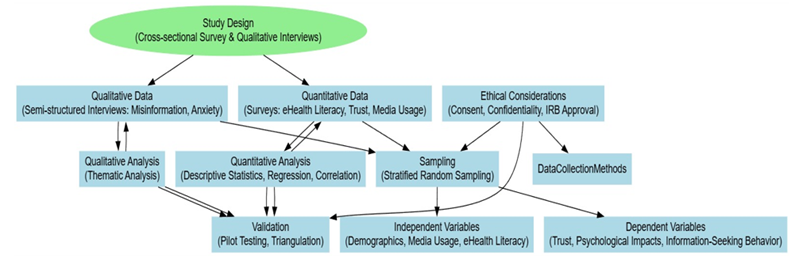
Figure 1
Methodology Flow
Chart
2.1. STUDY DESIGN
The research utilized a mixed-methods structure to acquire complete subject information by using both quantitative and qualitative research techniques. The research design enabled diverse data collection approaches which revealed hidden patterns while showing connections between different elements Appiah and Majeed (2024). The combined method helped investigate the complex relationships between e-health literacy alongside trust and media usage patterns in health information-seeking activities.
Through quantitative survey approaches researchers measured e-health literacy levels together with trust in health information sources as well as media usage patterns Mittelstadt (2017). The eHealth Literacy Scale (eHEALS) measured how well participants found and assessed then utilized health information through digital channels. Multiple survey questions measured behavioral trends among participants as well as media usage patterns and trust dynamics thereby creating a structured format for statistical evaluation Ghani et al. (2019).
Additional interviews utilizing semi-structured methods supported the study by enabling researchers to explore participant responses about their encounters with misinformation and psychological effects and their adoption of digital health platforms. Open-ended questions enabled researchers to study unique individual viewpoints while identifying obstacles like information overload and anxiety and confirmation bias Sbaffi et al. (2020). Users who navigated health information through digital channels were studied using this qualitative approach to understand their complex mental and emotional experiences.
Mixed methods research examined the research subject comprehensively through quantitative surveys together with qualitative interview analysis Jones and Kelly (2018). The integrated method allowed research results to analyze quantitative outcome data alongside contextual factors. Through combining survey data analysis and interview information this study established solid groundwork for comprehending health information transmission and trust development on digital networks.
2.2. SAMPLING
Straights random sampling technique allowed researchers to obtain an diverse group representation McDowall (2022). A diverse group of participants was formed by applying age gender educational and socioeconomic grading criteria to explore health information-seeking activities along with e-health literacy variations Lakshmikantha (2024). Using stratified random sampling decreased sample bias while adding to the study's generalability because every demographic group received sufficient representation.
People were chosen because regularly used new media platforms for obtaining health information Goodyear et al. (2019), Mano (2014). The study exclusively evaluated participants who depend on digital media platforms which include social media and health websites and forums when making health decisions. Research parameters focused on collecting information about behavioral sequences together with trust interactions alongside user-particular experiences of these respondents Mohammadi et al. (2019).
The quantitative survey received 500 participant responses to achieve statistically relevant analysis. A sufficient number of participants was selected to accurately study e-health literacy connections with media engagement alongside trust constructs and psychological effects Zhang et al. (2018). Thirty research participants were chosen to share their detailed personal accounts and viewpoints about the subject. The interview data collected was advantageous for obtaining thematic saturation and enabling comprehensive examination of specific aspects particularly misinformation and anxiety.
The research method adopted stratified sampling together with active media user purposeful selection to study the extensive range of health information-seeking behaviors. The research validity increased through an approach that collected insights from numerous demographic groups and verified participant relevance to the objectives Asgher et al. (2020).
2.3. DATA COLLECTION
Researchers obtained quantitative data by designing structured surveys that efficiently collected important study variables Gulec et al. (2022). Participants responded to validated instruments the eHealth Literacy Scale (eHEALS) which evaluated their capability to locate digital health information then evaluate and apply it for their healthcare needs. Structured questions monitored how users consume media content and what elements trust as health information sources by studying surveyable behavior and offline attitudes. Multiple data sources combined against demographic needs and behavioral tendencies and psychological aspects linking to information overload stress and anxiety facts supported the creation of a thorough dataset for statistical evaluation.
The study collected its qualitative data through semi-structured interview formats to obtain detailed participant perceptions and account experiences. The interviews investigated key concepts which addressed misinformation exposure patterns together with user motivational factors regarding health information searches and evaluated how inconsistent or untrustworthy content influenced trust levels and anxiety responses. Open-ended questioning allowed participants to report extensive information regarding their digital health platform engagements thus providing thorough contextual data beside the quantitative results.
The research used survey and interview data to examine quantitative dimensions of e-health literacy and trust while also uncovering subjective emotional and cognitive influences that patients experience during their search for digital health information. A combined research strategy delivered comprehensive insights into how users experienced the complicated relationships between them and new media platforms.
2.4. VARIABLES
A research design investigated demographic aspects like age, gender and educational attainment to explain how these factors affect health information pursuit and digital system trust. A detailed frequency analysis of media use established patterns of health-related content consumption on platforms composed of social media websites and forums. The ability of study participants to effectively locate and evaluate and apply digital health information known as e-health literacy scores was measured through validated instruments such as eHealth Literacy Scale (eHEALS). Through these variables researchers gained knowledge about how various factors influenced user behavior with digital health resources.
The evaluation studied trust dynamics within health information systems which encompassed how digital platforms were perceived for credibility alongside how users balanced between professional and user-generated content and how platform designs impacted trustworthiness. Researchers evaluated online health information interactions through a psychological examination of anxiety levels and information overload to measure engagement-based emotional and cognitive responses. The research examined user collaboration patterns through health information selection activities including precise searches for medical topics and random exposure to digital content so scientists could learn about platform use behaviors. These outcomes showed how individual characteristics interacted with exposure to media content.
The research investigated these variables to determine key determinant factors and observe related outcomes between them. Research examined how both media usage frequency and e-health literacy scores affected trust levels together with psychological outcomes. Researchers studied behavioral and trust patterns throughout various population segments based on demographic statistics. Researchers obtained substantial insights into the intricate relationships steering digital health information-seeking behaviors and trust mechanisms through thorough research analysis.
3. DATA ANALYSIS
The authors performed descriptive statistics to present a comprehensive profile of participant demographics and behavior patterns along with e-health literacy assessment results. These statistical results presented fundamental information about how data points distributed throughout the dataset. A series of regression examinations established how e-health literacy together with information source trust levels strongly predicted psychological impacts including both anxiety and information overload through variable analysis. Additional correlation tests allowed researchers to establish both the magnitude and orientation of variable interdependencies that explained user interactions with digital health platforms.
Research used thematic analysis to analyze semi-structured interview data collected from transcripts. Researchers used this method to detect persisting patterns throughout participants' digital health platform interactions. The analysis findings covered misinformation detection routes and information reliability testing methods together with health content discord's emotional consequences. Researchers studied trust patterns together with the psychological limitations users face which include feelings of anxiety coupled with information overload. Systematic interpretation became possible through categorizing and coding the gathered data so researchers could capture all the experiential complexities that participants faced.
Both qualitative and quantitative research methods came together to develop a complete understanding of the explored subject matter. Laboratory results brought forward quantitative data about variable connections alongside thematic research which provided contextual understanding of these patterns. A collegial research approach merged stable statistical findings together with real-world participant observations to interpret health information-seeking conduct and trust patterns after moving into digital age.
3.1. VALIDATION
A pilot testing phase confirmed the clarity along with reliability and appropriateness of the survey instrument and interview guide. A handful of participants who fulfilled representative criteria helped surface unclear elements within survey questions and interview prompts. Data collected from pilot testing helped perfect the instruments' language while restructuring both their format and organization to ensure optimal measurement of e-health literacy and trust alongside psychological effects. Adjustments focused on Participant understanding together with Engagement to minimize the risk of data collection errors and response incompleteness.
Complete verification of findings utilized a multiple data source approach to merge quantitative outcomes with qualitative responses. The research utilized statistical data relationships to verify consistency alongside textual data patterns in qualitative interview records. The combination of multiple data sources through methodological triangulation enhanced result validity because it eliminated data source-related biases. Survey data linking e-health literacy to trust found support when researchers explained why participants Trust certain information sources online through their digital platform navigation experiences. These various research methods produced compelling results which captured the intricate relationships between variables which control health information acquisition.
Neither the reliability nor credibility of study results suffered due to lack of proper validation procedures. The combination of piloting allowed for successful measurement error reduction and the implementation of triangulated methods which produced complex analytical results. The strict methodology helped establish trustworthy results which guide practitioners toward evidence-based strategies regarding digital health literacy improvement and information source trust development as well as new media platform user experiences.
3.2. ETHICAL CONSIDERATIONS
Each participant provided informed consent before the research study began to include them. Researchers provided complete understanding of their research role by describing its purpose as well as objectives and procedures to the study participants. Every consent form carried specific information regarding voluntary participation plus the participant's right to withdraw at any time along with a guarantee of no adverse consequences from study participation. The research design incorporated methods which allowed participants to gain full understanding of their rights and separately confirm their study enrollment.
The research included procedures both to guarantee confidentiality and to maintain participant anonymity for protecting personal data. Each participant received a special unique identifier which protected their individual answer information from identification. Specific authorized researchers-maintained access to sensitive data as researchers utilized secure storage systems to stop unauthorized information access. The research methodology incorporated robust ethical procedures which protected participant privacy while securing their feeling of secure information disclosure.
The research obtained institutional review board (IRB) approval to adhere to ethical norms for studies which examine human participants. The Institutional Review Board validated all aspects of the study framework by checking adherence to three essential ethical principles that protect autonomy while promoting beneficence and maintaining justice. An Institutional Review Board act as an extra regulatory body which enforced established ethical guidelines for research compliance.
The need to uphold ethical principles was essential for both participant transparency and the trust needed to permit free and unrestrained study participation. All study participants received ethical protection from approved research guidelines which maintained research credibility and safeguarded both their rights and their well-being during the process.
4. RESULT AND DISCUSSION
Figure 2
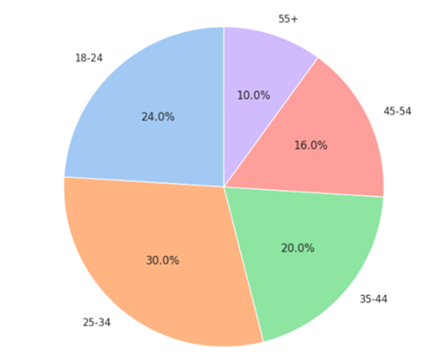
Table 1
|
Table 1 Demographic Characteristics of Participants |
||
|
Demographic Variable |
Frequency |
Percentage |
|
Age |
||
|
18-24 |
120 |
24% |
|
25-34 |
150 |
30% |
|
35-44 |
100 |
20% |
|
45-54 |
80 |
16% |
|
55+ |
50 |
10% |
|
Gender |
||
|
Male |
200 |
40% |
|
Female |
250 |
50% |
|
Non-binary |
50 |
10% |
|
Education Level |
||
|
High School |
50 |
10% |
|
Undergraduate |
200 |
40% |
|
Graduate/Professional |
250 |
50% |
The age distribution among study participants with the largest number of participants (30% amounting to 30) belonging to the 25-34 age segment. Youth between 18 and 24 years old comprised 24% of respondents in the sample according to this research data. Thirty-six percent of participants come from the middle-aged demographic including those between 35 and 44 and 45 to 54 years old indicating an equal distribution across working-age groups and older career stages. The 55+ age demographic stands out as the least represented segment with only 10 percent of study participants whereas all other brackets exceed 10 percent of the collected data. Analysis of health information searching patterns requires attention to these age segment distributions since younger population demographics tend to engage more actively in digital health literacy activities.
New media reliability and source credibility analysis in this study shows how participants' distribution across ages determines their trust in and use of online content. Digital health inquiries by younger participants especially those between 18 and 34 years-along represent their primary method of accessing health information. Young participants possess better familiarity with social media health apps and online forums so easily encounter dependable health information although the risk of exposure to harmful misinformation remains high. Survey participants aged 35 to 54 showed more hesitation in their trust activities by usually validating health information with medical experts and expert scholars. Participants aged 55 years or older had less engagement because either faced online health literacy challenges or strongly relied on medical experts' guidance and print information.
The breakdown of gender groups in this study shows females composing 50% of participants followed by 40% male participants and 10% non-binary individuals. The balanced figures reflect wide-ranging gender diversity which improves researchers' knowledge about how different groups utilize health-related information resources. Studies show women take a lead in actively exploring health information particularly pertaining to preventive conditions and wellness. The study participants' inclusion changes how research data be interpreted about health website trust and e-health literacy and misinformation's psychological impact. The study incorporates non-binary participant data to explore distribution patterns regarding healthcare resource utilization across different gender identities and access opportunities to inclusive medical information systems.
People whose educational attainment reached an undergraduate level made up forty percent of participants while graduate/professional education brought the total to fifty percent thus showing that educated individuals form the majority of this research sample. Education level rooted in the e-health literacy framework because those with higher academic achievement demonstrate better skills for evaluating health information and better discernment of valid versus untrustworthy content sources. Health information-seeking behaviors of respondents with high school education as their highest level of education differ from others since base their decisions on straightforward and accessible information. The distribution of misinformation across the analyzed population holds particular relevance for tracing its transmission mechanisms and decision-making influences. Study results capture digital-oriented mature audiences who remain aware of media biases since their perspectives emerge through structured demographic characteristics.
Figure 3
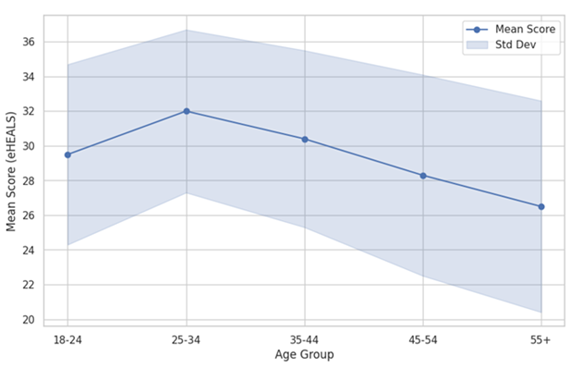
Table 2
|
Table 2 E Health Literacy Scores |
||
|
Participant Group |
Mean Score (eHEALS) |
Standard Deviation |
|
Age Group |
||
|
18-24 |
29.5 |
5.2 |
|
25-34 |
32.0 |
4.7 |
|
35-44 |
30.4 |
5.1 |
|
45-54 |
28.3 |
5.8 |
|
55+ |
26.5 |
6.1 |
|
Education Level |
||
|
High School |
24.8 |
6.3 |
|
Undergraduate |
30.1 |
5.4 |
|
Graduate/Professional |
34.2 |
4.2 |
The studied differences between evaluating and utilizing health information online between varying age groups show digital literacy forms an intricate connection with health-related choices. Survey results show participants in the age bracket of 25-34 achieve the highest score of 32.0 which demonstrates their most proficient online health information evaluation capacity. The combination of being more digitally sophisticated and familiar with online health content alongside active technological engagement creates the highest competency mark among participants. People in the 18–24-year bracket and 35–44-year bracket rate digital health content assessment reasonably well despite demonstrating individual distinctions in evaluation capabilities. The trend reveals that ongoing health information source involvement along with experience play a crucial role in developing e-health literacy abilities.
The score results exhibited a sequential decrease with advancing participant age across four age categories from 30.4 in the 35-44 group down to 26.5 in the 55+ group. Data points show older adults face digital platform complexities together with poor medical information judgment skills as follow traditional sources provided by healthcare providers. The standard deviation between digital skill proficiency across groups demonstrates sizeable differences because elderly adults display different ability levels in their digital skills. The wide diversity in interpretation abilities of online health resources creates challenges for accurate understanding which leads to higher risks of misinformation and suboptimal health decision making.
The level of education determined equally vital proficiency levels since better-educated individuals show stronger abilities for digital health content evaluation. People with graduate or professional degrees achieved an average score of 34.2 which demonstrates above-average skills related to evaluating trustworthy information from dubious content. The sense of digital health competence among students who attended undergraduate programs rests at 30.1 which reflects how higher education teaches analytical abilities valuable for digital health consumption. High school graduates show the minimal knowledge of identifying reliable healthcare information with their average score at 24.8 indicating possible barriers exist for this group to reach credible healthcare material.
The research highlights a particular requirement for specialized intervention programs which enhance digital health literacy specifically among older adults and people who come from lower educational groups. Educational programs adapted to individual needs along with simplified digital health content and intuitive platforms improve digital health competency for all users. Supported by efforts to bring digitally savvy youth who help senior citizens with technical skills we can enhance trust and confidence in digital healthcare resources. Equitable access to precise medical information and equal individual empowerment for decision-making required the elimination of these identified disparities.
Figure 4

Table 3
|
Table 3 Trust in Health Information Sources |
||
|
Source Type |
Mean Trust Score (1-5) |
Standard Deviation |
|
Health Websites |
4.3 |
0.8 |
|
Social Media |
2.9 |
1.1 |
|
Peer-Reviewed Journals |
4.8 |
0.5 |
|
Blogs/Forums |
3.1 |
1.2 |
|
Health Apps |
3.9 |
0.9 |
|
Doctors/Healthcare Professionals |
4.9 |
0.3 |
Results show that trust levels toward different health information sources vary substantially yet showcase substantial differences in perceived credibility ratings. Healthcare professionals and doctors emerged as the most trusted information source because study subjects gave them a mean trust score of 4.9. Medical professionals play critical roles according to studies for delivering evidence-based accurate healthcare information to patients. The rigorous proof of concepts in peer-reviewed journals leads to their high scientific credibility rating (4.8). These expert-driven channels exhibit minimal trust variability across populations thus supporting their position as the primary source for trustworthy health information.
Users display the lowest trust level (2.9) toward social media platforms yet show wide-ranging perception variability measured by a standard deviation of 1.1. The unregulated nature of social media produces unreliable health content that coexists alongside legitimate knowledge bases throughout these platforms. Eighty percent of participants expressed skepticism due to emerging misinformation alongside influencer content and platform algorithm processes. Users exhibit lower trust in blogs and forums because of their subjective material combined with the absence of professional oversight (3.1). Qualitative peer support channels deliver important experiential knowledge but their reliability remains under scrutiny because users depend heavily on subjective perspectives rather than scientific truth. The data backs previous research which showed how misinformation poses dangers due to people's inability to judge expert-level sources.
The growing significance of health websites combined with mobile health applications leads to moderate scores of 4.3 and 3.9 respectively. The credibility of websites with reputable content gets challenged by authorship inconsistencies and sponsorship elements and content update processes. Users struggle to determine the trustworthiness of health apps probably because these tools come with diverse regulatory measures and vary in evidence-based operational capabilities. The inclusion of digital health tools in healthcare decision processes shows user skepticism about their effectiveness because users require better clarity and quality assessments together with better digitized health training to make them more useful. The research backs prior studies which show digital health trust processes integrate with usage patterns by proving that reliable accredited medical content proves essential.
Medicine data demonstrates trust plays a fundamental part in driving patient choices for health information research. Users demonstrate a clear preference for expert-validated content over all kinds of sources even when digital information was increasingly available to them. Digital platforms show increasing evidence of moderate trust outcomes which signals a new approach to online health information management. The development of novel media requires essential e-health literacy improvement efforts alongside solutions against misinformation and enhanced regulatory control programs which bridge the trust gap between online content and medical professionals. Health communication delivery strategies need personalization because the variable trust scores demonstrate the need for content that meets users' expectations regarding accuracy and credibility. Health strategies must enable strategic communication tactics which merge accessible information delivery with reliable resources to support people making decisions about their health in our technology-dependent society.
Figure 5
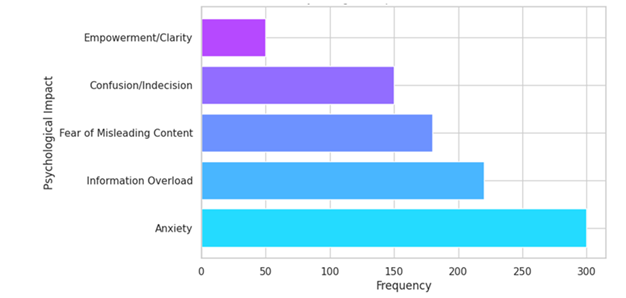
Table 4
|
Table 4 Psychological Impacts of Misinformation |
||
|
Psychological Impact |
Frequency |
Percentage |
|
Anxiety |
300 |
60% |
|
Information Overload |
220 |
44% |
|
Fear of Misleading Content |
180 |
36% |
|
Confusion/Indecision |
150 |
30% |
|
Empowerment/Clarity |
50 |
10% |
The obtained data shows anxiety stands as the dominant psychological response that individuals experience when accessing health information that contains false information. The interaction between contradictory health information and the public generates anxiety levels at 300 frequency points which affect 60% or 774 individuals who responded to the survey. This indicates exposure to false health content fundamentally affects people's mental health. The current research pattern matches earlier studies that show confusion about various health matters brings distress especially when people find it hard to identify real information from false information. Anxiety occurs frequently among study participants causing concern about misinformation which creates unnecessary health-based fears resulting in inappropriate health decision-making patterns.
The study indicated information overload became a common psychological response according to 44% of participants or 220 distinct occurrences. Health-related content that fills digital spaces and challenges accuracy verification drives exhaustion of mental processing abilities and shuts down decision-making. Too much divergent content and abundant information about health often causes people to lose ability to make correct health-related decisions. Digital code works to boost engagement metrics over accuracy so users experience massive differences in perspectives from one website to another in contemporary times. The inability to sort through and analyze crucial health information causes individuals to delay necessary medical decisions resulting in adverse public health results.
The concern about misleading health content recorded by 36% of survey participants amounts to 180 instances underscoring rising online health information skepticism. Having encountered numerous debunked claims and unverified medical advice and fraudulent health solutions keeps generating this feeling of fear. Into users encounter false health information become skeptical of every healthcare fact even from trusted sources. Trust deterioration proved problematic because it led people to lose interest in real healthcare services alongside evidence-based research information. Research reveals that digital platforms offer extensive health knowledge access but inability to recognize genuine information from deception leads users to be both cautious and reluctant about health content.
150 respondents representing 30% of participants encountered confusion and indecision during their experience with misinformation (150 occurrences). People face difficulties deciding what medical approach to follow because different health stories oppose each other. The resulting overall sense of confusion delayed medical care yet many peopleincorrectly diagnosed themselves or continued to depend on layperson advice. A positive psychological impact from health information consumption due to empowerment and outcome clarity emerges only in 10% (50 occurrences) of respondents. The existing health information systems fail to sufficiently enable people to make informed choices about their health. The current situation promotes uncertainty and stress because citizens lack essential digital health literacy and fact-checking tools and accessible expert guidance in online health discussions.
Figure 6
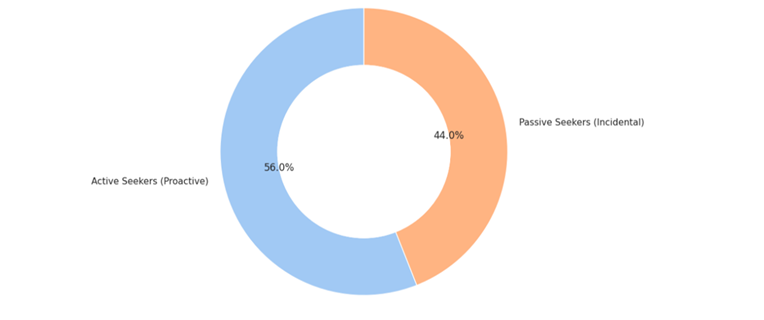
Table 5
|
Table 5 Health Information-Seeking Behavior Patterns |
||
|
Behavioral Type |
Frequency |
Percentage |
|
Active Seekers (Proactive) |
280 |
56% |
|
Passive Seekers (Incidental) |
220 |
44% |
|
Reasons for Seeking |
|
|
|
To learn about health conditions |
200 |
40% |
|
To find treatments/medications |
180 |
36% |
|
For wellness and lifestyle tips |
150 |
30% |
|
Preferred Source |
|
|
|
Websites/Apps |
250 |
50% |
|
Social Media |
150 |
30% |
|
Forums/Blogs |
100 |
20% |
The collected research data revealed two main methodological patterns regarding digital health information access which differentiate proactive from incidental consumers. Active content seekers make up 56% of the population who consciouly pursue health information that helps them understand medical conditions and treatments as well as wellness techniques. Many health consumers depend on structured information retrieval because value verified and credible and detailed health information about their concerns. The population split shows that passive seekers compose 44 percent of those who discover health-related information unexpectedly through social media activities and general browsing. This demographic accidentally encounters medical content yet absorbs and processes it without specific knowledge goals.
The analysis of individual health information-seeking purposes reveals why behavioral variations exist among users. Health content engagement started with needs for understanding medical conditions at (40%) while treatment and medication research came in second at (36%). Users demonstrate a diagnostic and functional perspective when accessing health content because purposefully search for more awareness and decision-making capabilities about themselves or their families' health. Wellness content represents a substantial 30% of users' engagement interests since this information frequently appears in social media feeds and common web discussions.
User choices in health information procurement indicate their behavior patterns when using digital solutions. Websites along with mobile applications represent the most selected information source because each method accounts for half of all reported use. Users prefer content organized in a structured fashion combined with evidence-based information mostly obtained from trusted medical websites or government platforms and research databases. Thirty percent of health information seekers access social media platforms which could result from platforms being easy to use along with their real-time dynamic while offering simple access points. Forum communities and blogging platforms together with 20% of healthcare information seekers show that user-driven empirical knowledge plays an essential role in healthcare decision making.
Digital health information-seeking behavior emerges from these discovered patterns as a multilayered phenomenon. Health management awareness continues grow because active seekers demonstrate increased interest in medical knowledge acquisition to make informed decisions about their healthcare. The large number of passive seekers demonstrates that unplanned exposure to health content continues to strongly influence both understanding and behavior. The understanding of these behavioral patterns provided essential knowledge for creating interventions which improve the accessibility and credibility of online health content to serve proactive and incidental seekers with reliable information.
5. CONCLUSION
The study results demonstrate the growing importance of new media as health information primary source thereby modifying the ways people interact with digital content. Active medical seekers adopt structured methods to obtain their medical understanding compared to passive seekers who find information by chance. Numerous studies show individuals seek digital health content primarily to learn about diseases and discover therapeutic answers which proves the value of genuine medical resources available online. Sources analyzed show online websites and mobile apps retain their status as most trusted options while social media and forums generate uncertainties because of potential misinformation risks. The results from Regression analysis demonstrate how users trust medical information based on credibility since unverified content generates substantial influence on health decisions. The research demonstrates an urgent need for enhanced digital health literacy training combined with government-approved material delivery for effective medical information dissemination. Risks resulting from misinformation alongside untrusted health information sources require better regulatory steps and improved content monitoring alongside user education programs. Healthcare professionals should team up with digital platforms to deliver evidence-based health communication which reduces the circulation of false medical information.
CONFLICT OF INTERESTS
None.
ACKNOWLEDGMENTS
None.
REFERENCES
Abdulai, A. F., Tiffere, A. H., Adam, F., and Kabanunye, M. M. (2021). COVID-19 Information-Related Digital Literacy Among Online Health Consumers in a Low-Income Country. International Journal of Medical Informatics, 145, 104322. https://doi.org/10.1016/j.ijmedinf.2020.104322
Aceto, G., Persico, V., and Pescapé, A. (2018). The Role of Information and Communication Technologies in Healthcare: Taxonomies, Perspectives, and Challenges. Journal of Network and Computer Applications, 107, 125–154. https://doi.org/10.1016/j.jnca.2018.02.008
Aker, H., and Aiken, M. (Eds.). (2021). Handbook of Research on Cyberchondria, Health Literacy, and The Role of Media in Society’s Perception of Medical Information. IGI Global. https://doi.org/10.4018/978-1-7998-8630-3
Allen Catellier, J. R., and Yang, Z. J. (2012). Trust and Affect: How do They Impact Risk Information Seeking in a Health Context? Journal of Risk Research, 15(8), 897–911. https://doi.org/10.1080/13669877.2012.686048
Amadu, M. F. (2024). Digital Divide or Digital Opportunities: Interrogating Online News Consumption Pattern of Ghanaian Tertiary Students. Cogent Social Sciences, 10(1), 2424987. https://doi.org/10.1080/23311886.2024.2424987
Appiah, D., and Majeed, J. D. (2024). We May Still Not be Ready for Newer Healthcare Technologies: An Ethical Perspective of Privacy Concerns. SSRN. https://doi.org/10.2139/ssrn.4880035
Asgher, S., Saleem, N., Kamal, A., and Ahmad, H. (2020). Knowledge Gap and Digital Media: Effect of Socio-Demographics and Ehealth Literacy on Perceived Trust in Online Health Information Among Female Users. Journal of Media and Communication, 1(2). https://doi.org/10.46745/ilma.jmc.2020.01.02.08
Başdeğirmen, A. (2023). Unraveling Cyberchondria Amidst the COVID-19 Era: A Comparative Literature Review. European Journal of Digital Economy Research, 4(2), 37–47.
Chen, Y., Wu, J., Ma, J., Zhu, H., Li, W., and Gan, Y. (2022). The Mediating Effect of Media Usage on the Relationship Between Anxiety/Fear and Physician-Patient Trust During the COVID-19 Pandemic. Psychology and Health, 37(7), 847–866. https://doi.org/10.1080/08870446.2021.1900573
Choukou, M. A., Sanchez-Ramirez, D. C., Pol, M., Uddin, M., Monnin, C., and Syed-Abdul, S. (2022). COVID-19 Infodemic and Digital Health Literacy in Vulnerable Populations: A Scoping Review. Digital Health, 8, 20552076221076927. https://doi.org/10.1177/20552076221076927
Farsi, D. (2021). Social Media and Health Care, Part I: Literature Review of Social Media use by Health Care Providers. Journal of Medical Internet Research, 23(4), e23205. https://doi.org/10.2196/23205
Ghani, N. A., Hamid, S., Hashem, I. A. T., and Ahmed, E. (2019). Social Media Big Data Analytics: A Survey. Computers in Human Behavior, 101, 417–428. https://doi.org/10.1016/j.chb.2018.08.039
Goodyear, V. A., Armour, K. M., and Wood, H. (2019). Young People and Their Engagement with Health-Related Social Media: New Perspectives. Sport, Education and Society. https://doi.org/10.1080/13573322.2017.1423464
Gulec, H., Kvardova, N., and Smahel, D. (2022). Adolescents’ Disease- and Fitness-Related Online Health Information Seeking Behaviors: The Roles of Perceived Trust in Online Health Information, Ehealth Literacy, and Parental Factors. Computers in Human Behavior, 134, 107318. https://doi.org/10.1016/j.chb.2022.107318
Jermutus, E., Kneale, D., Thomas, J., and Michie, S. (2022). Influences on User Trust in Healthcare Artificial Intelligence: A Systematic Review. Wellcome Open Research, 7, 65. https://doi.org/10.12688/wellcomeopenres.17550.1
Jones, S. L., and Kelly, R. (2018). Dealing With Information Overload in Multifaceted Personal Informatics Systems. Human-Computer Interaction, 33(1), 1–48. https://doi.org/10.1080/07370024.2017.1302334
Karamifar, F., Tabibian, S., and Rezaei, S. A. (2023). Legal and Ethical Challenges in Digital Public Health Systems: Data Privacy, Consent, and Security. Legal Studies in Digital Age, 2(4), 13–25.
Keshavarz, H. (2021). Evaluating Credibility of Social Media Information: Current Challenges, Research Directions, and Practical Criteria. Information Discovery and Delivery, 49(4), 269–279. https://doi.org/10.1108/IDD-03-2020-0033
Lakshmikantha, H. T. (2024). Emotional and Cognitive Experiences of Undergraduate Dental Students During Initial Orthodontic Prescriptions: A Mixed-Methods Study. https://doi.org/10.21203/rs.3.rs-5183465/v1
Link, E., Baumann, E., and Klimmt, C. (2024). Understanding the Importance of Trust in Patients’ Coping with Uncertainty Via Health Information-Seeking Behaviors. Communications, 49(1), 74–98. https://doi.org/10.1515/commun-2021-0117
Link, E., Rosset, M., and Freytag, A. (2022). Patterns of Online Information Seeking and Avoidance About SARS-CoV-2 and COVID-19. European Journal of Health Communication, 3(1), 53–75. https://doi.org/10.47368/ejhc.2022.103
Mano, R. S. (2014). Social Media and Online Health Services: A Health Empowerment Perspective to Online Health Information. Computers in Human Behavior, 39, 404–412. https://doi.org/10.1016/j.chb.2014.07.032
McDowall, C. (2022). Effective Strategies to Reduce Information Overload in the Workplace (Doctoral Dissertation, Walden University).
Melhem, S. J., Nabhani-Gebara, S., and Kayyali, R. (2023). Digital Trends, Digital Literacy, and E-Health Engagement Predictors of Breast and Colorectal Cancer Survivors: A Population-Based Cross-Sectional Survey. International Journal of Environmental Research and Public Health, 20(2), 1472. https://doi.org/10.3390/ijerph20021472
Mittelstadt, B. (2017). Ethics of the Health-Related Internet of Things: A Narrative Review. Ethics and Information Technology, 19(3), 157–175. https://doi.org/10.1007/s10676-017-9426-4
Mohammadi, V., Rahmani, A. M., Darwesh, A. M., and Sahafi, A. (2019). Trust-Based Recommendation Systems in Internet of Things: A Systematic Literature Review. Human-Centric Computing and Information Sciences, 9, 1–61. https://doi.org/10.1186/s13673-019-0183-8
Mouketou, C. (2023). Exploring the Relationship Between Electronic Health Literacy and COVID-19 Preventive Health Beliefs on Vaccination Intent (Doctoral Dissertation, Morgan State University).
Okoro, Y. O., Ayo-Farai, O., Maduka, C. P., Okongwu, C. C., and Sodamade, O. T. (2024). A Review of Health Misinformation on Digital Platforms: Challenges and Countermeasures. International Journal of Applied Research in Social Sciences, 6(1), 23–36. https://doi.org/10.51594/ijarss.v6i1.689
Palumbo, R., Nicola, C., and Adinolfi, P. (2022). Addressing Health Literacy in the Digital Domain: Insights from a Literature Review. Kybernetes, 51(13), 82–97. https://doi.org/10.1108/K-07-2021-0547
Peng, R. X. (2022). How online Searches Fuel Health Anxiety: Investigating the Link Between Health-Related Searches, Health Anxiety, and Future Intention. Computers in Human Behavior, 136, 107384. https://doi.org/10.1016/j.chb.2022.107384
Rutty, D. P. (2023). Investigating the Implications of Online Health Information Seeking and Prevalence of Cyberchondria Amongst Patients Visiting Emergency Departments (Doctoral Dissertation, University of Ottawa).
Sbaffi, L., Walton, J., Blenkinsopp, J., and Walton, G. (2020). Information Overload in Emergency Medicine Physicians: A Multisite Case Study Exploring the Causes, Impact, and Solutions in Four North England National Health Service trusts. Journal of Medical Internet Research, 22(7), e19126. https://doi.org/10.2196/19126
Shu, K., Bhattacharjee, A., Alatawi, F., Nazer, T. H., Ding, K., Karami, M., and Liu, H. (2020). Combating Disinformation in a Social Media Age. Wiley Interdisciplinary Reviews: Data Mining and Knowledge Discovery, 10(6), e1385. https://doi.org/10.1002/widm.1385
Soroya, S. H., Rehman, A. U., and Faiola, A. (2024). Exploring the Impact of Internet and Media Sources Exposure on Self-Care Behavior: Mediating the Role of Health Anxiety, Literacy, and Information-Seeking Behavior. Kybernetes, 53(11), 4797–4817. https://doi.org/10.1108/K-06-2023-1003
Thapliyal, K., Thapliyal, M., and Thapliyal, D. (2024). Social Media and Health Communication: A Review of Advantages, Challenges, and Best Practices. In Emerging Technologies for Health Literacy and Medical Practice (364–384). IGI Global. https://doi.org/10.4018/979-8-3693-1214-8.ch017
Wang, C. H., and Wu, C. L. (2022). Bridging the Digital Divide: The Smart TV as a Platform for Digital Literacy Among the Elderly. Behaviour and Information Technology, 41(12), 2546–2559. https://doi.org/10.1080/0144929X.2021.1934732
Wongmahesak, K., Singh, B., and Kaunert, C. (2025). The Complex Interplay of Generational Differences, Digital Literacy, and Cybercrime Fear. Asian Crime and Society Review, 12(1), 3–3.
Zhang, D., Shi, Z., Hu, H., and Han, G. (2021). Classification of the Use of Online Health Information Channels and Variation in Motivations for Channel Selection: Cross-Sectional Survey. Journal of Medical Internet Research, 23(3), e24945. https://doi.org/10.2196/24945
Zhang, X., Yan, X., Cao, X., Sun, Y., Chen, H., and She, J. (2018). The Role of Perceived E-Health Literacy in Users’ Continuance Intention to Use Mobile Healthcare Applications: An Exploratory Empirical Study in China. Information Technology for Development, 24(2), 198–223. https://doi.org/10.1080/02681102.2017.1283286
Zhang, X., and Ghorbani, A. A. (2020). An Overview of Online Fake News: Characterization, Detection, and Discussion. Information Processing and Management, 57(2), 102025. https://doi.org/10.1016/j.ipm.2019.03.004
|
|
 This work is licensed under a: Creative Commons Attribution 4.0 International License
© ShodhKosh 2026. All Rights Reserved.