ShodhKosh: Journal of Visual and Performing ArtsISSN (Online): 2582-7472
|
|
Navigating Law and Leadership in India’s Visual Arts Industry: Governance, Intellectual Property and Institutional Strategy
Dr. Anuj Kumar Sinha 1
 ,
Dr. Tridisha Bayan 2
,
Dr. Tridisha Bayan 2 , Pinki Mehta 3
 ,
Dr. Jaspreet Kaur 4
,
Dr. Jaspreet Kaur 4 ,
Ruchika Kulshrestha 5
,
Ruchika Kulshrestha 5 , Dr. Kaveri Khound 6, Subin Thomas 7
 ,
Dr. Minakshi Middha 8
,
Dr. Minakshi Middha 8
1 Assistant Professor, Amity Law School,
Amity University Jharkhand, India
2 Assistant Professor, Commerce and
Management, Assam Down Town University, India
3 Assistant Professor, Amity Law School, Amity University Jharkhand,
India
4 Associate Professor, University School of Business, Chandigarh
University, Mohali-140413, Punjab, India
5 Assistant Professor, Institute of Business Management, GLA
University, Mathura, India
6 Assistant Professor, Department of Economics, K.R. Mangalam
University, Gurugram – 122103, Haryana, India
7 Research Scholar, Alliance University, Bengaluru, India
8 Director, The Research Beacon, Mohali, Punjab, India
|
|
|
ABSTRACT |
|
|
Digital
transformation reconfigures the governance models of the Indian industry of
visual arts between the regulation of intellectual property, institutional
leadership, as well as blockchain-integrated property ownership models.
Splintered enforcement, incomplete provenance recording, and participation in
resale were historically limiting payments of artists and transparency in
institutions. A multidimensional system of assessment of governance was
created that would measure the socio-economic risk, compliance preparedness,
provenance assurance, and sustainability exposure within the framework of
museums, galleries, and digital space. Quantitative aggregation on the basis
of scenarios of normalized indicators of governance led to the creation of
composite governance scores of about 58 percent in museums, 58 percent in
galleries, and 78 percent in digital platforms, reflecting a fully completed
measurable efficiency in an automated royalty realization and programmable
compliance platforms. Variability analysis revealed that the more digital
governance is conducted, the more volatile the performance are likely to turn
out to be, the uncertainty of the regulation, and the systemic risk involved.
Findings analysis enables conclusions to be identified on the basis of an
integrated governance paradigm to be discovered a synthesis via legal
harmonization, establishment of institutional capacity, and sustainable
digital compliance infrastructure. This would make the income of artists more
stable in the long-term, enhance the transparency of provenance, and enhance
cultural market sustainability and ethical stewardship. The manuscript
contributes to the interdisciplinary forms of governance model which can be
co-related to law, leadership and technology to design digitally transforming
creative economies through evidence based cultural policy. |
|||
|
Received 17 September 2025 Accepted 19 December
2025 Published 17 February 2026 Corresponding Author Dr. Anuj
Kumar Sinha, anuj17apr@gmail.com DOI 10.29121/shodhkosh.v7.i1s.2026.7190 Funding: This research
received no specific grant from any funding agency in the public, commercial,
or not-for-profit sectors. Copyright: © 2026 The
Author(s). This work is licensed under a Creative Commons
Attribution 4.0 International License. With the
license CC-BY, authors retain the copyright, allowing anyone to download,
reuse, re-print, modify, distribute, and/or copy their contribution. The work
must be properly attributed to its author.
|
|||
|
Keywords: Visual Arts Governance, Intellectual Property,
Digital Provenance, Smart Contracts, NFTs, Cultural Policy, Institutional
Leadership, Creative Economy |
|||



1. INTRODUCTION
The rapid market growth, digital proliferation, the transformation of intellectual property governance systems along with the transformation of institutional governance systems present a complex change to the visual arts industry in India. Traditional structures of art eco systems that were previously grounded on the state academies, public museums and patronized galleries, now coexists with digitally mediated systems of art markets, non-profit cultural foundations, and blockchain-based systems of ownership. This form of structural plurality has made spaces of artistic production and circulation open as well as generating an ongoing ambiguity of control, biased implementation of intellectual property and decentered responsibility of leadership of cultural bodies Farooq et al. (2023). All these strains are connected to the fact that it is imperative to have an analytical lens with a combination of the concepts of law governance, an institutional strategy, and sustainability regarding the creative-economy in the Indian context. Visual arts industry is also a controversial aspect as far as legal protection is a base. Economic and reputational security of artists is determined by the copyright law, the moral rights doctrine, discussions on resale royalty, and the licensing mechanisms, yet, they are still subject to imbalance in enforcement, lack of awareness and complexity in jurisdiction, which presently weakly affect their practicability Paic (2021). The online reproducing technologies and the web-based distribution systems also contribute to the challenge of assigning authorship and owner validation and revenue capture particularly in situations where informal flow and derivatives innovativeness have been included in the culture Palandri (2020). As a result, the management of intellectual property within the field of visual arts in India cannot be addressed as a statutory approach but should be viewed as a social-institutional action that is influenced by the execution of policies, institutional leadership, and mediation of technology.
Figure 1

Figure 1 Integrated Law–Leadership–Technology Governance Framework for India
Leadership strategy and institutional governance forms the other half baked layer of analysis that is equally critical. Museums, cultural trusts, academic institutions, auction houses and independent galleries fit into heterogeneous regime models with high (or high) transparency, financial independence and policy fit as shown in Figure 1. Curatorial path, distribution of funds, representation of different artists, and adherence to legal and ethical guidelines are examples of areas that leadership choices can impact on and, as a result, curatorial choices affect cultural legitimacy and solvency Massi and Turrini (2020). New digital art markets like non-fungible tokens and authentication based on blockchain are not an exception: the leadership has to balance a threat of technological uncertainty, cross-border regulation and platform governance. The congruence of the law and strategic management then forms a final determinant of resilience of the Indian visual arts system. The study of cultural governance in India has traditionally paid attention either to heritage conservation, populist politics or economies of the art market as above grounds singly Matenaer (2023). The current limited studies of integrative research work on the interaction of legal regimes, institutional leadership and digital transformation are aimed at signifying their structural feasibility of the domain of visual arts. This kind of disparity constrains the prospects of evidence-based policymaking and imposes a barrier on the development of governance models that match the artistic freedom of expression, market innovation and regulatory accountability. A system of analytical services which takes interdependences between the protection of intellectual property and quality of institutional governance, exposure to socio-economic risks and output of creative-economy is therefore required Mauriès (2020).
The current research contributes to a framework of this kind by merging legal analysis, the theory of governance, and the institutional strategy into a single conceptual framework, specific to the Indian visual arts business. Governance effectiveness, awareness of the intellectual property, the dynamics of the dispute and indicators of the institutional performance are also evaluated through empirical and analytical evaluation to describe the interaction between the representative cultural actors. The simultaneously created governance-leadership architecture is intended to advise regulatory change, improve institutional responsibility and sustainability of artistic production and circulation. This interconnected approach helps to introduce the study to the recent interdisciplinary research on this field, on the border between law, cultural policy, and strategic management and provide concrete information to policymakers, institutional leaders, and creative practitioners who have to work in a highly dynamic environment of visual arts in India Humayun et al. (2025).
2. Evolution of India’s Visual Arts Governance Landscape
The governance structure of the visual arts in India has been the result of a stratified interplay of the legal inheritance of the colonial era, the post-independence construction of the cultural institutions in India, the processes of liberalization of the economy, and the modern digitalization. The initial control force came into play at the late-colonial times when museum administration, archaeological protection laws, and even the academic art schools formed formalized custodianship of the cultural production Kowalski (2021). The control of this period shifted towards preservation and official imperial record keeping instead of artist control and market evolution as shown in Figure 2. An Indian state took the nation-building approach to the culture and established common institutions including national academies, museums and grant-based cultural institutions that aimed to democratize artistic participation as well as preserve the heritage. The focus of policy orientation was put on public investment, centralized governance, and ceremonial culture identity, but the tools of intellectual property as well as market control by the privates were relatively ineffective. The 1990s economic liberalization was a structural shift to a market-based cultural activity.
Figure 2
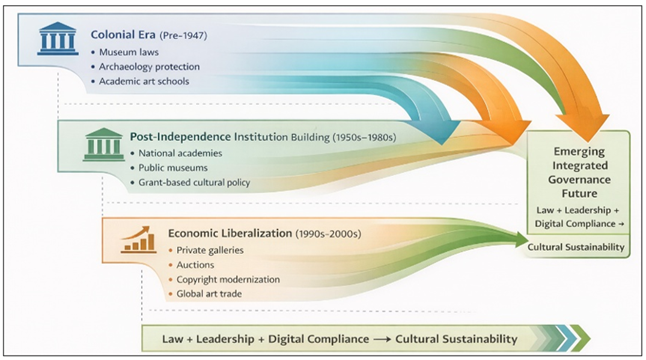
Figure 2 Historical
Evolution of Visual Arts Governance in India
In its present form, the modern day governance can be described as a hybrid system with elements of state custodianship, market dynamism of the privacy and decentralization of technology. The current disaggregation of legal enforcement, accountability of institutional leadership and regulation of the digital emphasize the fact that an integrated form of governance is required that can support the cultural sustainability with economic resilience and coherence on policy Kowalski (2022). Knowledge of this historical-policy arcade furnishes the analytic basis of gauging present institutional approach and forthcoming revamping of the Indian visual art ecology.
3. Intellectual Property Architecture in the Visual Arts Domain: India–Global Comparison
The commercial ecosystem was enlarged by involving the private galleries, auction houses, and international art fairs, and they brought up new governance issues concerning the transparency of valuation, contacting the artists, taxation, and sales across the borders. In the same period, there was a period of modernization of copyright and growing international interaction, heightened awareness on moral rights and control of reproduction although capability to enforce them remained below the pace of market increment Huang et al. (2024). The rate at which the twenty-first century becomes digitalized was the shift in the approaches to artistic creation and distribution to the online galleries, social media distribution, and commercial activity of platforms. Blockchain authentication and non-fungible tokens and smart-contract licensing both sabotaged established jurisdictional boundaries and compelled institutions and policymakers to reconsider ownership checks and resale payments and policy-related digital compliance. The Intellectual property dilemma in the visual arts sector is handled at the junction of the law protection, the cultural practice and the market economy. India has a copyright regime grounded on the Copyright Act of 1957 and its subsequent amendments and that recognizes artistic works, moral rights of attribution and integrity and certain more restricted licensing provisions to assist the creators in combating the unauthorized copying or distortion of works. Although legal, the outcomes of enforcement are unquestionable due to the absence of institutional knowledge, slowness of the procedures and the theatrics of informal circulation, implemented in both physical and internet marketplaces. When reclaiming resale entanglement, after utilizing derivatives, and conducting reasonable contractual transactions with the gallery, collectors and online communities, the visual artists usually struggle. It is this structural imbalance which highlights the distinction between the legal rights on paper and the practical enforceability of creative practitioners which develops to this day economic vulnerability of creative practitioners Humphry and Chesher (2021).
Figure 3

Figure 3 Law–Leadership–Technology Framework for Hybrid Art Governance
The comparison of the intellectual property architecture with the international jurisdictions reveals the convergence and dissent of the intellectual property architecture. European Union regimes concentrate on royalty rights in the resale of artists’ works (droit de suite), uniformity across the borders, and great safeguarding of the moral rights in civil law systems Ithurbide et al. (2023). These will maximize long term artist compensation and improve the cultural authorship integrity as indicated in Figure 3. The approach followed in the United States, instead, has been more focused on market-based copyright licensing, flexibility of the fair use, and freedom of contract, and descends towards digital distribution and provides relatively fewer resale claims. The India structure occupies a middle ground- institutionally constrained in capacity to institute and also in the capability to sit on the moral rights traditions, yet normatively oriented jagodzinski (2024). The absence of the enlightenment of artists and collectors, the discontinuity of the dispute-resolution channels, and the absence of documentation procedures only strengthen the invisibility of transactions in local art markets.
Table 1
|
Table 1 Comparative IP Protection Architecture for Visual Arts (India vs. EU vs. US) |
|||
|
Dimension |
India |
European Union (EU) |
United States (US) |
|
Core legal basis for
visual art copyright |
Copyright Act, 1957
(and amendments); “artistic works” protected |
National copyright
laws harmonized via EU directives; strong author-centric tradition in many
member states |
Copyright Act (Title
17); strong federal framework; market-driven licensing ecosystem |
|
Moral rights
(attribution, integrity) |
Recognized
(attribution + integrity); practical enforcement varies by awareness and
litigation cost |
Typically strong and
culturally entrenched (especially civil-law systems); more consistent
recognition across jurisdictions |
Limited moral rights;
narrower scope mainly via VARA for certain visual works (qualifying works and
contexts) |
|
Resale royalty for
artists (droit de suite) |
Limited/uncertain in
practice; not comparable to EU-wide enforceable resale right in most
transactions |
Established resale
right across EU (artist participation in secondary-market value capture) |
No general federal
resale royalty; largely absent (some historical state-level attempts) |
Digital transformation also comes with the added complexity in various jurisdictions. Non-fungible tokens, blockchain authentication and licensing smart-contracts are being considered to enable automatic payment of royalties and provenance, but the regulatory challenges of jurisdiction and taxation, and even the liability of the secondary-market at large have not been defined internationally Jain and Roy (2022). The discussion on the European policy has been linked to the regulation of digital art and data protection and regulation of cultural heritage on the other hand U.S. regulatory discussions have been linked to securities category and responsibility of the platforms. The Indian regulatory system is still immature, and the policy of crypto-assets and the deepening of the experiment with the digital cultural trade has reservations. Consequently, the present-day developments of securing intellectual property in the visual arts industry in India can be comprehended in no other way but that which integrates the international standards with the cultural realities on the ground besides the legislative doctrine Musale (2025). Then an intellectual property architecture of India should be consistent at various levels: a stronger enforcement infrastructure should be built, a system of clear resale participation should exist, a standard regime of digital provenance should be developed, artists should be given the tools and means they need to maneuver in the contractual and technological space. The consistency with the best practice of word, it is possible to keep at the same time the cultural specificity, and the sustainability of the economies of India can be higher, and also the frequency of the disputes can be less, and the visual arts industry of India will be put into the context of the more interrelated global creative economy. It is this kind of combined methodology that would establish the legal foundation of what is to be subsequently analyzed in the subject of institutional leadership/governance strategy within the broader cultural ecosystem.
4. Institutional Leadership and Cultural Governance Models
The Indian visual arts system possesses a fragmented institutional leadership in a setting of publicly-owned museums, privately-owned galleries, cultural foundations, auction houses and digitally-mediated spaces. Each of the institutional forms has a variety of governance logics, which are regulated by a funding structure, the regulatory demands, curatorial sovereignty and management ability of intellectual property Joshi et al. (2023). Traditionally, the central interests of the state-funded museums and custodians of the culture revolve around conservation, heritage preservation and educational provision, which are run in accordance with the bureaucratic responsibility and the policy-driven guidelines. These institutions center their regulations on provenance records, archival durability and availability to the community but inflexible procedures and few commercialization strategies are likely to reduce adaptive intellectual property applications. Consequently, although the recognition and attribution of moral rights practices are easily admitted on a formal level, the revenue-sharing innovation and digital licensing approaches are not as developed.
Figure 4

Figure 4 Digital
Provenance and Smart-Contract Workflow in Visual Arts
The market-oriented governance practices of the private galleries and auction institutions are marked with the legitimacy of the institution offered through the negotiation of the contract and representation of the artists as well as the existence of the transparency of the transaction. The leaders of such environments directly influence the pricing systems, reselling, copyrighting and international circulation of arts. When galleries are concerned with international collectors, it is more adaptable in the implementation of international intellectual property standards (resale royalty conscientiousness, authentication certification, clauses of the contract to moral rights) Jurriëns (2019). However, the absence of documentation standards and protection of artists through fragmentation of governance and disparities of market professionalization between regions create inconsistency in documentation standards and artist protection. The ongoing change of the intellectual property law into the viable institutional practice thereby heavily relies on the managerial skills, legal literacy and reputation incentive within the competitive art markets. The new third paradigm of governance that comes with the digitally native platforms is that of algorithmic mediation, decentralized ownership checks verification and automated receipt of royalty payments through smart contracting Kane (2010). The leaders in these platforms must find a balance between speed and technology and they should come as a result of changing regulatory pressure on digital assets, taxes and consumer protection as illustrated in Figure 4. The variations in intellectual property between jurisdictions are variables of operation platforms: The European resale royalty operates on embedded royalty logic; the U.S. approach to the commercial use of contracts is flexible, which will necessitate hybrid governance between the statutory recognition of copyright and blockchain-provenance assurance. Those platforms that are capable of holding these dimensions can enhance transparency, reduce the amount of disagreements, and get more platforms that artists are compensated, totally analogy institutional accountability via the existing physical intermediaries. The institutional strategy mapping of the intellectual property regimes reveals the variations in the patterns of governance Kanwal et al. (2022). Museums are tilted towards custodial legitimacy and attribution integrity, which aligns with the approaches based on moral rights, but requires the modernization of the digital reproduction regulation. Galleries tend to give more emphasis on the rule of contract and market credibility where resale and licensing structures are more defined but have more intensive documentation structures. Uncertain regulation is a way that digital platforms are searching to achieve an automated compliance and transnational scalability, via smart contracts and provenance ledgers. The proper cultural governance of India is therefore in the possession of such a leadership that could be able to harmonize such institutional strategies towards the good intellectual property enforcement and technological adaptation.
5. Digital Transformation, NFTs, and Legal Disruption in Art Markets
The digital revolution has made it evident that the organization of production, distribution, possession and appreciation of the visual art has been reorganized. Complete discovery systems, reproduction technologies of high-resolution and networked platforms have caused artists to be less dependent on galleries and auction houses, which is limited by the geographic location, thus artists can now directly interact with the world audience. It has increased the density of the availability of the markets as well as disturbed the classical system of governance founded on the physical provenance, curatorial validation and contractual enforcement founded on the jurisdiction. As artistic flow shifts to the digital structures, safeguarding of intellectual property and institutional liability is becoming more reliant on technological structures, and not always on the legal dogma. The most important technological interventions of the change are blockchain-based registries and non-fungible tokens (NFTs). Distributed ledgers provide provenance certificates of authenticity, royalty logic that can be programmed on computers, and available transaction histories that are capable of addressing historical issues with asymmetry in compensation in the secondary market and authenticity checks. This can be done by automatically decomposing resale royalties and sliding licensing agreements in addition to capturing chains of custody without centrally curated art automation in injecting the smart contract into tokenized arts. These types of mechanisms are very much compatible with both the European resale-royalty tradition and too much of the requirements of a contract-based governance that are quite prevalent in the United States.
Figure 5
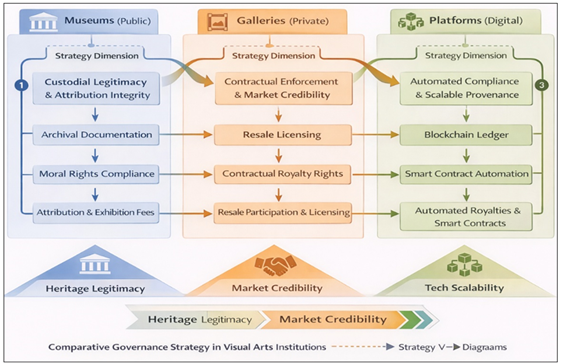
Figure 5 Strategy
Dimensions of Heritage, Market, and Digital Art Governance
The jurisdictional ambiguity regarding the classification of the tokens and tax, consumer protection and transborder enforcement complicates the institutional adoption. The European regulation discussion puts into deployment more of the cyber cultural assets in the broader plan of data-governance schemes and platform-liability schemes, which concern responsibility and protection of rights. A United States policy discourse of the securities regulation, disclosure and contractual risk distributions in privately regulated market places. Indian regulatory approach is comparatively lenient that depicts broader policy deliberations on crypto-assets and digital financial systems and permits trial applications in the culture as demonstrated in Figure 5. This kind of environment brings about an aspect of the drift in governance whereby technological competency has long since exceeded the formal harmonization of the law. Speculative trading and market volatility and platform concentration have the potential to lead to artistic valuation and creators in an unsustainable economic position. Environmental concerns of energy-intensive blockchain infrastructures are another challenge to legitimacy narrative of environmental issues. Simultaneously, the algorithmic visibility systems are able to reproduce the already existing disparities in nurturing the already identified artists or the commercialized aesthetics. Good governance must then not only be in the incarnation of the intellectual property enforcement but also a valid and ethical platform architecture, open royalty problem, a sustainable and technological infrastructure, and access to the digital cultural markets to all.
6. Case Study: Governance Dynamics
The rapid convergence of markets of material art and digitally mediated systems of ownership has created possibilities of governance most productively understood as scenario-based institutional observation. Consider an Indian artist nowadays who releases a mixed work of art in both a metropolitan private gallery and a blockchain-focused online market simultaneously. The gallery and a tokenized certificate of authenticity are done physically, and collectors and contractual sales are dealt with physically. This is a two-track circulation that can be described as a new hybrid governance wherein there is compliance of law, institutional leadership, and real time interaction technological infrastructure. It has initial stages of transaction, which demonstrate varying strengths of governance. The gallery has offered curatorial legitimacy, provenance discourse and collector confidence, which is founded on reputational capital. The assignment and a limited right of reproduction is also determined in the text of the contract, whereas the application of the resale royalty is under the voluntary adherence to the agreement or further resolution of disputes. Comparatively, the blockchain infrastructure leaves authorship metadata as a matter of record and programmatically distributes royalties in the smart contract to enable transparent engagement in the secondary market. However, the uncertainty in compliance due to a legal ambiguity in the categorization of the tokens, taxation outcome, and enforcement across the borders is a problem that creates uncertainty in compliance, which does not exist in the gallery in the conventional legal setting. The governance performance question is therefore not only answered with a single model of the given institution but rather with a combination of the custodial authority and programmable conformity. To analytically substantiate such a scenario, simulated normalized governance indicators were developed with performance scores using percentage across museums, galleries and on-line platforms.
Table 2
|
Table 2 Scenario-Based Governance Performance Dataset (Sample % Values) |
||||
|
Governance Indicator |
Museums (Public) |
Galleries (Private) |
Digital Platforms
(Blockchain) |
Scenario
Interpretation |
|
Provenance
Documentation Completeness |
92% |
78% |
88% |
Strong archival rigor
in museums; metadata-driven assurance on platforms |
|
Automated Royalty
Distribution Efficiency |
15% |
42% |
96% |
Smart contracts
dominate resale royalty realization |
|
IP Compliance
Readiness |
81% |
69% |
74% |
Formal compliance
strongest in public institutions |
|
Market Price
Volatility Exposure |
22% |
64% |
89% |
Tokenized assets show
highest speculative fluctuation |
|
Long-Term Artist
Income Stability Contribution |
63% |
71% |
87% |
Automated royalties
enhance digital income continuity |
These indicative values help to show that there is a trend of trade-off in the same governance custodial reliability dominates the museums, contractual and market credibility dominates the galleries, and automated transparency increases volatility in digital platforms. A real disruption scenario makes even a better exposer to a weakness in the system. Suppose the reselling price of the tokenized artwork with a burst in speculative trading in a world market. It works to the advantage of the artist since swift appreciation guarantees automatic royalties, yet there is doubt that it will harm reputation once the valuation becomes not pegged on curatorial or cultural quality. The apparent geographical differences in the regulation of digital assets have the ability to curtail the activity of other collectors by terminating an ownership history across more than one platform. Galleries may struggle to reconcile physical provenance registers with distributed ledger registers, and museums that revise physical provenance of ownership must provide physical, as well as, digital provenance of ownership. This aspect of governance is therefore emphasized to be at par with market stability, clarity in the law and archival coherence.
Figure 6

Figure 6 Governance Indicator Comparison
The radar map shows the difference of the governance capabilities according to the kind of institutions. Good provenance guarantee and IP regulations but low royalty automation and computer preparedness are ensured in museums. The exhibitions of galleries will have a level contractual control and middle level income stability and high volatility exposure. Online structures manage the royalty flow, electronic compliance as well as sustainability of the income but with high volatility level and sustainability risk. These tensions can be addressed by a policy-responsive institutional environment, that is, by formally inserting standardized soon online provenance data in gallery agreements, aligning smart-contract royalty agreements with domestic copyright doctrine, and introducing sustainability-conscious blockchain infrastructure as shown in Figure 6. Additional stabilization of participation would be informed by regulatory recommendations of the taxation, consumer protection, and transfer of tokenized cultural assets across borders.
Figure 7

Figure 7 Governance Score Comparison Across Institutions
The comparison of Figure 7 is a metric used to determine the differences in governance delivery. The automation of royalty and compliance by design systems is a dramatic booster of scores in the platforms, but museums have not been left out in the archival provenance and legal attribution integrity of Figure 7. Galleries fall between a contract enforcement and market sensitivity midpoint of regulation Outcome interpretation implies that automated royalty capture and transparent provenance offers long-term revenues to the artist and trustworthiness to the collector all the unresolved regulative fragmentation or speculative exuberance might destroy cultural legitimacy. Indian visual arts ecosystem sustainability is thus pegged on consistent advancement of law, direction and online infrastructure rather than technological isolation. Scenario based assessment hence provides the empirical foundation of the governance indicators and antecedents to the shift to quantitative performance analysis with the following section.
7. Conclusion and Future work
The substitution of the virtual governance of Indian ecosystem of visual arts is the entanglement of legislation transformation, framework administration and digitally mediated ownerships frameworks. The quantitative risk demonstration of the governance indicators is that the automated provenance tracking, smart-contract royalty achiever and compliance-by-design architectures can enhance measured governance performance, particularly in platform-based environment significantly. However, the degree of volatility exposure, regulations uncertainty, and sustainability externality suggest that efficiency in the use of technology would not ensure institutional resilience or culture. Custodial institutions have excelled in terms of archival integrity and the industriousness of the attribution but the market interest galleries have excelled in the field of contractual transparency and collector trusts. The long run sustainability therefore is founded on consensus between modes of governance rather than domination of one form of the institution. As it has been demonstrated, digital compliance infrastructure is the strongest component in compelling governance performance, even though provenance assurance, and contractual fairness are fundamental trusts of all types of institutions. The policy interpretation highlights the need to possess an organized recognition of tokenized cultural resources, mandatory resale engagement operations, standard digital provenance information, and sustainable blockchain implementation. When development in these fields is synchronized, then the trade-off can be found between efficiency and ethical responsibility and inclusive cultural participation. The empirical survey data of large scale, longitudinal governing measurement and cross interjurisdictional comparative research on new digital art market should be included in the current analytic framework into the future of the research. The causal relationships between the legal compliance and institutional leadership, and the creative-economy outcomes and legal compliance, can also be further elaborated through the help of developed modeling techniques, such as structural equation modeling, network governance analysis, and AI-assisted provenance verification.
CONFLICT OF INTERESTS
None.
ACKNOWLEDGMENTS
None.
REFERENCES
Farooq, S. M., Wooliscroft, B., and Ganglmair-Wooliscroft, A. (2023). Brand Systems: Integrating Branding Research Perspectives. European
Journal of Marketing, 57, 390. https://doi.org/10.1108/EJM-08-2021-0606
Huang, Y., Lin, M., and Liu, X. (2024). Digital Media and Interactive E-Learning Application in Art Teaching
Process Based on Big Data Platform. Entertainment Computing, 51. https://doi.org/10.1016/j.entcom.2024.100737
Humayun, S. M. M. M., Bhalerao,
A., and Sharma, B. (2025). Exploring Marketing
Dynamics and Sales Practices in India’s Automobile Industry: A Case Study of
Tejpal Mg Motors., ShodhPrabandhan: Journal of Management Studies. 2(1),
125–134.
https://doi.org/10.29121/ShodhPrabandhan.v2.i1.2025.52
Humphry, J., and Chesher, C. (2021).
Preparing for Smart Voice Assistants: Cultural Histories and Media Innovations.
New Media and Society, 23(7), 1971–1988. https://doi.org/10.1177/1461444820923679
Ithurbide, C., Bouquillion, P., Parthasarathi, V.,
and Sneha, P. P. (2023). Introduction: Platform
Challenges to Creative Industries in India. Contemporary South Asia, 31(2),
268–275.
https://doi.org/10.1080/09584935.2023.2203904
Jain, T., and Roy, S. T. (2022). Mapping the Agency of Trash: A New Materialist Re-Reading of
Contemporary Indian Art. Third Text, 36(5), 429–454. https://doi.org/10.1080/09528822.2022.2127550
Jagodzinski, J. (2024). The Significance of
Art Education for the Post-Anthropocene: Non-philosophy in a Newer Key.
International Journal of Art and Design Education, 43(3), 478–492. https://doi.org/10.1111/jade.12518
Joshi, Y., Lim, W. M., Jagani, K., and Kumar, S.
(2023). Social Media Influencer Marketing:
Foundations, Trends, and Ways Forward. Electronic Commerce Research. https://doi.org/10.1007/s10660-023-09719-z
Jurriëns, E. (2019).
The Countryside in Indonesian Contemporary Art and Media: From Distant Horizons
to Traversing Drones. Bijdragen Tot De Taal-, Land- En Volkenkunde, 175(4),
446–473.
https://doi.org/10.1163/22134379-17502023
Kane, C. L. (2010). “Programming the
Beautiful”: Informatic Color and Aesthetic Transformations in Early Computer
Art. Theory, Culture and Society, 27(1), 73–93. https://doi.org/10.1177/0263276409350359
Kanwal, A., Kanwar, N., Bharati, S., Srivastava, P.,
Singh, S. P., and Amar, S. (2022). Exploring New
Drug Targets for Type 2 Diabetes: Success, Challenges and Opportunities.
Biomedicines, 10(2). https://doi.org/10.3390/biomedicines10020331
Kowalski, W. (2021).
Miasta I Ich Symbole: Uwarunkowania Prawne Marketingowego Wykorzystywania
Wyglądu Znanych Zabytków. Santander Art and Culture Law Review, 1, 7. https://doi.org/10.4467/2450050XSNR.21.009.14598
Kowalski, W. (2022). Right to Photograph Monuments as a form of Exercising the Right to
cultural heritage: Scope of Freedom and Constraints. Journal of Heritage
Conservation, 71, 185.
Massi, M., and Turrini, A. (2020). The Artification of Luxury Fashion Brands. Palgrave Pivot. https://doi.org/10.1007/978-3-030-26121-4
Matenaer, P. (2023). Never Tell me The Odds: How to Avoid Infringement When Alluding to
Copyrighted Works in Branding. Chicago-Kent Journal of Intellectual Property,
22, 88–132.
Mauriès, P. (2020). Maison Lesage: Haute Couture Embroidery. Thames and Hudson.
Musale, M. (2025). The
Importance of Succession Planning in Talent Retention: Developing Future
Leaders Within the Organization. International Journal on Research and
Development – A Management Review, 14(1), 146–148. https://doi.org/10.65521/ijrdmr.v14i1.311
Paic, Z. (2021). Aesthetics
and the Iconoclasm of Contemporary Art: Pictures Without A World. Springer
Nature.
https://doi.org/10.1007/978-3-030-75305-4
Palandri, L. (2020). Fashion as Art: Rights
and Remedies in the Age of Social Media. Laws, 9(9). https://doi.org/10.3390/laws9010009
|
|
 This work is licensed under a: Creative Commons Attribution 4.0 International License
© ShodhKosh 2026. All Rights Reserved.