ShodhKosh: Journal of Visual and Performing ArtsISSN (Online): 2582-7472
|
|
Educational Aspirations and Artistic Identity Formation among Slum Youth: A Mixed-Methods Study
Anil Kumar 1 , Dr. Gopal Singh 2
 ,
Neelesh Kumar 3
,
Neelesh Kumar 3 ,
Pradeep Kumar Tiwari 4,
Avinash Kumar 5
,
Pradeep Kumar Tiwari 4,
Avinash Kumar 5
1 Senior
Research Fellow, Department of Education, Chhatrapati Shahu Ji Maharaj
University, Kanpur, Uttar Pradesh, India
2 Assistant
Professor, Department of Education, Chhatrapati Shahu Ji Maharaj University,
Kanpur, Uttar Pradesh, India
3 Senior Research Fellow,
Department of Education, Chhatrapati Shahu Ji Maharaj University, Kanpur, India
4 Research Scholar, Department of
Education, Chhatrapati Shahu Ji Maharaj University, Kanpur, Uttar Pradesh,
India
5 Research
Scholar, Department of Education, Chhatrapati Shahu Ji Maharaj University,
Kanpur, Uttar Pradesh, India
|
|
|
ABSTRACT |
|
|
Educational
inequality within urban slum environments constrains adolescents’ access to
stable schooling, future opportunity, and psychosocial development. Creative
engagement has emerged as a potential developmental resource capable of
strengthening motivation and identity in contexts of structural deprivation;
however, empirical integration between artistic participation, identity
formation, and educational aspiration remains limited. A convergent
mixed-methods design was employed with a sample of 150 slum-dwelling
adolescents aged 12–19 years. Quantitative survey measures assessed artistic
engagement, psychosocial identity attributes, mentorship support, structural
barriers, and educational aspiration, while qualitative interviews, focus
groups, and artwork narratives provided contextual interpretation.
Statistical analysis revealed significant positive relationships between
artistic engagement and identity formation (β = 0.52, p < 0.001) and
between identity formation and educational aspiration (β = 0.54, p <
0.001). Mediation testing confirmed identity formation as a partial mediator
linking artistic engagement to aspiration, whereas structural barriers showed
negative effects and mentorship support demonstrated reinforcing influence.
Scenario-based qualitative evidence corroborated these findings by
illustrating how sustained creative participation and community recognition
align with higher confidence, belonging, and schooling motivation. Integrated
interpretation positions artistic identity development as a measurable
psychosocial pathway that can partially counteract educational
marginalization in urban slum contexts. Implications highlight the importance
of community arts integration, mentorship networks, and inclusive educational
policy for strengthening youth aspiration and long-term social mobility. |
|||
|
Received 15 September 2025 Accepted 19 December 2025 Published 17 February 2026 Corresponding Author Anil
Kumar, anilkumar351990@gmail.com DOI 10.29121/shodhkosh.v7.i1s.2026.7174 Funding: This research
received no specific grant from any funding agency in the public, commercial,
or not-for-profit sectors. Copyright: © 2026 The
Author(s). This work is licensed under a Creative Commons
Attribution 4.0 International License. With the
license CC-BY, authors retain the copyright, allowing anyone to download,
reuse, re-print, modify, distribute, and/or copy their contribution. The work
must be properly attributed to its author.
|
|||
|
Keywords: Educational Aspiration, Artistic Engagement,
Identity Formation, Slum Youth, Mixed-Methods Research, Community Arts,
Social Mobility, Inclusive Education |
|||



1. INTRODUCTION
The high-rate urbanization of developing territories has resulted in the creation of high-density informal settlements where the youth population faces continuous educational disadvantage in addition to the limited social mobility Lee (2014). Poor school facilities, financial instability, haphazard school attendance and the live School-to-Work pipeline, together with poor school infrastructure, informal and unstable labor, are all contributors to the situations where the suture of educational futures is addressed within such structures. Goal orientations towards future education or career, thus, become not only consequences of institutional access but also strategies that permit psychosocial capital to keep motivation visible within structural limitation Quan et al. (2021). Creative involvement, especially engagement in visual arts, music, dancing, and performance is also becoming one of the identified resources that can cultivate self-expression, confidence and future orientation in the marginalised youth groups.
Figure
1

Figure 1 Educational Aspiration and Artistic Identity Formation Among Slum Youth
Art practice has the ability to create the symbolic spaces within which the negotiated identity, belonging, and agency can be achieved in the possibilities of material deprivation. The potential of cultural involvement in building resilience, social perceptions and making meaning is emphasized in the prior research in the sociology of education and the development of youth, but little empirical union of the formation of educational aspirations and the construction of identities using art within slum settings has been studied Nikou et al. (2022). Quantitative research tends to quantify the level of aspiration, and fails to capture stories of creativity lived, whereas qualitative arts research can be measured in a way that fails to depict the education outcome as is depicted in Figure 1. A more holistic view of interaction between artistic engagement and structural inequality is thus much needed in determining how these two factors relate in creating motivation towards schooling and long-term objectives Xiang and Stillwell (2023). Emphasis is laid on analyzed relationships between participation in artistic activities, perceived identity development, and articulated educational ambitiousness of adolescents living in urban slum communities.
1.1. Research Questions
· RQ1: How does the level of artistic engagement relate to psychosocial identity formation among slum youth?
· RQ2: To what extent does identity formation influence educational aspiration in marginalized urban contexts?
· RQ3: Does identity formation mediate the relationship between artistic engagement and educational aspiration?
· RQ4: How do structural barriers and mentorship support modify pathways linking creativity, identity, and aspiration?
· RQ5: How do qualitative narratives of artistic experience explain quantitative patterns of educational motivation and future orientation?
Synthetic analysis of survey data and narrative reports aims to help understand whether creative expression plays a supportive role only or a causal role in influencing educational intent and envisioned mobility. The results shall serve to advance the theory of youth identity development in the context of marginality and shall guide inclusive education, community arts education and the policy of urban development towards equal opportunities structure.
2. Urban Slum Context and Youth Educational Inequality
Urban slums settlement exemplify geographical clustering of socioeconomic disadvantage in which the access of stable houses, medical care, and formal education is disproportionate. Structural constraints such as poverty in the household, insecure job placement of the caregivers, overcrowding and insufficient supply of well-equipped schools dominate educational participation in such setups. Unstructured attendance and school dropout are often necessitated by the necessity to earn family earnings or hold up the family responsibilities, which creates disrupted learning records that compromise future academic self-esteem and the desire to study further. Gendered norms, migration cultures, and diversity in language only make it harder to access standardized schooling structures and in most cases adolescents end up in the periphery of institutional assistance Dutta and Mia (2011). The issue of inequality is also reproduced by means of symbolic processes which play a role in the perceptions of opportunity by the young people. Limited exposure to role models in a professional field, limited access to digital technologies, and stigmatization of slum residents due to living in a slum can reduce perceived educational opportunities, even in cases where people are capable of doing better.
Table 1
|
Table 1 Demographic and Schooling Characteristics of Participants (N = 150) |
|||
|
Variable |
Category |
Frequency (n) |
Percentage (%) |
|
Gender |
Male |
78 |
52.0 |
|
Age Group (years) |
12–14 |
46 |
30.7 |
|
School Enrollment
Status |
Currently Enrolled |
92 |
61.3 |
|
Type of School
Attended |
Government School |
101 |
67.3 |
|
Parental Education
(Highest) |
No Formal Education |
64 |
42.7 |
|
Household Monthly
Income |
< ₹10,000 |
69 |
46.0 |
|
Participation in
Artistic Activities |
Regular Participation |
58 |
38.7 |
Table 1 shows that there were high levels of socioeconomic weakness as indicated by low household income, low levels of parental education, and high dropout or uneven enrollment rates. Simultaneously, there exists a significant percentage of report use of artistic activities by the adolescent, which is evidence that informal developmental trajectories are present in structurally restricted settings Yang et al. (2022). Through peer networks and informal community structure, it is thus important to note that these are key areas where encouragement or discouragement thrives. Educational sociology research data demonstrates that aspiration is not as much dictated by material resources but results as a consequence of interaction between the elements of family encouragement, school climate, and perceived routes to social mobility. In an urban setting where a certain group of people was marginalized, these interactions are often not very coherent, creating confusion regarding the importance of further schooling Wu and Wang (2021).
3. Artistic Expression and Identity Formation in Marginalized Communities
Artistic expression is an imaginative psychosocial resource that teenagers in discriminated urban settings use to make meaning out of lived experience, negotiate a sense of belonging, and establish a intelligible sense of self. The involvement in visual arts, music, dance, theatre and community based creative work allows the symbolic expression of personal struggle and aspirations that might not be represented in the formal educational or family context. These creative spaces today seem to serve as other platforms of recognition where diligence, ability, and emotional sincerity are considered without reference to education, or social/economic position. Cultural sociology and developmental psychological theoretical groups conclude that the identity construction in adolescence is conditioned by the agency, personal self-reflection opportunity and social approval Ministry of Culture and Tourism (2022). Artistic engagement in the slum environment where stability and stigma is a characteristic feature may elicit self-efficacy, confidence, and a perceived future possibility. Imaginative partnership with colleagues and mentors also adds to societal connection and group solidarity, which offset the narrative of rejection that is often linked to poverty. Arts-based youth development Empirical research suggests that there are positive links between long-term creative involvement and emotional regulation, inspiration to schooling, and long-term goal orientation Sammut and Webb (2011). A theoretical model below incorporates sample qualitative code themes and statistical hypotheses to underpin the combined mixed-method analysis of the study of artistic engagement, identities, and educational ambition among slum youth Pathak (2024).
3.1. Sample Qualitative Coding Themes
1) Self-Concept
and Confidence:
Codes in this theme outnumber the perceptions of personal
worth, competence, and voice of expression created in the interaction of
adolescents through artistic involvement. Stories are often told about how
pride is generated when creative activity like drawing, performing or musical
expression is valued by the peers, teachers or members of the wider community.
Varying degrees of voluntary dialogue in classroom or social contexts, combined
with enhanced emotional expressiveness and security, indicate the developmental
use of creative interactions as a means of fortifying internal trust building
among students who have to reside in structurally restricted settings Lankshear and Knobel (2015).
2) Sense
of Belonging and Social Recognition
This is a theme of signs of peer acceptance, community validation, and collective identity developing on the basis of shared artistic activity. These social visibility and respect created by performing, participating in exhibitions or creative collaborations, can create a sense of social visibility and respect otherwise lacking in academic or socioeconomic environments Huang (2021). Exposure to being recognized as artists adds to their sense of belonging and social value, which strengthens the ties among themselves and minimizes any sense of being discriminated by the surrounding community.
3) Aspirational
Imagination and Future Orientation
Stories that were coded to this theme relate the appearance of dreams, vocational and education aspirations that were influenced through the practice of art. Young people often express wishes to become designer, and teacher and performer and also when expressing the desire to further their education they also have a connection to the future of their being and if they may have an opportunity to foster talent in this way or not Eynon (2021). The artistic form of expression is thus not just a form of emotive expression but a form of thought where the adolescents envisage other possible futures and possible life tracks.
4) Structural
Barriers and Constraints
It is a theme of lived experiences of poverty, stigma and gender roles and the institutional exclusion and lack of continuity in education and creative opportunities. The need to work in wage labor and household duties or inaccessibility to safe artistic facilities and resources are often mentioned in the stories and show how structural inequalities inhibit potential growth Hu et al. (2023). The acknowledgement of these obstacles gives important contextual basis of understanding the meaning of aspiration and formation of identity in marginalized urban environments.
5) Mentorship
and Support Systems
The codes in this category point to the importance of positive attitudes toward teachers, community artists, non-governmental organizations, and peer nurturing and engagement maintenance in motivation. Facilitator encouragement, exhibition or scholarship opportunities, and emotional guidance to the intended impacts in reinforcing the artist identity and educational persistence Audrin and Audrin (2022). These types of relational networks represent protective developmental resources in contexts of poor institutional support.
6) Resilience
and Coping through Creativity
This topic summarises the application of artistic activity as a barricade of emotional regulation, stress management, and adaptive coping to cope with uncertainty or adversity. The outlet of trauma in drawing, music, dance, or other creative practices can maintainness and balance of the psyche, and the continued education in the face of adversity is also indicative of patterns of resilience in general Saib et al. (2022). Creative participation then comes out as a therapeutic and inspirational ability to the developmental paths of the marginalized youth.
3.2. Quantitative Constructs for Integration
|
Construct |
Example Indicators |
Measurement Scale |
|
Artistic Engagement |
Frequency of
participation, type of art activity, public performance |
5-point Likert |
|
Identity Formation |
Self-confidence,
belonging, future self-image |
5-point Likert |
|
Educational Aspiration |
Desired education
level, career goals, persistence intention |
Ordinal / Likert |
|
Structural Barriers |
Financial hardship,
gender restriction, school access |
Index score |
|
Mentorship Support |
Presence of guide,
encouragement, opportunities |
Likert |
Informal learning settings and community art spaces thus have an increased importance with restrictions in institutions educational support. They offer space to tellings, cultural persistence and aspirational fantasy, to tie up individual identity with more widely recognized accounts of social mobility.
3.3. Statistical Hypotheses for Mixed-Methods Integration
·
H 1:
There is a positive effect of artistic activity on identity formation among
youth in the slum.
·
H 2:
There is a positive impact of identity development on educational aspiration.
·
H3: The
experience of art has a direct positive influence on the desire to learn.
·
H 4:
Identity formation is the mediating factor between artistic involvement and
study ambition.
·
H5:
Structural barriers undermine the favourable impact of identity formation on
the aspiration to education.
·
H6:
Mentorship support enhances the connection between artistic involvement and
identity development.
·
H7:
There are considerable disparities among gender and enrolment in educational
aspirations.
Quantitative
testing offers generalizable verification of narrative pattern but qualitative
theme offers the contextual explanation on the statistically observed
relationships. Convergent interpretation reinforces theoretical assertions that
creativeness is a route leading to aspiration in the context of structural
inequality Ocran
and Afful-Arthur (2022). Learning about the formation of artistic
identity in this kind of environment is critical towards explaining how
creativity is dispensed in structural inequality to form patterns about
aspiration towards education and development paths in the marginalized young
population.
4. Design and Framework
A research design that was used was mixed-methods research design, which aimed at studying the relationships between artistic engagement, identity formation, and educational aspiration of adolescents living in urban slum communities in a comprehensive manner. Combination of quantitative and qualitative evidence allows measuring both structural tendencies and investigate the lived experiences; thus enhancing the explanatory depth and empirical viability. The study was guided by a convergent parallel design where quantitative data and narrative qualitative data were collected through surveys in the same temporal phase and analyzed independently and then integrated to make an interpretation of the event. The researchers operated within the chosen places in the urban slums typified by socioeconomic vulnerability, un-systematic access to school, and community-based creative practices. The participants were adolescents between 12 and 19 years of age with diverse schooling levels, gender backgrounds and artistic involvement. The purposive sampling was stratified to include school and out-of-school young people so that the aspiration along heterogenous school and out-of-school education paths could be analyzed. Ethical appropriate protection was provided through informed consent, protection of confidentiality, and voluntary involvement which are appropriate under the standards of youth-oriented social research.
Figure
2
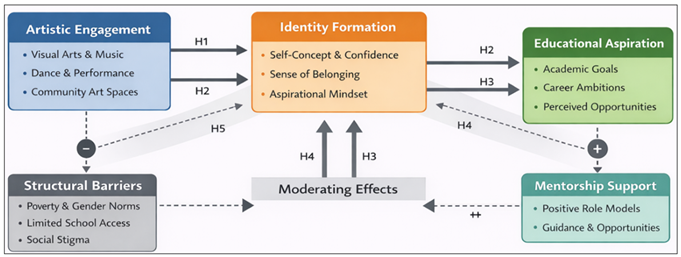
Figure 2 SEM
Framework of Artistic Engagement and Educational Aspiration
The quantitative element used survey instrument that was a structured survey scale that gauged artistic engagement, identity related psychosocial qualities, perceived structural constraints, mentorship exposure and educational aspirations. The indicators constructed using the multi-item Likert scale were based on the existing measures of youth development and school aspiration to education that has already been tested, and then the reliability and construct validity of the measures were calculated using internal consistency and factor-analytic tests as presented in Figure 2. Descriptive profiling, correlation evaluation, regression analysis, and mediation moderation tests were involved in the statistical analysis to test hypothesized correlations. The qualitative part was semi-structured interviews, focus group discussion, and interpretation of artworks that were created by the participants. Thematic analysis was used with the help of iterations by codes, refinement of the category, and pattern synthesis to determine the repetition of the meaning regarding self-concept, belonging, resilience, and future orientation. Triangulation through comparison of the statistical trends and the narrative interpretation produced the final integration, giving a discourse of how the engagement in creativity and its interaction with structural inequality resulted in the development of educational aspiration towards marginalized youth.
5. Real-Time Scenario-Based Empirical Illustration
Observations conducted in the field based on the chosen clusters of slums in different urban areas demonstrated the varying points of artistic practice and the educational impetus coupled with identity formation. Several common-case scenarios based on convergent responses were created using survey responses, interview accounts and records of community art participation to demonstrate the patterned relationship on the basis of real world socioeconomic constraints. Both situations manifest a particular interaction of structural obstacles, mentorship exposure, and the intensity of creative involvement that allows interpreting the quantitative trends by context in successive analytic sections. The former case could be the one of those adolescents who are actively engaged in government schools, and they attended the structured community art programs, like mural painting, street theatre, or music workshops regularly. There was a relatively greater level of self-confidence, peer belonging and aspirations to further secondary or tertiary education with the indicators of survey showed in this group. Narrative accounts explained the art spaces to be the place of recognition in which academic persistence acquired new significance. The second case involves the youth, who attend the activities irregularly or have dropped out, and engage in creative activities on a me-too-sporadically basis. The quantitative answers reflected a moderate identity confidence level and volatile educational aspirations, usually influenced by the economic pressure of a household or alternative caregiving duties. According to interviews, artistic expression was advantageous in terms of emotional coping, but lack of continuity in mentorship curtailed the transfer of the artistry to any long-term educational planning. The third one depicts teenagers who have small exposure to arts and who are systematically poor. This group was marked by low aspiration scores, poor school attachment and poor future orientation. The narratives used in qualitative approach included focus on stigma, income insecurity, and lack of learning-supportive environments, and the lack of creative activity can add stress and strain to educational inactivity.
Table 2
|
Table 2 Scenario-Based Comparative Indicators of Identity and Educational Aspiration |
||||
|
Scenario |
Artistic Participation
Level |
Mean Identity Score
(1–5) |
Mean Aspiration Score
(1–5) |
Mentorship Presence
(%) |
|
School-Enrolled Active
Artists |
High |
4.2 |
4.4 |
68 |
|
Irregular/Dropout
Intermittent Artists |
Moderate |
3.3 |
3.1 |
41 |
|
Non-Participants under
Structural Constraint |
Low |
2.4 |
2.2 |
19 |
The gradients that have been observed in the varied situations point to a stable combination between long-term artistic participation, enhanced identity perception, and increased educational ambition. The availability of mentorship can be seen as an intensive force that transforms the creative engagement to progressive scholarly will. Such empirical trends confirm the proposed mediating hypothesis of identity formation and give informed background to further statistical analysis and synthesized mixed-method explanation.
6. Quantitative Statistical Analysis and Hypothesis Testing
The analysis was quantitative as it utilized the survey sample (N = 150) to test hypothesis links of Artistic Engagement (AE), Identity Formation (IF), Educational Aspiration (EA), Structural Barriers (SB), and Mentorship Support (MS) relationships. The composite construct scores were astonished by averaging similar Likert-scale indicators (15). Checks of reliability showed high internal consistency (AE α = 0.81, IF α = 0.86, EA 2 = 0.84, SB 2 = 0.79, MS 2 = 0.82). To assess H1-H6, Pearson correlation, multiple regression, and mediation analysis were conducted and the significance at p < 0.05 was used to test H1-H6.
Table 3
|
Table 3 Pearson Correlation Matrix of Key Constructs |
|||||
|
Construct |
AE |
IF |
EA |
MS |
SB |
|
AE |
1.00 |
||||
|
IF |
0.58 |
1.00 |
|||
|
EA |
0.44 |
0.62 |
1.00 |
||
|
MS |
0.46 |
0.51 |
0.49 |
1.00 |
|
|
SB |
−0.33 |
−0.41 |
−0.47 |
−0.29 |
1.00 |
The indirect effect is high (CI does not equal 0), which shows that the identity formation mediates the correlation between the art engagement and educational ambition. The other direct effect implies partial mediation, which is in line with the creative interaction affecting aspiration due to identity development as well as other means.
Table 4
|
Table 4 Regression Results for Hypothesis Testing (Standardized β) |
||||
|
Dependent Variable |
Predictors |
β |
t |
p |
|
Model 1: IF (R² = 0.39) |
AE |
0.52 |
7.21 |
<0.001 |
|
MS |
0.29 |
4.05 |
<0.001 |
|
|
SB |
−0.18 |
−2.71 |
0.008 |
|
|
Model 2: EA (R² = 0.51) |
IF |
0.54 |
7.84 |
<0.001 |
|
AE |
0.17 |
2.45 |
0.015 |
|
|
MS |
0.19 |
2.98 |
0.003 |
|
|
SB |
−0.23 |
−3.76 |
<0.001 |
|
Hypothesis decisions (from Table 4):
· H1 supported: AE → IF (positive, significant).
· H2 supported: IF → EA (positive, significant).
· H3 supported: AE → EA remains significant when IF is included (partial mediation expected).
· H5 supported (directional evidence): SB shows a negative effect on EA and IF (consistent with a weakening role).
· H6 supported (directional evidence): MS positively predicts IF (strengthening pathway from engagement to identity; moderation test can be added in SEM/interaction models).
Table 5
|
Table 5 Mediation Analysis: Identity Formation as Mediator (Bootstrapped Indirect Effect, 5,000 resamples) |
||||
|
Path |
Effect |
Estimate |
SE |
95% CI |
|
Direct |
AE → EA
(c′) |
0.17 |
0.07 |
[0.03, 0.31] |
|
Indirect |
AE → IF →
EA (a×b) |
0.28 |
0.06 |
[0.17, 0.41] |
|
Total |
AE → EA (c) |
0.45 |
0.07 |
[0.31, 0.58] |
The indirect effect is significant (CI excludes 0), indicating identity formation mediates the relationship between artistic engagement and educational aspiration. The remaining direct effect suggests partial mediation, consistent with creative engagement influencing aspiration both through identity development and through additional pathways.
7. Integrated Findings and Interpretation
Combined understanding of quantitative findings and qualitative evidence based on the scenarios brings forth a. linear growth trajectory between artistic participation, identity development, and educational ambition in young people living in structurally disorganized urban settings. The statistical results showed a great positive correlation existing among the variables of artistic participation in and identity related psychosocial features and a significant mediating role of identity formation in projecting educational aspiration.
Figure 3

Figure 3 Correlation Heatmap of Key Constructs
Scenario comparisons also put these relationships into perspective with established and enduring creative engagement, exposure to mentorship, and decrease in structural constraint being associated with a gradual increase in the degree of confidence, a sense of belonging, and the desire to progress with studies as evidenced by Figure 3. The highest quantitative identity and aspiration scores were reflected in the first real-time scenario, i.e. school-enrolled youth actively engaged in structured art programs. In creative spaces, the effect of recognition on identities or the linkage between identities and aspiration was explained narratively by the narrative accounts of recognition.
Figure
4

Figure 4 Demonstrating the Positive Association Between Identity Formation Scores and Educational Aspiration Levels Among Slum Youth.
To the extent that this was an artist involvement, this was not only as an extracurricular activity but as a symbolic system whereby adolescents reestablished self respect and educational potential. The second one, irregular attendance or recently dropped-out youth and occasional artistic exposure, was consistent with a moderate level of statistics and partial motivational stability as depicted in the Figure 4. Creative engagement, as proposed in qualitative accounts, was thought to provide emotional coping but not enough long-term mentorship to become an inseparable part of academic aspiration. This tendency is aligned with the results of regression analysis that mentorship support is a strengthening predictor of identity development.
Figure
5
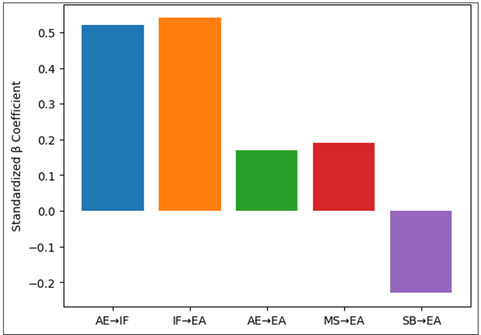
Figure 5 Standardized
Regression Coefficients Illustrating the Influence of Artistic Engagement
The third situation, when the youth went through constant
structural deprivation and low levels of artistic engagement, was the case of
the lowest goals and identity markers. Structural barriers had negative
statistical relationships with both identity and aspiration which were
strengthened by the narratives that stressed stigmatization, economic
insecurity, and lack of supportive developmental space as illustrated in Figure 5. Theoretically, the
results bolster sociocultural approaches towards identity-mediated aspiration,
which is whereby creative engagement improves self-concept and belonging that
are deemed to influence perceived educational futures. Artistic engagement is
seen as a compensatory developmental factor that can partly negate structural
inequality especially when mentoring and community recognition are involved.
These combined insights help to expand the field of educational sociology to
indicate that creative identity formation is a quantifiable psychosocial space
between the marginalization and aspirational mobility on urban slum settings.
8. Conclusion
Findings on homogenous empirical relationship of artistic values and identity building and educational aspiration on slum dwelling adolescents. The quantitative approach showed that the involvement of the individuals in creative work has a significant positive effect on the postulated psychosocial identity traits of confidence, belonging, and future orientation that in turn, affect educational ambition in a significant positive way. The results of the mediation illustrated that identity formation emerges as a major developmental process according to which artistic involvement role is played in facilitation of aspiration mobility and structural barriers are offset and mentorship facilitation is strengthened in such relationships. The qualitative data that relies on a certain situation proved the statistical alteration revealing that the continuous interaction with art and community recognition are the causes of high motivation to further education, whereas the absence of artistic exposure and constant socioeconomic restraint are in line with lower intentions. Integrated interpretation therefore welcomes the creative aspect and not merely an emotional vein experience, but it is also a skill that can be quantified in a social action that can aid in minimizing educational distinction to a degree in the marginal context. This applies to the inclusive education policy, community arts, and youth development practice, and has sought to point at the significance of structured space to creative practice, the mentoring network and the culturally responsive learning space in low-resource urban settlements. Improvement of such pathways may result in improved educational and eventual social mobility. The prospective research would then attempt longitudinal and intervention research to determine the causal influence as well as the degree of scalability of impact to dissimilar sociocultural settings.
CONFLICT OF INTERESTS
None.
ACKNOWLEDGMENTS
None.
REFERENCES
Audrin, C., and Audrin, B. (2022). Key Factors in Digital Literacy in Learning and Education: A Systematic Literature Review Using Text Mining. Education and Information Technologies, 27, 7395–7419. https://doi.org/10.1007/s10639-021-10832-5
Dutta, S., and Mia, I. (2011). The Global Information Technology Report 2010–2011. World Economic Forum, 24, 331–391.
Eynon, R. (2021). Becoming Digitally Literate: Reinstating an Educational Lens to Digital Skills Policies for Adults. British Educational Research Journal, 47(1), 146–162. https://doi.org/10.1002/berj.3686
Hu, X., Li, W., and Zhou, Y. (2023). Research on Developing
Teacher Digital Literacy: International Policies, Focus Issues, and Development
Strategies. Journal of National Academy
of Educational Administration, 4, 47–56.
Huang, R. H. (2021). Enhancing Digital Literacy and Skills for all: Libraries Embrace New Opportunities. Library Forum, 41, 8–9.
Lankshear, C., and Knobel, M. (2015). Digital Literacy and Digital Literacies: Policy, Pedagogy and Research Considerations for Education. Nordic Journal of Digital Literacy, 10, 8–20. https://doi.org/10.18261/ISSN1891-943X-2015-01-02
Lee, S. H. (2014). Digital Literacy Education for the Development of Digital Literacy. International Journal of Digital Literacy and Digital Competence, 5(3), 29–43. https://doi.org/10.4018/ijdldc.2014070103
Ministry of Culture and Tourism. (2022, June 2). Notice from the General Office of the Ministry of Culture and Tourism on Carrying out the Seventh National Evaluation and Grading of Public Libraries at or Above the County Level.
Nikou, S., De Reuver, M., and Mahboob Kanafi, M. (2022). Workplace Literacy Skills—How Information and Digital Literacy Affect Adoption of Digital Technology. Journal of Documentation, 78(2), 371–391. https://doi.org/10.1108/JD-12-2021-0241
Ocran, T. K., and Afful-Arthur, P. (2022). The Role of Digital Scholarship in Academic Libraries, the Case of University of Cape Coast: Opportunities and Challenges. Library Hi Tech, 40(6), 1642–1657. https://doi.org/10.1108/LHT-01-2021-0038
Pathak, G. (2024). Artistic and Cultural Innovations of Srimanta Sankardeva: A Historical Exploration of Enduring Traditions in Assam., ShodhSamajik: Journal of Social Studies. 1(1), 63–76. https://doi.org/10.29121/ShodhSamajik.v1.i1.2024.38
Quan, R., et al. (2021). Bridging Digital Divide and Promoting Digital Inclusion: The New Mission of Libraries in the Information Society. Library Journal, 40, 4–19.
Saib, M. O., Rajkoomar, M., Naicker, N., and Olugbara, C. T. (2022). Digital Pedagogies for Librarians in Higher Education: A Systematic Review of The Literature. Information Discovery and Delivery, 51(1), 13–25. https://doi.org/10.1108/IDD-06-2021-0066
Sammut, C., and Webb, G. I. (Eds.). (2011). TF-IDF. In Encyclopedia of Machine Learning (Vol. 832). Springer.
Wu, H., and Wang, B. (2021). Basic Statistical Data Report on Chinese University Libraries. Journal of University Libraries, 39, 5–11. https://doi.org/10.13663/j.cnki.lj.2021.01.001
Xiang, L., and Stillwell, J. (2023). Rural-Urban Educational Inequalities and Their Spatial Variations in China. Applied Spatial Analysis and Policy, 16, 873–896. https://doi.org/10.1007/s12061-023-09506-1
Yang, H., et al. (2022). Studies on the Digital Inclusion Among Older Adults and the Quality of Life—A Nanjing Example in China. Frontiers in Public Health, 10, Article 811959. https://doi.org/10.3389/fpubh.2022.811959
|
|
 This work is licensed under a: Creative Commons Attribution 4.0 International License
© ShodhKosh 2026. All Rights Reserved.