ShodhKosh: Journal of Visual and Performing ArtsISSN (Online): 2582-7472
|
|
From Contextual Need to Design Solution: A Novel Chair Design for Indian Design Students
Abhishek Srivastava 1
 ,
Nandadeep Paul 2
,
Nandadeep Paul 2 ,
Sonal Atreya 3
,
Sonal Atreya 3
1 Indian
Institute of Technology Roorkee, Haridwar, Uttarakhand, India
2 Indian Institute of
Technology Roorkee, Haridwar, Uttarakhand, India
3 Indian Institute of
Technology Roorkee, Haridwar, Uttarakhand, India
|
|
|
ABSTRACT |
|
|
In many
Eastern cultures (like India), floor sitting, particularly in postural
instances like Indian cross-legged position (locally known as pālathī), has been deeply rooted in daily life.
However, as global lifestyles evolve and the influence of Western furniture
design spreads, there has been an increasing shift towards the use of chairs.
This transition has created a unique challenge in designing seating that
accommodates both traditional floor-based postures and modern chair-based
postures. However, current seating options generally cater to either elevated
sitting or ground-based activities but rarely offer a solution that
seamlessly integrates both. This gap is particularly evident in environments
such as design classrooms, where versatile seating is crucial. This study
reinforces the discussed gap by investigating the literature, market,
patents, and through an observational study among design classrooms. Further,
A novel chair design is conceptualized for the design students in the Indian
context which facilitates conventional sitting as well as Indian cross-legged
sitting postures, while allowing multiple seating options like- stool, floor
seating, elevated seating along with features like- storage and carry on. The
proposed chair is also analyzed using Ansys software for structural
robustness under various load tests. Thus, the new design with several
benefits and advantages, holds immense potential for introduction in the
design classrooms and studios. The solution is also scalable to offices which
are now encouraging employee-centric seating preferences; and within
household contexts with remote work culture on the rise. |
|||
|
Received 29 November 2025 Accepted 18 March 2026 Published 27 March 2026 Corresponding Author Sonal
Atreya, sonal.atreya@design.iitr.ac.in
DOI 10.29121/shodhkosh.v7.i2s.2026.7164 Funding: This research
received no specific grant from any funding agency in the public, commercial,
or not-for-profit sectors. Copyright: © 2026 The
Author(s). This work is licensed under a Creative Commons
Attribution 4.0 International License. With the
license CC-BY, authors retain the copyright, allowing anyone to download,
reuse, re-print, modify, distribute, and/or copy their contribution. The work
must be properly attributed to its author.
|
|||
|
Keywords: Chair design, Design Students, Indian Cross-Legged, Multipurpose
Chair, Pālathī |
|||



1. INTRODUCTION
Seating practices have long been influenced by cultural norms, with a clear distinction between chair-sitting and floor-sitting traditions Gurr et al. (1998), Kullmann (2020). In many Eastern cultures like the Asian cultures including India, floor sitting, particularly in postures such as the Indian cross-legged position or pālathī, has been deeply embedded in daily life Mallampalli and Karmakar (2025), Nagrajan and Dsouza (2017), Goonetilleke (1998).
However, as global lifestyles evolved and the influence of Western furniture design with elevated forms of seating spread, there has been an increasing shift and transition towards the use of chairs. This transition has created a unique need in designing seating that accommodates both traditional floor-based postures and modern chair-based postures Srivastava et al. (2025). Current seating options generally cater to either elevated seating or ground-based activities but rarely offer a solution that seamlessly integrates both. This gap is particularly evident in environments such as Design classrooms and studios in which learning by doing is a core principle. As part of the creative design process in the studios, students make a variety of outputs that include physical, digital and experiential attributes Swanson (2020). These outputs require a variety of postural choices and seating positions. For instance, design students may need a chair with a backrest for- desk or screen related work; a stool for active sitting or in studios during clay pottery making or sketching; and would want to sit comfortably on the ground/floor for- model making, group discussions, or even brainstorming sessions, in the Indian context.
Further, research underscores the benefits of traditional postures, such as cross-legged sitting Kohli et al. (2019), in reducing back pain and improving posture and attention, yet these advantages are often overlooked in modern ergonomic design. Studies have shown that while chair-sitting cultures report higher rates of back pain, those who maintain traditional sitting practices experience fewer issues Fahrni (1975), Srivastava et al. (2026), Dutta and Dhara (2012). The Indian cross-legged posture also mimics various yoga-āsanas, like Sukhāsana, Padmāsana, Swastikāsana, etc., thus deriving numerous benefits on body and mind as listed in various ancient Indian scriptures like the Gheranda Samhita Saraswati (1992), Hath Yog Pradipika Muktibodhananda (2006), etc.
2. METHOD
The study method entails three key stages Figure 1.
· First, the study establishes the gap in the chair design ecosystem through- literature study via research articles from journals, book-chapters and other digital resources; online market study; comparative patents using Derwent search; as well as through observational study in design classrooms.
· Second, it proposes a novel chair design that facilitates both traditional and conventional sitting postures with added functional benefits.
· Lastly, it analyzes the design using engineering simulation software Ansys (2024 R2) for various load tests to enquire and ensure its structural strength under real world conditions.
Figure 1

Figure 1 Study Approach
3. study RESULTS
The findings of initial studies namely- Literature, Market, Patent, and Observational; are listed in the further subsections.
3.1. Literature study
Table 1 incorporates the literature that highlights the need to investigate traditional postures like floor sitting and recognizing this form of sitting, which is still largely prevalent in many cultures. It also demonstrates the need for seating solutions that accommodate such postural practices.
Table 1
|
Table 1 Literature Study Highlights and Identified Gaps |
|
|
Literature study highlights |
Gaps identified |
|
1. The utilization of floor-based sitting as genuine work postures
has been ignored by Ergonomics. While
there is significant amount of information in the ergonomic literature on
chair-based sitting, not much is known about floor sitting postures Gurr et al. (1998). 2. Despite the cross-legged sitting being popular in Asia and the
Middle east, it has the least information |
Ergonomic research largely neglects floor and
cross-legged sitting despite their widespread practice. |
|
3. Khanam et al.
|
Current chair-based seating in education is
primarily focused on conventional sitting with an elevated stance of sitting
on a chair. |
|
4. There are multiple risks associated with transferring ergonomics
technology from Western to developing nations. This transfer enforces
solutions that are inappropriate for societies that are not used to chair
sitting Gurr et al. (1998). 5. The chair designs for offices are essentially Western based,
which are typically made to accommodate work methods of Western nations Noro et al. (2006). |
Contemporary chair designs are Western based while
ignoring the sitting practices of other cultures. |
|
6. Sharmistha
et. al 7. Prof. Debkumar (Indian ergonomic
expert) deliberates the benefits of floor sitting by emphasizing how this
posture facilitates unrestricted movement and is conducive for collaborative
projects and ideation exercises NPTEL (2013). |
Requirement for seating solutions that offer
sufficient space for variable postural choices, including adopting a
cross-legged stance. |
|
8. Design students often adopt or switch to the Indian cross-legged
posture, and desire their chair to have attributes like- better cushioning,
storage, supports like - footrest, and others, according to the pilot study by Srivastava et
al. (2024) |
Seating solutions need to address the needs of
design students. |
Broadly, the studies Table 1 have stressed ignorance towards traditional sitting postures like cross-legged and indicating the need to have seating solutions that facilitates such postural choices and which addresses student’s needs.
3.2. market study
Interestingly, the chair designs allowing the Indian cross-legged sitting are available in the product offerings available predominantly in the Western market, though available in India through online purchase and substantial tariffs. However, these seating options Figure 2 mostly cater to a specific segment of the office environment with their usage limited to elevated stance of seating and no provision for ground-based activities. Additionally, the cost of chairs seats tends to be exceptionally high, making them unsuitable for educational settings. In schools and colleges, furniture requirements depend on a variety of factors like quantity, layout flexibility, storage, subject needs, aesthetics, cleanliness, etc.
Figure 2
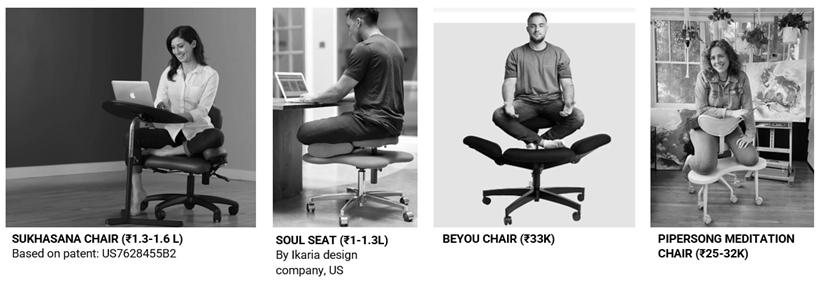
Figure 2 Seats Facilitating Indian Cross-Legged Sitting
Image Source: Sukhasana, Ikaria Design, Beyou, Pipersong; Collage Source: Author
Likewise, many
base supports Figure 3 have also been introduced in the market
that help in maintaining cross-legged sitting postures. These supports are
primarily for facilitating yoga-āsanas for sitting and aiding in meditative
practices; however, their usage expands to other activities while being seated
cross-legged, like working on a laptop, reading books/newspapers, eating meals,
etc. Some of them offer dual benefits of using it while sitting on the floor as
well as on a chair, like the pillow offered by Sleepsia.
Since these items are designed as support rather than full-fledged seats (apart
from Alexia), they tend to be more affordable. As a result, these are generally
available at lower prices as compared to the seating options.
Figure 3
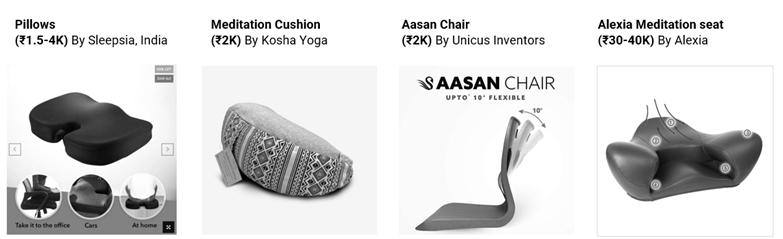
Figure 3 Supports Facilitating Asanas
Image Source: Sleepsia, Kosha Yoga, Unicus, Alexia;
Collage Source: Author
Both these
offerings appear to facilitate traditional postures, but their effectiveness
and suitability for students in the context of India’s educational landscape
requires further validation, as they are primarily designed to support the
individuals in the office work environments.
3.3. PATENT STudy
The Derwent Patent search for seats facilitating
cross-legged posture led to a few patents in this area Table 2.
Table 2
|
Table 2 Relevant Patents |
||
|
S.No. |
Patent details |
Image |
|
1 |
Cross-Legged Seating Apparatus |
|
|
2 |
Three-point cross-legged support
seat |
|
|
3 |
Adjustable cross-legged support
seat |
|
|
4 |
Universal chair enabling a user
to sit with various postures (Korea Patent No. KR2013078895A, 2013) |
|
|
5 |
Chair design to
enhance hip flexibility and strength while alleviating lower back pain |
|
|
6 |
An adaptable chair with multiple
adjustable components |
|
|
7 |
A chair having a chair back with
an enlarged and curved seating surface |
|
|
8 |
Device for comfortable sitting in a cross-legged posture (India
Patent No. IN202143042568A, 2023) |
|
|
9 |
A portable
meditation system |
|
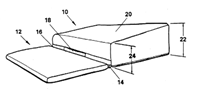
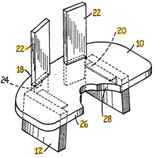
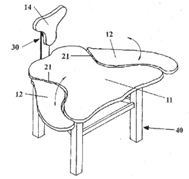
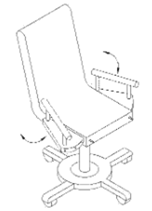
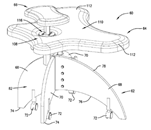
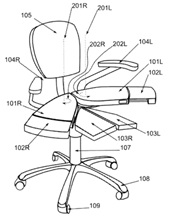
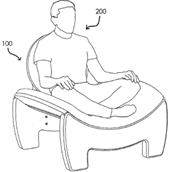
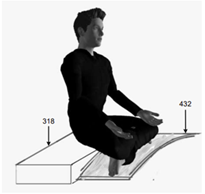

The comparative patent study revealed a significant gap in existing seating solutions. As reviewed from the above patents, the existing seating solutions often require users to choose between floor-based and chair-based sitting. Although some chairs accommodate cross-legged sitting, they are primarily designed for an elevated stance and do not work for this posture in ground-level activities. This limitation reduces their practicality in Indian environments like Design classrooms, where frequent rearrangement and movement are common. Additionally, they lack the flexibility to adjust height or convert between different seating modes, such as chair, stool, or floor seat, limiting their usability across different activities and environments.
Moreover, these seats focus on specific purposes, such as meditation or ergonomic seating, but they lack the versatility needed for various activities, like desk work, group discussions, or active sitting. Therefore, there exists a need for a multi-purpose seating solution that addresses the limitations of existing seating solutions and addresses the needs of the design classrooms in the Indian context.
3.4. OBSERVATIONAL STudy
The authors reached out to various design institutions via faculty members, to share the images of design students while working on design related activities. It was observed that the sitting patterns vary depending on activities in hand like- laptop/desktop screen-based work, sketching and drawing, hands-based model making, group discussions, etc. Notably, the Indian cross-legged posture was seen on chair as well as on ground-based activities, along with conventional sitting. Figure 4 demonstrates the adoption of various postures, including cross-legged, by the design students.
Figure 4

Figure 4 Design Students in Various Sitting Posture While
Working
Image Source: Author, Deepshikha, and Amaltas; Collage and Illustration Source: Author
Additionally, a pilot study by Srivastava et al. (2024) on industrial design students revealed the diverse problems associated with classroom seating including- un-addressed postural needs, situational concerns and limited chair features. It also mentioned the frequent adoption of cross-legged postures, which had been acknowledged as one of the intrinsic postures Srivastava et al. (2025) adopted by the design students.
All the above studies (Literature, Market, Patent, and Observational) pointed to the necessity of recognizing and facilitating traditional postures, such as the cross-legged, alike the conventional sitting, and cater to students’ needs.
4. Re-imagined chair design
Multiple iterations were developed before arriving at the proposed chair design Figure 5. This chair design facilitates conventional sitting, in addition to Indian cross-legged on elevated and ground. Novel features of the chair are:
1) Detachable cross-legged support seat with integrated stool which is visible after detaching the cross-legged support seat.
2) Foldable backrest allows comfortable sitting for both experts/proficient and novice in cross-legged sitting (at two levels) which shall aid in working and meditative activities.
3) The support seat can be carried on hand/shoulder using extendable belt/shoulder strap.
4) Distinct shape design on cross-legged support seat acting as visual nudge to motivate towards cross-legged sitting.
5) The seat also has a footrest and storage attached to the bottom cylindrical pipe.
Figure 5
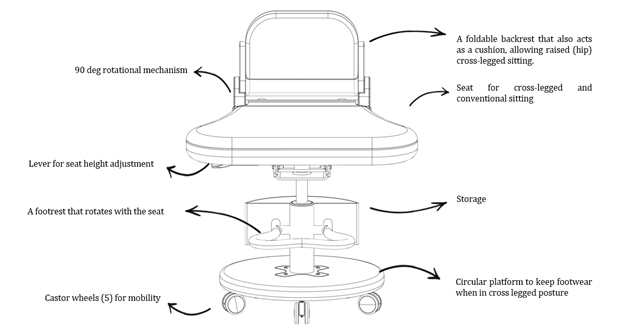
Figure 5 Re-Imagined Chair Design
4.1. The chair design and mechanism
The re-imagined chair design is further detailed on various attributes of – postural flexibility Figure 6, detachability mechanism to work as floor seat and stool Figure 7, rotational mechanism for seat backrest Figure 8, two-leveled ground seating Figure 9, height adjustment mechanism Figure 10, storage and footrest Figure 11, carry-on feature Figure 12, and Stitch design for visual nudge Figure 13.
Figure 6 presents the various sitting postures that can be adopted on this chair both on elevated and ground level.
Figure 6

Figure 6 Various Sitting Positions on the Chair
The design comprises a cross-legged support seat and an integrated stool with a top portion dimensioned to support the cross-legged support seat.
Figure 7
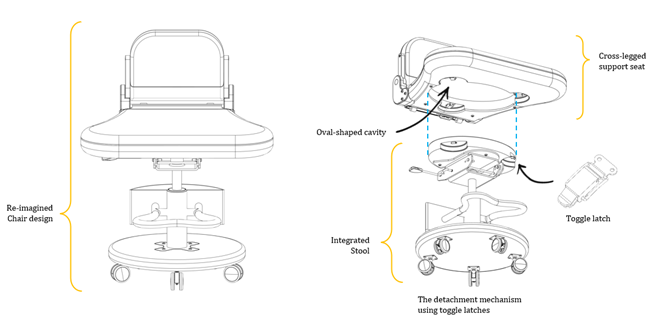
Figure 7 Chair Design and its Detachable Design
The cross-legged support seat is detachably mountable on the integrated stool by three toggle latches Figure 7. The cross-legged support seat comprises an oval-shaped cavity at its base configured to receive an oval-shaped top portion of the integrated stool. The toggle latches are positioned in the aligned cut-outs to releasably secure the cross-legged support seat.
The foldable backrest is coupled to the cross-legged support seat by two 90-degree stop hinges Figure 8.
Figure 8
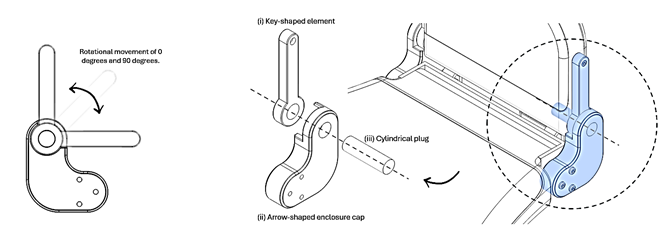
Figure 8: Foldable Backrest Mechanism
Each of the 90-degree stop hinges comprises a key-shaped hinge element fixed to the side surface of the foldable back rest. An enclosure cap is configured to receive a projecting portion of the key-shaped hinge element, and a cylindrical pivot plug extends through aligned openings of the enclosure cap (Figure 8). This design of stop-hinges limits the rotational movement of backrest from 0 deg. to 90 deg.
Figure 8
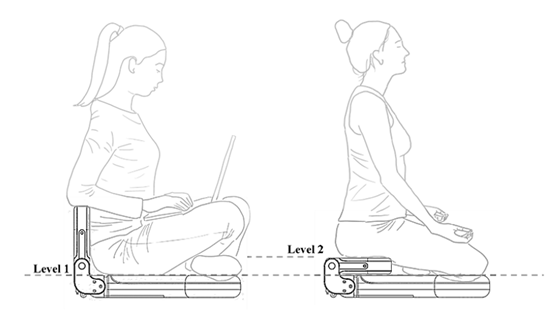
Figure 9 Two-Level Sitting in the Cross-Legged Posture
Figure 9 shows two levels of seating position provided by the cross-legged support seat on the ground/floor leveraging the controlled rotation of the backrest. The seat allows Level 1 sitting for experts/proficient in pālathī posture and Level 2 for novice in this posture, which shall aid in working and meditative activities.
Figure 10
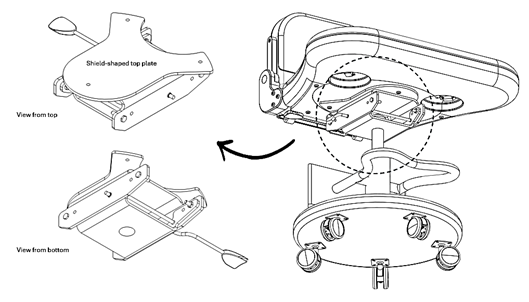
Figure 10 Modified Height Adjustment Mechanism
The integrated stool comprises a height adjustment assembly including a lever operatively connected to a pneumatic actuator. A shield-shaped top plate has a support frame positioned beneath the shield-shaped top plate coupled to the pneumatic actuator to provide stability during vertical height adjustment Figure 10. The integrated stool comprises a cylindrical rod extending from the oval-shaped top portion to a circular base platform provided with castor wheels (05 nos.) for mobility. The cylindrical rod further supports a footrest and a storage compartment Figure 11.
Figure 11

Figure 11 Additional Features
The cross-legged support seat with the foldable backrest is provided with a belt or a shoulder strap and is extendable to allow the seat to be carried over shoulder or via hand grip Figure 12.
Figure 12
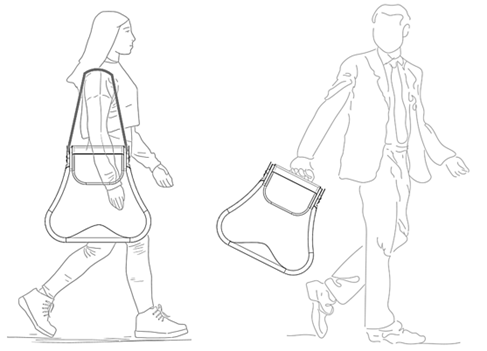
Figure 12 Ways of Carrying Using Belt/Shoulder Strap
Figure 13 shows the upholstery pattern of the cross-legged support seat which comprises differentiated upholstery stitching, marking two distinct shapes – (i) cropped bone shape, and (ii) minor segment, both coplanar.
Figure 13

Figure 13 Stitching Pattern on Upholstery for Visual Nudge
Wherein the shape (i) conforms with the cross-legged base area and acts as a visual nudge to motivate individuals to sit in this posture; while shape (ii) compliments the shape (i) and offers sufficient area to sit in both- cross legged, and conventional posture i.e., with feet resting on floor and providing enough support to the thigh region.
4.2. Proposed materials
The cross-legged support seat upholstery is proposed with natural fabric like hemp, linen, etc. with foam materials being made from sustainable alternatives like- Latex rubber, polythene foam (made from 100% recycled plastic bottles), etc. The foldable backrest has foam having IFD (Indentation Force Deflection) of approximately 50-70, on both sides, reinforced with wood (like particle board), and outer upholstered with natural fabric like hemp, linen, etc. aiding in comfortable support to the hip and lower back in the two levels of sitting. The stool has an oval shaped wooden top made from solid wood like- oak, pine, etc. The storage is proposed in perforated metal sheet (made from SS) which can be fixed or detachable, thus facilitating the cleaning aspect. The circular base platform (made from SS) is fixed with cylindrical pipe and holds five castor wheels for mobility ease.
4.3. simulation results
The Indian Standards for chairs and stools were referred for the Strength test on chairs comprising load tests for -Seat Static and Back Static.
Figure 14
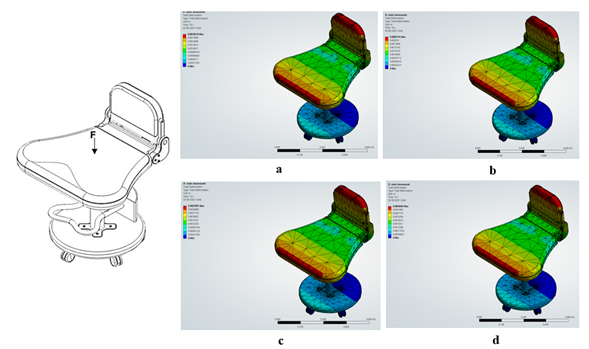
Figure 14 Seat Static Load Test
Figure 14 presents the Seat Static Load Test (SSLT) with an applied downward force (F) on the cross-legged support seat. Figure 14 (a-d) illustrate the results of the seat static load test performed with varying forces of 1100 N, 1300 N, 1600 N, and 2000 N, respectively. The simulation assessed the total deformation under the applied force (F). The results indicated maximum deformation values ranging from 1.92 mm to 3.49 mm. The deformation was primarily localized at the front edge of the cross-legged support seat and the upper portion of the foldable backrest. These results confirm that the multi-purpose seating device maintains structural stability under incremental static loading while allowing only minimal elastic displacement.
Figure 15
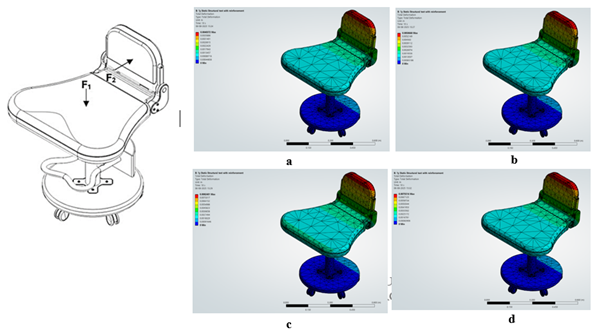
Figure 15 Back-static Load Test
Figure 15 presents the Back-Static Load Test (BSLT) conducted with a downward force (F1) applied on the cross-legged support seat and a horizontal force (F2) applied on the foldable backrest. Figure 15 (a-d) illustrate the results of the test under varying forces. Specifically, a downward force (F1) of 1100-2000 N was applied downward on the cross-legged support seat in combination with a horizontal force (F2) of 410-760 N applied to the foldable backrest. The simulation results demonstrated negligible displacement at the base and a maximum deformation of 8.24 mm confined to the backrest. These results validate the chair’s integrity under combined vertical and horizontal loads.
Across all load conditions tested, no
fractures, weld failures, or permanent deformations were observed. Furthermore,
the circular platform base and the castor wheels exhibited no structural
instability or deformation, confirming adequate anchoring and support of the
stool.
5. conclusion
The study concludes by highlighting the imperative need of investigating and recognizing floor sitting posture like the Indian cross-legged, as a legitimate posture for work. It further contributes to this gap by re-imagining a chair design that is contextual to the Indian context. The proposed chair design offers multiple benefits:
1) The chair design allows sitting flexibility on ground and elevated level. It can act as a chair for elevated sitting, become a stool by detaching from the chair, and the remaining top (cross-legged support seat) becomes a floor seat for ground-level activities.
2) It facilitates the conventional sitting postures as well as traditional postures like the Indian cross-legged.
3) The foldable seat backrest with rotational feature allows back and hip support for different seating levels.
4) The belt/shoulder strap in the seat increases convenience of carry-on, thus allowing carrying it with ease for ground-based outdoor seated activities.
5) The chair has storage facilitating space for personal items. The additional feature of footrest makes it convenient to adopt other postural stances.
6) Chair mobility is enabled by castor wheels, making it highly desirable for flexible classroom layouts.
The proposed seating solution is best suited for the design educational context as design students are engaged in a variety of activities like- desktop/laptop usage; brainstorming; group discussion; model-making; etc. and use desk space as well as ground/floor for performing various tasks. This solution addresses all these scenarios and is a suitable substitute for the contemporary chair offerings. The solution is also scalable to offices which are now flexible with employee-centric seating preferences; and household contexts with remote work culture on the rise.
CONFLICT OF INTERESTS
None.
ACKNOWLEDGMENTS
The authors would like to thank IPR Cell, IIT Roorkee and PMRF grant support. The authors have filed an Indian patent related to the chair design described in this manuscript with Application No. 202411070952.
REFERENCES
Banerjee, S., Goel, K. M.,
Chakrabarti, D., and Das, A. (2005). An Approach to Specify Informal
Sitting in Classroom. Humanizing Work and Work Environment (HWWE). Guwahati.
Brodeur, C. C. (2005). United States Patent No. US7628455B2.
Dutta, S., and Dhara, P. C. (2012). Evaluation of Different Sitting Postures of Rural Primary School Boys in the Classroom. Journal of Ergonomics, 2(3). https://doi.org/10.4172/2165-7556.1000105
Edelson, N. (1990). United States Patent No. US5029350A.
Fahrni, W. H. (1975). Conservative Treatment of Lumbar Disc Degenration. Orthopedic Clinics of North America, 6, 93. https://doi.org/10.1016/S0030-5898%2820%2931204-9
Goonetilleke, R. S. (1998). Designing to Minimize Discomfort. Ergonomics in Design, 12–19. https://doi.org/10.1177/106480469800600304
Gurr, K., Straker, L., and Moore, P. (1998). Cultural Hazards in the Transfer of Ergonomics Technology. International Journal of Industrial Ergonomics, 22, 397–404. https://doi.org/10.1016/S0169-8141%2897%2900094-2
Kohli, P., Patel, P., Waybase, H., Gore, S., and Nadkarni, S. (2019). The Value of Cross Legged Sitting: Virtue or Vice for Health. International Journal of Orthopaedics Sciences, 607–610. https://doi.org/10.22271/ortho.2019.v5.i3k.1596
Kullmann, C. (2020). The Monobloc Chair: Democratising the Practice of Sitting. International Research Journal of Furniture and Designed Objects, 3–18. https://doi.org/10.17811/rm.9.11.2020.1-18
Mallampalli, K. C., and Karmakar, S. (2025). Ergonomic Design Interventions to Minimize Musculoskeletal Disorders Among Female Workers in Cashew Kernel Separating Activity: A Participatory Approach. Theoretical Issues in Ergonomics Science, 589–607. https://doi.org/10.1080/1463922X.2025.2493817
Matthews, J. P. (2009). United States Patent No. US8616651B2.
McClintock, D. C. (2017). United States Patent No. US20190082848A1.
Muktibodhananda, S. (2006). Hath Yoga Pradipika. Yoga Publications Trust.
Mulholland, S. J., and Wyss, U. P. (2001). Activities of Daily Living in Non-Western Cultures: Range of Motion Requirements for Hip and Knee Joint Implants. International Journal of Rehabilitation Research, 24(3), 191–198. https://doi.org/10.1097/00004356-200109000-00004
NPTEL. (2013). Anthropometry: Squatting and Cross-Legged Postures [Video]. YouTube.
Nagrajan, A., and Dsouza, S. A. (2017). Using the Newly Developed Floor-Sitting Movement Analysis Proforma to Study the Effect of Age and Activity on Floor-Sitting in Indian Adults. Journal of Cross-Cultural Gerontology, 71–93. https://doi.org/10.1007/s10823-016-9310-4
Noro, K., Lueder, R., Yamada, S., Fujimaki, G., Oyama, H., and Hashidate, Y. (2006). Revisiting Sitting Cross-Cultural Aspects of Seating. Human Factors and Ergonomics Society 50th Annual Meeting, 814–819. https://doi.org/10.1177/154193120605000704
Salazar, N. M. (2021). United States Patent No. US20220354263A1.
Saraswati, S. N. (1992). Gheranda Samhita. Yoga Publication Trust.
Srivastava, A., Kumar, A., and Atreya, S. (2025). Crossed Sitting, Straight Insights: Pālathī (Cross-Legged) Posture in Design Education. In Proceedings of the 10th International Conference on Research into Design (ICoRD 2025) (99–110). Springer. https://doi.org/10.1007/978-981-96-5507-6_9
Srivastava, A., Kumar, S., and Atreya, S. (2026). Assessing the Musculoskeletal Discomfort of Students Practicing Cross-Legged Sitting Postures at Gurukuls. HWWE ACED BRICS 2023. Springer Nature. https://doi.org/10.1007/978-981-96-4186-4_37
Srivastava, A., Paul, N., and Atreya, S. (2024). Musculoskeletal Health of (Industrial) Design Students and Their Perspectives on Seating: A Pilot Study. In A. Sharma and R. Poovaiah (Eds.), Futuring Design Education 2024 (Vol. 2, 19–28). Springer Nature. https://doi.org/10.1007/978-981-97-9210-8_2
Swanson, G. (2020). Educating the Designer of 2025. She Ji: The Journal of Design, Economics, and Innovation, 101–105. https://doi.org/10.1016/j.sheji.2020.01.001
|
|
 This work is licensed under a: Creative Commons Attribution 4.0 International License
© ShodhKosh 2026. All Rights Reserved.