ShodhKosh: Journal of Visual and Performing ArtsISSN (Online): 2582-7472
|
|
VISUAL POLITICS OF MASCULINITY: A FEMINIST SEMIOTIC ANALYSIS OF MALE REPRESENTATION IN RAJA RAVI VARMA’S PAINTINGS
Sethulekshmi P.S 1
 ,
Dr. Saraswathy Selvarajan 2
,
Dr. Saraswathy Selvarajan 2
1 Research
Scholar, Department of English, Vellore Institute of Technology, Vellore, Tamil
Nadu, India
2 Assistant
Professor, Department of English, Vellore Institute of Technology, Vellore,
Tamil Nadu, India
|
|
|
ABSTRACT |
|
|
Raja Ravi
Varma plays a significant role in Indian art and cultural ethos to this day.
His artworks are considered revolutionary in popularising
Indian mythology and the diverse cultural traditions through paintings and
calendar art. Among Varma’s diverse paintings, his depiction of women gained
the most popularity and later evolved into the idealised
gender prototype across India. An examination of existing scholarship shows
that gender analyses of Varma’s paintings have largely focused on female
characters, while studies of masculine representation in visual art remain
underexplored. Therefore, this study initiates an exploratory analysis of
select male-centric portrayals, such as Rajput Soldier (1901), Reading Newspaper (1904),
The Student (1904), and Swordsman (N.d), to examine Varma’s
conception of masculinity and to trace the reasons for the elusiveness of
male portraits in comparison to his depictions of women. Through the
integration of Barthes’ visual semiotics and Pollock's concepts of ‘vision’,
‘voice’ and ‘power’, this qualitative and interpretive study argues that
Varma’s paintings of men are not accidental but a deliberate construction to
reflect the patriarchal gender hierarchy that was prevalent during the
period. These paintings position women within an aestheticised
and alluring framework, while men are rendered in realistic settings,
demonstrating the objectification of women and the naturalisation
of men’s social presence. The relative absence of male-centric paintings, in
contrast to female-oriented paintings, further indicates the privilege given
to men to maintain privacy and explains why the male-centric paintings are
limited and underexplored in academia. |
|||
|
Received 02 December 2025 Accepted 11 March 2026 Published 27 March 2026 Corresponding Author Dr. Saraswathy Selvarajan, saraswathy.s@vit.ac.in DOI 10.29121/shodhkosh.v7.i2s.2026.7154 Funding: This research
received no specific grant from any funding agency in the public, commercial,
or not-for-profit sectors. Copyright: © 2026 The
Author(s). This work is licensed under a Creative Commons
Attribution 4.0 International License. With the
license CC-BY, authors retain the copyright, allowing anyone to download,
reuse, re-print, modify, distribute, and/or copy their contribution. The work
must be properly attributed to its author.
|
|||
|
Keywords: Paintings, Gender Disparities, Connotation and
Denotation, ‘Vision’, ‘Voice’ and ‘Power’, Visual Narrative, Etc |
|||



1. INTRODUCTION
From ancient times to the present, the visual arts have been a significant source of knowledge dissemination by blurring linguistic barriers and contributing to the learning and understanding of complex ideas such as culture and gender. Analysis of Indian art history showed that gender is a much-debated topic, beginning with the ancient cave paintings. In the early Indian paintings, women were rarely portrayed and were often depicted to evoke sensual pleasure for the onlookers Sharma et al. (2016). Close examination of the women's depictions indicated the role of women in society, which was primarily associated with procreation, sensuality, and fertility cults Varma (1901). Though women’s portrayal evolved considerably over time, certain notions remained unchanged. Nude mother figures were found frequently in the terracotta figurines during the Indus Valley civilisation, the graceful, exotic, and sensuous divine apsaras aligned with Indian Shadangas, dominated mural traditions, and the concept of women as objects to be looked upon remained throughout. The Mughal paintings, Rajasthani miniatures, Pahari traditions, and the modern Indian paintings also continued to illustrate women as a person of beauty and charm. However, while women were extensively depicted in the later periods in Indian visual tradition, the visual construction of men, specifically through their absence, has received far less critical attention.
In the ongoing debate of gender portrayal in Indian paintings, Raja Ravi Varma has a significant role. His artworks were an integration of Western artistic style and Indian subjects rather than copying Western traditions as such. Varma used Western techniques to elevate Indian mythological episodes S (2025). Varma’s paintings of women from diverse backgrounds gained more recognition than his other landscape paintings, which eventually turned out to be the cultural ethos of India. His female characters are beautiful and alluring, who are often portrayed as a lover or wife, which aligns with the stereotypical perceptions about women Mehta (2024). Compared to his female characters, male representations are lacking in Ravi Varma’s artworks, but the available male portraits are distinct and grand, focusing not on physical allure or aesthetics but on realistic, action-oriented depictions. While Varma’s women portrayals have been widely celebrated and discussed, his male figures appear only occasionally and are characterised by controlled representation, realism and narrative closure. In a broader sociological point of view, the characteristics given to the male figures are in line with ‘hegemonic masculinity’, which describes social behaviour and expectations of men that function to maintain their dominant social position over women Groff (2025). In this context, this unequal representation reveals the diverse visual strategies through which gender operates in Colonial Indian visual culture. On the other hand, the idea of hegemonic masculinity is not only confined to the gender discussions and expressions in art, but it is also extended to other sociological contexts, such as nationalism. The recent article describes:
The discriminatory effects of hegemonic masculinity extend beyond gender relations to broader social hierarchies. It intersects with racism, xenophobia, homophobia and classicism to reinforce systemic inequalities. For example, hegemonic masculinity is often tied to nationalistic ideologies that portray dominant men as protectors of cultural or racial purity while marginalising minority groups perceived as threats Dochania and Dochania (2025).
In an initial observation, these concepts tied to masculinity are evident in the select paintings. Therefore, through the analysis of Ravi Varma’s male depictions and delving into the absence of male characterisation, this study seeks to understand how Varma visually constructed masculinity through restraint and limited representation, and why the relative absence of male figures functions as a strategy of autonomy rather than as a form of marginalisation. Since the study is primarily based on the paintings of Varma, the paper examines the visual elements that are employed as a strategic tool reflecting broader patriarchal and colonial gender ideologies that were in practice during the nineteenth and twentieth centuries Ashai and Singh (2025). Therefore, the selective appearance of male figures in Varma’s paintings serves as a deliberate strategy rather than a compositional accident.
Examination of the recent studies on Ravi Varma’s paintings was mostly confined to his interpretative portrayal of womanhood, male gaze, nationalism and social reforms. A study on the topic highlighted the relevance of Ravi Varma’s depictions of women as indicative of social change. It intervened in the traditional notion of perceiving Varma’s female figures as subjected to patriarchy and the male gaze by decoding the visual elements such as emotions, spatial arrangement and symbolic framing. Through the close readings of paintings like Shakuntala, Hamsa Damayanti, etc., the study elucidates that Varma’s women are not representations of the male gaze; instead, as subjects with emotional agency. It also points out that the infusion of Western stylistic elements in terms of body posture, gaze and sensuality has stylistically deprived those women of being completely free from the normative ideology Nair and Vinayakaselvi (2025). Varma’s conceptualisation of both men and women has later turned into cultural archetypes to be looked upon, indicating the narrative potential of paintings. They were largely inspired by Indian mythology and Western stylistics, which were new to Indian audiences. A recent study on men’s representation in Indian art details how Ravi Varma has transformed the perception of male beauty in the nineteenth century, inscribing masculinity as a blend of physical strength and moral beauty Pradhan (2025). However, these studies do not examine how masculinity operated visually through scarcity, restraint and narrative closure in Varma’s paintings, thereby suggesting that male authority remains visually unexplored. Academic interventions on Varma’s masculine philosophies are rare, though an earlier study on Masculinity in Nandalal Bose’s artworks has critiqued Varma’s idea of heavier status quo forms of depiction, as the Swadeshi artists viewed Varma’s artworks as imitations of the European artistic ideas Dinkar (2014).
Therefore, integrating the theoretical frameworks of Roland Barthes’s connotation and denotation with Griselda Pollock's feminist triad ‘vision’, ‘voice’ and ‘power’, the study evaluates masculinity as a form of normalised visual authority in Varma’s artworks. Via a close reading of the paucity, idealisation and visual positioning of male figures, the paper demonstrates that the limited visibility of male figures is not accidental but a deliberate visual strategy to reinforce patriarchal power within the colonial Indian context.
2. METHODOLOGY
The study adopts a qualitative visual analysis rooted in Roland Barthes’ concepts of denotation and connotation, alongside Griselda Pollock’s feminist triad of ‘vision’, ‘voice’ and ‘power’ to examine the philosophical significance of the relative absence of Varma’s male portraits. Analysing the paintings through denotative and connotative lenses sheds light on how cultural values and societal norms contribute to the construction and reinforcement of gender hierarchies, keeping male superiority intact. By interrogating visual elements such as colour palettes, symbols and backgrounds and by analysing their denotative meanings and connotative interpretations, the study decodes the gender discourses inherent in both the absent and present male portrayals in Varma’s paintings. These discourses conform to the normative societal norms. The absentee male figures and the visible male characters share ideological commonalities that are shaped by underlying gender politics.
Griselda Pollock, in Vision and Difference, introduces three correlated concepts that are integral to the learning of feminist studies of visual arts: ' vision’, ‘voice’ and ‘power’. For Pollock, ‘vision’ extends beyond the idea of seeing, that are shaped by social constructs such as ideology, class and gender. ‘Voice’ refers to those who have the authority to speak and be represented in art history, which, from a feminist point of view, is used to denote how men are allowed to voice, and women have been silenced. Within the triad, ‘power’signifies the authority of men to depict and silence women in art and beyond Jakubowicz (2017).
By integrating Barthesian denotative and connotative analysis with Pollock's three-tiered feminist ideas, the study examines how gaze, interiority and autonomy are structured within Varma’s select male portrayals. In the study, ‘absence’ refers not only to the numerical scarcity of male portraits but also to an ideological absence that is connected to the lack of vulnerability and domesticity, unlike in female portrayals.
Figure 1
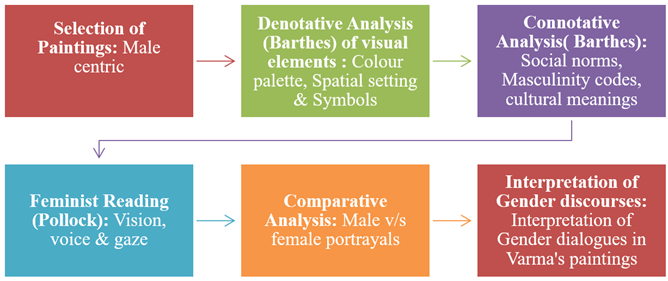
Figure 1
Method of Analysis
The study focuses on the select paintings by Raja Ravi Varma, such as The Student, Swords Man, Reading Newspaper, and Rajput Soldier, as they explicitly depict male figures and offer insights into their masculine identities and lifestyles of the period. These paintings highlight both private and social life scenarios that were common among the men. They intend to learn the visual elements that are found common in the select paintings when paralleled with his feminine portrayals, and closely read the visual elements, including colours, background and symbols.
The two theoretical frameworks intersect at two analytical levels: denotative and connotative. Denotative meanings operate at the primary level, while connotative meanings function at the secondary level to establish the initial visual impression that a viewer acquires when he or she looks at it. Pollock's feminist triads work on another analytical level, converging these interpretations to elucidate the real meaning, which functions within historical, cultural or the artist’s personal milieu, along with the significations.
Table 1
|
Table 1 Comparative Analysis |
|||||
|
No |
Visual
Elements |
Rajput Soldier (1901) |
Reading Newspaper (1904) |
Swords
Men (Undated) |
The Student (1904) |
|
1 |
Medium |
Watercolour on paper |
Oil
on board |
Watercolour on paper |
Oil
on canvas |
|
2 |
Pictorial
Content |
An idealised male figure, engaged in duty |
A
young man reading a newspaper |
A
heroic male figure in traditional attire, involved in his duty |
An
elite man ardently involved in learning |
|
3 |
Spatial
Setting |
Exterior |
Interior |
Exterior |
Interior |
|
4 |
Colour Palette |
Monochrome |
Monochrome |
Monochrome |
Monochrome |
|
5 |
Mood/
emotion |
Serious,
courageous, heroic |
Serious,
involved |
Serious,
vigilant |
Serious,
dedicated |
|
6 |
Symbols |
Gun |
Newspaper |
Sword |
Books |
Despite its analytical scope and innovative approach, the present study is subject to certain limitations. The use of visual semiotics and feminist theoretical frameworks, even when capable, can also create interpretive constraints and subjective opinions related to the analysis.
3. RESULT
The materials chosen for the study are the select male-centric paintings of Raja Ravi Varma produced in the early 1900s, namely Rajput Soldier, Reading Newspaper, Swords Man, and The Student. In examining the visual elements of the paintings, it is evident that all the paintings share consistency in the semiotics employed, specifically the colour palette, narrative restraint, emotional undertone, and spatiality. Semiotics in Linguistics is “the study of the social production of meaning from a sign system; the analysis of anything that can stand for something else” Griffin et al. (2012) Visual semiotics in a painting are the meaning-making tools that elevate and complete the idea being conceptualised. In the paintings, men and masculinity are depicted with serious emotional expressions, involvement and dedication to their duty, and the portrayal of their intelligence and responsibility. These paintings are minimal, realistic and lack sensual codes, which is a significant difference between his male and female conceptualisation. When paralleled with Varma’s feminine portrayals, his male portrayals are simple, restrict gazes, emotionally restrained, and narratively closed. This is a visual tactic employed by the artist to demonstrate the gender dialogues aligned to the concept of men and masculinity, which are associated with physical strength, responsibility, moral values and emotional interiority.
3.1. Denotative visual significations
According to Barthes, a denotative sign system is “a descriptive sign without ideological content” (Barthes (1977), p. 336). The select paintings, though they portray diverse social and cultural backgrounds, share consistent archetypes in their compositions. They include techniques, spatial setting or the background, colour palette and symbols.
Table 2
|
Table 2 Pictorial Structuring |
||||
|
Visual
structuring |
Rajput Soldier (1901) |
Reading Newspaper (1904) |
Swords
Men (undated) |
The Student (1904) |
|
Technique |
Realism |
Realism |
Realism |
Realism |
|
Spatiality |
Purpose-driven
exterior space |
Modest
interior setting |
Service-oriented
exterior |
Restrained
space |
|
Colour palette |
Subdued
colour palette |
Monochromatic
colour scheme |
Subdued
colour palette |
Monochromatic
colour scheme |
|
Symbols |
Sword,
gun |
Newspaper |
Sword |
Books |
The pictorial structuring of the male-centric paintings is extremely divergent when paralleling Varma’s women. The techniques applied to these paintings are realistic, with a blend of luminism. Luminism is a nineteenth-century Western art technique that can be defined as the soft rendering of light as a uniform glow to elevate the realistic traits of the painting The Art Story. (n.d.). The infusion of these art techniques can be seen as a deliberate attempt made by the artist in order to distinguish the aesthetic and social hierarchies that were prevalent in gender dialogues. Unlike the paintings of women, these paintings have controlled detailing, avoiding dramatic ornamentations, making it subtle and relatable. The colour palette adopted for the paintings is predominantly subdued or single-hued, hinting at the subtle emphasis on visual spectacle in male representations. While Varma’s women-centric paintings are essentially romantic and aesthetic, calling for ‘eye-up’ from the audience. In the visual strategies adopted, the techniques and colour schemes are interlinked. The spatial settings and the symbols are also intertwined, offering a detailed description of the male character's traits. The spatial organisation of the paintings, Rajput Soldier Varma (1901) and Swords Man Varma (n.d.), are functional exterior, and the symbols employed are the same, i.e., sword and gun. While the paintings Reading Newspaper Varma (1904a) and The Student Varma (1904b) have restrained interior setups, and symbols like books and newspapers, giving a glance at the private and individualistic life of men. Unlike the detailed and artistic backgrounds inVarma’s feminine representations, the spatial arrangement in the men’s portrayals limits elaborate narrative possibilities. The symbolic objects in these paintings are cues to the interpretation of men’s social as well as personal life, anchoring the idea of masculinity.
3.2. Connotative layers of the masculine signification
The text Rhetoric of the Image describes “The variation in reading is not, however, anarchic; It depends on the different kinds of knowledge- practical, national, aesthetic- invested in the image and these can be classified, brought into a typology” Barthes (1977). In line with this, the second tier of signification put forth by Barthes, termed ‘connotation’, is the meanings layered by social, cultural, religious, and gender ideologies. Connotative sign system can be defined as “ A mythic sign that has lost its historical referent form; without substance” Barthes (1977). The select portrayals of men are based on the societal and cultural ideals about men and masculinity, and therefore, these works are paradoxical to the conceptualisation of womanhood. In the cross-examination of Varma’s male figures, the overlapping imageries that can be found are their physical and intellectual capabilities. Unlike the feminine depictions, the characters are portrayed as disciplined, constrained, and inwardly looking, as if they are confined to their personal spaces and responsibilities. Varma’s women characters are constructed with an outward gaze, inviting onlookers' attention, while men are scarcely directed outward, and primarily their attention is diverted towards the tasks they are involved in or the objects that are kept in front of them. The absence of overt emotional expression and idealised bodily postures, and ornamentation positions the ideals of men as authoritative and unquestioned, while feminine depictions are constructed in a way demanding visual scrutiny on the basis of societal and cultural norms. This connotative restraint in the men’s depictions posits discrepancies in the understanding of men in paintings: when Varma’s men symbolise social and symbolic authority, their visibility remains narratively limited and aesthetically fleeting, when compared to Varma’s women.
3.3. Vision, Voice and Power in Varma’s Representation
Griselda Pollock explains the triads of gender dialogue in art history, identifying them as socially and historically constructed. The ‘vision’, ‘voice’, and ‘power’ are the three elements identified by Pollock in her analysis of gender discussions in art history Jakubowicz (2017). Pollock identifies ‘vision’ as beyond the biological act of seeing, they are altered by the cultural, ideological, religious and historical perspective Pollock (2003). Art does not simply reflect reality, but it constructs meanings. In Varma’s portrayal of men, the idea of masculinity is shaped by the patriarchal and colonial ideologies about gender roles. Rather than focusing on their physical appearance and dramatic background, Varma portrayed his male characters with the intellectual attributes of discipline, genius and responsibility. The Student is an example depicting the intellect of men; the character is depicted as if he is ardently reading the text, along with a few books placed near him. In these paintings, the primary idea of seeing is to observe rather than to gawk or to create sexual desire, like his feminine portrayals.
The second paradigm in the triad is ‘voice’, which in the literary landscape referred to the people who have the authority to speak, express, interpret and comment. In the context of art, it can be understood through the correlation between ‘representation’ and ‘agency’. In the brushstrokes of Ravi Varma, women characters are represented frequently, but in an idealised way. The women of Varma have ideal physical features, subtle emotional expression, traditional attires and are confined to the domestic setting, indicative of moral virtues prescribed in the texts like Manusmriti, which in turn suggests the voicelessness of women Yeasmin (2021). Pollock substantiates the notion that women artists were excluded from institutions, training and recognition and were also treated as historical subjects to speak about, who are not allowed to speak Pollock (2003). In art history, they are often objectified, while regarding Varma’s male characters, they seldom appear and are antithetical to the women’s visual construction. Varma’s men are seen as emotionally distant; they are involved in their activities and responsibilities, and no aesthetic elements can be seen in the paintings that invite gaze Dinkar (2014). In the select paintings, swordsman and Rajput soldiers are portrayed holding weapons; their physical stature indicates their physical capability as protectors. While the men in the paintings, The Student and Reading Newspaper portrays the intellect and the academic exposure that men used to have. In this instance, voice is not about the frequency of appearance or aesthetic appeal, but is embedded in action and symbolic representation. Thirdly, the indication of ‘authority’ or ‘power’ in the context of Varma’s male representation functions at the intersection of vision and voice. The cultural background in which the paintings are produced is essentially patriarchal; the idea of masculinity is considered an unmarked norm that needs no substantiation. Pollock sees:
Artist as the archetypal masculine personality structure, egomaniacal, posturing, over-identified with sexual prowess, sacrificing everything and everyone for something called art. Painting in particular is a quintessential masculine activity- a matter of making monuments to self Pollock (2003).
In the history of art, women have struggled against the given definitions and ideologies of femininity, which were created by men, but the identity and ideologies related to men were not questioned or misrepresented. Their authority and role in the social structure remained non-negotiated, reinforcing patriarchy. Thus, in the context of art history, power operates through the invisibility of males in canvases. Contrastingly, Varma appropriates artworks to reinforce authority aligned with men, leaving answers to the reason for the paucity of men's representation in canvases.
4. ‘INVISIBILITY’ AS GENDERED VISUAL STRATEGY
The analysis and synthesis of Barthesian visual signification and Pollock’s triad of ‘vision’, ‘voice’ and ‘power’, when applied to Varma’s oeuvre of masculine representation, contribute to a deeper understanding of the patterns and archetypes that coexist within the Indian socio-cultural context. The study sheds light on the contrasts the artist employs in the illustration of men and women, wherein men are constructed through visual restraint, a diverted gaze, functional spatiality and a monochromatic colour palette. The recurrence of the same archetypes in his portrayal of male figures reveals that the elusiveness of male characters is not accidental; rather, it functions as a reinforcement of male hegemony. When women are overtly represented in Varma’s painting, masculinity operates as self-evident and unquestioned, a situation that is suggestive of the colonial influence. To assert colonial superiority, colonial authorities introduced a framework of “civilisation” and “rationality” that redefined gender roles. Rather than resulting in empowerment, this framework reimposed marginalisation upon women through native patriarchal structures reinforced by colonial superiority. The painting titled The Student can be considered an exemplification of colonial influence. Ashai and Singh, in the 2016 article discusses that “upper-caste men adopted British education and administrative roles; they also absorbed and adapted Victorian ideals of womanhood-emphasising domesticity, chastity and obedience” Ashai and Singh (2025). This influence can be seen in Varma’s portrayal of men and women, as his female characters visually adhere to these virtues, while his men are idealised within the framework of masculinity shaped by Western ideals.
Comparatively, the rereading of Varma’s gender representation suggests that vision is not necessarily linked to power or authority, as men appear less frequently on his canvases than his female characters. The structural composition of male figures is contradictory: they are not aesthetically appealing, richly ornamented, or sensually embodied like women; yet they embody duty, intellectual authority, and moral virtue, thereby aligning with accepted societal norms. This observation validates the idea that ‘visibility’ does not necessarily signify power, and that elusiveness does not affirm weakness. For men, power primarily functions through normalisation. When integrated through Pollock’s triad, Varma’s male depictions and the broader elusiveness of men revealed the unquestioned authority they enjoy in society. This is the reason for men’s sparse appearance, and why male figures in male-centric paintings appear antithetical to the female prototypes. Rather than being perceived as objects, Varma portrayed men as archetypes of society's expectations; their diverted gaze is directed toward symbolic objects, reinforcing their authorised right to look. Secondly, the idea of ‘voice’ is articulated through the diverted gaze, symbolic objects, and the actions in which male figures participate. Thirdly, ‘power’ evolves from the privileges men enjoy in society; it operates through normalisation, invisibility and unquestioned authority, which explains why the absence of men in artworks often goes unnoticed.
5. CONCLUSION
In the Indian cultural context, Raja Ravi Varma and his paintings have a significant role in the development of Indian visual culture. Even though Varma was praised for his mythological translocation and divine portrayals, his paintings also address issues specific to the nineteenth and twentieth centuries in India. Varma’s conceptualisation of gender dynamics constitutes one of the most serious and overtly discussed topics in Indian art history. While Varma’s depiction of women is idealised and critiqued, his representation of masculinity remains underexplored, due to the limited number and the blunt depiction of men’s lives as they really are. When compared to his women's illustrations, the male-centric artworks lack aesthetic, romantic or dramatic visual elements inviting gazes from the viewers, which hints at the gender perceptions prevalent during the period. When Barthes's idea of visual signification is extended to the understanding of the elusiveness of men, Varma’s male representation shows that the denotative and connotative aspects that are traced from the paintings correlate with the idea of hierarchy that is intended to convey. When these significations reveal gender hierarchy and the allied privilege enjoyed by men in society, Pollock’s triad further reinstated this conceptual understanding. Through Varma’s male representations, the paintings reveal both the social and private lives of men, while simultaneously explaining the relative absence of male-centric paintings when compared to female portrayals. This absence is primarily because masculinity is associated with duty, responsibility, and grandeur, qualities that were perceived as requiring no visual demonstration. In the colonial period, paintings were adapted as a strong medium to propagate nationalist ideologies and gender archetypes were also disseminated, particularly related to womanhood. Raja Ravi Varma played a crucial role in setting up a prototype of gender within Indian art. It is because of the continuing belief in gender hierarchies that women's portrayals are subjected to massive visual scrutiny and men’s depictions are neglected.
So, based on the visual analysis, the study sheds light on the underexplored fact that men are privileged; their absence in the paintings is not negligence, but their invisibility and restraint as strategies claiming their authority. The limited number of academic interventions addressing masculinity in Indian art reflects the persistence of conventional gender perception, a phenomenon observable across cultures, specifically in the period of the nineteenth and twentieth centuries. This study highlights the narrative potential of the visual arts in normalising certain conventional ideologies, and it also reiterates the need to interrogate what is unseen, specifically related to gender. Therefore, through the examination, the study indicates that the absence of male representations when compared to women’s depiction is not natural, but it is constructed to normalise men’s authority, which is circulated across years.
CONFLICT OF INTERESTS
None.
ACKNOWLEDGMENTS
None.
REFERENCES
Ashai, I., and Singh, P. (2025). The Impact of Colonial Rule on Indian Women: Social Reforms, Economic Participation, and Resistance (1800–1947). International Journal of Creative Research Thoughts (IJCRT), 13(5), h626–h633.
Barthes, R. (1977). Rhetoric of the Image (S. Heath, Trans.). In Image–Music–Text (32–51). Hill and Wang.
Dinakar, N. (2010). Masculine Regeneration and the Attenuated Body in the Early Works of Nandalal Bose. Oxford Art Journal, 33(2), 167–188. https://doi.org/10.1093/oxartj/kcq013
Dinkar, N. (2014). Private Lives and Interior Spaces: Raja Ravi Varma’s Scholar Paintings. Art History, 37(3), 510–537. https://doi.org/10.1111/1467-8365.12085
Dochania, R., and Dochania, A. (2025). Burdened by Masculinity: Exploring Men's Discrimination in India through the Lens of Hegemonic Masculinity. Journal of Psychosexual Health, 7(4), 392–397. https://doi.org/10.1177/26318318251334872
Griffin, E. M., Ledbetter, A., and Parks, G. (2012). Semiotics of Roland Barthes. In A First Look at Communication Theory (10th ed., 336–337). McGraw-Hill Education.
Groff, A. (2025). Hegemonic Masculinity | Research Starters. EBSCO.
Jakubowicz, K. (2017). An Analysis of Griselda Pollock’s Vision and Difference: Feminism, Femininity and the Histories of art (1st ed.). Macat International Ltd. https://doi.org/10.4324/9781912284795
The Art Story. (n.d.). Luminism Movement Overview. Retrieved January 22, 2026, from
Mehta, K. (2024). Looking Through His Eyes: Women in Raja Ravi Varma’s Paintings. Research Journal of English (RJOE), 9(3), 499–507. https://doi.org/10.36993/RJOE.2024.9.3.507
Nair, L., and Vinayakaselvi, M. A. (2025). Shifting Gender Norms and Sexuality Questions Towards Transforming Womanhood in Ravi Varma’s Paintings. Shodhkosh: Journal of Visual and Performing Arts, 6(2), 111–118. https://doi.org/10.29121/shodhkosh.v6.i2.2025.5998
Pollock, G. (2003). Vision and Difference: Feminism, Femininity and the Histories of Art. Routledge.
Pradhan, R. (2025). Echoes of Male Beauty in Indian Art and Culture.
S, P. (2025). Impact of Art of Raja Ravi Varma in Pre-Independence India. International Journal for Multidisciplinary Research (IJFMR), 7(4), 1–5. https://doi.org/10.36948/ijfmr.2025.v07i04.50326
Sharma, M., Gupta, I., and Jha, P. N. (2016). From Caves to Miniatures: Portrayal of Woman in Early Indian Paintings. 6(1), 22–42.
Varma, R. R. (1901). Rajput Soldier [Painting].
Varma, R. R. (1904a). Reading Newspaper [Painting].
Varma, R. R. (1904b). The Student [Painting].
Varma, R. R. (n.d.). Swords Man [Painting].
Yeasmin, N. (2021). Position of Women with Special Reference to Manusmriti. In Haridra (Vol. 2, 54–60). https://doi.org/10.54903/haridra.v2i07.7772
|
|
 This work is licensed under a: Creative Commons Attribution 4.0 International License
© ShodhKosh 2026. All Rights Reserved.