ShodhKosh: Journal of Visual and Performing ArtsISSN (Online): 2582-7472
|
|
Shadows of Sundarbans: Unmasking Class Conflict in Bhoma
Vrinda Goel 1
 ,
Dr. Akhilesh Kumar Dwivedi 2
,
Dr. Akhilesh Kumar Dwivedi 2
1 Research
Scholar, Education and Humanities, Manav Rachna University, Haryana, India
2 Associate
Professor, Education and Humanities, Manav Rachna University, Haryana, India
|
|
|
ABSTRACT |
|
|
This paper
offers a Marxist reading of Badal Sircar’s Bhoma,
examining the plight of the marginalised class who harbour for a better future yet face unfulfilled promises
from the government. It sheds light on the fact that how the ecological and
human habitat of Sundarbans is threatened by the demands of technological
advancements and cultivation. It focusses on how Sircar’s Third Theatre
challenges and resists capitalist exploitation while advocating for
solidarity and collective action among the oppressed. Through this theatre,
Sircar aims to move beyond the proscenium theatre to create a more flexible
and accessible theatre. According to Marxists, power is monopolised
by the dominant class which owns the forces of production. This ruling class
uses power to exploit and oppress the proletariat class. In this paper, we
intend to reflect upon how theatre becomes a form of resistance against the
dominant class and interpret the broader implications of proletariat class to
understand the role of marginalised in the
contemporary society. |
|||
|
Received 02 February 2026 Accepted 10 March 2026 Published 28 March 2026 Corresponding Author Dr.
Akhilesh Kumar Dwivedi, akhilesh@mru.edu.in DOI 10.29121/shodhkosh.v7.i2s.2026.7135 Funding: This research
received no specific grant from any funding agency in the public, commercial,
or not-for-profit sectors. Copyright: © 2026 The
Author(s). This work is licensed under a Creative Commons
Attribution 4.0 International License. With the
license CC-BY, authors retain the copyright, allowing anyone to download,
reuse, re-print, modify, distribute, and/or copy their contribution. The work
must be properly attributed to its author.
|
|||
|
Keywords: Drama, Marxist Theory, Power, Politics, Class
Conflict |
|||



1. INTRODUCTION
Badal Sircar (1925-2011), a first-generation post-independence playwright known for formulating Third Theatre, is highly appreciated for his innovative style of technique. His focus on contemporary situations and societal problems to depict the life of a modern person sets him apart from other dramatists. The recurrent themes in his plays include the hollowness of existence, tolerance and the subjugation of working-class people in Calcutta and the rural areas of Bengal. Sircar is an Indian playwright known for people’s theatre, a theatre supported by people and not only performed by the people Dass (1988). He started his career in the late 1950s and initially emphasized on domestic comedies and science fantasies. Earlier he wrote plays to amuse his friends in a club called Chakra (group comprises of people who did not take theatre seriously and took it as a form of entertainment). However, he later moved away from Western theatre as he felt restricted by its conventions. Sircar aimed to make theatre a medium for social and political change and prioritized making it affordable to audiences. For this he formed Third Theatre which engaged in free and direct communication with the audience in an intimate setting. The aim of Sircar was to remove the third wall that existed between the actor and the audience to make theatre more relatable.
Some of his notable works include Evam Indrajit, Baki Itihas, Shesh Nei, Spartacus, Procession, Bhoma and Stale News. In his later plays, Sircar’s theatre moved from the proscenium to the space theatre (aanganmanch), open theatre and street theatre. For him, theatre is a collective exercise of the performers and audience to bring out the questions faced by the society and let them find answers on their own Mudi (2007). His theatre combined elements of city theatre and indigenous folk theatre. He viewed city theatre as commercial and aimed at drawing money from the audience while the latter was open and free to watch. Sircar's goal was to utilize every form of theatre in shaping the themes and structure of his plays.
The objective of this paper is to explore the plight of oppressed people in the play Bhoma. Through the character of Bhoma, Sircar scrutinizes societal norms perpetuating class-based injustices, shedding light on the oppression and silencing of marginalised within the broader narrative. The paper endeavours how the play explores the impact of uncontrolled ambition and moral compromises in the pursuit of power, especially within a capitalist society, from a Marxist perspective. Also, it examines Sircar’s portrayal of working-class people within the postcolonial Indian context, unravelling the layers of their experiences and providing insights into the broader narrative of their role in the contemporary society.
2. METHODOLOGY
Figure 1
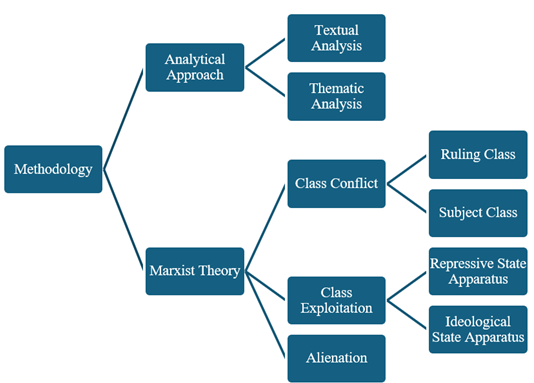
Figure 1 Theoretical Framework
As shown in Figure 1, this section of the
study provides a brief overview of application of appropriate literary theory-
Marxism to understand the role of marginalised in the society. The paper adopts
an analytical approach to interpret the thematic
concerns of the play focusing on how the playwright has used dramatic
techniques, such as characterization and dialogue to endorse the plot
construction.
Propounded by Karl Marx and Friedrich Engels, Marxist theory offers a critical analysis of power dynamics, focusing on the inherent conflict between social classes. According to Marxists, power is monopolised as the quantum of power is fixed in the society. The ruling class possess the power and controls the forces of production. This class has the power to dominate the economic base as well as the superstructure in the society. Base indicates the factors and relations of production while Superstructure refers to the law, literature, arts, religion etc. The dominant class exercises this power to promote and protect their self- interests. This results into conflicting of interests between the dominant and the subject class. The gap between them gets increased which results in inequalities, poverty and the exploitation.
Antonio Gramsci, a Marxist philosopher coined the term subaltern in his work Prison Notebooks (1973). For him, those people who are outside of hegemonic structure are considered as subaltern people Gayatri Chakravarty Spivak, an Indian literary critic, refined this term by stating that the subalterns are meant to be removed from all the lines of social mobility. The characters in the play are indulged in various kinds of processions because these people do not have a voice of their own. They have to face humiliation in society as the dominant class gains power over them. Another Marxist philosopher Louis Althusser sheds light on how the exploitative power relations are maintained within society. For him, it is state that protects and promotes the interest of ruling class. He talks about two apparatuses: Repressive State Apparatus and Ideological State Apparatus. The former one includes police, administration and army. These forces use power in the form of coercion to protect the interests of ruling class. The latter one controls the minds of innocent people through indoctrination. This is a subtle form of power as the minds of people are corrupted by the agencies of socialisation present in superstructure.
In the play Bhoma, the theme of class conflict is deeply
explored, highlighting the societal divisions based on conflicting interests
between different classes. Through the character of Bhoma,
the playwright conveys the inherent clashes between these classes, emphasizing
their significance in a capitalist society. The play brings attention to how
the material conditions of society profoundly influence the lives of
individuals, reflecting the profit-driven ruling class that exploits the
working class by offering minimal wages in return for maximum productivity.
This exploitation leads to the alienation of the working class, subjecting them
to the dehumanizing impacts of capitalism. Additionally, the play delves into the theme of alienation,
providing a platform for the audience to critically ponder over the social and
economic issues depicted. The fragmented narrative style of the play adds
another layer through which the audience can engage critically with its themes.
These effects collectively hint at the possibility of a revolutionary uprising
from the working class, suggesting a potential for change within the societal
structure. The play effectively endeavours to provoke contemplation on these
significant societal issues.
3. RESULTS AND DISCUSSION
3.1. INNOVATIVE TECHNIQUES OF BADAL SIRCAR
Badal Sircar is known for his unique style of addressing contemporary issues through his own theatre. This theatre is influenced by Jerzy Grotowski’s Poor Theatre. Developed in 1960’s, it is characterized by its minimalist approach and its focus on the actor's physical and psychological exploration. It aims to strip away the conventions of traditional theatre, such as elaborate sets, costumes, and lighting, to create a more intimate and direct experience for the audience. In an interview, he says we never use any kind of style or choreography for the sake of style. Never use any kind of sound for the sake of it, but only movements and the body play a vital role. We never used body movements unrelated to theme or content Sircar (2009c). Veena Noble Dass has rightly quoted this in her work about the style and technique of Sircar. Sircar has always made use of different theatres for the formation of his thematic contents and the structure of plays. For instance, Open Theatre emphasizes on actor, Environmental Theatre focusses on different kinds of setting, Round Theatre emphasizes on the audience in action and the Absurd Theatre. These are some of the theatres which have deeply influenced Sircar for the formation of his own theatre. He says, we adopted the concept of Poor Theatre in the literal sense that is inexpensive theatre. Our group was poor, so our countrymen but we wanted to utilize poverty and turn into an advantage instead of a restriction Bharucha (1983).
Table 1
|
Table 1 Major Plays of Badal Sircar and Their Socio-Political Concerns |
|||
|
Play Title |
Year |
Theatrical Phase |
Socio-Political Issues |
|
Evam Indrajit |
1963 |
Proscenium Theatre |
Hollowness of
middle-class, disillusionment |
|
Baki Itihas |
1965 |
Proscenium Theatre |
Domestic Comedy
juxtaposed with bleak vision of history |
|
Shesh Nei |
1969 |
Proscenium Theatre |
Unspecified
guilt/crime, sequel to Evam Indrajit |
|
Spartacus |
1973 |
Third Theatre Phase |
Historical Revolt,
struggle against oppression |
|
Michhil (Procession) |
1974 |
Third Theatre Phase |
Capitalism,
exploitation of common people, corruption, various types of social
processions |
|
Bhoma |
1976 |
Third Theatre Phase |
Oppression of rural
peasantry, socio-political issues |
|
Basi Khabar |
1979 |
Third Theatre Phase |
Santhali revolt, colonial suppression, police violence,
bonded labour and resistance |
3.2. rEADING OF bHOMA
The play first performed on 21st March 1976 can be considered as a group effort as all the members of Satabdi group contribute to create images out of their own experiences and feeling. Sircar heard the story of Bhoma from Tushar Kanjilal, headmaster of Rangabelia village school. The play was written in the 1960s, a period of significant social and political upheaval in India. The country had recently gained independence from British colonial rule and was grappling with the challenges of nation-building and modernization. The euphoria of independence soon gave way to disillusionment as the realities of poverty, inequality and social injustice became apparent. The 1960s were also a time of economic crisis and political instability. The country experienced several famines, and the government struggled to address the needs of its growing population. The political landscape was characterized by factionalism and corruption, leading to a sense of disillusionment and cynicism among the people. Additionally, the Naxalite Movement, which was about to end in the 1970s, led to the public killing of many young people. Sircar wrote the play with all these realities in mind. He was a member of the Indian People’s Theatre Association (IPTA), a progressive theatre movement inspired by Marxist ideology. The IPTA sought to use theatre as a tool for social change advocating for the rights of the working class and marginalized sections of society. Sircar’s plays including Bhoma, reflect the influence of the IPTA and its commitment to social justice. Bhoma was written at a time when Indian theatre was undergoing significant transformation. The dominance of commercial theatre which focused on entertainment and escapism was being challenged by a new generation of playwrights who were interested in exploring social and political issues. Sircar was a leading figure in this movement, and his plays were characterized by their experimentalism and their willingness to confront difficult subjects.
Bhoma is an open-ended play with no clear plot, storyline or defined characters. Sircar skilfully uses collage techniques to connect scenes in the streets of Calcutta through various episodes. Through this, Sircar aims to influence the audience’s mindset and provoke rational thinking. He makes use of modernist techniques like montage, simultaneity, collage, discontinuity, repetitions etc to give audience a chance to think critically. The play effectively establishes a connection between the audience and the actors, as the audience is seated around the room or courtyard, and the actors directly engage with them.
The play addresses socio-political issues such as violations, exploitation of common people, oppression of rural peasantry by the dominant class, and corruption in society. According to Sircar, the root cause of these issues is capitalism. There are six anonymous characters named One, Two, Three, Four, Five and Six. These characters indicate various problems prevailing in modern society. The play Bhoma confronts the dichotomy between urban and rural life in India. Bhoma like Khoka becomes the allegory of deprived and describes the exploitation of anonymous rural peasantry. It throws light on the problems faced by rural peasantry who are not getting access to their basic rights. Additionally, these people are forced to face the ecological imbalance as the ecological and human habitat of Sunderbans is threatened by the demands of urban expansionism, and cultivation, and wildlife have been preying on indigenous communities.
3.3. cLASS cONFLICT
The play Bhoma makes use of irony to throw light on the situations of rural peasantry. The playwright believes in making indirect references to aware people about the conditions of the needy people. For many years, the marginalised section of society has faced exploitation in terms of unequal distribution of wealth, unfair access to resources, racial discrimination, exclusion from the mainstream, unequal opportunities, and imbalance power. They are deprived of basic rights and are humiliated from time to time. According to Karl Marx, the history of all hitherto existing society is the history of class struggles Marx (1988). This reflects Marx’s central argument that all societal change is driven by conflict between different social classes, particularly the bourgeoisie and the proletariat. In Bhoma, class conflict is a central theme, illustrating the exploitation of the rural poor by wealthy classes and capitalist structures. Bhoma, the protagonist represents the downtrodden peasantry whose labour sustains the wealth of the landowning class, yet he remains trapped in poverty and hardship. It reflects upon how capitalists extract surplus value from the labour of workers. For instance:
· TWO: We need fertilizers give us fertilizers we need seeds give us seeds we need water give us water we need seeds...
· FOUR: There is nothing, nothing nothing ....
· ONE: No water no fertilizer no seeds no land no food no clothes no work no water. Sircar (2009a)
Bhoma works tirelessly on the land, but his labour is appropriated by the landlords and the state reflecting Marx’s theory of surplus value. The labourer’s work produces more value than he is compensated for, enriching the owners of the means of production. The novel Untouchable (1935) by Mulk Raj Anand sheds light on the harsh treatment of Dalits endured by the lower castes under the British colonial rule. It talks about the socio-political and economic changes in India, focusing on the brutal realities faced by Dalits. For instance, there was no provision for lights in the sweepers’ streets. So, most of the inhabitants compensated themselves for the lights spent in utter darkness amid the smoke of smouldering hearth fires in their small, congested houses by spending the most of their time in the open air Anand (2009). This passage highlights the degrade living conditions and systemic neglect of Dalits in the society. Bhoma’s exploitation is not just a personal suffering but representation of systemic injustice, reflecting the economic structures that keep the rural poor in a subservient position. The discussion between the characters implies that Bhoma is not a single person but represents the entire community of peasantry:
· ONE: I don’t fully know who he is. I’ve never seen him ... I’ve only heard of him.
· FOUR: Only heard of him?
· ONE: Yes. Only heard of him ..... I’ve come to know that Bhoma exists. Earlier, I didn’t even know that.
· OTHERS: Shut up. Don’t talk rot. Sircar (2009a)
The play highlights how capitalism relies on the exploitation of the working class for its survival. Additionally, Bhoma’s continued exploitation in independent India underscores the failure of political independence to address economic disparities. While the country gained sovereignty from colonial powers, the socio-economic structures perpetuating inequality remain largely unchanged, criticizing not only capitalism but also the post-colonial state’s inability to fulfil promises of social justice and economic equality. The play Mother Courage and Her Children (1939) by Bertolt Brecht is set during the Thirty Years’ War in Europe. It follows Mother Courage, a canteen woman who profits from the war but suffers personal losses along the way. Through this narrative, Brecht critiques the capitalist systems that exploit the poor and working-class during times of war, showing how the marginalized are often trapped in cycles of violence and exploitation while the wealthy profit from conflict. Also, in his play Procession, Sircar sheds light on the similar issue. Characters like Khoka, the Old Man represent different segments of society, each grappling with the consequences of a system that favours the bourgeoisie over the proletariat. The characters often remain unaware of the systemic injustices affecting their lives, distracted by superficial concerns and unable to see the underlying power structures controlling their destinies. The conversation between the youth and political leader throws light on how the youth of the country are fooled by the greedy pollical leaders:
· ONE: FIVE:
· ONE: FIVE:
· Of course! (With an oratorical flourish) Give me blood, I’ll give you jobs.
Who are you speaking to?
The youth power of the nation (shouting) Give me blood, I’ll give you permits.
Will they come?
What do you mean ‘will come’? They are coming. They have come! Long hair blowing, sideburns bristling .... there they come like tornado, in youthful ecstasy .... Give me blood, I’ll give you a kingdom. Sircar (2009a)
3.4. sENSE OF ALIENATION
The
exploitation that these people face make them alienated in the society. “The
worker becomes all the poorer the more wealth he produces, the more his
production increases in power and size. The worker becomes a cheaper commodity
the more commodities he creates” Marx (1988). He discusses how workers
become alienated from the products of their labour under capitalism, leading to
a sense of disconnection and powerlessness. In the play the characters seem to
be alienated from their surroundings. Despite working tirelessly on the
land, Bhoma has no ownership or control
over what he produces. His labour serves to enrich others leaving him with
little more than subsistence wages. This reflects Marx’s idea that under
capitalism, workers are alienated from the results of their work as the fruits
of their labour are appropriated by the capitalist class. Bhoma
is alienated from the society in which he lives. The play frequently contrasts
the experiences of the urban middle class with those of the rural poor,
highlighting how the latter are invisible and voiceless in the broader social
and political contexts. Bhoma’s suffering
is ignored by those in power, and even by well-meaning urbanites who are
disconnected from the realities of rural life. They feel so disconnected and
engage in absurd conversations. For instance, the characters discuss
regarding the nature of blood of fish, human beings and dinosaurs:
· ONE: Theory of Evolution. Darwin. Had man’s blood not grown cold, he wouldn’t have survived. ...... Died. Become extinct, like the dinosaurs. Sircar (2009a)
This kind of conversation is again highlighted in the play when the characters are involved in the discussion of human blood. The character one says that human blood is cold. The others put forward their disagreement regarding this. These type of conversations amongst them reflect the prevailing situation in the society:
· ONE: The blood of man is cold.
· FIVE: It’s a lie. In India men’s blood boil, when bloodthirsty Pakistan attacks India.
· TWO: When imperialist China attacks India!
· THREE: When the Indian cricket team loses a test match.
· FIVE: In Calcutta men’s blood boil ...
· SIX: When they keep on promising to telecast but don’t – Sircar (2009a)
The authorities have time to address other issues prevailing in the society but ignore the issues faced by the rural peasantry of the country. The blood of such people becomes cold towards the problems of marginalised section of the society. “The history of the proletariat in England shows that the lower classes are always driven into revolution by misery, while the higher classes do everything to preserve their privileges” (Engels 48). He highlights how class conflict is inevitable as the upper class seeks to maintain its wealth and power, while the oppressed class fights back due to its worsening conditions. Sircar deliberately uses disjointed episodes in order to reflect upon the disjointed nature of these oppressed people. Sircar was a master of shifting topics from one topic to the other. He masters the technique of how the read the minds of the audience. To avoid any boredom during the performance he adds some comic relief. The reason is to keep the audience engaging so that they are able to relate what Sircar wants to communicate through the play. For instance:
· THREE: You know, I fell in love with a girl ... No, no, a girl fell in love with me – I mean .... a love fell in me – a girl – I her – that is that girl – my love – I love a girl .... Sircar (2009a)
Through the comic version of love as presented by Three, Sircar wants to present the fact that amidst all the tensions that a modern common people have to encounter in their life, there are certain farcical elements too in their life which help them to escape form the situation for a while. Despite all the challenges that the marginalised section faced, Sircar emphasis on the need for collective action and revolutionary change. “The challenge of modernity is to live without illusions and without becoming disillusioned, to find new ways of thinking and new ways of struggling for change” (Gramsci 276). He emphasizes the importance of intellectual and cultural struggle in bringing about revolutionary change, moving beyond traditional economic theories. In contrast to other literary works that focus on individual characters and their personal journeys, Bhoma presents its protagonist as a symbol of the wider peasantry, suggesting that the solution to his plight lies not in individual action but in collective struggle.
3.5. RELEVANCE TODAY
The Marxist interpretation of the play in terms of class
conflict, alienation, exploitation provide insights into the context of
postcolonial India and the systematic oppression at the global level. It gives
exposure to the exploitation faced by the rural people of Sunderbans.
Bhoma’s exploitation is not seen as an
individual experience but a collective experience. This suggests the inherent
injustices in a capitalist society especially during postcolonial contexts
where economic power is concentrated in the hands of a few. The Indian freedom
from the British only indicates the political freedom while the economic
freedom for the working-class remains on the verge of struggle. The
disconnection between the urban and the rural people is a result of the effects
of capitalism. For Sircar, capitalism is one of the biggest enemies
irrespective of colonialism or independence. The statement, “During the
colonial period the people are called upon to fight against oppression; after
national liberation, they are called upon to fight against poverty, illiteracy
and underdevelopment. The struggle, they say, goes on. The people realize that
life is an unending contest” Fanon
(1963) holds the similar
view. The rural poor are not only economically marginalized but also culturally
and politically isolated from society. The estrangement feels by Bhoma represents the broader alienation of the
working class. Sircar’s play goes beyond depicting individual suffering and
highlights the necessity of collective action to overcome systemic
exploitation.
Bhoma’s story serves as a call for the rural poor and working classes to unite in resistance against the capitalist system. Along with Bhoma, other characters will also join hands to overcome the present situation. Towards the end, the character One picks up an imaginary axe and starts getting rid of all the poisonous trees around him:
· ONE: Strike men – heave ho! Cut down the forests – heave ho! The poisonous forests – heave ho! Bhoma’s axe – heave ho! Purge the poison – heave ho! .... The fire’s there in Bhoma’s eyes – heave ho! Heave ho! The fire burns – heave ho! Sircar (2009a)
Throughout the play, Bhoma’s suffering is presented as part of a larger systemic problem. The play’s depiction of the peasantry’s exploitation and alienation serves as a call to arms, urging the audience to recognize the need for collective action to overthrow the structures of oppression. In this way, Bhoma aligns with Marxist principles of revolutionary change, which argue that the working class must unite and rise up against the capitalist system. Bhoma is a play that “demands a revolutionary change in the way society is structured” Bhatia (2004). Sircar’s Marxist vision is not simply a call for charity or reform; it is a call for a fundamental restructuring of society along socialist lines, where the means of production are controlled by the workers, not the capitalist class. Bhoma’s plight is thus not just an individual tragedy, but a symbol of the need for collective action and systemic change. Sircar’s depiction of Bhoma’s exploitation resonates with current debates about land dispossession, corporate control, and the marginalization of rural and indigenous communities in both India and globally.
By connecting Bhoma’s struggles to modern-day concerns, the study shows how the same capitalist structures that oppressed the rural poor in the 1970s continue to operate today. The ecological destruction caused by capitalist development, reinforces the idea that Bhoma is not only a critique of economic inequality but also of the environmental consequences of capitalism. The media plays an important role here as it is a part of ideological state apparatus. Its function is to shape the thinking process of the people and reinforcing the interests of the ruling class. Within the context of Bhoma, media plays a critical role in perpetuating the invisibility of marginalized groups like Bhoma and rural labourers. The struggles of these people go unnoticed by the urban class and only the interests of ruling class are given importance. Due to this, their struggle remains sidelined in public while media focuses on the narratives that digresses these issues. The potential solution to such thing would be that if rural people like Bhoma represent in the alternative media (media is a reaction against the mainstream narratives which submerges the voices of marginalised people in the society), their voices could become heard, and struggles could become visible. This kind of media which challenges the conventional narratives, can help in exposing the harsh realities of these people and provide a platform to them to put forward their stories which could be seen as a step towards social and political change.
4. conclusion
Badal Sircar’s play Bhoma provides a strong critique of post-independence Indian society exposing widespread exploitation, alienation, and oppression. The play employs theatrical techniques from a Marxist perspective to emphasize the class struggle and the contradictions of the capitalist system. The character of Bhoma metaphorically represents the fragmented and disoriented state of post-independence India, reflecting the aimlessness and confusion prevalent in society. The characters often remain oblivious to the systemic injustices affecting their lives, distracted by superficial concerns and unable to perceive the underlying power structures controlling their fates.
Despite considerable economic and social progress, inequality and class struggle persist in many parts of the world. The play’s exploration of these themes offers valuable insights into the enduring power dynamics shaping societies. The exploitation of the working class by the ruling class echoes the experiences of many people today shedding light on how governments prioritize their own interests over the welfare of their citizens. Furthermore, the play’s examination of the link between economic development and environmental degradation is especially pertinent in today’s world, where climate change and ecological crises pose significant global challenges. Bhoma underscores the interconnectedness of social and environmental issues and the necessity of a more equitable and sustainable approach to development. The play’s exploration of cultural and social alienation continues to resonate with individuals who feel disconnected from their communities and broader society. Bhoma delivers a potent critique of the dehumanizing effects of consumerism and materialism. By analysing the play's themes through a Marxist lens, one can gain a deeper understanding of the systemic forces shaping our societies and the potential for social and political change.
CONFLICT OF INTERESTS
None.
ACKNOWLEDGMENTS
None.
REFERENCES
Anand, M. R. (2019). Untouchable. Mehta Publishing
House.
Bharucha, R. (1983). Rehearsals of Revolution. Seagull Books.
Bhatia, N. (2004). Acts of Authority/Acts of Resistance: Theatre and Politics in Colonial and Postcolonial India. University of Michigan Press. https://doi.org/10.3998/mpub.17085
Brecht, B. (1980). Mother Courage and Her Children (J.
Willett, Trans.). Methuen Drama.
Dass, V. N. (1988). Modern Indian Drama in English Translation. Taurus Printers.
Engels, F. (2009). The Condition of the Working Class in England (F. K. Wischnewetzky, Trans.). Penguin Classics. https://doi.org/10.1093/owc/9780199554652.003.0151
Fanon, F. (1963). The Wretched of the Earth (C. Farrington, Trans.). Grove Press.
Fatima, K. (2013). Post-Colonial Content in the Plays of Badal Sircar. Journal of Literary Exploration, 1(2), 207–215.
Gramsci, A. (1971). Selections from
the Prison Notebooks (Q. Hoare and G. Nowell Smith, Trans.). International
Publishers.
Marx, K. (1988). Economic and Philosophic Manuscripts of 1844 (M. Milligan, Trans.). Prometheus Books.
Mudi, A. (2011). Badal Sircar. Indian Literature, 55(5), 35–38.
Sircar, B. (2009a). Three Plays: Procession, Bhoma, stale news (B. Sircar and K. Ghose, Trans.). Seagull Books.
Sircar, B. (2009b). On Theatre. Seagull
Books.
Sircar, B. (2009c). Two plays: Indian History Made Easy / Life of Bagala (S. Sarkar, Trans.). Oxford University Press.
|
|
 This work is licensed under a: Creative Commons Attribution 4.0 International License
© ShodhKosh 2026. All Rights Reserved.