ShodhKosh: Journal of Visual and Performing ArtsISSN (Online): 2582-7472
|
|
Digital Soundscapes of Well-Being: A Study of Positive Psychological Outcomes of Motivational Podcast Consumption
Venkatesh M. 1
 ,
Dr. Sripriya M. 2
,
Dr. Sripriya M. 2 ,
Rajkamal N. 3
,
Rajkamal N. 3
1 Full-Time
Research Scholar, Department of Communication, PSG College of Arts and Science,
Coimbatore, Tamil Nadu, India
2 Assistant
Professor, Department of Visual Communication and Electronic Media, PSG College
of Arts and Science, Coimbatore, Tamil Nadu, India
3 Part-Time Research Scholar, Department of Communication, PSG College of Arts and Science, Coimbatore, Tamil Nadu, India
|
|
|
ABSTRACT |
|
|
Purpose: This research examined the effect of motivational podcasts in Tamil on the positive psychological well-being of Tamil college students in Tamil Nadu. It analyses the way in which exposure to motivational audio material, especially Oru Cup Confidence, Maname Nalama, and Leader - Rajmohan can result in optimism, resilience, and self-efficacy through Positive Psychology Seligman and Csikszentmihalyi (2000). Design/Methodology/Approach: Quantitative cross-sectional design was adopted and 250 college students of Coimbatore, Tamil Nadu were involved. A structured questionnaire on frequency of podcast listening, optimism, resilience and self-efficacy was used to gather data between June and October 2025 on a five-point Likert scale. The correlational and regression analysis was used to study the relationships between the listening to the podcast and well-being outcomes. Findings: The findings showed a high positive relationship between motivational podcast listening and psychological well-being (r =.62, p <.001). It was found that optimism, resilience and self-efficacy were greatly predicted by listening frequency (b =.58, p <.001). Emotional stability and goal orientation were higher among regular listeners than occasional and random listeners. Originality/Value: This study
offers factual information regarding the psychological strength and hope in
the minds of young people through Tamil inspirational podcasts. This
highlights the promise of vernacular digital media as a tool of mental
wellness promotion of students in India that can be affordable and culturally
relevant at the same time. |
|||
|
Received 22 November 2025 Accepted 09 March 2026 Published 27 March 2026 Corresponding Author Venkatesh
M., 22pmcf02@psgcas.ac.in DOI 10.29121/shodhkosh.v7.i2s.2026.7129 Funding: This research
received no specific grant from any funding agency in the public, commercial,
or not-for-profit sectors. Copyright: © 2026 The
Author(s). This work is licensed under a Creative Commons
Attribution 4.0 International License. With the
license CC-BY, authors retain the copyright, allowing anyone to download,
reuse, re-print, modify, distribute, and/or copy their contribution. The work
must be properly attributed to its author.
|
|||
|
Keywords: Motivational Podcasts, Positive Psychology, Optimism,
Resilience, Self-Efficacy, Tamil Nadu, Digital Well-Being |
|||



1. INTRODUCTION
The digital audio broadcasting systems have transformed the way people access information and motivation. Among them, inspirational podcast-short, story-based audio stories that aim to encourage personal growth have become especially popular amongst young adults. Compared to traditional media, the episodes of the podcasts are more intimate, flexible, and relatable, which is why they are the best means to convey the motivational content Berry (2016), Meden et al. (2024).
India is one of the top 5 podcast markets in the world with Tamil language programs having a distinct market niche in self-help and motivation. The Oru Cup Confidence (RJ Sha), Maname Nalama and Leader Rajmohan programs have thousands of listeners listening to them weekly via Spotify and YouTube. These performances are based on the real-life experiences and cultural idioms to give the students hope and purpose.
College students are encountering stressful academic pressure. In this regard, the scientific study of human strengths and flourishing, which is called positive psychology, can provide the framework of how motivational content can foster optimism, resilience, and self-efficacy Seligman and Csikszentmihalyi (2000). The informal but effective well-being interventions that may be provided through motivational podcasts may be the accessible narrative form.
Although there is world evidence of the relationship between podcast episodes and engagement and learning Palenque (2016), there is not much information on how these episodes have influenced the well-being of young Indians. This research paper fills this gap.
1.1. Objectives
1) To examine the connection between positive psychological well-being and motivational podcast listening.
2) To evaluate the prediction of optimism, resilience, and self-efficacy by listening frequency.
3) To investigate the implications to the educator and content creator to promote digital well-being.
2. Review of literature
As a versatile digital audio item, podcasts have developed as a tool of accessibility and emotion-finding to facilitate learning and well-being. The recent research points out their use in the informal education sector, where audio stories encourage knowledge retention and motivation due to the self-paced consumption Berry (2016), Meden et al. (2024). Podcasts are useful in the tertiary educational system as they can make the students more enthusiastic and motivated to learn, becoming an addition to conventional approaches König (2021). This is consistent with the wider trends in digital media, where audio formats foster psychological gains by establishing parasocial relationships and cultural salience especially in contextual diversity such as in India.
Positive psychology offers a fundamental prism in which the strengths are flourishing and emotional development Seligman and Csikszentmihalyi (2000). The broaden-and-build theory developed by Fredrickson assumes that positive emotions enlarge cognitive resources, which accumulate resilience in the long term Fredrickson (2001), Fredrickson (2013). Positive psychological interventions (PPIs) through apps and Web platforms are applied digitally, but with essential benefits as these schemes greatly increase well-being indices such as hope and gratitude and decrease stress and negative emotions in young people Saboor et al. (2024). Interventions such as mindfulness and optimism exercises have moderate effects, and better effects in young adults and nonclinical environments.
The motivational content is interrelated with central constructs, which are optimism, resilience, and self-efficacy. Optimism is associated with greater coping and persistence, which is witnessed in how digital media can improve psychological flexibility to boost the wellness of Gen Z Song et al. (2024). Through resilience and supported by social support and the digital space, young learners can overcome their difficulties, including political participation in the era of surveillance Yang et al. (2025). Per Bandura (1997), self-efficacy develops in vicarious experiences during audio stories, which include the development of belief in personal agency. Recent online trainings reveal the possibility to build resilience and decrease anxiety and high levels of satisfaction among users Bäuerle et al. (2023).
Mental health is specifically the focus of podcasts, which provide coping mechanisms and psychoeducation. Scoping reviews demonstrate their use in anxiety, depression, and stress treatment and in many cases as inexpensive and convenient methods Dascombe et al. (2025). Positive podcast content is inspirational, relaxing the stress just like meditation Nabi et al. (2025). In India, these effects can be enhanced by vernacular podcasts incorporating cultural accounts, and there are still gaps in empirical studies of youths. Altogether, the motivational podcasts could be discussed as an affordable means of positive psychological outcome, which should be investigated in terms of educational and therapeutic implications.
3. Methodology
The present study applied a quantitative cross-sectional research
design to analyze the connection between positive
psychological well-being and podcast exposure amongst students. One hundred and
fifty undergraduates and 100 postgraduates aged between 18 and 25 years were
recruited through the stratified random sampling method to represent
proportionality in terms of undergraduate (70) and postgraduate (30) student
groups of Coimbatore, Tamil Nadu. The sample consisted of 54 percent of females
and 46 percent males, mean age of the sample was 21.3 (SD = 2.4). The data
collection was done during a time span of five months (June- October 2025), and
this was adequate to collect detailed responses.
Two major constructs were measured, including Podcast Exposure and
Positive Psychological Well-Being. The Podcast Exposure was assessed in terms
of frequency, duration, and genre preference that comprises a multidimensional
perspective of the listening patterns of the participants. Positive
Psychological Well-Being was determined based on an 11-item scale that measures
optimism, resilience, and self-efficacy on a 5-point Likert scale. This scale
was tested with a high internal consistency (Cronbach a =.87) to make sure it
was reliable. The data analyses consisted of descriptive statistics to
summarize the features of the participants, Pearson correlation to investigate
the relationships between variables, and multiple regression analysis to find
out the predictive power of podcast exposure on psychological well-being. All
the analysis was done in SPSS version 26.
3.1. conceptual framework
Figure
1
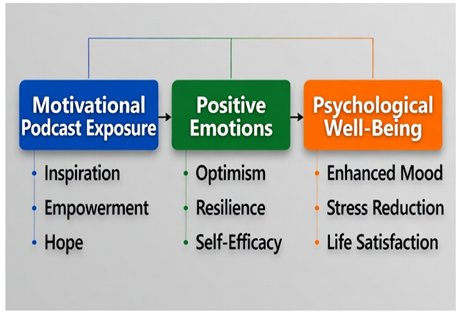
Figure 1 Conceptual Framework
4. Findings and analysis
4.1. Descriptive statistics
Table 1 is a summary of demographics and listening
trends. Students answered that they were listening motivational podcasts
(Spotify and YouTube) an average of 3.8 hours per week.
Table 1
|
Table 1 Demographic and Listening Profile of Respondents (N = 250) |
|||
|
Variable |
Category |
Frequency (n) |
Percentage (%) |
|
Gender |
Female |
135 |
54.0 |
|
Male |
115 |
46.0 |
|
|
Age Group (Years) |
18–20 |
84 |
33.6 |
|
21–23 |
126 |
50.4 |
|
|
24–25 |
40 |
16.0 |
|
|
Education Level |
Undergraduate |
175 |
70.0 |
|
Postgraduate |
75 |
30.0 |
|
|
Listening Frequency |
Daily |
90 |
36.0 |
|
Weekly |
103 |
41.2 |
|
|
Occasionally |
57 |
22.8 |
|
|
Preferred Platform |
Spotify |
120 |
48.0 |
|
YouTube |
95 |
38.0 |
|
|
Others |
35 |
14.0 |
|
Table 1 has offered a universal picture of the
demographic and listening pattern of the respondents. There is a near balance
in gender distribution with a small majority of female respondents (54%), which
guarantees gender diversity in the representation of listening behavior. Most respondents (50.4) were aged 21-23 and this
is attributable to the fact that there are more young students in colleges who
are digital citizens and are also more frequently using mobile audio platforms.
Another noteworthy fact is a large percentage of people who
listened to podcasts (70%), which suggests that the consumption of podcasts is
more widespread among early-stage learners who want to have a number of
motivating materials that can guide them personally. Regarding the frequency of
listening to the motivational podcasts, 77.2% of all participants would listen
to motivational podcasts daily or weekly, indicating that they listen on a
regular basis.
Spotify and YouTube prevail as the most frequent solutions (48% and
38% correspondingly), which proves the prevalence of mobile streaming services
among the young population of Tamil Nadu. The mean amount of time spent by the
respondents listening to the motivational podcasts amounts to 3.8 hours weekly,
which is a sign of moderate yet consistent consumption.
Altogether, the results provided above can be viewed as the
indications of the fact that motivational podcasts are properly incorporated
into the online routine of Tamil College students. The population structure
also shows the rising trend of podcasting as a self-help media of accessible
information among educated young people.
4.2. Descriptive Scores of Key Variables
Table 2 presents the means and standard deviations of
the main constructs.
Table 2
|
Table 2 Descriptive Statistics of Core Study Variables (N = 250) |
||||
|
Variable |
Mean |
SD |
Min |
Max |
|
Podcast Exposure |
3.94 |
0.82 |
1.00 |
5.00 |
|
Optimism |
4.12 |
0.73 |
2.10 |
5.00 |
|
Resilience |
4.08 |
0.68 |
2.00 |
5.00 |
|
Self-Efficacy |
4.00 |
0.71 |
1.90 |
5.00 |
|
Positive Well-Being
(Aggregate) |
4.07 |
0.69 |
2.10 |
5.00 |
As it is stated in Table 2, all psychological variables assessed in the
research-optimism (M = 4.12), resilience (M = 4.08), and self-efficacy (M =
4.00) scores were higher than the neutral point of the 5-point Likert scale.
This shows that there is a relatively high degree of positive psychological
well-being among the respondents.
All means of positive well-being (M = 4.07, SD = 0.69) can be taken
as evidence of the stable and confident temperament displayed by students that
actively listen to the motivational podcasts. The standard deviations are not
high (0.68-0.82) and it can be supposed that the answers are rather similar
among the participants and therefore there is a common benefit of listening to
a podcast.
The results confirm the assumption of Positive Psychology Seligman
and Csikszentmihalyi (2000), which states that optimism and resilience
cultivated by nurturing leads to the subjective well-being. In this regard,
frequent listening to inspirational podcasts seems to maintain positive
psychological states in students in colleges.
4.3. Correlation Analysis
Podcast exposure was strongly correlated with optimism, resilience,
and self-efficacy Table 3.
Table 3
|
Table 3 Pearson Correlations Among Core Variables (N = 250) |
|||||
|
Variable |
1 |
2 |
3 |
4 |
5 |
|
1. Podcast Exposure |
- |
||||
|
2. Optimism |
.58*** |
- |
|||
|
3. Resilience |
.60*** |
.63*** |
- |
||
|
4. Self-Efficacy |
.55*** |
.59*** |
.57*** |
- |
|
|
5. Psychological
Well-Being |
.62*** |
.71*** |
.74*** |
.69*** |
- |
|
Note.
**p < .001. |
|||||
The exposure to podcasts as shown in Table 3 had significant and positive positive relationships with optimism (r =.58), resilience
(r =.60), and self-efficacy (r =.55). Moreover, the entire amount of
psychological well-being showed peak correlation with podcast exposure r =.62
(p <.001), which suggests a strong linear correlation.
The internal relationships among optimism, resilience, and
self-efficacy are high (between.57 and.74), which indicates that these
constructs are all interdependent conceptions of psychological wellness, not
independent variables.
These findings empirically confirm the concept model that was
suggested in this research. The effects of motivational podcast episodes are
positive emotions that support psychological resources. This is in conformity
to the broaden and build theory by Fredrickson
(2001), whereby repetitive positive emotional
experiences increase the adaptive capacity and resilience of the individuals.
Essentially, the correlation testing evidences that the more
individuals are exposed to motivational podcast content, the more optimism,
resilience and self-belief individuals are likely to experience, which
justifies - "Podcast listening frequency is positively correlated with
positive psychological well-being.
4.4. Regression Analysis
Multiple regression Table 4 confirmed that podcast exposure significantly
predicted positive psychological well-being after controlling for gender and
education.
Table 4
|
Table 4 Regression Analysis Predicting Psychological Well-Being |
|||||
|
Predictor |
B |
SE |
β |
t |
p |
|
Constant |
1.84 |
0.18 |
- |
10.22 |
< .001 |
|
Podcast Exposure |
0.42 |
0.03 |
0.58 |
12.27 |
< .001 |
|
Gender |
0.06 |
0.05 |
0.06 |
1.04 |
0.30 |
|
Education Level |
0.04 |
0.05 |
0.04 |
0.71 |
0.47 |
|
Model
Summary. R = .62; R² = .38; F (3, 246) = 150.41; p < .001. |
|||||
In the multiple regression model to Table 4, exposure to podcast at the most significance
was related to predicting psychological well-being (b =.58, t = 12.27, p
<.001). The model accounted 38% of the overall variance (R2 =.38) showing a
significant contribution of podcast involvement to the well-being outcomes of
the students.
Both gender (b =.06, p =.30) and education level (b =.04, p =.47)
were not found to be a significant predictor, which means that the
psychological advantages of the podcasts listening are not demography-specific.
These findings support the theoretical assertion that repeated
viewing motivational material increases emotional regulation and cognitive
resilience regardless of gender and academic grade.
The self-efficacy theory as postulated by Bandura
(1997) holds that one builds confidence by
being verbally persuaded and observed numerous times. This mechanism is
supported by the strong beta (b =.58) that podcast exposure has on it: having
heard success stories and perseverance on motivational podcasts, students
internalize them, which in turn supports their psychological well-being. The
positive psychological well-being is, therefore, supported by the fact that the
exposure to Podcasts was a significant predictor of the same.
4.5. Mean Differences by Listening Frequency
Table 5 shows that daily listeners scored
significantly higher in all dimensions of well-being (F = 25.61, p < .001).
Table 5
|
Table 5 Mean Scores of Psychological Well-Being by Listening Frequency |
||||
|
Frequency |
Optimism (M ± SD) |
Resilience (M ± SD) |
Self-Efficacy (M ± SD) |
Overall Well-Being (M
± SD) |
|
Daily (n = 90) |
4.35 ± 0.56 |
4.29 ± 0.54 |
4.28 ± 0.61 |
4.31 ± 0.48 |
|
Weekly (n = 103) |
4.08 ± 0.65 |
4.03 ± 0.61 |
3.96 ± 0.64 |
3.98 ± 0.52 |
|
Occasional (n = 57) |
3.62 ± 0.71 |
3.68 ± 0.69 |
3.54 ± 0.74 |
3.42 ± 0.57 |
Table 5 gives a definite indication that the frequency
of podcast listening has a great impact on well-being. Daily listeners also
received the highest scores on all variables-optimism (M = 4.35), resilience (M
= 4.29), and self-efficacy (M = 4.28)- compared with the weekly and occasional
listeners. Statistically significant differences between groups are proved by
one-way ANOVA (F = 25.61, p <.001).
This trend showed that more psychological benefits were obtained
with habitual and regular listening to motivational podcasts. Not only did the
daily listeners express greater overall well-being (M = 4.31), but also, they
had less variance, indicating a less unstable emotional and motivational
pattern.
The results of these studies confirm the hypothesis of the
frequency effect when it comes to media psychology where the intensity of
exposure increases the affective and cognitive effect Rubin
(2009). The evidence also supports the essence of
Positive Psychology: the frequent reinforcement of positive stories creates
long-term hopefulness and strength. Therefore, listeners of Daily podcast have
much greater well-being than infrequent listeners".
4.6. Discussion
These results highlight the central nature of the motivational
podcasts in the improvement of the psychological well-being of the students
through the creation of the positive emotional states and the development of
the adaptive psychic resources. The fact that optimism, resilience, and
self-efficacy have increased over an agreed period point to the fact that
frequent interaction with such content does not only positively affect the mood
but also has a lasting personal strength that helps in coping with academic and
life difficulties. This is in accordance with the broaden-and-build theory of Fredrickson
(2001) which assumes that positive emotions
widen the repertoire of thought-action among individuals with the accumulation
of enduring psychological resources. Also, one can explain the concept of
vicarious experience by Bandura
(1997) as the success stories and
inspirational messages delivered by podcasts can be internalized by the
students, making them have a stronger belief in their abilities.
In addition, cultural and linguistic usefulness of the Tamil
motivational podcasts seems to enhance such psychological advantages by
providing the feeling of familiarity and enhanced emotional appeal. This
cultural closeness probably allows having more engagement and association with
the material, and motivational messages have more significant effects. New
media such as podcasts, in addition to spreading knowledge, also help in
personal growth by making listeners think about the attitudes, goals, and coping
mechanisms, thus helping to address holistic development outside the
educational system.
4.7. Practical implications
·
Teachers: Incorporate podcasts into student
success and counselling courses.
·
Podcast Makers: Be
authentic and culturally true to storytelling.
·
Mental Health Practitioners: Suggest
inspirational podcasts to use as a supplement to emotional resiliency.
·
Policy Makers: Podcasts are affordable digital
interventions that should be recognized by policy makers as effective methods
of supporting the youth in mental health.
4.8. Limitations and future research
The region Coimbatore under focus in the study limits its
generalizability. The longitudinal and experimental designs of the future are
supposed to be able to quantify causality and investigate the relative impact
of genres (e.g., mindfulness vs. motivation).
5. conclusion
The example of motivational podcasts, including Oru Cup Confidence,
Maname Nalama, and Leader -
Rajmohan, is an effective method to improve the psychological well-being of
college students in Tamil Nadu due to their establishment of optimism,
resilience, and self-efficacy. These podcasts are using culturally relevant
stories and emotionally authentic content, where the listeners can relate to
the content on a personal level. They become relatable and more influential
since they embed the local cultural values and experiences in the process of
storytelling, which resonate with the lives of youths. Such cultural
internalization does not only increase the sense of identity among the listener
but also offers functional modalities of overcoming the difficulties thus
enhancing mental health in a culture-sensitive way.
Moreover, these podcasts are also digital companions, which are affordable and provide full-time assistance in the everyday life of its listeners. The podcast listening habit allows developing hope, purpose, and confidence gradually, which are the essential elements of psychological resilience. Through linking media communication and promoting mental health, these digital platforms provide an informal but significant space to interact with positive psychological constructs among the youth. This creates a potentially valuable opportunity in incorporating motivational content into the mainstream public health programs to empower the youth adults particularly where traditional mental health service might be unavailable or stigmatized in some areas.
CONFLICT OF INTERESTS
The authors declare that they have no conflict of interest associated with this work. No financial, personal, or institutional relationships have influenced the research, analysis, or interpretation presented in the manuscript
ACKNOWLEDGMENTS
The authors sincerely thank all the participants who contributed their time to complete the survey and provide valuable insights for this study. The authors also extend their gratitude to colleagues and academic mentors for their constructive feedback throughout the development of this work. No external funding was received for this study.
DATA AVAILABILITY
The data supporting the findings of this study are available from the authors upon reasonable request. Due to the nature of the survey dataset and participant privacy considerations, the raw responses cannot be publicly shared. Processed data and analysis files can be provided by the corresponding author upon request.
DECLARATION OF GENERATIVE AI
The authors declare that generative AI tools were used only to assist in language refinement, grammar correction, and improving readability. All conceptualization, methodology, analysis, interpretation of results, and final conclusions were developed solely by the authors. The authors reviewed and verified all AI-assisted outputs to ensure accuracy and integrity.
REFERENCES
Bandura, A. (1997). Self-Efficacy: The Exercise of Control. W. H. Freeman.
Berry, R. (2016). Podcasting: Considering the Evolution of the Medium and its Association with the Word “Radio.” The Radio Journal: International Studies in Broadcast and Audio Media, 14(1), 7–22. https://doi.org/10.1386/rjao.14.1.7_1
Bäuerle, A., Jahre, L., Teufel, M., Jansen, C., Skoda, E.-M., and Dörrie, N. (2023). Feasibility and Efficacy of a Digital Resilience Training: A Pilot Study of the Strengths-Based Resilience Training “RESIST.” Internet Interventions, 32, Article 100620. https://doi.org/10.1016/j.invent.2023.100620
Dascombe, E. M., Morgan, P. J., Drew, R. J., Regan, C. P., Turner-McGrievy, G. M., and Young, M. D. (2025). Podcasts in Mental, Physical, or Combined Health Interventions for Adults: Scoping Review. Journal of Medical Internet Research, 27, Article e63360. https://doi.org/10.2196/63360
Fredrickson, B. L. (2001). The Role of Positive Emotions in Positive Psychology: The Broaden-and-Build Theory of Positive Emotions. American Psychologist, 56(3), 218–226. https://doi.org/10.1037/0003-066X.56.3.218
Fredrickson, B. L. (2013). Positive Emotions Broaden and Build. In P. Devine and A. Plant (Eds.), Advances in Experimental Social Psychology (Vol. 47, 1–53). Academic Press. https://doi.org/10.1016/B978-0-12-407236-7.00001-2
König, L. (2021). Podcasts in Higher Education: Teacher Enthusiasm Increases Students’ Excitement, Interest, Enjoyment, and Learning Motivation. Educational Studies, 47(1), 83–99. https://doi.org/10.1080/03055698.2019.1651695
Meden, E., Radovan, M., and Štefanc, D. (2024). Podcasts and Informal Learning: Exploring Knowledge Acquisition and Retention. Education Sciences, 14(10), Article 1129. https://doi.org/10.3390/educsci14101129
Nabi, R. L., Walter, N., Myrick, J. G., Wang, M., and Ekeler, B. (2025). Media Versus Meditation: A Comparison of the Stress-Relieving BenEfits of Multiple Media Experiences. Psychology of Popular Media. Advance Online Publication. https://doi.org/10.1037/ppm0000623
Palenque, S. M. (2016). The Power of Podcasting: Perspectives on Pedagogy. Journal of Instructional Research, 5, 4–9. https://doi.org/10.9743/JIR.2016.4
Rubin, A. M. (2009). Uses and Gratifications. In R. L. Nabi and M. B. Oliver (Eds.), The SAGE Handbook of Media Processes and Effects (147–159). SAGE Publications, Inc.
Saboor, S., Medina, A., and Marciano, L. (2024). Application of Positive Psychology in Digital Interventions for Children, Adolescents, and Young Adults: Systematic Review and Meta-Analysis of Controlled Trials. JMIR Mental Health, 11, Article e56045. https://doi.org/10.2196/56045
Seligman, M. E. P., and Csikszentmihalyi, M. (2000). Positive Psychology: An Introduction. American Psychologist, 55(1), 5–14. https://doi.org/10.1037/0003-066X.55.1.5
Song, P., Cai, X., Qin, D., Wang, Q., Liu, X., Zhong, M., Li, L., and Yang, Y. (2024). Analyzing Psychological Resilience in College Students: A Decision Tree Model. Heliyon, 10(11), Article e32583. https://doi.org/10.1016/j.heliyon.2024.e32583
Yang, J., Huang, H., Deng, M., and Gao, W. (2025). Resilience Under the Chilling Effect: How Social Support and Digital Media Reshape Online Political Participation Among Chinese Youth. Frontiers in Psychology, 16, Article 1634604. https://doi.org/10.3389/fpsyg.2025.1634604
|
|
 This work is licensed under a: Creative Commons Attribution 4.0 International License
© ShodhKosh 2026. All Rights Reserved.