ShodhKosh: Journal of Visual and Performing ArtsISSN (Online): 2582-7472
|
|
Human–AI Collaboration in Abstract Art Creation
Dr. Premalatha. P. 1 , Suvarna Milind Patil 2
 , Nitesh
Kumar Kushwaha 3
, Nitesh
Kumar Kushwaha 3 , Rohit
Jaiswal 4, Rajashri
C. K. 5
, Rohit
Jaiswal 4, Rajashri
C. K. 5 , Kalyani
P. Karule 6
, Kalyani
P. Karule 6
1 Department of Management and Science,
Mysore University, India
2 Department
of Engineering, Science and Humanities, Vishwakarma Institute of Technology,
Pune, Maharashtra, 411037, India
3 Assistant Professor, School of Fine Arts and Design, Noida
International University, Noida, Uttar Pradesh, India
4Assistant Professor, School of Management and School of Advertising, PR and Events, AAFT University of Media and Arts, Raipur, Chhattisgarh-492001, India
5 Assistant Professor, Meenakshi College of Arts and Science, Meenakshi
Academy of Higher Education and Research, Chennai, Tamil Nadu, 600106, India
6 Assistant Professor, Department of Computer Technology, Yeshwantrao Chavan College of Engineering, Nagpur, India
|
|
|
ABSTRACT |
|
|
Human-AI
collaboration is becoming a new paradigm in the modern form of abstract art
production with the redefinition of the concept of creativity, authorship,
and aesthetic choice. This paper explores a computer-assisted human and
AI-based collaborative system where human artists create abstract art with
artificial intelligence systems. The proposed solution is based on
co-creation, a concept where human intuition and emotion and intent to
generate are combined with the computational exploration, finding patterns,
and generative abilities of AI as compared to fully automated generative art
or purely human-driven abstraction. The study compiles the experiences of the
AI-generated art systems, human-in-the-loop creative systems and
machine-learning-generated abstract art to create a conceptual and
implementation framework of collaborative creativity. The methodology will be
based on an experimental design with three creative conditions and will
include human-only creation, AI-only generation, and human-AI collaboration.
Several generative models such as diffusion-based and transformer-inspired
are used with interactive interfaces that enable the use of human guidance in
an iterative manner, constraint setting, and feedback-based refinement. The
quantitative evaluation metrics, including the compositional complexity,
color variety, new score of novelty, and aesthetic integrity scores are
supported by qualitative ones of artistic intent and expressive depth.
Findings show that collaborative artworks are always more successful than the
human-only and AI-only works in their novelty-coherence balance, conceptual
diversity, and fashion variety. |
|||
|
Received 18 September 2025 Accepted 21 December
2025 Published 17 February 2026 Corresponding Author Dr.
Premalatha. P., Premalathapugazh1977@gmail.com DOI 10.29121/shodhkosh.v7.i1s.2026.7125 Funding: This research
received no specific grant from any funding agency in the public, commercial,
or not-for-profit sectors. Copyright: © 2026 The
Author(s). This work is licensed under a Creative Commons
Attribution 4.0 International License. With the
license CC-BY, authors retain the copyright, allowing anyone to download,
reuse, re-print, modify, distribute, and/or copy their contribution. The work
must be properly attributed to its author.
|
|||
|
Keywords: Human–AI Collaboration, Abstract Art Generative Art,
Human-In-The-Loop Creativity, Computational Aesthetics, Creative AI |
|||


1. INTRODUCTION
The swift development of the artificial intelligence (AI) has been influential in changing creative practices in visual arts, design, music, and literature. Abstract art is one of the most interesting areas to study the collaboration between humans and AI because abstraction does not emphasize the realism of the representation, but instead on the expression, form, emotion, and exploration of ideas. Historically abstract art has been developed as an experimental, intuitively developed, and subjectively interpreted form, which has permitted the artists to explore ambiguity, symbolism and aesthetic freedom. Introduction of AI to this field brings in new computational powers, including large-scale exploration of patterns, generative variation, and probabilistic creativity, as well as casts significant objections to authorship, agency, and what creativity is. The initial use of AI in art mainly aimed at automation, where workers created art with little human interference through generative algorithms. These methods were technically new, but could be shallow in context, willed, and heartfelt Deonna and Teroni (2025). On the other hand, abstract art that is purely human-based, in terms of its meaning and expressive complexity, is bound by mental biases, the lack of exploratory ability, and the physical restraint of time. This opposition has inspired a move toward the collaboration of humans and AI, in which AI is not presented as a substitute to the artist, but rather as an imaginative co-worker that enhances human imagination and increases the search space in the arts. When using AI in abstract art, human-AI cooperation does not focus on delegation, but on the co-creation. In this paradigm, the human artist brings in conceptual insight, aesthetic discernment, emotional willpower, and cultural background whereas AI brings in computational imagination using generative models that can create complex visual forms, color arrangements and fashion variations Sundquist and Lubart (2022). In Figure 1, a human creativity together with AI generative activities is collaborative. Such partnership is in line with human-in-the-loop creative paradigms, and such paradigms put more emphasis on shared control, interpretability, and ongoing feedback instead of black-box automation.
Figure 1
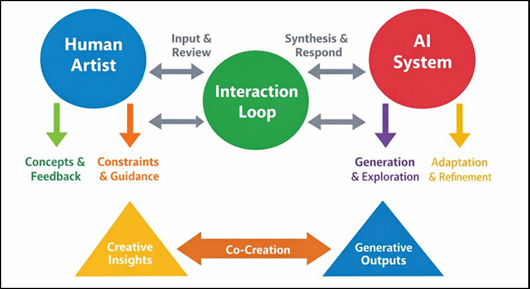
Figure 1 Conceptual Block Diagram of Human–AI Collaboration in Abstract Art Creation
The abstract art has a unique response to this model of collaboration in the sense that its criteria of evaluation are subjective and multidimensional in nature. The notions of novelty, coherence, emotional effect, and compositional balance cannot be perfectly approximated using the algorithmic optimization. Rather, they need humanity and interpretive judgment. AI systems, though, are extremely good at creating huge amounts of random visual options, discovering underlying patterns, and recombining style components in a manner that might not be instantly apparent to the human designer Čábelková et al. (2022). With these mutually supporting strengths, a more creative and more exploratory creative process is possible than with human-only or AI-only. Technologically, the latest developments in machine learning, especially in diffusion models, transformer-based architectures, and latent space representation, have increased by significantly more dramatic the expressive power of generative systems. The models are able to acquire high-level abstractions of form, texture, and color on large body of visual art, therefore, producing outputs that concur with the principles of abstract aesthetics Wu et al. (2024).
2. Related Work and Literature Review
2.1. AI-generated and AI-assisted art systems
Computational creativity AI-generated and AI-assisted art systems are conceptually different but closely related paradigms of AI systems in the art world. Artificial intelligence that produces art often uses high degrees of autonomy where algorithms create visual representations following learning on massive collections of pictures or artwork. Older models used rule-based or evolutionary algorithms, whereas more modern models now use deep learning models that are able to learn complicated visual representations Alzoubi et al. (2021). These systems have shown remarkable skills on the way of generating stylistically coherent and visually novel images usually with an implication to the traditional concept of the originality and authorship. But fully autonomous generation has been criticized as having poor contextual awareness, poor semantic grounding and no intentional meaning, especially in abstract art where interpretation and intent of meaning are critical. In comparison, AI-assisted art systems are devised to assist and supplement human creativity and not to substitute it. Under this method, AI acts as a transformation aid, which helps artists by providing hints or creating variations for a style or being able to explore styles or improve technical quality Prudviraj and Jamwal (2025). Human creator keeps the ultimate authorship and decision-making power with AI outputs being the source of inspiration or raw material. Research on this field has focused on usability, interpretability and creative control, where it is noted that artists attach importance to systems that are responsive, transparent and flexible in response to personal creative processes Alala (2025).
2.2. Human-in-the-loop creative frameworks
Human-in-the-loop (HITL) creative systems have been developed as an urgent reaction to the shortcomings of AI creativity with no human involvement. These systems clearly incorporate human input, advice, and assessment into the generative cycle, so that the product of the creative process does not become irresponsible to human values, aims, and aesthetic objectives. Humans in HITL systems do not in the active form of evaluation but are active participants in the creation of the creative path by means of iteration Chatterjee et al. (2024). This interaction can be in form of parameter adjustment, constraint definition, semantic input, preference selection or in form of real time feedback on generated outputs. The HITL creativity in the literature focuses on collaborative agency and adaptive collaborations. Instead of maximizing a pre-determined objective function, these systems evolve as a result of an ongoing communication between human and machine and subjective criteria, including emotional resonance, symbolic meaning or conceptual coherence can be used to shape generation Zhou et al. (2024). It has been discovered that these frameworks increase user engagement, sense of ownership, and creativity satisfaction because artists do not feel threatened by AI. HITL methods are especially significant in areas of art where judgment is subjective and situational in nature.
2.3. Abstract art generation using ML and generative models
Machine learning-based abstract art generation has received growing interest as the range of visual structures that generative models can represent has expanded to non-representational forms. Contrary to figurative and photorealistic image synthesis, the abstract art generation is centered on the form, color, texture, rhythm and space relations instead of recognisable objects. Early computational methods were based on procedural generation and mathematical rules to generate abstract compositions with a focus on symmetry, randomness and geometric variation De et al. (2020). Although these techniques were effective at creating visually stimulating designs, they had a low degree of stylistic flexibility and expressiveness. The implementation of generative models that were deep was a big change in the production of the abstract art. The new generative adversarial networks made it possible to create complex textures and color distributions; the manipulation of latent space enabled artists to learn about continuous variations between abstract forms Melville et al. (2023). However, more recently, diffusion-based and transformer-inspired models have proven to be more stable, more diverse, and have semantic controllability, and E G and A (2024)are therefore more appropriate in abstract visual exploration. Table 1 presents relative knowledge on AI-assisted and collaborative abstract art research. These models are capable of learning high level abstractions on curated art datasets, including style tendencies without being restricted to drawbacks of representations. Regardless of such advances, there are still challenges as emphasized in the literature.
Table 1
|
Table 1 Comparative Analysis of Related Work in AI-Assisted and Collaborative Abstract Art |
||||
|
Art Domain |
AI Technique Used |
Interaction Mode |
Key Contribution |
Limitations |
|
Generative Art Haj-Bolouri et al. (2024) |
Evolutionary Algorithms |
Parameter Tuning |
Early exploration of computational creativity |
Limited semantic control |
|
Visual Art |
GAN (CAN) |
Autonomous Generation |
Challenged art-style norms via adversarial
learning |
No human intent modeling |
|
Creative Systems |
Rule-based + ML |
Interactive Guidance |
Formalized computational creativity theory |
Limited scalability |
|
Digital Art Haase
and Pokutta (2024) |
Neural Style Transfer |
Constraint-based |
Popularized AI-assisted artistic workflows |
Style dominance issues |
|
Art & Design |
Hybrid AI Models |
Human-in-the-loop |
Theoretical framework for co-creativity |
Lacked implementation |
|
Abstract Painting |
GAN + Latent Editing |
Co-exploration |
Latent space navigation for abstraction |
Evaluation subjectivity |
|
Creative AI Jennings (2010) |
Interactive Evolution |
Feedback-driven |
Emphasized iterative human feedback |
Slow convergence |
|
Visual Arts |
VAE-based Models |
Semantic Guidance |
Improved abstraction control |
Limited emotional modeling |
|
Generative Art Mateja and Heinzl (2021) |
Diffusion Models |
Autonomous |
High-quality abstract synthesis |
Minimal human agency |
|
Creative Design |
Transformer Models |
Prompt-based |
Global coherence in compositions |
Prompt sensitivity |
|
Co-Creative Art |
RL + Human Feedback |
Feedback Loop |
Adaptive personalization in art creation |
Training complexity |
|
Abstract Art Chiou and Lee (2023) |
Multimodal Generative AI |
Co-exploration |
Integrated emotion and semantics |
Interface dependency |
|
Abstract Art |
Diffusion + Transformer + HITL |
Guidance + Feedback + Co-creation |
Balanced novelty, intent, and control |
Requires expert users |
3. Conceptual Framework for Human–AI Collaboration
3.1. Roles of human artists and AI agents
The responsibilities of human artists and AI agents do not oppose each other in an abstract art creation framework that involves human actors and AI agents, but rather complement each other. Human artists are mainly conceptual writers and aesthetic decision makers. They establish the artistic purpose, emotional focus, cultural allusions and the elevated visual objectives that govern the creative procedure. Artists, by means of intuition, subjective experience and subjective judgment, determine meaning, symbolism and the depth of expression, aspects that are hard to compute. Man is likewise a curatorial systems and takes over generated outputs, refines them and places them in contexts suitable to its own or thematic discourses Buschek et al. (2021). The AI agents on the other hand are generative and exploratory partners. By using machine learning models trained on an extensive range of visual data, AI systems will soon be able to generate variations, find latent patterns, and combine visual elements into novel combinations, which can well go beyond the limits of habitual human thought. The AI helps to bring computational creativity by exploring vast design spaces, suggesting unintuitive forms and being stylistically consistent over its iterations. Instead of having an independent artistic intention, the AI is meant to act as a response to human inputs, constraints, and feedback, and generatively behave in an adaptive way. This division of labor retains the human agency of art and also allows AI to act as an agent of experimentation and innovation Haase and Hanel (2023). The collaborative model encourages the ethical imagination of AI, which is openly authored and not artificial, as well as retains human significant control over abstract artistic expression.
3.2. Interaction modes: guidance, constraint, feedback, and co-exploration
In abstract art, successful collaborations between human and AI depend on a variety of interaction patterns that define the space of sharing creative control during the process. Guidance is the closest form of interaction in which human artists give semantic information, stylistic allusions, or conceptual indications that play a role in guiding the direction of the generation. This can be a textual description, sketch input or mood definitions which define the creative context of the AI system. Classical interaction Constraint-based interaction enables artists to set limits within which the AI will work. Limits can be in the form of color palletes, composition, geometric principles, or abstraction, so that the results of the generated work are not distorted out of artistic purpose. Instead of inhibiting creativity, constraints that are designed well narrow down exploration and eliminate results that are incoherent or unintended. The iterative refinement is brought by the feedback-driven interaction. In this case, the artists would be assessing generated outputs and giving explicit or implicit feedback to the AI, including but not limited to; selection, ranking or adjustment, which the AI would utilise to refine future generations. Such a cyclical process makes creation a discourse and subjective likes come to define computational behavior in the long term. Co-exploration is the most collaborative form of interaction, the process of which is not completely controlled by a human or an AI. Rather, agents co-evolve in response to new shapes, and find new visual opportunities together, through a series of successive actions.
3.3. Levels of autonomy and control sharing
The balance of control and autonomy in the joint creation of abstract art is characterized by levels of autonomy and control sharing between human artists and AI systems. At the low autonomy level, AI is more of a responsive device whose outputs are only produced in response to the explicit instructions given by the humans. The artist is left with almost complete authority and can speed up performance or experiment with small changes without changing the conceptual focus. This mode helps in transparency and predictability but can restrain creative surprise. Moderate autonomy brings adaptive behavior in which AI system are more flexible in terms of their interpretation of human inputs and suggest variations that go further than initial specifications. There is a dynamically distributed control: overarching objectives are directed by humans, and local design spaces by AI, which offers alternatives to the design process. This tier is said to be the best to work with creativity because it is not too intentional, yet generative enough. High autonomy puts more reponsibility on the AI as a creative entity as it is capable of creating its own compositions, developing new styles, or redefining constraints. Human intervention is changed to assessment, filtering, and contextualizing instead of controlling as such. Though such mode may produce unexpected and novel results, it also brings up the issue of authorship, interpretability and correspondence with artistic intent.
4. Methodology
4.1. Research design and experimental setup
The study takes a mixed-method experimental design to make a systemic study on the effect of human-AI cooperation in the creation of abstract art. There are three conditions of the experiments: human-only creation, AI-only generation, and human-AI collaborative creation. This comparative structure allows the controlled comparison of the results of creativity and isolates the role of interaction with others. The participants will be involved in professional visual artists and advanced art students who were exposed to digital tools previously to guarantee informed involvement in abstract aesthetics. All subjects are subjected to a set of abstract art creation activities under standardized conditions in which they are given the same set of thematic issues and time restrictions to make the conditions comparable. The collaborative condition includes individual participants communicating with the AI system repeatedly through several rounds of creation and improvement. Predefined aesthetic and structural measures are used to collect quantitative data, whereas the collection of qualitative data relies on post-task questionnaires and interviews with semi-structured questions in the form of semi-structured interviews addressing creative experience, perceived agency, and satisfaction. In order to reduce the bias, works of art are anonymized and rated by independent adjudicators through standardized rubrics. The experimental design during which the experiment would be conducted focuses on the repeatability and transparency of the experiment to allow one to make comparisons across conditions.
4.2. AI models and creative algorithms employed
The methodological framework unites various AI models and creative algorithms in order to assist abstract art generation in a variety of ways. The visual styles between which high-level abstractions of form, color, and texture can be smoothly interpolated with the help of latent-space-based generative models. Several noise samples are refined through diffusion-based generative processes to produce high visual diversity and stability based on their structure in the form of abstract compositions. Simultaneously, transformer-based attention models promote grid-scale compositional consistency by learners through long-range spatial factors on the canvas. Imaginative algorithms are developed in order to focus on exploration, as opposed to optimization to one goal. Stochastic sampling, deterministic randomness, and diversity-enhancing loss functions are made in order to prevent repetitive or excessively deterministic outputs. The methods of disentangling of features enable artists to meaningfully control abstract qualities by manipulating different color dynamics, geometric structure and textural complexity independently. Moreover, preference-learning mechanisms change the model behavior in accordance with the human selection and feedback during the iterations. This is a component of adaption that allows the AI to adopt generative tendencies as time goes and identify with personal artistic preferences. Notably, the system is not conditioned to recreate particular artwork but rather to work in a wide abstract aesthetics realm. This approach of methodology guarantees originality and encourages ethical creativity without being excessively expressively impoverished.
4.3. Human interaction mechanisms and interface design
The mechanism of human interaction lies at the core of the collaborative approach, and it determines the process of conveying the artistic intent to the AI system and understanding it. The interface is also meant to be a creative workspace that is interactive and helps in multimodal input, such as textual prompts, parameter sliders, visual sketches, and selection based feedback. These processes provide artists to convey explicit ideas, as well as intuitive preferences, without technical knowledge in machine learning. Guidance inputs help users to define themes, moods, or trendiness on a high level. In Figure 2, interaction mechanisms and interfaces are demonstrated that would allow human-AI collaboration. In constraint controls, the artist can restrict color palette, abstraction intensity, or compositional balance, all to make sure that there is a correspondence to the creative intentions. Feedback systems are established by the use of selection, ranking, and the refinement to allow the system to acquire experience of human aesthetic judgments as time goes by.
Figure 2

Figure 2 Human Interaction Mechanisms and Interface Design in Human–AI Collaborative Abstract Art Creation
The interface focuses on the importance of transparency and interpretability through visual representations of inputs by humans on the creation of generative results. Reflective comparison and creative decision-making are facilitated with the help of real-time previews and version histories. Notably, the design does not entail strict workflows and has an opportunity to choose between structured support and unstructured seeking on the part of the artists. This is flexible to a variety of creative styles and working rhythms. The interaction design will make AI an intuitive collaborative creative partner instead of a technical challenge to the creation of abstract art because it focuses on usability, responsiveness, and expressive freedom.
5. Implementation Architecture
5.1. System architecture and data flow
Its implementation architecture is modular and layered so that it can be adapted to any flexible human-assisted strategy in the creation of abstract art. On a high level, the system consists of four interconnected layers: user interaction layer, semantic processing layer, generative intelligence layer and visualization and output layer. Scalability, interpretability and experimentation ease are guaranteed by this separation. At the user interaction layer data flow commences where human data is captured in real time through the input of human ideas in the form of text, graphics, the manipulation of parameters, and the choice of feedback. These are relayed to the semantic processing layer that standardizes them and organizes them into machine understandable forms. The processed inputs are then passed on to the generative intelligence layer where AI models generate abstract visual outputs using the current inputs as well as past interaction context. Art generated is sent to the visualization layer to be rendered and compared and track versions. The feedback of the users at this stage is also fed back to the system which completes the loop of interaction. The architecture facilitates the creative exploration in a fluid and continuous manner with cycles occurring, without system restarts. The architecture enables the AI models or interaction tools to be changed independently, being decoupled with interface logic, so that the models respond flexibly to changing artistic and technological needs.
5.2. Human input encoding and semantic abstraction
The inputting of human input plays a very crucial role in the transition between instinctive artistry and the computerized analysis. The system converts a variety of human inputs in terms of textual descriptions, sketches, color choices, and preference cues into format semantic representations, which inform AI creation. The textual inputs are coded into high-dimensional semantic vectors which would represent conceptual themes, emotional coloring, and stylistic purpose. These vectors are at an abstract level and the system is able to affect composition without providing a literal visual correspondence. Visual data or input, e.g. rough drawings or reference images, are abstracted into latent data representations that focus on the spatial structure, contrast and rhythm and not on the actual forms. Such parameter-based inputs as sliders to control the intensity of abstraction or color harmony are normalized and mapped to control dimensions in the generative space that can be interpreted. The inputs of the feedback (selection or ranking) are coded as the signals of preference updating the internal weighting mechanisms. The semantic abstraction is what will make the intent of a human being play a crucial role despite the AI experimenting with a variety of visual results. Notably, the encoding process does not over-specify, and it maintains creative ambiguity and leaves generative surprise space. The system reinterprets the computational interpretation with the expressiveness of the abstract art by encoding and decoding at a conceptual instead of pixel-based level of the visual channel.
6. Results and Analysis
6.1. Comparative analysis: human-only vs. AI-only vs. collaborative art
The qualitative differences are evident by comparing human-only, AI-only, and human and AI collaborative abstract art on the comparative analysis. Man-made only art is very conceptually oriented, emotive, and descriptively narrative, but with little stylistic variation as well as descriptive scope. Artworks created by AI alone are associated with great visual complexity, color variety, and formal heterogeneity, though not always associated with conceptual clarity and deliberate meaning. Contrary to that, collaborative artworks are always on the equal footing between novelty and coherence, bringing together the human agency with AI-equipped exploration. Collaborative works were found to have a richer compositional texture, balanced expression and novelty by reviewers. The results demonstrate that creative results are improved when human-AI interaction is used and complementary strengths are merged instead of favoring automation or human intuition.
Table 2
|
Table 2 Comparative Evaluation of Abstract Art Creation Approaches (%) |
|||
|
Evaluation Metric |
Human-Only Art (%) |
AI-Only Art (%) |
Human–AI Collaborative Art (%) |
|
Conceptual Clarity |
88.4 |
71.6 |
90.2 |
|
Emotional Expressiveness |
86.9 |
69.3 |
89.5 |
|
Compositional Coherence |
84.7 |
75.8 |
91.1 |
|
Stylistic Diversity |
72.5 |
89.6 |
88.2 |
|
Visual Complexity |
74.1 |
91.3 |
89.7 |
Table 2 shows a distinct quantitative difference between human-only and AI-only and human-AI collaborative abstract art creation. Human-only art has good conceptual clarity (88.4%) and emotional expressiveness (86.9%), meaning the capacity of artists to incorporate a meaning and have an impact; however, it has relatively limited stylistic variation (72.5%) and visual complexity (74.1), meaning that it lacks exploration.
Figure 3

Figure 3 Comparative Evaluation of Human, AI, and Hybrid Art
Conversely, AI-only art is more competent in computational quality (visual complexity, 91.3%, and stylistic diversity, 89.6) as well as worse in conceptual clarity (71.6) and emotional expressiveness (69.3), so intentional depth is more apparent. Human-AI collaborative method is always the most balanced with the highest compositional coherence (91.1%), conceptual clarity (90.2), and high emotional expressiveness (89.5) and high visual complexities (89.7).
6.2. Quantitative performance outcomes
The qualitative data is backed up by the quantitative data, which demonstrated a high level of performance of collaborative artworks in terms of various measures. On the average, human-AI collaborative products received better scores on novelty, compositional complexity, and aesthetic coherence than human-only and AI-only ones. The measures of color diversity and structural variation were much greater than human-only results, whereas the scores of coherence and perceived meaning were greater than AI-only ones. Statistical analysis shows that there is a consistent improvement of the novelty-coherence balance index which indicates successful incorporation of exploration and control. Moreover, collaborative production used fewer cycles to achieve quality results which implied better creativity. These findings are indicative of quantifiable advantages of human-AI joint venture in abstract art creation.
Table 3
|
Table 3 Quantitative Performance Metrics Across Creation Modes (%) |
|||
|
Performance Indicator |
Human-Only (%) |
AI-Only (%) |
Human–AI Collaborative (%) |
|
Novelty Score |
79.2 |
88.5 |
93.1 |
|
Aesthetic Coherence Score |
85.6 |
73.4 |
91.8 |
|
Color Diversity Index |
74.9 |
90.7 |
89.3 |
|
Structural / Form Complexity Index |
76.8 |
92.1 |
90.6 |
|
Novelty–Coherence Balance Index |
81.3 |
77.9 |
92.5 |
The quantitative results of human-AI partnership regarding several major creative measures are shown in Table 3. Art created by humans scores a moderate novelty response of 79.2% and high aesthetic coherence rate of 85.6, which means that such works are well-structured, but do not show much exploration. AI-only results, on the contrary, are characterized by a high novelty (88.5%), diversity of color (90.7%), and structural complexity (92.1%), which is an indicator of a wide range of generative exploration on the part of the system.
Figure 4

Figure 4
Creative Performance
Trends Across Human, AI, and Hybrid Art
Nonetheless, the former is at the expense of a lower aesthetic coherence (73.4%) and a decrease in the novelty to coherence balance index (77.9%), implying the inability to match complexity with perceptual harmony. Human-AI artworks in collaboration with AI are significantly better than baselines in terms of almost all indicators. They score the highest in novelty (93.1%), and at the same time they have better aesthetic coherence (91.8) which shows they have integrated exploration and control effectively.
Figure 5
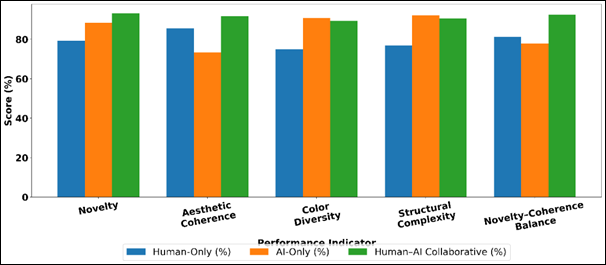
Figure 5
Comparative
Evaluation of Human, AI, and Collaborative Art
The novelty-coherence balance index is highest at 92.5% of human only and +11.2 percent AI only creation. Though a little less complex than AI-only, collaborative results are high structural complexity (90.6) and do not lose harmony. Such findings affirm that cooperation is quantitatively better and more balanced in terms of abstract art.
7. Conclusion
This paper has discussed the concept of human-AI collaboration as a new and productive trend of creating abstract art, showing how a joint creative agency can contribute to the artistic performance and creative work. Placing AI not as an independent writer, but as a creative collaborator, responsive, and adaptable, the suggested framework does not diminish the intentionality of human beings but opens the artistic dimension of creative intervention. The results are consistent in that collaborative artworks are more novel, richer in composition, and more aesthetically coherent than human-only and AI-only artworks, which proves that human intuition and computational generation are complementary. Conceptually, the study shows that a well-structured role, modes of interaction, and flexibility of the level of autonomy is imperative in ensuring that a meaningful collaboration is maintained. Human artists provide conceptual vision, emotional foundation as well as evaluative judgment whereas AI systems provide a quick exploration, pattern finding, and generative diversity. The dynamic creative procedure of this dialogue is carried out by means of the iterative interaction between these agents and benefits computational scale and speed in contrast to human artistic practice. Theoretically, the mixed assessment approach, which involves a set of quantitative approaches and qualitative techniques, proves that abstract art creativity is not something that can be measured solely by automation. Rather, human perception is still key in the assessment of meaning, expression and beauty. The findings also suggest that with human and AI collaboration, creative efficiency is enhanced, which means that artists can achieve quality results with fewer iterations and less thoughts. In addition to abstract art, this work has implications on the area of digital art teaching, creative industries, and computational creativity studies.
CONFLICT OF INTERESTS
None.
ACKNOWLEDGMENTS
None.
Alalaq, A. S. (2025). AI-Powered Search Engines. ShodhAI: Journal of Artificial Intelligence, 2(1), 49–62. https://doi.org/10.29121/shodhai.v2.i1.2025.31
Buschek, D., Mecke, L., Lehmann, F., and Dang, H. (2021). Nine Potential Pitfalls When Designing Human-AI Co-Creative Systems (arXiv:2104.00358). arXiv. https://arxiv.org/abs/2104.00358
Čábelková, I., Dvořák, M., Smutka, L., Strielkowski, W., and Volchik, V. (2022). The Predictive Ability of Emotional Creativity in Motivation for Adaptive Innovation Among University Professors Under COVID-19 Epidemic: An International Study. Frontiers in Psychology, 13, 997213.
Chatterjee, S. (2024). Diffmorph: Text-Less Image Morphing with Diffusion Models (arXiv:2401.00739). arXiv. https://arxiv.org/abs/2401.00739
Chiou, E. K., and Lee, J. D.
(2023). Trusting Automation: Designing for Responsivity and Resilience.
Human Factors, 65, 137–165.
De Vries, K. (2020). You Never Fake Alone: Creative AI in Action.
Information, Communication & Society, 23, 2110–2127.
Deonna, J., and Teroni, F. (2025). The Creativity of Emotions. Philosophical Explorations, 28, 165–179.
E G, J. J., and A, N. J. (2024). Art of gamification: Exploring the Transformative Influence of Games on English Language Teaching and Learning. ShodhGyan-NU: Journal of Literature and Culture Studies, 2(1), 36–45. https://doi.org/10.29121/shodhgyan.v2.i1.2024.27
Haase, J., and Pokutta, S. (2024). Human-Ai Co-Creativity: Exploring Synergies Across Levels of Creative Collaboration (arXiv:2411.12527). arXiv. https://arxiv.org/abs/2411.12527
Haj-Bolouri,
A., Conboy, K., and Gregor, S. (2024). Research Perspectives: An Encompassing Framework for Conceptualizing
Space in Information Systems: Philosophical Perspectives, Themes, and Concepts. Journal of the Association for
Information Systems, 25, 407–441.
Jennings, K. E. (2010). Developing Creativity: Artificial Barriers in Artificial Intelligence. Minds
and Machines, 20, 489–501.
Mateja, D., and Heinzl, A. (2021). Towards Machine Learning as an Enabler of Computational Creativity. IEEE
Transactions on Artificial Intelligence, 2, 460–475.
Melville, N. P., Robert, L., and Xiao, X. (2023). Putting Humans Back in the Loop: An Affordance Conceptualization of the 4th Industrial Revolution. Information Systems Journal, 33, 733–757.
Prudviraj, J., and Jamwal, V. (2025). Sketch and Paint: Stroke-By-Stroke Evolution of Visual Artworks (arXiv:2502.20119). arXiv. https://arxiv.org/abs/2502.20119
Sundquist, D., and Lubart, T. (2022). Being Intelligent with Emotions to Benefit Creativity: Emotion Across the Seven Cs of Creativity. Journal of Intelligence, 10, 106.
Wu, Z., Gong, Z., Ai, L., Shi, P., Donbekci, K., and Hirschberg, J. (2024). Beyond Silent Letters: Amplifying LLMs in Emotion Recognition with Vocal Nuances (arXiv:2407.21315). arXiv. https://arxiv.org/abs/2407.21315
Zhou, M., Wang, Z., Zheng, H., and Huang, H. (2024). Long and Short Guidance in Score Identity Distillation for One-Step Text-To-Image Generation (arXiv:2406.01561). arXiv. https://arxiv.org/abs/2406.01561
|
|
 This work is licensed under a: Creative Commons Attribution 4.0 International License
© ShodhKosh 2026. All Rights Reserved.