ShodhKosh: Journal of Visual and Performing ArtsISSN (Online): 2582-7472
|
|
Intelligent Museum Management Systems
Dr. Khriereizhünuo
Dzüvichü 1 , Dr. R. Vasanthan 2
 ,
Vinitha M. 3
,
Vinitha M. 3 , Sulabha Narendra Patil 4
 , Naman Soni 5
 , Dr. Shweta Bajaj 6
1 Associate
Professor, Department of History, Central University of Tamil Nadu, Tamil Nadu,
India
2 Associate
Professor, Department of English, Nagaland University, Kohima Campus, Meriema, Kohima, Nagaland - 797004, India
3 Assistant Professor, Meenakshi College of Arts and Science,
Meenakshi Academy of Higher Education and Research, Chennai, Tamil Nadu,
600109, India
4 Department of Engineering, Science and Humanities, Vishwakarma
Institute of Technology, Pune, Maharashtra, 411037, India
5 Assistant Professor, School of Fine Arts and Design, Noida
International University, Noida, Uttar Pradesh, India
6 Associate Professor, School of Management and School of Advertising, PR and Events, AAFT University of Media and Arts, Raipur, Chhattisgarh-492001, India
|
|
|
ABSTRACT |
|
|
IMMS is an
innovative paradigm in the management, conservation, and mediational
experience of cultural heritage organizations. IMMS can help transform
museums into adaptable, responsive, knowledge-oriented places through
artificial intelligence, Internet of Things, data-driven analytics, and
cyber-physical infrastructures. This paper conceptualizes IMMS to be
socio-technical ecosystems that integrate digital representations of objects,
real time monitoring of visitors and environments and intelligent decision
engines used to support curatorial, conservation, and operational processes.
The suggested framework presents a multi-layer structure including sensing
and data management layers, intelligence, and application layers that allow a
smooth interaction between physical assets of the museum and digital twins.
Modern AI modules enable visitor-centered services based on behavioral
profiling, recommendation of personal exhibitions, and adaptive content based
on a person's emotions, which positively affect the level of engagement,
inclusivity, and educational outcomes. At the same time, intelligent asset
management operations enhance predictive preservation, environmental
surveillance, and provenance authentication, which enhance heritage care. The
operational intelligence capabilities would streamline the process of
attendance forecasting, staffing, energy, and space utilization to achieve
sustainability and cost-effectiveness. The study presents representative
deployment situations to demonstrate quantifiable changes in the satisfaction
of visitors, resource utilization, and decision quality along with practical
issues connected to the integration of the data, ethical and institutional
preparedness. |
|||
|
Received 18 September 2025 Accepted 21 December
2025 Published 17 February 2026 Corresponding Author Dr. Khriereizhünuo Dzüvichü, khrienuodzuvichu@gmail.com DOI 10.29121/shodhkosh.v7.i1s.2026.7124 Funding: This research
received no specific grant from any funding agency in the public, commercial,
or not-for-profit sectors. Copyright: © 2026 The
Author(s). This work is licensed under a Creative Commons
Attribution 4.0 International License. With the
license CC-BY, authors retain the copyright, allowing anyone to download,
reuse, re-print, modify, distribute, and/or copy their contribution. The work
must be properly attributed to its author.
|
|||
|
Keywords: Intelligent Museum Management Systems, Smart Museums, Artificial Intelligence, Internet of Things, Visitor Experience Personalization, Digital Heritage Management |
|||



1. INTRODUCTION
Museums have long been traditionally the guardians of cultural memory, transmission of knowledge and overall education, storing both tangible and intangible heritage of the current generation as well as future generations. Historically, the practice of museum management has been based on manual expertise of Curatorial practice, fixed exhibition form and responsive operation practice. Nevertheless, the shift to the rapid development of digital technologies, along with shifting expectations of visitors and the pressures of sustainability, has permanently changed the situation in which museums have been operating. Modern audiences are more demanding of immersive, customized, and interactive experiences and institutions are experiencing the growing needs of operational efficiency, conservation accuracy, inclusivity, and data-driven accountability. Intelligent Museum Management Systems (IMMS) in this case become a strategic reaction to the complicated issues that modern museums face. IMMS are a combined technological and organizational system that brings on board artificial intelligence (AI), Internet of Things (IoT), data analytics, and cyber-physical systems to assist in comprehensive museum governance. In contrast to individual digital tools or individual information systems, IMMS serve as networked ecosystems that are used to mediate between the physical space of the museum and the digital intelligence layers Hou et al. (2024). Smart sensors, devices and digital infrastructures record information regarding visitor traffic, environmental, asset conditions and user activities, on a continual basis. This information is digested by using sophisticated analytics and AI-driven decision engines to create actionable information to the curators, conservators, administrators, and educators. This consequently leads to a change in the practices of museums where intuitive and reactive methods of work are replaced by predictive-adaptive and evidence-based decision-making. The changing nature of the museums as an object-oriented institution into a visitor-oriented cultural platform is one of the guiding impetuses of the IMMS. Museums are not seen as just a collection of objects but as an active social environment that helps to learn, communicate and be emotionally involved Cerquetti et al. (2024). Allowing museums to know their various audiences, predict needs, and tailor individual visitor experiences, intelligent systems can be used to profile visitors in finer detail and perform behavioral analytics. IMMS improve cognitive interaction, access and inclusivity among age groups, cultures, and abilities through recommendation, adaptive storytelling, and the ability to deliver content that is sensitive to emotions Wang et al. (2023). Figure 1 demonstrates multilayer architecture that allows smart and data-driven museum management systems. These features are especially topical in the age when digital natives demand experiences that are comparable to smart environments in retail environments, entertainment, and urban spaces.
Figure 1

Figure 1 Multilayer Flowchart of Intelligent Museum Management Systems (IMMS)
In addition to visitor interaction, IMMS are also very important in enhancing collection and asset management. Cultural artifacts are delicate in nature and are subject to environmental changes, material decay and human influence. Smart sensing and digital twins can be used to monitor the temperature, humidity, light exposure and structural health in real-time, which can serve to support predictive conservation measures in a building instead of regular inspections. Provenance analysis and authentication through AI will also help the community of scholars achieve greater scholarly rigor, transparency, and mitigate risks during collection management Wu et al. (2024).
2. Conceptual Foundations of Intelligent Museum Management
2.1. Definition and core components of Intelligent Museum Management Systems (IMMS)
IMMS may be described as hybrid socio-technical systems that utilise artificial intelligence, data analytics, Internet of Things (IoT), and digital infrastructures to facilitate comprehensive museum leadership, curation, conservation and visitor experience. IMMS unlike traditional museum information systems that emphasize cataloging or ticketing separately are dynamic ecosystems whereby data, intelligence and human expertise are continually harmonized to facilitate better decision-making and cultural value generation Bai et al. (2024). In its essence, IMMS are truly supposed to turn museums into responsive, learning-based organizations that are able to anticipate the needs of the visitors, preserve the assets in a proactive manner and run their operations in a sustainable way. Sensing and data acquisition modules, data management and integration layers, intelligent analytics engines, and application-level interfaces are the basic elements of IMMS. The sense components will receive real time data pertaining visitor movement, environmental conditions, status of artifacts, and user interaction by smart sensors, cameras and wearable or mobile devices Bai et al. (2024).
2.2. Cyber-Physical Integration of Digital and Physical Museum Assets
The idea underlying Intelligent Museum Management Systems is cyber-physical integration, which allows the creation of a smooth interaction between physical museum spaces and their online equivalents. Museums by nature have a presence in both the real and the virtual worlds: physical objects, spaces and buildings exist alongside digital documentation, explanatory discourse and virtual manifestations. IMMS fill this gap by integrating computational intelligence into the physical entity and at the same time grounded the digital system on the reality Wu et al. (2024). This combination enables the museums to transcend the slow digitization into the dynamic and real-time cultural ecosystems. One of the main processes that allow integrating cyber-physically is implementing smart sensors and embedded systems on artifacts, display cases, and architectural infrastructure. These systems provide constant attention to the parameters: temperature, humidity, vibration, exposure to light, and the distance to visitors and convert physical parameters into streams of digital information Zou et al. (2024). This data is used to simulate, predict and plan scenarios by creating digital twins, virtual representations of an object, exhibition or even a whole museum environment. As an illustration, conservation teams can evaluate the potential impact of changes in the environment on the lifespan of the artifacts, whereas curators can rearrange exhibitions virtually and only implement their designs once they are reviewed Liu and Chang (2024).
2.3. Human–AI Collaboration in Curatorial and Operational Decision-Making
The idea of human-AI cooperation is a focal point in the conceptual principle of Intelligent Museum Management System as it does not replace professional expertise but enhances it. Museums are intensely human organisations whereby they are influenced by curatorial judgment, scholarly interpretation, ethical responsibility, and cultural sensitivity. IMMS exist to assist in these human values through the offering of analytical insights and prediction capability, decision support without sacrificing human authority and interpretive agency Choi and Yoon (2025). Under this model of collaboration, AI is an intelligent assistant that improves the situational awareness rate and decreases cognitive and operational strains. Within the curatorial setting, AI-based systems are used to examine bulk data on collections, visitor feedback, and historical data to generate trends that would not necessarily be obvious to human professionals. Such lessons may have an impact on the planning of exhibitions, the thematic relation, and interpretive approaches, and the ultimate choices made by curators are still based on human judgment, cultural context, and institutional mission Świt et al. (2024). In the same manner, the AI-based provenance examination and authenticity check can assist in academic rigor but not in place of the scholarly validation. Table 1 presents comparative methods, technologies and results in the research on intelligent museum management. The predictive models are used in the operational areas to assist the administrators to predict attendance, manage the staffing and control the energy use and therefore enables proactive management and not reactive management. Transparency, explainability and trust are necessary in an effective human and AI collaboration in IMMS Gaikwad and Damodaran (2024).
Table 1
|
Table 1 Comparative Analysis of Related Work on Intelligent Museum Management Systems |
||||
|
Core Focus Area |
Key Technologies Used |
System Scope |
Visitor Experience Features |
Key Limitations |
|
Smart museum architecture |
IoT, Cloud Computing |
Museum-wide |
Basic digital guides |
Low personalization |
|
Visitor behavior
analysis Wu et al. (2021) |
AI, Computer Vision |
Visitor-centric |
Flow tracking, heatmaps |
Privacy concerns |
|
Digital heritage platforms |
AR/VR, Databases |
Exhibition-level |
Immersive storytelling |
High deployment cost |
|
Predictive conservation |
IoT, ML |
Asset-centric |
Indirect |
Limited scalability |
|
Personalized museum tours |
Recommender Systems |
Visitor-centric |
Adaptive tour paths |
Content cold-start |
|
Smart building management |
AI, IoT |
Infrastructure-level |
Comfort optimization |
Integration complexity |
|
Digital twin for museums Loupa et al. (2025) |
Digital Twin, Sensors |
Asset & space |
Virtual exhibitions |
High data dependency |
|
AI in curatorial planning |
ML, Knowledge Graphs |
Curatorial workflows |
Thematic guidance |
Explainability issues |
|
Emotion-aware exhibitions Jin et al. (2024) |
AI, Affective Computing |
Visitor-centric |
Emotion-adaptive content |
Ethical concerns |
|
Attendance forecasting |
Predictive Analytics |
Operations |
Reduced congestion |
Data sparsity |
|
Provenance verification |
AI, Image Analysis |
Collection-level |
Educational insights |
Requires expert validation |
|
Integrated smart museum |
AI, IoT, Big Data |
Museum-wide |
Personalized & adaptive |
High initial cost |
|
Sustainable museum systems Ullah et al. (2023) |
AI, Energy Analytics |
Infrastructure-level |
Comfort-aware control |
Limited cultural focus |
|
Holistic intelligent management |
AI, IoT, Digital Twins |
End-to-end system |
Personalized, emotion-aware |
Requires governance & training |
3. System Architecture of Intelligent Museum Management Systems
3.1. Multi-layer architecture: sensing, data, intelligence, and application layers
Intelligent Museum Management Systems (IMMS) system architecture is typically designed as a multi-layered model, which provides scalability, interoperability, and intelligent adaptiveness in the functionality of museums. Being a layered design, it isolates concerns but allows smooth movement of data between physical environments and strategic decision-making interfaces. The lower block is the sensing layer which consists of IoT devices, sensors, cameras, and embedded systems that are installed all over museum spaces. This layer is able to record the real-time information about visitor movement, environmental, artifact status, and infrastructure performance. Most importantly, the data layer is the integrative foundation of IMMS. It consolidates non-homogenous data streams across various sources, does data cleaning, normalization, storage, and protection of access. Infrastructure of cloud and edge computing is frequently used to trade the responsiveness in real-time with the long-term archival and analytical demands. The intelligence layer converts raw information into intelligence. It uses machine learning models, predictive analytics, rule-based systems, and knowledge graphs to identify patterns, predict trends and come up with recommendations. This layer aids strategic and operational intelligence, so that the museums can predict the demand of visitors, risks to their conservation, and limitations of resource.
3.2. IoT-Enabled Sensing for Visitor Flow, Environment, and Asset Monitoring
IoT-based sensing forms a highly important architectural aspect of Intelligent Museum Management Systems as it allows the constant monitoring of the dynamics of the museums. Museums are able to monitor and react to real-time situations by observing the visitors, collections, and infrastructure through a decentralized network of sensors and smart objects. The technologies used to track the visitor flow include RFID tags, Bluetooth beacons, Wi-Fi tracking, and computer vision and are used to record the movement patterns, dwell times, and the level of congestion in the galleries. These observations can be used in managing crowds, safety, and optimization of space as well as informing personal visitor experiences. Environmental sensing is concerned with the conservation of the delicate equilibrium necessary in artifact conservation. Display cases and storage areas contain sensors that check the temperature, humidity, light exposure, air quality and vibration. On-going environmental data can identify risk conditions that may result in erosion of materials at an early stage to preventive conservation measures. Compared to manual inspections done periodically, IoT-based monitoring is available to provide continuous control and quick reactions to any anomalies. Asset monitoring is a sensing option that is extended to artifacts and exhibition infrastructure. IoT-enabled smart museum monitoring systems smart museums have IoT-enabled sensing architecture as illustrated in Figure 2. Smart tags and embedded micro-sensors monitor the object location, events, and structural stability minimizing the risk of losing, damaging, or moving the objects unwantedly. Together, these sensing result into high-resolution data, which is inputted to higher-order analytics and decision engines in IMMS.
Figure 2
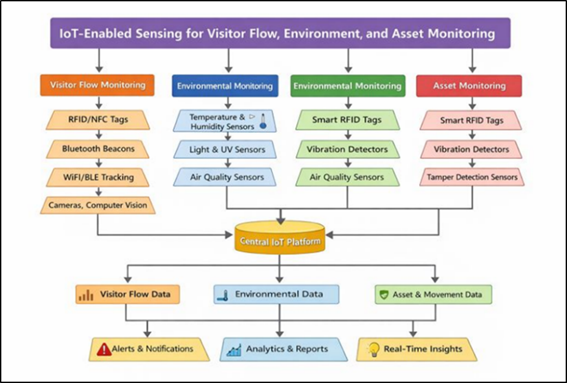
Figure 2 IoT-Enabled Sensing Architecture for Visitor Flow, Environmental Control, and Asset Monitoring in Smart Museums
Significantly, the idea of IoT-enabled sensing is meant to be as non-invasive as possible to avoid disrupting the atmosphere and artistic value of museums and allowing them to be managed intelligently. It is on this layer that adaptive museum management, as well as data-driven stewardship, is founded on empirically.
3.3. AI-Driven Analytics and Decision Engines
The engines combine machine learning, statistical modelling and knowledge-based reasoning with complex multidimensional datasets of visitor interactions, environmental monitoring and asset management systems. Through pattern recognition and correlation, the AI models can assist in transforming museums descriptive reporting to predictive and prescriptive decision-making. Visitor experience analytics Vis Emotion recognition and engagement analysis will also help to deliver contents in an adaptive way, synchronising interpretive narratives with visitor feedbacks. Predictive models used in conservation and asset management evaluate trends in the environment and the sensitivities of materials to predict deterioration risks to allow preventive measures before they occur. The provenance analysis tools facilitate the work of the researcher by indicating discrepancies or irregularities between historical documentation and material information. The operational decision engines would optimize the use of resources by predicting attendance, staffing schedules, and energy usage distribution in the museums. These systems are used to model alternative scenarios and assist the administrators to consider trade-offs prior to making policy or operational changes.
4. AI-Driven Visitor Experience Management
4.1. Visitor profiling and behavioral analytics
Intelligent Museum Management Systems Visitor experience management Visitor profiling and behavioral analytics are a core component of AI-based visitor experience management. The audiences of museums are diverse and vary in terms of age, cultural and cultural background, modes of learning, motivations and background knowledge. Conventional methods are based on aggregate data and post visit survey, which provide a weak understanding of the behavior of visitors in real time. AI-powered analytics address such shortcomings by continually processing the data of interaction produced with the help of ticketing systems, mobile apps, sensors, and digital interfaces and building dynamically changing visitor profiles. Such variables analyzed by behavioral analytics models include movement patterns, time spent at exhibits, frequency of interaction with digital media, revisiting patterns, and time. Visitors can be grouped using machine learning solutions into meaningful groups, including exploratory visitors, social visitor, focused researchers, or casual tourist. These profiles are not fixed but they can change during the visit with the acquisition of new behavioral signals. It is this dynamic understanding that allows museums to react to the needs of the visitors on-the-fly instead of just basing on the pre-prejudiced assumptions.
4.2. Personalized Exhibition Recommendation Systems
Personalized systems of exhibition recommendations further apply behavioral analytics into visitor-focused services that will maximize learning and interaction. Based on the recommendation engines applied to online media platforms, these systems utilize AI to propose exhibitions, artifacts, or interpretative content to match the personal interests and behaviors of a visitor. In Intelligent Museum Management Systems, the proposals are based not only on the similarity of the content but also on the geographical location, time, multitudes, and curatorial interests. Machine learning systems can study visitor profiles, past pattern of interactions, and real-time activity to provide dynamic recommendations during the experience in the museum. In other words, when a visitor expresses interest in a historical artifact over an extended period of time, they might be recommended other related galleries, thematic tours, or complementary digital stories. Recommendation systems are able to dynamically adapt depending on visitor rate, interest level, or congestion in certain places, and so that there is customization and business balance. The advantages of these systems is that they evenly spread the flow of visitors and limit the congestion in exhibitions with high attendance whereas they promote the exposure of smaller collections.
4.3. Emotion-Aware and Engagement-Adaptive Content Delivery
Emotion-sensitive and interaction-sensitive content delivery is the next level of AI-based visitor experience management which will allow museums to react to visitor behavior as well as influence feelings. Based on computer vision, sound analysis, and interaction data, AI models can detect the emotional indicators including interest, confusion, excitement, or disengagement. These lessons enable museums to specificate interpretive content in manners that appeal to the cognitive and emotional issues of visitors to a greater extent. Adaptive content systems are dynamically controlled systems which alter narrative depth, media form or pacing according to perceived engagement. As an example, visitors who are interested and pay attention can be provided with more historical detail or academic interpretations, and those who appear to be tired can be given brief summaries or engaging activities. Figure 3 demonstrates how emotion-conscious adaptive content delivery can be used to improve personal experiences of museum visitors. Emotion-sensitive systems may be used in immersive or digital exhibitions to keep the state of attention and engagement by controlling the lighting, soundscapes, or narration mechanisms.
Figure 3
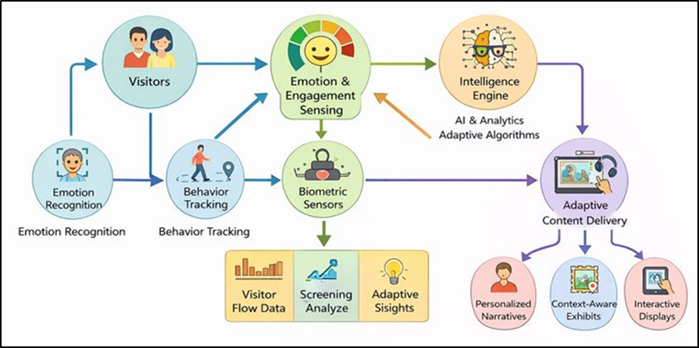
Figure 3 Emotion-Aware and Engagement-Adaptive Content
Delivery Framework for Intelligent Museum Experiences
This responsiveness leads to higher levels of inclusivity since there are different learning styles and emotional sensibilities that can be accommodated. Content that can change dynamically instead of following a fixed presentation style can be useful to children, first time visitors or people of varying cognitive abilities. Notably, emotion sensitive systems of IMMS have ethical design as a priority without manipulation and transparency regarding the use of the data. Considered properly, engagement-adaptive content presentation enhances meaning-making, reinforces emotional connections in between visitors and heritage, and makes museums become responsive and empathetic cultural experiences instead of information archives.
5. Operational Intelligence and Resource Optimization
5.1. Predictive analytics for attendance forecasting and staffing
Attendance forecasting and staffing predictive analytics is a fundamental operation of operational intelligence in Intelligent Museum Management Systems. Seasonal trends, special exhibitions, holidays, weather conditions, and socio-cultural events are some of the factors that subject museums to high variability in terms of visitor numbers. The conventional planning processes tend to be based on historical averages and subjective decisions, which result in inefficiencies (understaffing, congestion, or underuse of resources, etc.). I am going to solve these issues with AI-based predictive analytics, which model the complicated, multi-factor trends that are used to drive visitor demand. The machine learning models combine historic attendance databases, ticketing, event schedules, local tourism patterns, weather, and real-time booking databases to come up with the right demand forecasts. Such predictions help to make staffing choices in advance, as it is necessary to make sure that the number of guides, security personnel, educators, and operational personnel is maximum. Figure 4 demonstrates predictive analytics that optimize staffing and attendances in the museum. Dynamic staffing models are able to provide real time adjustment of schedules which enhance the quality of services provided and lower labor expenses and staff exhaustions.
Figure 4

Figure 4 Predictive Analytics–Based Attendance Forecasting and Staffing Optimization Framework for Intelligent Museum Operations
In addition to workforce management, attendance forecasting is useful to the larger operational planning, such as opening time, queue management, and facility preparation. Predictive insights also facilitate scenario analysis to see how exhibitions, pricing decisions, or marketing campaigns would change things but it is possible to evaluate the effect before it is implemented. Notably, predictive analytics can be regarded as a decision-support tool and not as a substitute of managerial experience, but as a complement of it. Operational intelligence of IMMS improves visitor satisfaction, staff welfare, and efficiency of the institution in sustainable and data-driven ways through alignment of human resources to expected demand.
5.2. Energy-Efficient Building Management Using AI and IoT
A key sustainability aim of museums is energy-efficient management of buildings, as most of them have large and climate-controlled areas that accommodate delicate artifacts. Intelligent Museum Management System matches AI and IoT to achieve equilibrium between conservation demands and energy-saving to lower the cost of operation and environmental impact. The conventional building management systems are based on fixed rule sets and manual adaptations that do not tend to be dynamically adapting to the changes in occupancy and environmental settings. IoT sensors that are spread throughout the museum amenities constantly check on temperature, humidity, occupancy, lighting level, and air quality. This data is analyzed by AI-controlled systems where the heating, ventilation, air conditioning, and lighting are optimized. As an example, the climate settings can be changed in accordance with the number of visitors, time, or weather conditions, without disturbing artifact-safe levels. The predictive models also foresee demand trends of the energy, which allows balancing of the load and reducing the peak. Application of energy optimization to exhibition design and exhibition timetable Exhibition design and exhibition schedules can be optimized by AI to suggest lighting setup or the sequence of exhibition display, which will use the least amount of energy without affecting visitor experience. Notably, the systems work under conservation restrictions provided by professionals, and artifact security is the main priority. With the help of incorporating sustainability objectives in daily activities, AI-enabled building management makes museums responsible cultural institutions that help to achieve greater environmental-level objectives without compromising the operational resilience or financial responsibility.
5.3. Optimization of Exhibition Scheduling and Space Utilization
Optimal scheduling and space optimization of the exhibitions is a strategic use of operational intelligence in Intelligent Museum Management Systems. Whenever planning exhibitions, museums need to juggle among curatorial desire, visitor attraction, physical space and resources at hand. Conventional methods of scheduling are frequently based on experience and manual inventory, which restrict the ability to react to the shifting numbers of visitors and organizational needs. Data-driven approaches present in AI-driven optimization are more flexible and effective. Analytics engines compare the patterns of attendance, visitor flows, dwell time and thematic preferences to assess the performance of the exhibition in various spaces. The optimization models model the alternative scheduling cases, evaluating the impact of the timing, duration, and location of exhibitions on visitor distribution and visits. The insights can assist curators and administrators to lessen congestion, enhance accessibility, and more exposure of various collections. Adaptive reuse of galleries, pop up exhibits and multi-use spaces are also supported by space utilization analytics. Operationally, the staffing, security, maintenance, and marketing activities are better coordinated in optimized scheduling.
6. Case Studies and Real-World Deployment Scenarios
6.1. Smart museums and digitally augmented heritage institutions
The Intelligent Museum Management Systems can be found in real-life applications in an increasing number of smart museums and digitally enriched heritage museums all over the world. These organisations have also embraced integrated AI, IoT, and data platforms to become more engaging with visitors, conservation oriented as well as optimising their operations. Smart museums are usually equipped with sensor-filled interiors, mobile apps, and interactive screens which make the exhibitions responsive to the needs of visitors. This is also applied to digitally augmented heritage institutions, which combine on-site and remote interactions through the inclusion of virtual tours, augmented reality overlay, and digital twins of artifacts. The case scenarios illustrate how IMMS facilitate context-driven storytelling, in which digital content dynamically react to the location of the visitor, interests, and behavior. Other museums utilize live tracking of traffic flow to control the number of visitors in the museum and provide customized tours of the exhibition at the same time. Others consider discoverability of conservation, with the help of digital replicas and sensor-based knowledge to facilitate preventive conservation without interfering with the access of the people. Physical-digital hybrids have been especially successful at attracting younger audiences and foreign visitors and increasing the cultural reach beyond geographic limits. These implementations demonstrate that IMMS do not require advanced institutions to implement them; scalable architectures enable the implementation to be adopted over time according to the capacity of the institution.
6.2. Analysis of System Impact on Visitor Experience and Operations
IMMS deployments have had considerable positive effects on visitor experience as well as operations in the museums, as seen through analysis. As a visitor, smart systems allow customised, engaging, and smooth experiences that enhance engagement, satisfaction and learning. Recommendation systems and behavioral analytics aid the visitor in more intuitively navigating hectic museum space to ease cognitive burden, and build narrative coherence. Emotional response and adaptive content pushes emotional engagement, the long-dwell time and frequent visits. IMMS enhance the quality of decisions operationally because they give real-time information about visitor flows, environmental factors and the utilization of resources. Information on attendance forecasting and staffing optimization decrease the bottleneck in services and enhance the allocation of the staff and comfort of the visitor. The results of conservation are also enhanced, since predictive monitoring reduces risks of deterioration and emergency actions. The use of energy management systems also helps to achieve quantifiable decrease in the cost of operation and carbon footprint without affecting the safety of artifacts. To measure the change in visitor flow, frequent quantitative deployments indicate enhanced distribution of visitor flow, more frequent use of under-used galleries, and efficiency in exhibition scheduling.
6.3. Lessons Learned and Implementation Challenges
Although they are beneficial, practical implementation of Intelligent Museum Management Systems has valuable challenges and lessons. Among the lessons is the need to find a balance between technological innovation and institutional culture and mission. Effective implementations focus on gradual integration, which enables the personnel to change progressively without losing curatorial authority and ethics. Implementations that are too technologically oriented will be likely to result in resistance by the professionals when they feel that the technology is being imposed upon them or the technology does not fit the museum philosophy. Privacy and data governance become the issues of high concern, especially when it comes to visitor analytics and emotion-sensitive systems. The key elements to the preservation of trust among the population are clear data policy, informed consent, and anonymization. The other common problem is interoperability whereby museums tend to use old systems that make it difficult to integrate with new AI and IoT infrastructure. This needs to be addressed with modular architectures and long-term digital strategies instead of buying technologies separately. The outcomes are also influenced by training requirements and skills deficiencies. The professionals working in museums need to be digitally literate and confident enough to understand AI-generated findings. The cost of adoption may be another constraint due to financial limitations, in particular among smaller institutions, which is why the scalability and affordability of solutions should be a priority.
7. Conclusion
Intelligent Museum Management Systems (IMMS) are a transformative change in the way museums are conceptualizing the matter of governance, engagement, and stewardship in a rapidly growing digital and data-driven cultural world. IMMS provides museums with an opportunity to leave the sphere of isolated digital solutions and adopt comprehensive, dynamic, and future-proof ecosystems by integrating artificial intelligence, Internet of Things technologies, cyber-physical systems, and advanced analytics. This study has shown that IMMS do not just represent a technological enhancement, but strategic models that harmonize the operational efficiency, visitor-focused experience design, and the preservation of the heritage in a responsible way. IMMS enables museums to learn visitor behavior, craft cultural stories to individual visitors and maximize the use of their resources without interfering with the curatorial integrity through layered system architectures, real-time sensing and AI-based decision support. By aligning exhibitions to various cognitive, emotional and cultural requirements, intelligent visitor experience management makes exhibitions more inclusive, engaging and learning. At the same time, smart gathering and property upkeep enhances the conservation routines with anticipatory observing, computerized twins, and the use of AI in provingance analysis, clenching the ethical accountability of museums as the custodians of cultural heritage. Operational intelligence also makes museums sustainable organizations that can act proactively in response to the changing attendance, energy requirements, and space estimates. These results highlight the fact that organizational preparedness and human-AI contacts are just as important as technical ability when it comes to the successful implementation of IMMS.
CONFLICT OF INTERESTS
None.
ACKNOWLEDGMENTS
None.
REFERENCES
Bai, Y., Yang, X., Zhang, L., Zhang, R., Chen, N., and Dai, X. (2024). Carbon Emission Accounting and Decarbonization Strategies in Museum Industry. Energy Informatics, 7, 83. https://doi.org/10.1186/s42162-024-00403-6
Cerquetti, M., Sardanelli, D., and Ferrara, C. (2024). Measuring Museum Sustainability Within the Framework of Institutional Theory: A Dictionary-Based Content Analysis of French and British National Museums' annual reports. Corporate Social Responsibility and Environmental Management, 31, 2260-2276. https://doi.org/10.1002/csr.2689
Choi, S., and Yoon, S. (2025). AI Agent-Based Intelligent Urban Digital Twin (I‑UDT): Concept, Methodology, and Case Studies. Smart Cities, 8, 28. https://doi.org/10.3390/smartcities8010028
Gaikwad, R. R., and Damodaran, D. (2024). The Rise of Predictive Analytics in Management Accounting: from Descriptive to Prescriptive. ShodhAI: Journal of Artificial Intelligence, 1(1), 159–167. https://doi.org/10.29121/shodhai.v1.i1.2024.54
Hou, Y. (2024). Application of Intelligent Internet of Things and Interaction Design in Museum Tour. Heliyon, 10, E35866. https://doi.org/10.1016/j.heliyon.2024.e35866
Jin, Y., Sharifi, A., Li, Z., Chen, S., Zeng, S., and Zhao, S. (2024). Carbon Emission Prediction Models: A Review. Science of the Total Environment, 927, 172319. https://doi.org/10.1016/j.scitotenv.2024.172319
Kudriashov, M. (2023). Eco-climatic Agenda of Italian Museums, Analysis, Best Practices, Perspectives and Recommendations (Master's thesis). Università degli Studi di Padova, Padua, Italy.
Liu, Z., and Chang, S. (2024). A Study of Digital Exhibition Visual Design led by Digital Twin and VR Technology. Measurement: Sensors, 31, 100970. https://doi.org/10.1016/j.measen.2023.100970
Loupa, G., Dabanlis, G., Kostenidou, E., and Rapsomanikis, S. (2025). Air quality and energy use in a Museum. Air, 3, 5. https://doi.org/10.3390/air3010005
Ullah, Z., Rehman, A. U., Wang, S., Hasanien, H. M., Luo, P., Elkadeem, M. R., and Abido, M. A. (2023). IoT-based Monitoring and Control of Substations and Smart Grids with Renewables and Electric Vehicles Integration. Energy, 282, 128924. https://doi.org/10.1016/j.energy.2023.128924
Wang, S., Duan, Y., Yang, X., Cao, C., and Pan, S. (2023). 'Smart Museum' in China: From Technology Labs to Sustainable Knowledgescapes. Digital Scholarship in the Humanities, 38, 1340-1358. https://doi.org/10.1093/llc/fqac097
Wu, R., Gao, L., Lee, H., Xu, J., and Pan, Y. (2024). A Study of the Key Factors Influencing Young Users' Continued use of the Digital Twin-enhanced Metaverse Museum. Electronics, 13, 2303. https://doi.org/10.3390/electronics13122303
Wu, Y., Jiang, Q., Liang, H. E., and Ni, S. (2022). What Drives Users to Adopt a Digital Museum? A Case of Virtual Exhibition Hall of National Costume Museum. Sage Open, 12, 21582440221082105. https://doi.org/10.1177/21582440221082105
Wu, Y., Zhang, K., and Zhang, Y. (2021). Digital twin networks: A Survey. IeeE Internet of Things Journal, 8, 13789-13804. https://doi.org/10.1109/JIOT.2021.3079510
Zou, C., Rhee, S. Y., He, L., Chen, D., and Yang, X. (2024). Sounds of History: A Digital Twin Approach to Musical Heritage Preservation in virtual museums. Electronics, 13, 2388. https://doi.org/10.3390/electronics13122388
Świt‑Jankowska, B. (2024). Adam Mickiewicz Museum in Śmiełów-towards a Contemporary Museum Concept Using Digital twin technology. Architectus, 79, 65-74. https://doi.org/10.37190/arc240307
|
|
 This work is licensed under a: Creative Commons Attribution 4.0 International License
© ShodhKosh 2026. All Rights Reserved.