ShodhKosh: Journal of Visual and Performing ArtsISSN (Online): 2582-7472
|
|
Sustainable Sculpture Design Using AI Optimization
Rashmi Manhas 1 , Milind Patil 2
 , Ram
Rameshwar Wayzode 3
, Ram
Rameshwar Wayzode 3 , Dr.
Gajanan P Arsalwad 4
, Dr.
Gajanan P Arsalwad 4 , Aishwarya
Pathak 5
, Aishwarya
Pathak 5 , Dhanalakshmi V 6
1 Assistant
Professor, School of Business Management, Noida International University, Greater
Noida 203201, India
2 Department
of E and TC Engineering, Vishwakarma Institute of Technology, Pune,
Maharashtra, 411037, India
3 Department of Mechanical Engineering, Suryodaya
College of Engineering and Technology, Nagpur, Maharashtra, India
4 Assistant Professor, Department of Computer Engineering, Trinity
College of Engineering and Research, Pune, India
5 Department of ENTC Engineering, Bharati Vidyapeeth's College of
Engineering, Lavale, Pune, Maharashtra, India
6 Assistant Professor, Meenakshi College of Arts and Science, Meenakshi
Academy of Higher Education and Research, Chennai, Tamil Nadu 600081, India
|
|
|
ABSTRACT |
|
|
The necessity
to create sustainable sculptures projects is becoming more and more
problematic due to the necessity to create a compromise between aesthetic
expression, structural integrity, material efficiency, and environmental
responsibility. Sculptural traditional practices, rich in cultural and
artistic significance, can be based on the initiation of decisions, intuitive
in their nature, which contribute to the overuse of materials, an increase in
energy use, and reduced flexibility to the requirements of sustainability. In
this research, the presented AI-based optimization framework in the field of
sustainable sculpture design is suggested as the concept that will combine
the principles of computational intelligence with modern artistic processes.
The study has used genetic algorithms, multi-objective optimization, and
neural network-based evaluation models to maximize sculptural shapes in
relation to several sustainability parameters, such as the material usage,
stability, carbon footprint, and aesthetic consistency. The main inputs of
digital sculptural models are supplemented by material properties and
environmental parameters in the form of density, recyclability and energy
cost. The AI-optimized sculptures are compared in a systematic approach to traditionally
designed sculptures through control experimental design and the use of a set
of sculptural case studies. Findings indicate that AI optimization can make
dramatic material savings and environmental savings and maintain, or even,
improve aesthetic and structural quality. The results point to the ability of
AI systems to act as intelligent partners of artists and designers but not
the substitutes to make data-driven creative choices. |
|||
|
Received 12 September 2025 Accepted 09 December 2025 Published 17 February 2026 Corresponding Author Rashmi
Manhas, rashmi.manhas@niu.edu.in DOI 10.29121/shodhkosh.v7.i1s.2026.7103 Funding: This research
received no specific grant from any funding agency in the public, commercial,
or not-for-profit sectors. Copyright: © 2026 The
Author(s). This work is licensed under a Creative Commons
Attribution 4.0 International License. With the
license CC-BY, authors retain the copyright, allowing anyone to download,
reuse, re-print, modify, distribute, and/or copy their contribution. The work
must be properly attributed to its author.
|
|||
|
Keywords: Sustainable Sculpture Design, AI Optimization,
Generative Design, Multi-Objective Optimization, Computational Art |
|||



1. INTRODUCTION
Cultural identity, mastery of materials and aesthetic philosophy have been long held in sculpture as a means of expression by societies. Since stone-carving and metal-casting to modern mixed-media installations, sculptural practice has an inherent connection between the form and material and environment. But within the framework of mounting environmental anxieties, including the loss of resources, carbon footprint, and garbage, a challenge is mounting against the conventional processes of sculpture, including the reduction and excessive use of resources. The issue in question to modern artists and designers is not as simple as the old one: it is not about generating a visual or symbolic impact anymore, but about environmental responsibility throughout the lifecycle of the sculptural work. This has led to the emergence of sustainable sculpture design which focuses on material efficiency, minimized environmental impact and long-term environmental ecological compatibility without interfering with artistic purpose Liu et al. (2023). Traditional methods of sustainable sculpture are typically based on manual material selection, experiential judgement and post hoc modification to minimise wastage or energy consumption. Although useful, such approaches are, by definition, constrained by the human cognitive processing ability to assess several, and sometimes competing, goals at the same time, i.e. aesthetics, structural integrity, longevity, price, and sustainability. With the increased complexity of the sculptural form and the increased strictness of the sustainability metrics, the need to have systematic and data-driven design support tools that can guide the artists and designers in navigating this multidimensional decision space is increasing Alnaser et al. (2024). Computational optimization and artificial intelligence (AI) can provide the ability to tackle these problems. Within the design and engineering fields, the AI-based optimization methods have shown a high potential in reducing the amount of materials used, enhancing structural performance, and increasing energy efficiency. The translation of these abilities into the form of sculpture design makes the experimentation of new form-material relationships possible, defining the artistic creativity in accordance with the sustainability objectives. Instead of unskilled people being supplanted by AI, it acts as a smart partner, coming up with alternatives, trade-off evaluation, and revealing design solutions that might remain hidden to intuition Chi et al. (2023). According to Figure 1, AI incorporates design, material and sustainability limitations to achieve sculptural optimization results. The problem of AI optimization in the sculpture design is especially topical because the problem is inherently multi-objective.
Figure 1
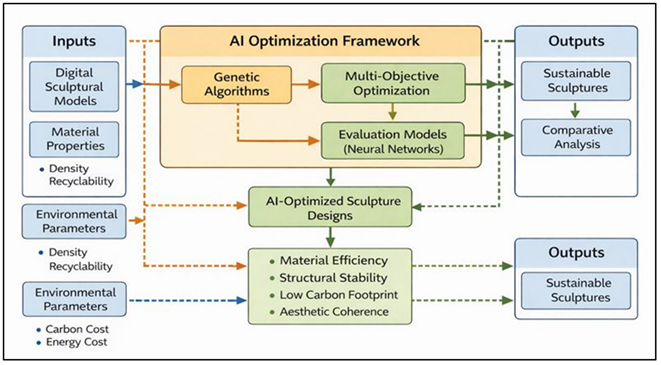
Figure 1 AI-Driven Optimization Architecture for Sustainable
Sculpture Design
Sculptural art should meet aesthetic standards in addition to physical ones like equilibrium, weight distribution, and the possibility of fabrication. Meanwhile, the concept of sustainability adds new goals, such as the decrease of material mass, minimization of embodied carbon and preference of recyclable or locally available materials. Such contexts are best suited to genetic algorithms and other evolutionary algorithms which can be used to obtain design solutions in a manner that can evolve with competing constraints Abioye et al. (2021). Multi-objective optimization also enables the designers to visualize trade-offs between artistic and environmental objectives and allows informed creative decision-making.
2. Literature Review
2.1. Sustainability in sculpture and contemporary art practices
Sustainability in contemporary art and sculpture has become a main ethical issue to the design principle. The earliest examples of sustainable practice in sculpture attention was mostly on reuse and recycling of material, i.e. the use of found objects, industrial wastes, or natural materials in order to minimize the use of resources. Land art and eco-art movements further extended this view by focusing on environmental consciousness, site-specificity and as much minimal disturbance as ecologically possible Shaamala et al. (2024). The strategies approached sustainability as a theoretical position, with the piece of artwork itself expressing ecological principles and criticism of industrial overkill. In more contemporary applicable procedures, sustainability has been implemented more operationalized using quantifiable parameters such as material lifecycle assessment, energy use in the fabrication, durability and recyclability upon end use. To place artistic production in harmony with environmental responsibility, sculptors are currently working with bio-based materials, recycled composites, and Pandey and Kumar (2025)low-impact production of fabrics Adewale et al. (2024). Nonetheless, many of these practices are still largely experience based and qualitative in nature and are not made systematically but depend on the intuition and the artistry of the artist. According to the scholarly discourse, there is an emerging tension between the freedom of aesthetics and restrictions of sustainability. Sustainable material can also restrict some types or finishes, though researchers believe that this can also encourage innovative creativity Elmousalami et al. (2025). Modern literature stresses the necessity of integrative models where artists can take into consideration the impact on the environment without the intention of expressiveness.
2.2. Computational and Generative Design in Sculptural Forms
Computational and generative design have played a major role in changing sculptural practices through allowing the production of complex non-traditional forms through the use of algorithms. Parametric modeling software enables sculptors to create form by means of parameters that can be manipulated to enable quick experimentation of the form that would be impractical in manual methods. This has been extended through generative design methods such as rule-based systems and procedural modelling which enable forms to be generated based on algorithmic logic as opposed to predefined geometric templates El Hafiane et al. (2025). This transformation has increased the dialect of the art of sculpture and has resulted in complex structures that are influenced by biological development, mathematical principles and nature. In the academic realm computational sculpture can be located at the border of art, architecture, and digital fabrication. Researchers observe that the algorithmic form generation helps in iterative experimentation, which has allowed the designers to test the stability of structures, spatial balance, and visual rhythm before it is physically feasible. Nevertheless, the early generative systems did not pay much attention to material efficiency and environmental impact since they mostly focused on aesthetic novelty and geometric complexity Heidari et al. (2024). Recent research proposes performance-based generative design, in which the computational models are comprised of the structural and material constraints and aesthetic objectives. It is an evolution of the purely exploratory form generation to an informed design synthesis.
2.3. AI Optimization Techniques in Design and Manufacturing
The techniques of AI optimization have become prevalent in engineering and manufacturing to solve more complicated design issues with multiple and sometimes contradictory goals. Genetic algorithms are also often mentioned as effective in search over large design space and discovery of solutions near optimal even in the absence of explicit analytic models that have been biologically inspired through biological evolution. These algorithms are used in designing because they improve candidate solutions by means of selection, crossover and mutations making them effective in optimization of forms under constraints of weight, strength and cost Elshapasy and Mohamed (2024). On top of this approach, multi-objective optimization methods allow optimizing multiple performance metrics simultaneously. Instead of developing a single best solution, such approaches generate Pareto-optimal sets that indicate trade-offs among objectives that help to aid informed decisions. Such techniques have been used in manufacturing in order to reduce the material usage, energy consumption, and structural performance. The evaluation models developed using neural networks also increase the optimization pipeline by learning non-linear, multiple relationships between the design parameters and the performance outcomes Wang and Fan (2025). Table 1 demonstrates the development of the sculptural design since traditional practices were the same to AI-based sustainability. When trained, these models give quick predictions which greatly save on the computation cost at the time of performing an iterative optimization. Although they are effective in the field of industry, there is no literature that shows the use of AI optimization in sculptural design.
Table 1
|
Table 1 Related Work on Sustainable, Computational, and AI-Driven Sculptural Design |
||||
|
Domain Focus |
Design Approach |
AI / Computational Technique |
Sustainability Focus |
Key Limitation |
|
Contemporary Sculpture |
Manual eco-design |
Rule-based modeling |
Recycled materials |
No optimization |
|
Digital Art Sarker (2021) |
Parametric design |
Procedural algorithms |
Material efficiency |
Lacks environmental metrics |
|
Architectural Sculpture |
Generative design |
Evolutionary algorithms |
Structural efficiency |
Aesthetic not evaluated |
|
Computational Art Rodrigo et al. (2024) |
Algorithmic modeling |
Genetic algorithms |
Material reduction |
Single-objective focus |
|
Sustainable Design |
Performance-driven |
Multi-objective optimization |
Energy & material |
Not art-specific |
|
Digital Fabrication |
Topology optimization |
Gradient-based AI |
Waste minimization |
Limited artistic freedom |
|
Interactive Sculpture KC et al. (2024) |
Parametric workflows |
Rule + ML hybrid |
Resource efficiency |
Small datasets |
|
Generative Art |
Data-driven design |
Neural networks |
Implicit sustainability |
No explicit eco-metrics |
|
Eco-Art Installations |
Digital prototyping |
Simulation-based |
Carbon footprint |
Manual iteration |
|
Artistic Manufacturing |
AI-assisted design |
Multi-objective GA |
Material & energy |
Fabrication excluded |
|
Computational Sculpture |
AI co-creation |
Deep learning + GA |
Material efficiency |
Style bias |
|
Sustainable Fabrication |
Smart design systems |
AI optimization |
Lifecycle sustainability |
High computation cost |
|
Sculptural Design Zhao et al. (2025) |
AI-optimized generative
design |
GA + MOO + NN evaluation |
Material & carbon
reduction |
Real-time fabrication
pending |
3. Methodology
3.1. Overall research design
The general research design of the research is structured, experimental, and an approach employing a comparative method on the issue of determining how effective AI optimization is in facilitating sustainable sculpture design. This study lies at the intersection of art, computational design and sustainability and follows a design science-based approach, which focuses on the artifact development as well as empirical assessment. The main point at issue is to evaluate the potential of AI-based optimization methods to enhance material efficiency and environmental performance of sculptural objects and preserve aesthetic and structural integrity. The paper starts by developing sustainability and design goals, such as material lessening, architectural steadiness, and aesthetic integrity. These goals are converted into measurable performance indicators according to which the optimization process is conducted. As parametric design artifacts, digital sculptural models are then created, and the variables related to form are controlled. Systematic integration of material and environmental parameters is done so that sustainability considerations are integrated at the very initial design stages. These digital models are optimized with AI to produce several optimized design variants through the application of the AI optimization techniques in an iterative manner. A comparative design is used where AI-optimized sculptures are compared to baseline designs developed through traditional methods of intuition.
3.2. Dataset and sculptural design inputs
1) Digital
sculptural models
The input of the AI optimization framework is the dataset of digital sculptural models. The models are developed through the aid of 3D modeling and parametric design to allow a strict control of such geometric characteristics as scale, curvature, thickness, and spatial balance. The chosen models illustrate a wide variety of sculptural typologies, such as abstract, semi-figurative, and structural models to provide variability in the complexity of design and expressiveness of art. All of the models are parameterized in such a way that important geometric attributes can be manipulated algorithmically when optimizing the result, instead of being fixed as static forms. The digital sculptures are uniformed to facilitate systematic experimentation; the coordinates systems, mesh resolution and file formats are standardized. The standardization is needed so that it can be compatible with optimization algorithms and simulation tools. AI-optimized variants of every sculptural model are compared to their baseline versions in order to establish direct comparison. Also the digital models incorporate geometric constraints like minimum-thickness, minimum stability, and fabrication-possible constraints to eliminate generation of unpractical designs. The research allows minimal time-to-iterate, objective assessment, and reproducibility due to the use of digital sculptural representations. Such models are not only visual artifacts, but structures filled with data, by which the performance of sustainability, the structure, and the aesthetic can be measured in a quantitative manner in a single computational space.
2) Material
and Environmental Parameters
Material and environmental parameters give the sustainability background on which sculptural optimization is carried out. There is a systematic collection of material characteristics related to every digital sculptural model, such as density, tensile strength, elasticity, durability, and recyclability. These parameters have an impact on the structural performance and the consumption of material that directly impacts the sustainability results of the design. Materials that might be considered in the study comprise of conventional sculptural materials like stone and metal, and sustainable or green materials like recycled composite and bio-based materials. Environmental parameters are not restricted to the material properties, but include those of embodied energy, carbon footprint, fabrication energy needs and waste production. They are calculated as a result of the existing material databases and sustainability assessment literature, where environmental impact can be measured consistently. There are also some contextual considerations like where it is to be installed and the anticipated life time to achieve real conditions of use. The inclusion of material and environmental information in the optimization structure makes the concept of sustainability one of the design variables, not an evaluation process.
3.3. AI optimization techniques
1) Genetic
algorithms
In this study, genetic algorithms (GAs) are used as one of the key optimization mechanisms since they are effective in searching non-linear and complex design space. As a result of biological evolution principles, GAs work with a population of candidate sculptural designs in the form of parameter sets based on digital sculptural models. The individual designs are optimized by a fitness functional that considers structural stability, material efficiency and indicators of sustainability. The algorithm uses selection, crossover, and mutation to develop sculptural forms over time through the process of evolution to that which performs better. Genetic algorithms are especially appropriate in a sculpture design context due to the fact that no explicit gradient information or closed-form solutions are needed. This flexibility enables optimization of very non-regular geometries and aesthetics parameters that are hard to convert into forms of analysis. Limits of fabrication viability and structurally required minimum are integrated into the fitness analysis in order to avoid impractically determined results.
2) Multi-Objective
Optimization
To solve the conflicting nature of goals inherent in the design of sustainable sculptures, multi-objective optimization is used. Sculpture should be able to meet aesthetic value, structural integrity, material effectiveness and reduction of environmental impacts. Multi-objective optimization is applied in place of a single scalar objective, in which a designer attempts to analyze the performance measures separately to allow a more comprehensive assessment of design trade-offs. Some of the techniques like Pareto-based optimization produce a collection of non-dominated solutions that represent each an alternative balance between competing goals. By doing so, this enables the designers and researchers to visualize the trade-off surface between sustainability and artistic or structural factors. An example can be given, where a design that has a small footprint in terms of material use can slightly reduce the smoothness of the aesthetic design, and another design can concentrate on visual enrichment at the expense of more material used. Multi-objective optimization assists in making informed decisions by showing the alternatives and not dictating an optimal solution. This paper represents a fusion of multi-objective optimization and evolutionary algorithms as a way to optimize sculptural designs.
3) Neural
Network–Based Design Evaluation
Design assessment models based on the neural network are included to increase the efficiency and the smartness of the optimization process. These models are learned using datasets of sculptural designs that have been annotated including performance metrics of structural stability, material use and aesthetic ratings. Neural networks provide a way to quickly predict the quality of design without necessarily having to work through computationally intensive simulations at each design point with performance outcomes, due to the complex, non-linear nature of the relationships between the design parameters and the performance outcomes. In a neural network formation, neural networks are used as surrogacy assessors to estimate the fitness of candidate sculptural designs as part of the optimization pipeline. Figure 2 depicts that neural networks are used to make optimized sculpture design based on the evaluation of aesthetics, structure, and sustainability. This substantially speeds up the evolutionary search process, and more design alternatives can be searched in a real-world environment.
Figure 2

Figure 2 Neural Network–Driven Design Evaluation and
Optimization Pipeline for Sculptural System
The models find it especially useful to assess aesthetic coherence, which cannot be described using more specific mathematical rules. The learned representations have some subtle geometrical patterns and proportional relations that are correlated with visual quality perceived. The framework is computationally efficient and expressive by jointly optimizing neural evaluation, genetic and multi-objective optimization.
4. Experimental Design and Case Studies
4.1. Selection of sculptural case studies
The case studies of sculptures have been chosen to provide diversity in form, scale, context of materials, and intent of art, which will make the experimental evaluation more valid. The study incorporates several case studies that are of abstract, semi figure and structurally expressive sculptures as opposed to limiting the analysis to a single sculptural typology. The given diversity enables the suggested AI optimization framework to be experimented on diverse geometric complexities and aesthetic philosophies. Case studies are selected in order to provide realistic artistic practice, which is usually observed in sculpture nowadays, and this makes them practical. The chosen sculptures differ in the spatial arrangement; some of them are vertical freestanding structures, horizontally arranged buildings, and volumetric compositions. This variation presents various structural and stability issues, thus making it possible to provide valuable evaluation on optimization performance. Moreover, the case studies vary in the options of material, including dense solid materials and lighter composition structures, to estimate the way AI optimization can respond to different sustainability limitations. Each case study is first designed with conventional digital sculpting processes based on artistic intuition and conventional heuristics in design. These baseline designs are used as a point of reference to future optimization using AI.
4.2. Experimental Setup and Parameter Tuning
The computational setting is created as an experimental environment with controlled computational settings where AI optimization methods may be applied systematically. The parameterization of each digital sculptural model reveals some major geometric variables, which are thickness distribution, curvature intensity, internal voids, and scale. These parameters are the design variables that are use in the optimization process. Fixed constraints are formulated so as to achieve structural stability, fabrication viability and aesthetic minimum standards so as to avoid the creation of unrealistic or structurally unsound forms. Parameters of optimization are well-adjusted to give the balance between exploration and convergence. In the case of genetic algorithms, trial and error define population size, mutation rate, crossover probability, and number of generations to ensure that these algorithms do not converge too soon and at the same time maintain computational efficiency. Neural network evaluators are trained and tested with a sample of sculptural data to provide accuracy and solidity in prediction. The experiments have the same conditions of calculation so as to compare them across case studies.
4.3. Baseline (Traditional) vs. AI-Optimized Sculpture Comparison
The main element of the evaluative part of the study is the comparison of the baseline and AI-optimized sculptures. Baseline designs are developed through traditional digital sculptural techniques based on artist intuition and experience and conventional structural concerns. These designs symbolize the normal contemporary flow of sculpture where sustainability is usually responded to either qualitatively or retrospectively. The sculptures created using AI optimization, however, are created by means of repeated optimization, which implies that material, environmental, and structural goals are explicitly considered in the design stage. Quantitative comparison is concerned with the measures of reduced material volumes, structural stability index, and approximate environmental impact. The metrics will enable objective evaluation of sustainability gains that will be obtained as a result of AI optimization. Simultaneously, the qualitative assessment considers the visual integrity, the balance of forms and the apparent aesthetic value to ensure that the attained sustainability is not at the cost of the aesthetic value. This twofold assessment system corresponds to hybrid character of sculptural design, which is the mixture of objective performance and subjective reading. The analysis of results is performed at the level of the case study and on aggregated examples in order to outline common trends. In lots of situations, AI-based designs are characterized by significant material savings without compromising or improving structural performance.
5. Limitations and Future Research Directions
5.1. Data and material constraints
The availability and scope of the information concerning the forms of sculptures and the characteristics of the materials is one of the main limitations of this study. The computerized sculptural representations with the help of which the AI is optimised are inevitably few and far between, and this may limit the representativeness of the explored design space. Although parametric models can vary according to the established shapes, they do not have the flexibility to express the full range of artistic expression in traditional sculpture and modern sculpture. Consequently, they can produce more biased optimization results depending on the way they can be parameterized and computed. Predictive material information also has restrictions. Generalized databases of materials are used to calculate the environmental and mechanical parameters like embodied energy, carbon footprint and recyclability instead of sculpture-specific contexts of fabrication. Differences in sourcing, craftsmanship, and local production techniques may have a serious impact on the sustainability performance and are not easily modeled. Also, new sustainable materials do not necessarily have extensive performance information, preventing their use in frameworks of optimization. The future studies ought to be aimed at the expanding datasets by liaising with artists, manufacturers and cultural institutions in order to represent a larger collection of sculptural typologies and material practices.
5.2. Generalizability across Sculptural Styles
The other major weakness is related to the applicability of the proposed AI optimization model to a wider range of sculpture types and artistic traditions. Sculpture covers a broad range of aesthetics philosophies starting with minimalism and abstraction to forms that are figurative and culturally symbolic. The optimization procedures suggested in this work are mostly tested using a small amount of modern sculptural art pieces, which might not be a full reflection of the limitations and art expressive objectives of other styles. Some sculptural traditions place more emphasis on symbolism, the art of touch, or the relevance, and are not as focused on efficiency, so quantitative optimization is not as easily relevant to them. Aesthetic evaluation models and especially the neural network based ones are dependent on the training data. The models can be biased towards certain visual features and disadvantage others in case the training datasets highlight certain stylistic features. Such a stylistic prejudice might curtail the reception of AI-optimized designs by artists creating in varied cultural/historical backgrounds. Future studies ought to examine adaptive and style-conscious optimization models that enable the artists to formulate the priorities of aesthetic directly. The use of style-related limitations, culture-related parameters, or user-directed assessment tools may make it more inclusive and relevant.
5.3. Integration with Real-Time Fabrication Technologies
The fact that AI optimization is being integrated with real-time fabrication technologies is a weakness and a major opportunity in future research. Optimization in the present work is done through the main design environment of a digital nature, and fabrication aspects are taken into account through set constraints instead of actual response of real production mechanisms. New digital fabrication technologies like robotic sculpting, additive manufacturing, and CNC milling provide new opportunities to eliminate this gap. Nonetheless, to combine AI optimization and these systems, a smooth information flow and responsiveness of control mechanisms are necessary. Real-time detection, feedback, and adjustment is still technically difficult especially when it comes to large-scale sculptures or heterogeneous ones. This may be made possible through such systems, allowing on-the-fly control of form, material allocation or fabrication plan to enhance sustainability and accuracy. The optimization of AI and real-time fabrication would shift sustainable sculpture design to a predictive digital undertaking to an adaptive, reactive, and material-based creative process.
6. Results and Discussion
The experimental data show that AI optimization provides a significant improvement in the sustainability results in sculptural design in comparison to the traditional methods. In all the considered case studies, AI-optimized sculptures did always record significant material efficiency and approximate environmental impact with keeping structural integrity and aesthetic consistency. Multi-objective optimization and genetic optimization allowed exploring design options efficiently and uncovering trade-offs which are hard to find by just intuition. Evaluation made with neural networks also enhanced computational efficiency and provided aesthetic consistency. It points out in the discussion that AI is used as a smart decision support system, enhancing artistic judgment, but not limiting creativity, and that it makes it possible to integrate sustainability directly into the design process of a sculpture.
Table 2
|
Table 2 Performance Comparison: Traditional vs. AI-Optimized Sculpture Designs |
|||
|
Performance Metric |
Traditional Design |
AI-Optimized Design |
Absolute Change |
|
Material volume (kg) |
520 |
382.5 |
−137.5 |
|
Structural stability index
(%) |
78 |
86 |
8 |
|
Fabrication energy (kWh) |
940 |
685 |
−255 |
|
Estimated carbon footprint
(kg CO₂e) |
1,120 |
812 |
−308 |
|
Waste material generated (%) |
18.6 |
9.4 |
−9.2 |
|
Aesthetic coherence score
(%) |
76 |
82 |
6 |
As it can be seen in Table 2, AI optimization has superior performance across all three dimensions, sustainability, structural, and aesthetic, in comparison to the conventional methods of sculptural design. In Figure 3, artificial intelligence sculptures are more effective than the conventional designs in important sustainability parameters. The biggest boost is noticed in the volume of materials, which reduces AI optimization by 137.5 kg, which demonstrates its capacity to remove unnecessary mass without losing the integrity of forms.
Figure 3

Figure 3 Comparative Performance Analysis of Traditional and
AI-Optimized Sculpture Designs Across Sustainability Metrics
This savings directly leads to reduction of fabrication energy consumption, which is reduced by 255 kWh, which means better manufacturing efficiency. In line with this, the estimated carbon footprint indicates a significant reduction of 308 kg CO 2 e, which supports the positive impacts of optimizing at the design phase towards the environment. There is also an improvement in structural performance whereby the stability index has gone up to 86. This implies that AI-based form refinement does not only reduce the material but also reallocates it more efficiently in order to improve load-carrying performance. Figure 4 indicates that there is a high level of material reduction, reduction in carbon footprint, and increased aesthetic coherence.
Figure 4
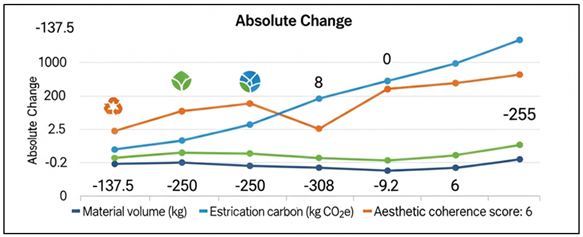
Figure 4 Absolute Change in Material Usage, Carbon Footprint,
and Aesthetic Coherence Between Traditional and AI-Optimized Sculpture Designs
The level of waste material being generated is reduced by almost half, to 9.4, which means improved distribution of the materials and lower wastes of fabrics. Notably, sustainability benefits do not affect the quality of art. The aesthetic coherence score also improves by six percentage points which suggests that AI optimization can reinforce, and not take away visual harmony and design intent.
7. Conclusion
The paper has discussed how AI optimization methodology can be applied as an organized and efficient method of designing sustainable sculptures. The study combines genetic algorithm, multi-objective optimization, and neural network-based evaluation as a single computational platform to show the way sustainability can be systematically introduced into the artistic design processes. Their results indicate that AI-aided approaches can minimize resource use and ecological footprint without affecting the aesthetic quality or building strength, which is a major issue of modern sculpture. One of the most significant contributions of this work is the fact that AI is offered as a collaborative tool to increase the ability of the designer to experiment with the relationships of complex forms and materials and environments. The comparative study of the baseline and AI-optimized sculptures reveals that data-directed optimization allows making better-informed choices in the design context, especially in the situation when there are two or more conflicting goals that need to be weighed against each other. Transparency, repeatability and evaluative rigor in sculptural design research is also improved by the use of parametric digital models and the quantifiable sustainability metrics. Although this has been contributed to, the study has recognized limitations to do with diversity of the dataset, material data accuracy and lack of real time fabrication feedback.
CONFLICT OF INTERESTS
None.
ACKNOWLEDGMENTS
None.
REFERENCES
Abioye, S. O., Oyedele, L. O., Akanbi, L., Ajayi, A., Davila Delgado, J. M., Bilal, M., Akinade, O. O., and Ahmed, A. (2021). Artificial Intelligence in the Construction Industry: A Review of Present Status, Opportunities, and Future Challenges. Journal of Building Engineering, 44, 103299. https://doi.org/10.1016/j.jobe.2021.103299
Adewale, B. A., Ene, V. O., Ogunbayo, B. F., and Aigbavboa, C. O. (2024). A Systematic Review of the Applications of AI in a Sustainable Building’s Lifecycle. Buildings, 14(7), 2137. https://doi.org/10.3390/buildings14072137
Alnaser, A. A., Maxi, M., and Elmousalami, H. (2024). AI-Powered Digital Twins and Internet of Things for Smart Cities and Sustainable Building Environment. Applied Sciences, 14(24), 12056. https://doi.org/10.3390/app142412056
Chi, Z., Liu, Z., Wang, F., and Osmani, M. (2023). Driving Circular Economy Through Digital Technologies: Current Research Status and Future Directions. Sustainability, 15(24), 16608. https://doi.org/10.3390/su152416608
El Hafiane, A., En-nadi, A., and Ramadany, M. (2025). Towards Sustainable Construction: Systematic Review of Lean and Circular Economy Integration. Sustainability, 17(15), 6735. https://doi.org/10.3390/su17156735
Elmousalami, H., Maxy, M., Hui, F. K. P., and Aye, L. (2025). AI in Automated Sustainable Construction Engineering Management. Automation in Construction, 175, 106202. https://doi.org/10.1016/j.autcon.2025.106202
Elshapasy, R. A., and Mohamed, S. F. (2024). A Framework Transformation of a Traditional Campus into a Bio-Tech Smart-Digital Campus. International Journal of Environmental Impacts, 7(2), 269–275. https://doi.org/10.18280/ijei.070211
Heidari, A., Peyvastehgar, Y., and Amanzadegan, M. (2024). A Systematic Review of BIM in Construction: From Smart Building Management to Interoperability of BIM and AI. Architectural Science Review, 67(3), 237–254. https://doi.org/10.1080/00038628.2023.2243247
KC, A., Senaratne, S., Perera, S., and Nanayakkara, S. (2024). Review of Current Digital Technologies for Material Passports to Enhance Circularity Towards Net Zero. Built Environment Project and Asset Management. https://doi.org/10.1108/BEPAM-03-2024-0085
Liu, Z., Zhang, X., Sun, Y., and Zhou, Y. (2023). Advanced Controls on Energy Reliability, Flexibility, and Occupant-Centric Control for Smart and Energy-Efficient Buildings. Energy and Buildings, 297, 113436. https://doi.org/10.1016/j.enbuild.2023.113436
Pandey, S., and Kumar, R. (2025). Reframing Space: Exploring Video Installation as Pedagogy in Design Education ShodhShreejan: Journal of Creative Research Insights, 2(1),57-69, https://doi.org/10.29121/shodhshreejan.v2.i1.2025.25
Rodrigo, N., Omrany, H., Chang, R., and Zuo, J. (2024). Leveraging Digital Technologies for Circular Economy in the Construction Industry: A Way Forward. Smart and Sustainable Built Environment, 13(1), 85–116. https://doi.org/10.1108/SASBE-05-2023-0111
Sarker, I. H. (2021). Deep learning: A Comprehensive Overview on Techniques, Taxonomy, Applications, and Research Directions. SN Computer Science, 2, 420. https://doi.org/10.1007/s42979-021-00815-1
Shaamala, A., Yigitcanlar, T., Nili, A., and Nyandega, D. (2024). Algorithmic Green Infrastructure Optimisation: Review of Artificial Intelligence-Driven Approaches for Tackling Climate Change. Sustainable Cities and Society, 101, 105182. https://doi.org/10.1016/j.scs.2024.105182
Wang, G., and Fan, F.-L. (2025). Dimensionality and Dynamics for Next-Generation Artificial Neural Networks. Patterns, 6(1), 101231. https://doi.org/10.1016/j.patter.2025.101231
Zhao, W., Hao, J. L., Gong, G., Fischer, T., and Liu, Y. (2025). Applying Digital Technologies in Construction Waste Management for Facilitating Sustainability. Journal of Environmental Management, 373, 123560. https://doi.org/10.1016/j.jenvman.2024.123560
|
|
 This work is licensed under a: Creative Commons Attribution 4.0 International License
© ShodhKosh 2026. All Rights Reserved.